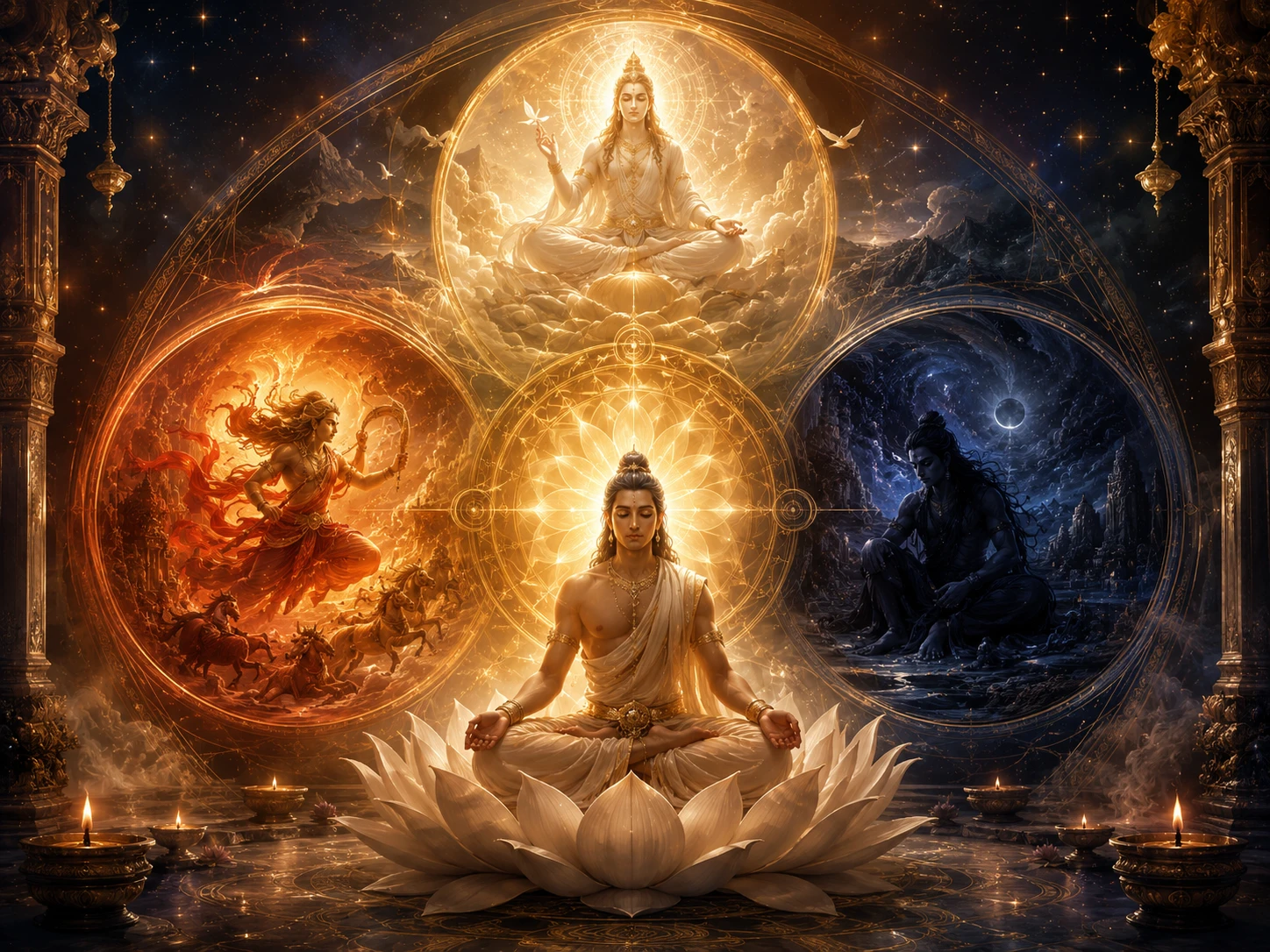
Gita Chapter 14 -- Three Gunas -- The Operating System You Never Knew You Were Running
गीता अध्याय 14 -- तीन गुण -- वह Operating System जिसके बारे में तुम्हें पता ही नहीं था
Open any self-help book published in the last decade and you will find some version of this idea: human behaviour falls into patterns, and those patterns can be categorised. Type A vs Type B personalities. Growth mindset vs fixed mindset. Fight, flight, or freeze. These are modern frameworks attempting to do what the Bhagavad Gita did 2,500 years ago in Chapter 14 -- classify the fundamental operating modes of human consciousness into a small number of categories and then explain how to transcend them all.
Chapter 14 is called Guna Traya Vibhaga Yoga -- the Yoga of Distinguishing the Three Gunas. It has 27 verses. It is one of the shortest chapters in the Gita, but it contains one of the most practically applicable frameworks in all of Indian philosophy. The three gunas -- Sattva (goodness, clarity, harmony), Rajas (passion, activity, restlessness), and Tamas (ignorance, inertia, darkness) -- are not abstract concepts. They are the lenses through which the Gita explains every human behaviour, from what you eat to how you die.
The chapter sits in the third hexad of the Gita (Chapters 13-18), which Shankaracharya identifies as the Jnana Kanda -- the knowledge section. Chapter 13 has just introduced the distinction between Kshetra (the field of matter) and Kshetrajna (the knower of the field). Chapter 14 now zooms in on the field itself. Prakriti, material nature, operates through these three gunas. Every object, every emotion, every thought, every food item, every time of day -- everything in the manifest universe is a combination of Sattva, Rajas, and Tamas in varying proportions. Including you.
सत्त्वं रजस्तम इति गुणाः प्रकृतिसम्भवाः। निबध्नन्ति महाबाहो देहे देहिनमव्ययम्॥
sattvaṁ rajas tama iti guṇāḥ prakṛti-sambhavāḥ | nibadhnanti mahā-bāho dehe dehinam avyayam ||
Sattva, Rajas, and Tamas -- these gunas born of Prakriti bind the imperishable soul to the body, O mighty-armed one.
— Bhagavad Gita 14.5
The word 'nibadhnanti' -- they bind -- is the key verb of the chapter. Krishna is not saying the gunas influence you or suggest tendencies to you. He is saying they bind you. The metaphor is of ropes. You are the atman, eternal and imperishable. But the moment you are embodied in Prakriti, three ropes wrap around you. One rope is made of golden silk -- it feels pleasant but it is still a rope. That is Sattva. One rope is made of rough jute -- it scratches and agitates. That is Rajas. One rope is made of heavy iron chain -- it drags you down and puts you to sleep. That is Tamas. The crucial insight: all three are bondage. Even Sattva, the 'good' guna, binds you -- to happiness, to knowledge, to the comforting illusion that you have figured it all out.
This is where Chapter 14 departs from every simplistic 'be positive, avoid negativity' framework. The Gita does not say 'cultivate Sattva and you are done.' It says Sattva is better than Rajas and Tamas, yes -- but it is still a cage. A golden cage is still a cage. The ultimate goal is Gunatita -- to transcend all three gunas entirely. That is liberation. Everything short of that is still some form of bondage, however comfortable.
Krishna spends verses 14.6 through 14.18 describing each guna in precise behavioural detail -- what it feels like when each guna dominates, what symptoms arise, what kind of afterlife results. This is not theology. This is an observational psychology manual.
Sattva (14.6): Pure, luminous, free from disease. It binds through attachment to happiness (sukha-sanga) and attachment to knowledge (jnana-sanga). When Sattva dominates, you feel clear, calm, eager to learn, and generally at peace. The trap is that you start to cling to that feeling. The person who meditates every morning and begins to feel superior to those who do not -- that is Sattva binding through knowledge-attachment. The IIT professor who is genuinely brilliant but cannot tolerate being wrong -- that is Sattva binding through the illusion of knowing.
Rajas (14.7): Born from desire and attachment. It binds through attachment to action (karma-sanga). When Rajas dominates, you feel driven, ambitious, restless, constantly planning the next thing. You cannot sit still. You are always on your phone, always scheduling, always optimising. The startup founder who cannot stop pitching, the UPSC aspirant who takes eight attempts not because of love for civil service but because stopping feels like dying, the Instagram influencer who measures self-worth in engagement metrics -- Rajas in action. It creates. But it never rests.
Tamas (14.8): Born from ignorance. It binds through heedlessness (pramada), laziness (alasya), and sleep (nidra). When Tamas dominates, you feel heavy, foggy, unmotivated, unable to start anything. You know you should study but you scroll. You know you should exercise but you nap. The Netflix-and-procrastinate cycle, the 'I'll do it tomorrow' loop, the state where even knowing the right thing does not translate into doing the right thing -- that is Tamas. It is not evil. It is gravity. It pulls everything down.
The Three Gunas -- A Behavioural Diagnostic
| Parameter | Sattva (Clarity) | Rajas (Drive) | Tamas (Inertia) | Verse |
|---|---|---|---|---|
| Binds Through | Happiness and knowledge attachment | Desire, ambition, attachment to action | Ignorance, heedlessness, excessive sleep | 14.6-8 |
| When Dominant, You Feel | Clear, calm, keen to learn, at peace | Restless, driven, greedy, unable to stop | Heavy, foggy, lazy, procrastinating | 14.11-13 |
| Symptom at the Gates of the Body | All senses radiate knowledge and awareness | Greed, ceaseless activity, craving, agitation | Darkness, inaction, confusion, delusion | 14.11-13 |
| Death in This Guna Leads To | Birth among the wise, higher realms | Birth among those attached to action | Birth in wombs of the deluded, lower realms | 14.14-15 |
| Fruit of Action | Sattvic and pure | Pain and suffering | Ignorance and delusion | 14.16 |
| What Arises From It | Knowledge | Greed | Heedlessness, delusion, ignorance | 14.17 |
| Direction of Movement | Upward (urdhvam) | Middle (madhye) | Downward (adhah) | 14.18 |
| Modern Parallel | Flow state, deep learning, genuine contentment | Hustle culture, ambition addiction, burnout | Doom-scrolling, binge-watching, chronic inertia | -- |
All three gunas are operative in every person at all times. The question is not which guna you 'are' but which guna currently dominates. This fluctuates hour by hour, season by season, and life phase by life phase.
The most sophisticated section of the chapter is verses 14.10-13, where Krishna describes the dynamic interplay of gunas. He says: sometimes Sattva prevails over Rajas and Tamas. Sometimes Rajas dominates. Sometimes Tamas overcomes both. This is not a static personality test. It is a real-time fluctuation model. You can be Sattvic at 5 AM during your morning meditation, Rajasic by 10 AM in a heated office meeting, and Tamasic by 9 PM when you collapse on the couch with a bag of chips.
Krishna then gives diagnostic criteria for each state. When Sattva dominates (14.11), knowledge radiates through all the 'gates' of the body -- the senses become instruments of awareness rather than craving. When Rajas dominates (14.12), greed, relentless activity, and desire arise. When Tamas dominates (14.13), darkness, inertia, and confusion cloud everything. These are not moral judgments. They are clinical descriptions. A doctor diagnosing a patient's condition does not blame the patient for having a fever. Similarly, the Gita does not blame you for being Rajasic on a Monday morning. It simply names the condition so you can treat it.
The Samkhya philosophical tradition, which the Gita draws upon heavily, treats the three gunas as the fundamental constituents of Prakriti -- like the three primary colours from which every other colour is mixed. There is no material object or experience that exists outside the guna framework. Even the food classification in Chapter 17 (Sattvic, Rajasic, Tamasic foods) follows from this foundation. An ITC hotel chef designing an Ayurvedic menu, a FSSAI nutritionist classifying dietary guidelines, a Zomato algorithm recommending 'healthy' options -- all of these are modern descendants of the guna framework applied to food.
The chapter's climactic section (14.19-27) addresses what most readers really want to know: how do I get out? Krishna describes the Gunatita -- the person who has transcended the gunas. In verse 14.22, Arjuna asks the classic student question: 'By what marks is the person who has transcended the three gunas recognised? How does he behave? And how does he go beyond them?'
Krishna's answer in 14.22-25 describes the Gunatita through behavioural markers, not metaphysical abstractions. The Gunatita does not hate illumination (Sattva's gift) when it arises, nor activity (Rajas' gift), nor delusion (Tamas' gift). He does not long for them when they are absent. He sits as if unconcerned, unmoved by the gunas, knowing that it is the gunas alone that operate -- not the Self. He is alike in pleasure and pain, self-contained, equal toward a clod of earth, a stone, and a piece of gold. He is the same to the beloved and the hated, to praise and blame. He is steady. He is the same in honour and dishonour. He is the same toward friend and enemy. He has renounced all undertakings.
This description is not of a robot or an ascetic indifferent to the world. It is of a person so deeply anchored in Self-knowledge that external circumstances no longer determine internal states. A corporate layoff does not destroy this person. A viral post does not inflate this person. A health diagnosis does not panic this person. The gunas continue to operate in the body -- hunger still happens, anger still arises, fatigue still hits. But the Gunatita watches these phenomena the way you watch weather outside a window. They happen. They pass. The Self remains.
मां च योऽव्यभिचारेण भक्तियोगेन सेवते। स गुणान्समतीत्यैतान्ब्रह्मभूयाय कल्पते॥
māṁ ca yo 'vyabhicāreṇa bhakti-yogena sevate | sa guṇān samatītyaitān brahma-bhūyāya kalpate ||
And the one who serves Me with unwavering devotional yoga transcends these gunas and becomes fit for union with Brahman.
— Bhagavad Gita 14.26
The chapter's final verse (14.27) delivers the punch: 'For I am the abode of Brahman, the immortal and immutable, of eternal dharma, and of absolute bliss.' In one line, Krishna identifies himself as the foundation of the formless Brahman, the principle of Dharma, and the source of Ananda. This is a theological bombshell -- it bridges the Advaita conception of impersonal Brahman with the Vaishnava conception of a personal God. Both traditions find their anchor in this verse. For Shankara, Krishna as Brahman's abode means the realised Self is identical with Brahman. For Ramanuja, it means the personal God contains and sustains the impersonal principle.
The practical takeaway of Chapter 14 is not complicated, even if the metaphysics is deep. Know which guna is operating in you right now. Do not judge it -- diagnose it. If Tamas is dominant, introduce Rajasic activity (go for a walk, start a small task, call a friend). If Rajas is dominant, introduce Sattvic calm (step away from the screen, breathe, eat clean food, read something contemplative). If Sattva is dominant, enjoy it -- but do not cling to it. And underneath all three, remember: you are none of these. You are the consciousness witnessing the play of the gunas. That remembering is the beginning of freedom.
For a generation of Indians navigating the particular cocktail of Rajasic professional ambition (placement season at IIMs, the Bengaluru startup grind, LinkedIn hustle culture), Tamasic digital habits (doom-scrolling, binge-watching, sleep deprivation), and occasional Sattvic aspiration (Vipassana retreats, weekend temple visits, 4 AM Sadhguru podcasts), Chapter 14 is not philosophy. It is a diagnostic tool for daily life.
The three-guna framework has been adopted by modern psychology researchers as a valid personality model. A 2020 study published in the Journal of Indian Psychology developed the 'Triguna Personality Inventory' and found statistically significant correlations between Sattva scores and emotional intelligence, Rajas scores and Type-A personality traits, and Tamas scores and clinical markers of depression and lethargy. AIIMS Delhi and NIMHANS Bengaluru have both published papers exploring the guna model as a culturally rooted alternative to the Western Big Five personality framework. Meanwhile, the entire Sattvic food movement -- from Sadhguru's Isha Foundation meals to the menus at Sattvik restaurants in Rishikesh and Vrindavan -- is a direct commercial application of Gita Chapter 14 and 17.
One of the subtlest teachings of Chapter 14 is in verse 14.19: 'When the seer perceives no doer other than the gunas, and knows that which is higher than the gunas -- he attains My being.' This verse is the philosophical key to the entire chapter. Liberation is not achieved by fighting the gunas. It is achieved by recognising that the gunas do all the doing. You -- the atman, the witness -- never act. The body acts. The mind acts. The gunas act. The Self watches.
This is a radical reframing. Most spiritual traditions tell you to change your behaviour -- be better, be kinder, be more disciplined. The Gita says something different here. It says: see clearly who is actually doing the doing. It is not you. It is Prakriti, operating through the gunas. When this recognition becomes not just intellectual but experiential -- when you actually witness your own anger arising and can say 'that is Rajas operating in this body' without identifying with it -- that is the beginning of the Gunatita state.
For the young professional in Mumbai or Hyderabad or Pune caught in the relentless churn of ambition, deadlines, and comparison -- Chapter 14 offers not escape but clarity. Name the guna. Stop identifying with it. Remember what you are. And if all else fails, verse 14.26 gives you the simplest instruction in the entire Gita: serve Krishna with unwavering devotion, and you will transcend the gunas automatically. That is the chapter's final word -- not that you must master a complex philosophical framework, but that bhakti itself is the master key that unlocks every door.
Observe Your Gunas Today
Set three alarms on your phone -- morning, afternoon and evening. At each, simply note which guna feels dominant. No judgement, just diagnosis. This is the beginning of gunatita awareness. Chapter 14, where Krishna describes the three gunas, is on Eternal Raga with Sanskrit and meaning.
Tags
Eternal Raga · शाश्वत राग
Institutional voice — scholarly articles on Sanatan Dharma
Deepen Your Understanding
अपनी समझ और गहरी करें
scriptural exegesis
Gita Chapter 2 -- Sankhya Yoga: The Chapter That Changed Indian Philosophy Forever
Arjuna drops his bow. His hands shake. He tells Krishna he would rather beg for food than kill his teachers and cousins. Krishna's response in Chapter 2 is the philosophical backbone of the entire Gita -- covering the immortality of the soul, the ethics of action without attachment, and the portrait of the Sthitaprajna (the person of steady wisdom). This single chapter contains more quotable verses than most entire scriptures. 'Karmanye vadhikaraste' lives on WhatsApp statuses for a reason.
scriptural exegesis
Gita Chapter 6 -- Dhyana Yoga -- The Honest Guide to Meditation
Chapter 6 is where the Gita gets brutally practical about meditation. Krishna describes the technique -- posture, gaze, breath, mental stillness -- and Arjuna immediately responds with perhaps the most relatable line in all of scripture: 'The mind is restless, turbulent, strong, and obstinate -- controlling it is harder than controlling the wind.' Krishna does not disagree. He says yes, the mind is impossible to tame -- except through practice and detachment. This chapter is 2,500 years old, and it reads like a therapy session between a frustrated student and a patient teacher.
scriptural exegesis
Gita Chapter 18 -- Moksha Sannyasa Yoga: The Final Exam Where Krishna Says 'Do As You Wish'
78 verses. The longest chapter in the Gita. Krishna classifies everything -- knowledge, action, doer, intellect, happiness -- into three gunas, then drops the most radical verse in Indian scripture: abandon all dharmas and just surrender to Me. And then, in a move no dictator would ever make, he tells Arjuna: now do as you wish.
philosophy darshana
Sattva, Rajas, Tamas -- The Three Gunas That Run Your Life
Every mood you have ever felt, every decision you have ever made, every Netflix binge and every 4 AM study session -- Hindu philosophy says it all comes down to three forces. Sattva illuminates, Rajas agitates, Tamas numbs. The Bhagavad Gita's Chapter 14 is essentially a 2,000-year-old personality framework that modern psychology is only now catching up to.
philosophy darshana
The Six Darshanas -- India's Original Intellectual Operating Systems
Long before Greek philosophy had its first argument, India had six complete philosophical systems -- each with its own logic, metaphysics, epistemology, and liberation path. Nyaya built formal logic. Vaisheshika invented atomic theory. Samkhya mapped consciousness. Yoga engineered the mind. Mimamsa decoded ritual. Vedanta asked the final question. Together, they are the most comprehensive intellectual framework any civilisation has produced.
vedic sciences
Ayurveda -- The 3,000-Year-Old Science That Knows Your Body Type Before You Do
Long before personalised medicine became a Silicon Valley buzzword, the Charaka Samhita classified every human being into one of seven constitutional types based on three biological forces -- Vata, Pitta, and Kapha. Modern genomic studies at CSIR-IGIB have found that these ancient types correlate with distinct gene expression profiles. Ayurveda did not guess. It observed.
scriptural exegesis
Gita Chapter 15 -- Purushottama Yoga -- The Upside-Down Tree and the Supreme Person
Chapter 15 opens with the most psychedelic image in the entire Gita: an upside-down tree with roots in heaven and branches reaching down into the material world. Its leaves are the Vedas. Its nutrients are the three gunas. Its aerial roots bind you to action in the human realm. And Krishna's instruction is blunt -- cut it down with the axe of detachment. In just 20 verses, the shortest chapter in the Gita, Krishna then reveals the three-tiered architecture of reality: the perishable (kshara), the imperishable (akshara), and beyond both -- the Supreme Person, Purushottama. This chapter is the Gita's answer to the question: if everything I can see and think is part of the matrix, who built the matrix?
The three-guna framework has been adopted by modern psychology researchers as a valid personality model. A 2020 study published in the Journal of Indian Psychology developed the 'Triguna Personality Inventory' and found …
More in Scriptural Exegesis
Abhimanyu and the Chakravyuha -- The Boy Who Knew How to Enter but Not How to Leave
14 min read
Adbhuta Ramayana -- The Ramayana Where Sita Becomes Kali
9 min read
After Kurukshetra -- What Happened Next
14 min readThe same translation error that turned '33 Koti' into '33 crore' in Hinduism also happened in Buddhism. The Chinese translation of Buddhist texts rendered 'Sapta Koti Buddha' (7 Supreme Buddhas) as '7 Crore Buddhas.' The…
Deities AvatarsCommunity Reflections
🕉️
Be the first to share your reflection.