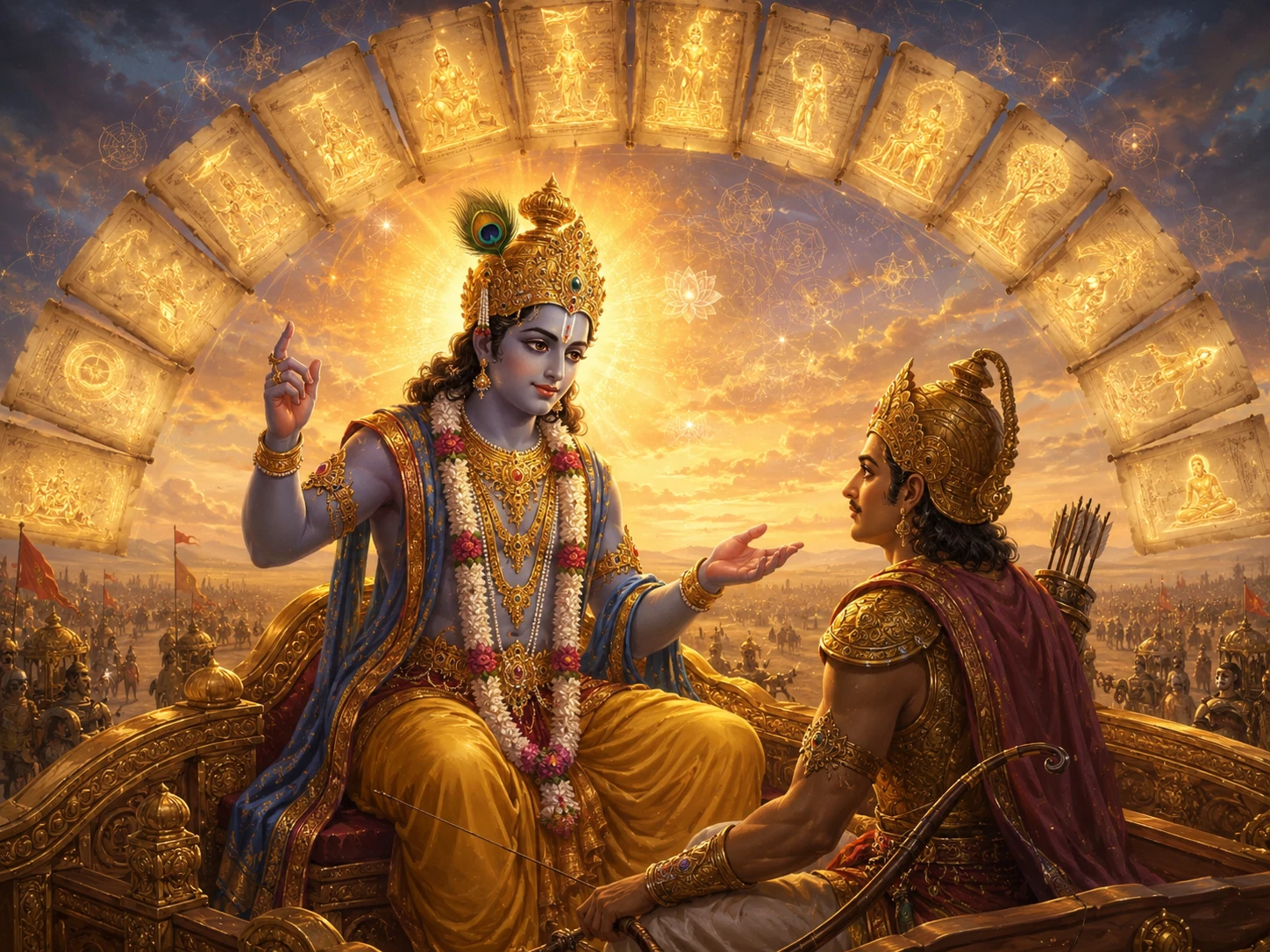
Gita Chapter 15 -- Purushottama Yoga -- The Upside-Down Tree and the Supreme Person
गीता अध्याय 15 -- पुरुषोत्तम योग -- उल्टा वृक्ष और परम पुरुष
Chapter 15 of the Bhagavad Gita is the shortest in the entire text -- just 20 verses -- and yet it is the chapter that Shankaracharya called the summary of the whole Gita. Madhvacharya considered it the single most important chapter for establishing the supremacy of Vishnu. And for the Vaishnava tradition, the very name of this chapter -- Purushottama Yoga, the Yoga of the Supreme Person -- is the theological centrepiece of the entire scripture. In 20 compressed verses, Krishna reveals the architecture of reality, names himself as the third principle beyond matter and spirit, and closes with one of the most quoted verses in all of Vedanta: 'Since I transcend the perishable and am even higher than the imperishable, I am celebrated in the world and in the Vedas as the Supreme Person.'
The chapter sits in the Gita's third hexad (Chapters 13-18), the Jnana Kanda. Chapter 13 introduced the field (Kshetra) and the knower of the field (Kshetrajna). Chapter 14 detailed the three gunas that operate within the field. Now Chapter 15 zooms out to the highest altitude. It asks: what is the total structure of this existence? Who are the players? And who is the ultimate source behind all of it?
The chapter is compact by design. There is no dialogue here -- no Arjuna asking questions. Krishna delivers a concentrated monologue. Every verse carries the weight of an Upanishadic declaration. For UPSC aspirants studying Indian philosophy, Chapter 15 is the single most efficient summary of the Gita's metaphysics. For JEE students who appreciate elegant brevity, this is the chapter that does in 20 verses what most philosophical texts need 200 pages to achieve.
ऊर्ध्वमूलमधःशाखमश्वत्थं प्राहुरव्ययम्। छन्दांसि यस्य पर्णानि यस्तं वेद स वेदवित्॥
ūrdhva-mūlam adhaḥ-śākham aśvatthaṁ prāhur avyayam | chhandāṁsi yasya parṇāni yas taṁ veda sa veda-vit ||
They speak of an imperishable Ashvattha tree with roots above and branches below, whose leaves are the Vedic hymns. One who knows this tree is the knower of the Vedas.
— Bhagavad Gita 15.1
The opening image is stunning. An upside-down tree -- the Ashvattha (Peepal, Ficus religiosa) -- with its roots reaching upward into Brahman and its branches extending downward into the material world. This image is not original to the Gita. It appears first in the Katha Upanishad (2.3.1): 'With root above and branches below, this Ashvattha is eternal.' But the Gita does something the Upanishad does not: it makes the image actionable. Krishna says in verse 15.3-4: this tree cannot be perceived in its true form in this world -- its beginning, end, and foundation are not graspable from within the tree itself. Therefore, having cut down this firmly-rooted tree with the strong axe of detachment (asanga-shastrena), one should seek that place from which, having gone, one does not return.
The metaphor works on multiple levels. The roots are Brahman -- the ultimate cause. The branches are the manifest world -- beings, bodies, realms. The leaves are the Vedic hymns -- the rituals, injunctions, and rewards that keep the tree alive and growing. The aerial roots that grow downward and bind to the soil of the human realm are the karmic impressions (vasanas) nourished by the three gunas. The entire manifest universe is this tree. And the instruction is not to climb the tree, not to decorate it, not to worship it -- but to cut it down.
This is radical, especially for a text that elsewhere extols the Vedas. Krishna is saying: the Vedas themselves are leaves on the tree of worldly existence. They serve a purpose -- but that purpose is not the highest goal. The highest goal is to cut through the entire apparatus of material existence and reach the root. Any engineering student from IIT Bombay or NIT Trichy who has ever asked 'why am I grinding through this curriculum when the real learning happens elsewhere?' has intuitively grasped the Ashvattha metaphor.
The middle section of the chapter (15.7-15) shifts from cosmology to the intimate. Krishna describes how the individual soul (jiva) is a fragment of himself -- 'an eternal portion of Myself' (mamaivamso jiva-loke jiva-bhutah sanatanah, 15.7). This fragment draws to itself the mind and the five senses, and when it leaves one body and enters another, it carries these with it the way wind carries fragrance from flowers (15.8). Those deluded by the gunas cannot see the soul arriving or departing. Only those with the eye of knowledge (jnana-chakshu) perceive it (15.10).
This section also contains one of the most beautiful verses in the Gita. In 15.12-13, Krishna says: 'The light in the sun that illuminates the whole world, the light in the moon, the light in fire -- know that all of it comes from Me. And entering the earth, I sustain all beings with My energy. Becoming the watery moon (Soma), I nourish all plants.' In 15.14, he adds: 'Becoming the fire of digestion (Vaishvanara) in the bodies of all living beings, joined with prana and apana, I digest the four kinds of food.'
This is not abstract theology. Krishna is locating himself in the most ordinary phenomena of daily life -- sunlight, moonlight, the fire that digests your lunch. The divine is not in some distant heaven. It is in the photosynthesis that grows your rice, the metabolism that breaks down your dal, the solar energy that powers the ISRO satellite and the street lamp in Chandni Chowk alike. Chapter 15 makes the divine tangible and immediate in a way that resonates with any science student who has ever marvelled at how energy flows through systems.
The chapter's climax arrives in verses 15.16-18 -- the three Purushas. Krishna presents a triadic model of reality. First, the Kshara Purusha -- the perishable. This is the entire manifest world: bodies, objects, planets, civilisations. Everything that changes, decays, and dies. Second, the Akshara Purusha -- the imperishable. This is the unchanging substratum -- the unmanifest Prakriti, the seed-state of creation, the jiva in its liberated form, the Brahman of the Upanishads. Both of these are real. Both exist. But there is a third.
In verse 15.17, Krishna introduces the Uttama Purusha -- the Supreme Person, Purushottama -- who is entirely distinct from both the perishable and the imperishable. He pervades the three worlds as the immutable Lord (Ishvara) and sustains everything. And in 15.18, the verse that gives the chapter its name: 'Since I transcend the perishable and am even higher than the imperishable, I am celebrated in the world and in the Vedas as Purushottama, the Supreme Person.'
This is the Gita's most explicit ontological statement. It says there are not two categories of reality -- matter and spirit -- but three: perishable matter, imperishable spirit, and the Supreme Person who transcends and sustains both. For Ramanuja and the Vishishtadvaita school, this is the proof-text for their theology: God is not identical with Brahman, nor is He merely the sum of souls and matter. He is a distinct, supreme reality that includes and transcends everything else. For Madhva's Dvaita school, it is even more direct evidence of the eternal distinction between God, souls, and matter. Even Shankara's Advaita must engage seriously with this verse, interpreting Purushottama as Saguna Brahman -- the conditioned form of the ultimate.
उत्तमः पुरुषस्त्वन्यः परमात्मेत्युदाहृतः। यो लोकत्रयमाविश्य बिभर्त्यव्यय ईश्वरः॥
uttamaḥ puruṣas tv anyaḥ paramātmety udāhṛtaḥ | yo loka-trayam āviśya bibharty avyaya īśvaraḥ ||
But distinct from these is the Supreme Person, called the Supreme Self (Paramatma), who as the imperishable Lord pervades and sustains the three worlds.
— Bhagavad Gita 15.17
The Three Purushas -- Architecture of Reality in Gita Chapter 15
| Parameter | Kshara Purusha (Perishable) | Akshara Purusha (Imperishable) | Uttama Purusha (Supreme) |
|---|---|---|---|
| Nature | All manifest beings and objects | The unchanging substratum -- unmanifest Prakriti / liberated jiva | The Supreme Lord who transcends and sustains both |
| Characteristic | Subject to change, decay, death | Eternal, beyond change, but still within Prakriti's domain | Beyond Prakriti and its gunas entirely; self-luminous |
| Gita Verse | 15.16a | 15.16b | 15.17 |
| Upanishadic Parallel | Vishva (waking), Taijasa (dream) | Prajna (deep sleep) -- Mandukya Upanishad | Turiya -- the fourth state beyond all three |
| Advaita Reading | Vyavaharika (empirical reality) | Paramartha Brahman viewed through Maya | Nirguna Brahman itself |
| Vishishtadvaita Reading | Prakrti and bound souls (chit + achit) | Nitya-vibhuti (eternal realm of God) | Narayana / Purushottama -- God as distinct supreme reality |
| Modern Analogy | The app running on your phone -- visible, crashable, updatable | The operating system -- invisible, foundational, persistent | The consciousness of the user -- beyond both hardware and software |
The three-Purusha framework is unique to the Gita and is not found in this explicit form in the Upanishads or Samkhya. It is Krishna's original synthesis.
The chapter closes with verse 15.19-20. In 15.19, Krishna says: 'One who, undeluded, knows Me as the Supreme Person -- he knows all, and he worships Me with his whole being.' And in 15.20, the closing verse: 'This is the most secret teaching, declared by Me. Understanding this, one becomes wise and has fulfilled all duties.'
The word 'guhyatamam' -- most secret -- is significant. The Gita uses three grades of secrecy: guhya (secret), guhyatara (more secret), and guhyatama (most secret). Chapter 15's revelation of Purushottama is classified at the highest grade. This is not merely important knowledge. It is the innermost teaching of the entire scripture.
For the Puri Jagannath tradition, Chapter 15 is the theological anchor. The very name 'Purushottama' is one of the primary names of Jagannath. The Purushottama Kshetra (Puri) derives its name from this chapter. The annual Rath Yatra is, in theological terms, the Supreme Person making himself accessible to all -- emerging from the sanctum to ride through the streets, visible to everyone regardless of caste, creed, or status. A devotee standing in the crowds at Puri's Grand Road during Rath Yatra is witnessing the Purushottama of Chapter 15 in processional form.
For the young Indian professional trying to make sense of competing spiritual claims -- Advaita says everything is one, Dvaita says God is separate, ISKCON says Krishna is supreme, Arya Samaj says focus on formless Brahman -- Chapter 15 is the Gita's own resolution. It says: there are three tiers. All the traditions are pointing at different tiers. And the highest tier is a person -- not an abstraction, not a force, not a philosophical principle, but a person who pervades, sustains, and transcends everything. That person, Krishna says, is Me.
The Ashvattha tree (Peepal, Ficus religiosa) described in Gita 15.1 is the same species under which the Buddha attained enlightenment at Bodh Gaya -- making it sacred to both Hinduism and Buddhism. In ecology, the Peepal is one of the few trees that releases oxygen at night through a process called Crassulacean Acid Metabolism (CAM), which may explain why Ayurvedic texts recommend sitting under it during early morning meditation. The Puri Jagannath Temple is officially called Purushottama Kshetra after this chapter. The Tirumala Tirupati temple's presiding deity Venkateswara is also identified as Purushottama in several Alvar hymns. The 'three-Purusha' model from 15.16-17 became a central subject of UPSC philosophy optional papers -- appearing in at least four questions across the last decade's Civil Services examinations.
Read Chapter 15 on Eternal Raga
Chapter 15 is just 20 verses -- short enough to read in one sitting. Go through all 20 on Eternal Raga, with Sanskrit, meaning in English and Hindi, and a simple commentary on each verse.
Tags
Eternal Raga · शाश्वत राग
Institutional voice — scholarly articles on Sanatan Dharma
Deepen Your Understanding
अपनी समझ और गहरी करें
scriptural exegesis
Gita Chapter 14 -- Three Gunas -- The Operating System You Never Knew You Were Running
Everything you think, feel, and do is running on one of three modes: Sattva (clarity), Rajas (restless drive), or Tamas (inertia). You did not choose them. They chose you -- through your food, your sleep cycle, the people you spend time with, and the habits you have compounded over lifetimes. Chapter 14 of the Gita is the most precise psychological framework in ancient literature. It explains why you feel inspired at 5 AM and sluggish at 3 PM, why some people are driven by ambition and others by apathy, and -- most importantly -- how to transcend all three.
scriptural exegesis
Gita Chapter 2 -- Sankhya Yoga: The Chapter That Changed Indian Philosophy Forever
Arjuna drops his bow. His hands shake. He tells Krishna he would rather beg for food than kill his teachers and cousins. Krishna's response in Chapter 2 is the philosophical backbone of the entire Gita -- covering the immortality of the soul, the ethics of action without attachment, and the portrait of the Sthitaprajna (the person of steady wisdom). This single chapter contains more quotable verses than most entire scriptures. 'Karmanye vadhikaraste' lives on WhatsApp statuses for a reason.
scriptural exegesis
Gita Chapter 18 -- Moksha Sannyasa Yoga: The Final Exam Where Krishna Says 'Do As You Wish'
78 verses. The longest chapter in the Gita. Krishna classifies everything -- knowledge, action, doer, intellect, happiness -- into three gunas, then drops the most radical verse in Indian scripture: abandon all dharmas and just surrender to Me. And then, in a move no dictator would ever make, he tells Arjuna: now do as you wish.
scriptural exegesis
Katha Upanishad -- Nachiketa and Yama
A teenage boy walks into the house of Death, waits three days without food, and then proceeds to negotiate the universe's deepest secret out of Yama himself. The Katha Upanishad is not a dusty scripture -- it is the original startup pitch where a kid with zero leverage outplayed the CEO of the afterlife.
philosophy darshana
The Six Darshanas -- India's Original Intellectual Operating Systems
Long before Greek philosophy had its first argument, India had six complete philosophical systems -- each with its own logic, metaphysics, epistemology, and liberation path. Nyaya built formal logic. Vaisheshika invented atomic theory. Samkhya mapped consciousness. Yoga engineered the mind. Mimamsa decoded ritual. Vedanta asked the final question. Together, they are the most comprehensive intellectual framework any civilisation has produced.
philosophy darshana
Advaita Vedanta Explained -- Shankara's Radical Philosophy of Non-Duality
You are not your job title. You are not your Instagram bio. According to Adi Shankaracharya, you are not even your body or mind -- you are Brahman itself, the infinite consciousness wearing a temporary costume. Advaita Vedanta is the most radical philosophical claim in Indian history: that the entire universe is one undivided reality, and separation is the grandest illusion.
philosophy darshana
Sattva, Rajas, Tamas -- The Three Gunas That Run Your Life
Every mood you have ever felt, every decision you have ever made, every Netflix binge and every 4 AM study session -- Hindu philosophy says it all comes down to three forces. Sattva illuminates, Rajas agitates, Tamas numbs. The Bhagavad Gita's Chapter 14 is essentially a 2,000-year-old personality framework that modern psychology is only now catching up to.
The Ashvattha tree (Peepal, Ficus religiosa) described in Gita 15.1 is the same species under which the Buddha attained enlightenment at Bodh Gaya -- making it sacred to both Hinduism and Buddhism. In ecology, the Peepal…
More in Scriptural Exegesis
Abhimanyu and the Chakravyuha -- The Boy Who Knew How to Enter but Not How to Leave
14 min read
Adbhuta Ramayana -- The Ramayana Where Sita Becomes Kali
9 min read
After Kurukshetra -- What Happened Next
14 min readThe same translation error that turned '33 Koti' into '33 crore' in Hinduism also happened in Buddhism. The Chinese translation of Buddhist texts rendered 'Sapta Koti Buddha' (7 Supreme Buddhas) as '7 Crore Buddhas.' The…
Deities AvatarsCommunity Reflections
🕉️
Be the first to share your reflection.