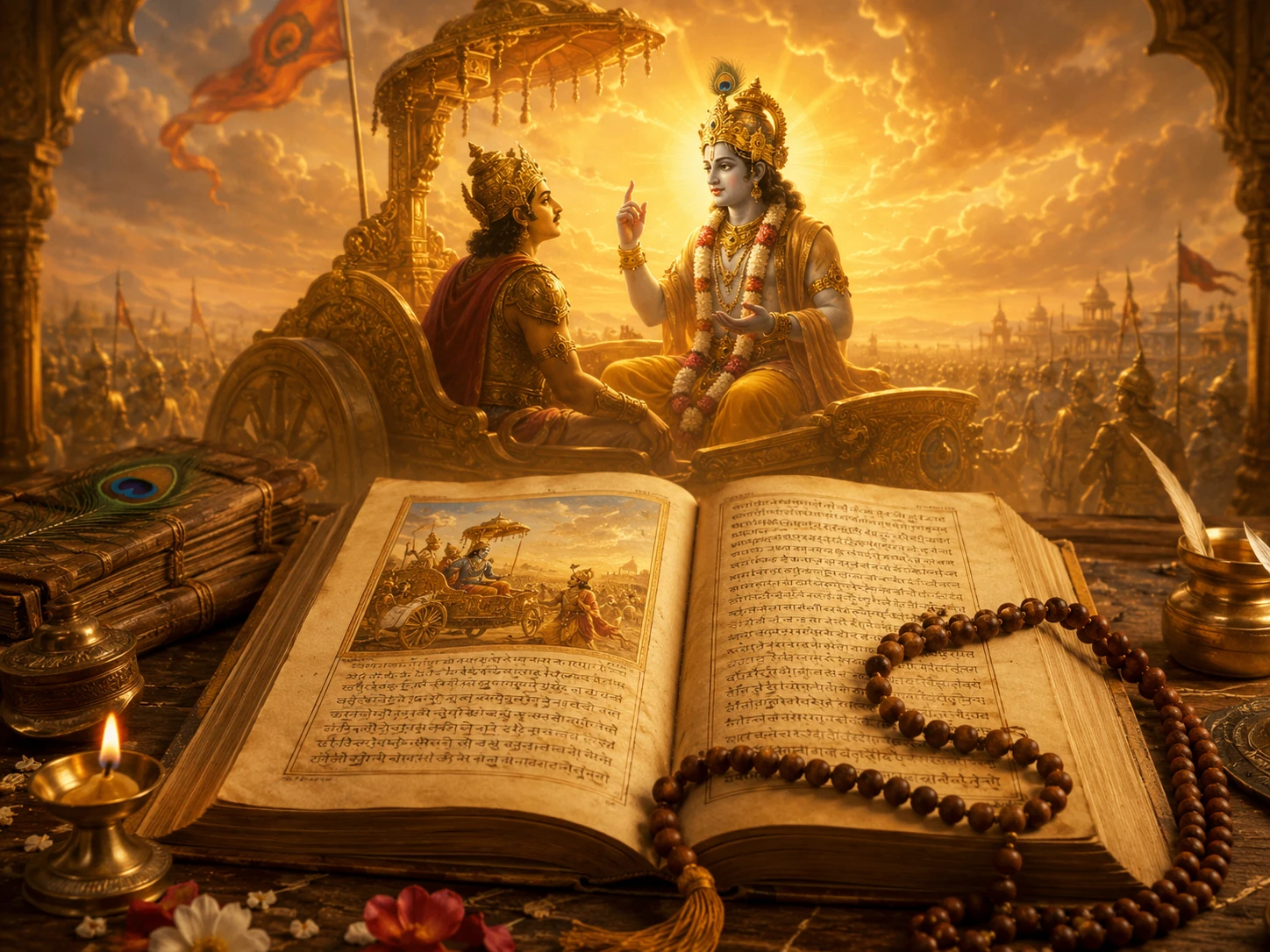
Gita Chapter 6 -- Dhyana Yoga -- The Honest Guide to Meditation
गीता अध्याय 6 -- ध्यान योग -- ध्यान का ईमानदार मार्गदर्शन
There is a reason Chapter 6 of the Bhagavad Gita is the most bookmarked chapter among meditation practitioners worldwide. It is the only chapter in the entire Gita that lays out an actual, step-by-step meditation technique -- posture, location, gaze direction, breath control, mental withdrawal -- and then immediately acknowledges that the whole thing is nearly impossible for ordinary human beings. No other scripture in world literature has the honesty to prescribe a practice and then let the student say, in the very next breath, 'This won't work for me.'
Chapter 6 -- Dhyana Yoga, the Yoga of Meditation -- arrives at a critical juncture. In Chapter 5, Krishna has concluded his comparison of Sannyasa (renunciation of action) and Karma Yoga (action without attachment). His verdict: both reach the same destination, but Karma Yoga is the more practical path. Now in Chapter 6, he goes deeper. Action without attachment is good, he says. But the ultimate state of a yogi is one where the mind itself has become still -- not suppressed, not drugged, not distracted, but genuinely quiet. The chapter opens with a correction that most modern yoga studios would benefit from hearing: the true sannyasi is not the person who has given up all activity, but the person who acts without selfish motive.
This chapter has 47 verses. The first 32 are Krishna's prescription. The last 15 are Arjuna's honest objections and Krishna's compassionate responses. The structure itself is a masterclass in teaching -- show the ideal, then address the student's fear of failure. Every JEE aspirant who has sat in a Kota hostel room trying to focus while WhatsApp notifications ping in the background will recognise this dynamic instantly.
The chapter's first major teaching is a redefinition of who qualifies as a yogi. In verse 6.1, Krishna says that the person who performs duty without depending on the fruits of action is the real sannyasi and the real yogi -- not the one who has merely stopped lighting the ritual fire or stopped acting. This is a direct correction to the popular understanding of the time (and ours) that renunciation means withdrawal from the world. Krishna's sannyasi is still at work -- in the office, in the kitchen, on the battlefield -- but internally detached from outcomes.
Verses 6.10 through 6.15 describe the actual meditation technique. The yogi should find a clean, secluded place. The seat should be firm -- not too high, not too low -- covered with kusha grass, then a deerskin, then a cloth. The yogi sits with body, head, and neck erect, gazing at the tip of the nose. The mind is focused, fear is abandoned, the vow of brahmacharya is observed. The goal is to fix the mind on the Self and think of nothing else.
What is remarkable here is the level of physical detail. Krishna is not speaking in abstractions. He is describing an actual practice -- the kind of instruction you would get at the Yoga Institute in Mumbai or the Bihar School of Yoga in Munger. The kusha grass and deerskin have been replaced by yoga mats from Decathlon, but the posture description is identical to what Patanjali codifies in the Yoga Sutras. Chapter 6 of the Gita is, in essence, the earliest accessible manual for seated meditation in Hindu literature -- predating Patanjali by centuries if we accept traditional dating.
उद्धरेदात्मनात्मानं नात्मानमवसादयेत्। आत्मैव ह्यात्मनो बन्धुरात्मैव रिपुरात्मनः॥
uddhared ātmanātmānaṁ nātmānam avasādayet | ātmaiva hy ātmano bandhur ātmaiva ripur ātmanaḥ ||
One should elevate oneself by one's own mind, and not degrade oneself. For the mind alone is one's friend, and the mind alone is one's enemy.
— Bhagavad Gita 6.5
Verse 6.5 is one of the most psychologically sophisticated statements in ancient literature. It says something that modern cognitive behavioural therapy took two millennia to arrive at: you are not your mind, but your mind is the instrument through which you either rise or fall. The verse uses the word 'atma' six times in two lines -- deliberately ambiguous, because atma can mean self, mind, or soul depending on context. Shankaracharya reads it as the higher Self elevating the lower self. Ramanuja reads it as the individual soul disciplining the mind. Both readings are valid. The genius of the verse is that it works at every level.
The practical implication is radical. Krishna is not saying 'God will save you' or 'perform this ritual and you will be liberated.' He is saying: you have to do the work yourself. Your mind is the gym equipment. If you train it, it becomes your ally. If you neglect it, it becomes the thing that destroys you. Every UPSC aspirant studying in Old Rajinder Nagar at 2 AM, every startup founder in Koramangala pushing through a Series A rejection, every NRI in New Jersey dealing with identity crisis -- this verse speaks directly to their condition. The battle is internal. The weapon is discipline. The enemy is the same mind that could be the friend.
Then comes the famous objection. After listening to Krishna describe the seated meditation in vivid detail -- the posture, the breath, the progressive withdrawal of senses, the state of samadhi where the yogi becomes like a 'lamp in a windless place' (6.19) -- Arjuna has had enough. In verse 6.33, he says: 'This yoga of equanimity that you have described, O Madhusudana -- I do not see how it can endure, because of the restlessness of the mind.' And then, in verse 6.34, he delivers one of the most quoted lines in all of Hindu scripture.
Arjuna says the mind has four fatal characteristics: it is restless (chanchala), turbulent (pramathi), powerful (balavat), and stubborn (dridha). And then the devastating punchline: controlling it, he says, is harder than controlling the wind. Think about what this means. Arjuna is not some random person. He is the greatest warrior of his age, a man who has single-handedly defeated armies. He has discipline, willpower, and physical mastery beyond any ordinary human. And he is saying: 'I cannot do this. My mind is too wild.' If Arjuna -- the Arjuna -- cannot control his mind, what chance do we have scrolling through Instagram reels at midnight?
चञ्चलं हि मनः कृष्ण प्रमाथि बलवद्दृढम्। तस्याहं निग्रहं मन्ये वायोरिव सुदुष्करम्॥
cañcalaṁ hi manaḥ kṛṣṇa pramāthi balavad dṛḍham | tasyāhaṁ nigrahaṁ manye vāyor iva suduṣkaram ||
The mind is restless, turbulent, powerful, and obstinate, O Krishna. I consider controlling it as difficult as controlling the wind.
— Bhagavad Gita 6.34
Krishna's response in verse 6.35 is one of the great compassionate moments in the Gita. He does not deny Arjuna's complaint. He does not say 'try harder' or 'have more faith.' He says: 'Without doubt, O mighty-armed one, the mind is difficult to control and restless. But through practice (abhyasa) and detachment (vairagya), it can be restrained.' Two words. Practice and detachment. That is the entire prescription.
Abhyasa means repetition -- doing the thing again and again until the neural pathways are established. Vairagya means non-attachment -- loosening the grip of desire that makes the mind chase objects in the first place. This is not mysticism. This is behavioural science stated in two Sanskrit words. Patanjali will later make this the cornerstone of his Yoga Sutras (1.12): abhyasa-vairagyabhyam tan-nirodhah. The practice-and-detachment formula originates here, in Gita 6.35.
What makes Krishna's answer so powerful is its honesty. He could have said 'meditate on me and the mind will become still.' He will say versions of this later in the Gita. But here, in Chapter 6, he meets Arjuna where Arjuna is -- a practical man asking a practical question -- and gives a practical answer. Practice. Detach. Repeat. The modern equivalent is what every sports psychologist tells a cricketer who freezes at the crease: trust the process, play more balls, detach from the scoreboard.
The chapter's third major segment addresses the most anxiety-producing question in all of spiritual practice: what happens if I try and fail? Arjuna asks in verse 6.37: 'The person who has faith but whose mind wanders from yoga -- what happens to him? Does he fall from both worlds, like a cloud torn apart, with no ground beneath and no sky above?' This is not an abstract question. Arjuna is voicing the terror of the person who gave up a secure career for a startup and watched it fail, the student who left coaching for self-study and scored lower, the devotee who tried meditation for months and felt nothing. What if spiritual effort is wasted?
Krishna's answer in verses 6.40-45 is one of the most reassuring passages in all of religious literature. He says: no effort on this path is ever wasted. The fallen yogi is not punished. Instead, he is reborn into a family of wise yogis, or into a prosperous and virtuous household, and from that better starting position, he resumes his practice. The momentum of previous effort (samskara) carries forward across lifetimes. The yogi who failed in one life begins the next life exactly where he left off. This is not a consolation prize. This is a structural guarantee built into the design of the universe.
Consider the modern implication. A person who spends five years practising meditation and then stops because life got in the way -- Krishna says that effort is banked, not lost. A student who studied philosophy seriously in college but then took an IT job in Hyderabad -- that philosophical foundation does not vanish. It resurfaces later, in a crisis, in a moment of clarity, in a conversation that suddenly makes sense. The Gita's position is that spiritual growth compounds like interest. There is no bankruptcy on this path.
Gita Ch6 -- The Mind as Friend vs Enemy
| Aspect | Mind as Friend (Bandhu) | Mind as Enemy (Ripu) | Verse |
|---|---|---|---|
| Nature | Disciplined through practice, calm, focused on Self | Restless, turbulent, chases sense objects compulsively | 6.5-6.6 |
| State in Meditation | Like a lamp in a windless place -- steady, unflickering | Like a boat tossed by wind on water -- no anchor | 6.19, 6.34 |
| Relationship to Senses | Withdrawn from sensory pull, turtle retracting limbs | Dragged by every desire, each sense pulling in a different direction | 6.24-26 |
| Outcome of Action | Acts without craving results -- equanimity in success and failure | Attached to fruit -- elated by gain, crushed by loss | 6.7-9 |
| Effect on Others | Sees the same Self in all beings -- friend, enemy, saint, sinner | Divides world into mine vs not-mine, us vs them | 6.29-32 |
| Long-term Trajectory | Progressive stillness across lifetimes -- spiritual compounding | Deeper entanglement in desire, heavier karmic debt each cycle | 6.40-45 |
Krishna's framework treats the mind not as inherently good or evil, but as a trainable instrument. The same mind can be the yogi's greatest asset or greatest liability depending on the direction of its habits.
The chapter concludes with a verse that has puzzled and inspired commentators for centuries. In 6.46, Krishna ranks the yogi above the ascetic (tapasvi), above the scholar (jnani), and above the ritualist (karmi). And then in 6.47, the closing verse, he says: 'Of all yogis, the one who, with inner self absorbed in Me, worships Me with faith -- he is the most intimately united with Me, and he is the highest yogi in My view.' This sudden pivot to devotion at the end of a chapter about meditation technique is deliberate. Krishna is foreshadowing the synthesis that the entire Gita is building toward -- that meditation, knowledge, action, and devotion are not competing paths but concentric circles with bhakti at the centre.
For the Advaita tradition, this verse means the yogi who realises the Self within is realising Brahman. For the Vaishnava tradition, it means the devotee who directs meditative focus toward Krishna personally is the supreme yogi. Both readings are supported by the text. The Gita is not a single-doctrine scripture. It is a multi-layered text that rewards each tradition that engages with it honestly.
The lasting gift of Chapter 6 is its realism. It does not pretend meditation is easy. It does not shame the student who struggles. It builds in a safety net for failure and promises that no honest effort is ever wasted. For a generation of young Indians dealing with anxiety, distraction, and the relentless noise of digital life, this chapter is not ancient wisdom. It is survival equipment.
The phrase 'chanchalam hi manah' (the mind is restless) from Gita 6.34 has become a viral Sanskrit phrase on Indian social media, appearing on T-shirts, Instagram reels, and even startup pitch decks about focus and productivity. The verse has been cited in at least two Indian Supreme Court judgments on mental health and prisoner rehabilitation. Neuroscience research at NIMHANS Bengaluru on meditation-induced neuroplasticity effectively validates Krishna's 'abhyasa-vairagya' formula -- repeated practice physically rewires the brain's default mode network, reducing mind-wandering by up to 50% in trained meditators.
A note on the chapter's relevance to the larger Gita architecture. Chapter 6 is the last chapter of the first hexad (Chapters 1-6), which traditional commentators call the Karma Kanda or the section on action. Shankaracharya divides the Gita into three sets of six: Chapters 1-6 focus on the individual self (jiva) and the path of action, Chapters 7-12 focus on the nature of God and the path of devotion, and Chapters 13-18 focus on the distinction between matter and spirit and the path of knowledge. Chapter 6 thus serves as the climax and summary of the entire first third of the Gita.
This is why the chapter covers so much ground -- it needs to tie together action (Chapters 3-5), knowledge (Chapter 2), and now meditation into a single coherent framework. The fallen yogi passage also serves as a bridge to the second hexad: if even the best meditation practice can fail, then perhaps what is needed is not more technique but a relationship with the divine. That relationship -- bhakti -- becomes the subject of Chapters 7-12. Chapter 6 is both a destination and a doorway.
Try Meditation on Eternal Raga
Chapter 6 prescribes daily meditation as the foundation of yoga. Start with five minutes of breath-focused sitting -- no kusha grass required. The Pause Between Breaths dharana on Eternal Raga is a good first practice.
Tags
Eternal Raga · शाश्वत राग
Institutional voice — scholarly articles on Sanatan Dharma
Deepen Your Understanding
अपनी समझ और गहरी करें
scriptural exegesis
Gita Chapter 2 -- Sankhya Yoga: The Chapter That Changed Indian Philosophy Forever
Arjuna drops his bow. His hands shake. He tells Krishna he would rather beg for food than kill his teachers and cousins. Krishna's response in Chapter 2 is the philosophical backbone of the entire Gita -- covering the immortality of the soul, the ethics of action without attachment, and the portrait of the Sthitaprajna (the person of steady wisdom). This single chapter contains more quotable verses than most entire scriptures. 'Karmanye vadhikaraste' lives on WhatsApp statuses for a reason.
scriptural exegesis
Gita Chapter 3 -- Karma Yoga: Why Sitting Still Is Not an Option
After hearing Chapter 2, Arjuna asks the most logical follow-up question in the history of philosophy: 'If knowledge is superior to action, why are you pushing me to fight?' Krishna's answer in Chapter 3 builds the complete architecture of Karma Yoga -- why action is inescapable, how selfless action purifies, why leaders must act even when they have nothing to gain, and how desire is the real enemy on every battlefield.
scriptural exegesis
Gita Chapter 12 -- Bhakti Yoga: The Shortest Chapter With the Longest Impact
With just 20 verses, Gita Chapter 12 is the shortest in the entire scripture -- yet it answers the biggest question: what does God actually want from you? Krishna's answer is not rituals, not renunciation, not philosophy. It is love. And then he draws the most specific personality sketch of an ideal human being ever written.
scriptural exegesis
Gita Chapter 18 -- Moksha Sannyasa Yoga: The Final Exam Where Krishna Says 'Do As You Wish'
78 verses. The longest chapter in the Gita. Krishna classifies everything -- knowledge, action, doer, intellect, happiness -- into three gunas, then drops the most radical verse in Indian scripture: abandon all dharmas and just surrender to Me. And then, in a move no dictator would ever make, he tells Arjuna: now do as you wish.
vedic sciences
The Science Behind Yoga -- From Patanjali's 196 Sutras to NIMHANS Brain Scans
Yoga is the most successful cultural export in Indian history -- practised by over 300 million people worldwide. But what most people call 'yoga' is only the third limb (asana) of an eight-limbed system that Patanjali designed as a complete technology for mastering the mind. The Yoga Sutras do not mention a single pose by name. They define yoga in four words: 'yogash chitta vritti nirodhah' -- yoga is the cessation of the fluctuations of the mind. This article traces yoga from its Vedic roots through Patanjali's systematic framework to the neuroscience labs at AIIMS and NIMHANS that are now proving what the sutras described 2,000 years ago -- that sustained practice physically rewires the brain.
scriptural exegesis
Katha Upanishad -- Nachiketa and Yama
A teenage boy walks into the house of Death, waits three days without food, and then proceeds to negotiate the universe's deepest secret out of Yama himself. The Katha Upanishad is not a dusty scripture -- it is the original startup pitch where a kid with zero leverage outplayed the CEO of the afterlife.
scriptural exegesis
Gita Chapter 14 -- Three Gunas -- The Operating System You Never Knew You Were Running
Everything you think, feel, and do is running on one of three modes: Sattva (clarity), Rajas (restless drive), or Tamas (inertia). You did not choose them. They chose you -- through your food, your sleep cycle, the people you spend time with, and the habits you have compounded over lifetimes. Chapter 14 of the Gita is the most precise psychological framework in ancient literature. It explains why you feel inspired at 5 AM and sluggish at 3 PM, why some people are driven by ambition and others by apathy, and -- most importantly -- how to transcend all three.
The phrase 'chanchalam hi manah' (the mind is restless) from Gita 6.34 has become a viral Sanskrit phrase on Indian social media, appearing on T-shirts, Instagram reels, and even startup pitch decks about focus and produ…
More in Scriptural Exegesis
Abhimanyu and the Chakravyuha -- The Boy Who Knew How to Enter but Not How to Leave
14 min read
Adbhuta Ramayana -- The Ramayana Where Sita Becomes Kali
9 min read
After Kurukshetra -- What Happened Next
14 min readThe same translation error that turned '33 Koti' into '33 crore' in Hinduism also happened in Buddhism. The Chinese translation of Buddhist texts rendered 'Sapta Koti Buddha' (7 Supreme Buddhas) as '7 Crore Buddhas.' The…
Deities AvatarsCommunity Reflections
🕉️
Be the first to share your reflection.