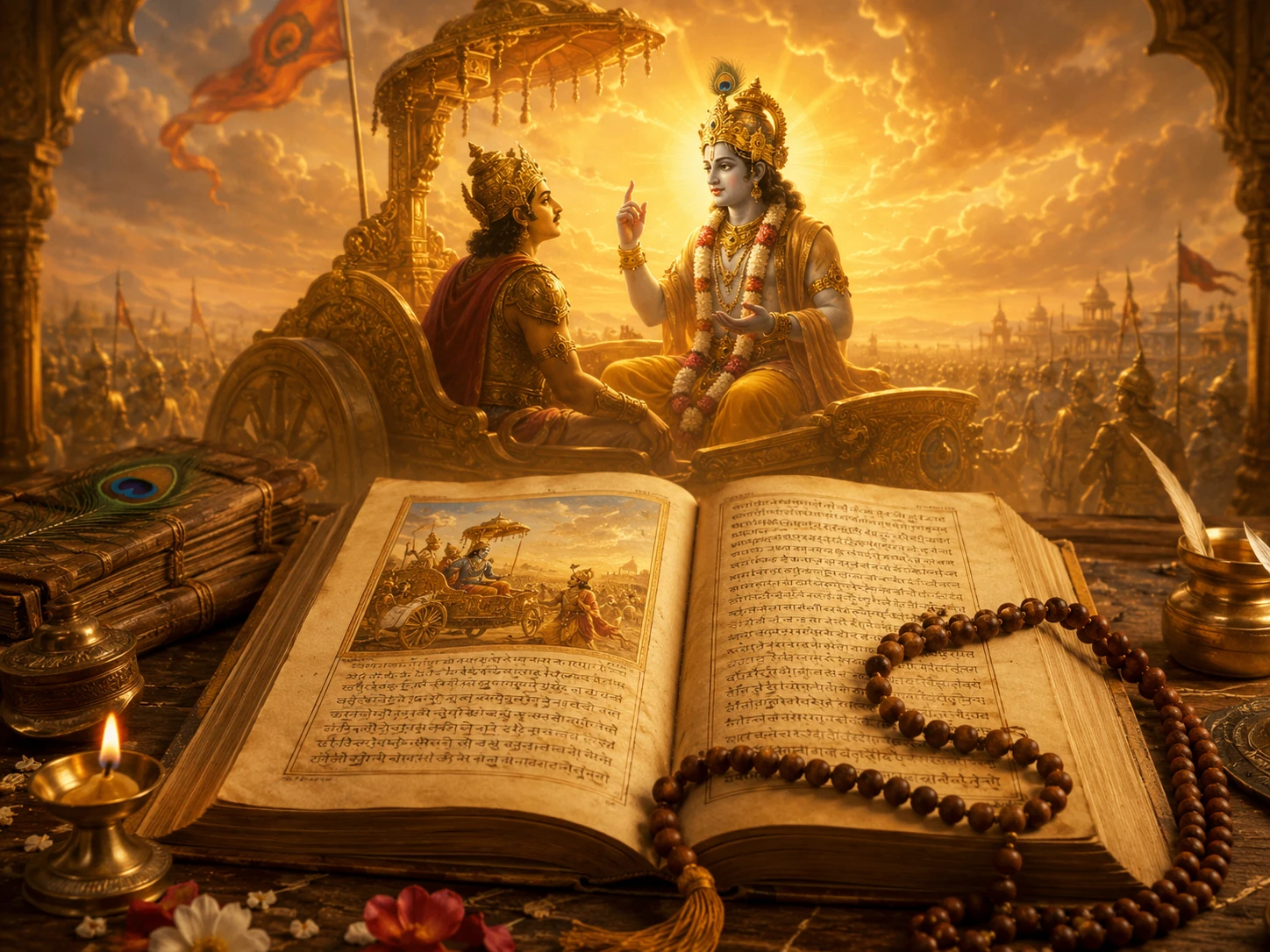
Gita Chapter 12 -- Bhakti Yoga: The Shortest Chapter With the Longest Impact
गीता अध्याय 12 -- भक्ति योग: सबसे छोटा अध्याय, सबसे गहरा असर
Arjuna has just witnessed something no human mind was built to process. In Chapter 11, Krishna ripped open the fabric of spacetime and showed him the Vishwaroop -- every being, every timeline, every death compressed into one terrifying cosmic form. Arjuna begged him to stop. Krishna returned to his gentle, two-armed form. And now, in the opening of Chapter 12, Arjuna asks perhaps the most honest question in the entire Gita.
He does not ask about metaphysics. He does not ask about duty. He asks: between those who worship your personal form (Saguna) and those who meditate on the formless, imperishable Absolute (Nirguna) -- who are the better yogis?
This is not an academic question. Arjuna has just seen both -- the intimate friend who drives his chariot, and the infinite cosmic terror that swallows worlds. Which one should he hold onto? The answer Krishna gives in Chapter 12 is the shortest chapter in the Gita (just 20 verses), but it carries the longest emotional arc. It moves from a direct answer (worship my personal form) to a compassionate four-step ladder for those who struggle, and finally to the most beautiful personality sketch in all of Indian scripture -- the portrait of the ideal devotee.
If Chapter 2 is the Gita's brain, and Chapter 11 is its eyes, then Chapter 12 is its heart. Every UPSC aspirant memorizes the Sthitaprajna (man of steady wisdom) from Chapter 2. But the devotee portrait in Chapter 12 verses 13-19 is something deeper -- it is not what an enlightened person looks like from the outside, but what they feel like from the inside. No hatred. No ego. No claim of ownership. Equal in praise and insult, heat and cold, joy and grief. This is not stoic detachment. This is the emotional freedom that comes from having placed your entire self -- mind, intellect, identity -- in something larger than your personal story.
For a generation drowning in comparison on Instagram, burning out in Kota coaching centres, or grinding through startup culture in Koramangala, this chapter offers a radical counter-model. The ideal devotee is not the person with the best outcomes. They are the person who has stopped keeping score.
मय्येव मन आधत्स्व मयि बुद्धिं निवेशय । निवसिष्यसि मय्येव अत ऊर्ध्वं न संशयः ॥
mayy eva mana ādhatsva mayi buddhiṁ niveśaya nivasiṣyasi mayy eva ata ūrdhvaṁ na saṁśayaḥ
Fix your mind on Me alone, and rest your intellect in Me. Thereafter, you shall dwell in Me alone -- of this there is no doubt.
— Bhagavad Gita, Chapter 12, Verse 8
THE BIG QUESTION: SAGUNA OR NIRGUNA? (12.1-7)
Arjuna's opening question (12.1) sets up what has been one of Hinduism's longest-running philosophical debates -- is it better to worship God with form (Saguna Bhakti) or meditate on the formless Absolute (Nirguna Upasana)? This is not just a Gita question. It is the fault line between Shankaracharya's Advaita (formless Brahman is ultimate), Ramanuja's Vishishtadvaita (the personal God is ultimate), and Madhva's Dvaita (the personal God is eternally distinct from the soul).
Krishna's answer in verses 2-5 is fascinating because it validates both -- but establishes a clear preference. Those who worship his personal form with supreme faith (shraddha paraya upetah) are, in his view, the most perfectly united in yoga (yuktatamah). He does not reject the Nirguna path -- he acknowledges that those who meditate on the imperishable, indefinable, unmanifest Brahman also reach him (verse 4). But he adds a critical qualifier in verse 5: the path of the Nirguna meditator is exceedingly difficult (kleshah adhikatarah) for embodied beings (deha-vadbhih), because the mind has nothing tangible to anchor to.
This is not a theological ranking -- it is a psychological observation. Human beings need something to love. You cannot build a relationship with an abstraction. A JEE student preparing for months can stay motivated because there is a specific exam date, a specific campus to dream about. Ask someone to study 'for the sake of knowledge' with no exam, no college, no tangible goal -- and watch motivation collapse within weeks. Krishna is making the same point about spiritual practice. The formless is real, but the formed is accessible.
This is why Indian devotion has always gravitated toward murtis, nama, leela -- not because Hindus are unsophisticated, but because Krishna himself said the embodied path is easier for embodied beings. Every grandmother doing japa on her Tulsi mala, every auto driver in Chennai with a Murugan sticker on his dashboard, every NRI who keeps a small Ganesh idol in their Bay Area apartment -- they are all following Krishna's explicit instruction in 12.6-7: those who dedicate all actions to Me and worship Me with single-pointed meditation, I swiftly rescue them from the ocean of birth and death.
THE COMPASSIONATE LADDER: FOUR STEPS DOWN (12.8-12)
What makes Chapter 12 extraordinary is what comes next. Krishna does not just state the ideal and walk away. He builds a four-step ladder of compassion for people at different levels of spiritual readiness -- arguably the first 'progressive curriculum' in the history of religious instruction.
Step 1 (12.8) -- Absorption: Fix your mind and intellect on Me alone. This is the highest rung. Total, spontaneous, effortless absorption in God -- the way a mother's mind is absorbed in her newborn. No technique needed, no effort. Just love.
Step 2 (12.9) -- Abhyasa Yoga (Practice): If you cannot fix your mind on Me steadily, then seek to reach Me through the discipline of repeated practice (abhyasa yoga). This is the path of the sadhak who sits for meditation and the mind runs to WhatsApp notifications, grocery lists, and that unresolved argument from last Tuesday. Krishna says: that is fine. Keep practising. The word abhyasa means 'repeated effort' -- not perfection, but persistence.
Step 3 (12.10) -- Karma for Krishna: If even disciplined practice is too much, then dedicate your actions to Me. Just do your work -- your job, your studies, your cooking, your parenting -- but do it as an offering. This is the path of the working professional in Gurgaon who cannot sit for 40 minutes of meditation but can choose to approach their Monday meeting as an act of service. Perfection in action for My sake (matkarma-paramah) leads to the same destination.
Step 4 (12.11-12) -- Tyaga of Fruits: And if even dedicated action feels impossible, then simply give up attachment to the results of your actions. This is the lowest rung on the ladder but still a valid path. You do not need to renounce action. You do not need to meditate. You do not even need to dedicate your work to God. Just stop clinging to outcomes. Krishna adds a remarkable statement: better than knowledge is meditation, better than meditation is renunciation of the fruits of action -- for from such renunciation, peace immediately follows (shantih anantaram).
This progressive descent is one of the most compassionate structures in world scripture. It says: wherever you are is a valid starting point. The Gita does not gatekeep enlightenment. It builds ramps.
Krishna's Four-Step Ladder of Devotion (12.8-12)
| Step | Verse | Practice | Who Is This For? | Modern Parallel |
|---|---|---|---|---|
| 1 -- Absorption | 12.8 | Fix mind and intellect on God alone | The natural mystic -- spontaneous devotion without effort | A musician who loses track of time in riyaaz -- flow state as worship |
| 2 -- Repeated Practice | 12.9 | Abhyasa Yoga -- disciplined, repeated meditation | The sincere seeker whose mind wanders but keeps returning | A NEET aspirant who fails mock tests but shows up every morning at 5 AM |
| 3 -- Dedicated Action | 12.10 | Perform all work as offering to God | The busy householder or professional who cannot sit for formal meditation | A Zomato delivery partner who treats every order as seva, rain or shine |
| 4 -- Renounce Fruits | 12.11-12 | Let go of attachment to results of all actions | The overwhelmed person who needs just one thing to change | A startup founder who builds with passion but sleeps peacefully regardless of funding rounds |
Krishna presents these in descending order of difficulty but ascending order of accessibility. Step 4 is where most people can begin today.
THE IDEAL DEVOTEE: GOD'S PERSONALITY SKETCH (12.13-19)
What follows is the emotional peak of the entire Bhagavad Gita. In verses 13-19, Krishna paints a portrait of the devotee who is dearest to him (sa me priyah -- 'that one is dear to Me'). This phrase repeats at the end of five consecutive verse-groups like a refrain in a love song, building intensity with each repetition. Chinmayananda compared this passage to a master painter stepping back from his canvas, adding stroke after stroke to reveal the beauty of the inner life.
The qualities fall into four clusters:
Cluster 1 -- Relationship with others (12.13): No hatred towards any being (adveshta sarva-bhutanam). Friendly and compassionate (maitrah karunah). Free from possessiveness and ego (nirmamah nirahankarah). Equal in pleasure and pain (sama-duhkha-sukhah). Forgiving (kshami). This is the devotee's social signature -- how they move through the world of relationships.
Cluster 2 -- Inner stability (12.14): Ever content (santushtah satatam). Self-controlled (yatatma). Firm in resolve (dridha-nischayah). Mind and intellect surrendered to God (mayy arpita-mano-buddhih). This is the devotee's psychological foundation.
Cluster 3 -- Freedom from reactivity (12.15-16): Neither disturbing the world nor disturbed by it (yasmat na udvijate lokah). Free from elation, envy, fear, and anxiety (harsha-amarsha-bhaya-udvegaih muktah). Expecting nothing (anapekshah). Pure (shuchih). Skilled yet unconcerned (dakshah udaasino). This is the devotee in action -- present, competent, yet utterly non-reactive.
Cluster 4 -- Equanimity in pairs of opposites (12.17-19): Same towards friend and foe (mitra-ari). Same in honour and dishonour (mana-apamana). Same in heat and cold, pleasure and pain. Free from attachment (sangavivarjitah). Equal in praise and blame (tulya-ninda-stutih). Content with whatever comes (yenakenachit santushtah). Homeless in the deepest sense -- not attached to any place or situation (aniketah sthiramati).
Read this list slowly and you realize: this is not a supernatural being. This is a description of radical emotional health. A therapist would recognize these qualities as the opposite of every pattern that drives human suffering -- comparison, reactivity, ego-protection, outcome-dependence. The Gita is describing a person who has achieved what modern psychology calls 'non-attachment to self-image' -- and it was written 2,500 years before cognitive behavioral therapy.
The corporate world talks about 'leadership presence' and 'emotional intelligence.' Silicon Valley runs workshops on 'radical candor' and 'psychological safety.' Verses 12.13-19 are the original manual.
अद्वेष्टा सर्वभूतानां मैत्रः करुण एव च । निर्ममो निरहंकारः समदुःखसुखः क्षमी ॥ सन्तुष्टः सततं योगी यतात्मा दृढनिश्चयः । मय्यर्पितमनोबुद्धिर्यो मद्भक्तः स मे प्रियः ॥
adveṣṭā sarva-bhūtānāṁ maitraḥ karuṇa eva ca nirmamo nirahaṅkāraḥ sama-duḥkha-sukhaḥ kṣamī santuṣṭaḥ satataṁ yogī yatātmā dṛḍha-niścayaḥ mayy arpita-mano-buddhir yo mad-bhaktaḥ sa me priyaḥ
One who bears no hatred towards any being, who is friendly and compassionate, free from possessiveness and ego, equal in pleasure and pain, forgiving, ever content, self-controlled, firm in resolve, with mind and intellect surrendered to Me -- such a devotee is dear to Me.
— Bhagavad Gita, Chapter 12, Verses 13-14
THE CLOSING PROMISE (12.20)
The final verse seals the chapter with a sweeping embrace. Krishna declares: those who follow this immortal dharma (dharmya-amritam) with faith (shraddha), holding Me as the supreme goal (mat-paramah) -- they are exceedingly dear to Me (te ativa me priyah). The word amritam -- nectar of immortality -- frames the entire teaching of this chapter as something that grants deathlessness. Not physical immortality, but freedom from the cycle of grasping and losing that makes mortal life feel like death while still alive.
Notice what Krishna does NOT say. He does not say 'those who achieve perfection in meditation.' He does not say 'those who renounce the world.' He does not say 'those who master the Vedas.' He says: those who follow this dharma with faith. The bar is not perfection -- it is sincerity.
WHY CHAPTER 12 MATTERS FOR MODERN INDIA
In a culture that increasingly defines human worth by measurable outcomes -- board exam percentages, CTC packages, Instagram followers, matrimonial biodata statistics -- Chapter 12 offers a fundamentally different metric. The ideal devotee is not the highest achiever. They are the person who has internalized such deep equanimity that external outcomes have lost the power to define them.
This is not indifference. Verses 15-16 make it clear: the ideal devotee is daksha (skilled, competent) and shuchi (pure, clean in conduct). They are fully engaged in the world. They just do not let the world's scoreboard become their inner scoreboard.
Consider the epidemic of student suicides in India -- from Kota to IIT campuses. The root cause, study after study shows, is not academic difficulty but an inability to separate self-worth from academic performance. Chapter 12 directly addresses this: sama-duhkha-sukhah (equal in pain and pleasure), tulya-ninda-stutih (equal in criticism and praise), yenakenachit santushtah (content with whatever comes). These are not abstract philosophical ideals. They are survival skills for a generation under siege by comparison culture.
At ISRO, scientists famously slept on the floor after the Chandrayaan-2 lander lost contact -- then showed up the next morning to start working on Chandrayaan-3. That is Chapter 12 in action: fully invested in the work, fully detached from the result. The phrase 'karmaphala-tyaga se shanti milti hai' (peace comes from renouncing the fruit of action) could be ISRO's unofficial motto.
Chapter 12 also speaks to the NRI diaspora experience. Living between two cultures, belonging fully to neither, many Indian-Americans struggle with identity anchoring. The Gita's answer is aniketah sthiramati -- homeless but stable-minded. Your stability does not come from geography or community approval. It comes from an internal locus that no relocation can disturb.
Chapter 12 is the only chapter in the Gita where Krishna uses the word 'priyah' (dear to Me) repeatedly -- five times in seven verses (13-19). This density of emotional expression is unmatched anywhere else in the text. Shankaracharya's commentary notes that Krishna's tone shifts here from that of a teacher to that of a lover describing the beloved. The Indian Army's counter-insurgency manual reportedly uses the concept of 'sama-duhkha-sukhah kshami' (equal in pain/pleasure, forgiving) as a psychological resilience framework for soldiers deployed in high-stress border areas.
The four-step ladder (12.8-12) maps remarkably onto modern habit-formation science. James Clear's 'Atomic Habits' framework -- identity-level change, process-level change, outcome-level change -- is the same descending structure Krishna presents. Step 1 (absorption) is identity-level: you ARE a devotee. Step 2 (practice) is process-level: you DO the practice. Step 3 (dedicated action) is environment-level: you structure your work as offering. Step 4 (renounce fruits) is outcome-level: you release attachment to results. The Gita got there first.
Practice the Bhakti of Chapter 12
Begin with Krishna's simplest instruction -- fix your mind on the divine through japa. Chant Om Namo Bhagavate Vasudevaya 108 times daily on a mala. Whatever step you are on, you can start here. The mantra's page on Eternal Raga gives its meaning and how to chant it.
Tags
Eternal Raga · शाश्वत राग
Institutional voice — scholarly articles on Sanatan Dharma
Deepen Your Understanding
अपनी समझ और गहरी करें
scriptural exegesis
Gita Chapter 2 -- Sankhya Yoga: The Chapter That Changed Indian Philosophy Forever
Arjuna drops his bow. His hands shake. He tells Krishna he would rather beg for food than kill his teachers and cousins. Krishna's response in Chapter 2 is the philosophical backbone of the entire Gita -- covering the immortality of the soul, the ethics of action without attachment, and the portrait of the Sthitaprajna (the person of steady wisdom). This single chapter contains more quotable verses than most entire scriptures. 'Karmanye vadhikaraste' lives on WhatsApp statuses for a reason.
scriptural exegesis
Gita Chapter 3 -- Karma Yoga: Why Sitting Still Is Not an Option
After hearing Chapter 2, Arjuna asks the most logical follow-up question in the history of philosophy: 'If knowledge is superior to action, why are you pushing me to fight?' Krishna's answer in Chapter 3 builds the complete architecture of Karma Yoga -- why action is inescapable, how selfless action purifies, why leaders must act even when they have nothing to gain, and how desire is the real enemy on every battlefield.
scriptural exegesis
Gita Chapter 11 -- Vishwaroop: When Arjuna Saw Everything and Could Not Bear It
Arjuna asks to see Krishna's true form. He gets what he asks for. Infinite mouths, infinite eyes, infinite arms, the entire universe being consumed. Warriors rushing into blazing mouths like moths into flame. Time itself as a devouring force. This is the chapter Oppenheimer quoted at Trinity. It is the Gita's most terrifying passage -- and its most honest statement about what happens when a human mind encounters infinity without a filter.
scriptural exegesis
Gita Chapter 18 -- Moksha Sannyasa Yoga: The Final Exam Where Krishna Says 'Do As You Wish'
78 verses. The longest chapter in the Gita. Krishna classifies everything -- knowledge, action, doer, intellect, happiness -- into three gunas, then drops the most radical verse in Indian scripture: abandon all dharmas and just surrender to Me. And then, in a move no dictator would ever make, he tells Arjuna: now do as you wish.
deities avatars
Krishna Leela -- Why God Chose to Play
He stole butter, broke pots, lied to his mother's face, danced with married women under the full moon, and lifted an entire mountain on his little finger. The Bhagavata Purana's Tenth Skandha -- the most popular 4,000 verses in all of Hindu literature -- is not a biography. It is a theological argument that the Supreme Being's highest expression is not creation, destruction, or cosmic governance. It is play. Krishna Leela is the radical idea that God's truest nature is joy.
tantra mantra yantra
Om Namo Narayanaya -- The Eight-Syllable Key to Vishnu
Eight syllables. No complicated ritual. No prerequisite initiation for the basic form. Om Namo Narayanaya is the most accessible Vishnu mantra in existence -- chanted by Alvars in Tamil Nadu, ISKCON devotees in Manhattan, grandmothers in Tirupati queues, and software engineers in Bengaluru doing japa on their morning commute. But simplicity is not shallowness. The Ashtakshara Mantra encodes an entire theology of surrender, and the three schools of Vedanta have spent centuries arguing about what exactly 'Namo' means.
deities avatars
Dashavatara -- Why Vishnu Comes Back Ten Times
Fish, tortoise, boar, half-lion, dwarf, axe-warrior, prince, cowherd, enlightened teacher, future horseman. The ten avatars of Vishnu are not random folklore. Read them in sequence and you get something startling -- a narrative that mirrors evolutionary biology, tracks the rise and fall of political systems, and argues that God does not sit above history but enters it, gets dirty, and does the work. The Dashavatara is Hinduism's answer to the question every civilisation asks: why does the world keep breaking, and who fixes it?
Chapter 12 is the only chapter in the Gita where Krishna uses the word 'priyah' (dear to Me) repeatedly -- five times in seven verses (13-19). This density of emotional expression is unmatched anywhere else in the text. …
More in Scriptural Exegesis
Abhimanyu and the Chakravyuha -- The Boy Who Knew How to Enter but Not How to Leave
14 min read
Adbhuta Ramayana -- The Ramayana Where Sita Becomes Kali
9 min read
After Kurukshetra -- What Happened Next
14 min readThe same translation error that turned '33 Koti' into '33 crore' in Hinduism also happened in Buddhism. The Chinese translation of Buddhist texts rendered 'Sapta Koti Buddha' (7 Supreme Buddhas) as '7 Crore Buddhas.' The…
Deities AvatarsCommunity Reflections
🕉️
Be the first to share your reflection.