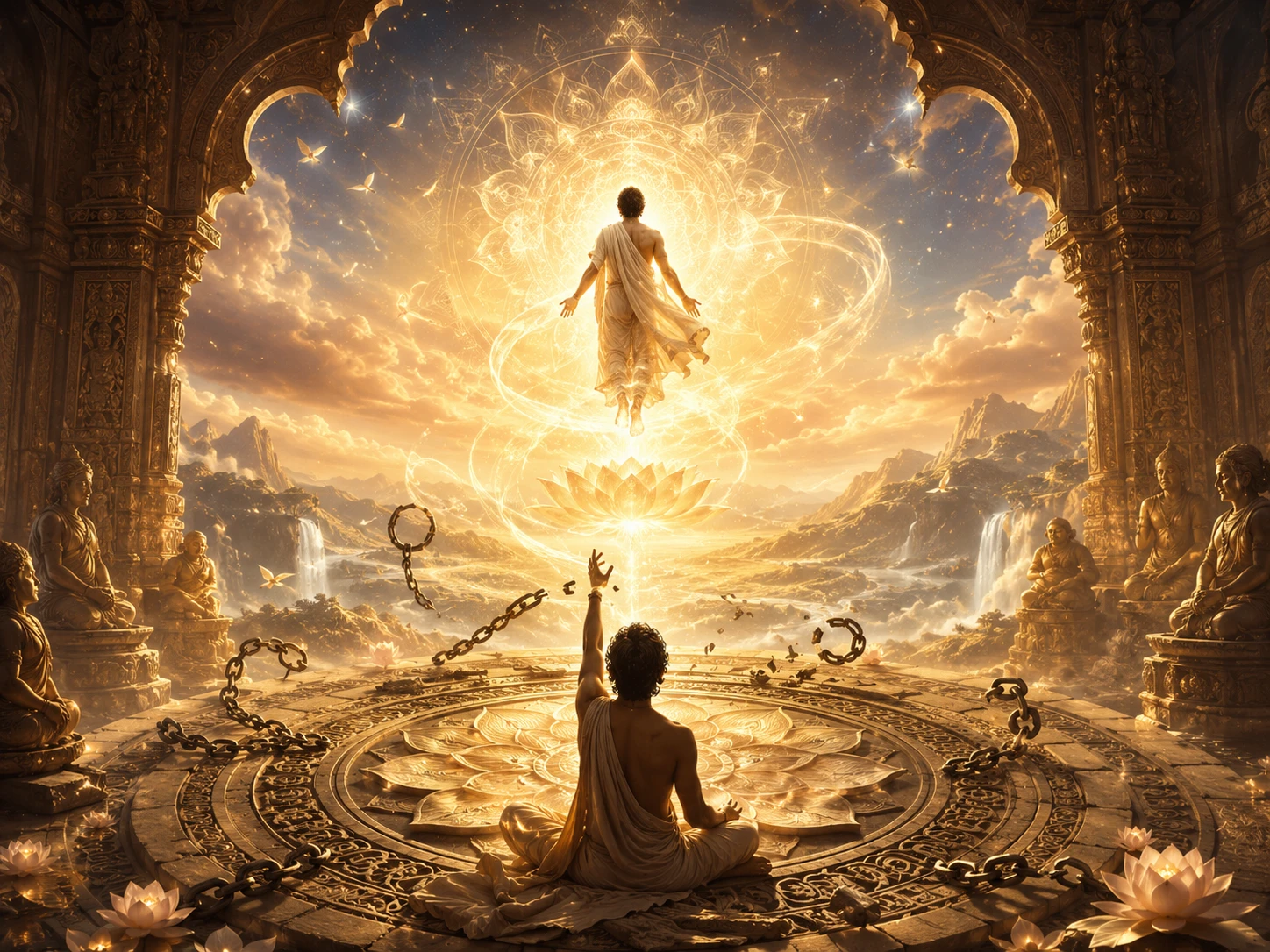
Moksha -- What Liberation Really Means
मोक्ष -- मुक्ति का असली अर्थ क्या है
Hindu civilisation organises the entire purpose of human life into four goals -- the Purusharthas. Dharma (righteousness, duty). Artha (wealth, material security). Kama (pleasure, desire, aesthetics). And Moksha (liberation). The first three are worldly goals. They keep society running, families fed, and culture alive. But they are not the endgame. Moksha is. It is the only Purushartha that, once achieved, makes the other three unnecessary -- because the person who attains Moksha has transcended the need for duty, wealth, and pleasure without rejecting any of them.
This is a civilisational claim of extraordinary ambition. Most cultures define the good life as some combination of the first three: be ethical, be prosperous, be happy. Hindu philosophy says: and then go beyond all of it. There is a state that is not dependent on ethics being rewarded, wealth being accumulated, or desires being fulfilled. That state is Moksha -- and it is your birthright as a conscious being.
But here is where it gets complicated. Moksha does not mean one thing. Across the major schools of Hindu philosophy, it means profoundly different things -- different experiences, different metaphysical endpoints, different relationships between self and God. The word is the same; the destination is not. Understanding these differences is essential, because your sadhana (spiritual practice), your chosen deity, your temple tradition, and even your philosophical temperament all depend on which Moksha you are seeking.
For the UPSC aspirant preparing the Indian Philosophy optional, Moksha appears in virtually every question on Vedanta, Yoga, and Samkhya. For the spiritually curious young Indian browsing Reddit threads on Advaita or attending ISKCON Sunday programmes, the distinction between 'merging into Brahman' and 'eternally serving Krishna' is not academic -- it determines what practice you adopt, what teacher you follow, and what you expect liberation to feel like.
सर्वधर्मान्परित्यज्य मामेकं शरणं व्रज। अहं त्वां सर्वपापेभ्यो मोक्षयिष्यामि मा शुचः॥
sarvadharmānparityajya māmekaṃ śaraṇaṃ vraja | ahaṃ tvāṃ sarvapāpebhyo mokṣayiṣyāmi mā śucaḥ ||
Abandoning all dharmas, take refuge in Me alone. I shall liberate you from all sins. Do not grieve.
— Bhagavad Gita, Chapter 18, Verse 66
In Advaita Vedanta, Moksha is the recognition that you are Brahman. Not becoming Brahman. Not reaching Brahman. Recognising that you always were Brahman and the appearance of bondage was caused by Avidya (ignorance). The classic analogy: a man searches everywhere for his spectacles, growing increasingly frantic, until someone points out that the spectacles are on his forehead. He was never without them. He only thought he was. That recognition -- 'Oh, they were here all along' -- is Moksha. Nothing changes in the external world. Everything changes in the internal understanding.
This Moksha can happen while you are alive. It is called Jivanmukti -- liberation while living. The Jivanmukta continues to eat, sleep, walk, talk, and function in the world, but the fundamental confusion is over. They no longer identify with the body-mind complex. They know themselves as the witness, as Brahman. Their body continues because of Prarabdha Karma (the momentum of past actions that has already begun to bear fruit, like an arrow already released from the bow), but no new Karma accumulates because there is no doer-identity left to generate it.
In Dvaita Vedanta, Moksha is radically different. It is not recognition of identity with God -- it is the attainment of God's eternal presence. The liberated soul goes to Vaikuntha (Vishnu's divine abode) and experiences the bliss of being forever in the presence of the Lord. Crucially, individuality is preserved. You remain you -- a distinct soul, with your own unique relationship to God. You do not merge. You love. Madhvacharya insists that the joy of Moksha is the joy of eternal Bhakti, not the dissolution of the self. For the devotee who sings 'Hari Om' at the Udupi temple or chants the Hare Krishna Mahamantra on Marine Drive, this vision of Moksha is not abstract -- it is the anticipated culmination of a lifetime of loving service.
Ramanujacharya's Vishishtadvaita offers a middle path. Moksha is Prapatti (total surrender to God's grace), which leads the soul to Vaikuntha where it experiences infinite bliss in God's company. The soul retains individuality but recognises its nature as part of Brahman's body. The Tirupati tradition, where millions stand in queues for darshan, embodies this vision: Moksha is not intellectual recognition but relational communion, not merging but meeting.
In Yoga (Patanjali's system), Moksha is called Kaivalya -- aloneness, isolation. When Purusha (consciousness) fully discriminates itself from Prakriti (matter), it rests in its own nature, alone and free. There is no God required, no Vaikuntha, no merging. Just consciousness being itself, undisturbed, complete. This is the most austere and least emotional vision of liberation in Hindu philosophy.
In Samkhya, Moksha is similarly the cessation of suffering through discriminative knowledge (Viveka-jnana). When Purusha knows it is not Prakriti, Prakriti withdraws -- like a dancer who stops when the audience has truly seen the performance. Liberation is not a reward. It is the natural state restored.
Notice the range. For Advaita: you dissolve into the infinite. For Dvaita: you love the infinite forever. For Yoga: you rest alone as pure consciousness. For Samkhya: matter withdraws from your awareness. Same word -- Moksha -- pointing to experiences as different as a wave merging into the ocean, a lover embracing the beloved, a light shining in an empty room, and a dancer leaving the stage.
Moksha Across the Major Schools
| School | Name for Liberation | What Happens | How to Attain | Individuality After Moksha |
|---|---|---|---|---|
| Advaita Vedanta | Moksha / Jivanmukti | Atman recognised as identical to Brahman. The illusion of separateness dissolves. | Jnana (knowledge) through Shravanam, Mananam, Nididhyasanam | Dissolved. No separate self remains. |
| Vishishtadvaita | Moksha / Prapatti | Soul reaches Vaikuntha and enjoys eternal bliss in God's presence. | Prapatti (surrender) + Bhakti. Grace of Vishnu is essential. | Preserved. Soul is part of Brahman's body forever. |
| Dvaita | Mukti | Soul enters Vaikuntha in eternal loving service to Vishnu. | Bhakti. Grace alone liberates. No self-effort suffices. | Fully preserved. Soul is eternally distinct from God. |
| Yoga (Patanjali) | Kaivalya | Purusha rests in its own nature, separate from Prakriti. | Ashtanga Yoga: yama, niyama, asana, pranayama, pratyahara, dharana, dhyana, samadhi. | Purusha remains distinct. Each Purusha is individual. |
| Samkhya | Kaivalya | Prakriti withdraws when Purusha achieves discriminative knowledge. | Viveka-jnana (discriminative knowledge of Purusha vs Prakriti). | Each Purusha remains individual. |
| Kashmir Shaivism | Moksha / Shiva-Sayujya | Recognition (Pratyabhijna) that individual consciousness IS Shiva. | Shaktipata (divine grace) + self-recognition practices. | Dissolved into universal Shiva-consciousness. |
| Bhakti traditions | Prema-Mukti / various | Eternal loving relationship with the personal God. | Bhakti, nama-japa, kirtan, seva, surrender. | Preserved. Love requires two. |
The Purushartha framework ranks Moksha as the highest goal, but does not prescribe a single path. Hindu civilisation's pluralism extends even to its definition of the ultimate destination.
There are two important distinctions within the concept of Moksha that deserve attention: Jivanmukti versus Videhamukti, and the five types of Mukti in the Vaishnava tradition.
Jivanmukti (liberation while living) is primarily an Advaita concept. It holds that you do not need to die to be free. The moment Avidya is destroyed by knowledge, you are liberated -- right here, right now, in this body. The Jivanmukta walks through the world without being of the world. Ramana Maharshi sitting on Arunachala, Nisargadatta Maharaj selling bidis in a Mumbai shop while teaching Non-dual awareness -- these are the modern faces of Jivanmukti. The body still functions, karma still unwinds, but the person knows they are not the person.
Videhamukti (liberation after death) is liberation that occurs when the body falls away. The Prarabdha Karma that kept the body running is exhausted, and the subtle body dissolves. For Advaitins, this is the completion of what Jivanmukti began. For Dvaita and Vishishtadvaita, Videhamukti is when the soul actually reaches Vaikuntha.
The Vaishnava tradition, particularly in the Bhagavata Purana, enumerates five types of Mukti: Salokya (residing in God's realm), Samipya (being near God), Sarupya (having a form like God's), Sarshti (having powers like God's), and Sayujya (merging into God). Most Vaishnava devotees actively reject Sayujya, considering it inferior to the relational forms. The Gaudiya Vaishnava tradition (ISKCON's lineage) explicitly seeks a sixth: Prema-Bhakti -- not any of the five Muktis, but pure love itself, which transcends even liberation.
For the modern Indian, Moksha may feel distant -- a goal for sannyasis and saints, not for a product manager in Hyderabad or a CA student in Jaipur. But the framework insists that Moksha is not just for the elite few. The Gita's Chapter 18, Verse 66 -- 'Abandon all dharmas and surrender to Me alone; I shall liberate you from all sins; do not grieve' -- is addressed to Arjuna, a warrior on a battlefield, not a monk in a cave. The message is clear: liberation is available in the middle of life, not only at its margins.
The practical implication is this: you do not need to renounce the world to begin the journey toward Moksha. You need to change your relationship to the world. Whether that change comes through Jnana (knowledge), Bhakti (devotion), Karma (selfless action), or Yoga (meditative discipline) depends on your nature, your tradition, and your guru. But the destination -- freedom from the fundamental confusion about who you are -- is the same. And it is, according to every major school of Hindu philosophy, the single most worthwhile thing a human being can achieve.
The concept of Moksha has no direct equivalent in Abrahamic religions. Christianity's 'salvation' is closer to Dvaita's Moksha (eternal relationship with God) than to Advaita's (dissolution of individual self). Islam's Jannah (paradise) is a place of reward, not a state of metaphysical transformation. Buddhism's Nirvana ('blowing out') is structurally closest to Advaita's Moksha but differs crucially in denying a permanent Self. The uniqueness of Hindu Moksha lies in its plurality -- the same civilisation offers dissolution (Advaita), eternal love (Dvaita), and pure aloneness (Yoga) as equally valid destinations, and does not insist that all seekers must arrive at the same place. This internal pluralism about the ultimate goal is, arguably, Hinduism's most distinctive philosophical feature.
Begin the Journey -- Guided Self-Inquiry
Whatever school resonates with you, the journey toward Moksha begins with a single question: 'Who am I?' Sit quietly, ask the question, and let every answer dissolve. What remains when all answers are gone is what every tradition calls liberation.
Eternal Raga · शाश्वत राग
Institutional voice — scholarly articles on Sanatan Dharma
Deepen Your Understanding
अपनी समझ और गहरी करें
philosophy darshana
Atman and Brahman -- The Self and the Absolute
The Upanishads make a claim so radical that 3,000 years have not dulled its edge: the individual self (Atman) and the ultimate reality of the universe (Brahman) are not two different things. They are one. Every school of Hindu philosophy is essentially an argument about what this identity means.
philosophy darshana
Dvaita vs Advaita -- The Greatest Debate in Hindu Philosophy
Are you and God the same being, temporarily confused? Or are you and God eternally different, connected by love but never identical? This question split Hindu philosophy into rival schools, produced centuries of razor-sharp debate, and still determines whether you pray saying 'I am Brahman' or 'I am Brahman's servant'. The answer depends on which genius you believe -- Shankaracharya or Madhvacharya.
philosophy darshana
Neti Neti -- The Method of Negation That Reveals Everything
What is Brahman? Not the body. Not the mind. Not the intellect. Not the ego. Not the universe. Not even the gods. The Brihadaranyaka Upanishad's 'Neti Neti' is the most radical answer ever given to the most fundamental question -- an answer that works by refusing to answer, stripping away everything false until only truth remains.
philosophy darshana
Yoga Darshana -- Patanjali's Science of the Mind
Before yoga became a global fitness trend worth $80 billion, it was India's most rigorous system of psychology. Patanjali's 196 sutras are not about touching your toes -- they are about rewiring your mind. Here is the philosophy the world forgot when it turned yoga into exercise.
philosophy darshana
Bhakti as Philosophy, Not Just Emotion
The intellectual establishment has always underestimated Bhakti. They call it emotional, sentimental, the path for those who cannot do 'real' philosophy. They are wrong. Bhakti has its own sutras, its own epistemology, its own metaphysics, and its own devastating critique of Jnana. Narada, Shandilya, the Alvars, the Haridasas, Mirabai, Tulsidas -- they did not bypass philosophy. They transcended it.
philosophy darshana
Sattva, Rajas, Tamas -- The Three Gunas That Run Your Life
Every mood you have ever felt, every decision you have ever made, every Netflix binge and every 4 AM study session -- Hindu philosophy says it all comes down to three forces. Sattva illuminates, Rajas agitates, Tamas numbs. The Bhagavad Gita's Chapter 14 is essentially a 2,000-year-old personality framework that modern psychology is only now catching up to.
philosophy darshana
Maya -- The Cosmic Illusion That Runs the Universe
You walk down a dark path and see a snake. Your heart pounds, your body freezes. Then someone brings a lamp. It was a rope. The snake was never there. Hindu philosophy says the entire universe works exactly like this -- and the lamp is called knowledge. Welcome to Maya, the most counterintuitive and most liberating idea in Indian thought.
The concept of Moksha has no direct equivalent in Abrahamic religions. Christianity's 'salvation' is closer to Dvaita's Moksha (eternal relationship with God) than to Advaita's (dissolution of individual self). Islam's J…
More in Philosophy & Darshana
The 14 Lokas -- Hindu Cosmology as a Map of Consciousness
14 min read
Achintya Bhedabheda -- Chaitanya's Theology of Inconceivable Difference-and-Unity
13 min read
Adhyasa -- Superimposition and the Foundational Error of the Self
13 min readThe same translation error that turned '33 Koti' into '33 crore' in Hinduism also happened in Buddhism. The Chinese translation of Buddhist texts rendered 'Sapta Koti Buddha' (7 Supreme Buddhas) as '7 Crore Buddhas.' The…
Deities AvatarsCommunity Reflections
🕉️
Be the first to share your reflection.