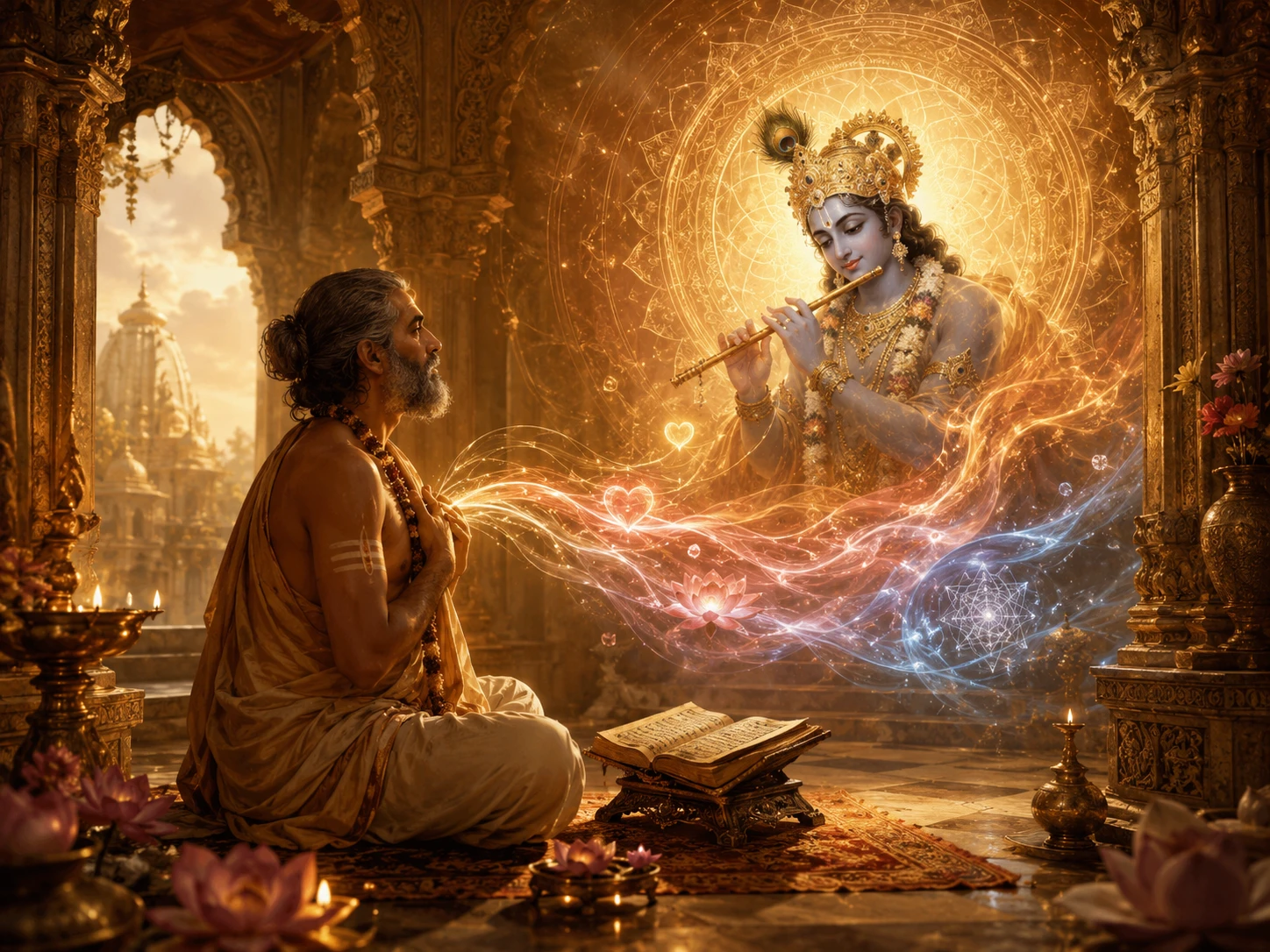
Bhakti as Philosophy, Not Just Emotion
भक्ति -- केवल भावना नहीं, एक सम्पूर्ण दर्शन
In the hierarchy of Indian philosophical discourse -- as taught in most universities, as framed in most UPSC coaching notes, as assumed in most intellectual conversations -- Jnana sits at the top and Bhakti somewhere below. Jnana is rigorous, analytical, philosophical. Bhakti is emotional, accessible, popular. Jnana is for the sharp-minded scholar. Bhakti is for the simple-hearted devotee. Jnana is Shankaracharya debating at Sringeri. Bhakti is the grandmother crying during the Ramcharitmanas path.
This hierarchy is a distortion. It misrepresents both Jnana and Bhakti, and it reveals more about the intellectual prejudices of its proponents than about the actual philosophical traditions.
Bhakti is not the absence of philosophy. It is a complete, self-contained philosophical system with its own foundational texts (the Narada Bhakti Sutra, the Shandilya Bhakti Sutra), its own epistemology (love as a Pramana -- a valid means of knowing God), its own metaphysics (God is personal, real, and accessible through love), its own ethics (service, humility, surrender), and its own devastating critique of the Jnana path (knowledge without love is dry, partial, and ultimately incomplete).
The Bhagavad Gita itself refuses the Jnana-over-Bhakti hierarchy. In Chapter 12, Arjuna asks Krishna directly: which is superior, the path of the formless (Nirguna) or the path of the personal God (Saguna)? Krishna's answer in 12.2 is unambiguous: those who worship Me with devotion, fixing their minds on Me -- I consider them the best yogis. Not the Jnanis. Not the contemplatives of the formless Absolute. The Bhaktas. This is not a minor verse buried in an obscure chapter. It is Krishna's direct ranking, and it places Bhakti above Jnana in the Gita's own value system.
The intellectual resistance to taking Bhakti seriously as philosophy comes from a modern bias -- the assumption that emotion and reason are opposites, that rigour requires detachment, that love cannot be epistemologically valid. Hindu philosophy makes no such assumption. In the Bhakti tradition, love is not an obstacle to knowledge. It is the highest form of knowledge -- because it grasps the object (God) in its fullness, not just its abstract properties.
सा त्वस्मिन् परमप्रेमरूपा॥ अमृतस्वरूपा च॥
sā tvasmin paramapremarūpā || amṛtasvarūpā ca ||
That Bhakti is of the nature of supreme love for God. And it is of the nature of immortality (nectar).
— Narada Bhakti Sutra, Sutras 2-3
The Narada Bhakti Sutra, traditionally attributed to the celestial sage Narada (though likely composed around the 10th-12th century CE), is an 84-verse treatise that does for Bhakti what the Yoga Sutras do for Yoga and the Brahma Sutras do for Vedanta -- it systematises the entire path into a concise, rigorous framework.
Narada's definition of Bhakti in Sutra 2 is precise: 'Sa tvasmin parama-prema-rupa' -- Bhakti is the form of supreme love directed toward God. This is not sentimental affection. The word 'parama' (supreme, highest) indicates that this love transcends all other forms of love -- parental, romantic, patriotic, self-directed. It is love that has been purified of all self-interest, all expectation of return, all conditionality. It is, in modern psychological terms, the most mature form of attachment -- secure, unconditional, and identity-forming without being identity-dependent.
Narada then makes a remarkable epistemological claim in Sutra 30: 'Bhakti is its own fruit.' It does not need Jnana or Karma as prerequisites. It does not need external validation. The experience of loving God is itself the reward -- not something that leads to a reward. This is a radical philosophical position. Most systems treat their path as a means to an end (Moksha). Narada says Bhakti is both the means and the end. The lover does not love in order to achieve something. The loving itself is the achievement.
The Shandilya Bhakti Sutra, another foundational text (attributed to the sage Shandilya), defines Bhakti differently: 'Saanuraktir Ishvare' -- supreme attachment to God. Shandilya's emphasis on 'anurakti' (attachment, passionate clinging) is philosophically interesting because it redeems a quality that Jnana traditions condemn. In Advaita, attachment is the root of bondage. In Bhakti philosophy, attachment directed toward God is not bondage -- it is liberation wearing a different face. The chain that binds you to the finite becomes a bridge when it connects you to the infinite.
The Bhakti tradition also produced the Rasa theory of devotion -- a sophisticated taxonomy of the different emotional flavours (Rasas) through which a devotee can relate to God. The Gaudiya Vaishnava tradition enumerates five primary Rasas: Shanta (peaceful contemplation), Dasya (servant-master), Sakhya (friendship), Vatsalya (parental love), and Madhurya (conjugal love). Each represents a legitimate mode of relating to the divine. The Vrindavan tradition considers Madhurya Rasa -- the love of the Gopis for Krishna -- as the highest, most complete expression of Bhakti. This is not sentimentalism. It is a structured phenomenology of religious experience that maps the inner landscape of devotion with a precision that parallels William James's 'Varieties of Religious Experience' -- except it was composed centuries earlier.
The Bhakti movement -- the mass devotional wave that swept across India from the 6th century CE in Tamil Nadu to the 17th century CE in Maharashtra and beyond -- was simultaneously a philosophical revolution, a social revolution, and a literary revolution.
The twelve Alvars of Tamil Vaishnavism (6th-9th centuries CE) composed the Divya Prabandham -- 4,000 verses of devotional poetry so philosophically rich that they were called the 'Tamil Veda'. Nammalvar, the greatest among them, articulated a theology of complete surrender (Prapatti) and divine grace that Ramanujacharya later systematised into Vishishtadvaita. The Alvars were not naive singers. They were theologians who happened to sing.
In Karnataka, the Haridasa movement produced Purandaradasa (the 'father of Carnatic music'), Kanakadasa, and Vijaya Dasa -- poet-saints whose compositions are simultaneously musical masterpieces, philosophical arguments, and social critiques. Kanakadasa's 'Nanu Hodare Hodenu' ('Even if I go, I won't go') is a philosophical meditation on detachment wrapped in folk melody. Purandaradasa's 'Jagadoddharana' is a distillation of Dvaita theology into four minutes of song.
In North India, Tulsidas composed the Ramcharitmanas -- the Hindi retelling of the Ramayana that became the single most influential text in North Indian devotional life. It is read aloud in millions of homes during Navratri. It is performed as Ramleela in every city from Varanasi to Vrindavan. And it is deeply philosophical -- its opening invocations discuss the nature of Brahman, the relationship between Saguna and Nirguna, and the supremacy of Rama-Bhakti as a path to liberation.
Kabir, the 15th-century weaver-poet of Varanasi, demolished all sectarian boundaries with couplets that are philosophical hand grenades: 'Pothi padh padh jag mua, pandit bhaya na koi / Dhai aakhar prem ka, padhe so pandit hoi' -- The world died reading books, no one became wise / Read two and a half letters of love, and you become wise. This is not anti-intellectualism. It is the Bhakti tradition's sharpest epistemological claim: love knows what reason cannot reach.
Mirabai in Rajasthan, Andal in Tamil Nadu, Akka Mahadevi in Karnataka, Lalleshwari in Kashmir -- women saints whose philosophical voice was inseparable from their devotional ecstasy. In a patriarchal culture that restricted women's access to formal Sanskrit education, Bhakti provided an alternative epistemological path. You did not need to read the Brahma Sutras to know God. You needed to love. And love was available to everyone -- Brahmin and Dalit, man and woman, scholar and illiterate.
This radical accessibility is Bhakti's most powerful philosophical claim. If liberation is available only through intellectual knowledge (as strict Advaita implies), then it is available only to an educated elite. If liberation is available through love, it is available to every conscious being with a heart. Bhakti democratised Moksha. That is not a minor philosophical footnote. That is a civilisational intervention.
Bhakti vs Jnana vs Karma -- The Three Margas Compared
| Dimension | Bhakti Marga | Jnana Marga | Karma Marga |
|---|---|---|---|
| Core method | Love, devotion, surrender to a personal God | Discriminative knowledge (Viveka) of Self and non-Self | Selfless action without attachment to results |
| Key text | Narada Bhakti Sutra, Bhagavata Purana, Gita Ch.12 | Vivekachudamani, Upanishads, Gita Ch.2 | Gita Ch.3 (Karma Yoga), Mimamsa Sutras |
| View of God | Personal (Saguna) -- God has form, name, qualities, and a relationship with the devotee | Impersonal (Nirguna) or irrelevant -- Brahman is formless, attributeless | God as ordainer of Dharma -- the cosmic law that governs right action |
| Who can practise | Everyone -- no caste, gender, education barrier | Requires sharp intellect, study, Guru | Everyone -- but full benefit requires understanding of Dharma |
| Emotional register | Intense love, longing, ecstasy, surrender | Detachment, equanimity, dispassion (Vairagya) | Steadiness, duty, discipline |
| Critique of other paths | 'Knowledge without love is dry and incomplete' | 'Emotion without knowledge is blind' | 'Both knowledge and devotion need action to be real' |
| Liberation looks like | Eternal loving relationship with God | Dissolution of ego into Brahman | Freedom from karmic bondage through selfless action |
| Modern Indian exemplar | Devotee at Tirupati, ISKCON kirtan, bhajan singer | Ramana Maharshi, Nisargadatta, Vedanta study circles | Gandhian activist, NGO worker, Karma Yogi in daily life |
The Gita integrates all three, treating them not as rivals but as complementary. Chapter 3 teaches Karma, Chapters 2 and 13 teach Jnana, Chapter 12 teaches Bhakti. The 'best' path depends on the seeker's nature (Svadharma).
The Bhakti movement is arguably the largest sustained social revolution in Indian history. Over a thousand years, it challenged caste hierarchy (Ravidas, a Chamar, and Kabir, a Julaha, became revered saints), gender exclusion (Mirabai, Andal, and Akka Mahadevi became philosophical authorities), and linguistic elitism (devotional poetry was composed in Tamil, Kannada, Marathi, Hindi, Bengali, and Gujarati rather than Sanskrit). The movement produced India's richest literary heritage -- the Divya Prabandham, the Abhangas of Maharashtra, the Dohas of Kabir, the Padas of Mirabai, the Kirtanas of the Haridasas, and the songs of Rabindranath Tagore (whose Gitanjali is essentially modern Bengali Bhakti poetry). When ISRO names a mission or DRDO names a missile, they reach for this heritage. When a Bollywood film uses a devotional song as its emotional anchor -- from 'Jai Ho' to 'Kun Faya Kun' -- it is channelling Bhakti's power to move millions without a single philosophical argument.
Experience Bhakti -- Devotional Chanting
Bhakti is not understood by reading about it; it is understood by doing it. Choose an aarti, bhajan or stotra that speaks to you from Eternal Raga's mantra library and sing it aloud. Let the intellect rest and the heart lead -- that is the first step on the bhakti path.
Tags
Eternal Raga · शाश्वत राग
Institutional voice — scholarly articles on Sanatan Dharma
Deepen Your Understanding
अपनी समझ और गहरी करें
philosophy darshana
Moksha -- What Liberation Really Means
It is not heaven. It is not an afterlife reward. It is not escaping the world. Moksha -- the ultimate goal of Hindu life -- is the recognition that you were never bound in the first place. But each school defines it differently: for Advaita it is knowledge, for Dvaita it is eternal love, for Yoga it is aloneness. Same word, radically different destinations.
philosophy darshana
Dvaita vs Advaita -- The Greatest Debate in Hindu Philosophy
Are you and God the same being, temporarily confused? Or are you and God eternally different, connected by love but never identical? This question split Hindu philosophy into rival schools, produced centuries of razor-sharp debate, and still determines whether you pray saying 'I am Brahman' or 'I am Brahman's servant'. The answer depends on which genius you believe -- Shankaracharya or Madhvacharya.
philosophy darshana
Achintya Bhedabheda -- Chaitanya's Theology of Inconceivable Difference-and-Unity
Are you different from God or identical to God? Chaitanya Mahaprabhu's answer: both, simultaneously, inconceivably. This 16th-century Bengali mystic dissolved the Advaita-Dvaita debate not by choosing a side but by transcending the question. His philosophy powers ISKCON, the world's largest Vaishnava movement, and its logic is sharper than it first appears.
philosophy darshana
Vishishtadvaita -- Ramanuja's Philosophy of Qualified Non-Dualism
Shankaracharya said the world is an illusion. Ramanuja said: try telling that to a mother holding her sick child. Vishishtadvaita is the philosophy that insists both God and the world are real, that love is the highest spiritual method, and that liberation means eternal union with the divine -- not dissolution into emptiness.
philosophy darshana
Sattva, Rajas, Tamas -- The Three Gunas That Run Your Life
Every mood you have ever felt, every decision you have ever made, every Netflix binge and every 4 AM study session -- Hindu philosophy says it all comes down to three forces. Sattva illuminates, Rajas agitates, Tamas numbs. The Bhagavad Gita's Chapter 14 is essentially a 2,000-year-old personality framework that modern psychology is only now catching up to.
deities avatars
Radha -- Krishna's Eternal Beloved and the Supreme Devotee Who Became Greater Than God
She is not mentioned by name in the Bhagavata Purana. She has no temple at the centre of Vrindavan. She did not marry Krishna. And yet -- in the devotional traditions of North India, in the poetry of Jayadeva, in the philosophy of Chaitanya, and in the hearts of millions who chant 'Radhe Radhe' -- she is considered superior to Krishna himself. That is the paradox and the power of Radha.
philosophy darshana
Neti Neti -- The Method of Negation That Reveals Everything
What is Brahman? Not the body. Not the mind. Not the intellect. Not the ego. Not the universe. Not even the gods. The Brihadaranyaka Upanishad's 'Neti Neti' is the most radical answer ever given to the most fundamental question -- an answer that works by refusing to answer, stripping away everything false until only truth remains.
The Bhakti movement is arguably the largest sustained social revolution in Indian history. Over a thousand years, it challenged caste hierarchy (Ravidas, a Chamar, and Kabir, a Julaha, became revered saints), gender excl…
More in Philosophy & Darshana
The 14 Lokas -- Hindu Cosmology as a Map of Consciousness
14 min read
Achintya Bhedabheda -- Chaitanya's Theology of Inconceivable Difference-and-Unity
13 min read
Adhyasa -- Superimposition and the Foundational Error of the Self
13 min readThe same translation error that turned '33 Koti' into '33 crore' in Hinduism also happened in Buddhism. The Chinese translation of Buddhist texts rendered 'Sapta Koti Buddha' (7 Supreme Buddhas) as '7 Crore Buddhas.' The…
Deities AvatarsCommunity Reflections
🕉️
Be the first to share your reflection.