Vishishtadvaita -- Ramanuja's Philosophy of Qualified Non-Dualism
विशिष्टाद्वैत -- रामानुज का विशिष्ट अद्वैतवाद
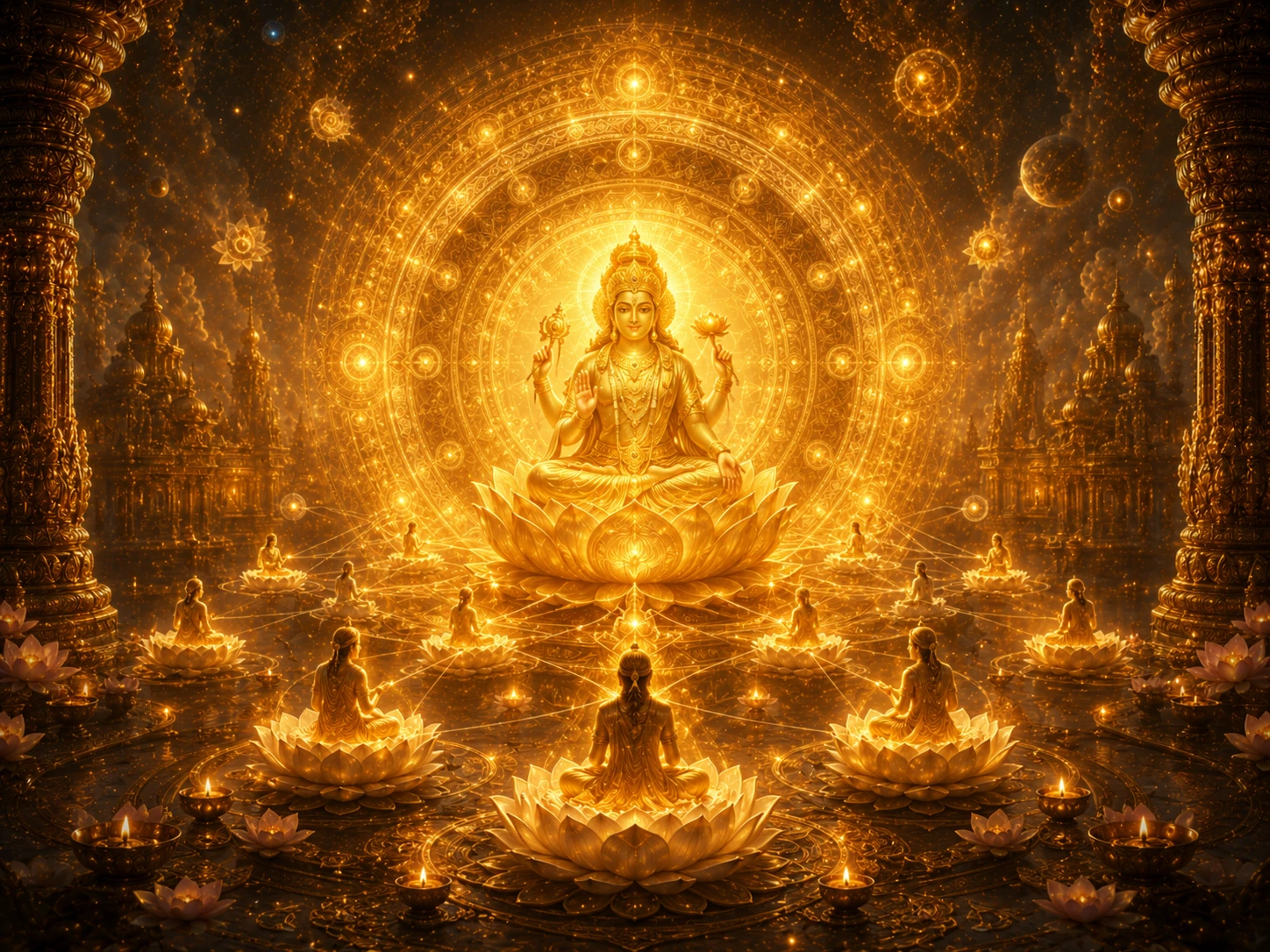
Stand inside the Ranganathaswamy Temple at Srirangam -- the largest functioning Hindu temple in the world, its seven concentric walls enclosing an entire town -- and you stand inside the living heart of Vishishtadvaita philosophy. The deity reclining here, Ranganatha (Vishnu in his cosmic sleep), is not a symbol of an abstract principle. He is, for the Sri Vaishnava tradition, a real person -- infinite, conscious, omnipotent, and actively in love with every soul in the universe. This is the God of Ramanuja. Not an impersonal Brahman dissolving all distinctions. Not a distant watchmaker. A God who knows your name, hears your prayer, and has taken a personal vow to protect anyone who surrenders to Him.
Vishistadvaita -- literally 'non-duality of the qualified' or 'qualified non-dualism' -- is the philosophical system formalised by Ramanujacharya (c. 1017-1137 CE), the greatest theologian in the Sri Vaishnava tradition and one of the most influential philosophers India has produced. His central claim is breathtaking in its ambition: he reads the same Upanishads, the same Brahma Sutras, and the same Bhagavad Gita as Shankaracharya -- and arrives at a completely different conclusion. Where Shankara saw illusion, Ramanuja sees reality. Where Shankara saw an attributeless Absolute, Ramanuja sees a God overflowing with infinite auspicious qualities. Where Shankara prescribed knowledge as the path to liberation, Ramanuja prescribed devotion.
Ramanuja was not inventing a new religion. He was reclaiming what he believed was the original meaning of the Vedantic texts -- a meaning obscured, in his view, by Shankara's brilliant but misleading Advaita commentary. The philosophical battleground was the Brahma Sutras, and Ramanuja's weapon was the Sri Bhashya -- a monumental commentary that attacks Shankara's reading point by point while constructing a complete alternative vision of reality.
The stakes are not abstract. If Shankara is right, your individual personality is ultimately unreal -- a temporary distortion in the featureless ocean of Brahman. If Ramanuja is right, your individual personality is eternally real -- a genuine part of God's cosmic body, destined for eternal, conscious, loving relationship with the Supreme. The difference between these two positions determines how you live, how you worship, how you love, and how you face death.
अशेषचिदचित्प्रकारं ब्रह्मैकमेव तत्त्वम्
aśeṣa-cid-acit-prakāraṃ brahmaikam eva tattvam
Brahman alone is the ultimate reality, qualified by (having as its modes) the entirety of sentient beings (chit) and insentient matter (achit).
— Vedanta Desika's formulation of Vishishtadvaita's core thesis, summarising Ramanuja's Sri Bhashya
The Sharira-Shariri Model -- God Has a Body, and You Are In It
Ramanuja's most revolutionary philosophical move is the Sharira-Shariri Bhava -- the body-soul relationship between God and the universe. The universe (comprising all sentient souls and all insentient matter) is the body (Sharira) of Brahman, and Brahman is its indwelling soul (Shariri).
This is not a metaphor. Ramanuja defines 'body' (Sharira) with philosophical precision through three criteria: Adheyatva -- the body is supported by the soul. Niyamyatva -- the body is controlled by the soul. Seshatva -- the body exists for the purpose of the soul. By these criteria, the entire universe -- every atom, every creature, every galaxy -- is the body of God. God supports it, controls it, and it exists for His purposes.
The implications are staggering. If you are part of God's body, you are not an illusion. You are real, because God's body is real. You are not identical with God (as Shankara claims), because a body part is not the same as the soul that animates it. Your hand is not you, but it is inseparably part of you. Similarly, each individual soul (Jiva) is a real, conscious, eternal entity that is inseparably connected to Brahman while remaining distinct from Brahman.
This is what 'qualified non-dualism' means. There is only one ultimate reality (Brahman) -- that is the non-dualism. But this reality is 'qualified' by real internal distinctions -- sentient souls and insentient matter that are its real attributes (Prakara). Unity exists, but it is a unity-with-distinctions, not a featureless unity that erases all difference.
For the medical student at AIIMS: think of the relationship between your body and your consciousness. Your body is real. Your consciousness is real. They are intimately connected but not identical. Now scale that up to the entire cosmos -- that is Ramanuja's Sharira-Shariri Bhava. For the product manager at a Bangalore tech startup: a company is one entity, but it contains distinct employees with distinct roles. The CEO is not 'the same as' the junior developer, but neither exists without the other. Brahman is the ultimate CEO of a cosmic enterprise called existence.
Ramanuja's Critique of Advaita -- Seven Unbreakable Objections
In his Vedarthasangraha and Sri Bhashya, Ramanuja launches what may be the most sustained philosophical attack in Indian history against Shankara's Advaita. His famous 'Saptavidha Anupapatti' (seven-fold impossibility) argues that the concept of Maya -- which is central to Advaita -- is logically incoherent.
The core question Ramanuja asks is: what is Maya? If Maya is real, then something other than Brahman is real, and Advaita's non-dualism collapses. If Maya is unreal, then how can something unreal produce the very real experience of the world? If Maya is neither real nor unreal (as Shankara claims -- it is 'anirvachaniya' or indescribable), then Ramanuja asks: can you build an entire philosophical system on a foundation you yourself admit you cannot describe?
Ramanuja further asks: whose ignorance is Maya? If it belongs to Brahman, then Brahman is ignorant -- which contradicts Brahman's omniscience. If it belongs to the individual soul (Jiva), then the Jiva must already exist for Maya to have a locus -- which means the Jiva is real before Maya is overcome, contradicting Advaita's claim that the Jiva is ultimately unreal.
These are not casual objections. They are precision strikes at the logical foundations of Advaita, and they have never been fully resolved. Advaita scholars have responded across centuries (notably Madhusudana Saraswati in the 16th century), but the debate remains alive. Any philosophy student at JNU or Oxford studying Indian philosophy must grapple with Ramanuja's seven objections.
Beyond logic, Ramanuja also raises a powerful emotional and devotional objection: if the world is illusion and individual souls are ultimately unreal, then love is also unreal. The devotee's tears before the deity, the mother's sacrifice for her child, the guru's compassion for the student -- all become cosmic mistakes, temporary errors in perception. Ramanuja refuses to accept this. For him, love is the highest form of knowledge, not its opposite.
Bhakti and Prapatti -- Two Paths to the Same God
Vishishtadvaita recognises two primary paths to liberation: Bhakti Yoga and Prapatti (Sharanagati).
Bhakti Yoga in Ramanuja's system is not casual devotion. It is a rigorous, sustained, loving meditation on God that requires prerequisite qualifications -- knowledge of scriptures, ethical purity, dispassion, and practice of karma yoga. This path is accessible to those with the spiritual capacity and the lifespan to develop it fully.
Prapatti (self-surrender) is the path for everyone else -- which, Ramanuja honestly acknowledges, is almost everyone. Prapatti requires no special qualifications. It requires only six conditions: the positive will to live according to God's will (Anukulyasya Sankalpah), the resolve to avoid what displeases God (Pratikulyasya Varjanam), faith that God will protect (Maha Vishvasah), choosing God as sole protector (Goptrtva Varanam), self-offering to God (Atma Nikshepah), and the feeling of utter helplessness without God's grace (Karpanyam).
The tension between these two paths eventually split the Sri Vaishnava community into two sub-traditions: the Vadakalai (Northern School, following Vedanta Desika, emphasizing both God's grace and the devotee's effort) and the Tenkalai (Southern School, following Pillai Lokacharya and Manavala Mamunigal, emphasizing God's grace as completely sufficient -- the 'cat-hold' theology where God picks you up like a mother cat carries her kitten).
The Alvar saints -- twelve Tamil poet-mystics who lived between the 6th and 9th centuries CE -- are the devotional fountainhead of the entire tradition. Their 4,000 verses (Nalayira Divya Prabandham) constitute the 'Tamil Veda' and hold equal scriptural authority with the Sanskrit Vedas in Sri Vaishnavism. This is Ubhaya Vedanta -- the dual Vedanta, honouring both Sanskrit and Tamil as vehicles of divine truth. When a priest at the Tirupati Balaji temple chants Tamil Prabandham alongside Sanskrit mantras, that is Ramanuja's legacy in action.
The 216-foot Statue of Equality in Hyderabad, inaugurated in 2022, commemorates Ramanuja's revolutionary social vision. He opened temple worship to all castes, organised community kitchens, and declared that devotion knows no birth-based hierarchy. The UPSC aspirant should note: Ramanuja's social reforms anticipate the Bhakti movement's egalitarian impulse by centuries and provide crucial context for questions on medieval Indian social history.
Advaita vs. Vishishtadvaita -- Point-by-Point Comparison
| Issue | Advaita (Shankara) | Vishishtadvaita (Ramanuja) |
|---|---|---|
| Nature of Brahman | Nirguna (without qualities) | Saguna (with infinite auspicious qualities) |
| Identity of Brahman | Impersonal Absolute | Personal God (Narayana/Vishnu) |
| Status of the world | Mithya (neither real nor unreal) | Real -- Brahman's body |
| Status of the individual soul | Identical with Brahman; difference is illusion | Real part of Brahman; eternally distinct but inseparable |
| Concept of Maya | Cosmic illusion hiding true reality | Rejected as logically incoherent |
| Path to liberation | Jnana (knowledge) removes ignorance | Bhakti (devotion) and Prapatti (surrender) |
| Nature of liberation | Identity with featureless Brahman | Eternal loving union with God in Vaikuntha |
| Key text | Vivekachudamani | Sri Bhashya, Vedarthasangraha |
Both schools accept the Prasthana Traya (Upanishads, Gita, Brahma Sutras) as authoritative. Their disagreement is entirely about interpretation.
The 216-foot Statue of Equality in Hyderabad, inaugurated in 2022, is the second tallest sitting statue in the world and is dedicated to Ramanujacharya. It was built to honour his 1,000th birth anniversary and his revolutionary teaching that all souls are equal before God regardless of caste, gender, or birth. The statue sits atop a 54-foot lotus-shaped base representing the 108 Divya Desams (sacred Vishnu temples) celebrated by the Alvar saints.
Sri Vaishnavism's Ubhaya Vedanta tradition -- accepting both Sanskrit Vedas and the Tamil Divya Prabandham as scripture -- makes it one of the only major Hindu philosophical traditions to canonise a vernacular language alongside Sanskrit. This was 800 years before the European Reformation made similar moves with vernacular translations of the Bible. The Alvars proved that divine truth can speak in your mother tongue.
Practice Prapatti -- Surrender to the Divine
Begin with the simplest and most powerful act in Vishishtadvaita: say to God, 'I am Yours.' This is the seed of prapatti. Then sit quietly with those words for ten minutes. The 'Sitting in His Presence' dharana on Eternal Raga is a practice of this kind.
Tags
Eternal Raga · शाश्वत राग
Institutional voice — scholarly articles on Sanatan Dharma
Deepen Your Understanding
अपनी समझ और गहरी करें
philosophy darshana
Advaita Vedanta Explained -- Shankara's Radical Philosophy of Non-Duality
You are not your job title. You are not your Instagram bio. According to Adi Shankaracharya, you are not even your body or mind -- you are Brahman itself, the infinite consciousness wearing a temporary costume. Advaita Vedanta is the most radical philosophical claim in Indian history: that the entire universe is one undivided reality, and separation is the grandest illusion.
philosophy darshana
Brahma Sutra -- The Architecture of Vedantic Thought
555 aphorisms. 4 chapters. The most technically demanding text in Hindu philosophy. The Brahma Sutra is the text every school of Vedanta must interpret to prove its legitimacy -- and every school reads it completely differently. Welcome to the ultimate intellectual battlefield of Indian civilisation.
philosophy darshana
Atman and Brahman -- The Self and the Absolute
The Upanishads make a claim so radical that 3,000 years have not dulled its edge: the individual self (Atman) and the ultimate reality of the universe (Brahman) are not two different things. They are one. Every school of Hindu philosophy is essentially an argument about what this identity means.
philosophy darshana
The Six Darshanas -- India's Original Intellectual Operating Systems
Long before Greek philosophy had its first argument, India had six complete philosophical systems -- each with its own logic, metaphysics, epistemology, and liberation path. Nyaya built formal logic. Vaisheshika invented atomic theory. Samkhya mapped consciousness. Yoga engineered the mind. Mimamsa decoded ritual. Vedanta asked the final question. Together, they are the most comprehensive intellectual framework any civilisation has produced.
philosophy darshana
The Four Mahavakyas -- Upanishadic Sentences That Changed Civilisation
Four sentences. Twelve words of Sanskrit. Three thousand years of commentary. The Mahavakyas are the most compressed, most powerful, and most debated statements in all of Indian philosophy. Each one claims that the individual self and the ultimate reality of the universe are not two different things. And each one has been interpreted to mean something completely different by every major school of Vedanta.
deities avatars
Dashavatara -- Why Vishnu Comes Back Ten Times
Fish, tortoise, boar, half-lion, dwarf, axe-warrior, prince, cowherd, enlightened teacher, future horseman. The ten avatars of Vishnu are not random folklore. Read them in sequence and you get something startling -- a narrative that mirrors evolutionary biology, tracks the rise and fall of political systems, and argues that God does not sit above history but enters it, gets dirty, and does the work. The Dashavatara is Hinduism's answer to the question every civilisation asks: why does the world keep breaking, and who fixes it?
philosophy darshana
Dharma, Artha, Kama, Moksha -- The Four Goals That Make a Complete Life
Hinduism does not ask you to choose between God and money. Between spirituality and pleasure. Between duty and desire. Its four Purusharthas -- Dharma, Artha, Kama, Moksha -- are the most holistic life-framework any civilisation has designed. The catch? Each must be pursued in the right order, at the right time, under the right constraints.
The 216-foot Statue of Equality in Hyderabad, inaugurated in 2022, is the second tallest sitting statue in the world and is dedicated to Ramanujacharya. It was built to honour his 1,000th birth anniversary and his revolu…
More in Philosophy & Darshana
The 14 Lokas -- Hindu Cosmology as a Map of Consciousness
14 min read
Achintya Bhedabheda -- Chaitanya's Theology of Inconceivable Difference-and-Unity
13 min read
Adhyasa -- Superimposition and the Foundational Error of the Self
13 min readThe same translation error that turned '33 Koti' into '33 crore' in Hinduism also happened in Buddhism. The Chinese translation of Buddhist texts rendered 'Sapta Koti Buddha' (7 Supreme Buddhas) as '7 Crore Buddhas.' The…
Deities AvatarsCommunity Reflections
🕉️
Be the first to share your reflection.