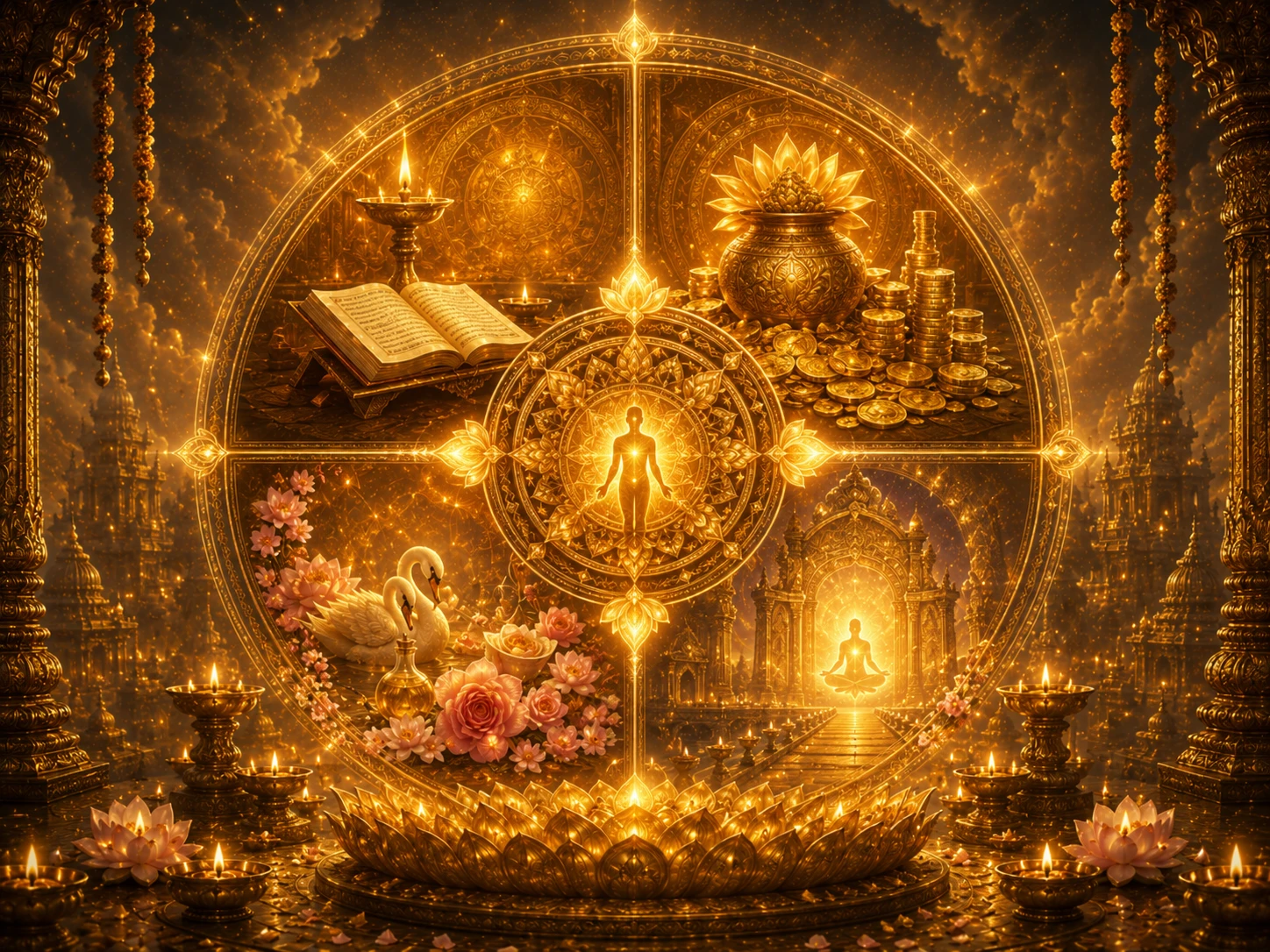
Dharma, Artha, Kama, Moksha -- The Four Goals That Make a Complete Life
धर्म, अर्थ, काम, मोक्ष -- वे चार लक्ष्य जो पूर्ण जीवन बनाते हैं
There is a question that every civilisation must answer: what is a good life? The Greeks said virtue and contemplation. The Romans said duty and civic honour. Modern capitalism says maximise wealth and individual freedom. Modern wellness culture says maximise happiness and self-care.
India's answer is the most comprehensive of all: a good life requires four things, pursued simultaneously but in the right relationship to each other. These four are the Purusharthas -- literally 'goals of a person' -- and they are Dharma (righteous duty), Artha (material prosperity), Kama (pleasure and desire), and Moksha (spiritual liberation).
Notice what this framework does that others do not. It does not force you to choose between worldly success and spiritual depth. It does not shame desire. It does not declare wealth evil. It does not tell you to abandon family and run to a cave. Instead, it says: pursue all four, but let Dharma govern the first three, and let Moksha be the ultimate horizon of all of them.
This is not a loose suggestion. The Purusharthas are a precise architecture of human life, woven into the ashrama system (four stages of life), the varna system (four social functions), and the elaborate code of personal and social ethics found in the Dharma Sutras, Dharma Shastras, the Mahabharata, and the Puranas.
In modern India, we live inside this framework whether we recognise it or not. The parent who tells their child 'first study, then marry, then you can think about retirement' is articulating a Purushartha sequence. The startup founder in Koramangala who wonders whether chasing the next funding round is 'enough' is feeling the pull of Moksha against Artha. The NRI in New Jersey who sends money home to parents while wondering why American success feels hollow is experiencing the tension between Artha and Dharma that the tradition anticipated millennia ago.
धर्मार्थकाममोक्षाणां यस्यैकोऽपि न विद्यते। अजागलस्तनस्येव तस्य जन्म निरर्थकम्॥
dharmaarthakaamemokshaanam yasyaiko'pi na vidyate | ajaagalastanasyeva tasya janma nirarthakam ||
One who has not attained even one of the four -- Dharma, Artha, Kama, Moksha -- has a birth as useless as the nipple on a goat's neck.
— Chanakya Niti, Chapter 11 (attributed)
Dharma is the foundation -- the non-negotiable constraint within which all other Purusharthas must operate. But Dharma is also the most complex concept in Indian thought, precisely because it has no single English equivalent. It is simultaneously cosmic order (rita), ethical duty, social obligation, personal righteousness, natural law, and the path appropriate to your specific situation.
The Mahabharata says 'dharmasya tattvam nihitam guhayam' -- the essence of Dharma is hidden in a cave. This is not poetic evasion. It is an honest admission that Dharma cannot be reduced to a rulebook. What is dharmic changes based on context: the dharma of a student is different from a householder's, a king's from a merchant's, peacetime from wartime.
This contextual flexibility is Dharma's strength and its difficulty. The Bhishma Parva of the Mahabharata devotes hundreds of verses to Dharma and still concludes that in hard cases, you must use your own viveka (discernment) because no rule covers every situation. This is remarkably modern -- it anticipates the ethical philosophy of situation ethics and virtue ethics by two millennia.
For a young professional in Pune or Bengaluru, Dharma might mean: do your work honestly, support your family, pay your taxes, keep your commitments, tell the truth even when it is costly, and treat people with the respect their humanity deserves regardless of their position. This is not flashy. It is not Instagram-worthy. It is the unglamorous bedrock on which the other three Purusharthas stand.
Artha -- material wealth and security -- is the second Purushartha, and its inclusion is what makes the Hindu framework distinctive. Many religions treat wealth with suspicion. Hinduism embraces it -- with conditions. The Arthashastra of Kautilya (roughly 4th century BCE) is a treatise on statecraft, economics, and strategic thinking that is as unsentimental and pragmatic as anything Machiavelli wrote -- and predates The Prince by nearly two thousand years.
Artha is not greed. It is the legitimate pursuit of material well-being for yourself, your family, and your community. The tradition recognises that a hungry person cannot contemplate Brahman. Poverty is not a spiritual advantage; it is an obstacle. The Vidura Niti in the Mahabharata says that a man without Artha cannot perform Dharma -- because religious rites, charitable giving, family obligations, and social duties all require resources.
But Artha unchecked by Dharma becomes Ravana -- immense power without ethical restraint, leading inevitably to destruction. The Mahabharata's Kauravas had Artha (they controlled the kingdom of Hastinapura) but violated Dharma (through deceit, humiliation of Draupadi, unjust exile of the Pandavas). Their Artha, unmoored from Dharma, destroyed them.
Kama -- pleasure, desire, aesthetic enjoyment, love, sensory experience -- is the third Purushartha. Its inclusion is perhaps the most striking feature of the Hindu framework. This is a civilisation that produced the Kama Sutra (a treatise on pleasure, not merely a sex manual), the Natya Shastra (the world's most comprehensive treatise on performing arts), the traditions of Raga music, temple sculpture celebrating the human body, and an entire literature of shringar rasa (erotic-romantic sentiment) in both Sanskrit and vernacular traditions.
Kama is not sin. Desire is not the enemy. The enemy is desire divorced from Dharma. Kama within Dharmic bounds is celebrated -- the love between Rama and Sita, the playful romance of Krishna and Radha, the sensual poetry of Kalidasa's Meghadutam. Kama outside Dharmic bounds is catastrophe -- Ravana's lust for Sita, Duryodhana's desire for power at any cost, Indra's repeated inability to control his desires.
Moksha -- spiritual liberation -- is the fourth and ultimate Purushartha. It is the recognition that Dharma, Artha, and Kama, however well-pursued, are ultimately bounded by mortality. You can be the most dutiful person, the wealthiest, the most pleasure-filled -- and still die. Moksha is the goal that transcends death: the liberation of consciousness from the cycle of birth and death (samsara).
Different schools define Moksha differently. For Advaita, it is realisation of identity with Brahman. For Vishishtadvaita, it is eternal loving communion with God. For Samkhya, it is the discrimination of Purusha from Prakriti. For Yoga, it is kaivalya -- absolute aloneness of consciousness. But all agree that Moksha is the highest Purushartha, the one that gives meaning to the other three.
The Four Purusharthas -- Architecture of a Complete Life
| Purushartha / पुरुषार्थ | Domain / क्षेत्र | Key Text / मुख्य ग्रन्थ | Modern Expression / आधुनिक अभिव्यक्ति | Without Dharma / धर्म के बिना |
|---|---|---|---|---|
| Dharma / धर्म | Duty, ethics, cosmic order / कर्तव्य, नीति, ब्रह्माण्डीय व्यवस्था | Dharma Sutras, Mahabharata / धर्मसूत्र, महाभारत | Honest work, tax compliance, integrity / ईमानदार कार्य, कर अनुपालन | Foundation itself -- cannot lack Dharma / आधार स्वयं -- अनुपस्थित नहीं हो सकता |
| Artha / अर्थ | Wealth, security, power / सम्पत्ति, सुरक्षा, शक्ति | Arthashastra (Kautilya) / अर्थशास्त्र (कौटिल्य) | Career, savings, investments / career, बचत, निवेश | Becomes Ravana -- power without ethics / रावण बनता है -- नीतिहीन शक्ति |
| Kama / काम | Pleasure, love, aesthetics / सुख, प्रेम, सौन्दर्यबोध | Kama Sutra (Vatsyayana) / कामसूत्र (वात्स्यायन) | Relationships, art, travel, food / सम्बन्ध, कला, यात्रा, भोजन | Becomes addiction -- pleasure without limits / व्यसन बनता है -- असीमित सुख |
| Moksha / मोक्ष | Liberation, self-realisation / मुक्ति, आत्मज्ञान | Upanishads, Brahma Sutra / उपनिषद्, ब्रह्मसूत्र | Meditation, self-inquiry, surrender / ध्यान, आत्मविचार, शरणागति | Becomes escapism -- spirituality avoiding life / पलायनवाद बनता है -- जीवन से बचती आध्यात्मिकता |
Dharma is the governing constraint on all Purusharthas. Artha and Kama without Dharma are destructive. Even Moksha pursued as escape from duty -- rather than as the culmination of a life fully lived -- is a distortion.
The Indian Constitution implicitly reflects the Purushartha framework. The Fundamental Rights (Articles 14-32) protect Kama (individual liberty and pleasure) and Artha (right to property, trade). The Directive Principles of State Policy (Articles 36-51) articulate Dharma -- the state's duty to ensure social justice, equitable distribution, and protection of the weak. The Preamble's aspiration for 'Justice, Liberty, Equality, Fraternity' maps directly onto Dharmic principles. B.R. Ambedkar, the Constitution's chief architect, was deeply read in both Buddhist and Brahmanical philosophical traditions. IAS officers preparing for the Ethics paper in UPSC Mains (General Studies IV) are required to study concepts of Dharma, Nishkama Karma, and the Purusharthas -- making ancient philosophy directly relevant to contemporary governance. IIM Bangalore and IIM Ahmedabad both offer electives on Indian philosophical frameworks for management -- courses where startup founders learn that Kautilya's Arthashastra anticipated game theory, stakeholder management, and strategic intelligence by two millennia.
The Purushartha framework is not static. It is meant to evolve across the four Ashramas -- stages of life.
In Brahmacharya (student stage, roughly ages 8-25), the emphasis is on Dharma and the acquisition of knowledge. Artha and Kama are deferred. This is the stage of discipline, celibacy, and focused learning -- not as punishment but as investment. The student is building the foundation on which the rest of life will stand. In modern terms, this maps onto school, college, competitive exam preparation, and early career skill-building.
In Grihastha (householder stage, roughly ages 25-50), all four Purusharthas are active simultaneously. This is the fullest, most complex stage of life. The householder earns wealth (Artha), enjoys family life and pleasures (Kama), fulfils social and familial duties (Dharma), and begins to deepen spiritual practice (Moksha). The tradition considers Grihastha the most important ashrama because the householder supports all the others -- students, retirees, and renunciants all depend on the householder's productivity and generosity.
In Vanaprastha (retirement/forest-dweller stage, roughly ages 50-75), Artha and Kama are gradually released. The focus shifts to Dharma and Moksha. In ancient practice, this literally meant moving to the forest with your spouse. In modern terms, it means transitioning from accumulation to contribution -- mentoring, teaching, social service, and deeper spiritual practice. The Vanaprastha phase is what empty-nest parents and retirees intuitively seek when they say 'I want to give back.'
In Sannyasa (renunciation, from 75 onward or whenever the seeker is ready), only Moksha remains. All social roles, possessions, and personal identities are released. The sannyasi belongs to no family, no caste, no nation. This is the ultimate expression of the tradition's conviction that consciousness is more fundamental than any social or material identity.
The beauty of this system is its refusal to idealise any single stage. The celibate student is not superior to the householder. The renunciant is not superior to the retiree. Each stage has its own dharma, its own dignity, and its own contribution to the whole. The framework says: live fully at every stage, but know which stage you are in and what it demands.
This is India's most practical gift to the modern world -- a life architecture that validates career ambition, romantic love, family duty, and spiritual seeking as equal parts of a single integrated life. You do not have to choose. You have to sequence.
Reflect: Which Purushartha Leads Your Life Now?
Take a page and four headings -- dharma, artha, kama, moksha. Under each, note where your time and attention actually went this week. The pattern shows which aim leads your present stage of life, and whether it is the one you would choose. Sit with it quietly; the Meditate section has practices to help.
Eternal Raga · शाश्वत राग
Institutional voice — scholarly articles on Sanatan Dharma
Deepen Your Understanding
अपनी समझ और गहरी करें
philosophy darshana
Karma Explained -- Not Punishment, Not Reward, but the Physics of Action
Karma is not cosmic revenge. It is not 'what goes around comes around.' It is India's most sophisticated theory of causation -- a framework that explains why your choices matter, why consequences are inescapable, and why freedom is still possible. The Gita's karma teaching changed Oppenheimer's life. It might change yours.
philosophy darshana
Advaita Vedanta Explained -- Shankara's Radical Philosophy of Non-Duality
You are not your job title. You are not your Instagram bio. According to Adi Shankaracharya, you are not even your body or mind -- you are Brahman itself, the infinite consciousness wearing a temporary costume. Advaita Vedanta is the most radical philosophical claim in Indian history: that the entire universe is one undivided reality, and separation is the grandest illusion.
philosophy darshana
Yoga Darshana -- Patanjali's Science of the Mind
Before yoga became a global fitness trend worth $80 billion, it was India's most rigorous system of psychology. Patanjali's 196 sutras are not about touching your toes -- they are about rewiring your mind. Here is the philosophy the world forgot when it turned yoga into exercise.
philosophy darshana
The Six Darshanas -- India's Original Intellectual Operating Systems
Long before Greek philosophy had its first argument, India had six complete philosophical systems -- each with its own logic, metaphysics, epistemology, and liberation path. Nyaya built formal logic. Vaisheshika invented atomic theory. Samkhya mapped consciousness. Yoga engineered the mind. Mimamsa decoded ritual. Vedanta asked the final question. Together, they are the most comprehensive intellectual framework any civilisation has produced.
philosophy darshana
Atman and Brahman -- The Self and the Absolute
The Upanishads make a claim so radical that 3,000 years have not dulled its edge: the individual self (Atman) and the ultimate reality of the universe (Brahman) are not two different things. They are one. Every school of Hindu philosophy is essentially an argument about what this identity means.
philosophy darshana
Brahma Sutra -- The Architecture of Vedantic Thought
555 aphorisms. 4 chapters. The most technically demanding text in Hindu philosophy. The Brahma Sutra is the text every school of Vedanta must interpret to prove its legitimacy -- and every school reads it completely differently. Welcome to the ultimate intellectual battlefield of Indian civilisation.
philosophy darshana
The Four Mahavakyas -- Upanishadic Sentences That Changed Civilisation
Four sentences. Twelve words of Sanskrit. Three thousand years of commentary. The Mahavakyas are the most compressed, most powerful, and most debated statements in all of Indian philosophy. Each one claims that the individual self and the ultimate reality of the universe are not two different things. And each one has been interpreted to mean something completely different by every major school of Vedanta.
The Indian Constitution implicitly reflects the Purushartha framework. The Fundamental Rights (Articles 14-32) protect Kama (individual liberty and pleasure) and Artha (right to property, trade). The Directive Principles…
More in Philosophy & Darshana
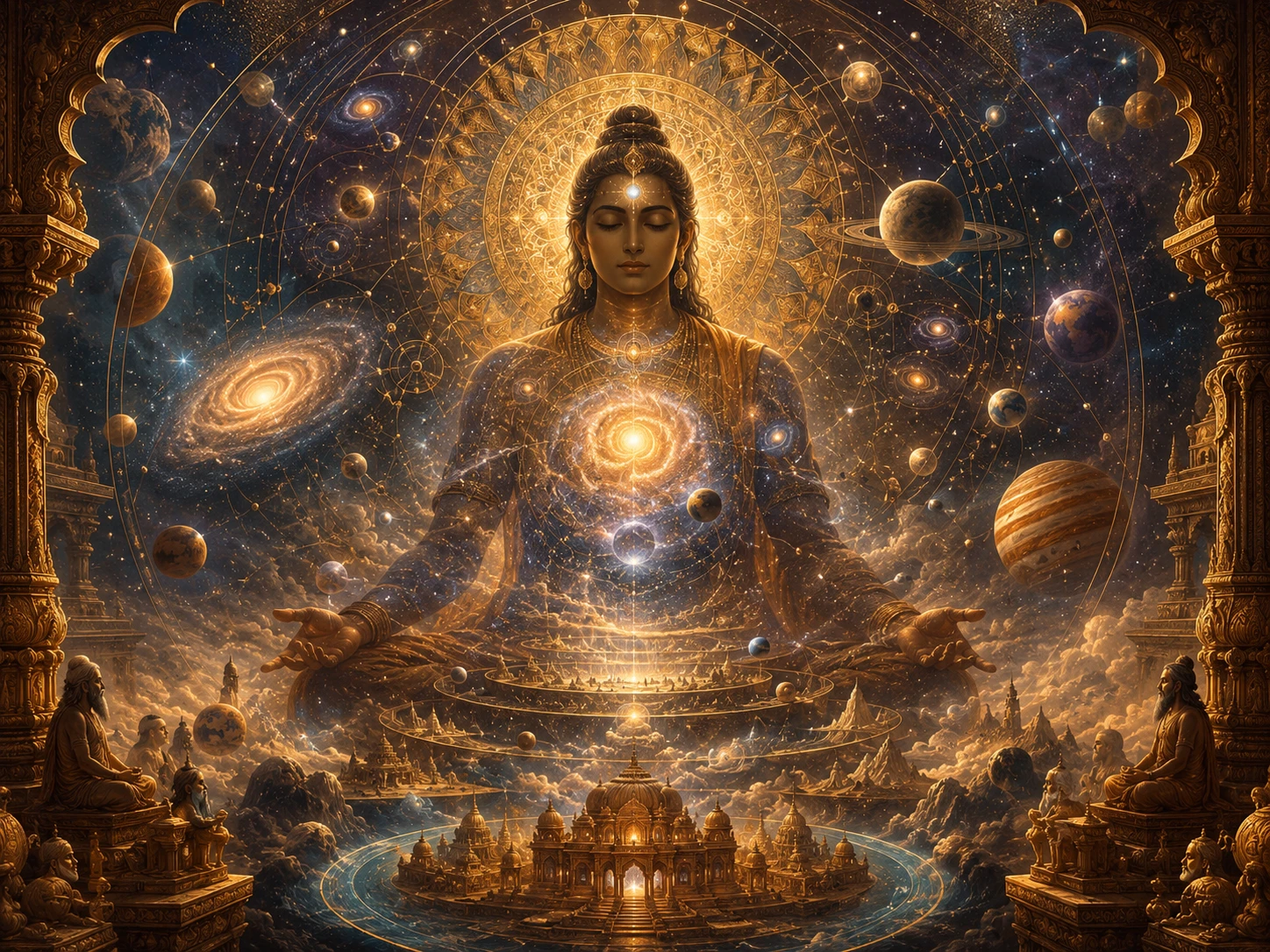
The 14 Lokas -- Hindu Cosmology as a Map of Consciousness
14 min read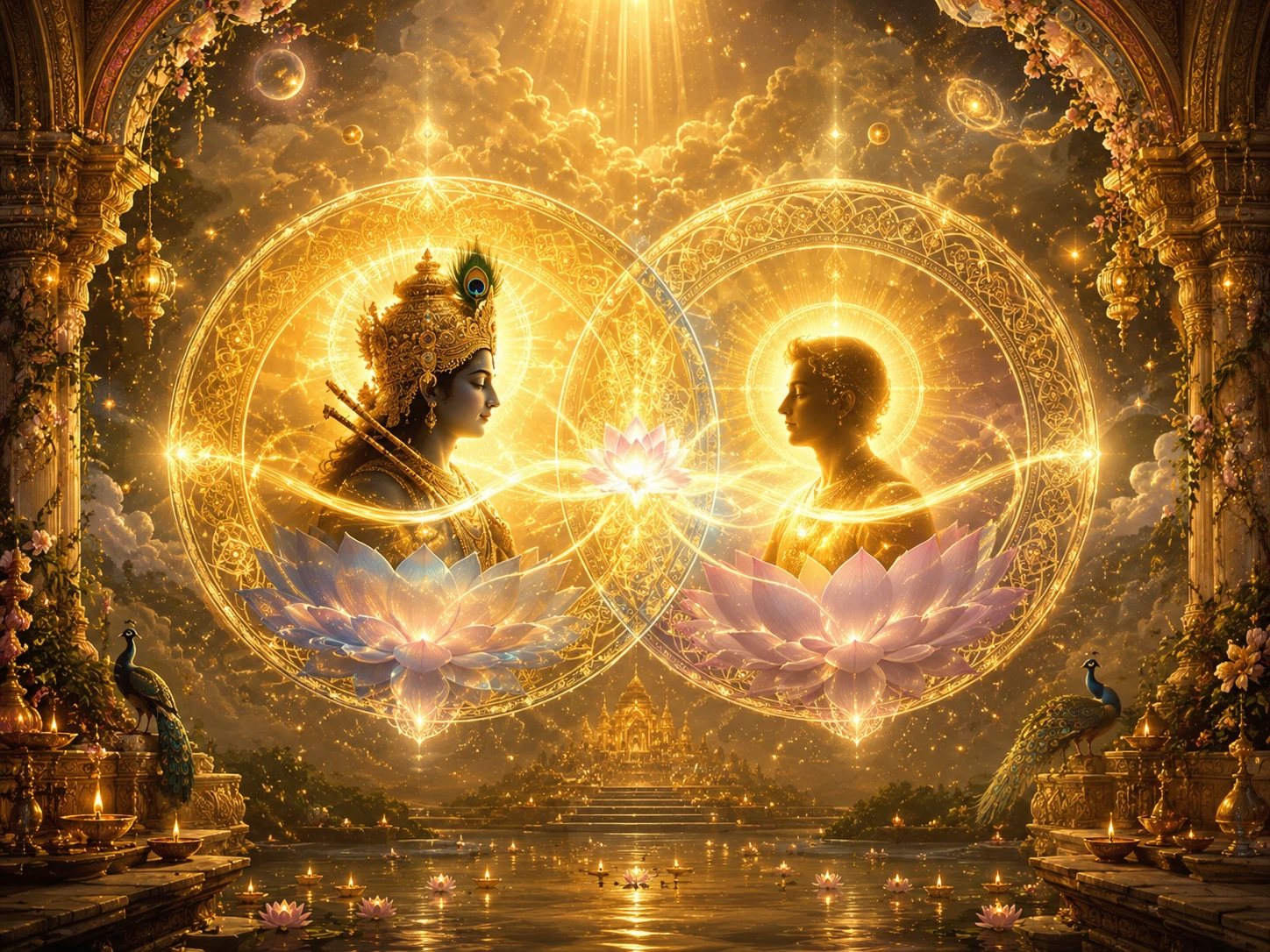
Achintya Bhedabheda -- Chaitanya's Theology of Inconceivable Difference-and-Unity
13 min read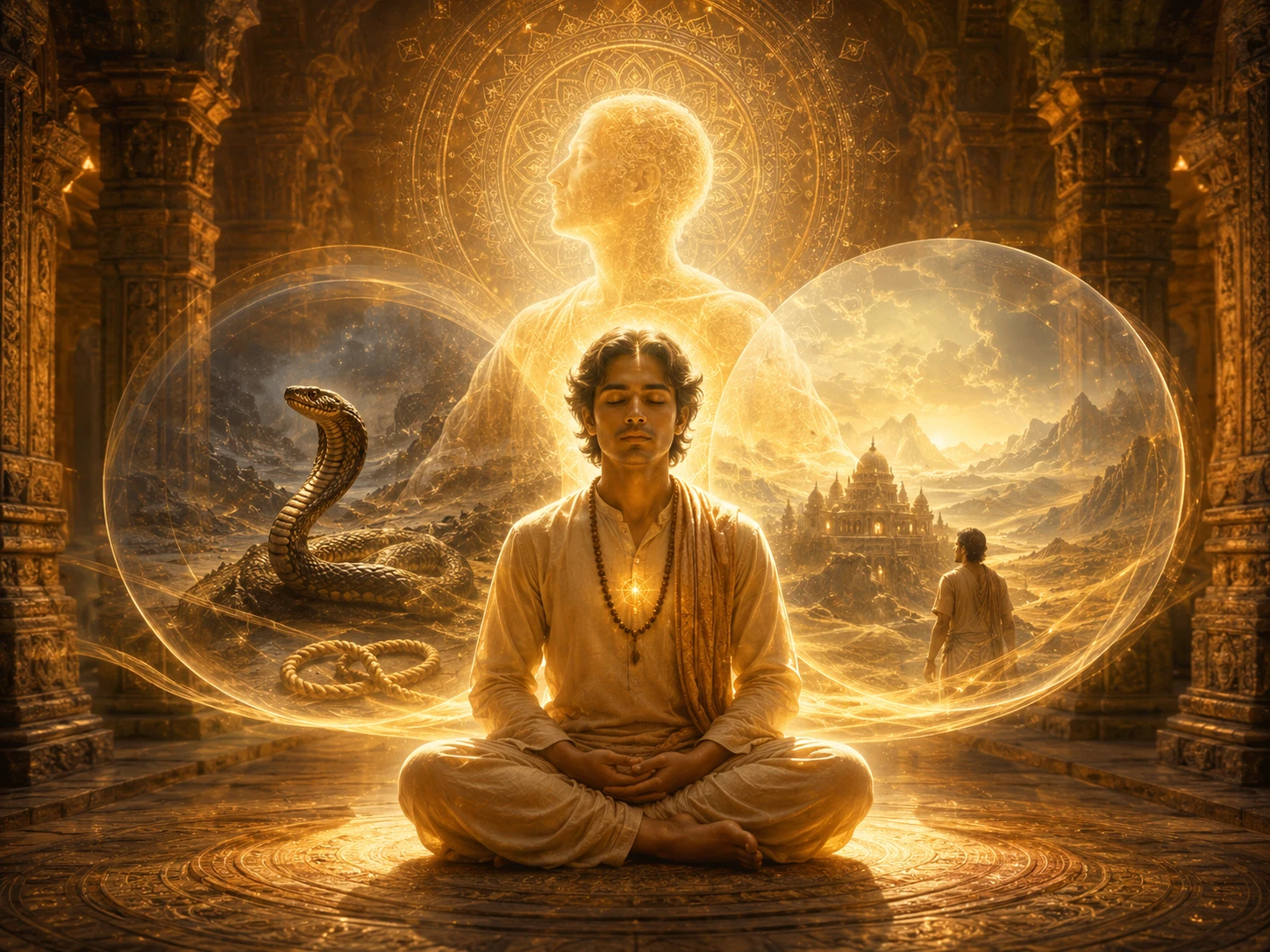
Adhyasa -- Superimposition and the Foundational Error of the Self
13 min readThe same translation error that turned '33 Koti' into '33 crore' in Hinduism also happened in Buddhism. The Chinese translation of Buddhist texts rendered 'Sapta Koti Buddha' (7 Supreme Buddhas) as '7 Crore Buddhas.' The…
Deities AvatarsCommunity Reflections
🕉️
Be the first to share your reflection.