Advaita Vedanta Explained -- Shankara's Radical Philosophy of Non-Duality
अद्वैत वेदान्त -- शंकराचार्य का क्रान्तिकारी अद्वैत दर्शन
In a coaching centre in Kota, a seventeen-year-old solving thermodynamics problems is operating under a hidden philosophical assumption: that she is a separate self, distinct from the chair she sits on, the air she breathes, the equations she writes, and the consciousness of the teacher across the room. Every action she takes -- every meal, every phone call home, every anxious 2 AM revision session -- rests on this foundational belief that 'I' am here, the 'world' is out there, and the gap between us is real.
Adi Shankaracharya looked at this assumption and said: wrong. All of it. The gap is not real. The separation between self and world, between you and the divine, between subject and object -- it is Maya, cosmic illusion. What actually exists is one undivided, infinite, unchanging consciousness called Brahman. And you -- the real you beneath the name, the body, the thoughts, the exam anxiety -- are that Brahman.
This is Advaita Vedanta. 'A-dvaita' means 'not-two.' Not monism in the Western sense of 'everything is the same stuff.' Rather, it is the claim that the very categories of 'stuff' and 'things' are themselves illusions projected onto a reality that has no parts, no divisions, no inside or outside.
Shankara did not invent this idea from nothing. He systematised something the Upanishads had been saying for centuries -- that Atman (individual self) is Brahman (universal self). But he did it with a rigour, consistency, and argumentative ferocity that nobody before him had managed. He wrote commentaries on the Brahma Sutras, the principal Upanishads, and the Bhagavad Gita -- collectively called the Prasthanatrayi or 'triple canon' -- and in each, he hammered home one point: reality is non-dual.
He did this before turning 32. Tradition says he died at 32. In modern terms, imagine someone finishing a PhD at IIT, then walking barefoot across India debating every professor at every university, defeating them all, and establishing four institutional headquarters (mathas) at the four corners of the country -- all before the age most people get their first promotion.
ब्रह्म सत्यं जगन्मिथ्या जीवो ब्रह्मैव नापरः।
brahma satyam jaganmithyaa jiivo brahmaiva naaparah |
Brahman is the only truth, the world is an illusion (mithya), and the individual self (jiva) is nothing other than Brahman.
— Vivekachudamani, Verse 20 (attributed to Adi Shankaracharya)
That single verse is the entire Advaita Vedanta system compressed into one sentence. Three claims: Brahman is real. The world as you perceive it is not ultimately real. You, at your deepest level, are Brahman. Everything else Shankara ever wrote is an elaboration, defence, or application of these three propositions.
But what does 'mithya' mean? This is where most people misunderstand Advaita, and where the philosophy becomes genuinely subtle. Mithya does not mean 'non-existent' in the way that a square circle is non-existent. The world is not nothing -- you stub your toe and it hurts. Mithya means that the world does not have independent, self-sustaining existence. It depends on something else for its reality -- the way a dream depends on the dreamer, or the way a movie depends on the screen.
Shankara's classic analogy is the rope and the snake. In dim light, you see a rope on the ground and mistake it for a snake. The snake is not 'there' -- there was never a snake. But the fear was real, the physical response was real, and the experience of seeing a snake was real in the moment. The error was not in the seeing but in the interpretation. When light comes, the snake is 'sublated' -- revealed to have been rope all along. The snake was mithya: neither fully real nor fully unreal.
The world, says Shankara, is exactly like that snake. It is a superimposition (adhyasa) upon Brahman. We see multiplicity -- trees, people, planets, exam results, bank balances -- where there is actually only undifferentiated consciousness. The error is beginningless (anadi) but not endless -- it can be destroyed by knowledge (jnana).
This is the crux of Advaita's liberation model. You do not need to do anything to become Brahman. You already are Brahman. The problem is not absence of divinity but ignorance (avidya) of your true nature. Moksha is not achievement; it is recognition. The coaching analogy works here too: a JEE aspirant does not need to 'create' the ability to solve problems. The ability is already there. What is needed is the removal of confusion, distraction, and wrong methods that obscure it.
अज्ञानेनावृतं ज्ञानं तेन मुह्यन्ति जन्तवः।
ajnaanenaavrtam jnaanam tena muhyanti jantavah |
Knowledge is veiled by ignorance; thereby beings are deluded.
— Bhagavad Gita, Chapter 5, Verse 15
Shankara's intellectual architecture rests on a three-level theory of reality that is one of the most elegant frameworks in world philosophy.
At the top is Paramarthika Satya -- absolute reality. This is Brahman: infinite, undivided, without qualities (nirguna), without form, without beginning or end. It cannot be described positively because any description would limit it. Shankara therefore uses the method of 'neti neti' -- 'not this, not this' -- borrowed from the Brihadaranyaka Upanishad. Brahman is not matter, not energy, not consciousness-as-we-experience-it, not God-with-a-form, not nothing. It is beyond all categories.
At the bottom is Pratibhasika Satya -- apparent reality. This is the level of dreams, hallucinations, and errors like the rope-snake. Things at this level are real only to the person experiencing them and dissolve on examination. Your dream of flying last night was Pratibhasika -- real in the dream, gone on waking.
In the middle is Vyavaharika Satya -- empirical or transactional reality. This is the world as we live in it: Pune's traffic, Mumbai's stock exchange, the weight of a textbook, the taste of chai. This level is neither ultimately real (like Brahman) nor purely illusory (like a dream). It operates by its own consistent rules -- physics, chemistry, economics -- and is perfectly functional for everyday life. You should still pay your rent. You should still prepare for exams. But it is not the final word on what exists.
This three-tier model solves a problem that has plagued non-dual philosophies everywhere: if everything is one, why does the world look like many? Shankara's answer is that Maya -- the power of illusion -- projects multiplicity onto Brahman the way a prism projects a spectrum onto white light. The white light does not become seven colours. The seven colours do not destroy the white light. They are a real phenomenon at the empirical level but not the ultimate truth about light.
Notice that Shankara does not ask you to deny the world. He asks you to understand its status. A software engineer in Bengaluru's Koramangala does not stop writing code because she has understood Advaita. She writes code with the understanding that neither the code, the startup, the funding round, nor the imposter syndrome define who she fundamentally is. The liberation is not from the world but from misidentifying yourself with the world.
Shankaracharya's life itself reads like a screenplay that Bollywood has somehow not yet made. Born around 788 CE (some traditions say earlier) in Kaladi, Kerala, he was a prodigy who reportedly mastered the Vedas by age eight. He sought sannyasa -- monastic renunciation -- as a child, and legend says that when his mother refused, a crocodile seized his leg while he bathed in the Periyar river. He called out that if she granted him permission for sannyasa, his life would be spared. She agreed. The crocodile released him. Whether literally true or not, the story captures something real about the tradition's understanding of Shankara: here was someone for whom the ordinary life trajectory was never an option.
He became the disciple of Govindapada, who was a student of Gaudapada -- the author of the Mandukya Karika, the earliest systematic Advaita text. In Gaudapada's work, particularly the concept of 'ajativada' (the doctrine that nothing is ever truly born), we see the seeds of everything Shankara would later develop.
Shankara then embarked on a digvijaya -- a 'conquest of all directions' -- a philosophical debate tour across the Indian subcontinent. His most famous debate was with Mandana Mishra, a celebrated Purva Mimamsa scholar, in Mahishmati (likely modern Maheshwar in Madhya Pradesh). The judge was Mandana Mishra's own wife, Ubhaya Bharati -- herself a scholar. Shankara won the philosophical argument, but Ubhaya Bharati challenged him on the topic of kama (erotic love), which as a celibate monk he had no experience of. According to tradition, Shankara used yogic powers to temporarily enter the body of a recently deceased king to gain this knowledge, then returned to complete the debate. Mandana Mishra became his disciple, taking the name Sureshvaracharya.
Shankara established four mathas at the cardinal points of India: Jyotirmath (Uttarakhand, north), Sringeri (Karnataka, south), Dwaraka (Gujarat, west), and Puri (Odisha, east). These function to this day as institutional centres of Advaita Vedanta. The current Shankaracharyas of these four seats remain among the most respected religious authorities in Hinduism -- a living institutional legacy spanning over twelve centuries.
He composed dozens of works, including the Vivekachudamani (Crest-Jewel of Discrimination), Atma Bodha (Self-Knowledge), Upadeshasahasri (A Thousand Teachings), and devotional hymns to Shiva, Vishnu, and Devi. The hymns are particularly interesting because they appear to contradict his philosophical non-dualism -- why worship a personal God if only nirguna Brahman is real? Shankara's answer was that devotion to a personal God (saguna Brahman) is valid at the empirical level and can prepare the mind for the higher knowledge of non-duality. He did not despise bhakti; he placed it on the path to jnana.
The practical toolkit of Advaita Vedanta centres on what Shankara called Sadhana Chatushtaya -- the fourfold qualification for a seeker of Brahman.
First is Viveka -- discrimination between the eternal and the non-eternal. This is the ability to see that your job, your relationship, your body, your bank account, your social media following -- all these are impermanent and therefore cannot be your ultimate identity. This does not mean they are worthless. It means they cannot bear the weight of 'who I really am.'
Second is Vairagya -- dispassion toward the fruits of action, both in this world and the next. This is not cold indifference. It is the mature recognition that chasing results -- the next salary hike, the next vacation, even heavenly pleasures -- cannot give lasting satisfaction. The UPSC aspirant who studies from genuine love of governance has Vairagya. The one who studies solely for IAS status does not.
Third is Shamadi Shatka Sampatti -- the six virtues. Shama (mental tranquillity), Dama (sensory restraint), Uparati (withdrawal from worldly distractions), Titiksha (endurance of suffering without complaint), Shraddha (faith in the teacher and scriptures), and Samadhana (single-pointed concentration). These are not exotic monastic virtues. Anyone who has survived a competitive exam season in India has practiced versions of all six.
Fourth is Mumukshutva -- an intense, burning desire for liberation. Not a casual interest. Not a weekend hobby. The analogy Shankara uses is a person whose hair is on fire -- that person does not pause to check their phone before seeking water. Mumukshutva is existential urgency directed at the question 'Who am I?'
With these four qualifications, the seeker approaches a qualified guru (teacher), studies the Upanishads through shravanam (listening), mananam (reflection), and nididhyasanam (deep meditation), and eventually experiences the direct realisation: Aham Brahmasmi -- I am Brahman. This is not a thought. It is not a belief. It is an experiential recognition that dissolves the subject-object duality permanently.
Three Levels of Reality in Advaita Vedanta
| Level / स्तर | Sanskrit / संस्कृत | Nature / स्वरूप | Example / उदाहरण | Status / स्थिति |
|---|---|---|---|---|
| Absolute / परम | Paramarthika / पारमार्थिक | Undivided, eternal Brahman / अखण्ड, शाश्वत ब्रह्म | Pure consciousness without objects / विषयरहित शुद्ध चेतना | Never negated / कभी बाधित नहीं |
| Empirical / व्यावहारिक | Vyavaharika / व्यावहारिक | World as experienced / अनुभूत संसार | Pune traffic, exam results, chai / पुणे traffic, परीक्षा परिणाम, चाय | Valid until Brahma-jnana / ब्रह्मज्ञान तक वैध |
| Illusory / आभासी | Pratibhasika / प्रातिभासिक | Personal error / व्यक्तिगत त्रुटि | Dream, rope-snake / स्वप्न, रज्जु-सर्प | Dissolves on examination / परीक्षण पर विलीन |
Shankara's three-level framework is unique in world philosophy for allowing the empirical world full functional validity while denying it ultimate reality.
Erwin Schrodinger, the Nobel Prize-winning physicist who formulated the wave equation of quantum mechanics, was deeply influenced by Advaita Vedanta. In his 1944 book 'What Is Life?', he wrote that the multiplicity of minds is 'only apparent' and that in truth 'there is only one mind.' He directly credited the Upanishads for this insight. Robert Oppenheimer, Nikola Tesla, and Werner Heisenberg also referenced Vedantic ideas in their work. The IIT Bombay philosophy department today offers courses on Advaita Vedanta alongside Western analytic philosophy -- recognition that Shankara's framework is not merely religious but a serious metaphysical system that engages with the same questions modern physics asks about the nature of reality.
Advaita Vedanta has not gone unchallenged within the Hindu tradition itself. Ramanuja (11th century) argued that Shankara's nirguna Brahman was an abstraction that could not account for devotion, love, or the personal relationship between God and the soul. His Vishishtadvaita (qualified non-dualism) holds that individual souls and the material world are real -- they are the body of Brahman, not illusions projected upon it. For Ramanuja, saying 'the world is mithya' is not just philosophically wrong but spiritually dangerous because it devalues bhakti.
Madhvacharya (13th century) went further with Dvaita (dualism), arguing that Brahman, individual souls, and the material world are eternally distinct realities. The soul never becomes Brahman; it can only attain proximity and devotion to Brahman.
These three -- Advaita, Vishishtadvaita, Dvaita -- form the great Vedantic triad, and their debates are among the most sophisticated in the history of philosophy anywhere in the world. They are not settled. They cannot be settled. They are three different ways of reading the same texts (the Upanishads, the Brahma Sutras, the Gita), each internally consistent, each with genuine insight.
In modern India, the influence of Advaita is everywhere, often unrecognised. When Swami Vivekananda said 'Each soul is potentially divine' at the Parliament of Religions in Chicago in 1893, he was articulating Advaita. When Ramana Maharshi sat in silence on Arunachala asking 'Who am I?', he was practicing Advaita. When Nisargadatta Maharaj, a beedi-shop owner in Mumbai's Khetwadi lanes, told seekers 'You are not the body, you are not the mind,' he was teaching Advaita in the most direct, no-frills form possible.
Today, in Silicon Valley, Advaita is repackaged in secular forms: mindfulness, non-dual awareness, consciousness studies. Apps like Headspace and Calm teach meditation techniques that trace back through a lineage to Advaita practice. The irony is that a philosophy from 8th-century India is being sold back to Indians by American tech companies -- while the original texts sit freely available in every public library and online Sanskrit repository.
The invitation of Advaita is radical and simple. You are not your resume. You are not your caste. You are not your failures. You are not even your successes. Beneath all the identities that Pune traffic, Mumbai rents, Kota pressure, and NRI guilt pile on top of you, there is something that was never born and will never die. Shankara called it Brahman. The Upanishads called it Atman. What you call it does not matter. What matters is whether you look.
Meditate on 'Who Am I?' -- Atma Vichara Practice
Practise Ramana Maharshi's self-inquiry, rooted in Advaita Vedanta. Sit quietly and trace every thought back to its source -- the 'I' that observes. The 'I Am, Before Everything Else' dharana on Eternal Raga is a written practice built on the same pointer.
Tags
Eternal Raga · शाश्वत राग
Institutional voice — scholarly articles on Sanatan Dharma
Deepen Your Understanding
अपनी समझ और गहरी करें
philosophy darshana
Atman and Brahman -- The Self and the Absolute
The Upanishads make a claim so radical that 3,000 years have not dulled its edge: the individual self (Atman) and the ultimate reality of the universe (Brahman) are not two different things. They are one. Every school of Hindu philosophy is essentially an argument about what this identity means.
philosophy darshana
Brahma Sutra -- The Architecture of Vedantic Thought
555 aphorisms. 4 chapters. The most technically demanding text in Hindu philosophy. The Brahma Sutra is the text every school of Vedanta must interpret to prove its legitimacy -- and every school reads it completely differently. Welcome to the ultimate intellectual battlefield of Indian civilisation.
philosophy darshana
Vishishtadvaita -- Ramanuja's Philosophy of Qualified Non-Dualism
Shankaracharya said the world is an illusion. Ramanuja said: try telling that to a mother holding her sick child. Vishishtadvaita is the philosophy that insists both God and the world are real, that love is the highest spiritual method, and that liberation means eternal union with the divine -- not dissolution into emptiness.
philosophy darshana
The Six Darshanas -- India's Original Intellectual Operating Systems
Long before Greek philosophy had its first argument, India had six complete philosophical systems -- each with its own logic, metaphysics, epistemology, and liberation path. Nyaya built formal logic. Vaisheshika invented atomic theory. Samkhya mapped consciousness. Yoga engineered the mind. Mimamsa decoded ritual. Vedanta asked the final question. Together, they are the most comprehensive intellectual framework any civilisation has produced.
philosophy darshana
The Four Mahavakyas -- Upanishadic Sentences That Changed Civilisation
Four sentences. Twelve words of Sanskrit. Three thousand years of commentary. The Mahavakyas are the most compressed, most powerful, and most debated statements in all of Indian philosophy. Each one claims that the individual self and the ultimate reality of the universe are not two different things. And each one has been interpreted to mean something completely different by every major school of Vedanta.
philosophy darshana
Karma Explained -- Not Punishment, Not Reward, but the Physics of Action
Karma is not cosmic revenge. It is not 'what goes around comes around.' It is India's most sophisticated theory of causation -- a framework that explains why your choices matter, why consequences are inescapable, and why freedom is still possible. The Gita's karma teaching changed Oppenheimer's life. It might change yours.
philosophy darshana
Kashmir Shaivism -- The Philosophy of Divine Recognition
What if liberation is not about gaining something new but recognising what you already are? Kashmir Shaivism says you are already Shiva -- infinite, free, blissful consciousness. You have simply forgotten. The entire universe is Shiva's dance of self-concealment and self-recognition. Your job is to remember.
Erwin Schrodinger, the Nobel Prize-winning physicist who formulated the wave equation of quantum mechanics, was deeply influenced by Advaita Vedanta. In his 1944 book 'What Is Life?', he wrote that the multiplicity of mi…
More in Philosophy & Darshana
The 14 Lokas -- Hindu Cosmology as a Map of Consciousness
14 min read
Achintya Bhedabheda -- Chaitanya's Theology of Inconceivable Difference-and-Unity
13 min read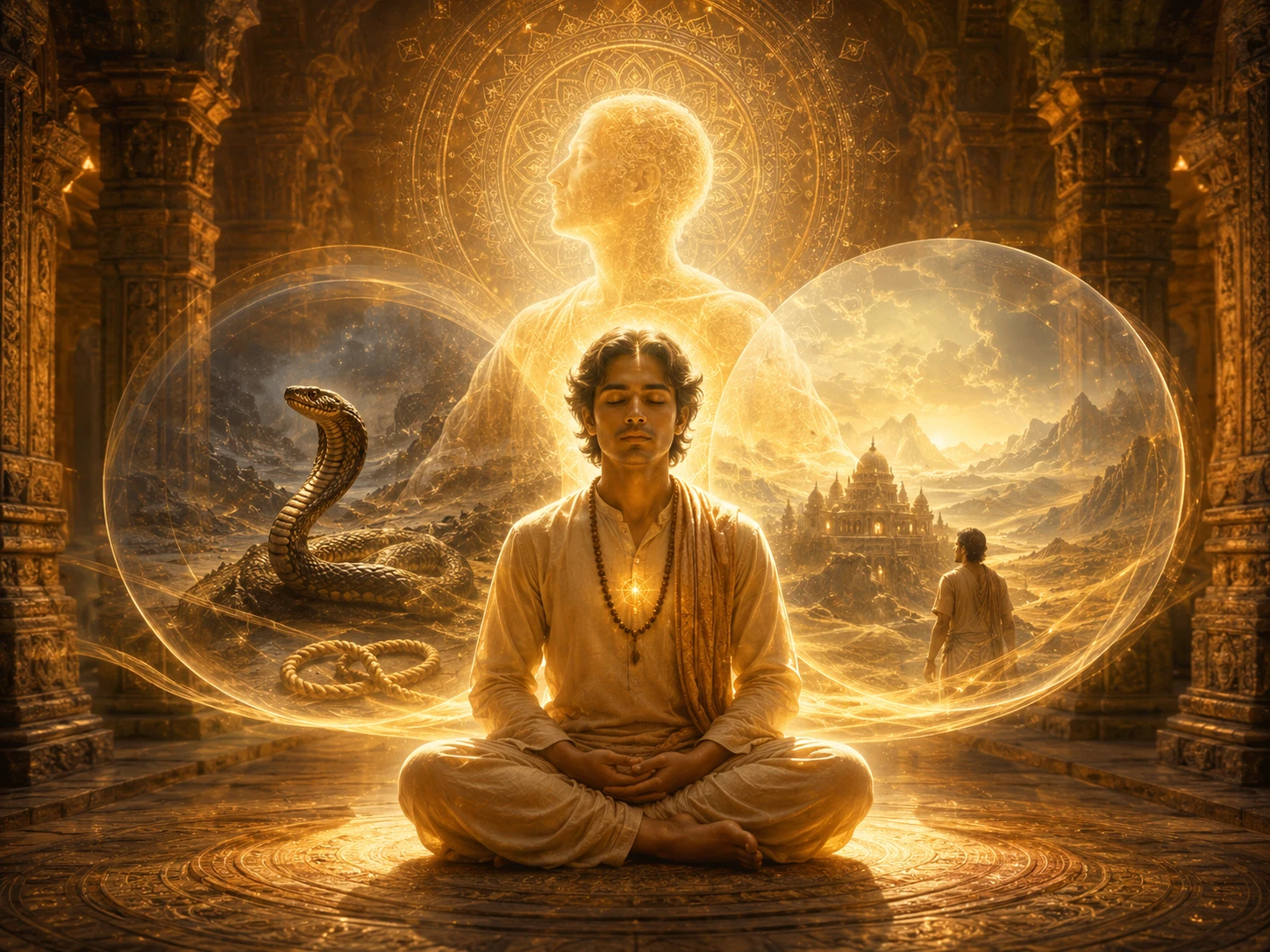
Adhyasa -- Superimposition and the Foundational Error of the Self
13 min readThe same translation error that turned '33 Koti' into '33 crore' in Hinduism also happened in Buddhism. The Chinese translation of Buddhist texts rendered 'Sapta Koti Buddha' (7 Supreme Buddhas) as '7 Crore Buddhas.' The…
Deities AvatarsCommunity Reflections
🕉️
Be the first to share your reflection.