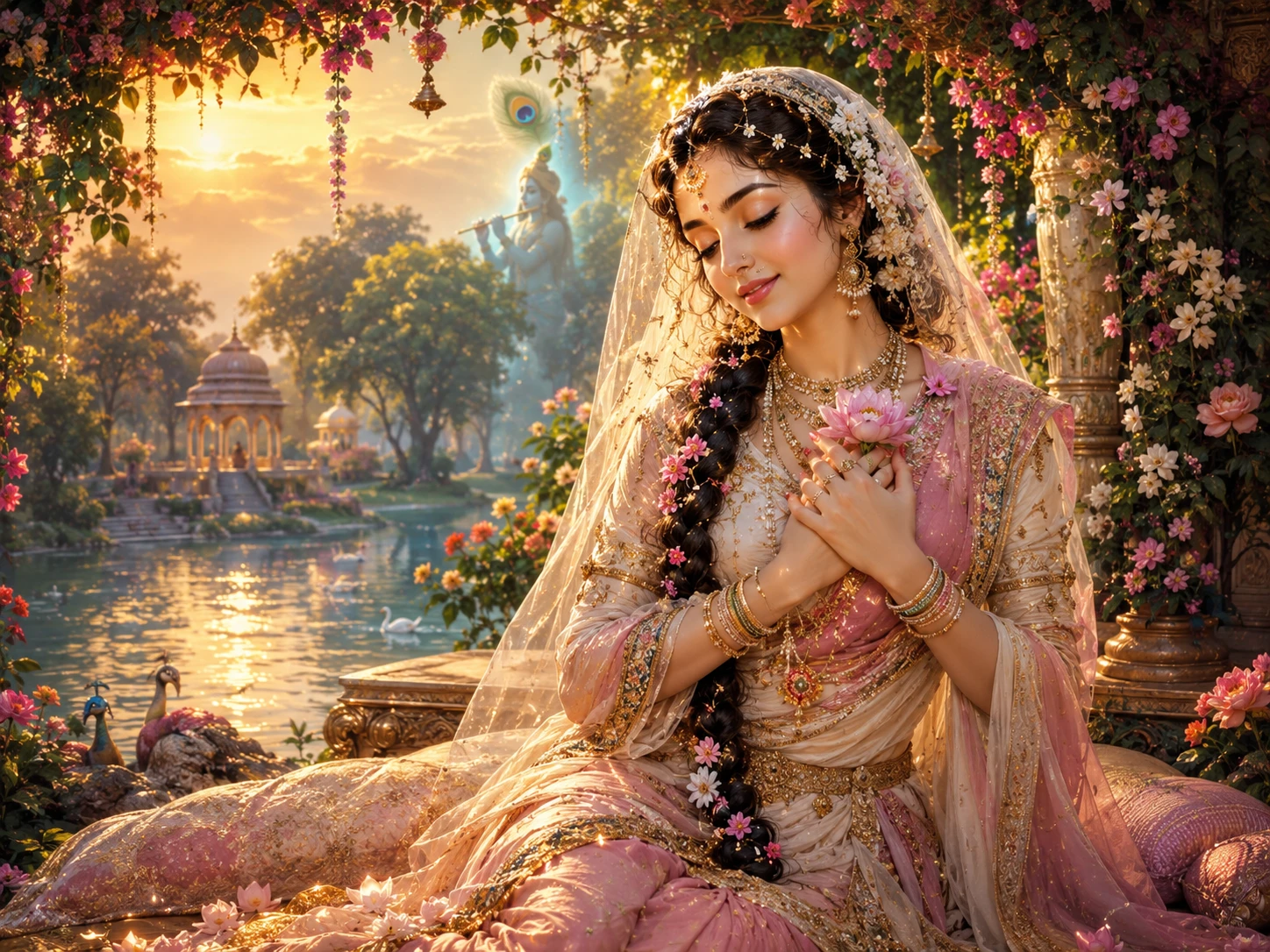
Radha -- Krishna's Eternal Beloved and the Supreme Devotee Who Became Greater Than God
राधा -- कृष्ण की शाश्वत प्रिया और वो परम भक्त जो भगवान से भी बड़ी हुईं
In the entire Hindu pantheon, there is no figure more paradoxical than Radha. She is worshipped by hundreds of millions of people. Her name is chanted before Krishna's in most Vaishnava traditions -- 'Radhe Krishna,' not 'Krishna Radhe.' ISKCON temples across the world have 'Radha-Krishna' as their primary deities, with Radha always named first. The Hare Krishna Maha Mantra -- 'Hare Krishna, Hare Krishna, Krishna Krishna, Hare Hare / Hare Rama, Hare Rama, Rama Rama, Hare Hare' -- is interpreted by Gaudiya Vaishnavas as an invocation of Radha ('Hare' being a vocative form of Hara, an epithet of Radha) alongside Krishna. She is, in effect, present in every syllable of the most widely chanted mantra in global Hinduism.
And yet -- she is not mentioned by name in the Bhagavata Purana, the primary text of Krishna's life. The Bhagavata Purana's Rasa Lila chapters (Book 10, Chapters 29-33) describe Krishna dancing with the gopis of Vrindavan on a full-moon autumn night, and one gopi is singled out as special -- Krishna leaves the Rasa dance to be with her alone. She is not named. She is described only as 'one gopi' who became proud of Krishna's exclusive attention and was then abandoned by him in the forest, left weeping, until she was humbled and he returned. Later commentators -- most importantly Sridhara Swami (14th century) and Vishvanatha Chakravarti (18th century) -- identified this unnamed gopi as Radha, but the Bhagavata itself maintains a deliberate, tantalising silence.
This silence is not accidental. It is theologically strategic. By not naming Radha, the Bhagavata Purana achieves something remarkable: it makes her presence felt through absence. Every reader knows she is there. Every commentator identifies her. But the text refuses to speak her name -- as if she is too sacred to be uttered directly, or as if her love for Krishna is too intimate to be published. The greatest love story in Hindu literature is told through omission.
For anyone who has ever loved someone so deeply that they could not speak the beloved's name aloud -- the Bhagavata's silence on Radha is not a mystery. It is a recognition.
वागदेवताचरितचित्रितचित्तसद्म पद्मावतीचरणचारणचक्रवर्ती। श्रीवासुदेवरतिकेलिकथासमेतम् एतं करोति जयदेवकविः प्रबन्धम्॥
vāgdevatācaritacitritacittasadma padmāvatīcaraṇacāraṇacakravartī | śrīvāsudevaratikelihathāsametam etaṃ karoti jayadevakavim prabandham ||
The poet Jayadeva composes this work -- he whose heart-mansion is decorated with the play of the Goddess of Speech (Saraswati), who is the greatest among the servants of Padmavati's (Lakshmi's) feet, and whose poem is filled with the love-sport narratives of Sri Vasudeva (Krishna).
— Gita Govinda, Sarga 1, Verse 2 -- Jayadeva (12th century CE)
Radha's literary emergence is a fascinating study in the archaeology of devotion. She does not appear fully formed; she crystallises gradually across centuries of Indian literary and theological tradition.
The earliest reference to Radha in any text is debated, but strong candidates include King Hala's Gatha Saptasati (also called Sattasai), a Prakrit collection of 700 verses from roughly the 1st-2nd century CE. Several verses describe a herding girl's love for Krishna in terms that later traditions identify as Radha. Hala's verses are erotic and earthy -- this is not theology but folk poetry, the voice of rural Maharashtra and the Deccan, where the love of a milkmaid for a divine cowherd was already a powerful cultural motif.
The transformation from folk figure to theological principle occurs primarily through three literary and philosophical traditions.
First, Jayadeva's Gita Govinda (12th century CE, composed in Puri, Odisha). This 12-canto Sanskrit poem is the defining text of Radha-Krishna theology. It describes their love through the cycle of union (sambhoga), separation (vipralambha), and reunion -- following the aesthetic theory of Bharata's Natyashastra, which holds that shringara rasa (the erotic-romantic sentiment) is the king of all rasas. Jayadeva's Radha is not a passive beloved; she is proud, jealous, angry, heartbroken, and ultimately triumphant. When Krishna prostrates before her and places his head at her feet, the poem achieves a theological inversion that shocked its first audiences: God kneels before his devotee. The devotee's love is so powerful that it subordinates the divine. This is the foundational claim of Radha theology.
Second, the Brahma Vaivarta Purana and the Garga Samhita -- texts that provide Radha with a full biographical framework. In these texts, Radha is not merely a gopi but an incarnation of Lakshmi, the eternal consort of Vishnu, who descends to Vrindavan to enact her divine love-play (lila) with Krishna. The Brahma Vaivarta Purana describes their wedding in Goloka (the celestial Vrindavan), making Radha not just Krishna's beloved but his wife in the cosmic realm -- even though they do not marry in the earthly lila.
Third, Chaitanya Mahaprabhu (1486-1534 CE) and the Gaudiya Vaishnava tradition. Chaitanya, the great Bengali mystic, is considered by his followers to be a dual incarnation of Radha and Krishna in one body. His ecstatic devotion -- dancing, weeping, fainting in the streets of Puri, chanting the names of Krishna for hours -- was understood by his followers as Radha's love expressed through a male body. Chaitanya's philosophy, systematised by the Six Goswamis of Vrindavan (Rupa, Sanatana, Jiva, Raghunatha Bhatta, Raghunatha Dasa, and Gopala Bhatta), established Radha as the hladini shakti of Krishna -- his bliss-potency, the power that enables him to experience love. Without Radha, Krishna cannot experience his own ananda. She is not subordinate to him; she is the condition of his joy.
This is the theological bombshell that Gaudiya Vaishnavism drops: God needs love. And the source of that love -- the supreme devotee whose devotion is so complete that it completes God himself -- is a woman from a village in Braj.
The theological concept of parakiya rasa -- the love of Radha and Krishna as illicit, extra-marital love rather than married love -- is one of the most debated, controversial, and philosophically significant ideas in all of Hindu thought.
In most Vaishnava traditions, Radha is understood to be married -- but not to Krishna. She is married to a man named Abhimanyu (or Ayan Ghosh in some traditions), and her love for Krishna is therefore parakiya -- the love of another's wife. This is not a minor detail; it is the theological crux of the entire Radha tradition.
Why would a devotional tradition deliberately construct its central love story as an extramarital affair? The answer, as articulated by Rupa Goswami (the principal theologian of Gaudiya Vaishnavism) in his Ujjvala Nilamani, is that parakiya love is theologically superior to svakiya (married) love precisely because it involves greater risk, greater sacrifice, and greater intensity. Married love has social sanction; it is safe, expected, dutiful. Parakiya love defies society, risks reputation, and exists solely because the lovers choose each other despite every obstacle. It is love for love's sake -- love that has no justification except itself.
This is not a celebration of adultery. It is a metaphysical argument about the nature of devotion. The soul's love for God, the tradition is saying, must be like parakiya love -- unconditional, uncalculating, defiant of social convention, and willing to risk everything. The bhakta who worships God because it is culturally expected, because their family does it, because it brings social respectability -- that is svakiya bhakti, married devotion, safe and predictable. The bhakta who worships God against every rational calculation, who gives up career, comfort, and reputation for a love that society does not understand -- that is parakiya bhakti. That is Radha.
The parakiya debate caused genuine theological controversy. The Vallabha Sampradaya (Pushti Marga) rejected it, holding that Radha and Krishna are eternally married (svakiya). The Nimbarka Sampradaya took a middle position. The Gaudiya Vaishnavas insisted on parakiya as theologically essential. These debates, conducted in Sanskrit across centuries, are among the most sophisticated discussions of love, desire, and devotion in any religious tradition.
For the modern reader, the parakiya theology offers a framework for understanding any love that defies convention: the inter-caste couple in a Delhi metro, the queer couple in a conservative small town, the artist who abandons a safe engineering career to paint. All of them are choosing parakiya -- the love that society did not authorise. Radha's theology says: that is the highest love.
Radha Across Vaishnava Sampradayas -- Different Theologies of Love
| Sampradaya | Founder | Radha's Status | Radha-Krishna Relationship | Key Text |
|---|---|---|---|---|
| Nimbarka Sampradaya | Nimbarkacharya (12th-13th c.) | Eternal consort, equal to Krishna | Svakiya (married) in Goloka, plays parakiya in Vrindavan | Vedanta Parijata Saurabha |
| Gaudiya Vaishnavism | Chaitanya Mahaprabhu (15th-16th c.) | Hladini Shakti -- Krishna's bliss-power, superior in devotion | Parakiya (unmarried/another's wife) -- theologically essential | Ujjvala Nilamani, Chaitanya Charitamrita |
| Pushti Marga (Vallabha) | Vallabhacharya (15th-16th c.) | Svamini (mistress), Krishna's queen in Goloka | Svakiya (eternally married) -- parakiya rejected | Subodhini commentary on Bhagavata |
| Radha Vallabh Sampradaya | Hit Harivansh Mahaprabhu (16th c.) | Supreme deity -- superior to Krishna | Radha is the sole ultimate; Krishna her subordinate | Hita Chaurasi |
| ISKCON / Brahma-Madhva-Gaudiya | A.C. Bhaktivedanta Swami (20th c.) | Krishna's pleasure potency, inseparable from Krishna | Parakiya (following Gaudiya theology) | Bhaktivedanta Purports, Nectar of Devotion |
The variety of Radha theologies reveals that Hinduism does not have one 'official' position on divine love. Each sampradaya offers a different lens, and devotees choose the theology that speaks to their spiritual temperament. This pluralism of love-theologies is unique to Hinduism.
The Gita Govinda deserves special attention because it is not merely a poem about Radha and Krishna -- it is the text that transformed Radha from a literary figure into a theological principle, and its influence on Indian culture is rivalled only by the Ramayana and the Mahabharata.
Composed by Jayadeva in the 12th century CE at the court of the Sena king Lakshmanasena in Bengal (though Jayadeva's connection to the Jagannath Temple in Puri is equally strong), the Gita Govinda is a 12-sarga poem with 24 songs (ashtapadis) interspersed with narrative verses. Each song is assigned a specific raga and tala, making the Gita Govinda one of the earliest examples of a composed musical-literary text in world history -- a Sanskrit opera, if you will.
The poem follows a single night's emotional arc: Krishna dances with the gopis, Radha witnesses his attention to others and is consumed by jealousy (mana), she withdraws in pride, Krishna searches for her, a sakhi (female friend) mediates between them, Radha and Krishna are reunited in ecstatic love. The emotional arc -- joy, jealousy, separation, mediation, reunion -- maps onto the five stages of the aesthetic experience described in Bharata's Natyashastra and later codified by Rupa Goswami as the five stages of divine love (shanta, dasya, sakhya, vatsalya, and madhurya rasa).
The most theologically explosive moment comes in Sarga 10, when Krishna prostrates before Radha, placing his head at her feet and begging forgiveness. The verse (10.9) literally places God beneath his devotee. This is not a casual metaphor; it is a deliberate theological inversion that Gaudiya Vaishnavas cite as proof that Radha's love is superior to Krishna's divinity. The supreme being, out of love, becomes subordinate to his beloved. The implications for the nature of devotion are radical: if God himself kneels before love, then love is greater than God.
The Gita Govinda's influence on Indian performing arts is immense. Odissi dance was virtually created around this text -- the classical dance form of Odisha evolved in the temples of Puri where the Gita Govinda was (and still is) sung as part of the daily ritual to Jagannath. Bharatanatyam's padam tradition draws heavily from Jayadeva's ashtapadis. In Manipuri dance, the Rasa Lila performances are set to Gita Govinda verses. In Carnatic music, the ashtapadis have been set to various ragas and are part of the standard concert repertoire. In painting, the Gita Govinda inspired entire schools of miniature art -- the Mewar, Kangra, Bundi, and Kishangarh traditions all produced illustrated Gita Govinda manuscripts that are now among the most prized possessions of museums worldwide.
The Gita Govinda is still sung daily in the Jagannath Temple in Puri -- making it one of the oldest continuously performed musical-literary works in human history. When the temple priests sing Jayadeva's verses at the evening aarti, they are performing a composition that has been performed in the same location, in the same language, for over 800 years. For context, that is older than Dante's Divine Comedy, older than Shakespeare's entire oeuvre, and older than the Renaissance itself.
For the Bollywood songwriter who sets a love song in the rain. For the Instagram poet who writes about heartbreak in 280 characters. For anyone who has ever tried to express what it feels like when love overwhelms language. Jayadeva did it first, did it in Sanskrit, did it in 24 songs, and did it so well that 800 years later, no one has improved upon it.
Radha's influence on Indian art and culture is immeasurable. She is the muse of North Indian devotional culture in a way that no other figure -- divine or human -- can match.
The miniature painting traditions of Rajasthan and the Pahari hills (17th-19th century) are saturated with Radha-Krishna imagery. The Kishangarh school's iconic 'Bani Thani' painting -- showing Radha in profile with elongated eyes, sharp features, and an expression of longing -- is often called the 'Indian Mona Lisa.' The Kangra Valley paintings of Radha and Krishna in forest settings, with monsoon clouds, peacocks, and kadamba trees, created a visual language of divine romance that still defines how India imagines love. Every Rajasthani hotel room, every NRI living room with 'ethnic decor,' every wedding invitation with 'Radha-Krishna' motifs traces its aesthetic lineage to these paintings.
In music, Radha is the dominant subject of the entire Bhajan and Pad tradition of Braj Bhasha poetry. Surdas's Sur Sagar (16th century), Meera Bai's pads, Tulsidas's occasional Krishna poetry, and the compositions of Ashtachhap poets (the eight poet-devotees of the Pushti Marga) -- all centre on Radha's love for Krishna. The bhajan 'Radha Kaise Na Jale' and hundreds of similar compositions are part of the living repertoire of every kirtan singer in North India. In Carnatic music, Radha-themed compositions by Kshetrayya and others form a significant strand of padam singing.
In the performing arts, the Raslila of Braj is the longest continuously performed devotional theatre tradition in India. Performed in Vrindavan and Mathura by boy-actors who embody Krishna and the gopis, the Raslila has been a living tradition for at least 500 years. The dance form of Manipuri, from the northeast Indian state of Manipur, is centred almost entirely on Radha-Krishna themes -- the Ras Lila of Manipur, performed in temple courtyards during Kartik Purnima, is one of the most graceful classical dance forms in the world.
Holi -- the festival of colours -- is, in its Braj heartland, fundamentally a Radha-Krishna festival. The Lathmar Holi of Barsana (Radha's birthplace) and Nandgaon (Krishna's village) re-enacts the playful battle between Radha's women and Krishna's men, with women wielding sticks (lathis) and men shielding themselves -- an annual reversal of gender power dynamics that is simultaneously hilarious, devotional, and deeply embedded in Radha theology.
For the couple posing for pre-wedding photos in matching Radha-Krishna costumes at a Vrindavan studio. For the Bollywood choreographer setting a song in a flower-filled garden with a flute-playing hero and a dancing heroine. For the grandmother who begins every morning with 'Radhe Radhe' on her lips. Radha is not a historical figure to be studied. She is a living presence that shapes how an entire civilisation understands love.
The Banke Bihari Temple in Vrindavan -- one of the most visited Krishna temples in India -- does not allow the continuous viewing of the deity's eyes. The curtain is pulled every few minutes to break the devotee's gaze, because the deity's eyes are said to be so captivating (the legend says they are Radha's eyes looking through Krishna's form) that a devotee could lose consciousness. Meanwhile, the ISKCON Temple in Vrindavan -- the Krishna Balaram Mandir -- houses deities named 'Radha-Shyamasundar,' with Radha positioned to Krishna's left (indicating she is his heart, as the heart is on the left side). In Barsana, Radha's birthplace, the temple built on the hilltop is called Shriji Temple, and Radha is worshipped here as the primary deity -- Krishna is her visitor, not her host. And the phrase 'Radhe Radhe' -- used as a greeting, a farewell, an exclamation, and a prayer by millions in the Braj region -- is statistically the most spoken divine name in Hindi-speaking India, surpassing even 'Jai Shri Ram' and 'Om Namah Shivaya' in everyday usage in the Mathura-Vrindavan belt.
Vrindavan today is a town of contradictions -- and every one of them is Radha's.
The town, located 150 km south of Delhi in Uttar Pradesh's Mathura district, receives an estimated 5-6 million pilgrims annually. It is simultaneously one of the most sacred places in Hinduism and one of the most chaotically developed small towns in India. Ancient temples sit next to multi-storey ashrams built with NRI donations. Narrow medieval lanes are jammed with auto-rickshaws, cycle-rickshaws, and cows. The air smells of incense, cow dung, and frying puris from the hundreds of bhandara (free food) kitchens that operate daily.
The Banke Bihari Temple, Radha Raman Temple (established by Gopal Bhatta Goswami in 1542, where the deity is believed to have self-manifested from a shaligrama shila), ISKCON's Krishna Balaram Mandir, and the Prem Mandir (a massive white marble temple completed in 2012 by the Jagadguru Kripalu Parishat) are the primary pilgrimage destinations. Each represents a different theological tradition: Banke Bihari is Haridas Swami's lineage, Radha Raman is Gaudiya Vaishnavism's most sacred deity, ISKCON represents the global expansion of Chaitanya's tradition, and Prem Mandir represents modern devotional architecture.
But Vrindavan's most remarkable institution may be its widows. For centuries, Hindu widows -- particularly from Bengal -- have come to Vrindavan to spend their final years chanting Radha's name. These women, many of them abandoned by their families after their husbands' deaths, live in ashrams and bhajan mandalis, chanting 'Radhe Radhe' for hours each day. Their devotion is both heartbreaking and inspiring: marginalised by society, they find in Radha -- herself a woman whose love was socially unsanctioned -- a goddess who understands what it means to love without social approval. The Vrindavan widows are, in their own quiet way, the truest followers of parakiya theology: women who love God not because society rewards them for it, but because they have nothing else and nothing else matters.
The annual festivals of Vrindavan -- Holi (with its legendary Lathmar celebrations in nearby Barsana and Nandgaon), Janmashtami, Radhashtami (Radha's birthday, celebrated on the eighth day of the bright half of Bhadrapada), and the Kartik month celebrations -- draw millions and generate the religious tourism economy that sustains the town. The Braj Parikrama -- a 300-km circumambulation of the entire Braj region covering 48 sacred forests (vans) associated with Krishna's childhood -- is one of the most demanding pilgrimage circuits in India, undertaken on foot over several weeks by devotees who chant 'Radhe Radhe' with every step.
For the NRI family from New Jersey who visits Vrindavan on their India trip, buying Radha-Krishna murtis and Vrindavan paintings to ship back to their Piscataway home. For the young monk at the ISKCON temple who left a software job at Infosys to chant Hare Krishna full-time. For the 82-year-old widow from Midnapur who sits in the Banke Bihari courtyard every evening, eyes closed, whispering 'Radhe' -- the name that the Bhagavata Purana never spoke, but that she has spoken ten million times. Radha is not theology. Radha is alive.
Chant the Hare Krishna Maha Mantra
Chant the Maha Mantra -- Hare Krishna, Hare Krishna, Krishna Krishna, Hare Hare -- an invocation of both Radha and Krishna, chanted daily by millions worldwide. Its page on Eternal Raga gives the meaning and how to chant it.
Eternal Raga · शाश्वत राग
Institutional voice — scholarly articles on Sanatan Dharma
Deepen Your Understanding
अपनी समझ और गहरी करें
deities avatars
Lakshmi -- Beyond Wealth, the Goddess Who Refuses to Stay
India lights 300 million diyas on Diwali night for a goddess whose central teaching is that wealth is not meant to be hoarded. Lakshmi is the most worshipped and most misunderstood deity in Hinduism -- she represents not money but the flow of abundance, and the moment you try to trap her, she leaves.
deities avatars
Parvati -- Shakti, Wife, Mother, and the Woman Who Moved a Mountain God
She is the daughter of the Himalayas who performed tapas so intense that even Shiva -- the god who burned Kamadeva to ash for daring to disturb his meditation -- was compelled to open his eyes. Parvati is Hinduism's most complete feminine archetype: lover, mother, warrior, philosopher, and the literal other half of god.
scriptural exegesis
Krishna's 16,108 Queens -- The Story Behind the Number
The number sounds absurd until you understand what it means. Krishna did not 'collect' 16,108 wives. He rescued 16,100 women from a demon's prison, and when no one in society would accept them back -- because they were 'tainted' -- he married every single one to restore their honour. Add 8 named queens (the Ashtabharya) married through love, valour, or diplomacy, and you get the most misunderstood number in Hindu mythology. This is not a harem story. It is the largest social rehabilitation programme in ancient literature.
scriptural exegesis
Gita Chapter 11 -- Vishwaroop: When Arjuna Saw Everything and Could Not Bear It
Arjuna asks to see Krishna's true form. He gets what he asks for. Infinite mouths, infinite eyes, infinite arms, the entire universe being consumed. Warriors rushing into blazing mouths like moths into flame. Time itself as a devouring force. This is the chapter Oppenheimer quoted at Trinity. It is the Gita's most terrifying passage -- and its most honest statement about what happens when a human mind encounters infinity without a filter.
deities avatars
Devi Swaroopa -- Forms of the Goddess
She is Durga on the battlefield and Annapurna in the kitchen. She is Kali at the cremation ground and Lakshmi in the boardroom. She is Saraswati at the university and Parvati in the family. The Hindu Goddess is not one deity with accessories -- she is the entire spectrum of feminine power, from terrifying to tender, from cosmic to domestic. Understanding her forms is understanding the universe itself.
rituals traditions
Vrindavan -- The Forest Where Krishna Grew Up
A forest of tulsi on the bank of the Yamuna, where the cowherds moved to escape danger and Krishna spent his childhood. How the Bhagavata describes Vrindavan, how the town was rediscovered in the sixteenth century, and what pilgrims go to find there today.
scriptural exegesis
Gita Govinda -- Jayadeva's Song of Radha and Krishna
Written in the twelfth century and still sung every night before Jagannath in Puri, Jayadeva's Gita Govinda turned the love of Radha and Krishna into music. What the poem is, how it is built, and why it changed Indian devotion, dance and music.
The Banke Bihari Temple in Vrindavan -- one of the most visited Krishna temples in India -- does not allow the continuous viewing of the deity's eyes. The curtain is pulled every few minutes to break the devotee's gaze, …
More in Deities & Avatars
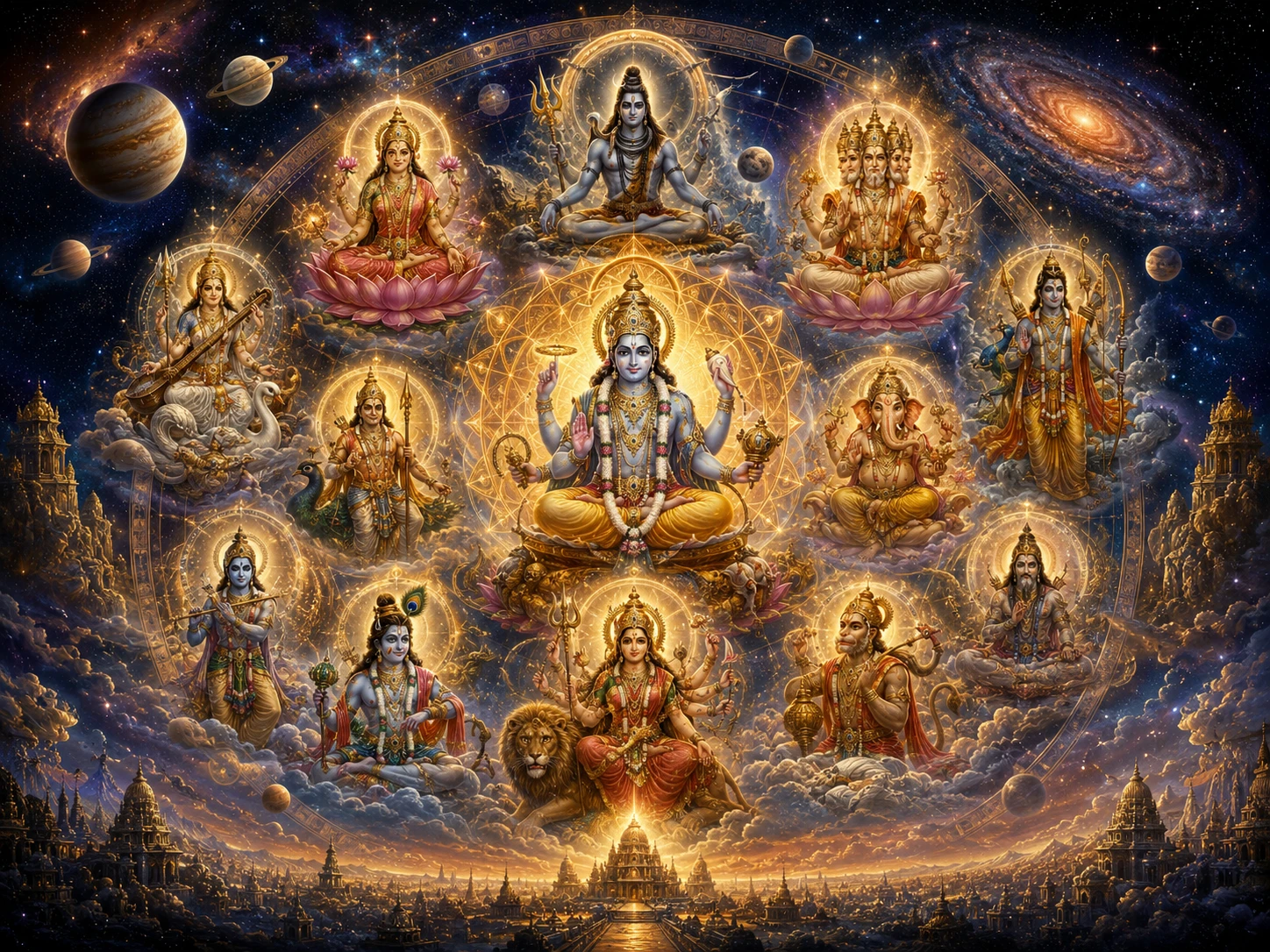
33 Koti Devata -- Why Hinduism Has 33 Types of Gods, Not 33 Crore
13 min read
Agni -- The Fire God
19 min read
Annapurna -- Goddess of Food
19 min readThe same translation error that turned '33 Koti' into '33 crore' in Hinduism also happened in Buddhism. The Chinese translation of Buddhist texts rendered 'Sapta Koti Buddha' (7 Supreme Buddhas) as '7 Crore Buddhas.' The…
Deities AvatarsCommunity Reflections
🕉️
Be the first to share your reflection.