Taittiriya Upanishad -- Panchakosha, the Five Sheaths, and Why Bliss Is Brahman
तैत्तिरीय उपनिषद् -- पंचकोश, पाँच आवरण, और क्यों आनन्द ही ब्रह्म है
The Taittiriya Upanishad is structured as three chapters called Vallis (literally, 'creepers' or 'sections'): Shiksha Valli (the chapter on instruction), Ananda Valli (the chapter on bliss), and Bhrigu Valli (the chapter on Bhrigu's quest). This tripartite structure corresponds to three phases of the spiritual journey: preparation (Shiksha), understanding (Ananda), and realisation through personal inquiry (Bhrigu). It belongs to the Krishna (Black) Yajurveda, specifically the Taittiriya school attributed to sage Vaishampayana's pupils. It is listed as number 7 in the Muktika canon of 108 Upanishads.
The Shiksha Valli opens with one of the most famous passages in Indian educational history -- a convocation address from guru to departing student. After years of Vedic study, the teacher speaks: 'Satyam vada. Dharmam chara.' -- Speak truth. Follow dharma. Do not neglect your studies. Do not neglect your duties to the gods and ancestors. Treat your mother as God. Treat your father as God. Treat your teacher as God. Treat your guest as God. Whatever good practices you see in us, follow those. Whatever mistakes you see in us, do not follow those.
This is not generic advice. It is an ethical programme of remarkable specificity delivered at the moment of transition from student to householder. Every IIT convocation speech, every IIM farewell address, every school principal's graduation day sermon in India is -- knowingly or not -- an echo of Taittiriya 1.11. The original is better than any of the copies because it has the courage to include: 'If you have any doubt about an action, or any doubt about conduct, follow the example of Brahmins who are competent, gentle, devoted to dharma, and not harsh.' It acknowledges that the student will face moral ambiguity and offers a practical heuristic: find exemplary people and mirror them.
The Shiksha Valli also contains the Samhita Upasana -- a meditation on the combinations of sounds, connecting the individual (microcosm) to the cosmic (macrocosm) through the very structure of language. This is a proto-linguistic theory: the teacher shows how every paired element in speech (the preceding letter and the following letter, the space between them, and the junction) maps onto paired elements in the cosmos (earth and heaven, fire and sun, teacher and student). Language is not arbitrary -- it mirrors reality.
आनन्दो ब्रह्मेति व्यजानात् । आनन्दाध्येव खल्विमानि भूतानि जायन्ते । आनन्देन जातानि जीवन्ति । आनन्दं प्रयन्त्यभिसंविशन्ति ॥
ānando brahmeti vyajānāt | ānandādhyeva khalvimāni bhūtāni jāyante | ānandena jātāni jīvanti | ānandaṃ prayantyabhisaṃviśanti ||
He (Bhrigu) realised that Bliss is Brahman. From Bliss, indeed, all these beings are born. Having been born, by Bliss they live. Into Bliss, upon departing, they enter and merge.
— Taittiriya Upanishad, Bhrigu Valli (Chapter 3), Anuvaka 6; Krishna Yajurveda, Taittiriya Aranyaka
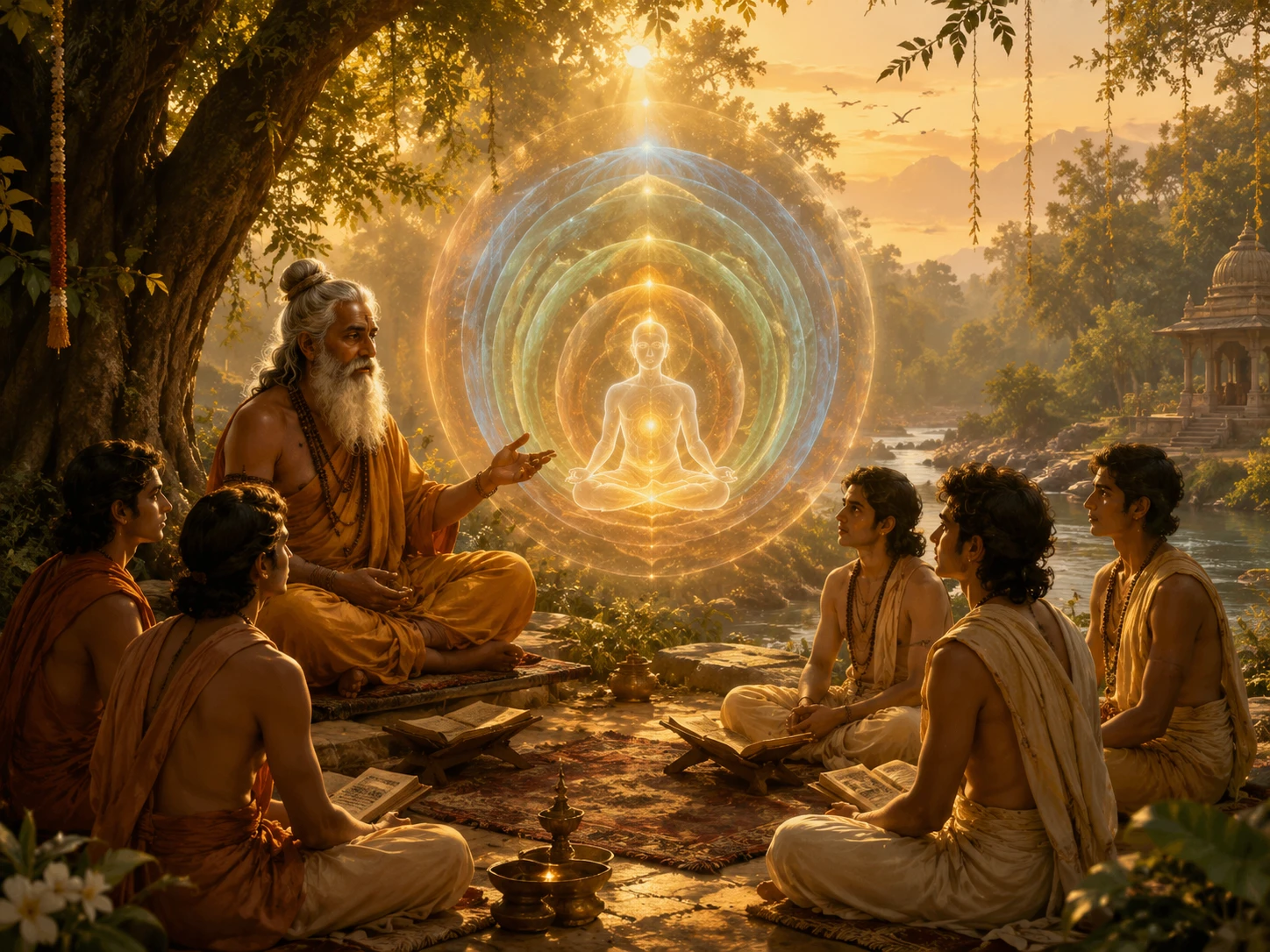
The Ananda Valli (Chapter 2) introduces the Panchakosha model -- one of the most influential frameworks in Indian philosophy, yoga, and Ayurveda. The teaching describes the Self as wrapped in five progressive sheaths (koshas), each more subtle than the last:
1. Annamaya Kosha -- the food sheath. The physical body, made of and sustained by food. This is what you see in the mirror, what the doctor examines, what ages and dies.
2. Pranamaya Kosha -- the vital breath sheath. The energy body that animates the physical. Prana, apana, vyana, udana, samana -- the five vital breaths. This is what acupuncturists and pranayama teachers work with.
3. Manomaya Kosha -- the mental sheath. The layer of thoughts, emotions, desires, and sensory processing. This is what psychologists study, what CBT addresses, what social media exploits.
4. Vijnanamaya Kosha -- the knowledge/intellect sheath. The layer of discrimination, understanding, and self-reflective awareness. This is what distinguishes philosophical inquiry from emotional reaction.
5. Anandamaya Kosha -- the bliss sheath. The subtlest layer, closest to the Atman. Experienced in deep sleep, in moments of selfless joy, in the gap between thoughts.
The model is not just descriptive -- it is diagnostic. Most human suffering occurs because people misidentify with the wrong kosha. The person who identifies entirely with Annamaya (the body) suffers terribly when the body ages -- the 50-year-old Bollywood actor who cannot accept wrinkles, the ageing cricketer whose knees betray him. The person who identifies with Manomaya (thoughts and emotions) is at the mercy of every mood swing -- the corporate worker whose self-worth rises and falls with quarterly reviews. The Taittiriya Upanishad says: you are not any of these sheaths. You are the consciousness within which all five sheaths appear.
The Panchakosha -- Five Sheaths of the Self
| Kosha | English Name | What It Governs | Bhrigu's Identification | Modern Parallel |
|---|---|---|---|---|
| Annamaya | Food Sheath | Physical body, bones, muscles, organs | First attempt: 'Food is Brahman' | Physical health, gym culture, body image |
| Pranamaya | Vital Breath Sheath | Energy, breath, metabolic processes | Second attempt: 'Breath is Brahman' | Pranayama, breathwork, bioenergetics |
| Manomaya | Mental Sheath | Thoughts, emotions, desires, sensory mind | Third attempt: 'Mind is Brahman' | Psychology, therapy, emotional intelligence |
| Vijnanamaya | Knowledge Sheath | Intellect, discrimination, self-reflection | Fourth attempt: 'Knowledge is Brahman' | Critical thinking, philosophy, wisdom traditions |
| Anandamaya | Bliss Sheath | Pure joy, the subtlest veil before Atman | Final realisation: 'Bliss is Brahman' | Flow states, deep meditation, selfless love |
Each kosha is not rejected but transcended. Bhrigu does not abandon food when he discovers breath. He includes it and goes deeper. This is Ken Wilber's 'transcend and include' principle -- stated 2,500 years before Wilber.
The Bhrigu Valli (Chapter 3) is the Taittiriya Upanishad's narrative masterpiece. Bhrigu, the son of Varuna (the cosmic lord of waters and cosmic order), approaches his father and says: 'Adhihi Bhagavo Brahmeti' -- Teach me Brahman, Revered Sir. Varuna does not lecture. He gives Bhrigu a method: 'Tapasa Brahma vijijnanasasva. Tapo Brahmeti.' -- Seek to know Brahman through tapas (austerity/concentrated inquiry). Tapas is Brahman.
Bhrigu goes away and meditates. He returns with his first realisation: 'Annam Brahmeti vyajanat' -- Food is Brahman. Because from food beings are born, by food they live, into food they return upon death. Varuna does not correct him. He simply says: 'Go deeper. Meditate more.' Bhrigu returns again: Prana (breath/life-force) is Brahman. Again Varuna sends him back. Mind is Brahman. Again. Vijnana (knowledge/intellect) is Brahman. Again. Finally: 'Anando Brahmeti vyajanat' -- Bliss is Brahman. From bliss all beings are born, by bliss they live, into bliss they merge.
This pedagogical method is extraordinary. Varuna does not teach Bhrigu the answer. He teaches him the method (tapas) and lets Bhrigu discover the answer himself. Each time Bhrigu returns with a partial truth, Varuna does not say 'wrong.' He says 'go deeper.' This is not Socratic questioning -- Socrates leads the student toward a predetermined answer through strategic questions. Varuna genuinely lets Bhrigu discover on his own, trusting that concentrated inquiry will naturally move from gross to subtle, from surface to depth, from food to bliss.
Every parent in India who has told their child 'figure it out yourself' is unconsciously channelling Varuna. The difference is that Varuna also gave Bhrigu the tool -- tapas. He did not abandon his son to blind experimentation. He gave him a method of inquiry and then trusted the method. This is the model for genuine education: provide the framework, demonstrate the method, and then step back.
The Ananda Valli's 'scale of bliss' (ananda-mimamsa) is one of the most audacious passages in Upanishadic literature. The text constructs an escalating hierarchy of joy: start with one unit of human bliss -- a young man, healthy, learned, strong, with the whole earth full of wealth at his command. That is one unit. Then multiply: the bliss of human gandharvas is a hundredfold. The bliss of divine gandharvas is a hundredfold of that. The bliss of the pitris is a hundredfold further. Then the devas. Then Indra. Then Brihaspati. Then Prajapati. Then Brahman -- whose bliss is beyond all computation.
The mathematical structure is the point. The Upanishad is not saying 'God is happier than you.' It is constructing a thought experiment to show that bliss has no ceiling. Every time you think you have reached the maximum -- the most successful career, the most passionate love, the most beautiful sunset -- the Taittiriya says: multiply by a hundred. And again. And again. Until you reach a joy that is infinite, self-sustaining, and unconditional. That is Brahman.
This directly addresses the most common spiritual misconception in India: that enlightenment is the end of pleasure, that the spiritual life means grey austerity, that renunciation means giving up joy. The Taittiriya Upanishad says the exact opposite. Brahman IS bliss. Liberation is not the absence of happiness but the discovery of a happiness so vast, so unconditional, so structurally integral to reality that it cannot be taken away by any circumstance -- not by job loss, not by heartbreak, not by illness, not by death. The Ananda that the Upanishad describes is not emotion. It is the nature of being itself.
For the modern Indian, this reframe matters enormously. The startup founder in Koramangala who equates success with happiness and then discovers that the Series B funding did not make the anxiety go away. The NRI in New Jersey who achieved the American dream and still wakes up feeling empty at 3 AM. The retired bureaucrat in Lucknow whose identity collapses when the power and protocol disappear. All of them are on Bhrigu's journey -- they identified bliss with something external (money, status, achievement) and found it insufficient. The Taittiriya says: the bliss you are looking for is not in the object. It is in you. It IS you.
The Panchakosha model has had an extraordinary afterlife in Indian therapeutic and wellness traditions. Ayurveda uses it as a diagnostic framework -- disease that manifests in Annamaya (physical symptoms) may originate in Manomaya (psychological stress) or Pranamaya (disrupted energy). Modern yoga therapy, as taught at institutions like S-VYASA University in Bangalore and Kaivalyadhama in Lonavala, explicitly maps therapeutic interventions onto the five koshas: asana for Annamaya, pranayama for Pranamaya, meditation for Manomaya, self-inquiry for Vijnanamaya, and yoga nidra for Anandamaya.
In Western psychology, Abraham Maslow's hierarchy of needs (physiological, safety, belonging, esteem, self-actualisation) bears a striking structural resemblance to the Panchakosha -- moving from the most material (food/physical) to the most transcendent (bliss/self-actualisation). Maslow himself acknowledged the influence of Eastern philosophy on his later work, particularly his concept of 'peak experiences' which maps closely onto the Anandamaya Kosha.
The Taittiriya Upanishad's convocation address (Shiksha Valli 1.11) has been adopted by several Indian universities as part of their official ceremonies. IIT Kharagpur, Banaras Hindu University, and several traditional Vedic institutions include Sanskrit recitations from this passage at graduation. The address remains relevant because it speaks to the permanent human condition at the moment of transition: you are leaving a protected environment and entering an uncertain world. Here are your tools. Here is your compass. Now go.
The closing prayer of the Taittiriya Upanishad is itself worth memorising: 'Aham annam aham annam aham annam / Aham annadah aham annadah aham annadah' -- I am food, I am food, I am food; I am the eater of food, I am the eater of food, I am the eater of food. This ecstatic declaration collapses the distinction between consumer and consumed, subject and object, self and world. It is the Upanishad's final teaching in a single image: you are not separate from what sustains you. The eater and the eaten are one.
The Panchakosha model has an important structural feature that is often missed: it is not a stack of separate layers but a set of nested sheaths, each containing and being pervaded by the next. Annamaya contains Pranamaya which contains Manomaya which contains Vijnanamaya which contains Anandamaya. And the Atman pervades all five. This means that when you heal the Pranamaya (through breathwork), the Annamaya (body) also benefits -- and this is exactly what clinical studies on pranayama and yoga therapy are confirming.
The application to mental health is direct. The epidemic of anxiety and depression among Indian youth -- particularly among JEE/NEET aspirants, early-career professionals, and urban millennials -- is typically addressed at the Manomaya level (therapy, medication, stress management). The Taittiriya Upanishad suggests that Manomaya-level interventions alone are insufficient because the disturbance may originate in Pranamaya (disrupted breathing, irregular sleep, sedentary lifestyle) or even Annamaya (poor diet, processed food, chronic dehydration). Conversely, meditation that reaches Vijnanamaya or Anandamaya can heal disturbances at all three outer layers simultaneously.
S-VYASA University in Bangalore has published extensive research applying the Panchakosha model to clinical settings -- treating conditions from diabetes to PTSD by addressing the appropriate kosha. Their approach, which they call Yoga-based Integrated Approach of Therapy (IAYT), has been adopted by multiple AIIMS campuses and recognized by the Ministry of AYUSH. The Taittiriya Upanishad's 2,500-year-old model is now being validated through randomized controlled trials in 21st century hospitals.
The Taittiriya Upanishad's Ananda Valli also contains a verse that became the foundation for Vedantic soteriology: 'Yato vacho nivartante aprapya manasa saha / Anandam brahmano vidvan na bibheti kadachana' -- From which words return without reaching, together with the mind; the knower of the bliss of Brahman fears nothing whatsoever. This is the promise: the person who has realised Brahman-as-Ananda is beyond fear. Not because they have become supernaturally brave, but because the source of all fear -- the belief that you can lose something essential to your being -- has been dissolved. If you ARE bliss, you cannot lose bliss. If you ARE the Self, you cannot lose the Self. Fear requires the possibility of loss. When you recognise that your deepest nature is imperishable, the fear mechanism has nothing to attach to.
This is directly relevant to the anxiety epidemic in modern India. The coaching centre student in Kota fears failure because they believe their worth is their rank. The startup founder fears shutdown because they believe their identity is their company. The middle-aged professional fears irrelevance because they believe their value is their job title. In each case, fear exists because identity is placed in something that can be lost -- a rank, a company, a title. The Taittiriya Upanishad says: move your identity to the one thing that cannot be lost. That is Ananda. That is Atman. That is Brahman.
The text's treatment of food (anna) is also noteworthy. The Taittiriya does not spiritualise food by making it a metaphor. It treats food as genuinely sacred -- literally the first face of Brahman that Bhrigu encounters. 'Do not disrespect food. Do not waste food. Grow more food.' These injunctions in 3.7-3.9 are ecological, practical, and anti-waste. They ground the Upanishad's highest philosophy in the most basic material reality: before you can meditate on the Infinite, you must eat. And the food you eat is not separate from Brahman -- it IS the outermost expression of Brahman. The Anna-Suktam (hymn to food) that closes the Bhrigu Valli collapses the distinction between the spiritual and the material: 'I am food, I am the eater of food, I am the unifier of both.'
The Taittiriya Upanishad's significance in the history of Indian education cannot be overstated. The Shiksha Valli is literally a textbook on how to teach -- it covers phonetics (how to pronounce Vedic mantras correctly), pedagogical relationships (how teachers and students should treat each other), and ethical formation (the convocation address). This tripartite structure -- technical competence, relational ethics, and life guidance -- is arguably the earliest surviving curriculum design document in world education.
The phonetic teaching in the Shiksha Valli is remarkably sophisticated. It analyses speech sounds in terms of five parameters: the place of articulation, the effort (prayatna), the duration (matra), the pitch (svara), and the conjunction (sandhi). This five-parameter model anticipates the articulatory phonetics that linguists would not formalise until the 19th century. Panini's grammar, which came later, builds directly on this phonetic foundation. For the IIT student who studies signal processing or computational linguistics, the Taittiriya Upanishad's analysis of speech sounds is the ancestral algorithm.
The convocation prayer -- 'Satyam vada, dharmam chara' -- has been translated into institutional mottos across India. BHU's founding principles echo it directly. The National Law Schools' ethical codes reference its spirit. Even corporate India's obsession with 'values statements' is a distant, diluted echo of this original. The difference is that the Taittiriya's convocation was delivered personally by a guru who had lived with the student for years, who knew the student's strengths and weaknesses, and who spoke with the authority of lived example. No PowerPoint deck or HR manual can replicate that authority.
The Bhrigu Valli's progressive discovery also maps onto stages of human development. A child's first relationship with reality is through food (Annamaya) -- the infant knows the world through what it can eat. The adolescent discovers energy and vitality (Pranamaya) -- sports, physical exertion, the rush of being alive. The young adult discovers the mind (Manomaya) -- intellectual formation, emotional relationships, the world of ideas. The mature professional discovers knowledge and discrimination (Vijnanamaya) -- the ability to distinguish the essential from the inessential, to make judgments, to teach others. And the elder, if they are fortunate, discovers that beneath all of these is a joy that does not depend on any of them (Anandamaya).
This developmental reading suggests that the Panchakosha is not just a meditation map but a map of maturation. The tragedy of modern life is that most people get stuck at Manomaya -- the mental sheath -- because consumer culture, social media, and the achievement treadmill all operate at that level. The person whose identity is entirely in their thoughts, opinions, and emotional states is living in the Manomaya Kosha. They have not yet discovered that there is something deeper -- a knowing awareness (Vijnanamaya) and a causeless joy (Anandamaya) -- that makes the mental fluctuations bearable.
The Taittiriya Upanishad remains required reading for multiple academic and professional tracks in India. It appears in UPSC philosophy optional papers under 'Indian Philosophy -- Upanishadic thought.' It is the primary source text for Panchakosha studies in yoga teacher training programmes certified by the Ministry of AYUSH. It features in comparative religion courses at JNU and DU alongside Western phenomenology. And its convocation address is recited at traditional Vedic institutions like Kanchi Kamakoti Peetham and Sringeri Sharada Peetham as part of their educational rituals.
The text's enduring power lies in its double movement: it moves from the most practical (how to pronounce correctly, how to behave after graduation) to the most transcendent (Brahman is Bliss, all creation arises from and returns to joy). It refuses to separate the mundane from the sacred. The student who learns to pronounce Sanskrit correctly in the Shiksha Valli is performing the same quality of attention that will later carry them into the Anandamaya Kosha. The discipline of phonetics and the discipline of meditation are not different in kind -- only in degree. This is the Taittiriya's genius: it builds the bridge between the classroom and the cosmos, and it walks you across it one step at a time.
The Taittiriya Upanishad's Shiksha Valli convocation address (1.11) contains the lines 'Matru devo bhava, Pitru devo bhava, Acharya devo bhava, Atithi devo bhava' -- Mother is God, Father is God, Teacher is God, Guest is God. The phrase 'Atithi Devo Bhava' was adopted by the Indian Ministry of Tourism as its official campaign slogan in 2005, promoting hospitality to foreign visitors. It remains on tourism billboards, airport signage, and hotel lobbies across India -- a 2,500-year-old Upanishadic verse serving as a marketing tagline. Additionally, the Panchakosha model has been adopted by the World Health Organization's definition of health (which includes physical, mental, and social well-being) and is explicitly referenced in integrative medicine protocols at AIIMS Delhi and NIMHANS Bangalore.
Journey Through the Five Koshas -- Guided Meditation
Follow Bhrigu's path inward. Begin with awareness of your body (Annamaya). Shift to your breath (Pranamaya). Notice your thoughts (Manomaya). Observe the observer (Vijnanamaya). Rest in the joy that remains when everything else is still (Anandamaya). This is the Taittiriya Upanishad's experiment.
Tags
Eternal Raga · शाश्वत राग
Institutional voice — scholarly articles on Sanatan Dharma
Deepen Your Understanding
अपनी समझ और गहरी करें
philosophy darshana
The Four Mahavakyas -- Upanishadic Sentences That Changed Civilisation
Four sentences. Twelve words of Sanskrit. Three thousand years of commentary. The Mahavakyas are the most compressed, most powerful, and most debated statements in all of Indian philosophy. Each one claims that the individual self and the ultimate reality of the universe are not two different things. And each one has been interpreted to mean something completely different by every major school of Vedanta.
philosophy darshana
Pancha Kosha -- The Five Sheaths of Consciousness and What Actually Leaves the Body at Death
The internet says the soul weighs 21 grams. The Taittiriya Upanishad says the soul has no weight because it is not a physical thing -- it is consciousness layered in five sheaths from food to bliss. Hindu psychology mapped the human being into five nested layers 2,500 years before Freud drew three. Here is the complete framework, with what actually happens at death according to scripture.
scriptural exegesis
Isha Upanishad -- The Complete Guide to 18 Verses That Changed Indian Philosophy
Eighteen verses. That is all. The Isha Upanishad is the shortest of the principal Upanishads -- the final chapter of the Shukla Yajurveda -- and yet it tackles more ground in fewer words than most philosophical treatises manage in hundreds of pages. Enjoy the world through renunciation. Act for a hundred years without attachment. See your Self in all beings. These are not greeting-card platitudes. They are precision-engineered instructions for living in the world without being destroyed by it. Gandhi called it the essence of Hinduism. Shankara built his Advaita commentary around it. And its opening verse remains the most quoted line in all Upanishadic literature.
scriptural exegesis
Katha Upanishad -- Nachiketa and Yama
A teenage boy walks into the house of Death, waits three days without food, and then proceeds to negotiate the universe's deepest secret out of Yama himself. The Katha Upanishad is not a dusty scripture -- it is the original startup pitch where a kid with zero leverage outplayed the CEO of the afterlife.
scriptural exegesis
Mundaka Upanishad -- Higher and Lower Knowledge, Two Birds, and the Arrow of the Self
A householder walks up to a sage and asks: 'What is that one thing, knowing which, everything becomes known?' The sage replies by dividing all knowledge into two categories -- lower knowledge (which includes the four Vedas themselves) and higher knowledge (by which the Imperishable is known). Then he tells the story of two birds on a tree -- one eating fruit, the other silently watching. And then he hands the seeker a bow and arrow: 'AUM is the bow, the Atman is the arrow, Brahman is the target. Pierce it.' This is the Mundaka Upanishad -- 64 verses that gave India its national motto, its most famous metaphor, and its sharpest distinction between information and wisdom.
philosophy darshana
Atman and Brahman -- The Self and the Absolute
The Upanishads make a claim so radical that 3,000 years have not dulled its edge: the individual self (Atman) and the ultimate reality of the universe (Brahman) are not two different things. They are one. Every school of Hindu philosophy is essentially an argument about what this identity means.
philosophy darshana
Yoga Darshana -- Patanjali's Science of the Mind
Before yoga became a global fitness trend worth $80 billion, it was India's most rigorous system of psychology. Patanjali's 196 sutras are not about touching your toes -- they are about rewiring your mind. Here is the philosophy the world forgot when it turned yoga into exercise.
The Taittiriya Upanishad's Shiksha Valli convocation address (1.11) contains the lines 'Matru devo bhava, Pitru devo bhava, Acharya devo bhava, Atithi devo bhava' -- Mother is God, Father is God, Teacher is God, Guest is…
More in Scriptural Exegesis
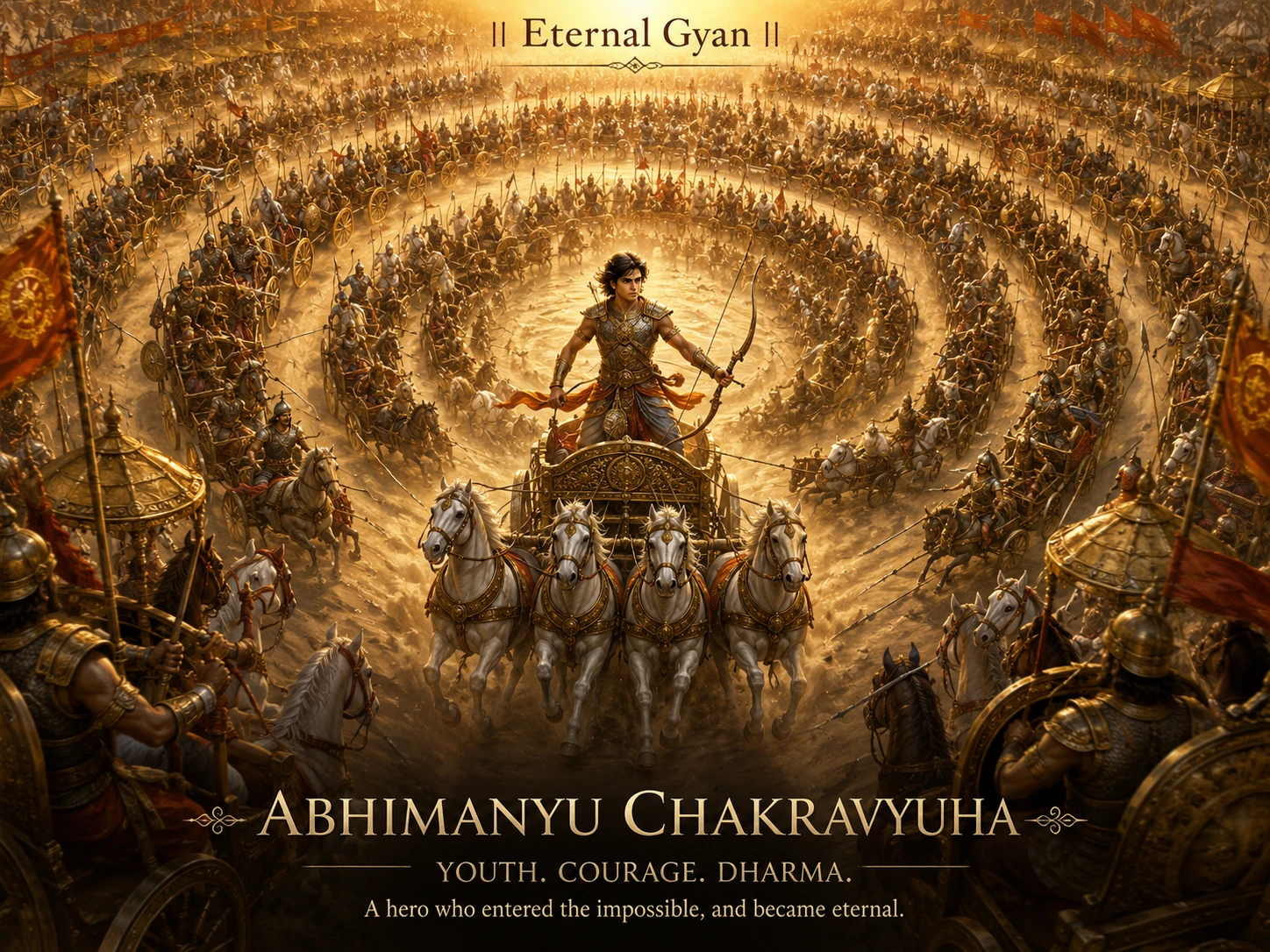
Abhimanyu and the Chakravyuha -- The Boy Who Knew How to Enter but Not How to Leave
14 min read
Adbhuta Ramayana -- The Ramayana Where Sita Becomes Kali
9 min read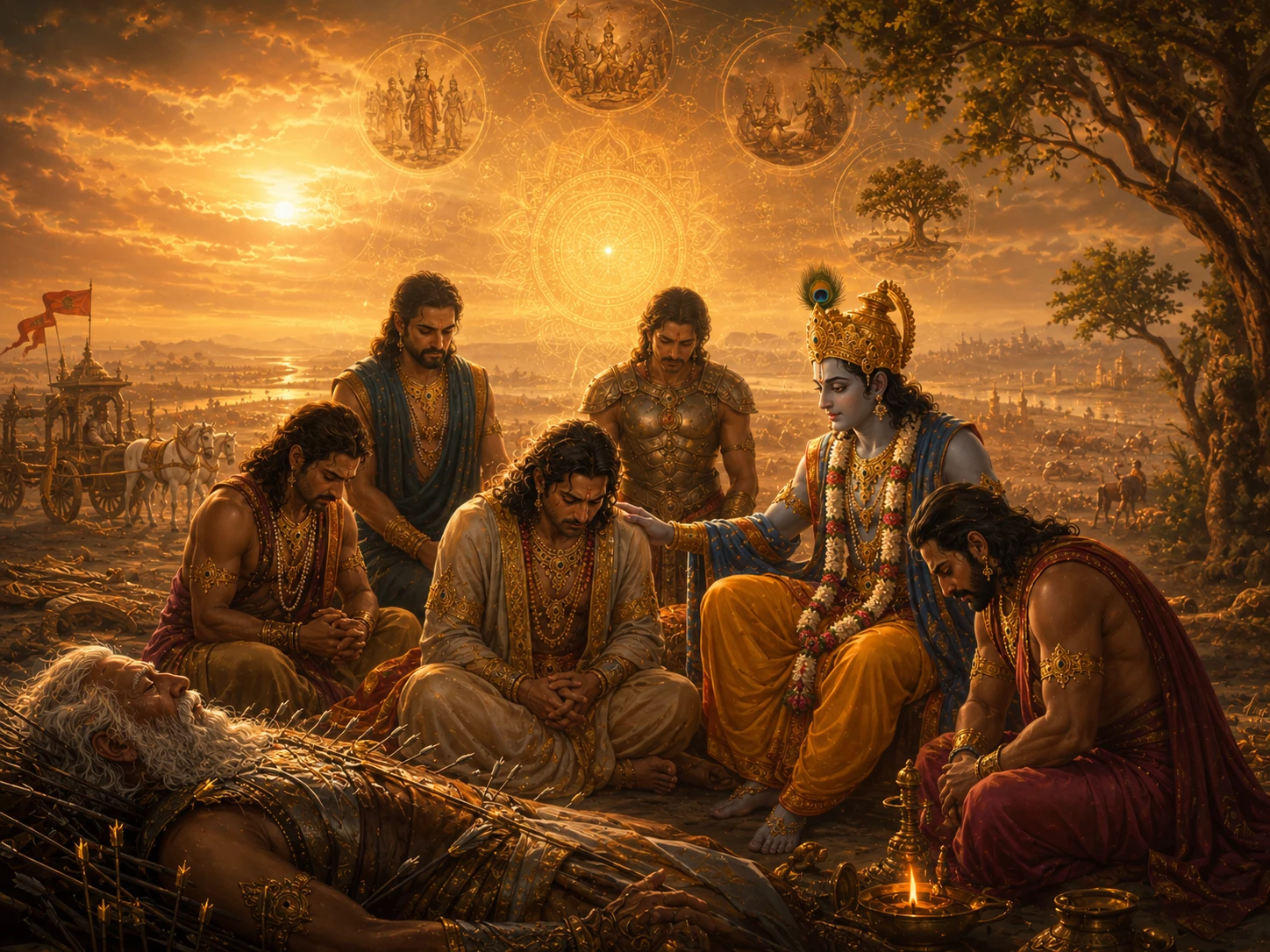
After Kurukshetra -- What Happened Next
14 min readThe same translation error that turned '33 Koti' into '33 crore' in Hinduism also happened in Buddhism. The Chinese translation of Buddhist texts rendered 'Sapta Koti Buddha' (7 Supreme Buddhas) as '7 Crore Buddhas.' The…
Deities AvatarsCommunity Reflections
🕉️
Be the first to share your reflection.