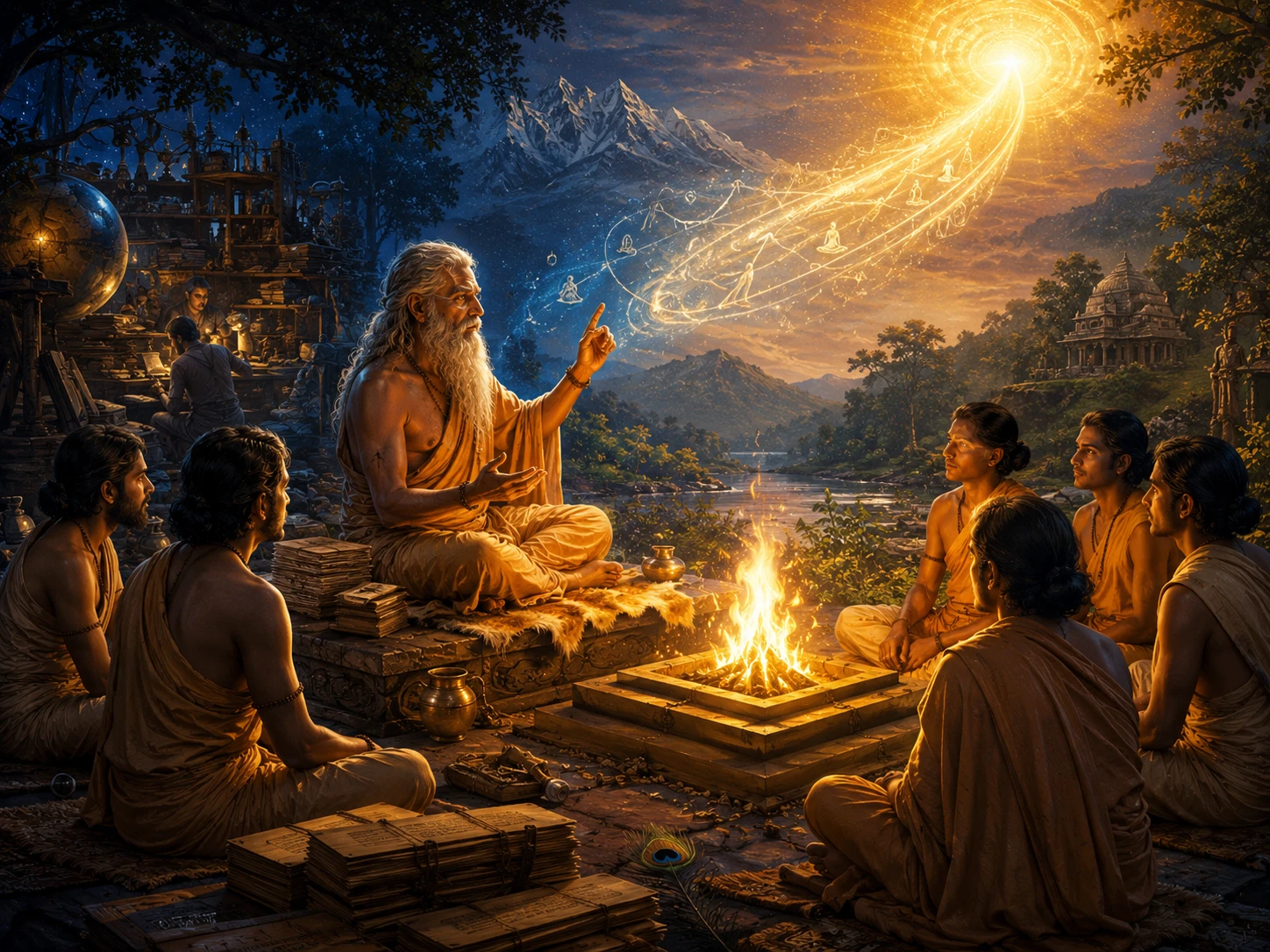
Mundaka Upanishad -- Higher and Lower Knowledge, Two Birds, and the Arrow of the Self
मुण्डक उपनिषद् -- परा-अपरा विद्या, दो पक्षी, और आत्मा का बाण
The Mundaka Upanishad opens with the most ambitious question in the history of education: 'Kasmin nu bhagavo vijnate sarvam idam vijnatam bhavati?' -- Revered sir, what is that by knowing which everything becomes known? This is not a question about a subject you can study. It is a question about the ground of all subjects. It presupposes that there exists a single piece of knowledge so fundamental that everything else follows from it -- like knowing the nature of clay makes you understand every pot, or knowing gold makes you understand every ornament.
The question is asked by Shaunaka, described as a 'maha-shala' -- a great householder, a man of wealth and learning. This detail matters. Shaunaka is not a dropout seeking escape. He is an accomplished person who has mastered the conventional knowledge of his time and found it insufficient. He approaches the sage Angiras in the proper manner (vidhivat upasannah) -- with humility, with ritual correctness, with genuine readiness to learn. This is the Upanishadic template for the ideal student: someone who has succeeded in the world and yet senses that worldly success does not answer the deepest questions.
The Mundaka Upanishad belongs to the Atharvaveda. It is listed as number 5 in the Muktika canon. It has 64 verses across three Mundakas (parts), each divided into two Khandas (sections). The name 'Mundaka' comes from the root 'mund' meaning 'to shave' -- those who master this knowledge are said to shave off (destroy) ignorance. Another interpretation is that the Upanishad was meant for sannyasis -- those who have shaved their heads. Either way, the name signals transformation: this text cuts.
Angiras's answer to Shaunaka introduces one of the most consequential distinctions in Indian intellectual history: the division of all knowledge into Para Vidya (higher knowledge) and Apara Vidya (lower knowledge). And the shock is in what gets classified as 'lower.'
तस्मै स होवाच । द्वे विद्ये वेदितव्ये इति ह स्म यद्ब्रह्मविदो वदन्ति परा चैवापरा च ॥ ४ ॥ तत्रापरा ऋग्वेदो यजुर्वेदः सामवेदोऽथर्ववेदः शिक्षा कल्पो व्याकरणं निरुक्तं छन्दो ज्योतिषमिति । अथ परा यया तदक्षरमधिगम्यते ॥ ५ ॥
tasmai sa hovāca | dve vidye veditavye iti ha sma yadbrahmavido vadanti parā caivāparā ca || 4 || tatrāparā ṛgvedo yajurvedaḥ sāmavedo'tharvavedaḥ śikṣā kalpo vyākaraṇaṃ niruktaṃ chando jyotiṣamiti | atha parā yayā tadakṣaramadhigamyate || 5 ||
To him he said: Two kinds of knowledge must be known -- so say the knowers of Brahman -- the higher and the lower. Of these, the lower knowledge is the Rig Veda, Yajur Veda, Sama Veda, Atharva Veda, phonetics, ritual procedure, grammar, etymology, metre, and astronomy. And the higher knowledge is that by which the Imperishable (Akshara) is attained.
— Mundaka Upanishad, Mundaka 1, Khanda 1, Verses 4-5; Atharvaveda
Read that list again. The four Vedas themselves -- the most sacred texts in Hinduism -- are classified as lower knowledge. Along with the six Vedangas (ancillary sciences): phonetics, ritual, grammar, etymology, metre, and astronomy. Everything that a Brahmin would spend a lifetime mastering. Everything that constituted 'education' in the Vedic world. All of it: lower.
This is not anti-intellectualism. The Mundaka Upanishad is not saying the Vedas are worthless. It is making a precise distinction between knowledge that is instrumental (gets you somewhere, accomplishes something, earns merit, produces results) and knowledge that is liberating (transforms the knower's very nature). The Vedas teach you how to perform yajnas, how to live ethically, how to structure society. These are immensely valuable. But they do not answer the question Shaunaka asked: what is that one thing knowing which everything becomes known? No amount of ritual procedure or grammatical analysis will answer that.
Translate this to modern India and the distinction is devastating. Your IIT degree, your MBBS, your CA qualification, your MBA from ISB, your PhD from an Ivy League -- all Apara Vidya. Your JEE rank, your NEET score, your UPSC rank -- all Apara Vidya. Every technical skill, every professional credential, every piece of information stored in your brain -- Apara. Not because these are bad. Not because they are useless. But because they do not answer the only question that the Mundaka Upanishad considers worth asking: who are you?
Para Vidya -- higher knowledge -- is 'that by which the Akshara (Imperishable) is known.' Akshara literally means 'that which does not perish.' It is Brahman. And it is known not through study but through direct realisation (adhigamyate). You cannot read your way to Para Vidya. You cannot research your way there. You can only realise it -- by turning the instrument of knowing back upon the knower.
द्वा सुपर्णा सयुजा सखाया समानं वृक्षं परिषस्वजाते । तयोरन्यः पिप्पलं स्वाद्वत्त्यनश्नन्नन्यो अभिचाकशीति ॥ १ ॥
dvā suparṇā sayujā sakhāyā samānaṃ vṛkṣaṃ pariṣasvajāte | tayoranyaḥ pippalaṃ svādvattyanaśnannanyo abhicākaśīti || 1 ||
Two birds, inseparable companions, cling to the same tree. One of them eats the sweet fruit; the other looks on without eating.
— Mundaka Upanishad, Mundaka 3, Khanda 1, Verse 1; also found in Rig Veda 1.164.20 and Shvetashvatara Upanishad 4.6
This is arguably the most famous image in all of Upanishadic literature. Two birds on a tree. One eating, one watching. The image is so powerful that it appears in three separate Vedic texts: the Rig Veda (1.164.20), the Mundaka Upanishad (3.1.1), and the Shvetashvatara Upanishad (4.6). In each context, the meaning is the same: the two birds represent the Jiva (individual self) and the Atman/Ishvara (universal Self/God).
The tree is the body -- or more broadly, the entire field of worldly experience. It is called 'pippala' (the sacred fig tree, ashvattha) in some versions, connecting it to the ashvattha-vriksha metaphor that Krishna uses in Bhagavad Gita Chapter 15. The first bird -- the Jiva -- is the experiencer. It eats the fruits of the tree: some sweet (pleasure), some bitter (pain). It is constantly engaged -- tasting, reacting, desiring more sweet fruit, avoiding bitter fruit. This is the life of every human being. You eat, you work, you love, you grieve, you celebrate. You are the bird eating fruit.
The second bird -- the Atman -- sits on the same tree, in the same branch, and simply watches. It does not eat. It does not react. It does not desire. It is perfectly still, perfectly aware, perfectly present. It is the witness consciousness -- the sakshi -- that observes all experience without being changed by it.
Now here is the critical point. The Mundaka Upanishad says in the very next verse (3.1.2): 'The individual self, immersed in the same tree, is deluded and grieves because of its helplessness. When it sees the other -- the Lord (Isha) -- and recognises His glory, then its grief passes away.' The cure for suffering is not to stop eating fruit. It is to recognise the second bird. You do not need to escape the tree. You need to shift your identification from the eating bird to the watching bird.
This is the entire soteriological programme of Vedanta in a single image. The eating bird does not need to be killed. The watching bird does not need to be created. Both are already present on the same tree. The only thing that changes is which bird you think you are.
Para Vidya vs Apara Vidya -- The Mundaka Upanishad's Knowledge Hierarchy
| Dimension | Apara Vidya (Lower Knowledge) | Para Vidya (Higher Knowledge) |
|---|---|---|
| Content | Four Vedas, six Vedangas (phonetics, ritual, grammar, etymology, metre, astronomy) | Knowledge of the Imperishable (Akshara Brahman) |
| Method | Study, memorisation, analysis, practice | Direct realisation (adhigamyate), self-inquiry, meditation |
| Result | Worldly competence, ritual merit, dharmic living, professional skill | Liberation (moksha), cessation of grief, fearlessness |
| Modern equivalent | IIT/NEET/UPSC knowledge, professional degrees, technical skills, scientific research | Self-knowledge -- knowing who the knower is |
| Limitation | Cannot answer 'Who am I?' -- teaches about objects but not the subject | Cannot function without Apara -- you need language and logic to receive the teaching |
| Upanishadic status | Necessary but not sufficient -- like a boat that takes you across but is not the shore | Sufficient but depends on Apara as preparation -- the shore you were travelling toward |
The Mundaka Upanishad does not reject Apara Vidya. It says both must be known (dve vidye veditavye). The hierarchy is about final purpose, not about value. A ladder is 'lower' than the roof, but you cannot reach the roof without it.
The Mundaka Upanishad contains another image that has entered Indian culture so deeply that most people do not know its source. Verse 2.2.4 gives the archery metaphor: 'Pranavo dhanuh sharo hy atma brahma tallakshyam uchyate / apramattena veddhavyam sharavat tanmayo bhavet.' AUM is the bow, the Atman is the arrow, Brahman is the target. With unwavering attention, one should pierce it. Like the arrow, one should become absorbed in that.
This is a meditation instruction disguised as a martial metaphor. The bow (AUM) provides the tension and direction. The arrow (your Self) must be sharpened through discipline and self-knowledge. The target (Brahman) is not somewhere else -- it is the ground of your own being. 'Piercing' the target means realising your identity with it. And 'becoming absorbed like the arrow' means that the distinction between seeker and sought collapses -- just as an arrow that hits its target is no longer separate from it.
Every archery range in India, every sports academy, every coach who tells a cricket batsman 'be one with the ball' is unconsciously channelling this verse. Arjuna's focus on the bird's eye in the Mahabharata story is the same principle. The metaphor works because it captures a universal truth about excellence: mastery requires total absorption, the erasure of the gap between subject and object. The Mundaka Upanishad says: what is true of archery is true of spiritual realisation. Focus. Aim. Pierce. Become.
And then there is the verse that became India's national motto. Mundaka Upanishad 3.1.6: 'Satyameva jayate nanritam' -- Truth alone triumphs, not falsehood. These words are inscribed on India's national emblem, the Ashoka Pillar's lion capital. They appear on every Indian passport, every government document, every court seal. The phrase was adopted as the national motto by the Constituent Assembly and placed on the emblem in 1950.
Most Indians encounter 'Satyameva Jayate' as a political slogan. Few know it comes from a meditation text about the nature of Brahman. In context, the verse continues: 'By truth is laid out the path of the gods, by which the sages whose desires are fulfilled travel to where that highest treasure of truth resides.' This is not a statement about courtroom justice or political honesty. It is a statement about the structure of reality: truth (satya) is not merely a moral preference. It is the fabric of existence. The universe is built on truth. Falsehood has no structural support -- it can win battles but it cannot win wars, because it is fighting against the grain of reality itself.
The Mundaka Upanishad's guru-parampara (lineage of teachers) is also significant. The knowledge flows from Brahma to Atharva, from Atharva to Angiras, from Angiras to Satyavaha of the Bharadvaja clan, and from Bharadvaja to Angiras (a different Angiras, or the same one in a cyclical lineage -- traditions differ). This chain establishes that the highest knowledge is not discovered independently by each generation. It is transmitted through a lineage of teacher to student.
This has direct implications for the Indian education system. The Mundaka Upanishad does not say 'read a book and figure it out.' It says: find a teacher. Approach properly. Ask the right question. And then listen. The guru-shishya parampara is not a cultural accessory. It is an epistemological requirement -- because Para Vidya cannot be transmitted through text alone. It requires a living consciousness to ignite another living consciousness, like one candle lighting another.
The Mundaka's three-part structure itself mirrors a pedagogical progression. The first Mundaka diagnoses the problem (lower vs higher knowledge; the insufficiency of ritual). The second Mundaka provides the metaphysics (the nature of Brahman, the cosmic fire metaphor, the arrow metaphor). The third Mundaka offers the vision and the resolution (two birds, Satyameva Jayate, the knot of the heart being cut). This is masterful teaching design: motivate, explain, transform.
The concluding verse (3.2.9) describes the final state: 'Bhidyate hridaya-granthih chhidyante sarva-samshayah / kshiyante chasya karmani tasmin drishte paravare.' When That -- the highest and the lowest -- is seen, the knot of the heart is cut, all doubts are severed, and all karmas are exhausted. This is the Mundaka Upanishad's promise: not merely intellectual understanding but a structural transformation in which the very mechanism of suffering -- the knot in the heart -- is permanently untied.
The Mundaka Upanishad's fire metaphor in the second Mundaka deserves attention because it bridges the gap between the Vedic ritual worldview and the Upanishadic philosophical worldview. Verses 2.1.1 onwards describe creation as emerging from Brahman the way sparks fly from a fire. This is not the creation ex nihilo of Abrahamic theology. It is emanation -- the universe emerges from Brahman the way heat emerges from fire, the way a web emerges from a spider, the way plants emerge from the earth. The cause is not diminished by the effect. Brahman does not lose anything by creating the world.
This fire-and-sparks metaphor directly challenges the ritualistic understanding of fire (Agni) that dominated earlier Vedic thought. In the Samhita and Brahmana literature, fire is something you build on an altar, feed with ghee, and use to transmit offerings to the gods. In the Mundaka Upanishad, fire is a metaphor for the creative power of Brahman itself. The shift is from fire-as-tool to fire-as-reality, from ritual to philosophy.
The Mundaka also introduces the concept of the 'knot of the heart' (hridaya-granthi) -- the psychological structure that creates the experience of being a separate self. This is not a physical knot. It is the fundamental misidentification that says 'I am this body, I am this mind, I am this person with this name and this history.' When Para Vidya is realised, this knot is cut (bhidyate), and the individual recognises itself as the universal. All doubts (sarva-samshayah) are severed because the questions were based on a false premise -- the premise that the questioner was separate from the answer.
For the modern Indian dealing with anxiety -- the corporate professional in Gurgaon who cannot sleep, the medical student in Manipal who panics before exams, the young mother in Chennai who feels she is losing herself -- the hridaya-granthi concept offers a non-clinical frame. The knot is not a disorder to be medicated. It is a misidentification to be seen through. You are not the person you think you are. You are the awareness in which that person appears. When this is recognised -- not intellectually but viscerally, the way you recognise your face in a mirror -- the knot loosens on its own.
The Mundaka Upanishad occupies a unique position in the history of Indian philosophy because it does something that very few sacred texts dare to do: it relativises its own tradition. By classifying the four Vedas as Apara Vidya, it establishes a hierarchy within the sacred itself. This is not heresy -- it is radical honesty. The text does not say the Vedas are wrong. It says the Vedas are not enough. There is something beyond them, something that the Vedas point toward but cannot themselves deliver.
This has enormous implications for how we understand religious authority. In most traditions, the scripture IS the final authority. In the Mundaka Upanishad, the scripture explicitly says: I am not the final authority. The final authority is the direct realisation of the Imperishable. I can guide you there, but I cannot substitute for the journey. This is intellectually courageous and it set the tone for the entire Upanishadic movement -- the idea that knowledge must ultimately be experiential, not merely textual.
The second Mundaka's cosmogony is also worth noting for its poetic precision. The universe emerges from Brahman like sparks from fire, like waves from the ocean, like a web from a spider (2.1.1-2). Each metaphor captures a different aspect. Sparks suggest multiplicity from unity. The ocean suggests that the wave is never separate from its source. The spider suggests that the creator creates from its own substance -- unlike a potter who needs external clay, Brahman is both the material and efficient cause of the universe.
This spider metaphor (urnanabhi) is central to the Advaita argument that the world is not a creation separate from God but an appearance within God. If the spider makes the web from itself and reabsorbs it into itself, then the web is never ontologically independent of the spider. Similarly, the universe is never independent of Brahman. This is not pantheism (God = the world). It is panentheism (the world is in God, but God is more than the world). The distinction matters because pantheism collapses the divine into the mundane, while the Mundaka preserves Brahman's transcendence even while affirming its immanence.
For the contemporary Indian seeker, the Mundaka Upanishad offers a uniquely practical framework. Unlike some Upanishads that are highly abstract, the Mundaka gives you three concrete tools: a diagnostic (Para vs Apara -- know which kind of knowledge you are pursuing), a metaphor (two birds -- identify which bird you currently identify with), and a method (the arrow of AUM -- concentrate, aim, pierce, become). These three together form a complete spiritual programme.
The diagnostic is especially powerful in a country obsessed with credentials. India has more engineering colleges than any other country. More medical aspirants. More civil service aspirants. The entire coaching industry -- from Kota to Hyderabad to Delhi -- is a massive machine for producing Apara Vidya. The Mundaka does not condemn this. But it asks: after the degree, after the posting, after the package -- then what? If all you have is Apara Vidya, you will be a learned person who suffers. If you add Para Vidya, you will be a liberated person who also happens to be learned. The Vedas plus self-knowledge is greater than the Vedas alone.
The two-birds metaphor has entered Indian languages as a proverb in various forms. In Tamil Nadu, the concept appears in Shaiva Siddhanta literature as Pati (Lord) and Pashu (bound soul). In Bengali Vaishnavism, it maps onto Krishna (the witness) and the Jiva (the experiencer). In Marathi saint poetry, Tukaram and Dnyaneshwar both reference the watching bird in their abhangas. The image is so versatile because it captures something universally human: the experience of being simultaneously the one who acts and the one who watches the action. Every human being has had moments of stepping outside themselves and watching their own life as if from above. That observer-self is the second bird. The Mundaka Upanishad's radical claim is that the observer is more real than the actor.
The Mundaka Upanishad's pedagogy has a final lesson for modern educators. The text moves from shock (your entire education is 'lower knowledge') to image (two birds -- understand your condition) to method (the arrow -- here is what to do) to promise (the knot will be cut, all doubts will end). This is not random sequencing. It is masterful curriculum design: first destabilise the student's complacency, then provide a vivid frame for self-understanding, then offer a concrete practice, then show the destination. Every great teacher, from a Kota coaching legend to a Stanford professor, follows this arc instinctively. The Mundaka formalised it 2,500 years ago in 64 verses.
India's national motto 'Satyameva Jayate' comes from Mundaka Upanishad 3.1.6. When the Constituent Assembly adopted it in 1950, they were placing a verse from a meditation text about the nature of Brahman on every passport, coin, and government seal in the country. The original verse continues beyond the famous four words: 'satyena pantha vitato devayanah yenaakramantyrishayo hyaptakamah / yatra tat satyasya paramam nidhanam' -- by truth is spread the path of the gods, on which sages whose desires are fulfilled travel to that highest abode of truth. Additionally, the Mundaka Upanishad's 'two birds on a tree' metaphor was independently reimagined by the 20th century physicist Erwin Schrodinger in his book 'What Is Life?' (1944), where he used Upanishadic concepts to argue that consciousness is singular -- there is only one universal awareness appearing as many, exactly as the watching bird sees through all the eating birds simultaneously.
The Arrow of Atman -- Meditation with AUM
The Mundaka Upanishad says: AUM is the bow, Atman is the arrow, Brahman is the target. Sharpen the arrow through self-inquiry. Draw the bow through focused AUM chanting. Release into the silence. Become one with the target.
Tags
Eternal Raga · शाश्वत राग
Institutional voice — scholarly articles on Sanatan Dharma
Deepen Your Understanding
अपनी समझ और गहरी करें
philosophy darshana
The Four Mahavakyas -- Upanishadic Sentences That Changed Civilisation
Four sentences. Twelve words of Sanskrit. Three thousand years of commentary. The Mahavakyas are the most compressed, most powerful, and most debated statements in all of Indian philosophy. Each one claims that the individual self and the ultimate reality of the universe are not two different things. And each one has been interpreted to mean something completely different by every major school of Vedanta.
scriptural exegesis
Mandukya Upanishad -- 12 Verses That Map the Entire Landscape of Consciousness
Twelve verses. The shortest Upanishad. And yet Gaudapada built the entire edifice of Advaita philosophy on it, and Rama told Hanuman in the Muktika Upanishad that this one text alone is sufficient for liberation. The Mandukya Upanishad maps consciousness into four states -- waking, dreaming, deep sleep, and Turiya (the Fourth) -- and then shows that the syllable AUM contains all four. It is not a meditation manual. It is a complete theory of reality compressed into 12 sentences.
scriptural exegesis
Isha Upanishad -- The Complete Guide to 18 Verses That Changed Indian Philosophy
Eighteen verses. That is all. The Isha Upanishad is the shortest of the principal Upanishads -- the final chapter of the Shukla Yajurveda -- and yet it tackles more ground in fewer words than most philosophical treatises manage in hundreds of pages. Enjoy the world through renunciation. Act for a hundred years without attachment. See your Self in all beings. These are not greeting-card platitudes. They are precision-engineered instructions for living in the world without being destroyed by it. Gandhi called it the essence of Hinduism. Shankara built his Advaita commentary around it. And its opening verse remains the most quoted line in all Upanishadic literature.
scriptural exegesis
Katha Upanishad -- Nachiketa and Yama
A teenage boy walks into the house of Death, waits three days without food, and then proceeds to negotiate the universe's deepest secret out of Yama himself. The Katha Upanishad is not a dusty scripture -- it is the original startup pitch where a kid with zero leverage outplayed the CEO of the afterlife.
scriptural exegesis
Chandogya Upanishad -- Tat Tvam Asi
A 24-year-old returns from 12 years of Vedic study, bloated with pride and stuffed with textbook knowledge, only to have his father demolish his certainty with nine repetitions of three words: Tat Tvam Asi -- You Are That. The Chandogya Upanishad is the text that broke the wall between God and you.
philosophy darshana
Atman and Brahman -- The Self and the Absolute
The Upanishads make a claim so radical that 3,000 years have not dulled its edge: the individual self (Atman) and the ultimate reality of the universe (Brahman) are not two different things. They are one. Every school of Hindu philosophy is essentially an argument about what this identity means.
scriptural exegesis
Gita Chapter 15 -- Purushottama Yoga -- The Upside-Down Tree and the Supreme Person
Chapter 15 opens with the most psychedelic image in the entire Gita: an upside-down tree with roots in heaven and branches reaching down into the material world. Its leaves are the Vedas. Its nutrients are the three gunas. Its aerial roots bind you to action in the human realm. And Krishna's instruction is blunt -- cut it down with the axe of detachment. In just 20 verses, the shortest chapter in the Gita, Krishna then reveals the three-tiered architecture of reality: the perishable (kshara), the imperishable (akshara), and beyond both -- the Supreme Person, Purushottama. This chapter is the Gita's answer to the question: if everything I can see and think is part of the matrix, who built the matrix?
India's national motto 'Satyameva Jayate' comes from Mundaka Upanishad 3.1.6. When the Constituent Assembly adopted it in 1950, they were placing a verse from a meditation text about the nature of Brahman on every passpo…
More in Scriptural Exegesis
Abhimanyu and the Chakravyuha -- The Boy Who Knew How to Enter but Not How to Leave
14 min read
Adbhuta Ramayana -- The Ramayana Where Sita Becomes Kali
9 min read
After Kurukshetra -- What Happened Next
14 min readThe same translation error that turned '33 Koti' into '33 crore' in Hinduism also happened in Buddhism. The Chinese translation of Buddhist texts rendered 'Sapta Koti Buddha' (7 Supreme Buddhas) as '7 Crore Buddhas.' The…
Deities AvatarsCommunity Reflections
🕉️
Be the first to share your reflection.