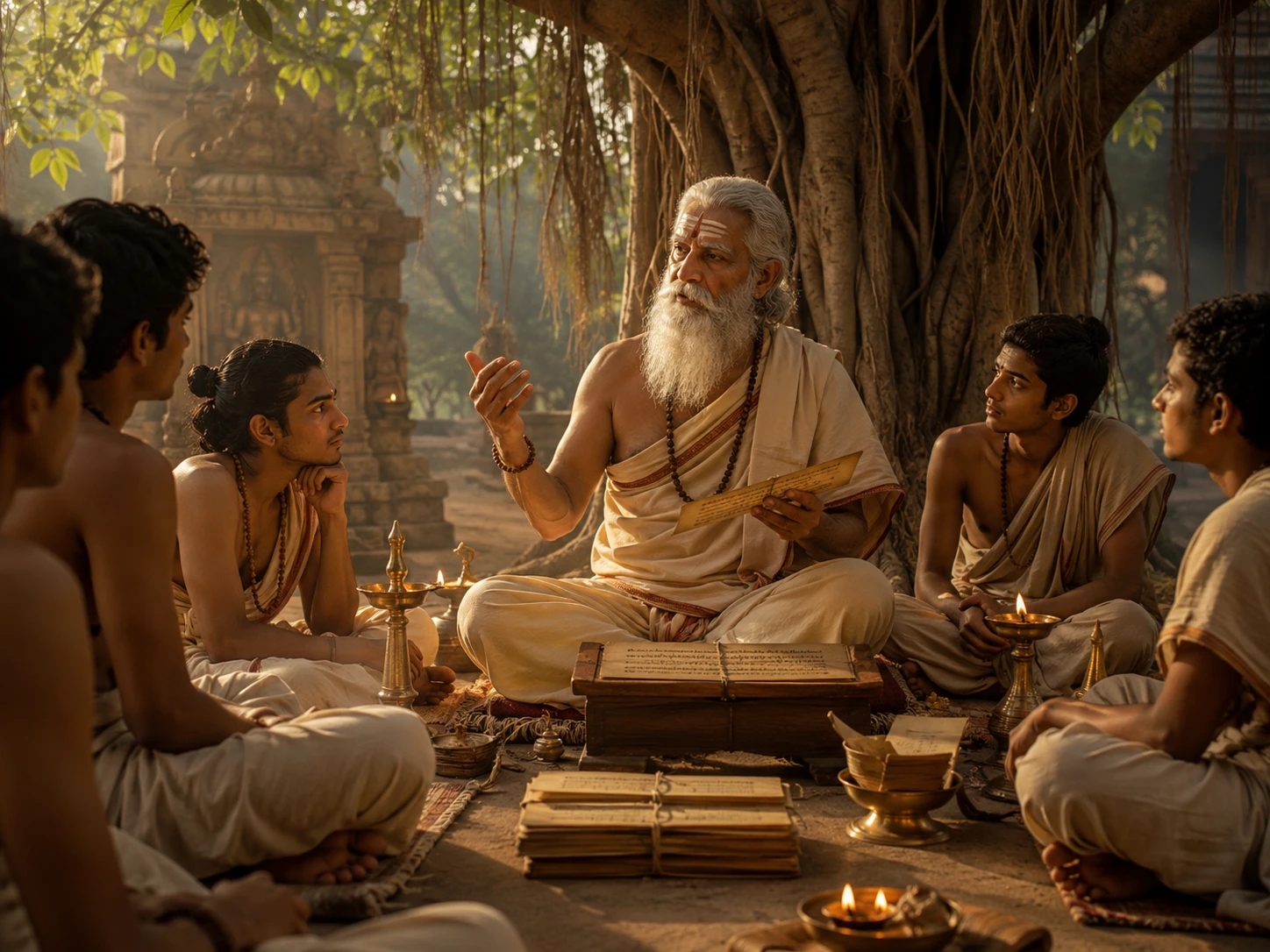
Isha Upanishad -- The Complete Guide to 18 Verses That Changed Indian Philosophy
ईशोपनिषद् -- 18 श्लोकों में पूरा ब्रह्माण्ड, पूरा जीवन-दर्शन
There is a reason the Isha Upanishad comes last in the Shukla Yajurveda and yet is placed first in almost every Upanishad anthology. It is the text that most directly answers the question every thinking person eventually asks: how do I live in this world -- with its pleasures, its demands, its relentless motion -- without losing my centre?
The title itself is the answer. Isha means 'by the Lord.' Vasya means 'to be enveloped, to be pervaded.' The very first word of the very first verse declares: everything that exists, everything that moves in this moving world, is pervaded by Ishvara. You do not need to leave the world to find the sacred. The sacred is already inside the world. Your job is to see it.
This is a radical position in Indian philosophy -- and it was radical three thousand years ago when it was composed. The dominant Vedic culture of the time was ritualistic. You earned merit through yajnas, through dakshina, through correct performance of ceremony. The Isha Upanishad does not reject ritual. But it insists that ritual without Self-knowledge is blindness. And it insists, equally, that Self-knowledge without action in the world is a different kind of blindness. Both are needed. Neither alone is sufficient.
The text has only 18 verses in the Kanva recension (17 in the Madhyandina recension). It belongs to the 40th and final chapter of the Shukla Yajurveda Samhita. This placement is significant -- it comes after all the ritual instructions, as if the Veda itself is saying: now that you have learned everything about how to perform sacrifices, here is the one thing that actually matters.
ईशावास्यमिदं सर्वं यत्किञ्च जगत्यां जगत् । तेन त्यक्तेन भुञ्जीथा मा गृधः कस्य स्विद्धनम् ॥ १ ॥
īśāvāsyamidaṃ sarvaṃ yatkiñca jagatyāṃ jagat | tena tyaktena bhuñjīthā mā gṛdhaḥ kasya sviddhanam || 1 ||
All this -- whatever moves in this moving world -- is pervaded by the Lord. Enjoy through renunciation. Do not covet, for whose is wealth?
— Isha Upanishad (Ishavasya Upanishad), Verse 1; Shukla Yajurveda Samhita, Adhyaya 40, Kanva recension
This opening verse is one of the most debated in all of Indian philosophy. The phrase 'tena tyaktena bhunjitha' -- enjoy through renunciation -- sounds paradoxical. How can you enjoy something by giving it up? But the Upanishad is not asking you to become a cave-dwelling ascetic. It is asking you to change the operating system of your desire.
Think of it this way. A JEE aspirant in Kota who is consumed by anxiety about rank -- every meal tastes like cardboard, every friendship is measured against study hours, every sunset is wasted time. That student is in the world but not enjoying it. Now picture a student who studies with full intensity but does not attach identity to the outcome -- who can laugh at dinner, notice the sky, sleep without dread. Same world. Same Kota hostel. Radically different experience. That is what 'tena tyaktena bhunjitha' means in practice.
Shankara's Advaita reading interprets 'Isha' as the Paramatman, the Supreme Self, which is identical with the individual Atman. The world is pervaded by Brahman because the world IS Brahman -- there is nothing outside it. His reading makes this an ontological statement: reality is non-dual. Ramanuja's Vishishtadvaita reading interprets 'Isha' as Narayana, the personal God who indwells all things as their inner controller (antaryamin). The world is pervaded by God because God is present in every atom as its sustaining force. Same verse, radically different metaphysics -- and both readings have been held for over a thousand years.
Madhva's Dvaita school reads it as a declaration of God's sovereignty -- everything belongs to Isha, therefore nothing belongs to you, therefore do not be greedy. Three Acharyas, three readings, one verse. This is why the Isha Upanishad is considered the seed-text of Vedanta.
Verse 2 delivers the practical instruction: 'kurvann eveha karmani jijivishet shatam samah' -- performing actions right here, one should wish to live a hundred years. This is not a longevity mantra. It is a philosophical bombshell. The Upanishad is saying: do not run away from life. Stay. Act. Work. But do it in such a way that karma does not stick to you. How? By seeing all action as pervaded by Isha (verse 1).
This is the exact tension that the Bhagavad Gita will later explore across 700 verses -- the reconciliation of action and renunciation. The Isha Upanishad does it in two verses. Some scholars believe Krishna's teaching in the Gita is essentially an extended commentary on the first two verses of the Isha Upanishad.
Verses 3 through 8 form the metaphysical core. Verse 3 warns about 'asurya' -- demonic or sunless worlds to which those who slay the Self are condemned. Shankara reads 'atmahanah' (slayers of the Self) as those who deny their own Atman through ignorance. You do not need to commit a dramatic sin. Simply not recognizing your true nature is the killing.
Verses 4 and 5 deliver one of the great paradoxes of Upanishadic thought: 'It moves, It moves not. It is far, It is near. It is within all this, and It is outside all this.' This is not contradictory. It is describing something that transcends the categories of motion, space, and location -- categories which only apply to objects within consciousness, not to consciousness itself. If you have ever tried to locate your own awareness -- where exactly IS the thing that is aware right now? -- you have encountered this paradox firsthand.
Verse 6 gives the ethical consequence: 'He who sees all beings in the Self, and the Self in all beings, never shrinks from anything.' This is the origin of the ahimsa argument in Vedantic terms. Violence is not wrong because of an external commandment. Violence is wrong because the person you harm IS you -- literally, at the level of Atman. The person cutting you off in Pune traffic shares the same Self as you. The domestic help in your apartment, the Zomato delivery rider in the rain, the slum kid selling roses at the signal -- same Atman. The Upanishad does not say 'be nice to them.' It says 'recognise that you ARE them.'
Isha Upanishad -- Three Vedantic Interpretations of Key Verses
| Verse / Concept | Advaita (Shankara) | Vishishtadvaita (Ramanuja) | Dvaita (Madhva) |
|---|---|---|---|
| Isha (Lord) in Verse 1 | Paramatman identical with Atman; Brahman pervades because Brahman IS the world (vivarta) | Narayana as Antaryamin (inner controller) who indwells all beings and matter | Vishnu as sovereign ruler; everything is His property, jiva is eternally distinct |
| Tena tyaktena bhunjitha (Enjoy through renunciation) | Renounce the superimposition of names-forms on Brahman; enjoy the bliss of Self-knowledge | Renounce possessiveness, enjoy as a trustee knowing God is the true owner | Renounce attachment to results, enjoy as God's servant receiving His grace |
| Atmahanah (Slayers of Self) in Verse 3 | Those who deny the Atman through avidya (ignorance); they remain trapped in samsara | Those who neglect the indwelling God; spiritual negligence is self-destruction | Those who do not worship Vishnu; they fall into tamas and lower births |
| Vidya and Avidya (Verses 9-11) | Avidya = karma/ritual; Vidya = Brahma-jnana; both needed, neither alone sufficient | Avidya = worldly knowledge; Vidya = knowledge of God; integration through bhakti | Avidya = material sciences; Vidya = Vedic knowledge of Vishnu; both serve devotion |
| Hiranmayena patrena (Golden Disc, Verse 15) | Maya covers the face of Truth like a golden lid; prayer to remove ignorance | The dazzling splendour of Brahman's form veils His transcendent nature; prayer for vision | The material world (golden disc) obscures the Lord; devotee prays for direct darshana |
All three Acharyas wrote detailed bhashya on Isha Upanishad. The differences are not minor -- they represent fundamentally different metaphysical architectures built on the same 18 verses.
Verses 9 through 14 contain the Isha Upanishad's most structurally complex teaching -- and its most misunderstood. The text says: 'Into blind darkness enter they who worship avidya (ignorance). Into still greater darkness enter they who delight in vidya (knowledge) alone.' Then it says the same thing about 'sambhuti' (creation/manifested) and 'vinasha' (destruction/unmanifested).
This has puzzled commentators for centuries. Why would the Upanishad condemn knowledge? The answer lies in understanding what avidya and vidya mean in this context. They do not mean 'ignorance' and 'knowledge' in the ordinary sense. Avidya here refers to karma-kanda -- the path of ritual action and worldly engagement. Vidya refers to upasana or jnana -- meditative knowledge and contemplation of the divine.
The Upanishad's position is devastatingly balanced: the person who only does rituals without understanding their deeper meaning is in darkness. But the person who only pursues abstract knowledge while neglecting duty, action, and engagement with the world is in even deeper darkness -- because they know better and still retreat. This is directly relevant to every UPSC aspirant who quits their job to 'find themselves' in Rishikesh, every startup founder who reads Vedanta but treats employees like resources, every NRI who meditates daily but has not called their ageing parents in Bhopal for six months.
The integration of vidya and avidya -- knowledge and action, contemplation and engagement, the transcendent and the worldly -- is the Isha Upanishad's signature contribution. It refuses the false binary that most spiritual traditions create between the sacred and the secular. The householder who teaches their child to share lunch at school is performing a spiritual act. The engineer who builds an honest bridge is performing a spiritual act. The doctor in a government hospital in Jharkhand who actually shows up for her shift is performing a spiritual act. None of these people need a guru, a mantra, or a Himalayan cave. They need the awareness described in verse 1 -- the awareness that Isha pervades all this.
हिरण्मयेन पात्रेण सत्यस्यापिहितं मुखम् । तत्त्वं पूषन्नपावृणु सत्यधर्माय दृष्टये ॥ १५ ॥
hiraṇmayena pātreṇa satyasyāpihitaṃ mukham | tattvaṃ pūṣannapāvṛṇu satyadharmāya dṛṣṭaye || 15 ||
The face of Truth is hidden by a golden disc. O Pushan (Sun, nourisher), remove it, so that I -- who am devoted to Truth -- may behold it.
— Isha Upanishad, Verse 15; Shukla Yajurveda Samhita, Adhyaya 40
Verse 15 is among the most beautiful prayers in Sanskrit literature. The seeker addresses the sun -- Pushan, the nourisher -- and asks him to remove the golden disc that covers the face of Truth. The metaphor is precise: the very brilliance that illuminates the world also blinds you to what lies behind it. The dazzle of the manifest world (the golden disc) prevents you from seeing the formless reality behind it.
This is phenomenally relevant to modern India. The golden disc today is not the physical sun. It is the glittering surface of achievement, status, and material success that covers the deeper questions. The IIT tag, the foreign posting, the Gurgaon flat, the startup valuation, the Instagram follower count -- all of these are hiranmaya patra, golden vessels that blind precisely because they shine so brightly. The Upanishad does not say the gold is false. It says the gold is a lid. Something real is behind it. You have to ask for the lid to be removed.
Verses 15-18 constitute a death prayer -- they are traditionally recited at the time of death or at the cremation ground. The seeker addresses Surya (sun), Agni (fire), and Vayu (wind), asking for the dissolution of the body and the liberation of the breath-Self (prana-atman). Verse 17 is especially powerful: 'Let this body end in ashes. Om. O mind, remember your deeds. Remember. O mind, remember your deeds. Remember.' The repetition is not accidental. At the moment of death, the Upanishad says, what matters is not your bank balance or your LinkedIn profile. What matters is whether you lived with awareness.
The Isha Upanishad's Shanti Patha (peace invocation) is itself legendary: 'Om purnamadah purnamidam purnat purnamudachyate / purnasya purnamadaya purnamevavashishyate' -- That is full, this is full, from the full the full is taken, and the full alone remains. This is not mathematics. This is the Upanishad's final teaching: infinity minus infinity is still infinity. You cannot diminish Brahman by extracting the universe from it. The source is never depleted. The well never runs dry.
The Isha Upanishad had an extraordinary afterlife in modern Indian thought. Mahatma Gandhi considered it the single most important text in Hinduism. He wrote in 1932: 'If all the Upanishads and all the other scriptures happened all of a sudden to be reduced to ashes, and if only the first verse in the Ishopanishad were left in the memory of Hindus, Hinduism would live for ever.' This is not empty praise. Gandhi's entire political philosophy of trusteeship -- the idea that the wealthy hold property not as owners but as trustees for society -- comes directly from 'tena tyaktena bhunjitha.'
Vinoba Bhave, Gandhi's spiritual heir, launched the Bhoodan (land gift) movement in 1951 with explicit reference to the Isha Upanishad. The argument was simple: if all this is pervaded by the Lord, then no one truly owns land. Those who have excess must give. This was Vedanta applied to agrarian reform.
Swami Vivekananda drew on the Isha Upanishad when constructing his idea of Practical Vedanta -- the notion that spirituality must manifest as service. His famous statement 'To serve man is to serve God' is a direct translation of verse 6 into social action. Sri Aurobindo wrote extensive commentaries on the Isha Upanishad, seeing it as the foundation for his integral yoga -- the reconciliation of the spiritual and material, the ascending and descending arcs of consciousness.
In academic philosophy, the Isha Upanishad remains a primary text in university syllabi across India. It appears in UPSC philosophy optional papers, in NET examinations, and in comparative philosophy courses at JNU, BHU, and Pune University. Its brevity makes it ideal for close reading -- each of the 18 verses can sustain an entire semester of seminar discussion.
The Isha Upanishad also holds a unique structural position in Vedic literature. As the 40th chapter of the Shukla Yajurveda Samhita, it is technically part of the Samhita layer -- the oldest textual layer of the Vedas. Most Upanishads belong to the Aranyaka or Brahmana layers. This makes the Isha Upanishad a 'Samhita Upanishad' -- a philosophical text embedded directly in the hymn collection, not in a later commentary or forest treatise.
This matters because it means the Isha Upanishad's ideas were considered essential enough to be woven into the primary liturgical text itself. The priests who chanted the Yajurveda at sacrifices would have encountered these philosophical verses at the very end of their recitation -- a deliberate culmination.
The two recensions -- Kanva and Madhyandina -- differ slightly. The Kanva version has 18 verses and is the more commonly studied. The Madhyandina has 17, omitting what is verse 18 in the Kanva. Both belong to the Shukla (White) Yajurveda tradition. The Krishna (Black) Yajurveda does not contain the Isha Upanishad -- it has its own philosophical texts, notably the Taittiriya and Katha Upanishads.
For the student encountering Upanishadic thought for the first time, the Isha Upanishad is the ideal entry point. It is short enough to memorise. It is direct enough to understand. And it is deep enough that you will find new meaning in it every decade of your life. The person who reads it at 18 before a college entrance exam will read it differently at 35 during a career crisis, and differently again at 60 when the questions of death and legacy become real.
The Isha Upanishad's treatment of death in its closing verses (15-18) deserves special attention because it addresses what most people actually fear when they think about spirituality. Verse 17 is recited at Hindu funerals across India -- 'vayur anilam amritam / athedam bhasmantam shariram' -- let this body be reduced to ashes, but the breath-Self is immortal. This is not a consolation. It is a factual claim about the nature of identity. The Upanishad asserts that what you call 'I' is not the body that will burn on the pyre. The body is fuel. The Self is the fire's witness.
The prayer to Agni in verse 18 is remarkable for its emotional honesty. The seeker asks: 'O Agni, lead us by the good path to prosperity. You know all our deeds. Remove from us deceitful sin. We offer you our deepest word of salutation.' This is not the prayer of someone who has transcended all desire. This is the prayer of a human being who knows they have failed, who knows they have taken wrong paths, and who asks for guidance anyway. The Isha Upanishad does not demand perfection. It demands honesty.
In contemporary India, the death verses have acquired a new resonance. The first generation of post-liberalisation Indians -- those who grew up in the 1990s and 2000s -- are now reaching the age where parents are dying, where health scares are becoming real, where the question 'what have I actually done with my life?' stops being philosophical and starts being urgent. These are the verses for that moment. Not comforting verses. Not numbing verses. Verses that say: yes, this body will burn. And: the thing that matters is not the body. The thing that matters is whether your actions were aligned with satya-dharma -- truth-in-action.
The Isha Upanishad has also been a source of ecological thought in Hindu environmentalism. If everything is pervaded by Isha, then polluting a river is not merely an environmental crime -- it is a desecration. If every moving thing in this moving world is enveloped by the divine, then deforestation is a form of spiritual violence. Sunderlal Bahuguna, the leader of the Chipko movement in the 1970s, drew directly from the Isha Upanishad when he argued that trees have the same divine indwelling as humans. The movement to protect the Narmada, the Ganga, the Western Ghats -- all of these draw, whether explicitly or implicitly, on the radical non-dualism of verse 1.
For the student approaching the Isha Upanishad as a primary text, the commentarial tradition offers three essential gateways. Shankara's bhashya (8th century) reads every verse through the lens of Brahman-Atman identity and the superimposition theory (adhyasa) -- the world appears real but is ultimately a projection on the changeless substrate. His reading transforms the Isha Upanishad into a manual for jnana yoga. Ramanuja's commentary (11th century) reads the same verses as a hymn to Narayana's indwelling presence -- the world is real, Brahman is its inner controller, and the correct response is loving surrender (prapatti). Madhva's commentary (13th century) reads it as an assertion of God's absolute sovereignty and the jiva's eternal dependence.
What makes the Isha Upanishad extraordinary is that all three readings are textually defensible. The text is precise enough to generate rigorous philosophical systems yet open enough to support fundamentally different metaphysical conclusions. This is not vagueness -- it is the mark of a text that operates at a level deeper than any single system can capture. The physicist Niels Bohr kept a representation of the yin-yang symbol with the motto 'Contraria sunt complementa' -- opposites are complementary. The Isha Upanishad had already demonstrated this principle in Indian thought: vidya and avidya are both needed, sambhuti and vinasha are both real, action and renunciation are both essential. The reconciliation of opposites is not a compromise. It is the highest teaching.
The Isha Upanishad's Shanti Patha -- 'Om Purnamadah Purnamidam' (That is full, this is full) -- was independently discovered by German mathematician Georg Cantor in the 1870s as a property of infinite sets. Cantor proved that you can remove an infinite subset from an infinite set and the original set remains the same size (the same 'cardinality'). The Upanishadic seers expressed this as 'purnat purnamudachyate, purnasya purnamadaya purnamevavashishyate' -- from the full, the full emerges, and the full alone remains. IIT mathematicians have noted the structural parallel: infinity minus infinity equals infinity is not just mystical poetry. It is set theory, stated 2,500 years before Cantor.
Chant the Isha Upanishad Shanti Patha
Begin your meditation with the 'Om Purnamadah Purnamidam' invocation. The Isha Upanishad's peace prayer reminds you that nothing is ever lost -- the source is infinite, and so are you.
Tags
Eternal Raga · शाश्वत राग
Institutional voice — scholarly articles on Sanatan Dharma
Deepen Your Understanding
अपनी समझ और गहरी करें
philosophy darshana
The Four Mahavakyas -- Upanishadic Sentences That Changed Civilisation
Four sentences. Twelve words of Sanskrit. Three thousand years of commentary. The Mahavakyas are the most compressed, most powerful, and most debated statements in all of Indian philosophy. Each one claims that the individual self and the ultimate reality of the universe are not two different things. And each one has been interpreted to mean something completely different by every major school of Vedanta.
scriptural exegesis
Kena Upanishad -- 'By Whom?' The Question That Humbled the Gods
By whom is the mind directed? By whom does the first breath move? By whose will do people speak? The Kena Upanishad opens with the most dangerous question a human can ask: what is the power behind my own power? It then delivers the answer through one of the greatest stories in Upanishadic literature -- the tale of Agni, Vayu, and Indra who could not burn, blow, or even identify a single blade of grass when challenged by Brahman. The goddess Uma Haimavati had to appear to tell them the truth they were too proud to see.
scriptural exegesis
Katha Upanishad -- Nachiketa and Yama
A teenage boy walks into the house of Death, waits three days without food, and then proceeds to negotiate the universe's deepest secret out of Yama himself. The Katha Upanishad is not a dusty scripture -- it is the original startup pitch where a kid with zero leverage outplayed the CEO of the afterlife.
scriptural exegesis
Chandogya Upanishad -- Tat Tvam Asi
A 24-year-old returns from 12 years of Vedic study, bloated with pride and stuffed with textbook knowledge, only to have his father demolish his certainty with nine repetitions of three words: Tat Tvam Asi -- You Are That. The Chandogya Upanishad is the text that broke the wall between God and you.
philosophy darshana
Advaita Vedanta Explained -- Shankara's Radical Philosophy of Non-Duality
You are not your job title. You are not your Instagram bio. According to Adi Shankaracharya, you are not even your body or mind -- you are Brahman itself, the infinite consciousness wearing a temporary costume. Advaita Vedanta is the most radical philosophical claim in Indian history: that the entire universe is one undivided reality, and separation is the grandest illusion.
philosophy darshana
Atman and Brahman -- The Self and the Absolute
The Upanishads make a claim so radical that 3,000 years have not dulled its edge: the individual self (Atman) and the ultimate reality of the universe (Brahman) are not two different things. They are one. Every school of Hindu philosophy is essentially an argument about what this identity means.
philosophy darshana
Karma Explained -- Not Punishment, Not Reward, but the Physics of Action
Karma is not cosmic revenge. It is not 'what goes around comes around.' It is India's most sophisticated theory of causation -- a framework that explains why your choices matter, why consequences are inescapable, and why freedom is still possible. The Gita's karma teaching changed Oppenheimer's life. It might change yours.
The Isha Upanishad's Shanti Patha -- 'Om Purnamadah Purnamidam' (That is full, this is full) -- was independently discovered by German mathematician Georg Cantor in the 1870s as a property of infinite sets. Cantor proved…
More in Scriptural Exegesis
Abhimanyu and the Chakravyuha -- The Boy Who Knew How to Enter but Not How to Leave
14 min read
Adbhuta Ramayana -- The Ramayana Where Sita Becomes Kali
9 min read
After Kurukshetra -- What Happened Next
14 min readThe same translation error that turned '33 Koti' into '33 crore' in Hinduism also happened in Buddhism. The Chinese translation of Buddhist texts rendered 'Sapta Koti Buddha' (7 Supreme Buddhas) as '7 Crore Buddhas.' The…
Deities AvatarsCommunity Reflections
🕉️
Be the first to share your reflection.