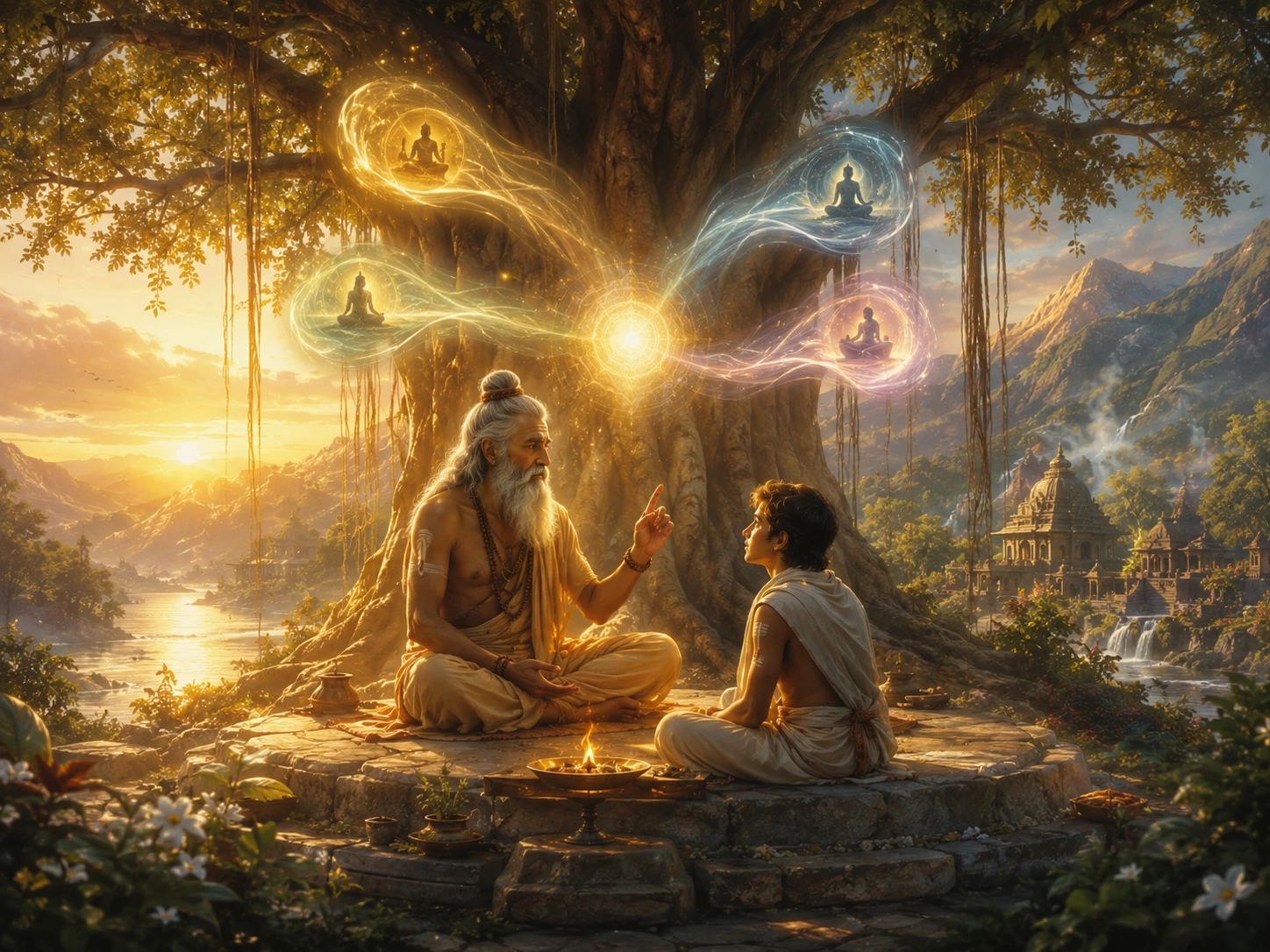
Kena Upanishad -- 'By Whom?' The Question That Humbled the Gods
केनोपनिषद् -- 'किसके द्वारा?' वह प्रश्न जिसने देवताओं को झुका दिया
The Kena Upanishad begins where every honest inquiry must begin -- with a confession of ignorance disguised as a question. 'Keneshitam' -- by whom? By whose will does the mind fly to its object? By whose command does the first breath move? Who is the god that harnesses the eyes and the ears?
Notice what the question is NOT asking. It is not asking 'what is the mind made of' (that would be neuroscience). It is not asking 'how does the eye see' (that would be optics). It is asking: what is the POWER behind the power? Your eye can see -- but what enables the seeing? Your mind can think -- but what enables the thinking? There is a difference between the instrument and the force that animates the instrument. The Kena Upanishad is asking about the force.
This belongs to the Samaveda, specifically the Talavakara Brahmana (which is why it is also called the Talavakara Upanishad). It is listed as number 2 in the Muktika canon of 108 Upanishads. The text has an unusual hybrid structure -- the first two khandas (sections) are metrical verse, the last two are prose narrative. Scholars like Paul Deussen believe the prose section (the Yaksha story) is actually older than the poetic section, suggesting the Kena Upanishad bridges two eras of Upanishadic composition.
The text is short -- roughly 34 verses and prose paragraphs across four khandas. But its intellectual architecture is surgical. Khandas 1 and 2 establish the philosophical argument through negative theology (Brahman is not what you worship, not what you perceive, not what you think you know). Khandas 3 and 4 deliver the same teaching through a story so vivid that it has survived three millennia of retelling without losing a single ounce of impact.
केनेषितं पतति प्रेषितं मनः केन प्राणः प्रथमः प्रैति युक्तः । केनेषितां वाचमिमां वदन्ति चक्षुः श्रोत्रं क उ देवो युनक्ति ॥ १ ॥
keneṣitaṃ patati preṣitaṃ manaḥ kena prāṇaḥ prathamaḥ praiti yuktaḥ | keneṣitāṃ vācamimāṃ vadanti cakṣuḥ śrotraṃ ka u devo yunakti || 1 ||
By whom willed and directed does the mind go forth? By whom commanded does the first breath move? By whose will do people utter this speech? What god directs the eyes and the ears?
— Kena Upanishad, Khanda 1, Verse 1; Talavakara Brahmana of Samaveda
The teacher's answer in Khanda 1 is a masterclass in negative theology -- defining something by systematically denying what it is not. 'It is the ear of the ear, the mind of the mind, the speech of speech, the breath of breath, the eye of the eye.' This is not mystical obscurantism. It is making a precise epistemological point.
Consider your ear. It hears sounds. But the ear does not know that it is hearing. The awareness that 'I am hearing' is not in the ear -- it is in something behind the ear. That something is consciousness, and the Kena Upanishad calls it Brahman. It is 'the hearing behind hearing, the seeing behind seeing, the thinking behind thinking.' Every instrument of perception depends on something that is not itself an instrument of perception.
This is the move that changes everything. Most spiritual traditions tell you to look outward -- worship this god, perform this ritual, visit this temple. The Kena Upanishad tells you to look at the looker. Who is the one that is reading these words right now? Not your eyes -- they are instruments. Not your brain -- it is a processor. The one who is aware that reading is happening -- what is that? The Kena Upanishad says: that is Brahman. And then it says something even more radical: 'It is different from the known, and It is beyond the unknown.' (Verse 3)
This is not agnosticism. It is a specific technical claim: Brahman cannot be an object of knowledge because it is the SUBJECT of all knowledge. You cannot see your own eye without a mirror. You cannot think about the thinker without the thinker becoming an object -- at which point it is no longer the thinker. This is why the Upanishad's most famous paradox works: 'It is known to him who says he knows it not; it is not known to him who says he knows it.' (Verse 2.3)
Every IIT student who has aced thermodynamics but cannot explain why they love their mother -- every neuroscientist who can map the brain but cannot locate consciousness within it -- every AI researcher at a Bangalore startup who builds systems that process language but cannot explain what 'understanding' is -- they are all running into the Kena Upanishad's wall. The instrument cannot comprehend the force that animates the instrument. The software cannot debug the programmer.
यन्मनसा न मनुते येनाहुर्मनो मतम् । तदेव ब्रह्म त्वं विद्धि नेदं यदिदमुपासते ॥ ५ ॥
yanmanasā na manute yenāhurmano matam | tadeva brahma tvaṃ viddhi nedaṃ yadidamupāsate || 5 ||
That which is not thought by the mind, but by which, they say, the mind thinks -- know That alone to be Brahman, not this which people worship here.
— Kena Upanishad, Khanda 1, Verse 5 (also marked as 1.6 in some editions)
Now comes the story that makes the Kena Upanishad unforgettable. Khandas 3 and 4 shift from verse to prose, from abstract philosophy to vivid narrative. And the narrative is devastating.
The gods (devas) have just won a great victory over the demons (asuras). They are celebrating. They are congratulating themselves. 'This victory is ours! This glory is ours!' They have forgotten -- or perhaps they never knew -- that the power they used in battle was not their own. It was Brahman's.
Brahman notices the gods' arrogance and decides to teach them a lesson. It appears before them as a Yaksha -- a mysterious, radiant being. The gods do not recognize it. They send Agni, the god of fire, to investigate.
Agni approaches the Yaksha. The Yaksha asks: 'Who are you?' Agni declares proudly: 'I am Agni! I am Jatavedas! I can burn anything on this earth!' The Yaksha places a single blade of grass before Agni and says: 'Burn this.' Agni rushes at it with his full power. He cannot burn it. Not even singe it. He retreats in confusion.
Next goes Vayu, the god of wind. Same question, same boast -- 'I am Vayu! I am Matarishva! I can blow away anything on earth!' Same test -- one blade of grass. 'Blow this away.' Vayu hurls himself at it. Cannot move it an inch. He too retreats.
Finally Indra himself goes -- the king of the gods, lord of lightning, the mightiest of the mighty. But when Indra approaches, the Yaksha vanishes. In its place appears a radiant woman -- Uma Haimavati, the daughter of the Himalayas. Indra asks her: 'What was that being?' And Uma replies: 'That was Brahman. It is through Brahman's power that you achieved your victory, not your own.'
This story is doing several things simultaneously. At the surface level, it is a humility lesson: the gods were arrogant, and Brahman humbled them. But at a deeper level, it is demonstrating the Kena Upanishad's philosophical thesis through narrative. Agni's power to burn, Vayu's power to blow, Indra's power to strike -- none of these powers belong to the gods themselves. The power behind the power is Brahman. The fire does not burn by its own strength. Something enables the burning. That something is Brahman.
The appearance of Uma Haimavati is one of the most significant moments in all Upanishadic literature -- and it is frequently overlooked. Consider what happens: the three most powerful male gods in the Vedic pantheon -- Agni, Vayu, Indra -- all fail to comprehend Brahman through their own power. Knowledge comes not from any of them but from a goddess. Uma appears unbidden, unsent by anyone. She is not a messenger. She IS the knowledge.
Shankara interprets Uma Haimavati as Brahma-vidya personified -- the knowledge of Brahman itself appearing in feminine form. This is not incidental. The Upanishadic tradition consistently associates wisdom-transmission with feminine figures -- Gargi challenges Yajnavalkya in the Brihadaranyaka, Maitreyi demands the highest teaching from the same sage, and here Uma reveals to Indra what no god could discover through brute force.
The feminist reading is available but the metaphysical reading is even more interesting. The masculine gods represent power, agency, action -- they are the doers. They rush towards the Yaksha. They attempt. They fail. Uma represents a different mode of knowing -- not through force but through receptivity, not through ego but through grace. She does not rush anywhere. She simply appears. She simply knows. And her knowledge is immediate, direct, effortless.
This maps precisely onto the epistemology of the first two khandas. You cannot know Brahman by attacking it intellectually (Agni rushing at the grass). You cannot know it by forcing your way through meditation (Vayu blowing at the grass). You cannot even know it by being the king of all knowers (Indra approaching). You know it when the knowledge arises in you -- when grace appears. When you stop trying to know and simply become available to knowing.
Every competitive exam aspirant in India has experienced this. You study thermodynamics for weeks, batter the concept, memorise the formulas. Nothing clicks. Then one morning in the shower, the insight arrives uninvited. That shower insight is Uma Haimavati. The months of struggle were Agni and Vayu. The moment of surrender and the sudden understanding is Indra meeting the goddess.
Kena Upanishad -- The Three Gods and Their Failures
| God | Self-Declaration | Claimed Power | Test | Result | Philosophical Symbolism |
|---|---|---|---|---|---|
| Agni (Fire) | I am Agni, I am Jatavedas | I can burn anything on earth | Burn this blade of grass | Failed completely | Speech (Vak) -- the naming power cannot describe Brahman (Khanda 1: 'what speech cannot express') |
| Vayu (Wind) | I am Vayu, I am Matarishva | I can carry away anything on earth | Blow this blade of grass away | Failed completely | Prana (vital force) -- the life-breath cannot grasp Brahman (Khanda 1: 'what prana cannot breathe') |
| Indra (Lightning / King of Gods) | Approached with curiosity rather than boast | Supreme power over all | Yaksha disappeared before testing | Received knowledge from Uma | Manas (mind) -- the mind cannot think Brahman as an object but can receive knowledge through grace |
The three gods map onto the three faculties discussed in Khanda 1 (Vak, Prana, Manas). Agni = speech, Vayu = breath, Indra = mind. Shankara explicitly draws this parallel in his Vakyabhashya.
The fourth khanda closes the Yaksha narrative and then offers a practical instruction for spiritual practice. It describes the recognition of Brahman as being like a flash of lightning -- 'vidyut' -- or the blink of an eye -- 'ah iti.' This is not metaphorical. The Upanishad is saying that the recognition of Brahman is not a gradual process of accumulation. It is sudden. It is instantaneous. It strikes.
This has profound implications for how we understand spiritual progress. The dominant model in popular Hinduism (and most other religions) is incremental: you do more pujas, read more scriptures, meditate more hours, and gradually you get closer to God. The Kena Upanishad's model is different. The preparation may be gradual (Agni tried, Vayu tried, Indra sought), but the recognition itself is instantaneous (Uma appeared, knowledge struck). You do not approach Brahman by degrees. You either see or you do not.
This is strikingly similar to the insight model in Zen Buddhism (satori) and to the concept of 'eureka moments' in scientific discovery. Archimedes did not gradually discover buoyancy. Newton did not slowly figure out gravity. The work was slow, but the insight was sudden. The Kena Upanishad locates spiritual awakening in the same category -- not as the end of a long effort, but as a sudden flash within a long effort.
The closing section offers an epilogue on the disciplines that support this recognition: tapas (austerity), dama (self-restraint), and karma (right action). The Vedas are its limbs; satya (truth) is its foundation. This is the Kena Upanishad's final balance -- it is not anti-effort or anti-discipline. The preparation matters enormously. But the preparation is not the goal. The goal is the lightning strike of understanding that comes when you have done everything you can and then stopped doing.
The Kena Upanishad's relevance to modern India runs deeper than motivational analogies. The Yaksha story is fundamentally about the illusion of agency -- the belief that 'I am the doer.' This is the central delusion of every corporate achiever, every exam topper, every social media influencer who says 'I built this.' The Kena Upanishad does not deny the effort. It denies the ownership of the power behind the effort.
Consider the IIT placement season. A student cracks a 2-crore package at Google. The LinkedIn post follows: 'My journey from a small town to Google -- hard work, resilience, never giving up.' All true. But the Kena Upanishad would add: the intelligence that solved those coding problems, the memory that retained those algorithms, the body that survived those 16-hour study days, the circumstances that placed a coaching centre within reach -- where did all that come from? You worked hard. But the capacity to work hard was not manufactured by you. It was given.
This is not meant to diminish achievement. It is meant to locate achievement accurately. The fire still burns. But Agni does not own the burning. The wind still blows. But Vayu does not own the blowing. You still act, succeed, build, create. But the power behind your action is not your personal property. Recognising this is not weakness. It is the beginning of genuine strength -- the strength that does not collapse when the LinkedIn post gets no likes, when the startup fails, when the body gets a diagnosis.
Shankara's two commentaries on the Kena Upanishad -- the Padabhashya (word-by-word on the verse sections) and the Vakyabhashya (sentence-commentary on the prose sections) -- are among his most detailed works. He treats the verse and prose sections as two complementary modes of the same teaching: philosophy and story, argument and illustration. This two-track approach itself became a model for how Hindu philosophical traditions teach -- always grounding the abstract in the concrete.
The Kena Upanishad is short enough to read in a single sitting. Most people do. Very few people read it only once. Because the question it opens with -- 'By whom?' -- is a question that deepens every time you live through something that your own power could not have predicted, prevented, or produced.
The Kena Upanishad's philosophical structure has a direct bearing on one of the most heated debates in contemporary Indian intellectual life -- the relationship between science and spirituality. Science operates by making the unknown into the known. You take a phenomenon, study it, model it, predict it, and eventually explain it. The Kena Upanishad says: this works beautifully for everything except the knower. You can study the brain. You can map neural correlates. You can build artificial systems that mimic cognition. But the moment you try to study consciousness itself -- not its correlates, not its effects, not its neural substrate, but the raw fact of awareness -- you hit the wall. The instrument cannot study itself.
This is not an anti-science position. The Kena Upanishad is not saying science is wrong. It is saying science has a built-in structural limit -- a limit that science itself cannot cross, because the limit is the scientist. The person conducting the experiment is the one thing the experiment cannot fully capture. This is why the 'hard problem of consciousness' -- why does subjective experience exist? -- remains unsolved after decades of neuroscience. The Kena Upanishad predicted this impasse three thousand years ago. Not as mystical prophecy, but as a logical consequence of its epistemological framework.
In the Indian education system, this matters practically. Every NEET aspirant learns biology -- anatomy, physiology, biochemistry. They learn how the eye works (rods, cones, optic nerve, visual cortex). But no NEET textbook explains why there is a subjective experience of seeing. The mechanism is fully described. The experience is not. The Kena Upanishad's question -- 'who is the god that directs the eye?' -- is the gap between the mechanism and the experience. Modern neuroscience fills in more and more detail about the mechanism. The gap remains exactly where it was.
The Kena Upanishad has also been central to inter-religious philosophical dialogue. Christian theologians have compared the Yaksha story to the theophany traditions in the Hebrew Bible -- God appearing in forms that humble human presumption (the burning bush, the still small voice). Islamic Sufi scholars have drawn parallels with the hadith about God being a hidden treasure wanting to be known. The Kena Upanishad's insistence that Brahman is 'different from the known and beyond the unknown' resonates with the apophatic theology of Pseudo-Dionysius and Meister Eckhart in the Christian tradition. This is not syncretism -- these are genuinely independent philosophical discoveries converging on the same structural insight: ultimate reality cannot be an object of the mind because it is the ground of the mind.
The Kena Upanishad's pedagogical method is worth studying for its own sake. It uses two entirely different modes of instruction for the same teaching. The verse sections (Khandas 1-2) use dialectical negation -- 'not this, not this' -- dismantling each faculty until nothing is left except the aware subject. The prose sections (Khandas 3-4) use story -- a narrative with characters, conflict, failure, and revelation. Same truth. Two completely different delivery systems.
This dual-track method became a template for Indian philosophical teaching. The Bhagavad Gita uses exactly the same structure -- abstract metaphysics (Sankhya yoga, Jnana yoga) alternating with vivid narrative (Arjuna's crisis, the Vishvarupa revelation). Shankara's own method mirrors it -- rigorous Brahma-sutra analysis followed by devotional hymns and accessible stories. The Kena Upanishad may be the earliest surviving example of this pedagogical insight: human beings need both logical argument and emotional narrative to genuinely understand something. Neither alone is sufficient.
For modern educators -- whether in IIT classrooms, UPSC coaching centres, or corporate training rooms -- the Kena Upanishad's method has a direct application. If you only teach theory (the verse approach), students can reproduce formulas without understanding. If you only teach through stories (the prose approach), students feel inspired but cannot apply. The Kena Upanishad's solution is to do both, in sequence: first the hard thinking, then the living illustration. The grass that cannot be burned is worth a thousand abstract arguments about the limits of empirical knowledge.
The Kena Upanishad's Yaksha story inspired French poet Victor Hugo to write a poem based on it in the 19th century. Hugo's version has Indra declaring to the Light (Brahman): 'I see everything! I know everything!' -- to which the Light replies by placing a blade of straw before him. Hugo interpreted the story as a parable about the limits of human knowledge before the infinite -- and it became one of the earliest examples of Hindu philosophy entering mainstream European literature. Separately, the hard problem of consciousness in modern philosophy (formulated by David Chalmers in 1995) -- the question of why subjective experience exists at all -- is structurally identical to the Kena Upanishad's opening question: by WHOM does the mind think? Three thousand years later, neuroscience still cannot answer the question that this Samaveda text asked.
Meditate on the 'Witness Behind the Witness'
The Kena Upanishad teaches that Brahman is the ear of the ear, the mind of the mind. Try this: close your eyes and observe your own thoughts. Then ask: who is the one observing? That silent witness is what the Kena Upanishad points to. The 'Seeing the Seeing' dharana on Eternal Raga sits with the same inquiry.
Tags
Eternal Raga · शाश्वत राग
Institutional voice — scholarly articles on Sanatan Dharma
Deepen Your Understanding
अपनी समझ और गहरी करें
philosophy darshana
The Four Mahavakyas -- Upanishadic Sentences That Changed Civilisation
Four sentences. Twelve words of Sanskrit. Three thousand years of commentary. The Mahavakyas are the most compressed, most powerful, and most debated statements in all of Indian philosophy. Each one claims that the individual self and the ultimate reality of the universe are not two different things. And each one has been interpreted to mean something completely different by every major school of Vedanta.
scriptural exegesis
Isha Upanishad -- The Complete Guide to 18 Verses That Changed Indian Philosophy
Eighteen verses. That is all. The Isha Upanishad is the shortest of the principal Upanishads -- the final chapter of the Shukla Yajurveda -- and yet it tackles more ground in fewer words than most philosophical treatises manage in hundreds of pages. Enjoy the world through renunciation. Act for a hundred years without attachment. See your Self in all beings. These are not greeting-card platitudes. They are precision-engineered instructions for living in the world without being destroyed by it. Gandhi called it the essence of Hinduism. Shankara built his Advaita commentary around it. And its opening verse remains the most quoted line in all Upanishadic literature.
scriptural exegesis
Katha Upanishad -- Nachiketa and Yama
A teenage boy walks into the house of Death, waits three days without food, and then proceeds to negotiate the universe's deepest secret out of Yama himself. The Katha Upanishad is not a dusty scripture -- it is the original startup pitch where a kid with zero leverage outplayed the CEO of the afterlife.
scriptural exegesis
Chandogya Upanishad -- Tat Tvam Asi
A 24-year-old returns from 12 years of Vedic study, bloated with pride and stuffed with textbook knowledge, only to have his father demolish his certainty with nine repetitions of three words: Tat Tvam Asi -- You Are That. The Chandogya Upanishad is the text that broke the wall between God and you.
philosophy darshana
Atman and Brahman -- The Self and the Absolute
The Upanishads make a claim so radical that 3,000 years have not dulled its edge: the individual self (Atman) and the ultimate reality of the universe (Brahman) are not two different things. They are one. Every school of Hindu philosophy is essentially an argument about what this identity means.
philosophy darshana
Advaita Vedanta Explained -- Shankara's Radical Philosophy of Non-Duality
You are not your job title. You are not your Instagram bio. According to Adi Shankaracharya, you are not even your body or mind -- you are Brahman itself, the infinite consciousness wearing a temporary costume. Advaita Vedanta is the most radical philosophical claim in Indian history: that the entire universe is one undivided reality, and separation is the grandest illusion.
scriptural exegesis
Devi Mahatmya -- The Three Charitas That Changed How India Worships the Feminine
700 verses. 13 chapters. Three battles. One thesis: when every god in the universe has failed, a woman finishes the job. The Devi Mahatmya from the Markandeya Purana is not just a scripture -- it is the founding document of Shakta theology and the reason 300 million people celebrate Navaratri.
The Kena Upanishad's Yaksha story inspired French poet Victor Hugo to write a poem based on it in the 19th century. Hugo's version has Indra declaring to the Light (Brahman): 'I see everything! I know everything!' -- to …
More in Scriptural Exegesis
Abhimanyu and the Chakravyuha -- The Boy Who Knew How to Enter but Not How to Leave
14 min read
Adbhuta Ramayana -- The Ramayana Where Sita Becomes Kali
9 min read
After Kurukshetra -- What Happened Next
14 min readThe same translation error that turned '33 Koti' into '33 crore' in Hinduism also happened in Buddhism. The Chinese translation of Buddhist texts rendered 'Sapta Koti Buddha' (7 Supreme Buddhas) as '7 Crore Buddhas.' The…
Deities AvatarsCommunity Reflections
🕉️
Be the first to share your reflection.