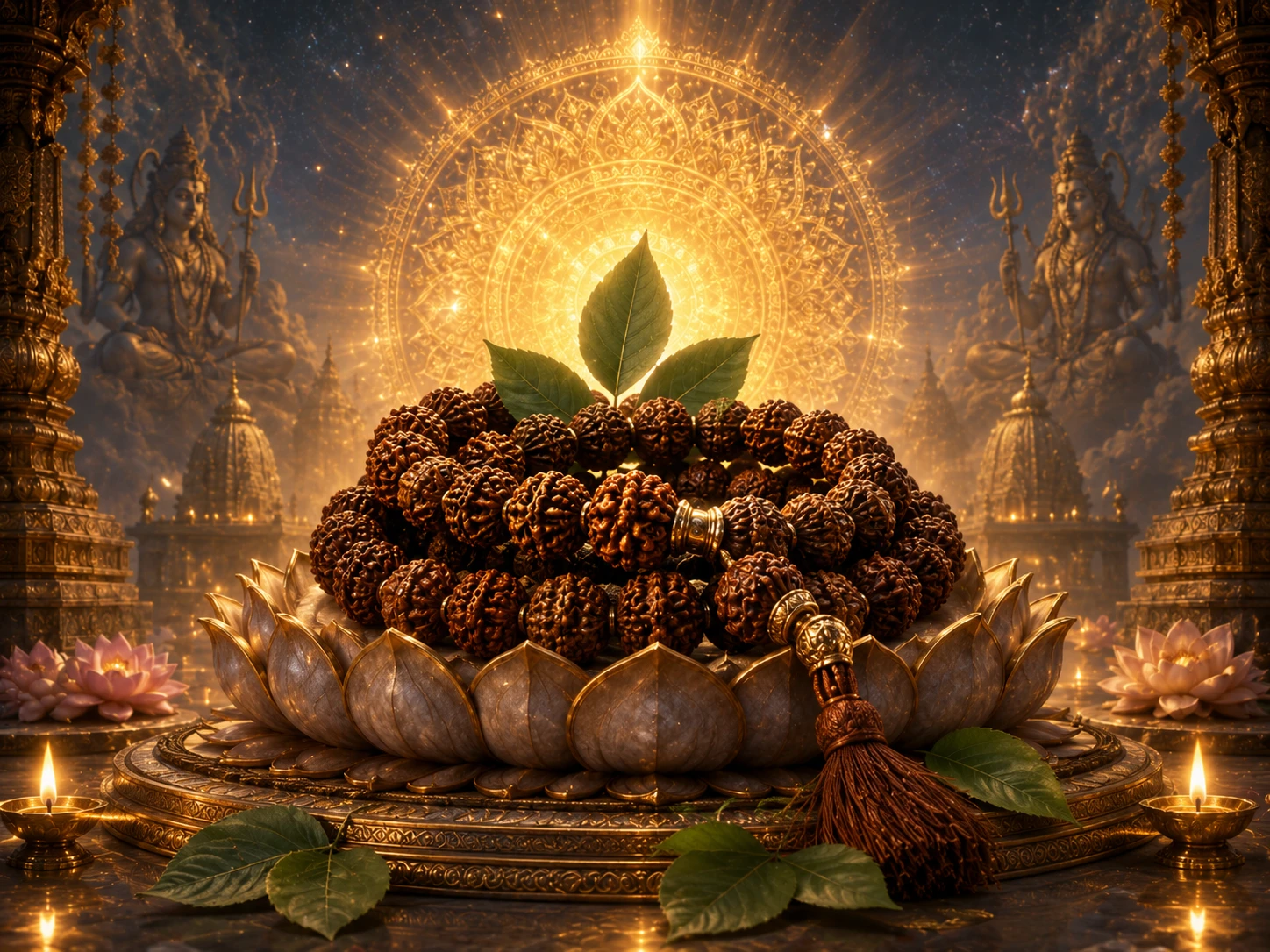
Rudraksha -- Shiva's Tears and the Science Inside the Bead
रुद्राक्ष -- शिव के अश्रु और मनके के भीतर का विज्ञान
The word Rudraksha comes from 'Rudra' (Shiva in his fierce form) and 'Aksha' (eye, or tear). The Shiva Purana and Devi Bhagavata Purana narrate that Shiva once entered a deep meditation for the welfare of all beings. When he opened his eyes after aeons, tears of compassion fell from them. Where these tears touched the earth, Rudraksha trees grew. The seed is literally 'the tear of Shiva' -- solidified compassion, made wearable.
The tree is Elaeocarpus ganitrus Roxb., a large evergreen species of the family Elaeocarpaceae. It grows natively in the sub-Himalayan belt (Nepal, Uttarakhand, Assam), parts of Southeast Asia (Indonesia, Java, Bali), and scattered populations in Papua New Guinea and northern Australia. Nepal produces the most valued beads -- smaller, heavier, more lustrous, and harder than Indonesian specimens, due to the higher altitude and cooler climate. About 75% of commercial Rudraksha globally comes from Indonesia, 20% from India (primarily Haridwar-Rishikesh-Garhwal belt), and 5% from Nepal.
The bead itself is the dried stone (endocarp) of the blue fruit. When the blue outer flesh is removed, the hard seed beneath reveals natural vertical grooves called Mukhis (faces). These Mukhis divide the seed's surface into segments, and their number -- from 1 to 21, though 1-14 are the most commonly discussed -- determines the bead's classification, associated deity, associated planet, and prescribed use in Ayurvedic and Jyotish traditions.
This is where most online guides stop and where this article begins. Because the interesting question is not 'which Mukhi is for which planet.' The interesting question is: does the bead actually do anything measurable? And the answer, as of 2019-2022 peer-reviewed research, is: yes.
रुद्राक्षधारणादेव सर्वपापैः प्रमुच्यते। सर्वदेवमयं प्रोक्तं रुद्राक्षं धारयेत्सदा॥
rudraakShadhaaraNaadeva sarvapaapaiH pramuchyate | sarvadevamayaM proktaM rudraakShaM dhaarayetsadaa ||
By merely wearing Rudraksha, one is freed from all transgressions. Rudraksha is said to contain all deities within it -- one should always wear it.
— Shiva Purana, Vidyeshvara Samhita, Chapter on Rudraksha Mahatmya
The Science: What the Lab Found
Dr. Subhas Rai (IIT BHU, Varanasi) and subsequent researchers at Shobhit University, Meerut conducted the first systematic scientific investigations of Rudraksha beads using modern analytical instruments. Their findings, published in peer-reviewed journals between 2018-2022, established the following:
Electrical properties: Using impedance spectroscopy (SOLARTRON SI 1260), the researchers demonstrated that Rudraksha beads are not complete insulators despite being organic seed material. They possess measurable impedance, resistance, capacitance, dielectric constant, and permittivity. In simple terms: the bead stores and releases small amounts of electrical charge. It behaves as a partial capacitor and partial inductor -- not powerfully, but measurably.
Magnetic properties: Using Vibrating Sample Magnetometer (VSM), SQUID (Superconducting Quantum Interference Device), and Electron Paramagnetic Resonance (EPR) Spectroscopy, the beads showed paramagnetic behaviour -- they respond to external magnetic fields. This paramagnetism was traced to trace iron and other transition metals naturally present in the seed's composition.
Mukhi-specific variation: Critically, the electromagnetic properties differed measurably between 3-Mukhi, 4-Mukhi, and 5-Mukhi beads. This means the traditional claim that different Mukhis have different effects is not entirely mystical -- the physical properties actually vary with the number of grooves, because groove count correlates with internal structural differences in the seed.
Composition: Rudraksha is approximately 50% carbon, with measurable nitrogen, hydrogen, oxygen, and trace elements including iron, calcium, and silica. The bead's porous microstructure (documented via Scanning Electron Microscopy) creates a high surface area that interacts with moisture, temperature, and electromagnetic fields.
What this means practically: when a Rudraksha bead rests against your skin, it interacts with your body's own weak electromagnetic field (generated by heart, brain, and nervous system). It does not 'cure' anything in the pharmaceutical sense. But it functions as what materials scientists would call a 'bio-compatible dielectric interface' -- a natural material that passively modulates the electromagnetic environment at the skin-nerve boundary. The tradition says it 'harmonises the body's energy.' The science says it 'exhibits passive field modulation at the dermal interface.' They are describing the same phenomenon in different vocabularies.
Rudraksha Mukhi Guide -- 1 to 14 Faces
| Mukhi | Presiding Deity | Planet (Graha) | Traditional Benefit | Rarity |
|---|---|---|---|---|
| 1 Mukhi | Shiva (Parameshwara) | Surya (Sun) | Supreme consciousness, leadership, self-realisation | Extremely rare. Round 1-Mukhi from Nepal are the rarest Rudraksha in the world. |
| 2 Mukhi | Ardhanarishvara (Shiva-Shakti) | Chandra (Moon) | Harmony in relationships, emotional balance, unity | Rare. Oval shape. Often from Indonesia. |
| 3 Mukhi | Agni (Fire deity) | Mangal (Mars) | Purification, digestive health, confidence, freedom from past karma | Uncommon. Three clear lines. |
| 4 Mukhi | Brahma (Creator) | Budh (Mercury) | Knowledge, speech, memory, creativity, education | Available. Recommended for students. |
| 5 Mukhi | Kalagni Rudra (Pancha Brahma) | Guru (Jupiter) | General wellbeing, peace, health, spiritual growth | Most common. The 'default' Rudraksha. Used in 108-bead malas. |
| 6 Mukhi | Kartikeya (Skanda) | Shukra (Venus) | Emotional stability, willpower, focus, grounding | Available. Good for professionals. |
| 7 Mukhi | Kamadeva / Lakshmi | Shani (Saturn) | Prosperity, good fortune, overcoming financial obstacles | Moderately rare. |
| 8 Mukhi | Ganesha (Vinayaka) | Rahu | Obstacle removal, wisdom, new beginnings | Rare. Highly valued. |
| 9 Mukhi | Durga (Navadurga) | Ketu | Fearlessness, energy, protection, courage | Rare. Associated with Shakti. |
| 10 Mukhi | Vishnu (Narayana) | All Navagrahas | Protection from negative energies, peace, stability | Rare. |
| 11 Mukhi | Hanuman / Ekadash Rudra | All Navagrahas | Wisdom, adventure, protection during travel, courage | Very rare. |
| 12 Mukhi | Surya (Adityas) | Surya (Sun) | Leadership, radiance, administrative ability, confidence | Very rare. |
| 13 Mukhi | Kamadeva / Indra | Shukra (Venus) | Charisma, attraction, fulfilment of desires, material success | Extremely rare. |
| 14 Mukhi | Hanuman / Shiva (Deva Mani) | Shani (Saturn) | Intuition, foresight, third-eye activation, supreme protection | Rarest commonly discussed. Called Deva Mani (divine jewel). |
Mukhis 15-21 exist but are exceedingly rare and not widely discussed in traditional texts. The 5-Mukhi Rudraksha is the most commonly available and is considered suitable for all purposes -- if in doubt, start here. Authentic Rudraksha sinks in water, has clearly defined natural Mukhis (not carved), and shows a natural hole at the top and bottom. Beware of fakes: artificial beads made from wood, stone, or moulded resin are prevalent in the market.
How Rudraksha Works in Practice
The primary traditional use of Rudraksha is in the Japa Mala -- a string of 108 beads (typically 5-Mukhi) plus one Sumeru (head) bead, used for mantra repetition. When you chant Om Namah Shivaya or the Mahamrityunjaya Mantra while moving from bead to bead, the Rudraksha serves three simultaneous functions:
Tactile anchor: Each bead provides a physical reference point for counting, keeping the mind focused. The natural texture of the grooves makes each bead distinctive to the touch, preventing the fingers from 'auto-piloting' and the mind from wandering.
Electromagnetic interaction: Based on the research described above, each bead in continuous skin contact creates a micro-interaction with the body's bioelectric field. Over 108 repetitions, this cumulative contact may contribute to the calming and stabilising effects practitioners report.
Ritual continuity: The same 108-bead mala format has been used for at least 2,000 years. When you use a Rudraksha mala, you are participating in a practice chain that connects you to Shaiva practitioners across millennia -- from Himalayan caves to the Nath Sampradaya to contemporary urban meditators.
Beyond malas, Rudraksha is worn as bracelets (kantha), armlets, and individual pendant beads. The Shiva Purana prescribes specific combinations: a mala of 108 around the neck, bracelets of 12 on each wrist, 3 on each arm. In practice, most modern wearers keep it simple: one 5-Mukhi bead on a thread, or a 108-bead mala for daily Japa.
Authentication matters. The market is flooded with fakes -- especially for rare Mukhis (1, 2, 13, 14). Reliable tests: a genuine Rudraksha sinks in water, has natural irregular Mukhis (not mechanically carved), shows a natural seed-hole, and will not dissolve in acid. X-ray testing provides the most definitive verification for high-value beads. If someone sells you a 1-Mukhi for a few hundred rupees, it is not real. Genuine 1-Mukhi Nepalese Rudraksha can cost lakhs.
The Rudraksha tree (Elaeocarpus ganitrus) produces a striking electric-blue fruit -- one of the few genuinely blue fruits in the plant kingdom. The blue colour comes from structural colouration (similar to how a morpho butterfly's wings are blue), not from pigment. The seed (bead) is inside this blue fruit. In Nepal and Uttarakhand, Rudraksha trees are protected species in many regions. The oldest known Rudraksha trees are estimated to be 500-700 years old in some Himalayan valleys. The tree takes 15-20 years to start bearing fruit and can produce beads for centuries. This slow maturation is part of why high-quality Himalayan Rudraksha commands premium prices -- you cannot mass-produce a tree that takes two decades to begin its work.
In Ayurvedic tradition, Rudraksha water (bead soaked in water overnight) has been consumed for centuries as a health tonic. Recent physicochemical analysis showed that soaking Rudraksha in water measurably changes the water's electrical conductivity, TDS (total dissolved solids), and pH -- confirming that the bead does release trace minerals and alter the water's properties. Whether this constitutes a meaningful health intervention remains to be definitively established, but the traditional practice is not without a measurable physical basis. The Ayurvedic texts prescribe Rudraksha water specifically for Vata-dominant conditions -- anxiety, insomnia, palpitation, and hypertension. Modern pharmacological studies on Elaeocarpus ganitrus extracts have shown anti-hypertensive, anti-inflammatory, analgesic, and anxiolytic (anti-anxiety) activity in laboratory settings.
Start Your Rudraksha Japa Practice
A five-mukhi rudraksha mala. 108 beads. Om Namah Shivaya or the Mahamrityunjaya. Twelve minutes a day. Shiva's tear in your hand, the mantra on your breath, and thousands of years of practitioners behind you. Begin. The Om Namah Shivaya page on Eternal Raga gives its meaning and how to chant it.
Tags
Eternal Raga · शाश्वत राग
Institutional voice — scholarly articles on Sanatan Dharma
Deepen Your Understanding
अपनी समझ और गहरी करें
deities avatars
Who is Shiva?
He is the ash-smeared ascetic who is also the ideal husband. The destroyer of the universe who is called 'The Auspicious One.' The god of death who drank poison to save all life. He sits in meditation on a Himalayan peak, and simultaneously dances the cosmos into existence and annihilation. No deity in Hinduism contains more contradictions -- and no deity resolves them more completely. This is not a mythology explainer. This is an attempt to stand at the foot of the mountain and look up.
tantra mantra yantra
Om Namah Shivaya -- The Panchakshari Mantra
Five syllables. Three thousand years of continuous chanting. The most spoken mantra in Shaivism, extracted from the heart of the Vedas -- the eighth Anuvaka of the Sri Rudram in the Krishna Yajurveda. Na is earth. Ma is water. Shi is fire. Va is air. Ya is space. When you chant Om Namah Shivaya, you are not simply praying to a deity. You are vibrating the five elements that constitute your body, the universe, and the consciousness that witnesses both. This is how a mantra becomes a technology.
tantra mantra yantra
Mahamrityunjaya Mantra -- Conquering Death
A 16-year-old boy clings to a Shiva Linga as the god of death throws a noose around his neck. Shiva emerges from the Linga, kicks Yama in the chest, and declares the boy immortal. That boy is Markandeya. That mantra is the Mahamrityunjaya. It appears in the Rig Veda, the Yajur Veda, and the Atharva Veda -- the only healing mantra attested in three of the four Vedas. It is chanted in ICU corridors, before surgeries, at bedsides, and in cremation grounds. This is not a mantra about avoiding death. It is a mantra about not being afraid of it.
sacred artefacts
Rudraksha Mala -- Shiva's Tears That Became Seeds of Power
Legend says Shiva meditated for a thousand years, and when his eyes opened, tears of compassion fell to earth and became the Rudraksha tree. Science says the seeds of Elaeocarpus ganitrus contain electromagnetic properties measurable in a laboratory. Between the legend and the lab lies the most worn sacred object in India.
sacred symbols
Shiva Linga -- Symbol, Form, and Misunderstanding
The most searched, most misunderstood, and most deliberately distorted symbol in Hinduism. The word 'Linga' means 'sign' or 'mark' in Sanskrit -- the same word Panini uses in grammar for 'gender marker' and the Nyaya school uses for 'evidence in logical inference.' The Shvetashvatara Upanishad says Shiva has no linga -- meaning He is beyond all characteristics, including gender. The Linga Purana says the Linga is the formless Brahman made graspable. Colonial-era mistranslation turned this into something else entirely. Here is what the texts actually say.
sacred symbols
108 -- The Sacred Number That Links Your Mala to the Solar System
Why does a japa mala have exactly 108 beads? Why do temples list 108 names for every deity? The answer involves astronomy, anatomy, music, and mathematics -- and a coincidence so precise it still stuns astrophysicists: the distance from Earth to the Sun is approximately 108 times the Sun's diameter.
sacred artefacts
Navaratna -- Nine Gems That Map the Cosmos to Your Finger
Nine planets. Nine gems. Nine frequencies of cosmic light captured in crystalline matter and worn on the human body. The Navaratna system is not superstition -- it is the oldest surviving framework of planetary gemology, codified in the Garuda Purana, the Brihat Samhita, and still followed by jewellers from Jaipur to Jakarta.
The Rudraksha tree (Elaeocarpus ganitrus) produces a striking electric-blue fruit -- one of the few genuinely blue fruits in the plant kingdom. The blue colour comes from structural colouration (similar to how a morpho b…
More in Sacred Symbols
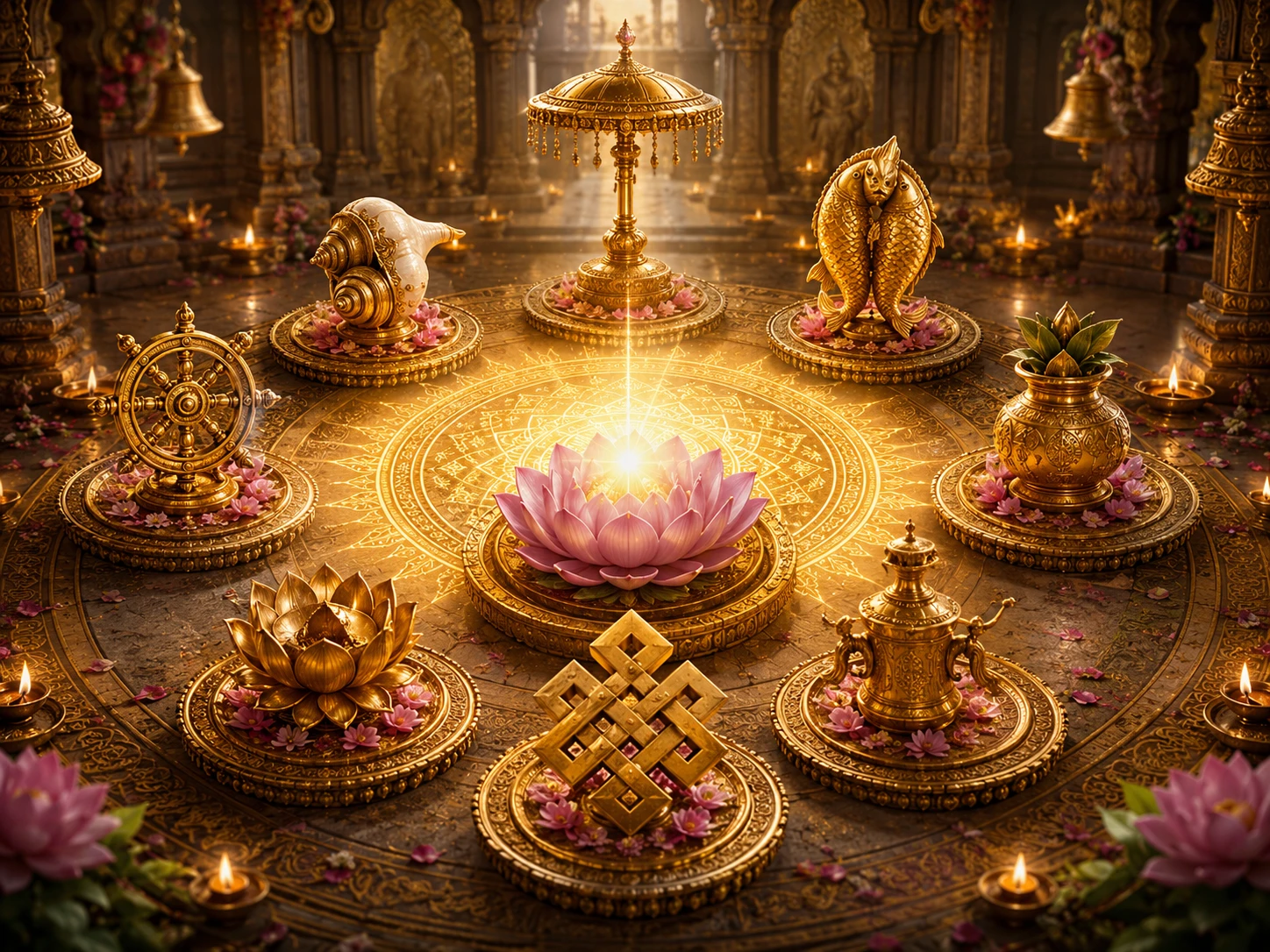
Ashtamangala -- The Eight Auspicious Symbols of Hindu Tradition
13 min read
Bindu -- The Point from which Creation Emerges
12 min read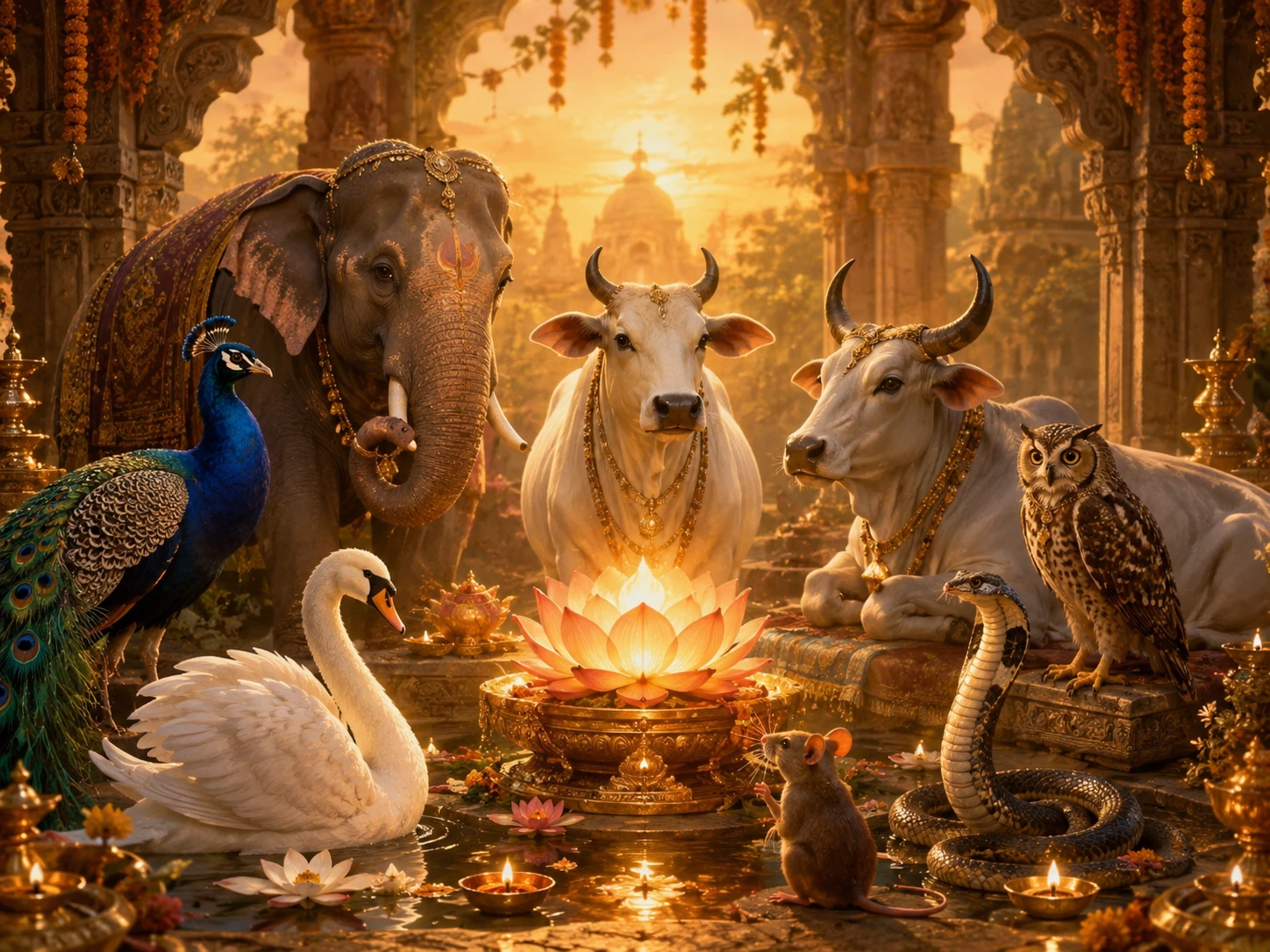
Gau -- Why the Cow Holds the Place She Does in Hindu Life
14 min readThe same translation error that turned '33 Koti' into '33 crore' in Hinduism also happened in Buddhism. The Chinese translation of Buddhist texts rendered 'Sapta Koti Buddha' (7 Supreme Buddhas) as '7 Crore Buddhas.' The…
Deities AvatarsCommunity Reflections
🕉️
Be the first to share your reflection.