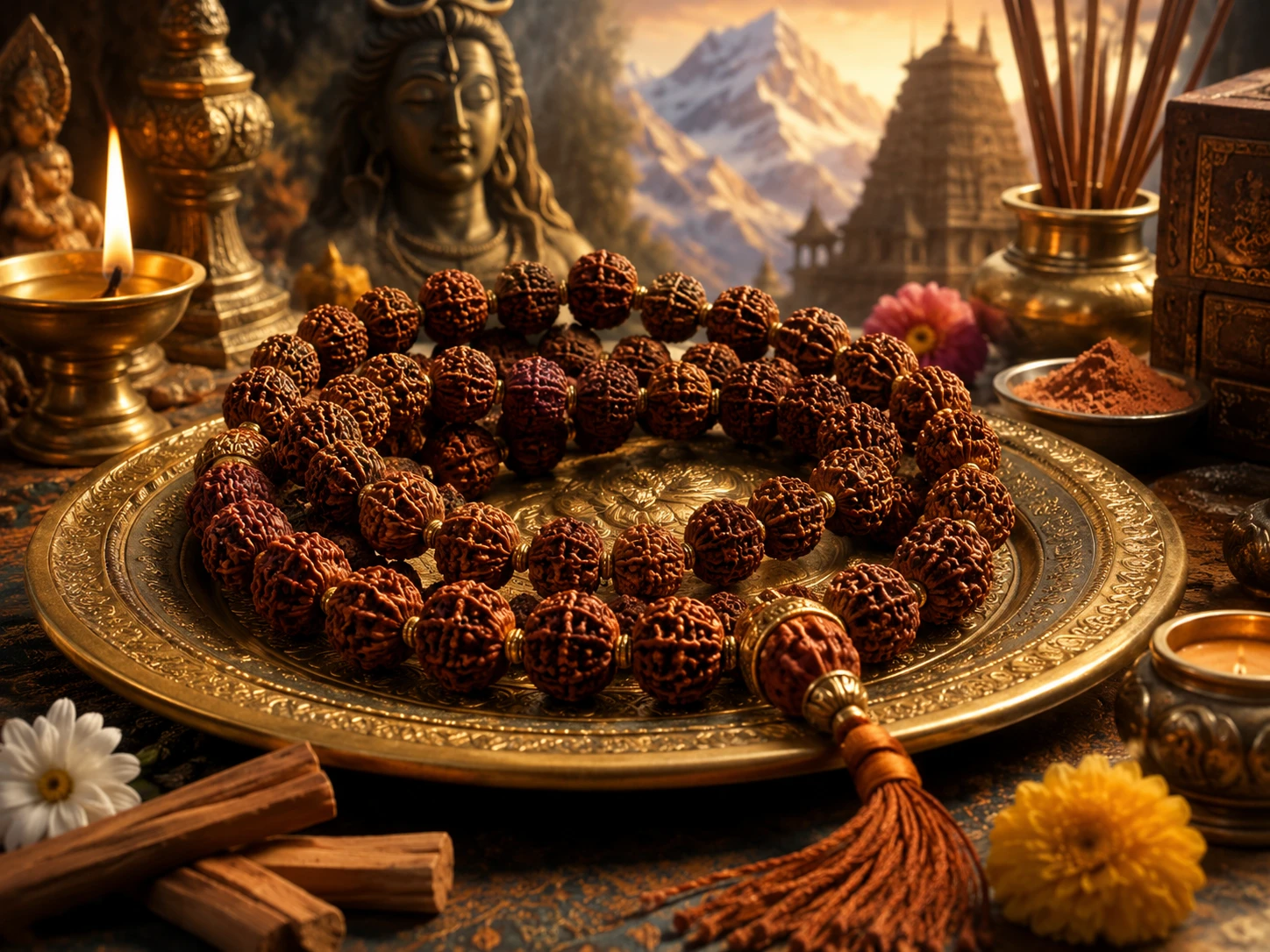
Rudraksha Mala -- Shiva's Tears That Became Seeds of Power
रुद्राक्ष माला -- शिव के अश्रु जो शक्ति के बीज बने
Walk through any city in India and you will see them. The auto driver in Varanasi with a thick Rudraksha mala around his neck. The sadhu at Haridwar with Rudraksha winding from wrist to elbow. The CEO of a Bengaluru startup tucking a single Rudraksha bead under his shirt collar at a board meeting. The grandmother in Kolkata counting her evening japa on a well-worn 108-bead mala, each bead smoothed by decades of thumb and prayer. The cricket-watching uncle in Nagpur who believes his five-mukhi Rudraksha is the reason his blood pressure dropped.
Rudraksha beads are everywhere in India -- across caste, class, region, age, and sect. Shaivas wear them as Shiva's direct gift. Vaishnavas use them for japa. Smartas incorporate them in panchayatana worship. Sikhs use them in some Udasi traditions. Even non-religious Indians wear them as 'health beads' after reading about their electromagnetic properties in a WhatsApp forward.
The Rudraksha is simultaneously the most sacred and the most commercialised sacred object in contemporary India. A genuine five-mukhi (five-faced) bead costs as little as fifty rupees. A genuine one-mukhi (single-faced) Rudraksha can command prices exceeding twenty lakh rupees. The market is flooded with fakes -- plastic replicas, chemically treated berries, and Indonesian seeds sold as Nepali. This article cuts through the fog: what is a Rudraksha, what does the tradition actually say about it, what has science measured, and how do you identify a genuine bead from a manufactured fraud?
रुद्रस्य नयनेभ्यस्तु यदश्रु प्रपतद्भुवि। तदेव रुद्राक्षफलं तस्माद्रुद्राक्षसंज्ञितम्॥
rudrasya nayanebhyas tu yad aśru prapatad bhuvi tad eva rudrākṣa-phalaṃ tasmād rudrākṣa-saṃjñitam
From the eyes of Rudra (Shiva), tears fell upon the earth. Those very tears became the Rudraksha fruit. Hence, it is known as Rudraksha -- 'the tear of Rudra.'
— Shiva Purana, Vidyeshvara Samhita, Chapter 25
The Mythology -- When Shiva Wept
The Shiva Purana and the Padma Purana both narrate the origin of the Rudraksha. Shiva, in his form as Rudra, entered deep meditation (dhyana) for the welfare of all beings. For a thousand divine years, he remained in unbroken contemplation -- eyes closed, breath stilled, consciousness absorbed in the totality of creation and suffering.
When he opened his eyes, tears of compassion streamed down his face. These were not tears of sorrow or weakness -- they were tears of a consciousness that had fully absorbed the pain of every living being across all three worlds. Where those tears fell upon the earth, Rudraksha trees sprouted. The tradition holds that different tears fell from different eyes: the tears from Shiva's right eye (surya, sun) became the white Rudraksha, from his left eye (chandra, moon) the red Rudraksha, and from his third eye (agni, fire) the black Rudraksha. The most common variety -- the brown Rudraksha found in Nepal and Indonesia -- is considered a blend.
The Rudraksha tree (Elaeocarpus ganitrus) is native to the Himalayan foothills of Nepal, parts of Indonesia (Java, Sumatra), and scattered regions of India (Assam, Arunachal Pradesh, parts of the Western Ghats). The tree grows at elevations between 500 and 2,000 metres. It produces small blue-coloured fruit, inside which is the hard seed -- the Rudraksha bead. The seed's surface is naturally divided into segments by vertical lines called 'mukhis' (faces). The number of mukhis determines the bead's type and significance.
The Shiva Purana declares that merely wearing a Rudraksha -- regardless of whether one has bathed, performed sandhya, or maintained ritual purity -- generates spiritual merit equivalent to the worship of Shiva Himself. This radical accessibility is characteristic of Shaiva theology: the god of ascetics is also the most generous, requiring no elaborate qualification from his devotees. Just the tear-seed, touching your skin, is enough.
Rudraksha Types by Mukhi (Face) -- Properties and Presiding Deity
| Mukhi | Presiding Deity | Primary Benefit | Rarity | Approximate Price (Genuine) |
|---|---|---|---|---|
| 1 Mukhi (Ek Mukhi) | Shiva / Parabrahman | Supreme consciousness, moksha | Extremely rare (round form almost non-existent) | Rs 5 lakh to 25+ lakh (round); Rs 2,000-10,000 (half-moon) |
| 2 Mukhi | Ardhanarishvara (Shiva-Shakti) | Harmony in relationships, unity | Rare | Rs 500-5,000 |
| 3 Mukhi | Agni (Fire God) | Purification, freedom from past karma | Moderate | Rs 200-2,000 |
| 4 Mukhi | Brahma / Brihaspati | Knowledge, speech, creativity | Moderate | Rs 100-1,000 |
| 5 Mukhi (Panchmukhi) | Kalagni Rudra / Pancha-Brahma | General wellbeing, BP regulation, peace | Very common (80%+ of all Rudraksha) | Rs 20-200 per bead |
| 6 Mukhi | Kartikeya / Subrahmanya | Willpower, focus, grounding | Common | Rs 50-500 |
| 7 Mukhi | Lakshmi / Ananga (Kamadeva) | Prosperity, fortune, charisma | Moderate | Rs 200-3,000 |
| 14 Mukhi | Hanuman / Shiva's third eye | Intuition, fearlessness, foresight | Very rare | Rs 5,000-50,000+ |
Prices are approximate for genuine Nepal-origin Rudraksha as of 2026. Indonesian Rudraksha are typically 60-80% cheaper but smaller in size. Beads beyond 14 mukhi (15 to 21) are extraordinarily rare and their prices are largely unregulated. Always verify with an X-ray or water test before purchasing high-value beads.
The Science -- What Laboratories Have Measured
The scientific investigation of Rudraksha beads has produced intriguing, if preliminary, findings.
First, electromagnetic properties. Research conducted at IIT Bombay and Banaras Hindu University (BHU) has measured that Rudraksha seeds possess a measurable magnetic field and exhibit diamagnetic properties -- they are weakly repelled by both poles of a magnet. The seeds also show capacitive properties, meaning they can store and slowly release small amounts of electrical charge. When worn against the skin, a Rudraksha bead interacts with the body's bioelectric field. The hypothesis (not yet conclusively proven) is that this interaction modulates the wearer's bioelectrical signals, potentially affecting heart rate and blood pressure regulation.
Second, blood pressure effects. A study published in the International Journal of Pharmaceutical Sciences and Research measured statistically significant reductions in systolic and diastolic blood pressure among subjects who wore five-mukhi Rudraksha beads for 30 days, compared to a control group. The mechanism proposed was that the bead's surface resistance and electromagnetic properties create a stabilising feedback loop with the cardiac bioelectrical system when worn near the chest.
Third, chemical composition. Rudraksha seeds contain carbon (50.024%), hydrogen (17.897%), nitrogen (0.521%), and oxygen (30.453%). The hard shell is composed of complex organic compounds including alkaloids and flavonoids. Some researchers hypothesize that when Rudraksha is immersed in water (as done during traditional worship), trace compounds leach into the water, creating a mildly alkaline solution with potential antioxidant properties.
Fourth, the 'water test' for authenticity. A genuine Rudraksha, when placed in a glass of water, should sink to the bottom -- its density is higher than water. A fake bead (plastic, wood, or chemically treated berry) often floats or sinks unevenly. While not foolproof, this test catches the majority of crude fakes.
The scientific community treats these findings as preliminary. No peer-reviewed study has definitively established the mechanism by which Rudraksha affects human physiology. But the convergence of traditional claims (blood pressure regulation, stress reduction, enhanced meditation) with measurable electromagnetic properties makes Rudraksha one of the more scientifically interesting sacred objects globally.
The Indian Space Research Organisation (ISRO) carried Rudraksha seeds aboard the PSLV-C37 mission in 2017 as part of a biological experiment to study the effects of microgravity on seed germination patterns. The seeds were later returned to earth and planted. The experiment was conducted in collaboration with students from a Varanasi school -- connecting India's space programme, Shiva's sacred city, and the sacred seed in a single mission.
The Japa Mala -- Why 108 Beads
The Rudraksha japa mala is among the most ancient meditation counting tools in human history. A standard mala contains 108 beads plus one additional bead called the Meru (summit) or Bindu bead, which marks the beginning and end of a round.
The number 108 is one of the most loaded numbers in Indian mathematical and spiritual traditions. The distance between the Earth and Sun is approximately 108 times the Sun's diameter. The distance between the Earth and Moon is approximately 108 times the Moon's diameter. There are 108 Upanishads in the Muktika canon. There are 108 marma points in Ayurvedic anatomy. The number 108 = 1^1 x 2^2 x 3^3 -- a formula connecting the first three integers raised to their own powers. Whether these correlations are designed or discovered, they converge on 108 as a number of completion.
The Meru bead is never crossed during japa. When you reach it, you reverse direction and begin again. The Meru represents Mount Meru -- the cosmic axis. You circumambulate it, just as devotees circumambulate a temple. To cross the Meru is considered disrespectful -- like stepping over a sacred threshold.
For japa practice: the mala is held in the right hand, draped over the middle finger. The index finger (associated with the ego/ahankara in mudra tradition) never touches the beads. The thumb advances the beads one at a time. Each bead = one complete mantra repetition. 108 beads = one mala = one round.
An engineering professor at IIT Kharagpur once explained to his students: 'The Rudraksha mala is the oldest binary counter in human technology. Each bead is a bit. 108 bits per cycle. The Meru is the interrupt that signals cycle completion. The thumb is the clock pulse. It is digital computation reduced to its most elegant physical form.'
How to Identify Genuine Rudraksha -- The Fake Epidemic
The Rudraksha market is plagued by counterfeits. Some estimates suggest that 40-60% of beads sold in Indian markets are fake or misrepresented. Here are the verification methods, ranked from simple to definitive.
Test 1 -- Water test. Place the bead in a glass of water. A genuine Rudraksha sinks. A fake (plastic, wood, or hollowed seed) often floats. However, some chemically treated seeds also sink, so this test is necessary but not sufficient.
Test 2 -- Visual inspection. Genuine Rudraksha have natural, irregular mukhis (face-lines) running from top to bottom. The lines should be continuous and organic, not perfectly uniform. Under magnification (10x loupe), the surface shows natural pitting and texture, not the smooth finish of plastic or the regular grain of wood. The natural hole at top and bottom of the bead should be irregular and organic, not machine-drilled.
Test 3 -- Copper coin test. Place the bead between two copper coins. A genuine Rudraksha will rotate slightly due to its electromagnetic properties. This test is not definitive but adds corroboration.
Test 4 -- X-ray verification. The gold standard. An X-ray of a genuine Rudraksha reveals internal compartments corresponding exactly to the number of external mukhis. A five-mukhi bead will show five internal chambers. A fake bead will show either a solid mass or artificially created chambers. Several established Rudraksha sellers in Varanasi and Haridwar now offer X-ray certificates.
Test 5 -- Boiling test. Boil the bead in water for two hours. A genuine Rudraksha's colour will not change and no external coating will peel. A dyed or coated fake will leach colour.
Buy from established sellers: Rudra Centre (Mumbai), Rudraksha Ratna (Mumbai), or directly from Nepal via verified suppliers in Kathmandu's Boudha area. Avoid roadside vendors, unverified online listings, and sellers who claim rare mukhis (1, 14, 21) at suspiciously low prices.
The world's largest Rudraksha tree is believed to be in the Manang district of Nepal, near the Annapurna Circuit trekking route. It is over 200 years old and produces thousands of beads annually. Local tradition holds that beads from this specific tree carry the strongest Shiva energy. Trekkers on the Annapurna Circuit can visit the tree -- making it perhaps the only sacred pilgrimage site that doubles as an adventure tourism attraction.
Wearing Rules and Daily Care
Rudraksha can be worn as a mala (108 beads for japa), as a bracelet (27 or 54 beads), or as a single bead on a thread or chain. The Shiva Purana is remarkably permissive about wearing conditions -- it states that Rudraksha worn in any state (bathed or unbathed, sleeping or waking, pure or impure) generates merit.
However, traditional guidelines recommend: string the mala on silk thread or gold/silver wire (copper thread is acceptable). Replace the stringing thread every 6-12 months. Do not share your mala with others -- it absorbs your bioelectric field over time and becomes personalised. Remove during activities involving chemicals, chlorinated swimming pools, or extreme physical contact. Oil the beads monthly with a light coating of almond or sandalwood oil to prevent cracking.
The mala should be energised periodically: immerse it in water mixed with a few drops of unboiled milk and Ganga jal (or any clean water with Tulsi leaves) for 30 minutes, then air-dry. Chant Om Namah Shivaya 108 times while holding the mala before wearing it for the first time.
For the gym-going professional in Mumbai's Bandra or the college student in Delhi's North Campus who wears Rudraksha daily -- basic respect is sufficient. Do not take it into the bathroom for bathing (some traditions disagree on this point). Do not wear it during intimacy. Store it in a clean pouch when not wearing. These are not superstitions -- they are maintenance protocols for an object that, regardless of whether one believes in its spiritual properties, is a natural seed that responds to environmental conditions like moisture, chemicals, and heat.
Start Your Japa -- 108 Beads with Shiva Mantras
Take up your rudraksha mala and choose Om Namah Shivaya or the Mahamrityunjaya mantra. Set a daily number -- one round of 108 is the traditional start -- and keep to it; the beads do the counting. The Om Namah Shivaya page on Eternal Raga gives its meaning and how to chant it.
Tags
Eternal Raga · शाश्वत राग
Institutional voice — scholarly articles on Sanatan Dharma
Deepen Your Understanding
अपनी समझ और गहरी करें
sacred artefacts
Shalagrama Shila -- The 140-Million-Year-Old Face of Vishnu
A black river stone from a Himalayan gorge in Nepal. A fossil of a creature that swam in an ocean that no longer exists. And yet, for over two thousand years, Hindus have recognised this stone as a direct, living manifestation of Vishnu -- not a symbol, not a representation, but the deity Himself. Science calls it an ammonite. Faith calls it God.
sacred symbols
108 -- The Sacred Number That Links Your Mala to the Solar System
Why does a japa mala have exactly 108 beads? Why do temples list 108 names for every deity? The answer involves astronomy, anatomy, music, and mathematics -- and a coincidence so precise it still stuns astrophysicists: the distance from Earth to the Sun is approximately 108 times the Sun's diameter.
tantra mantra yantra
The Science of Mantra -- How Sacred Sound Rewires Consciousness
A mantra is not a prayer. It is not a wish. It is a precision instrument of consciousness -- a vibrational key engineered in Sanskrit thousands of years ago to unlock specific states of mind. Modern neuroscience is only now catching up.
tantra mantra yantra
Tantra, Mantra and Yantra -- The Three Pillars of Spiritual Practice
Tantra is the loom, Mantra is the thread, Yantra is the pattern. Together they form the complete technology of spiritual transformation that India gifted to the world -- and they are far more profound than popular culture imagines.
sacred artefacts
Navaratna -- Nine Gems That Map the Cosmos to Your Finger
Nine planets. Nine gems. Nine frequencies of cosmic light captured in crystalline matter and worn on the human body. The Navaratna system is not superstition -- it is the oldest surviving framework of planetary gemology, codified in the Garuda Purana, the Brihat Samhita, and still followed by jewellers from Jaipur to Jakarta.
deities avatars
Nine Forms of Shiva -- The Many Faces of Mahadeva
He is the silent teacher under a banyan tree and the screaming destroyer on a battlefield. He is half-woman and half-man. He drank the poison that would have ended the universe and his throat turned blue. Nine scripturally-attested forms of Shiva -- from Nataraja to Rudra -- and why each one exists.
tantra mantra yantra
What Makes a Mantra -- The Anatomy of Sacred Sound
Not every Sanskrit word is a mantra. Not every chant carries power. A mantra is an engineered formula with six mandatory components -- rishi, devata, chhanda, beej, shakti, and viniyoga. Miss any one and the circuit is incomplete. Here is the blueprint.
The Indian Space Research Organisation (ISRO) carried Rudraksha seeds aboard the PSLV-C37 mission in 2017 as part of a biological experiment to study the effects of microgravity on seed germination patterns. The seeds we…
More in Sacred Artefacts
Ashtadhatu -- The Sacred Eight-Metal Alloy of Indian Temples
12 min read
Banalinga -- The Stone God Made Himself in a River Over Millions of Years
13 min read
Celestial Trees -- Kalpavriksha and Parijata
12 min readThe same translation error that turned '33 Koti' into '33 crore' in Hinduism also happened in Buddhism. The Chinese translation of Buddhist texts rendered 'Sapta Koti Buddha' (7 Supreme Buddhas) as '7 Crore Buddhas.' The…
Deities AvatarsCommunity Reflections
🕉️
Be the first to share your reflection.