Navaratna -- Nine Gems That Map the Cosmos to Your Finger
नवरत्न -- नौ रत्न जो ब्रह्माण्ड को तुम्हारी उँगली पर उतारते हैं
Walk into any traditional jeweller's shop in Jaipur's Johari Bazaar and ask for a Navaratna ring. The goldsmith will not ask for your ring size first. He will ask for your janma kundali -- your birth chart. Because in the Indian tradition, gemstones are not fashion. They are prescription. Each stone corresponds to a celestial body. Each celestial body governs a specific domain of your life. Wearing the wrong stone is not merely a waste of money -- it is, in the tradition's own terms, like taking medication for a disease you do not have.
The Navaratna -- literally 'nine gems' -- is the most ancient and systematic framework of planetary gemology in human civilisation. It maps nine celestial bodies (the Navagrahas) to nine specific gemstones, codified in texts dating back over two millennia. The Garuda Purana, the Agni Purana, Varahamihira's Brihat Samhita (6th century CE), and the Ratna Pariksha all elaborate the science of gems, their planetary correspondences, their healing properties, and -- critically -- the dangers of wearing flawed or inappropriate stones.
This is not a fringe tradition. The Navaratna system shaped royal jewellery across the entire Indian subcontinent and spread to Southeast Asia -- Thailand's Nopparat, Myanmar's Nawarat, Indonesia's Navaratna, and Sri Lanka's Navaratne are all descendants of the same Vedic framework. The British Crown Jewels contain Indian gems originally set according to Navaratna principles. Mughal emperors wore Navaratna configurations. Today, a Tanishq or Kalyan Jewellers showroom in any Indian city stocks Navaratna rings -- the most commercially successful sacred jewellery format in the world.
But the tradition also carries dangers. The astrology-gem industry in India is a multi-billion-rupee market rife with exploitation: inflated prices, fake stones, and fear-based selling that preys on anxious parents and competitive exam aspirants. This article provides the complete framework -- what the tradition actually says, what science has measured about gemstone properties, and how to navigate the market without being fleeced.
माणिक्यं तरणेः सुजात्यममलं मुक्ताफलं शीतगोः माहेयस्य च विद्रुमं मरकतं सौम्यस्य गारुत्मतम्। देवेज्यस्य च पुष्पराजमसुराचार्यस्य वज्रं शनेः नीलं निर्मलमन्ययोश्च गदिते गोमेदवैदूर्यके॥
māṇikyaṃ taraṇeḥ sujātyam amalaṃ muktāphalaṃ śītagoḥ māheyasya ca vidrumaṃ marakataṃ saumyasya gārutmatam devejyasya ca puṣparājam asurācāryasya vajraṃ śaneḥ nīlaṃ nirmalam anyayoś ca gadite gomedavaidūryake
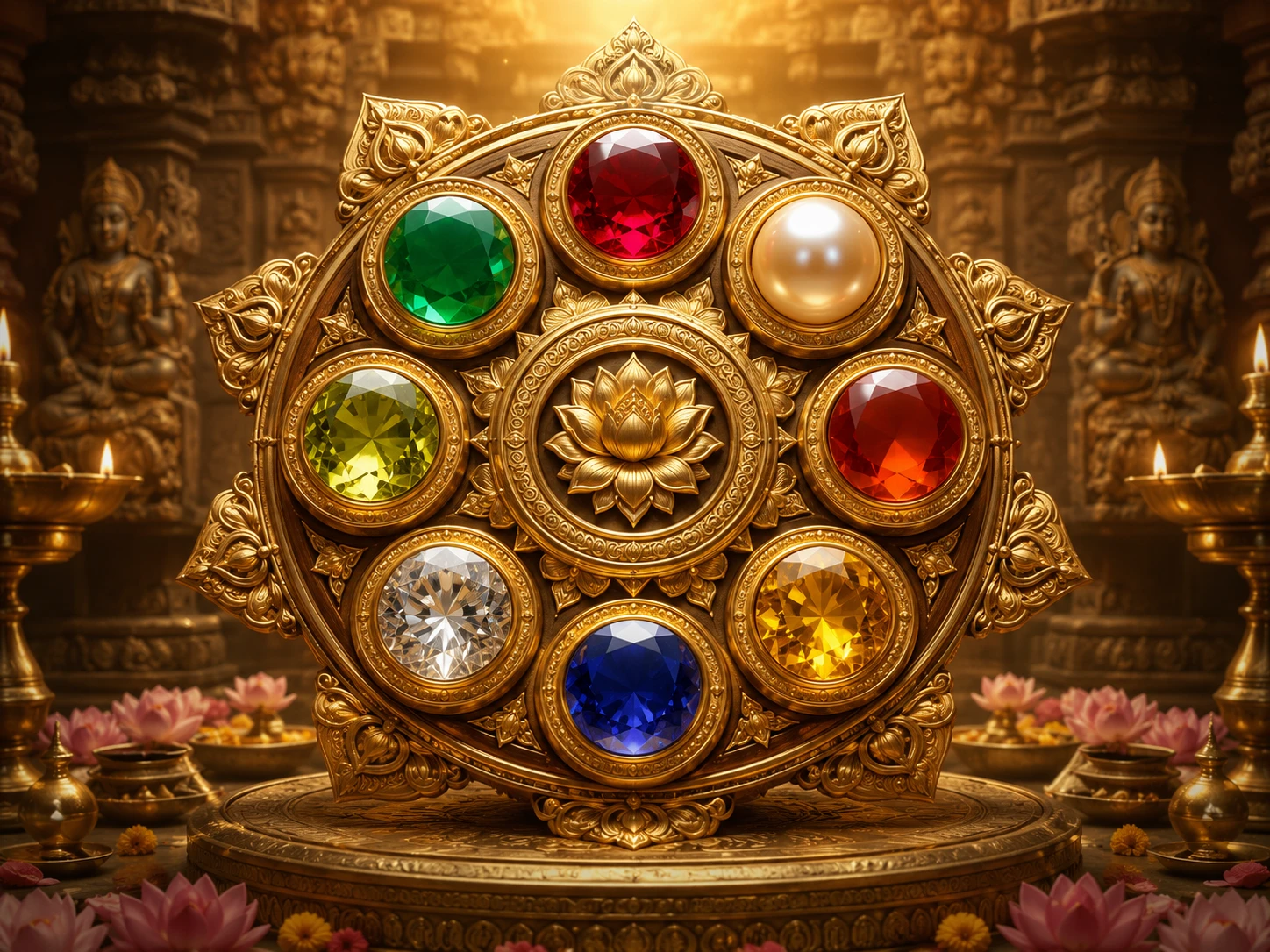
Ruby is the gem of the Sun, flawless pearl of the Moon, red coral of Mars, emerald of Mercury, yellow sapphire of Jupiter, diamond of Venus, blue sapphire of Saturn. For the remaining two (Rahu and Ketu) are declared hessonite garnet and cat's eye.
— Brihat Jataka (attributed), also cited in Mani-Mala and Jataka Parijata, Chapter 2, Sloka 21
The Nine Gems -- Complete Planetary Correspondence
| Graha (Planet) | Ratna (Gem) | Sanskrit Name | Colour | Finger (Traditional) | Metal | Day to Wear |
|---|---|---|---|---|---|---|
| Surya (Sun) | Ruby | Manikya | Deep red (pigeon blood) | Ring finger, right hand | Gold | Sunday sunrise |
| Chandra (Moon) | Natural Pearl | Mukta | White with lustre | Little finger, right hand | Silver | Monday |
| Mangala (Mars) | Red Coral | Vidruma / Praval | Ox-blood red | Ring finger, right hand | Gold or copper | Tuesday |
| Budha (Mercury) | Emerald | Marakata / Panna | Deep green without yellow | Little finger, right hand | Gold | Wednesday |
| Brihaspati (Jupiter) | Yellow Sapphire | Pushparaja / Pukhraj | Golden yellow | Index finger, right hand | Gold | Thursday |
| Shukra (Venus) | Diamond | Vajra / Heera | Colourless, brilliant | Middle or ring finger, right | White gold or platinum | Friday |
| Shani (Saturn) | Blue Sapphire | Neelam / Indraneela | Deep blue, velvety | Middle finger, right hand | Gold or iron (panch-dhatu) | Saturday |
| Rahu (Ascending node) | Hessonite Garnet | Gomedha / Gomed | Honey-coloured | Middle finger, right hand | Silver or panch-dhatu | Saturday or Wednesday |
| Ketu (Descending node) | Cat's Eye Chrysoberyl | Vaidurya / Lehsunia | Chatoyant green-yellow | Little finger or ring finger | Gold or silver | Tuesday or Saturday |
The Navaratna arrangement in jewellery always places Ruby (Sun) at the centre, with the remaining eight stones arranged around it in a specific sequence. This central placement reflects the heliocentric cosmology of Vedic astronomy -- the Sun at the centre of the planetary system. Substitute stones (upratna) exist for each primary gem and are used when the primary gem is unaffordable.
The Logic -- How Gems and Planets Connect
The Navaratna framework rests on a fundamental premise of Vedic astrology: that celestial bodies emit specific frequencies of energy (rashmi) that influence life on earth, and that certain crystalline materials resonate with and amplify specific planetary frequencies. This is not a modern invention -- the concept is codified in the Brihat Samhita of Varahamihira (6th century CE), one of the earliest systematic works on astronomy, meteorology, and gemology.
The logic operates on colour correspondence. The Sun emits the fullest spectrum of light; its gem, the ruby, captures and concentrates the red frequency -- the colour of vitality, authority, and fire. The Moon reflects cool white light; its gem, the pearl, captures the white-silver frequency associated with calm, emotion, and intuition. Mars radiates red-orange energy; red coral, formed from marine organisms in tropical seas, captures the martial frequency. Mercury, the swiftest planet, corresponds to the green of emerald -- green being the colour of adaptability, communication, and intellect.
Modern gemology has established that each mineral absorbs certain wavelengths of light and transmits others -- this is, in fact, why gems appear coloured. A ruby appears red because it absorbs all wavelengths except red. An emerald appears green because it transmits green wavelengths while absorbing others. The Vedic claim that gems 'capture' specific cosmic frequencies has a structural parallel in the physics of selective light transmission, even if the metaphysical layer remains outside scientific verification.
The Garuda Purana makes a critical distinction that most commercial astrologers ignore: flawed gems are worse than no gems at all. A cracked, included, or cloudy stone not only fails to transmit beneficial energy -- it actively transmits harmful energy. The Purana states that a flawed gem brings disease, poverty, grief, and enemies. This is the tradition's own built-in quality control, and it directly contradicts the market practice of selling low-quality stones at high prices to desperate clients.
The Blue Sapphire Warning -- Shani's Double-Edged Sword
No discussion of Navaratna is complete without addressing the most feared gem in the system: Neelam, the blue sapphire of Saturn (Shani). In Indian popular culture, the blue sapphire carries a reputation unlike any other stone. Bollywood has dramatised it. Family elders warn against it. Astrologers hedge their advice about it. The tradition itself treats it with extraordinary caution.
The blue sapphire is associated with Shani -- the planet whose influence is the most transformative and the most punishing in Vedic astrology. Shani governs karma, discipline, delays, suffering, and ultimately, justice. A well-placed Saturn in one's horoscope can confer extraordinary endurance, authority, and wisdom. A poorly-placed Saturn can bring years of hardship -- the dreaded Sade Sati (seven-and-a-half-year Saturn transit) that every Indian family knows and fears.
The blue sapphire amplifies whatever Saturn is doing in your chart. If Saturn is beneficial, the stone accelerates fortune. If Saturn is malefic, the stone accelerates suffering. This is why the tradition prescribes a 'trial period' -- wearing the blue sapphire for three days tucked under your pillow or tied in a cloth on your arm before committing to wearing it on the finger. If the trial period brings nightmares, accidents, or sudden losses, the stone is considered unsuitable.
The Amitabh Bachchan narrative is perhaps the most famous Navaratna story in modern India. The actor has publicly spoken about wearing a blue sapphire on the advice of an astrologer during a period of career decline -- and his subsequent resurgence with Kaun Banega Crorepati. Whether the gem caused the comeback or the story is confirmation bias depends on your epistemological framework. The tradition would say: the stone's power is not in question. The question is whether it is appropriate for the wearer.
This caution extends to all Navaratna stones, not just blue sapphire. The Garuda Purana explicitly states that wearing a gem associated with a malefic planet in your chart does not 'pacify' that planet -- it strengthens its influence, for good or ill. This is why blanket recommendations ('everyone should wear Pukhraj for Jupiter') are dangerous. A gem is not a vitamin. It is a targeted intervention that requires diagnostic precision -- which is why the tradition insists on a competent jyotishi reading the birth chart before prescribing any stone.
India's gem-cutting capital Jaipur processes over 90% of the world's coloured gemstones. The Johari Bazaar in the Pink City has been a gem trading hub for over 300 years, since Maharaja Sawai Jai Singh II -- himself a renowned astronomer who built the Jantar Mantar observatories -- deliberately settled gem-cutting families in his new city. The man who mapped the stars also built the market for the stones that harness their light.
Substitute Stones (Upratna) -- The Affordable Alternative
Not everyone can afford a three-carat natural ruby or a flawless yellow sapphire. The tradition anticipates this through the concept of Upratna (substitute gems) -- secondary stones that carry a similar, though less concentrated, planetary frequency.
For Ruby (Sun): Red garnet (tamra) or red spinel. For Pearl (Moon): Moonstone (chandrakanta mani). For Red Coral (Mars): Carnelian (akik). For Emerald (Mercury): Peridot or green tourmaline. For Yellow Sapphire (Jupiter): Citrine or yellow topaz. For Diamond (Venus): White sapphire or white zircon (zarkan). For Blue Sapphire (Saturn): Amethyst or iolite (kaka neeli). For Hessonite (Rahu): Orange zircon. For Cat's Eye (Ketu): Tiger's eye or chrysoberyl.
Upratna are significantly more affordable. A natural ruby may cost lakhs; a red garnet of similar size costs a few thousand rupees. The tradition holds that upratna produce 30-40% of the primary gem's effect -- sufficient for general wellbeing, though not for intensive jyotish remedial purposes.
For a college student in Kota or a first-job professional in Hyderabad, upratna offer a practical entry point. The tradition does not demand that you impoverish yourself to wear a planetary stone. It demands only that the stone be genuine, flawless within its category, and appropriate for your birth chart.
The Fraud Epidemic -- How to Protect Yourself
The gem industry in India is plagued by fakes, treatments, and misrepresentation. Here are the essential safeguards.
First, always demand a gemological certificate from a recognised laboratory -- GII (Gemological Institute of India), IGI (International Gemological Institute), or GIA (Gemological Institute of America). A certificate verifies the stone's identity, natural origin, and whether it has been treated (heated, filled, irradiated). Reputable jewellers provide certificates as standard.
Second, understand common frauds. Glass-filled rubies (lead glass is injected into fractures to improve clarity) are the most common ruby fraud -- they look flawless but are structurally compromised and worth a fraction of natural rubies. Heated blue sapphires are widespread -- heating improves colour but reduces the stone's astrological potency according to tradition (which requires unheated, natural stones). Synthetic stones (lab-grown) are chemically identical to natural stones but carry no astrological value per the tradition because they lack the geological history of planetary exposure. Dyed pearls, reconstituted coral, and treated emeralds are ubiquitous in budget markets.
Third, the price test. If a deal seems too good, it is. A natural, unheated blue sapphire of good colour and 3+ carats will cost a minimum of Rs 50,000-1,00,000 per carat. Anyone offering it for Rs 5,000 total is selling a synthetic or treated stone. Similarly, a one-mukhi Rudraksha for Rs 500 is a guaranteed fake, and a 'real emerald' for Rs 200 per carat is glass.
Fourth, buy from established names with return policies: C. Krishniah Chetty in Bengaluru, Gem Palace in Jaipur, Khanna Gems in Delhi, or certified online platforms with GII certification. Avoid astrologers who sell gems directly after the consultation -- the conflict of interest is obvious.
The Garuda Purana's own prescription is the best defence: only flawless gems benefit the wearer. A cheap, flawed gem is worse than no gem at all. If you cannot afford a flawless primary gem, wear a flawless upratna. Quality over size. Always.
The Koh-i-Noor diamond -- now in the British Crown -- was originally set according to Navaratna principles in the Mughal Peacock Throne. It represented Venus (Shukra), the planet of beauty and luxury. When it was removed from its Navaratna context and set alone in a British crown, Indian tradition would say the gem lost its astrological balance. The Koh-i-Noor's legendary 'curse' on male owners may well be the tradition's own commentary: a gem extracted from its planetary system behaves unpredictably.
शुद्धा दोषविवर्जिताश्च मणयो ये रक्षणं प्राणिनाम् कुर्वन्ति ग्रहपीडनं च हरति प्रख्याता देशे देशे।
śuddhā doṣa-vivarjitāś ca maṇayo ye rakṣaṇaṃ prāṇinām kurvanti graha-pīḍanaṃ ca harati prakhyātā deśe deśe
Pure and flawless gems protect living beings and remove the afflictions caused by planetary influences -- this is renowned in land after land.
— Garuda Purana, Chapter 68 (paraphrased verse)
Modern India and the Navaratna -- Between Faith and Exploitation
The Navaratna tradition occupies an uncomfortable position in modern India. On one hand, planetary gemology is deeply embedded in Indian life -- from the pandit who checks the kundali before a wedding to the startup founder who wears a Pukhraj on his index finger to the UPSC aspirant whose mother has gifted her a coral ring for Mars strength during the gruelling exam years.
On the other hand, the gem-astrology industry is one of the most exploitative sectors in Indian commerce. Fake astrologers prescribe expensive stones to frightened clients. Unscrupulous jewellers sell treated gems as natural. WhatsApp forwards claim that wearing a blue sapphire will 'fix' your Sade Sati. Instagram ads offer 'astrological gem prescriptions' from AI chatbots. The gap between the tradition's sophisticated, careful framework and the market's fear-driven opportunism is vast.
Intellectual honesty requires acknowledging that the efficacy of planetary gemology has not been established through controlled scientific studies. No double-blind trial has demonstrated that wearing a ruby improves one's relationship with authority figures, or that a yellow sapphire enhances Jupiter's influence on wisdom and wealth. The tradition's evidence base is experiential and accumulated over millennia, not experimental in the modern scientific sense.
What can be said with confidence: the Navaratna framework is a internally consistent, remarkably sophisticated system that maps the nine gravitational influences of Vedic astronomy to nine specific crystalline materials based on their optical properties. Whether you engage with it as astrology, as cultural heritage, as gemological knowledge, or as aesthetic tradition, the Navaratna deserves to be understood on its own terms -- not reduced to superstition by sceptics or inflated into magic by sellers.
Eternal Raga's position: the Navaratna are a living tradition of extraordinary depth. Approach them with respect, with knowledge, and with the Garuda Purana's own insistence on quality above all else. And never, ever buy a gem from someone who just told you your Shani is bad.
Chant Navagraha Mantras -- Planetary Harmony Through Sound
Before wearing a gem, many traditions first chant the beej mantra of its graha. The nine Navagraha beej mantras and the Navagraha Stotram are both on Eternal Raga with their meaning.
Tags
Eternal Raga · शाश्वत राग
Institutional voice — scholarly articles on Sanatan Dharma
Deepen Your Understanding
अपनी समझ और गहरी करें
sacred artefacts
Divine Gems -- Syamantaka, Kaustubha, and Chintamani
Hindu mythology's most precious stones are not mere ornaments -- they are plot devices, moral tests, and cosmic forces. The Syamantaka Mani turned Krishna into a detective. The Kaustubha emerged from the Ocean of Milk to sit forever on Vishnu's chest. The Chintamani fulfils every wish -- and teaches why that might be the worst thing that could happen to you.
sacred symbols
108 -- The Sacred Number That Links Your Mala to the Solar System
Why does a japa mala have exactly 108 beads? Why do temples list 108 names for every deity? The answer involves astronomy, anatomy, music, and mathematics -- and a coincidence so precise it still stuns astrophysicists: the distance from Earth to the Sun is approximately 108 times the Sun's diameter.
deities avatars
Navagraha -- The Nine Planetary Deities Who Govern Your Horoscope and Your Life
Before every job interview, before every wedding, before buying a house or starting a business -- millions of Indians check their Navagraha positions. These nine celestial deities -- the Sun, Moon, Mars, Mercury, Jupiter, Venus, Saturn, and the shadow planets Rahu and Ketu -- constitute the most practically influential theological system in Hinduism. Whether you believe in astrology or not, the Navagraha are shaping Indian culture around you.
sacred artefacts
Rudraksha Mala -- Shiva's Tears That Became Seeds of Power
Legend says Shiva meditated for a thousand years, and when his eyes opened, tears of compassion fell to earth and became the Rudraksha tree. Science says the seeds of Elaeocarpus ganitrus contain electromagnetic properties measurable in a laboratory. Between the legend and the lab lies the most worn sacred object in India.
vedic sciences
Kaal Ganana -- The Hindu Measure of Time
From a single blink of the eye (Nimesha) to one Day of Brahma (4.32 billion years) -- explore the complete cosmic time hierarchy of Hindu cosmology, anchored in Vishnu Purana 1.3, with its remarkable parallels to modern science.
sacred artefacts
Shalagrama Shila -- The 140-Million-Year-Old Face of Vishnu
A black river stone from a Himalayan gorge in Nepal. A fossil of a creature that swam in an ocean that no longer exists. And yet, for over two thousand years, Hindus have recognised this stone as a direct, living manifestation of Vishnu -- not a symbol, not a representation, but the deity Himself. Science calls it an ammonite. Faith calls it God.
vedic sciences
Jyotish Shastra -- The Vedic System of Astronomy and Astrology That India Never Stopped Using
Every year, millions of Indian marriages are fixed only after the kundali matches. ISRO times its satellite launches on muhurtas. JEE students wear navagraha rings. Real-estate agents check Rahu-Ketu transits before closing deals. Whether you believe in it or not, Jyotish Shastra -- the Vedic science of light, time, and celestial influence -- is the most actively practised ancient knowledge system in India today. It spans 9 Grahas, 12 Rashis, 27 Nakshatras, and 2,500 years of continuous mathematical and observational tradition. This article explains the system as the texts describe it -- not as a prediction engine, but as a framework for understanding time, cycles, and the relationship between the cosmos and human life.
India's gem-cutting capital Jaipur processes over 90% of the world's coloured gemstones. The Johari Bazaar in the Pink City has been a gem trading hub for over 300 years, since Maharaja Sawai Jai Singh II -- himself a re…
More in Sacred Artefacts
Ashtadhatu -- The Sacred Eight-Metal Alloy of Indian Temples
12 min read
Banalinga -- The Stone God Made Himself in a River Over Millions of Years
13 min read
Celestial Trees -- Kalpavriksha and Parijata
12 min readThe same translation error that turned '33 Koti' into '33 crore' in Hinduism also happened in Buddhism. The Chinese translation of Buddhist texts rendered 'Sapta Koti Buddha' (7 Supreme Buddhas) as '7 Crore Buddhas.' The…
Deities AvatarsCommunity Reflections
🕉️
Be the first to share your reflection.