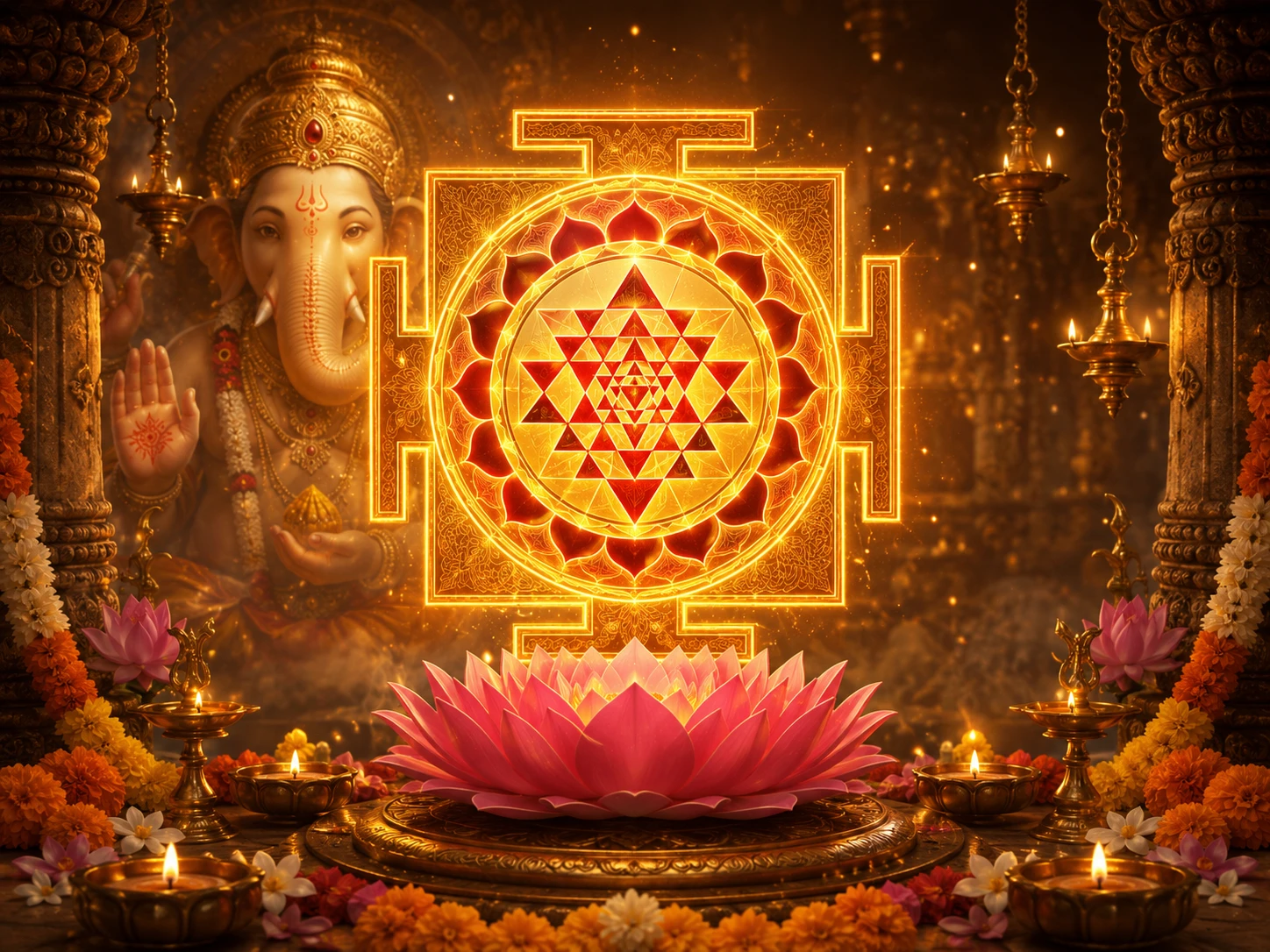
Ganesh Yantra -- The Obstacle Remover's Sacred Geometry
गणेश यन्त्र -- विघ्नहर्ता की पवित्र ज्यामिति
Before Vishnu is invoked, before Shiva is worshipped, before Devi is called, before the sacred fire is lit, before the first syllable of any mantra is uttered -- Ganesha is worshipped. This is not convention. This is cosmic protocol. The Ganapati Upanishad, a minor Upanishad attached to the Atharva Veda, declares Ganesha to be identical with Brahman itself -- the ultimate reality that precedes and contains all other realities.
The Ganesh Yantra is this primacy encoded in geometry.
When a family in Nagpur starts construction on a new house, they perform Ganesh Puja. When a tech startup in Koramangala launches its first product, the founders light a diya before a Ganesha idol. When a student in Kota begins a new academic year of JEE preparation, many touch the feet of a Ganesha murti before opening the first textbook. When ISRO launches a satellite, a coconut is broken before a Ganesha image at Sriharikota. The impulse is universal across Hindu civilisation: begin with the remover of obstacles.
The Ganesh Yantra takes this impulse and gives it a precise, meditatable form. Unlike the anthropomorphic murti that shows Ganesha's physical attributes (elephant head, four arms, modaka, ankusha, mouse vahana), the yantra encodes his energy in abstract geometry -- bindu, triangle, hexagram, lotus petals, and the bhupura (square enclosure with four gates). Each layer of the yantra maps to a dimension of Ganesha's function: the bindu is his concentrated will, the triangles are his creative and preservative powers, the lotus petals are the siddhis (spiritual powers) he bestows, and the bhupura's four gates represent the four directions through which he clears obstacles.
If the murti is Ganesha's photograph, the yantra is his engineering diagram. Both are valid representations. But the yantra, for the meditator, offers something the murti cannot: a progressive journey inward, from the outermost gate to the innermost point, that mirrors the spiritual journey from scattered awareness to one-pointed focus.
The universality of this practice crosses sectarian lines. Whether the family follows Shaiva, Vaishnava, Shakta, or Smarta tradition, the protocol is identical: Ganesha first. This is codified in the Mudgala Purana and Ganesha Purana, both dedicated exclusively to Ganesha, establishing him as Pratham Pujya (first to be worshipped) not as a matter of sectarian preference but as cosmic law. The Yantra tradition formalises this priority into a meditatable object that can sit on a student's desk next to the textbooks and the laptop, silently clearing the path before the work begins.
वक्रतुण्ड महाकाय सूर्यकोटिसमप्रभ। निर्विघ्नं कुरु मे देव सर्वकार्येषु सर्वदा॥
vakratuṇḍa mahākāya sūryakoṭi-samaprabha | nirvighnaṃ kuru me deva sarva-kāryeṣu sarvadā ||
O Lord with the curved trunk and massive form, whose brilliance equals a crore suns -- make all my undertakings free of obstacles, always.
— Traditional Ganesh Shloka (recited before all Hindu rituals)
Anatomy of the Ganesh Yantra -- Layer by Layer
The Ganesh Yantra, like all Hindu yantras, is a mandala of concentric layers that the meditator traverses from outside to centre, moving from the gross to the subtle.
Bhupura (Outer Square): The outermost layer is the Bhupura -- a square boundary with four T-shaped gates (dvara) opening on each side. This represents the material world and the four cardinal directions. In Ganesha's context, the four gates symbolise the four Purusharthas (Dharma, Artha, Kama, Moksha) that Ganesha protects and enables. Each gate is an invitation: enter through any life-goal, and Ganesha will guide you to the centre.
Lotus Petals: Inside the bhupura, a ring of lotus petals (typically eight, sometimes sixteen) represents the eight Siddhis -- the supernatural powers associated with Ganesha. These are Anima (becoming infinitely small), Mahima (becoming infinitely large), Garima (becoming infinitely heavy), Laghima (becoming weightless), Prapti (obtaining anything desired), Prakamya (irresistible will), Ishitva (lordship), and Vashitva (power of subjugation). These are not fantasy -- they are codified yogic attainments found in Patanjali's Yoga Sutras as well. Each petal is a seat of power that Ganesha governs.
Hexagram (Shatkon): The six-pointed star formed by two interlocking triangles sits at the heart of the yantra. The upward triangle represents Shiva (consciousness, the masculine principle), the downward triangle represents Shakti (energy, the feminine principle). Their union produces Ganesha -- the son of Shiva and Parvati, the embodiment of consciousness-energy integration. The hexagram is a simplified Sri Yantra, encoding the same cosmic truth in a more accessible form.
Bindu (Central Point): At the exact centre sits the Bindu -- the dimensionless point that contains everything. This is Ganesha in his most abstract form: pure potential before manifestation, the still point from which all creation emanates and to which all obstacles dissolve. In meditation, holding attention on the Bindu is the final stage -- where the meditator's individual consciousness meets Ganesha's cosmic intelligence.
Gam -- The Beej Mantra That Powers the Yantra
A yantra without mantra is inert geometry -- a map without fuel. The fuel for the Ganesh Yantra is the Beej (seed) Mantra 'Gam' (गं).
The full invocation mantra is: Om Gam Ganapataye Namah -- 'Om, I bow to the Lord of the Ganas (celestial hosts), whose seed syllable is Gam.' This mantra is used for daily puja before the yantra, for Japa meditation using the yantra as a visual focus, and for the initial Prana Pratishtha (energisation) ceremony when the yantra is first installed.
The syllable 'Gam' is not arbitrary. In the Tantric science of Beej Mantras, each seed syllable is a compressed cosmic force. 'Ga' carries the vibrational frequency of Ganesha's intelligence and obstacle-removing power. The anusvara (the nasal 'm' sound represented by the dot above the letter) directs the vibration upward through the nasal cavity to the Ajna Chakra, connecting the earth energy of Ganesha (Muladhara) to the insight energy of the third eye.
The Ganapati Atharvasirsha, one of the most recited Ganesha texts, reveals that Om itself is a visual encoding of Ganesha: the upper curve is his face, the lower curve is his belly, the twisted stroke is his trunk, and the bindu (dot) is the modaka (sweet) he holds. Every time you write Om, you are drawing Ganesha. Every time you chant Om, you are invoking him. This is why he is worshipped first -- because Om comes first, and Om is Ganesha.
The standard Japa count for the Ganesh Mantra is 108 repetitions daily. For specific wish-fulfilment (Kamya Puja), the tradition prescribes a Purascharana of 5,000 repetitions over a defined period, typically beginning on a Chaturthi (fourth lunar day, sacred to Ganesha). For the Ganesh Chaturthi festival, devotees may chant 1,008 or 10,008 repetitions as a special offering.
The connection to Muladhara Chakra is key. Ganesha is the presiding deity of the root chakra -- the energy centre at the base of the spine that governs survival, stability, grounding, and the earth element. A blocked Muladhara manifests as anxiety, financial insecurity, career instability, and scattered thinking. The Ganesh Yantra meditation, combined with the Gam mantra, directly activates and stabilises this foundation. This is why the tradition is emphatic: worship Ganesha first. If the foundation is unstable, nothing built on it will stand.
When to Use the Ganesh Yantra -- New Beginnings and Blocked Paths
The Ganesh Yantra is the most practically oriented yantra in the Hindu tradition. While the Sri Yantra is for advanced sadhaks seeking cosmic consciousness, and the Kali Yantra is for the fearless practitioner ready to dissolve ego, the Ganesh Yantra is for everyone -- and for everyday life.
New ventures: Before starting a business, registering a company, or launching a product -- install a Ganesh Yantra in the office facing East. The Yantra amplifies the blessing that Shiva himself declared: nothing begins without Ganesha's permission. The startup ecosystem in India, whether in Bengaluru's HSR Layout or Mumbai's Andheri co-working spaces, unconsciously follows this protocol when founders keep a Ganesha murti on their desks. The yantra formalises and deepens this practice.
Exam preparation: Students preparing for JEE, NEET, UPSC, or any competitive exam face obstacles both external (syllabus volume, competition, financial pressure) and internal (anxiety, self-doubt, procrastination). A daily five-minute meditation on the Ganesh Yantra with the Gam mantra stabilises the Muladhara Chakra, grounding scattered energy and converting anxiety into focused determination. Multiple coaching centres in Kota have unofficial traditions of Ganesh Puja before mock exams.
Obstacle resolution: When life feels stuck -- a project stalled, a relationship gridlocked, a health issue undiagnosed, a legal matter entangled -- the Ganesh Yantra serves as a focal point for clarifying the obstacle. The meditation process itself (moving from the bhupura's chaos to the bindu's stillness) mirrors the mental process of finding clarity within confusion.
Ganesh Chaturthi: The ten-day festival is the premier occasion for Ganesh Yantra worship. Many households install a fresh copper yantra alongside the clay Ganesha murti, performing daily puja to both for the duration of the festival. The yantra remains after the murti is immersed -- a permanent geometric anchor for the blessings invoked during the festival.
Griha Pravesh (housewarming): Placing a consecrated Ganesh Yantra near the main entrance of a new home is traditional in Maharashtra, Gujarat, and Karnataka. The four gates of the bhupura align with the four walls of the home, creating a protective field that the tradition says filters negative energies before they enter.
Ganesha, Om, and the Muladhara -- Why the Elephant God Comes First
The theological reason for Ganesha's primacy is layered and connects yantra worship to the chakra system in a way that most devotees never hear explained.
Ganesha presides over the Muladhara Chakra -- the root energy centre at the base of the spine. In the Tantric map of the subtle body, Muladhara is the foundation. Kundalini Shakti lies coiled here in dormant form. No spiritual progress is possible until Muladhara is stable, activated, and clear. If the root is blocked, the tree cannot grow. If the foundation is cracked, the building falls. This is not metaphor in the Tantric system -- it is energy mechanics.
Ganesha's elephant form encodes this function perfectly. The elephant is the most grounded animal in the natural world -- massive, stable, rooted to the earth by sheer weight, yet surprisingly agile and intelligent. The elephant's trunk can uproot a tree and pick up a needle. This combination of raw power and delicate precision is exactly what Muladhara demands: strength to hold the foundation, sensitivity to detect subtle blockages.
The connection to Om deepens this. Om is traditionally the first sound -- the Pranava, the primordial vibration from which all creation emerges. The Ganapati Atharvasirsha equates Ganesha with Om. When you chant Om, the sound naturally travels from the belly (O -- an open, gut-level vibration) through the chest to the lips (M -- a sealed, buzzing vibration that ascends to the crown). This sonic journey maps exactly onto the Kundalini's path from Muladhara to Sahasrara. Ganesha-as-Om is the sound of Kundalini rising.
This is why a Kota JEE student who keeps a small Ganesh Yantra on the study desk is doing something more precise than 'praying for good luck.' The yantra activates Muladhara -- the centre that governs survival anxiety, financial stability, and the ability to focus on long-term goals despite daily stress. A stable Muladhara is the neurological foundation for sustained concentration. The ancient tradition encoded this in the instruction 'worship Ganesha first.' The modern neuroscientist might phrase it as 'stabilise the sympathetic nervous system before attempting cognitive tasks.' The insight is identical.
During Ganesh Chaturthi in Mumbai, when an estimated 150,000+ Ganesha murtis are installed across the city, the collective energy of millions of people simultaneously activating the Ganesha frequency creates what the tradition calls a 'shakti field' -- a zone of amplified grounding energy that the city rides for ten days. Whether you explain this through faith or through the social psychology of collective ritual, the practical effect is the same: a city-wide reset at the foundation level.
How to Worship the Ganesh Yantra -- Practical Puja Vidhi
Installing and worshipping a Ganesh Yantra does not require a priest, a fire ritual, or any special qualification. It requires only sincerity, cleanliness, and consistency.
Obtaining the Yantra: The ideal material is copper (tamba), which has been the traditional medium for yantras for centuries due to its conductivity and durability. A Ganesh Yantra engraved on a copper plate can be purchased from any traditional puja shop or reputable online source. Paper or cloth prints are also acceptable for daily meditation, though copper is preferred for permanent installation.
Prana Pratishtha (Energisation): Before first use, the yantra should be energised. Wash it in raw milk, then clean water, then Ganga jal (or any sacred water). Dry it with a fresh cloth. Place it on a clean red or yellow cloth on your altar or puja shelf, facing East. Light a diya and an incense stick. Chant Om Gam Ganapataye Namah 108 times while gazing softly at the centre of the yantra. This Prana Pratishtha can be done by the devotee themselves -- no pandit needed.
Daily Worship: Each morning (ideally during Brahma Muhurta, 4:00-5:30 AM, but any consistent time works), light a diya before the yantra. Offer a fresh flower, a small piece of jaggery or modaka (Ganesha's favourite sweet), and chant the Gam mantra 21 or 108 times. The total time: five to ten minutes. On Chaturthi (the fourth lunar day, which comes twice a month), perform an extended puja with durva grass (sacred to Ganesha), red flowers, and 1,008 repetitions of the mantra.
Meditation Method: For those using the yantra as a meditation tool rather than (or in addition to) a worship object, the Trataka technique works beautifully. Sit at arm's length from the yantra. Gaze steadily at the bindu (centre point) without blinking for as long as comfortable. When the eyes water, close them and visualise the yantra's afterimage on the inner screen of the closed eyelids. This afterimage meditation -- seeing the yantra burned into your visual field -- is one of the most powerful concentration techniques available, and it directly addresses the scattered-mind problem that plagues students, professionals, and anyone living in the age of infinite distraction.
For the pragmatic professional who does not have a puja room: keep a high-quality print of the Ganesh Yantra as your laptop wallpaper. Before opening your first email of the day, gaze at the centre for 30 seconds and mentally chant Gam three times. This micro-practice takes less time than making chai. Over weeks, the association between the yantra image and a focused mental state becomes automatic.
Ganesh Yantra Components and Their Meanings
| Component | Sanskrit Name | Geometric Form | Spiritual Meaning | Ganesha Connection |
|---|---|---|---|---|
| Outer enclosure | Bhupura | Square with 4 T-gates | Material world; 4 directions; 4 Purusharthas | 4 directions from which Ganesha clears obstacles |
| Petal ring | Ashtadala Padma | 8 lotus petals | 8 Siddhis (Anima to Vashitva) | 8 powers Ganesha bestows on devotees |
| Star | Shatkon | 6-pointed hexagram (2 triangles) | Union of Shiva (up) and Shakti (down) | Ganesha as child of Shiva-Shakti union |
| Central point | Bindu | Dimensionless dot | Pure consciousness; source of all | Ganesha as Brahman; Om; the origin point |
| Seed syllable | Beej Mantra | Gam (गं) | Compressed vibrational essence | Ganesha's acoustic signature; Muladhara activator |
The yantra is meditated upon from outside to inside (bhupura to bindu) during worship, and from inside to outside (bindu to bhupura) during creation/manifestation practices. Both directions are valid and serve different purposes.
The Ganesh Yantra's numerical variant is a 3x3 magic square where the numbers 1-9 are arranged so that every row, column, and diagonal adds up to 15. This mathematical yantra (called Ganesh Ank Yantra) is one of the oldest magic squares in human history, predating similar magic squares in Chinese (Lo Shu) and Islamic mathematical traditions. The Khajuraho Jain temple contains a 4x4 magic square called the Chautisa Yantra (every row and column adds to 34), carved in stone in the 10th century. Modern mathematicians at institutions including McGill University have studied Indian planetary magic squares as examples of combinatorial mathematics -- demonstrating that Vedic yantra design anticipated formal number theory by centuries.
Begin with Ganesha -- Daily Yantra Meditation for Clear Paths
Set a Ganesh Yantra image as your phone wallpaper, or keep one engraved on copper. Each morning, gaze at the bindu at its centre for two minutes while chanting Om Gam Ganapataye Namah 21 times, then complete a full round of 108 on a mala. Begin every project, exam season or new venture this way. The mantra's page on Eternal Raga gives its meaning and how to chant it.
Tags
Eternal Raga · शाश्वत राग
Institutional voice — scholarly articles on Sanatan Dharma
Deepen Your Understanding
अपनी समझ और गहरी करें
tantra mantra yantra
Sri Yantra -- The Supreme Geometry of Creation
Nine interlocking triangles. 43 smaller triangles. A single point from which the entire universe unfolds. The Sri Yantra is the most complex and revered sacred diagram in Hinduism -- and modern mathematicians have found that constructing it requires solving simultaneous equations that Western mathematics did not formalise until the 18th century. This is not decoration. This is the visual body of the Goddess.
deities avatars
Ganesha -- The Elephant God Decoded
An elephant head on a child's body. A broken tusk in one hand and a sweet in the other. A mouse as a vehicle for the largest deity in the room. Nothing about Ganesha makes sense on the surface -- and everything makes sense once you decode the symbols. This is the deity India invokes before every exam, every business launch, and every WhatsApp group creation.
tantra mantra yantra
Yantra Meditation Guide -- How to Meditate with Sacred Geometry
A yantra is not a decoration. It is an optical mantra -- a geometric diagram engineered to restructure visual perception and, through it, consciousness itself. This guide teaches you how to meditate with yantras, from beginner trataka to advanced Sri Yantra navigation.
tantra mantra yantra
Beeja Mantras of Major Deities -- The Seed Syllables That Contain Universes
Om is not just a sound. It is the compression of the entire Vedic cosmology into a single syllable. Shreem contains Lakshmi's abundance. Hreem holds Devi's creative power. Kleem carries Krishna's attraction. Aim encodes Saraswati's wisdom. Each Beej Mantra is a cosmic zip file -- one syllable containing the complete energy signature of a deity.
tantra mantra yantra
Navagraha Yantras -- The Nine Planetary Magic Squares
Each of the nine Vedic planets has its own yantra -- a magic square where every row, column, and diagonal adds up to the same number. Sun's square sums to 15, Moon's to 18, Mars to 21, all the way to Ketu at 39. These are not superstition. They are India's oldest contribution to combinatorial mathematics -- and they still hang in millions of homes and temples as instruments of cosmic balance.
tantra mantra yantra
Tantra, Mantra and Yantra -- The Three Pillars of Spiritual Practice
Tantra is the loom, Mantra is the thread, Yantra is the pattern. Together they form the complete technology of spiritual transformation that India gifted to the world -- and they are far more profound than popular culture imagines.
tantra mantra yantra
The Seven Chakras -- Energy Centres That Map Your Inner Universe
You have seven power stations running along your spine. Each governs a specific domain of human experience -- from survival instinct to sexual energy to willpower to love to expression to intuition to cosmic consciousness. The chakra system is not mystical poetry. It is the most detailed map of human psychology ever embedded in a spiritual framework -- and modern neuroscience is only now catching up to what Tantric yogis described 1,500 years ago.
The Ganesh Yantra's numerical variant is a 3x3 magic square where the numbers 1-9 are arranged so that every row, column, and diagonal adds up to 15. This mathematical yantra (called Ganesh Ank Yantra) is one of the olde…
More in Tantra, Mantra & Yantra
Agama vs Tantra vs Veda -- Three Streams of Hindu Practice
14 min read
Agni Dhyana -- What Meditation on Fire Is Actually Grounded In
8 min read
Ashta Siddhi -- The Eight Yogic Powers and How Hanuman Embodies Them
13 min readThe same translation error that turned '33 Koti' into '33 crore' in Hinduism also happened in Buddhism. The Chinese translation of Buddhist texts rendered 'Sapta Koti Buddha' (7 Supreme Buddhas) as '7 Crore Buddhas.' The…
Deities AvatarsCommunity Reflections
🕉️
Be the first to share your reflection.