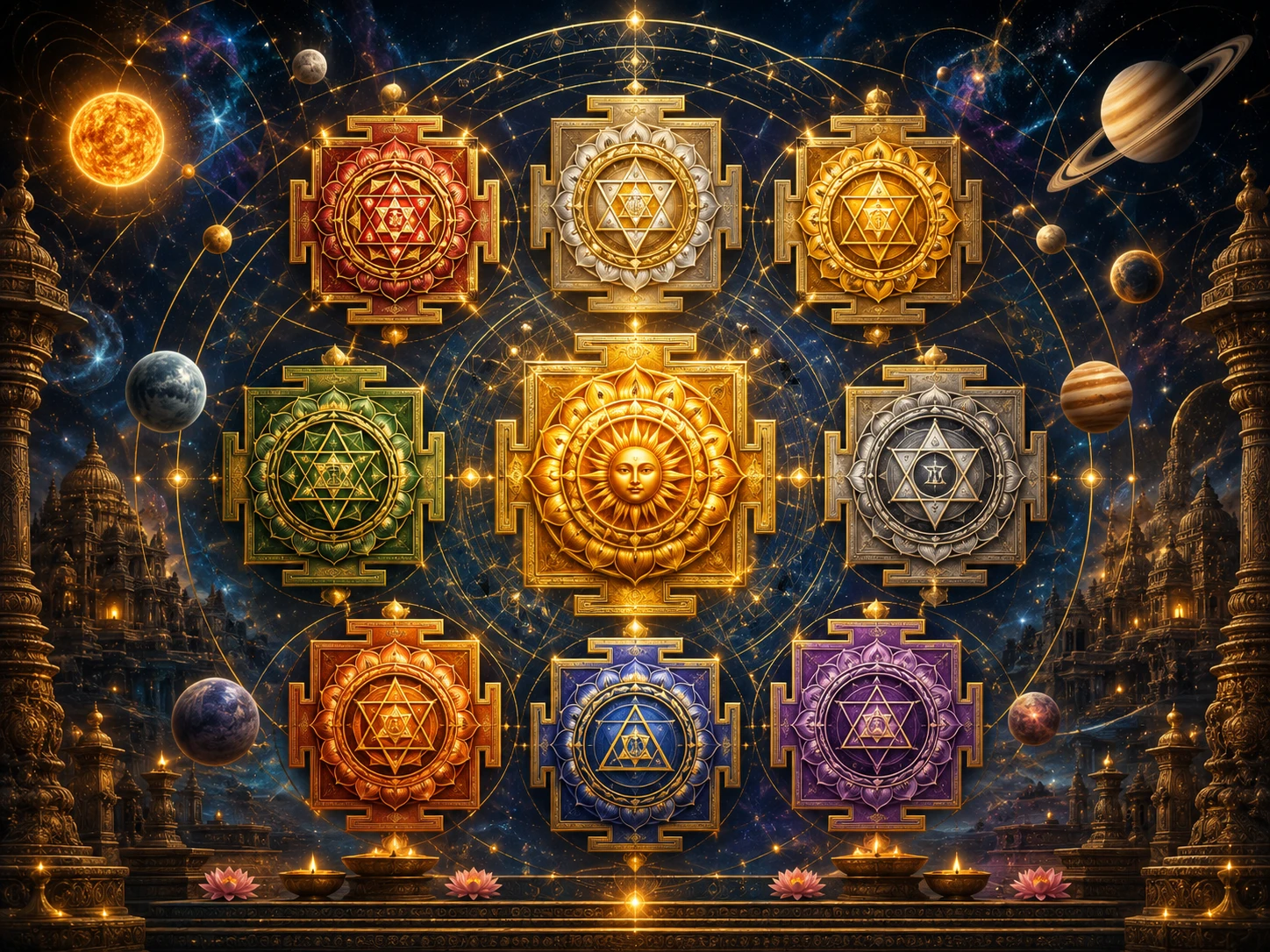
Navagraha Yantras -- The Nine Planetary Magic Squares
नवग्रह यन्त्र -- नौ ग्रहों के जादुई वर्ग
Take a 3x3 grid. Place the numbers 2, 7, 6 in the top row, 9, 5, 1 in the middle, and 4, 3, 8 in the bottom. Now add any row: 2+7+6 = 15. Any column: 2+9+4 = 15. Either diagonal: 2+5+8 = 15 and 6+5+4 = 15. Every possible line through this grid sums to exactly 15.
Congratulations. You have just constructed the Surya (Sun) Yantra -- the oldest documented magic square in Indian mathematics and one of the foundational objects of Vedic astro-geometry.
This is not a party trick. This is the mathematical DNA of an entire system of cosmic remedy that has governed the spiritual, medical, and architectural decisions of Hindu civilisation for millennia. Each of the nine Vedic grahas (celestial influences) -- Surya (Sun), Chandra (Moon), Mangala (Mars), Budha (Mercury), Guru/Brihaspati (Jupiter), Shukra (Venus), Shani (Saturn), Rahu (North Node), and Ketu (South Node) -- has its own unique magic square yantra. Each square uses a specific set of numbers, and each sums to a specific constant that encodes the planet's numerical essence.
The Navagraha Yantra system sits at the intersection of three Indian knowledge traditions that modern academia treats as separate but that the tradition always understood as one: Jyotish (Vedic astrology), Ganita (mathematics), and Tantra (ritual technology). The yantras are simultaneously mathematical objects (studied by number theorists), astrological instruments (used by Jyotishis for planetary remedy), and meditation tools (used by Tantric practitioners for balancing cosmic energies in the body).
For the JEE aspirant who loves number patterns, the Navagraha Yantras are a gateway into the history of Indian mathematics. For the person visiting a Jyotishi after a difficult Saturn transit, they are a prescribed remedy. For the temple architect designing a Navagraha shrine, they are the blueprints. One system. Nine squares. Three thousand years of continuous use.
आदित्याय च सोमाय मङ्गलाय बुधाय च। गुरुशुक्रशनिभ्यश्च राहवे केतवे नमः॥
ādityāya ca somāya maṅgalāya budhāya ca | guru-śukra-śanibhyaś ca rāhave ketave namaḥ ||
Salutations to Aditya (Sun), Soma (Moon), Mangala (Mars), Budha (Mercury), Guru (Jupiter), Shukra (Venus), Shani (Saturn), Rahu, and Ketu.
— Navagraha Stotram (traditional, recited at all Navagraha temples)
The Mathematics -- How Planetary Magic Squares Work
Each Navagraha Yantra is a 3x3 magic square constructed using nine consecutive integers specific to that planet. The starting number and magic constant for each planet are determined by its Vedic planetary number (Graha Anka).
The system works as follows: each planet is assigned a number from 1 to 9. Sun = 1, Moon = 2, Mars = 3, Mercury = 4, Jupiter = 5, Venus = 6, Saturn = 7, Rahu = 8, Ketu = 9. The 3x3 magic square for each planet uses nine consecutive numbers beginning from a specific starting point, and the magic constant (the sum of each row, column, and diagonal) increases by 3 for each successive planet.
The elegant result: Sun's yantra uses numbers that sum to 15 in every direction. Moon's sums to 18. Mars to 21. Mercury to 24. Jupiter to 27. Venus to 30. Saturn to 33. Rahu to 36. Ketu to 39. The progression is perfectly arithmetic -- each planet's constant is exactly 3 more than the previous one.
This is pure combinatorial mathematics, executed with a sophistication that Western mathematicians would not formally describe until Euler's work on Latin squares in the 18th century. Yet these Indian magic squares appear in texts and temple inscriptions dating to at least the 10th century CE, and the oral tradition places them much earlier.
The master Navagraha Yantra combines all nine individual yantras into a single 9x9 grid -- a magic square of magic squares. The Sun yantra occupies the centre position (because Surya is the king of the Navagrahas), with the other eight arranged around it in a specific directional pattern that mirrors the Navagraha temple layout: Sun centre, Moon northeast, Mars south, Mercury northeast, Jupiter north, Venus east, Saturn west, Rahu southwest, Ketu northwest.
For the mathematics student, these yantras are not curiosities but serious mathematical objects. The existence of a magic square for any given n (where n is the grid size) was proven by various mathematicians over centuries. The Indian tradition produced 3x3, 4x4 (the Khajuraho Chautisa Yantra), and even larger magic squares well before their European counterparts. The Navagraha system is one of the earliest applications of combinatorics to a systematic purpose -- nine related but distinct magic squares unified by a single mathematical principle.
The Nine Planetary Yantras -- Numbers, Constants, and Associations
| Planet | ग्रह | Planetary Number | Magic Constant | Day | Gemstone | Beej Mantra |
|---|---|---|---|---|---|---|
| Surya (Sun) | सूर्य | 1 | 15 | Sunday | Ruby (Manikya) | Om Hraam Hreem Hraum Sah Suryaya Namah |
| Chandra (Moon) | चन्द्र | 2 | 18 | Monday | Pearl (Moti) | Om Shraam Shreem Shraum Sah Chandraya Namah |
| Mangala (Mars) | मंगल | 3 | 21 | Tuesday | Red Coral (Moonga) | Om Kraam Kreem Kraum Sah Bhaumaya Namah |
| Budha (Mercury) | बुध | 4 | 24 | Wednesday | Emerald (Panna) | Om Braam Breem Braum Sah Budhaya Namah |
| Guru (Jupiter) | गुरु/बृहस्पति | 5 | 27 | Thursday | Yellow Sapphire (Pukhraj) | Om Graam Greem Graum Sah Gurave Namah |
| Shukra (Venus) | शुक्र | 6 | 30 | Friday | Diamond (Heera) | Om Draam Dreem Draum Sah Shukraya Namah |
| Shani (Saturn) | शनि | 7 | 33 | Saturday | Blue Sapphire (Neelam) | Om Praam Preem Praum Sah Shanaischaraya Namah |
| Rahu (N. Node) | राहु | 8 | 36 | Saturday (alt.) | Hessonite (Gomed) | Om Bhraam Bhreem Bhraum Sah Rahave Namah |
| Ketu (S. Node) | केतु | 9 | 39 | Tuesday (alt.) | Cat's Eye (Lehsuniya) | Om Sraam Sreem Sraum Sah Ketave Namah |
Each planetary number determines the magic square's structure. The magic constant = 3 x (planetary number + 4). All nine Beej Mantras follow the same phonetic template (Om + Xraam Xreem Xraum Sah + Planet Dative + Namah), with only the initial consonant changing per planet.
The Number 9 -- Why It Rules the Navagraha System
The number 9 saturates the Navagraha Yantra system in a way that transcends coincidence and enters the territory of mathematical necessity.
There are 9 planets. The master yantra is divided into 9 sections. Each section contains a 3x3 grid -- 3 being the square root of 9. The digital root (repeated digit sum) of every magic constant in the system reduces to 9: Sun's 15 (1+5=6... wait: 6 is not 9. But 15 itself is the sum of digits 1 through 5, and the full grid uses 1-9 whose sum is 45, and 4+5=9). Moon's 18: 1+8=9. Mars's 21: 2+1=3 (but the full grid sum is 63: 6+3=9). The universal grid total -- the sum of all numbers in the master 9x9 Navagraha Yantra -- is 3,348, and 3+3+4+8 = 18, and 1+8 = 9.
In Hindu numerology, 9 represents completeness and exaltation. It is the highest single digit in a decimal system. Adding 9 to any number does not change the digital root (15+9=24, 2+4=6; and 1+5=6 -- same). Multiplying any number by 9 produces a result whose digits sum to 9 (9x7=63, 6+3=9). Nine is the number that absorbs everything into itself without changing -- it is mathematically selfless. This property made 9 the perfect choice for a system designed to represent cosmic totality.
The Vedic connection goes further. There are 9 forms of Bhakti (Navavidha Bhakti). 9 nights of Navaratri. 9 planets. 108 -- the sacred count of the Japa mala -- is 12 x 9. The Navagraha Yantras are not just mathematical -- they are part of an interlocking system where the number 9 serves as a structural constant across astronomy, ritual, architecture, and devotion.
For the IIT-JEE student studying number theory or modular arithmetic, the Navagraha Yantras are a historical case study in how number patterns were systematised and applied. For the CA student, the magic constant formula (3 x (planet number + 4)) is an elegant example of parametric pattern generation. The ancients did not separate mathematics from spirituality -- they understood both as explorations of the same underlying order.
Navagraha Temples and Yantra Worship in Practice
The most famous Navagraha temple complex in India is the cluster of nine temples in Tamil Nadu, each dedicated to a single graha. The Suryanar Kovil (Sun), Thingalur (Moon), Vaitheeswaran Kovil (Mars), Thiruvenkadu (Mercury), Alangudi (Jupiter), Kanjanur (Venus), Thirunallar (Saturn), Thirunageswaram (Rahu), and Keezhperumpallam (Ketu) form a pilgrimage circuit that devotees complete to balance all nine planetary influences simultaneously. Each temple houses the planetary deity's yantra alongside the murti.
The Navagraha shrine inside virtually every major South Indian temple follows a standardised arrangement: Surya at the centre, and the remaining eight planets positioned in specific cardinal and inter-cardinal directions. This arrangement mirrors the master Navagraha Yantra -- the temple is a three-dimensional yantra you walk through.
In daily practice, the combined Navagraha Yantra (a single copper plate containing all nine magic squares in a 3x3 arrangement) is the most common home-worship variant. Families install it in the puja room, typically on a Saturday (governed by Shani, the most feared graha), and perform weekly puja with the Navagraha Stotram. This is the default prescription when a Jyotishi identifies multiple afflicted planets in a horoscope -- rather than wearing nine gemstones (expensive and often contradictory), the devotee worships the combined yantra, which harmonises all nine influences simultaneously.
The UPSC aspirant studying Art and Culture will encounter Navagraha temples in questions about temple architecture and regional pilgrimage traditions. The IAS officer posted in Tamil Nadu will find that Navagraha temple visits are a living administrative reality -- these temples receive millions of pilgrims annually, and their festivals require district-level coordination. The NRI family that visits Thirunallar to appease Shani after a difficult seven-and-a-half-year Sade Sati period is participating in a tradition that seamlessly merges mathematical precision, astronomical observation, and devotional faith.
For the sceptic, the Navagraha Yantras offer a different entry point: pure mathematics. Whether or not you believe that a copper plate with numbers can influence planetary forces, the mathematical elegance of nine interlocking magic squares -- each internally perfect, each related to the others by a constant arithmetic progression -- is undeniable. You can appreciate the yantra as sacred geometry without accepting its astrological claims, just as you can appreciate a cathedral's architecture without being Christian.
Graha Dosha and Yantra Remedies -- The Jyotish Connection
The practical context in which most Indians encounter Navagraha Yantras is Jyotish -- Vedic astrology. When a Jyotishi analyses a birth chart (Kundali) and identifies that a particular planet is afflicted (weak, combust, debilitated, or in an unfavourable house), the standard remedial prescription includes three components: a gemstone (ratna), a mantra (japa of the planetary Beej Mantra), and a yantra (installation and worship of the planetary magic square).
The logic is multi-channel reinforcement. The gemstone works on the physical body (worn against the skin, transmitting specific light frequencies). The mantra works on the subtle body (vibrational frequency of sound). The yantra works on the spatial environment (geometric field of numerical harmony installed in the home or temple). Together, the three create a comprehensive remedial field that addresses the planetary imbalance at every level.
Shani (Saturn) is the planet most commonly remedied through yantras, because Shani Dosha -- the affliction of Saturn -- is the most feared astrological condition in Indian culture. The Sade Sati (seven-and-a-half-year period when Saturn transits the natal Moon sign and its adjacent signs) is blamed for career setbacks, health crises, relationship breakdowns, and general life disruption. Millions of Indians visit Thirunallar Shani temple in Karaikal or the Shani Shingnapur temple in Maharashtra specifically for Shani Dosha remediation. The Shani Yantra (magic constant 33) is installed in homes alongside the temple visit.
Rahu and Ketu, the shadow planets (mathematical points representing the lunar nodes rather than physical bodies), receive yantra remedies for Kaal Sarp Dosha -- the condition where all seven visible planets are hemmed between Rahu and Ketu in the birth chart. This is one of the most anxiety-producing astrological conditions in popular Indian culture, and the Rahu Yantra (36) and Ketu Yantra (39) are prescribed alongside the Navagraha Stotram.
It is worth noting that traditional Jyotish texts like Brihat Parashara Hora Shastra emphasise that yantras and mantras are remedies to be combined with right action (Karma) and devotion (Bhakti). No yantra substitutes for personal effort. The yantra creates favourable conditions; the individual must act within those conditions. This is not fatalism but a sophisticated framework for aligning individual will with cosmic timing -- much like a sailor who cannot control the wind but can adjust the sails.
How to Use Navagraha Yantras at Home -- A Practical Guide
For most households, the combined Navagraha Yantra -- a single plate or print containing all nine planetary magic squares -- is the most practical choice. Here is a step-by-step guide for installation and daily worship.
Choosing the Yantra: Copper is the traditional and preferred material. A combined Navagraha Yantra engraved on a copper plate (typically 6x6 or 8x8 inches) is available at any traditional puja shop in cities like Varanasi, Haridwar, Ujjain, and Nashik, or through reputable online sources. Ensure the numbers in each 3x3 square are correct -- verify that each row, column, and diagonal in every individual planetary square sums to its magic constant (15 for Sun, 18 for Moon, and so on). An incorrectly engraved yantra is worse than no yantra at all.
Installation: Choose a Saturday (Shani's day, which governs the most feared planetary influences) during Shukla Paksha (waxing moon phase). Clean the yantra with Ganga jal or turmeric water. Place it on a clean yellow cloth on the altar or a dedicated shelf, facing East. Light a ghee diya and incense. Recite the Navagraha Stotram three times while gazing at the yantra's centre (the Sun square). Then chant Om 108 times. The yantra is now installed.
Weekly Puja: Every Saturday, light a sesame oil diya (sesame is sacred to Shani) before the yantra. Offer blue or black flowers (for Shani), and chant the Navagraha Stotram once. Follow with 27 repetitions of each planetary Beej Mantra (9 planets x 27 = 243 total chants, approximately 20-25 minutes). For those with less time, chanting just the Navagraha Stotram with Om 108 times takes about 10 minutes.
Specific Planetary Days: For targeted remedy, worship the specific planet's individual yantra on its governing day -- Sun on Sunday, Moon on Monday, Mars on Tuesday, Mercury on Wednesday, Jupiter on Thursday, Venus on Friday, Saturn on Saturday. Rahu and Ketu share Saturday and Tuesday respectively in some traditions, though others assign them to specific Nakshatras.
For Working Professionals: Keep a small laminated Navagraha Yantra in your wallet or office drawer. On difficult days -- when multiple things seem to go wrong simultaneously (what Jyotish might call a difficult transit) -- take the yantra out, place it on the desk, and silently chant Om Adityaya Namah through Om Ketave Namah (the nine salutations) once. This takes under two minutes and provides a psychological anchor of order amid chaos -- whether you attribute the effect to planetary influence or to the calming power of structured ritual.
For the student preparing for competitive exams: the Budha (Mercury) Yantra specifically enhances intellectual capacity, memory, and analytical thinking. Install a separate Budha Yantra (magic constant 24) and worship it on Wednesdays with green flowers and the mantra Om Braam Breem Braum Sah Budhaya Namah 108 times. Mercury governs Buddhi (intellect) -- the very faculty that competitive exams test.
The 3x3 magic square that forms the Surya Yantra (also known as the Lo Shu square in Chinese tradition) has been proven mathematically unique -- there is only one possible arrangement of numbers 1-9 in a 3x3 grid where all rows, columns, and diagonals sum to 15 (excluding rotations and reflections). This makes the Surya Yantra not merely sacred but mathematically singular. India and China developed this identical magic square independently, suggesting either very ancient cultural exchange or a convergent mathematical discovery. The Parshvanath Jain temple at Khajuraho (10th century CE) contains a 4x4 magic square carved in stone -- the Chautisa Yantra -- where every row, column, diagonal, and even the four quadrants each sum to 34. This is one of the oldest surviving 4x4 magic squares in the world, and it remains a popular example in recreational mathematics textbooks globally.
Balance All Nine Planets -- Navagraha Stotram Japa with Yantra Focus
Print or buy a combined Navagraha Yantra, as a copper plate or a good print, and place it in your puja room facing east. Every Saturday, recite the Navagraha Stotram once while gazing at the central Surya square, then chant Om 108 times on a mala. It is a weekly practice that addresses all nine grahas together. The Navagraha Stotram is on Eternal Raga with its meaning.
Tags
Eternal Raga · शाश्वत राग
Institutional voice — scholarly articles on Sanatan Dharma
Deepen Your Understanding
अपनी समझ और गहरी करें
tantra mantra yantra
Ganesh Yantra -- The Obstacle Remover's Sacred Geometry
Every Hindu ritual begins with Ganesha. Every mantra starts with Om -- and the shape of Om itself encodes Ganesha's form. His yantra is the geometric blueprint of this primacy: a sacred diagram that clears obstacles before you even name them. From JEE aspirants to startup founders, the Ganesh Yantra is India's oldest project-launch protocol.
tantra mantra yantra
Sri Yantra -- The Supreme Geometry of Creation
Nine interlocking triangles. 43 smaller triangles. A single point from which the entire universe unfolds. The Sri Yantra is the most complex and revered sacred diagram in Hinduism -- and modern mathematicians have found that constructing it requires solving simultaneous equations that Western mathematics did not formalise until the 18th century. This is not decoration. This is the visual body of the Goddess.
vedic sciences
Jyotish Shastra -- The Vedic System of Astronomy and Astrology That India Never Stopped Using
Every year, millions of Indian marriages are fixed only after the kundali matches. ISRO times its satellite launches on muhurtas. JEE students wear navagraha rings. Real-estate agents check Rahu-Ketu transits before closing deals. Whether you believe in it or not, Jyotish Shastra -- the Vedic science of light, time, and celestial influence -- is the most actively practised ancient knowledge system in India today. It spans 9 Grahas, 12 Rashis, 27 Nakshatras, and 2,500 years of continuous mathematical and observational tradition. This article explains the system as the texts describe it -- not as a prediction engine, but as a framework for understanding time, cycles, and the relationship between the cosmos and human life.
deities avatars
Navagraha -- The Nine Planetary Deities Who Govern Your Horoscope and Your Life
Before every job interview, before every wedding, before buying a house or starting a business -- millions of Indians check their Navagraha positions. These nine celestial deities -- the Sun, Moon, Mars, Mercury, Jupiter, Venus, Saturn, and the shadow planets Rahu and Ketu -- constitute the most practically influential theological system in Hinduism. Whether you believe in astrology or not, the Navagraha are shaping Indian culture around you.
tantra mantra yantra
Kubera Yantra -- The Wealth Grid That Sums to 72
A 3x3 grid. Numbers 20 through 28. Every row, column, and diagonal adds up to 72 -- the sacred number of Kubera, the Yaksha King and divine treasurer. Drawn as kolam on Tamil Nadu doorsteps, engraved on copper plates in Diwali puja rooms, and tucked inside the wallets of Dalal Street traders -- the Kubera Yantra is India's oldest algorithm for attracting abundance.
tantra mantra yantra
Yantra Meditation Guide -- How to Meditate with Sacred Geometry
A yantra is not a decoration. It is an optical mantra -- a geometric diagram engineered to restructure visual perception and, through it, consciousness itself. This guide teaches you how to meditate with yantras, from beginner trataka to advanced Sri Yantra navigation.
tantra mantra yantra
Tantra, Mantra and Yantra -- The Three Pillars of Spiritual Practice
Tantra is the loom, Mantra is the thread, Yantra is the pattern. Together they form the complete technology of spiritual transformation that India gifted to the world -- and they are far more profound than popular culture imagines.
The 3x3 magic square that forms the Surya Yantra (also known as the Lo Shu square in Chinese tradition) has been proven mathematically unique -- there is only one possible arrangement of numbers 1-9 in a 3x3 grid where a…
More in Tantra, Mantra & Yantra
Agama vs Tantra vs Veda -- Three Streams of Hindu Practice
14 min read
Agni Dhyana -- What Meditation on Fire Is Actually Grounded In
8 min read
Ashta Siddhi -- The Eight Yogic Powers and How Hanuman Embodies Them
13 min readThe same translation error that turned '33 Koti' into '33 crore' in Hinduism also happened in Buddhism. The Chinese translation of Buddhist texts rendered 'Sapta Koti Buddha' (7 Supreme Buddhas) as '7 Crore Buddhas.' The…
Deities AvatarsCommunity Reflections
🕉️
Be the first to share your reflection.