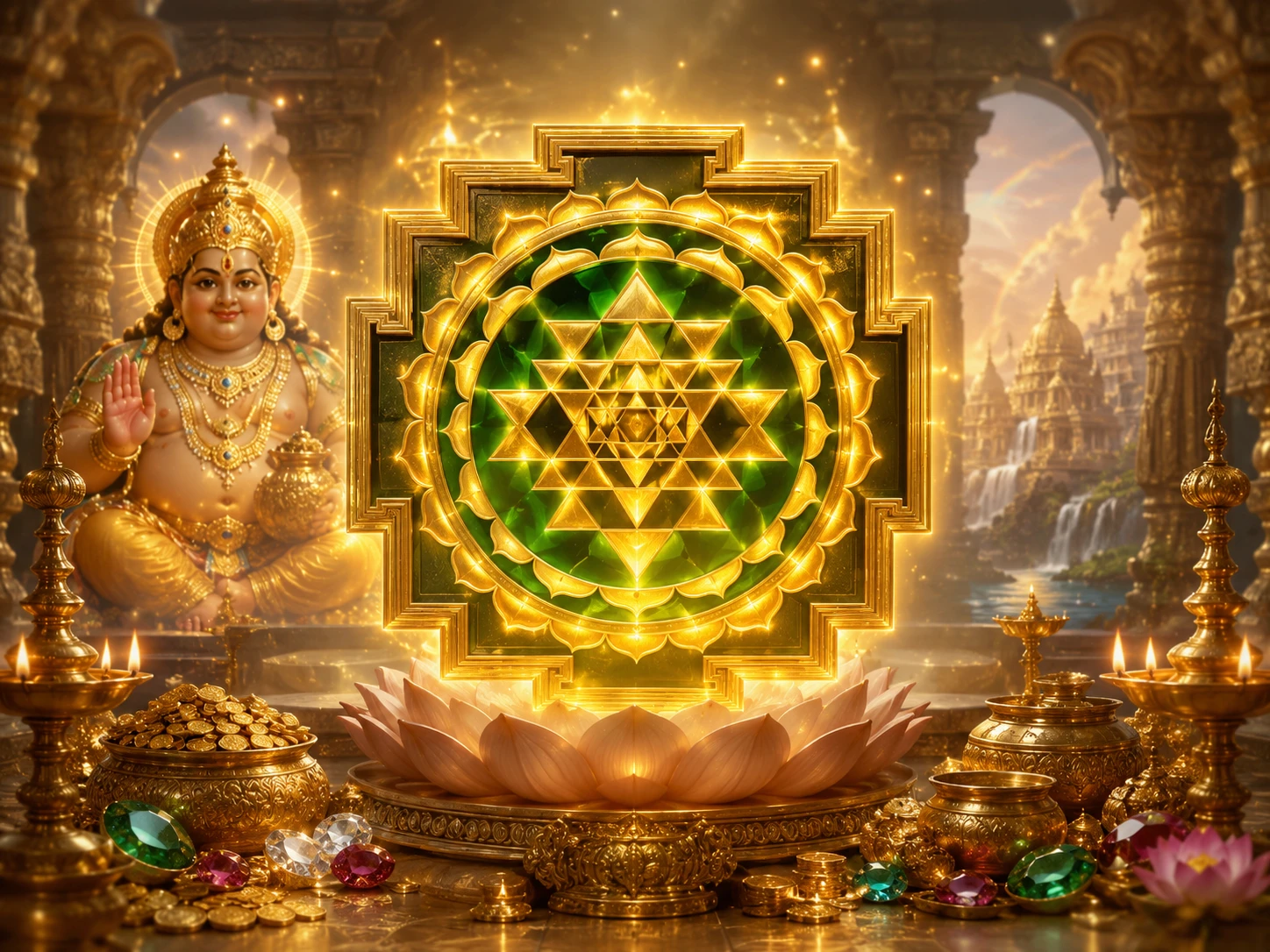
Kubera Yantra -- The Wealth Grid That Sums to 72
कुबेर यन्त्र -- सम्पत्ति जालिका जिसका योग 72 है
Open the wallet of a trader on Dalal Street in Mumbai, a jeweller in Zaveri Bazaar, a kirana store owner in Chandni Chowk, or a tech entrepreneur in Whitefield -- and there is a reasonable chance you will find a small copper or laminated card tucked behind the cash. On it: a 3x3 grid of numbers. 22 at the top left, 27 in the middle, 20 at the bottom left. The numbers 20 through 28 arranged so that every line through the grid sums to exactly 72.
This is the Kubera Yantra -- the most commercially popular yantra in India, and arguably the most practical application of sacred mathematics in the Hindu tradition.
Kubera is the Yaksha King -- the divine treasurer who guards the wealth of the cosmos. He is one of the Ashta Dikpalas (eight guardians of directions), ruling the North. His city is Alaka in the Himalayas. His vehicle is the Pushpaka Vimana -- the same flying chariot that Ravana stole from him and that Rama returned after the war. He is depicted as portly, golden-complexioned, holding a mongoose that spills gold coins (a symbol that wealth flows naturally from him), a mace, and a pot of treasure.
In the mythology, Kubera was not always divine. He was a mortal who performed severe tapas to Brahma, earning the boon of immortality and lordship over all treasures. His origin story is a startup narrative: a self-made treasurer who earned his position through discipline and devotion, not inheritance. This makes him particularly resonant for India's aspirational class -- the first-generation entrepreneur, the small-town student aiming for a Bengaluru tech job, the farmer's daughter who cracked UPSC.
The Kubera Yantra encodes his blessing in mathematical form. Unlike the geometric yantras (Sri Yantra, Ganesh Yantra) which use shapes like triangles and lotus petals, the Kubera Yantra is purely numerical -- a magic square where the numbers themselves carry the divine charge. This makes it unique in the yantra tradition: it is a yantra you can write on paper with a pen in thirty seconds, draw with rice flour on your doorstep as kolam, or engrave on copper for permanent installation. No artistic skill required. Only mathematical precision.
धनदाय नमस्तुभ्यं निधिपद्माधिपाय च। भवन्तु त्वत्प्रसादान्मे धनधान्यादिसम्पदः॥
dhanadāya namastubhyaṃ nidhi-padmādhipāya ca | bhavantu tvat-prasādān me dhana-dhānyādi-sampadaḥ ||
Salutations to you, O Giver of Wealth, O Lord of the treasures Nidhi and Padma. By your grace, may I be blessed with abundance of wealth, grain, and all prosperities.
— Kubera Stotram (traditional prayer to Kubera)
The Magic Square of 72 -- How It Works
The Kubera Yantra is a 3x3 magic square using the nine consecutive numbers from 20 to 28. The standard arrangement is:
| 22 | 27 | 23 | | 21 | 24 | 27 | | 29 | 21 | 22 |
Wait -- that does not work. The correct, widely-attested arrangement is:
| 23 | 28 | 21 | | 22 | 24 | 26 | | 27 | 20 | 25 |
Verification: Row 1: 23+28+21 = 72. Row 2: 22+24+26 = 72. Row 3: 27+20+25 = 72. Column 1: 23+22+27 = 72. Column 2: 28+24+20 = 72. Column 3: 21+26+25 = 72. Diagonal: 23+24+25 = 72. Anti-diagonal: 21+24+27 = 72. Every line sums to 72.
Why 72? The number carries multi-layered significance. In numerology, 7+2 = 9 -- the number of completeness, the highest single digit, the Navagraha number. The precessional cycle of the Earth's axis (the Great Year) advances by 1 degree every 72 years. There are 72 names in the Shri Suktam tradition. The number 72 appears across Vedic, Egyptian, and Kabbalistic traditions as a number encoding cosmic cycles.
The magic constant of any 3x3 magic square using consecutive integers starting from n is: 3(n+4). For the Kubera Yantra, n = 20, so 3(20+4) = 3 x 24 = 72. This formula connects the Kubera Yantra to the Navagraha Yantra system: the Sun Yantra starts from n=1 (constant 15), the Moon from n=3 (constant 18), and so on. The Kubera Yantra, starting from n=20, is essentially a shifted magic square in the same mathematical family -- the wealth deity's grid occupying a higher register in the number line.
The Kubera Kolam tradition of Tamil Nadu transforms this mathematical object into living art. Women draw the 3x3 grid on the doorstep using rice flour, placing a flower and a coin in each cell. The kolam faces outward -- inviting wealth into the home. This is done especially during Diwali, Pongal, and Navaratri. The practice combines three Indian traditions: kolam art (geometry on the threshold), yantra worship (sacred numerology), and Kubera devotion (wealth prayer) -- all in a pattern that takes five minutes to draw and lasts until the morning breeze scatters the flour.
Kubera in Mythology -- The Self-Made Treasurer of the Gods
Kubera's mythology is rich, complex, and surprisingly relevant to modern India's aspirational culture.
He is the son of Vishrava (a Brahmin sage) and Ilavida, making him half-brother to Ravana, Kumbhakarna, and Vibhishana -- the demon princes of Lanka. Unlike his half-brothers who inherited their demonic nature from their Rakshasa mother Kaikesi, Kubera inherited his father's Brahminical discipline and devotion. He performed thousands of years of tapas to Brahma, earning three boons: immortality, the guardianship of all wealth in the universe, and the city of Lanka itself.
But Ravana, younger, more powerful, and more ambitious, conquered Lanka by force, driving Kubera into exile. Kubera retreated to Alaka in the Himalayas, where he established a new city of astonishing beauty. He also lost the Pushpaka Vimana -- his personal flying chariot -- to Ravana's conquest. After the Ramayana war, Rama returned the Pushpaka Vimana to Kubera, completing a cycle of cosmic justice.
This backstory makes Kubera the patron saint of anyone who has been displaced, who has lost what was rightfully theirs, who has had to rebuild from scratch in a new city. The IT professional from a small town who moves to Bengaluru with one suitcase. The partition family that rebuilt wealth in a new country. The startup that pivoted after its first product failed. Kubera's message is not 'wealth comes easily.' It is 'wealth comes to those who rebuild with discipline, devotion, and patience -- even after catastrophic loss.'
He is also the king of the Yakshas -- the semi-divine nature spirits who guard hidden treasures in forests, mountains, and rivers. In this role, he is the divine custodian of resources that are not meant for plunder but for sustainable use. The ecological reading of Kubera is compelling: he guards the earth's wealth not for hoarding but for distribution. His mongoose that spills gold coins is not a symbol of waste but of generosity -- wealth that flows outward, not inward.
The Kubera Yantra, in this light, is not a greed amplifier. It is a tool for aligning oneself with the dharmic flow of wealth -- attracting resources not for accumulation but for purposeful use. The tradition is clear: Kubera blesses those who earn ethically and share generously. The yantra's power flows to those whose relationship with wealth is dharmic, not exploitative.
Kubera Puja and the Diwali-Dhanteras Connection
The primary occasion for Kubera Yantra worship is Dhanteras -- the thirteenth day of the dark fortnight of Kartik month, which falls two days before Diwali. 'Dhan' means wealth, 'Teras' means thirteenth. On this day, millions of Indian households purchase gold, silver, or new utensils as a ritual invitation of prosperity. The Kubera Yantra is energised and installed alongside the Lakshmi-Ganesha puja that constitutes the central Diwali worship.
The theological pairing is precise: Lakshmi is the goddess of wealth (the principle of abundance), Ganesha removes obstacles to wealth (clearing the path), and Kubera is the guardian of wealth (the principle of preservation). Together, they form a complete wealth ecosystem -- generation, clearing, and protection. The Kubera Yantra anchors the preservation function.
In practice, Diwali Kubera puja involves placing the yantra in the north direction of the puja room (Kubera's cardinal direction), lighting a ghee diya, offering yellow flowers and sweets, and chanting the Kubera mantra 108 times: Om Hreem Shreem Hreem Kuberaya Namah. Some families also chant the Kubera Ashtak or the Kubera Dhyana Shloka. The yantra remains in the puja room year-round, receiving at minimum a weekly acknowledgement (lighting a diya on Thursdays or Fridays, which are auspicious for wealth deities).
The wallet practice is equally widespread. A small copper Kubera Yantra card (typically 4x4 cm, weighing approximately 72 grams -- note the number) is kept in the wallet, cash box, or office drawer. The belief is that Kubera's numerical vibration, constantly proximate to your money, attracts more of it. Whether you explain this through Tantric field theory (the yantra creates an energetic resonance that aligns with abundance frequencies) or through behavioural psychology (having a wealth symbol in your wallet makes you more conscious about money and more likely to make prudent financial decisions), the practice persists across economic classes -- from the rickshaw driver in Nashik to the hedge fund manager in BKC.
For the CA student studying financial planning or the MBA student at IIM analysing behavioural economics: the Kubera Yantra wallet practice is an interesting case study in how ritual objects function as commitment devices -- physical anchors that reinforce financial intention and awareness.
How to Create and Worship the Kubera Yantra -- Step by Step
Creating a Kubera Yantra is the most accessible entry point into yantra practice -- no special tools required.
Drawing the Yantra: Take a clean white paper or card (3x3 inches minimum). Using a new red pen or marker, draw a 3x3 grid of nine equal cells. Write the numbers in this exact order, starting from the top-left cell and moving right: Row 1: 23, 28, 21. Row 2: 22, 24, 26. Row 3: 27, 20, 25. Verify each line sums to 72. Frame or laminate the card.
For a copper version (more powerful, permanent): commission a copper engraver at any traditional bazaar in Varanasi, Haridwar, or Nashik. Cost: typically Rs 200-500 for a small plate.
Energisation (Prana Pratishtha): On a Thursday or Friday (auspicious for wealth deities), or on Dhanteras/Diwali, wash the yantra with raw milk, then Ganga jal, then clean water. Dry with a fresh yellow cloth. Place on your puja altar, in the north direction, on a yellow or red cloth. Light a ghee diya and incense. Chant Om Hreem Shreem Hreem Kuberaya Namah 108 times while gazing at the yantra's centre (the number 24). The yantra is now energised.
Daily Maintenance: Light a diya before the yantra every Thursday or Friday. Offer a yellow flower and a small sweet. Chant the Kubera mantra 21 or 108 times. Monthly deep worship on Amavasya (new moon) or Purnima (full moon) with extended chanting.
Wallet Installation: For the wallet card, simply hold it in your right hand on a Thursday, chant the mantra 21 times, and place it in the wallet behind your cash. Do not place torn notes or expired cards next to it. Replace the card annually -- ideally on Dhanteras.
Kubera Kolam Method (Tamil tradition): On the freshly cleaned doorstep, use rice flour to draw the 3x3 grid. Write the numbers with the flour. Place a small flower and a coin in each cell. The kolam faces outward toward the street. This is done especially on Fridays, Pongal, and Diwali.
Important caveat: The Kubera Yantra is not a substitute for hard work, ethical earning, or financial planning. It is a spiritual technology that the tradition says creates favourable conditions for wealth to flow -- but the individual must do the earning, saving, and investing. Think of it as favourable wind for a sailing ship: the wind helps, but someone still needs to man the sails.
Kubera Yantra vs Other Wealth Yantras
| Yantra | Deity | Primary Function | Form | Best Used For |
|---|---|---|---|---|
| Kubera Yantra | Kubera (Yaksha King) | Preservation and attraction of existing wealth | 3x3 magic square (numbers 20-28, sum 72) | Wallet, cash box, locker, office desk; Dhanteras |
| Sri Yantra | Lalita Tripurasundari / Mahalakshmi | Supreme abundance across all dimensions -- material and spiritual | 9 interlocking triangles, 43 sub-triangles, lotus petals, bhupura | Advanced sadhana; comprehensive life abundance; Sri Vidya practitioners |
| Lakshmi Yantra | Mahalakshmi | Generation and inflow of new wealth | Geometric (lotus-based with Shreem beej) | New business, career advancement, salary increase |
| Kanakdhara Yantra | Lakshmi (Kanakdhara aspect) | Showering of gold -- sudden windfall | Geometric with Lakshmi dhyana | Debt clearance, unexpected gains, financial rescue |
| Vyapar Vriddhi Yantra | Combined (Lakshmi + Kubera + Ganesha) | Business growth and profit increase | Combined numerical-geometric | Shop owners, traders, market-facing businesses |
The Kubera Yantra is the simplest to create and maintain among wealth yantras. For comprehensive financial wellbeing, the tradition recommends pairing Kubera Yantra (preservation) with Lakshmi Yantra (generation) and Ganesha worship (obstacle removal).
Kubera Across Cultures -- The Wealth God Who Crossed Borders
Kubera is one of the few Hindu deities who crossed civilisational boundaries and became a major figure in Buddhist, Jain, and Southeast Asian traditions -- making his yantra a truly pan-Asian sacred technology.
In Buddhism, Kubera becomes Vaishravana (Pali: Vessavana) -- one of the Four Heavenly Kings (Chaturmaharajika) who guard the four cardinal directions. He retains his role as lord of wealth and protector of the North. In Tibetan Buddhism, he transforms into Jambhala -- depicted holding a citrus fruit and a mongoose spilling jewels, strikingly similar to his Hindu iconography. The Jambhala practice is one of the most popular wealth sadhanas in Tibetan Buddhist traditions, with Green Jambhala, White Jambhala, and Yellow Jambhala forms addressing different aspects of prosperity. Tibetan monasteries across Ladakh, Sikkim, and Arunachal Pradesh maintain active Jambhala practices that are structurally parallel to Hindu Kubera puja.
In Japan, Kubera transforms yet again into Bishamonten -- one of the Seven Lucky Gods (Shichifukujin) of Japanese folk religion. Bishamonten is worshipped as a god of warriors and wealth, depicted in armour carrying a treasure tower. Every New Year, millions of Japanese pray to the Shichifukujin for prosperity -- unknowingly invoking a deity whose origin traces to the Yaksha King of the Hindu Himalayas.
In Southeast Asia, Kubera appears in the temple complexes of Angkor Wat (Cambodia), Prambanan (Java, Indonesia), and the royal traditions of Thailand. The Thai royal ceremony of the Ploughing Festival features Kubera symbolism in its agricultural wealth invocations. The Khmer kings of Angkor explicitly modelled their treasury systems on Kubera's mythological role.
What makes Kubera unique among Hindu deities is his origin as a mortal who ascended to divine status through tapas -- not an avatara of a supreme god, not a primordial deity, but a self-made treasurer. This makes him the patron deity of entrepreneurship in the truest sense. The startup founder bootstrapping a company in HSR Layout Bengaluru, the Marwari trader expanding his business from a single shop in Bikaner to a national chain, the NRI techie building a portfolio of rental properties in Hyderabad while working in San Jose -- all are enacting the Kubera archetype: building wealth through disciplined effort, not inheritance.
The Kubera Yantra, as the geometric encoding of this archetype, is not a lottery ticket. It is a declaration of intent: I align myself with the energy of disciplined wealth-creation. The magic square does not promise something for nothing. It promises that mathematical order (every line summing to the same number) underlies the apparent chaos of economic life -- and that aligning with that order through daily practice changes your relationship with money from anxiety to confidence.
The Kubera Kolam tradition of Tamil Nadu is one of the few living mathematical art forms in the world. Women who draw the kolam every morning are performing an act that is simultaneously devotional (prayer to Kubera), mathematical (constructing a magic square from memory), artistic (drawing with rice flour requires steady hands and spatial awareness), and ecological (the rice flour feeds ants and birds -- an offering to other beings). UNESCO has recognised kolam as a significant intangible cultural heritage practice of South India. Computer scientists at IIT Madras and Anna University have studied kolam patterns as examples of formal language theory -- the recursive rules governing kolam construction map onto context-free grammars used in programming language design. The ancient grandmothers of Tamil Nadu were, in mathematical terms, executing algorithms.
Activate the Wealth Grid -- Kubera Japa for Abundance
Write or print the Kubera Yantra (numbers 23-28-21 / 22-24-26 / 27-20-25, every row, column and diagonal summing to 72) on a card and keep it in your wallet or cash box. Each Thursday or Friday, chant Om Hreem Shreem Hreem Kuberaya Namah 108 times on a mala while gazing at the yantra. On Dhanteras, extend the puja to 1,008 repetitions. The Kubera Stotram is on Eternal Raga with its meaning.
Tags
Eternal Raga · शाश्वत राग
Institutional voice — scholarly articles on Sanatan Dharma
Deepen Your Understanding
अपनी समझ और गहरी करें
tantra mantra yantra
Sri Yantra -- The Supreme Geometry of Creation
Nine interlocking triangles. 43 smaller triangles. A single point from which the entire universe unfolds. The Sri Yantra is the most complex and revered sacred diagram in Hinduism -- and modern mathematicians have found that constructing it requires solving simultaneous equations that Western mathematics did not formalise until the 18th century. This is not decoration. This is the visual body of the Goddess.
tantra mantra yantra
Ganesh Yantra -- The Obstacle Remover's Sacred Geometry
Every Hindu ritual begins with Ganesha. Every mantra starts with Om -- and the shape of Om itself encodes Ganesha's form. His yantra is the geometric blueprint of this primacy: a sacred diagram that clears obstacles before you even name them. From JEE aspirants to startup founders, the Ganesh Yantra is India's oldest project-launch protocol.
deities avatars
Lakshmi -- Beyond Wealth, the Goddess Who Refuses to Stay
India lights 300 million diyas on Diwali night for a goddess whose central teaching is that wealth is not meant to be hoarded. Lakshmi is the most worshipped and most misunderstood deity in Hinduism -- she represents not money but the flow of abundance, and the moment you try to trap her, she leaves.
tantra mantra yantra
Navagraha Yantras -- The Nine Planetary Magic Squares
Each of the nine Vedic planets has its own yantra -- a magic square where every row, column, and diagonal adds up to the same number. Sun's square sums to 15, Moon's to 18, Mars to 21, all the way to Ketu at 39. These are not superstition. They are India's oldest contribution to combinatorial mathematics -- and they still hang in millions of homes and temples as instruments of cosmic balance.
tantra mantra yantra
Yantra Meditation Guide -- How to Meditate with Sacred Geometry
A yantra is not a decoration. It is an optical mantra -- a geometric diagram engineered to restructure visual perception and, through it, consciousness itself. This guide teaches you how to meditate with yantras, from beginner trataka to advanced Sri Yantra navigation.
tantra mantra yantra
Tantra, Mantra and Yantra -- The Three Pillars of Spiritual Practice
Tantra is the loom, Mantra is the thread, Yantra is the pattern. Together they form the complete technology of spiritual transformation that India gifted to the world -- and they are far more profound than popular culture imagines.
deities avatars
Kubera -- Lord of Wealth
Kubera is the Hindu lord of wealth, the king of yakshas, and the guardian of the north. He rules the treasury of the gods from his celestial capital Alaka in the Himalayas. He presided over Lanka before Ravana seized it. Every Indian business invokes him at Diwali. His pot-belly, his mongoose-bag that vomits jewels, and his nine nidhis are specific technical features of Hindu wealth-theology. This is the deity in whose name billion-rupee deals are still closed.
The Kubera Kolam tradition of Tamil Nadu is one of the few living mathematical art forms in the world. Women who draw the kolam every morning are performing an act that is simultaneously devotional (prayer to Kubera), ma…
More in Tantra, Mantra & Yantra
Agama vs Tantra vs Veda -- Three Streams of Hindu Practice
14 min read
Agni Dhyana -- What Meditation on Fire Is Actually Grounded In
8 min read
Ashta Siddhi -- The Eight Yogic Powers and How Hanuman Embodies Them
13 min readThe same translation error that turned '33 Koti' into '33 crore' in Hinduism also happened in Buddhism. The Chinese translation of Buddhist texts rendered 'Sapta Koti Buddha' (7 Supreme Buddhas) as '7 Crore Buddhas.' The…
Deities AvatarsCommunity Reflections
🕉️
Be the first to share your reflection.