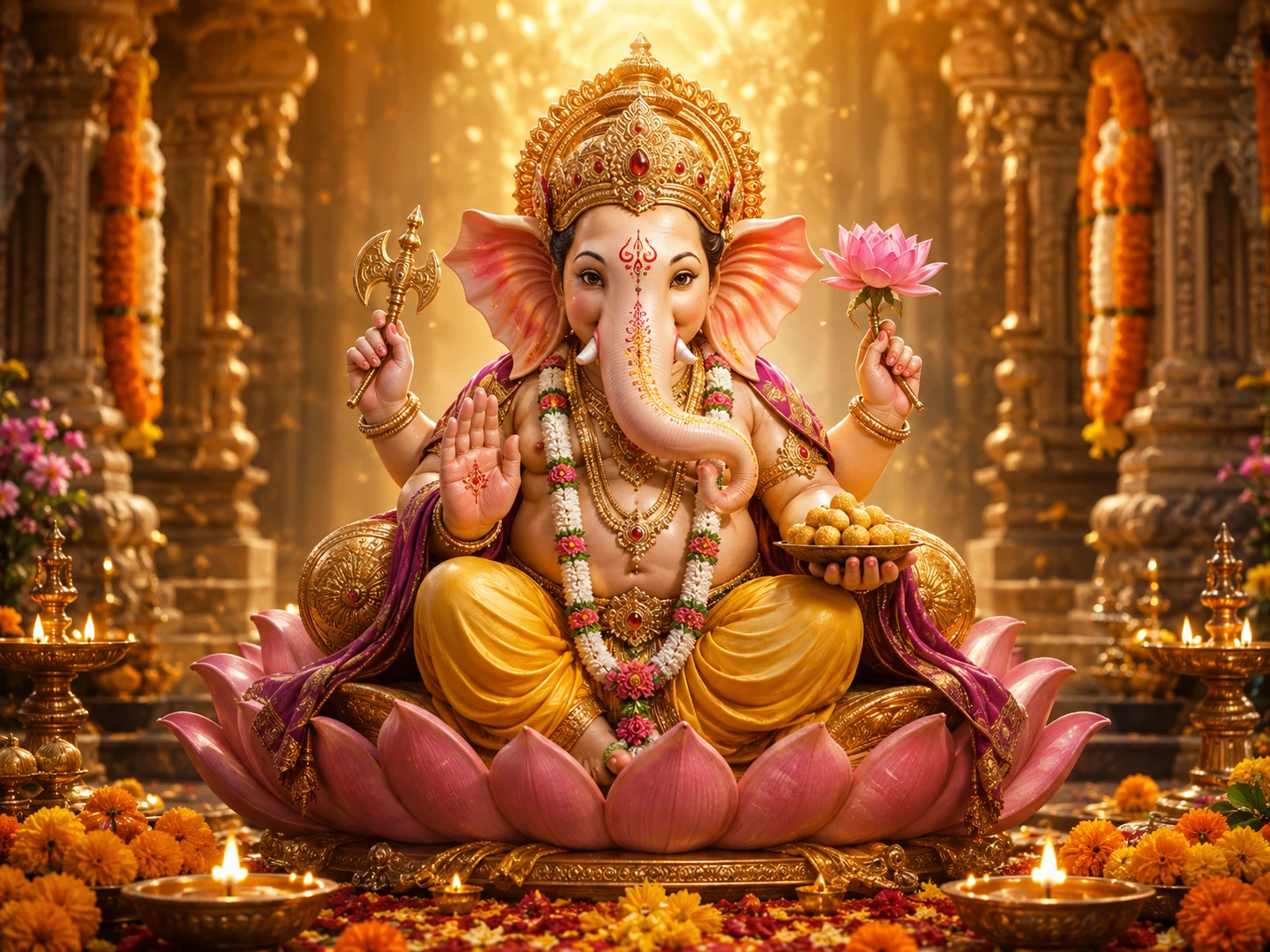
Ganesha -- The Elephant God Decoded
गणेश -- गजानन के प्रतीकों का रहस्य
There is a moment that happens in nearly every Indian household, office, and exam hall. Before the pen touches the answer sheet, before the shopkeeper opens the cash register on Dhanteras, before the priest begins a wedding ceremony, before the coder pushes the first commit of a new project -- someone says 'Shri Ganeshaya Namah.' It is so automatic, so deeply wired into Indian life, that most people never stop to ask: why this deity? Why first?
Ganesha is not the most powerful god in the Hindu pantheon. He did not churn oceans, he did not lift mountains (well, not literally), he did not fight the great wars. And yet he is the one every other god defers to at the start of any undertaking. The Ganapati Atharvasirsha, a late Upanishadic text from the Atharvaveda tradition, declares him to be Brahman itself -- the supreme, all-pervading reality. The Mudgala Purana and Ganesha Purana build entire theological systems around him. And in the everyday life of a billion people, his image appears more frequently than any other deity -- on dashboards, above doorways, on wedding cards, on the first page of account books, and increasingly, as the default display picture on new business WhatsApp groups.
But Ganesha is also the most visually unusual deity in Hinduism. An elephant head grafted onto a potbellied child's body. One tusk intact, one broken. Four arms (sometimes two, sometimes more). A tiny mouse crouching at his feet, supposedly his vehicle. A sweet dumpling -- the modak -- perpetually in hand. Large fan-like ears. Small, intelligent eyes.
None of this is accidental. Every element of Ganesha's iconography is a coded instruction manual for living. The form is the philosophy. And once you learn to read it, you never look at a Ganpati murti the same way again.
वक्रतुण्ड महाकाय सूर्यकोटि समप्रभ। निर्विघ्नं कुरु मे देव सर्वकार्येषु सर्वदा॥
vakratuṇḍa mahākāya sūryakoṭi samaprabha | nirvighnaṃ kuru me deva sarvakāryeṣu sarvadā ||
O Lord with a curved trunk and a massive body, whose radiance equals that of ten million suns -- make all my endeavours free of obstacles, always.
— Vakratunda Mahakaya Shloka (Popular invocation, attributed to various Ganesha stotras)
The Elephant Head -- Why Ganesha Looks the Way He Does
The most common origin story comes from the Shiva Purana. Parvati, while Shiva is away in meditation, creates a boy from the turmeric paste on her body and breathes life into him. She stations him as a guard outside her bathing chamber. Shiva returns, finds a stranger blocking his path, and in the ensuing confrontation, severs the boy's head. When Parvati's grief threatens to destroy creation, Shiva sends his ganas to find the head of the first living being they encounter sleeping with its head facing north. They return with the head of an elephant. Shiva attaches it to the boy's body and revives him, declaring him Ganapati -- lord of the ganas.
There are variants. The Brahma Vaivarta Purana offers a different account involving the gaze of Shani (Saturn) that burns the child's head. The Mudgala Purana presents Ganesha as a primordial being who takes the elephant form deliberately. But across all versions, the elephant head is not an accident or a punishment. It is a transformation.
And the symbolism of the elephant head is precise. The elephant is the largest land animal in the Indian ecosystem. It is intelligent, has prodigious memory, is gentle unless provoked, and removes obstacles from its path by sheer mass. The large ears signify the ability to listen deeply -- a quality every leader, student, and seeker needs. The small eyes suggest focused concentration rather than scattered attention. The trunk, which can uproot a tree and also pick up a needle, represents the combination of strength and discrimination -- the ability to handle the big picture and the fine details simultaneously.
For a JEE aspirant sitting in a Kota coaching centre, that trunk is the most relevant symbol: the capacity to solve a multi-step integration problem (macro strength) while not making a sign error in step three (micro precision). For a startup founder pitching to a VC, it is the ability to present a grand vision while answering a pointed question about unit economics. The elephant trunk is the original symbol of what modern management calls strategic and operational thinking combined.
The Broken Tusk -- The Price of Knowledge
Ganesha's broken left tusk is one of the most loaded symbols in Hindu iconography. The most celebrated explanation comes from the Mahabharata tradition itself. When Vyasa needed someone to transcribe the Mahabharata as he dictated it, he approached Ganesha. Ganesha agreed, on the condition that Vyasa would not pause in his recitation. Vyasa counter-conditioned that Ganesha must understand every verse before writing it down. During the transcription, Ganesha's pen broke. Rather than stop and lose the flow of the world's longest epic, he broke his own tusk and used it as a stylus to continue writing.
This is not a minor detail. It encodes a profound philosophy of knowledge: true learning requires sacrifice. You do not gain wisdom while keeping yourself intact. Something must break. The comfortable assumption. The ego. The certainty. The tusk.
The Brahmanda Purana offers another account where Ganesha breaks his tusk in combat with Parashurama -- Vishnu's sixth avatar. When Parashurama hurls an axe given to him by Shiva, Ganesha recognises the weapon as his father's and chooses not to deflect it, accepting the blow out of respect. The tusk breaks. This version adds another layer: sometimes the right response to force is not counter-force but conscious acceptance.
In modern India, the broken tusk resonates with anyone who has sacrificed comfort for a larger goal. The UPSC aspirant who gives up three years of social life to study in a 10-by-10 room in Mukherjee Nagar. The first-generation college student who breaks family patterns to pursue education in a distant city. The woman entrepreneur in a tier-2 town who breaks social expectation every time she shows up at a bank to negotiate a business loan. Every broken tusk is an investment in something that will outlast the pain.
एकदन्ताय विद्महे वक्रतुण्डाय धीमहि। तन्नो दन्तिः प्रचोदयात्॥
ekadantāya vidmahe vakratuṇḍāya dhīmahi | tanno dantiḥ pracodayāt ||
May we know the single-tusked one. May we meditate upon the one with the curved trunk. May that tusked one inspire and guide us.
— Ganesha Gayatri, from Ganapati Atharvasirsha Upanishad, Verse 8
The Mouse -- Ego Under Control
Of all Ganesha's symbols, his vahana (vehicle) is the most counterintuitive. The largest deity in the room rides the smallest creature. The mushak -- the mouse -- seems absurd as a mount for a god whose body is described as massive enough to contain the universe. And that is precisely the point.
The mouse in Indian symbolism represents desire, ego, and the tendency to nibble away at things -- grain stores, peace of mind, self-discipline. It moves in darkness. It is restless. It is nearly impossible to contain. Ganesha sitting on the mouse is the image of a consciousness that has mastered its own restlessness. The ego is not killed. It is not denied. It is trained, directed, and used as a vehicle.
This is radically different from many spiritual traditions that advocate the annihilation of ego. The Ganesha teaching is more practical: your ego, your ambition, your hunger -- these are not enemies. They are vehicles. But only if they are under your seat, not in the driver's position.
For a young professional in Bengaluru's Koramangala navigating the startup scene, the mushak teaching is immediately applicable. Ambition (the mouse) is what gets you to the pitch meeting. But ego unchecked (the mouse running wild) is what makes you dismiss feedback, ignore co-founders, and burn through funding. Ganesha does not tell you to stop wanting things. He tells you to sit on your wanting, not under it.
The Modak and the Big Belly -- The Reward of Wisdom
The modak -- the sweet dumpling that Ganesha perpetually holds -- is not just a snack. It is a symbol of the sweetness that comes from the attainment of inner knowledge (ananda). The Ganesha Purana explicitly connects the modak to the essence of the cosmos. The word itself can be parsed as moda (bliss) + ka (a small piece) -- a morsel of bliss.
And the large belly? It is not obesity. It is the capacity to digest all of life's experiences -- the bitter and the sweet, the failures and the successes, the insults and the praise -- without being destabilised. The Sanskrit concept is udara, which means both stomach and magnanimity. Ganesha's belly is the visual representation of the ability to take everything in and still remain centred.
In a culture that increasingly confuses thinness with discipline and appearances with substance, Ganesha's potbelly is a quiet act of resistance. It says: capacity matters more than appearance. What you can hold matters more than what you look like.
Ganesha's Symbols Decoded
| Symbol | Visual Form | Philosophical Meaning | Modern Parallel |
|---|---|---|---|
| Elephant Head | Large cranium, trunk, fan-ears | Wisdom (buddhi), deep listening, obstacle removal through discernment | CEO who listens before deciding; coder who reads docs before writing |
| Broken Tusk | Left tusk snapped, used as a pen | Sacrifice for knowledge; imperfection in service of a greater goal | UPSC aspirant sacrificing years; entrepreneur breaking comfort zones |
| Trunk | Curved, flexible, powerful | Strength + precision combined; adaptability | Architect who designs skyscrapers and selects door handles |
| Mouse (Mushak) | Tiny creature beneath Ganesha | Ego and desire -- mastered, not destroyed; used as vehicle | Ambition channelled into disciplined execution at a startup |
| Modak (Sweet) | Dumpling in one hand | Ananda -- the sweetness of realised knowledge | Satisfaction of finally cracking a hard problem or shipping a product |
| Large Belly | Prominent, round stomach | Capacity to absorb all experiences; magnanimity (udara) | Emotional resilience; not destabilised by criticism or praise |
| Four Arms | Multiple hands holding objects | Multitasking across material and spiritual planes simultaneously | Work-life balance; managing career, family, sadhana together |
| Ankusha (Goad) | Sharp hook in one hand | Instrument to push forward; overcoming lethargy and resistance | Mentor who pushes you past procrastination |
| Pasha (Noose) | Rope loop in another hand | Instrument to restrain; pulling back from wrong paths | Self-discipline; saying no to distractions |
Every symbol in Ganesha's murti is a teaching. The form is the curriculum.
Ganesh Chaturthi -- The Festival That Became a Movement
Ganesha's annual festival, Ganesh Chaturthi, falls on the fourth day of the bright fortnight in Bhadrapada (August-September). While the festival has ancient roots, its modern form as a public celebration is directly traceable to Lokmanya Bal Gangadhar Tilak, who in 1893 transformed it from a private household observance into a massive public event.
Tilak's genius was political. The British colonial administration had banned large public gatherings to prevent political organising. By framing Ganesh Chaturthi as a religious festival, Tilak created a legal and culturally protected space where Indians could gather in the thousands, listen to speeches, develop community bonds, and build the organisational muscles that would later serve the independence movement. The Sarvajanik Ganeshotsav (public Ganesh festival) became one of the earliest instruments of mass political mobilisation in modern Indian history.
Today, Ganesh Chaturthi is celebrated on a scale that rivals any festival in the world. In Mumbai, over 200,000 Ganesh mandals are set up across the city. In Pune, the Dagdusheth Halwai Ganpati and the Kasba Ganpati draw hundreds of thousands of visitors. Hyderabad's Khairatabad Ganesh, often exceeding 50 feet in height, is an annual engineering marvel. The festival lasts from one and a half days (for smaller household Ganpatis) to ten days (for major public mandals), culminating in the Visarjan -- the immersion of the murti in a body of water, symbolising the cyclical nature of creation and dissolution.
In recent years, environmental concerns have prompted a shift toward eco-friendly Ganesh murtis made of natural clay, POP-free colours, and even chocolate or plant-based materials. The Brihanmumbai Municipal Corporation and several state governments now actively promote eco-friendly Visarjan. This is Ganesha's latest teaching: even devotion must evolve with the ecology it exists within.
Ganesha is the patron deity of the Indian stock markets. The Bombay Stock Exchange (BSE) has a Ganesha temple on its premises, and trading floors across India perform Ganesha puja on Muhurat Trading day (Diwali). The Indian Space Research Organisation (ISRO) scientists have been photographed offering prayers to Ganesha before major rocket launches -- including the Mars Orbiter Mission (Mangalyaan). Ganesha's title Vighnaharta (remover of obstacles) makes him the default deity for any high-stakes launch -- whether it is a satellite or a startup.
Ganesha Beyond India
Ganesha is one of the few Hindu deities who has travelled far beyond the borders of India without losing his identity. In Thailand, he is Phra Phikanet, the patron of arts and knowledge. In Japan, he appears as Kangiten, a dual-bodied embracing figure associated with conjugal harmony and prosperity. In Indonesia, particularly in Bali, Ganesha appears on university logos and is revered as the lord of learning. The 20,000 Rupiah banknote of Indonesia featured Ganesha until recently.
In the West, Ganesha's image has become one of the most recognisable symbols of Hinduism. He appears in yoga studios, on album covers, in tattoo designs, and in corporate offices of Indian-origin executives who place a small murti on their desk not out of superstition but as a daily reminder: listen deeply, act with strength and precision, master your ego, and remember that obstacles are often the path, not the obstruction.
The academic study of Ganesha has also grown significantly. Paul Courtright's controversial work 'Ganesa: Lord of Obstacles, Lord of Beginnings' (1985) sparked extensive scholarly debate about Western interpretations of Hindu iconography. The Ganapati tradition (Ganapatya), while small today, was once a full-fledged sect that rivalled Shaivism and Vaishnavism in certain periods of medieval Indian history. The Ashtavinayak pilgrimage circuit in Maharashtra, connecting eight ancient Ganesha temples, remains one of the most popular yatras in western India.
What makes Ganesha endure is that his teachings require no scripture, no language, and no formal initiation. You just look at the murti. The elephant head teaches you to listen and think big. The broken tusk teaches you to sacrifice for wisdom. The mouse teaches you to master desire. The modak teaches you that the reward of knowledge is sweetness. And the whole form together teaches you something that no MBA programme in the world can teach as efficiently: the art of beginning.
Begin with Ganesha -- Japa Practice
Chant Om Gam Ganapataye Namah 108 times on a mala before your next important task -- an exam, a meeting, a creative project. The mantra's page on Eternal Raga gives its meaning and how to chant it.
Tags
Eternal Raga · शाश्वत राग
Institutional voice — scholarly articles on Sanatan Dharma
Deepen Your Understanding
अपनी समझ और गहरी करें
rituals traditions
Janmashtami -- Birth of Krishna
A midnight birth in a locked prison. A father walking through a flooding river with a newborn on his head. The most celebrated birthday in Hindu civilisation is not about cake and candles -- it is about dharma arriving exactly when the world needs it most. Janmashtami is the night India stays awake.
deities avatars
Nine Forms of Shiva -- The Many Faces of Mahadeva
He is the silent teacher under a banyan tree and the screaming destroyer on a battlefield. He is half-woman and half-man. He drank the poison that would have ended the universe and his throat turned blue. Nine scripturally-attested forms of Shiva -- from Nataraja to Rudra -- and why each one exists.
tantra mantra yantra
Tantra, Mantra and Yantra -- The Three Pillars of Spiritual Practice
Tantra is the loom, Mantra is the thread, Yantra is the pattern. Together they form the complete technology of spiritual transformation that India gifted to the world -- and they are far more profound than popular culture imagines.
scriptural exegesis
Shastra Vriksha -- The Complete Map of Hindu Scriptures
Vedas, Upanishads, Puranas, Gita -- everyone has heard these names, but almost nobody knows how they connect to each other. Shastra Vriksha is the GPS of Hindu scripture -- a single interactive tree that maps every major text, from the root of the four Vedas to the 126 catalogued Gitas, and finally makes the whole system click.
vedic sciences
Kaal Ganana -- The Hindu Measure of Time
From a single blink of the eye (Nimesha) to one Day of Brahma (4.32 billion years) -- explore the complete cosmic time hierarchy of Hindu cosmology, anchored in Vishnu Purana 1.3, with its remarkable parallels to modern science.
sacred artefacts
Divine Gems -- Syamantaka, Kaustubha, and Chintamani
Hindu mythology's most precious stones are not mere ornaments -- they are plot devices, moral tests, and cosmic forces. The Syamantaka Mani turned Krishna into a detective. The Kaustubha emerged from the Ocean of Milk to sit forever on Vishnu's chest. The Chintamani fulfils every wish -- and teaches why that might be the worst thing that could happen to you.
Ganesha is the patron deity of the Indian stock markets. The Bombay Stock Exchange (BSE) has a Ganesha temple on its premises, and trading floors across India perform Ganesha puja on Muhurat Trading day (Diwali). The Ind…
More in Deities & Avatars
33 Koti Devata -- Why Hinduism Has 33 Types of Gods, Not 33 Crore
13 min read
Agni -- The Fire God
19 min read
Annapurna -- Goddess of Food
19 min readThe same translation error that turned '33 Koti' into '33 crore' in Hinduism also happened in Buddhism. The Chinese translation of Buddhist texts rendered 'Sapta Koti Buddha' (7 Supreme Buddhas) as '7 Crore Buddhas.' The…
Deities AvatarsCommunity Reflections
🕉️
Be the first to share your reflection.
Related across Eternal Raga