Janmashtami -- Birth of Krishna
जन्माष्टमी -- कृष्ण के जन्म का महापर्व
Every year, sometime between late August and early September, India does something extraordinary. It stays awake. Not for a cricket match. Not for election results. Not for a startup funding announcement on Twitter. India stays awake for a baby.
Krishna Janmashtami is the midnight celebration of the birth of Krishna -- the eighth avatar of Vishnu, the speaker of the Bhagavad Gita, the butter thief of Gokul, the flute player of Vrindavan, the charioteer of Kurukshetra, and arguably the most beloved figure in all of Hindu civilisation. The festival falls on the eighth day (Ashtami) of the dark fortnight (Krishna Paksha) in the month of Bhadrapada. The word itself tells you everything: Janma means birth, Ashtami means the eighth. Born on the eighth tithi, the eighth child of Devaki, the eighth avatar. The number eight runs through Krishna's story like a signature.
But Janmashtami is not simply a religious holiday marked on a government calendar. It is a living, breathing event that looks completely different in Mathura and Mumbai, in Manipur and Manhattan. A grandmother in Varanasi decorates a tiny silver cradle. A group of boys in Dadar builds a seven-tier human pyramid to smash a clay pot of buttermilk suspended three storeys high. A Manipuri dancer performs Raslila at the Govindajee Temple. An ISKCON temple in Brooklyn hosts a 24-hour kirtan. The same story, a thousand expressions.
To understand why this night matters, you must first understand the circumstances of that birth -- because the story is not merely mythological. It is a masterclass in how the universe course-corrects when power becomes tyranny.
यदा यदा हि धर्मस्य ग्लानिर्भवति भारत। अभ्युत्थानमधर्मस्य तदात्मानं सृजाम्यहम्॥ परित्राणाय साधूनां विनाशाय च दुष्कृताम्। धर्मसंस्थापनार्थाय सम्भवामि युगे युगे॥
yadā yadā hi dharmasya glānir bhavati bhārata | abhyutthānam adharmasya tadātmānaṃ sṛjāmy aham || paritrāṇāya sādhūnāṃ vināśāya ca duṣkṛtām | dharmasaṃsthāpanārthāya saṃbhavāmi yuge yuge ||
Whenever there is a decline of dharma and a rise of adharma, O Bharata, then I manifest Myself. For the protection of the good, for the destruction of the wicked, and for the establishment of dharma, I appear in every age.
— Bhagavad Gita, Chapter 4, Verses 7-8
These are not abstract theological words. They are the reason Krishna was born. The Bhagavata Purana's Tenth Skandha, Third Chapter, lays out the backstory with the precision of a thriller. Kamsa, king of Mathura, belongs to the Yadava clan. He is powerful, ambitious, and paranoid. At the wedding of his sister Devaki to Vasudeva, a celestial voice -- an akashvani -- drops a single sentence that changes everything: Devaki's eighth child will kill Kamsa.
Kamsa's response is immediate and totalitarian. He imprisons Devaki and Vasudeva. He kills their first six children one by one as they are born. The seventh child, Balarama, is mystically transferred from Devaki's womb to that of Rohini, Vasudeva's first wife, who lives in Gokul under the protection of the cowherd chief Nanda. Kamsa believes seven are dead. He waits for the eighth.
And then, on the eighth night of the dark fortnight of Bhadrapada, in the constellation Rohini, at midnight, in a prison cell in Mathura, the eighth child is born. The Bhagavatam says that at this moment, all of creation responded. The rivers ran clear. The winds turned gentle. The directions became auspicious. The stars aligned. Time itself seemed to pause.
Vasudeva finds the prison guards asleep, the doors unlocked, the chains fallen. He places the newborn in a basket and walks out into a raging storm. The Yamuna is in spate. As Vasudeva steps in with the child on his head, the waters rise -- and then part, touching only the infant's feet, as if paying obeisance. He reaches Gokul, swaps Krishna with Nanda's newborn daughter Yogamaya, and returns to the prison. When Kamsa arrives to kill the eighth child, the baby girl slips from his hands, rises into the sky, and declares: the one who will destroy you is already beyond your reach.
This is not just a birth story. It is a story about the limits of state power, the futility of trying to control destiny, and the idea that dharma has a way of arriving precisely when all human systems fail.
The Textual Sources Behind the Story
The Janmashtami narrative draws from multiple scriptures, each adding a distinct layer. The Bhagavata Purana (Srimad Bhagavatam), Tenth Skandha, Chapters 1 through 6, is the primary source -- the most detailed, the most literary, and the most emotionally charged. It describes the cosmic preparations for Krishna's birth, the conversation between Kamsa and Narada that deepens Kamsa's paranoia, and the exquisite moment when Devaki and Vasudeva first see the divine four-armed form of Vishnu in their child before he assumes the form of an ordinary infant.
The Vishnu Purana (Book 5) covers the same ground but with a more genealogical and dynastic focus. The Harivamsa, an appendix to the Mahabharata, provides the earliest extended narrative of Krishna's childhood and is considered the bridge text between the epic tradition and the later Puranic tradition. The Mahabharata itself references Krishna's birth in the Adi Parva and Sabha Parva, though less elaborately. Each source has a slightly different emphasis -- the Bhagavatam focuses on bhakti and lila, the Vishnu Purana on vamsha (lineage), and the Harivamsa on the heroic and the miraculous.
What is remarkable is the consistency across these texts on the core facts: eighth child, midnight, Bhadrapada Krishna Ashtami, Rohini nakshatra, prison in Mathura, river crossing to Gokul. This convergence across independently composed texts spanning several centuries gives the narrative a textual gravity that few mythological birth stories possess.
Janmashtami Celebrations Across India
| Region | Local Name | Signature Tradition | Key Element |
|---|---|---|---|
| Maharashtra & Goa | Dahi Handi / Gopalakala | Human pyramids to break curd pots hung high above streets | Govinda groups compete for prize money; pots at 30-40 feet |
| Mathura-Vrindavan (UP) | Janmashtami Mahotsav | Midnight abhishekam of baby Krishna idol; Raslila performances | Millions gather at Keshav Dev Temple on the exact birth spot |
| Manipur | Krishna Janma | Classical Raslila dance at Shree Govindajee Temple | Unique Meitei tradition blending Vaishnavism with local dance |
| Gujarat | Janmashtami Utsav | Garba and dandiya around Krishna idols; temple decorations | Women draw tiny footprints (paglaa) from door to prayer room |
| Odisha | Sri Krishna Jayanti | Ratha Yatra of baby Krishna at Jagannath Temple, Puri | Separate procession distinct from the main Rath Yatra |
| Tamil Nadu | Sri Jayanthi / Gokulashtami | Kolam designs; uriyadi (pot-breaking similar to Dahi Handi) | Houses decorated with Krishna's tiny footprints in rice flour |
| ISKCON (Global) | Janmashtami Festival | 24-hour kirtan, elaborate abhishekam, drama performances | Celebrated in 800+ centres across 90 countries |
Regional traditions reflect local art forms, yet all converge at midnight -- the universal moment of Krishna's birth.
The Ritual Architecture of the Night
Janmashtami is not a casual festival. It has a ritual architecture as precise as any temple's floor plan. The day before the festival, devotees begin fasting. The fast can range from a fruit-only diet (phalahar) to a complete waterless fast (nirjala vrat). In many households, cooking shifts entirely to saatvik mode -- no onion, no garlic, no grains until the fast is broken after midnight puja.
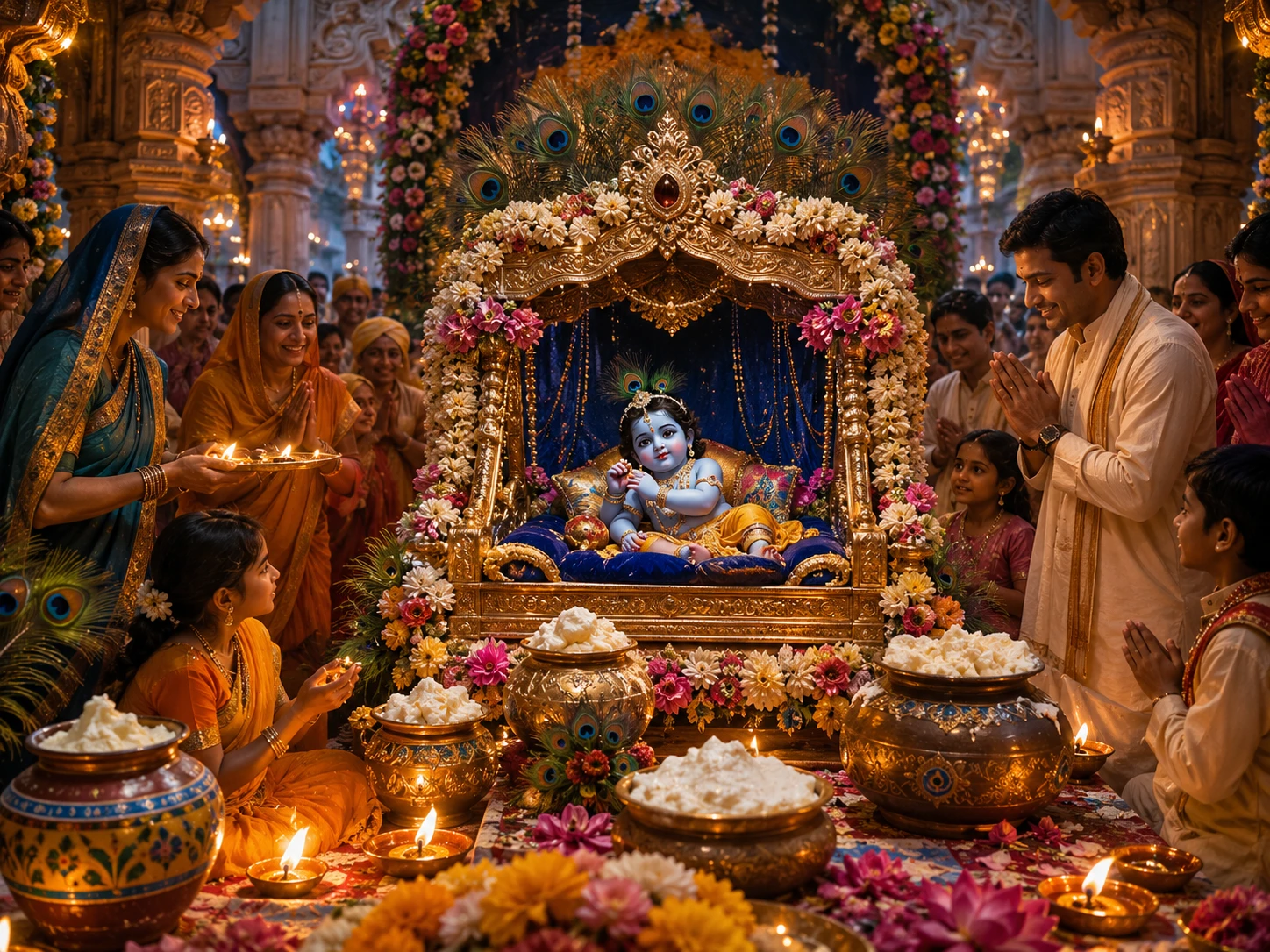
The afternoon and evening are spent in preparation. Temples are decorated with marigolds, mango leaves, and banana trunks. In homes, a small jhula (swing or cradle) is set up for baby Krishna's murti, often made of silver or brass, dressed in new silk clothes, crowned with a tiny mukut (crown), and adorned with a peacock feather. Some families create elaborate jhankis -- three-dimensional tableaux recreating scenes from Krishna's life: the prison of Kamsa, the Yamuna crossing, Yashoda's kitchen with tiny pots of butter.
As midnight approaches, the energy shifts. Bhajans intensify. In classical Hindustani music, Janmashtami night is considered ideal for ragas like Malkauns and Bageshri -- ragas of depth and midnight stillness. Temples begin the Dashama Skandha recitation, specifically the chapters describing Krishna's birth. The congregation sings, sways, claps. At exactly midnight, conch shells blow, bells ring, and the murti of baby Krishna is bathed in panchamrit (a mixture of milk, curd, ghee, honey, and sugar), dressed, and placed in the decorated cradle. The cradle is rocked, and the temple erupts in joy. Sweets -- especially peda, makhan mishri, and panchamrit -- are distributed as prasad.
The fast is broken after midnight. In many parts of North India, the next morning is celebrated as Nandotsav -- the joyous celebration of Nanda and Yashoda discovering the divine child in their home.
Dahi Handi -- The Extreme Sport of Devotion
If midnight puja is the spiritual heart of Janmashtami, then Dahi Handi is its adrenaline rush. Celebrated primarily in Maharashtra and Goa on the day after Janmashtami, Dahi Handi recreates Krishna's childhood habit of stealing butter. A clay pot filled with curd, buttermilk, or butter is hung high above a street -- sometimes as high as 30 to 40 feet. Teams of young men called Govinda Pathaks form human pyramids to reach and break the pot.
This is not a gentle affair. It is competitive, dangerous, and massively popular. In Mumbai, individual Dahi Handi events draw crowds of tens of thousands. Govinda groups train for months, building strength and coordination. Prize money can run into lakhs. Politicians sponsor events. Bollywood songs blast from loudspeakers. The entire neighbourhood shuts down.
The tradition has roots in the Bhagavata Purana's description of child Krishna's butter-stealing exploits. Yashoda would hang pots of butter from the ceiling to keep them out of Krishna's reach. He would climb on his friends' shoulders, or stack pots and stools, and still manage to get the butter -- and then distribute it to the monkeys. The Dahi Handi recreates this lila at urban scale.
In 2012, a Mumbai group set a world record for a 13-metre (approximately 43-foot) human pyramid. The Maharashtra government has periodically debated height restrictions for safety, but the tradition remains a point of fierce cultural pride. For many young men from chawls and working-class neighbourhoods in Mumbai, Pune, Thane, and Nashik, Govinda season is their moment -- a chance to be seen, to compete, and to participate in something larger than their daily routine.
The deeper reading of Dahi Handi is about collective effort. No single person can reach the pot. It requires trust, coordination, sacrifice (the bottom tiers bear enormous weight), and a shared goal. That is not a bad metaphor for how societies are supposed to function.
Janmashtami in the Modern Indian Calendar
Janmashtami occupies a unique space in the Indian cultural calendar. It is neither as commercially driven as Diwali nor as politically charged as Ram Navami has become in recent decades. It is not region-locked like Onam or Bihu. It is one of the few festivals that sits comfortably in both the deeply devotional and the wildly celebratory registers -- the same festival that inspires a grandmother to sing 'Nand Ghar Anand Bhayo' at midnight also inspires a 19-year-old in Lalbaug to climb a forty-foot human tower the next morning.
For UPSC aspirants in Old Rajinder Nagar or Mukherjee Nagar, Janmashtami is a case study in Indian polity (the interplay of state power and divine intervention in the Kamsa narrative maps neatly onto questions of governance and resistance). For students of literature, the Krishna birth narrative in the Bhagavatam is one of the finest examples of Sanskrit poetic prose -- lyrical, visual, and emotionally layered. For students of comparative religion, the midnight-birth-in-oppression motif invites comparison with other traditions while being wholly its own.
In the NRI diaspora, Janmashtami has become one of the anchor festivals that connect second-generation Indians to their heritage. ISKCON temples in London, New York, Los Angeles, and Sydney host massive celebrations that draw not just Indian-origin attendees but spiritual seekers from all backgrounds. The kirtan tradition, amplified through social media, has given Janmashtami a global reach that would have been unimaginable even two decades ago.
In Bollywood, Krishna and Janmashtami have been evergreen subjects. From Raj Kapoor's depiction of Krishna in 'Janam Janam Ka Saath' to the Dahi Handi sequences in films like 'Singham Returns', the festival has been woven into popular culture as both devotion and spectacle.
But perhaps the most modern manifestation of Janmashtami is the midnight Instagram post. As the clock strikes twelve, millions of Indians -- devout and secular, believer and culturally curious -- share images of baby Krishna, Janmashtami greetings, and Bhagavad Gita quotes. For a few hours, the algorithm serves something ancient. And for one night, India's social media feed looks exactly the way Vrindavan might have looked on that first Nandotsav morning -- full of butter, flowers, and uncontainable joy.
The Mathura district administration reported that over 25 lakh (2.5 million) pilgrims visited Mathura-Vrindavan during Janmashtami week in 2024. The Keshav Dev Temple in Mathura -- built on what tradition identifies as the exact spot of Krishna's birth -- becomes one of the most densely packed sites in India for 48 hours. Meanwhile, in Mumbai, the Dahi Handi tradition has an economic ecosystem of its own: Govinda groups raise sponsorship, local businesses profit, and the total economic activity around Mumbai's Dahi Handi events runs into crores annually.
Why the Story Still Matters
Strip away the ritual and the spectacle, and the Janmashtami narrative still speaks to something fundamentally human. A child born into captivity. Parents powerless against the state. A river that parts for innocence. A tyrant whose grip on power unravels not through war but through a baby's cry.
Every generation reads this story through its own lens. For freedom fighters during the independence movement, Krishna's birth was a metaphor for the inevitable arrival of liberation. For social reformers, the story of a divine child born in a prison to persecuted parents carried a message about dignity in oppression. For today's young Indian navigating the pressures of competitive exams, parental expectations, and an uncertain job market, the Janmashtami message is simpler and more personal: dharma arrives on schedule. Not when you expect it. Not in the form you planned. But precisely when it is needed.
The Bhagavata Purana uses a powerful image. As Vasudeva crosses the Yamuna, the river rises to touch Krishna's feet. The waters do not recede out of fear. They rise in devotion. The obstacle becomes the offering. This is not just mythology. It is a philosophy of engagement with difficulty -- the idea that what stands in your way might be trying to reach toward the divine in you.
And so, every Bhadrapada Ashtami, India sets an alarm for midnight. Not because a calendar tells it to. But because the story insists: when things are at their darkest, something worth staying awake for is about to arrive.
Chant Krishna's Name This Janmashtami
Chant 'Om Namo Bhagavate Vasudevaya' 108 times on a mala, and keep your own vigil until midnight, the hour of Krishna's birth. The mantra's page on Eternal Raga gives its meaning and how to chant it.
Tags
Eternal Raga · शाश्वत राग
Institutional voice — scholarly articles on Sanatan Dharma
Deepen Your Understanding
अपनी समझ और गहरी करें
deities avatars
Ganesha -- The Elephant God Decoded
An elephant head on a child's body. A broken tusk in one hand and a sweet in the other. A mouse as a vehicle for the largest deity in the room. Nothing about Ganesha makes sense on the surface -- and everything makes sense once you decode the symbols. This is the deity India invokes before every exam, every business launch, and every WhatsApp group creation.
scriptural exegesis
Krishna's 16,108 Queens -- The Story Behind the Number
The number sounds absurd until you understand what it means. Krishna did not 'collect' 16,108 wives. He rescued 16,100 women from a demon's prison, and when no one in society would accept them back -- because they were 'tainted' -- he married every single one to restore their honour. Add 8 named queens (the Ashtabharya) married through love, valour, or diplomacy, and you get the most misunderstood number in Hindu mythology. This is not a harem story. It is the largest social rehabilitation programme in ancient literature.
philosophy darshana
Rama vs Krishna -- Two Faces of Dharma, One Question for Your Life
Rama followed every rule and lost his wife. Krishna broke every rule and won the war. Both are Vishnu. Both upheld Dharma. So who was right? The answer might be the most important thing Hindu philosophy has to say to a world that thinks morality is simple.
scriptural exegesis
Shastra Vriksha -- The Complete Map of Hindu Scriptures
Vedas, Upanishads, Puranas, Gita -- everyone has heard these names, but almost nobody knows how they connect to each other. Shastra Vriksha is the GPS of Hindu scripture -- a single interactive tree that maps every major text, from the root of the four Vedas to the 126 catalogued Gitas, and finally makes the whole system click.
vedic sciences
Kaal Ganana -- The Hindu Measure of Time
From a single blink of the eye (Nimesha) to one Day of Brahma (4.32 billion years) -- explore the complete cosmic time hierarchy of Hindu cosmology, anchored in Vishnu Purana 1.3, with its remarkable parallels to modern science.
deities avatars
Nine Forms of Shiva -- The Many Faces of Mahadeva
He is the silent teacher under a banyan tree and the screaming destroyer on a battlefield. He is half-woman and half-man. He drank the poison that would have ended the universe and his throat turned blue. Nine scripturally-attested forms of Shiva -- from Nataraja to Rudra -- and why each one exists.
The Mathura district administration reported that over 25 lakh (2.5 million) pilgrims visited Mathura-Vrindavan during Janmashtami week in 2024. The Keshav Dev Temple in Mathura -- built on what tradition identifies as t…
More in Rituals & Traditions
Aarti -- Why Hindus Circle Light Before God
13 min read
Abhisheka -- Why Hindus Bathe Their Gods
10 min read
Akshaya Tritiya -- The Day Nothing Given Away Runs Out
12 min readThe same translation error that turned '33 Koti' into '33 crore' in Hinduism also happened in Buddhism. The Chinese translation of Buddhist texts rendered 'Sapta Koti Buddha' (7 Supreme Buddhas) as '7 Crore Buddhas.' The…
Deities AvatarsCommunity Reflections
🕉️
Be the first to share your reflection.