Abhisheka -- Why Hindus Bathe Their Gods
अभिषेक -- हिन्दू अपने देवताओं को स्नान क्यों कराते हैं
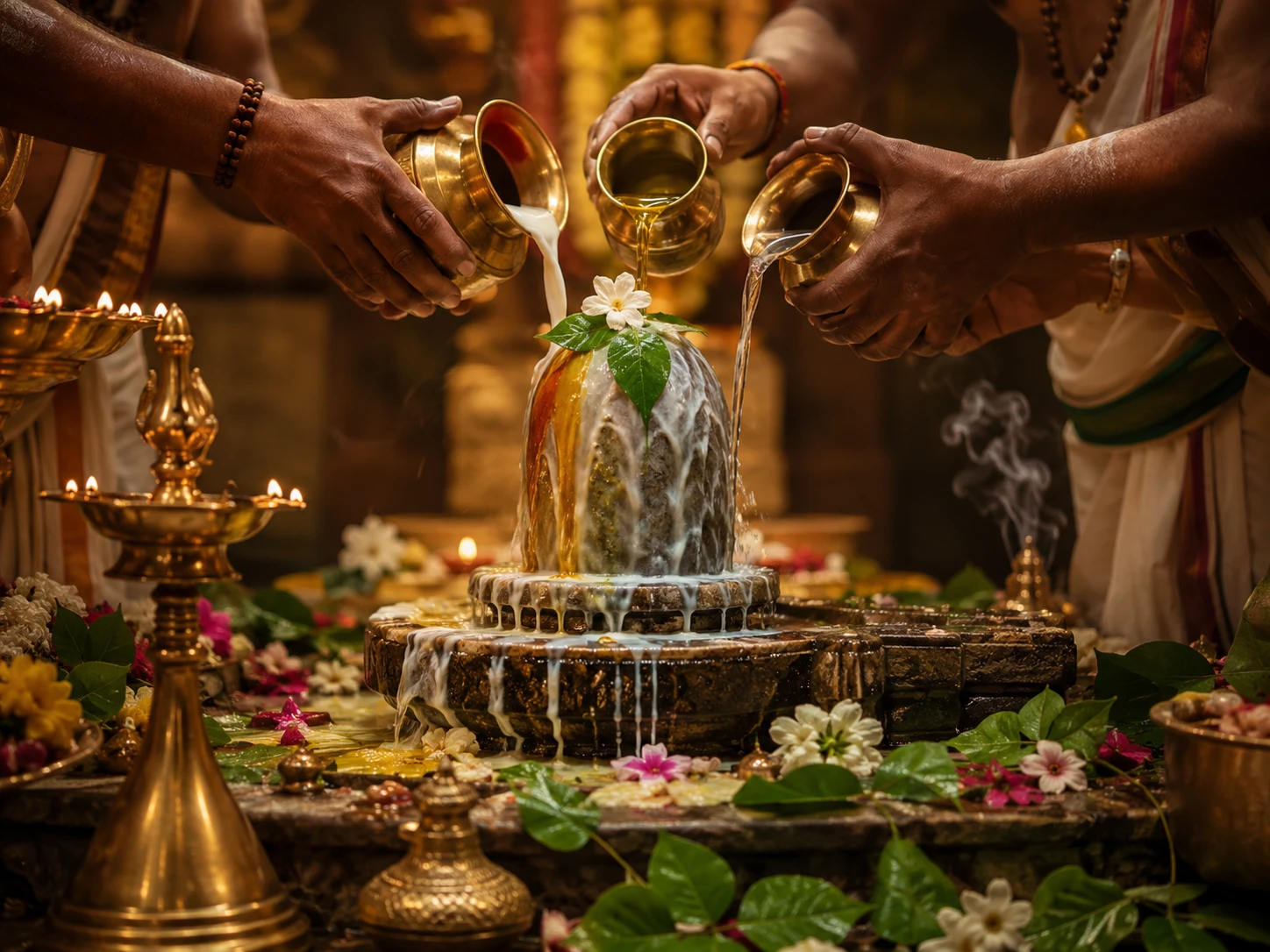
Walk into the Mahakaleshwar Temple in Ujjain at 4 AM and you will witness one of Hinduism's most visually arresting rituals. The ancient Shiva Linga -- one of the twelve Jyotirlingas -- is bathed in an elaborate sequence of substances while the sonorous chanting of Sri Rudram fills the underground sanctum. Milk cascades over the dark stone. Honey follows, glistening amber in the lamplight. Curd, ghee, sugar water, sandalwood paste, rose water -- each poured with precision, each accompanied by specific mantras. The entire ritual takes over an hour, and by the end, the Linga is freshly adorned and ready for the day's darshan.
This is Abhisheka -- from the Sanskrit root 'abhishich,' meaning to sprinkle, to anoint, to consecrate. In its literal sense, it is the ceremonial bathing of a deity. In its deeper sense, it is one of the most sophisticated ritual technologies in Hindu worship -- a multi-sensory, multi-substance, mantra-encoded act of devotional engineering that the Agama texts describe in extraordinary detail.
The question that every first-time observer asks is obvious: why bathe a stone? The stone is not dirty. The deity, being divine, presumably does not need a bath. What is actually happening here?
The answer lies in a principle that the Agama tradition articulates with precision: in a properly consecrated temple, the murti is not a symbol of the deity. It IS the deity -- or more precisely, it is the locus where the deity's energy has been installed through Prana Pratishtha (life-force consecration). The Abhisheka is not cleaning a statue. It is nourishing a living divine presence with substances that carry specific energetic signatures. Each liquid offered during Abhisheka has a purpose, a mantra, and a corresponding effect on both the deity and the devotee.
त्र्यम्बकं यजामहे सुगन्धिं पुष्टिवर्धनम्। उर्वारुकमिव बन्धनान्मृत्योर्मुक्षीय मामृतात्॥
tryambakaṁ yajāmahe sugandhiṁ puṣṭivardhanam urvārukam iva bandhanān mṛtyor mukṣīya māmṛtāt
We worship the three-eyed One (Shiva) who is fragrant and nourishes all beings. As a ripe cucumber is freed from its stalk, may we be liberated from death, not from immortality.
— Sri Rudram, Taittiriya Samhita 4.5.11 (Mahamrityunjaya Mantra)
The Substances and Their Significance
The Abhisheka substances are not chosen randomly. Each carries a specific symbolism and, according to Ayurvedic and Agamic tradition, a specific energetic property.
Water (Jala) is the universal purifier and the base of all Abhisheka. Gangajal is considered most sacred, but any clean water sanctified with mantras serves the purpose. Water represents the flow of life itself.
Milk (Dugdha) represents nourishment and maternal love. Pouring milk over the deity is a statement: this deity nourishes the universe as a mother nourishes a child. Ayurveda classifies milk as the most sattvic of all foods.
Curd (Dadhi) represents transformation -- milk that has undergone a beneficial change. Offering curd symbolises the devotee's prayer that their consciousness may undergo a similar transformation.
Ghee (Ghrita) is the essence extracted from milk through heat and patience. It represents tejas (radiance, spiritual lustre). In Ayurveda, ghee is the supreme carrier -- it enhances the potency of whatever it is mixed with.
Honey (Madhu) represents the sweetness of devotion and natural healing power. One of the few natural substances that never spoils -- a metaphor for the eternal nature of divine grace.
These five together constitute Panchamrita -- the 'five nectars' that form the core of most Abhisheka rituals. Beyond Panchamrita, extended Abhishekas may include sugarcane juice (sweetness of liberation), coconut water (inner purity), sandalwood paste (cooling of anger), turmeric water (auspiciousness), vibhuti (sacred ash -- dissolution of ego), and rose water (devotion's fragrance).
Abhisheka Substances -- Complete Reference
| Substance | पदार्थ | Quality | Symbolism | Deity Association |
|---|---|---|---|---|
| Water (Jala) | जल | Universal purifier | Flow of life, purity | All deities |
| Milk (Dugdha) | दुग्ध | Sattvic nourishment | Maternal love | All, esp. Shiva |
| Curd (Dadhi) | दही | Transformation | Consciousness evolution | All deities |
| Ghee (Ghrita) | घी | Tejas (radiance) | Spiritual lustre | All deities |
| Honey (Madhu) | मधु | Eternal sweetness | Imperishable grace | All deities |
| Sugarcane Juice | गन्ने का रस | Natural sweetness | Sweetness of moksha | Ganesha, regional |
| Coconut Water | नारियल जल | Inner purity | Hidden purity within | South Indian |
| Sandalwood Paste | चन्दन | Cooling | Patience, calming anger | Shiva, Vishnu |
| Vibhuti | विभूति | Dissolution | Ego dissolved, essence remains | Shiva |
| Rose Water | गुलाब जल | Fragrance | Devotion's perfume | Devi, Krishna |
The first five constitute Panchamrita and are standard across all traditions. Additional substances vary by region, temple, and deity.
Rudrabhisheka -- The King of All Abhishekas
The most elaborate and powerful form of Abhisheka is the Rudrabhisheka -- the bathing of the Shiva Linga while chanting Sri Rudram from the Krishna Yajurveda's Taittiriya Samhita. Sri Rudram consists of two parts: the Namakam (11 anuvakas of salutation, containing over 300 repetitions of 'namah') and the Chamakam (11 anuvakas of requests for blessings).
What makes Rudrabhisheka extraordinary is the layering of mantra and matter. Each anuvaka of the Namakam is chanted while a specific substance is poured over the Linga. The mantras address Rudra in all his forms -- as the lord of thieves and of the marketplace, of forests and of battlefields, of animals and of scholars. By the time all eleven anuvakas are complete, Rudra has been acknowledged in every dimension of existence.
The Mahamrityunjaya Mantra -- one of the most powerful healing mantras -- appears in the final anuvaka of the Namakam. The water that flows over the Linga after this chanting is considered especially potent. Devotees collect this Abhisheka water ('tirtha') and take it home as medicine, blessing, and protection.
The sound architecture of the Rudrabhisheka is remarkable. The repeated 'namah' (I bow, or 'not me') directly attacks the ego. Three hundred repetitions of 'not me' in the course of an hour is a systematic dismantling of self-importance. By the end, the usual grip of the ego has loosened, and a quieter awareness has taken its place.
Trimbakeshwar in Nashik, Mahakaleshwar in Ujjain, Kashi Vishwanath in Varanasi, and Somnath in Gujarat are among the most sought-after locations. But the tradition explicitly permits Rudrabhisheka at home with a small Shiva Linga.
Abhisheka Across Traditions -- Not Just Shiva
While Rudrabhisheka for Shiva is the most well-known, Abhisheka is performed across all Hindu traditions for virtually all deities.
In Vaishnava temples, Tirumanjanam is performed for Vishnu with elaborate ceremony. Tirumala Venkateswara performs daily Abhisheka using Pancharatra Agama prescriptions. Ranganathaswamy Temple in Srirangam follows the Vaikhanasa Agama.
For Devi, special Abhishekas during Navaratri use kumkum-mixed water, turmeric paste, and flowers. Kamakhya Temple in Guwahati and Meenakshi Temple in Madurai have distinctive Shakti Abhisheka traditions.
Jain traditions perform Abhisheka to Tirthankara images, most spectacularly during the Mahamastakabhisheka of Gomateshwara at Shravanabelagola, Karnataka -- a 57-foot monolithic Bahubali statue bathed with milk, sugarcane juice, saffron, and sandalwood from scaffolding. This occurs every twelve years and attracts millions.
The universality of the practice suggests something fundamental: anointing, bathing, and nourishing a sacred object creates a visceral sense of care, intimacy, and connection that verbal prayer alone cannot achieve. You cannot pour milk over a deity without feeling tenderness. The substance, the gravity, the flow -- they engage the body in devotion in ways words cannot.
Abhisheka at Home -- A Practical Guide
You do not need a temple or priest for a simple home Abhisheka. Here is a basic procedure:
For Shiva: obtain a small Shiva Linga (stone, metal, or crystal). Place on a clean plate or Abhisheka patra. Gather Panchamrita: water, milk, curd, honey, ghee.
Begin with water, pouring slowly while chanting 'Om Namah Shivaya' or the Mahamrityunjaya Mantra. Follow with milk, curd, honey, ghee -- each with the same mantra. After the substances, wash the Linga with clean water again. Wipe gently. Apply sandalwood paste and offer Bilva leaves and flowers.
The process can take fifteen minutes to two hours. The Panchamrita collected below is sacred Prasada -- distribute to family.
For the young professional in Koramangala with a small Shiva Linga on the shelf: even a simple water Abhisheka with 'Om Namah Shivaya' on a Monday morning is a valid and complete act of worship. Start where you are. The deity meets you there.
For Vishnu devotees, a Shaligrama or Krishna murti bathed with Panchamrita while chanting 'Om Namo Narayanaya.' For Devi devotees, kumkum-water poured over a Durga or Lakshmi murti while chanting the Devi Beej Mantra.
The tradition also recognises Manasa Abhisheka -- purely mental Abhisheka performed through visualisation during meditation. Adi Shankaracharya composed the Manasa Puja Stotram specifically for this purpose, enabling devotees who cannot perform physical Abhisheka to offer the ritual through the power of imagination and concentration. A student in a hostel room, an NRI in a shared apartment, a patient in a hospital bed -- all can perform Manasa Abhisheka. The tradition leaves no one out.
The Mahamastakabhisheka of Gomateshwara at Shravanabelagola is one of the largest religious gatherings in South India, performed once every twelve years. The 57-foot statue of Bahubali -- carved in 981 CE -- is bathed from temporary scaffolding with 1,008 pots of consecrated substances. The 2018 ceremony attracted over 3 million visitors. ISRO provided satellite imagery for crowd management -- ancient ritual meeting space-age logistics. The next Mahamastakabhisheka is expected around 2030.
The Thermodynamics of Devotion -- Why Liquids Matter
There is a practical dimension to Abhisheka that goes beyond symbolism. Stone and metal murtis in Indian temples absorb enormous amounts of heat, particularly in South India where granite sanctums can reach temperatures above 40 degrees Celsius during summer. The daily Abhisheka with cool liquids -- water, milk, coconut water -- literally cools the murti, maintaining the stone at a temperature conducive to the preservation of its molecular integrity over centuries.
The Agama texts prescribe specific sequences of hot and cold substances that suggest an intuitive understanding of thermal cycling. Warm ghee is followed by cool milk. Room-temperature honey is followed by cold water. This alternation prevents thermal shock to the stone while maximising the absorption of each substance's properties. Temple architects and sthapatis (master builders) designed sanctum ventilation systems specifically to complement the thermal effects of daily Abhisheka.
The Chola-era temples of Tamil Nadu -- Brihadeeswarar in Thanjavur, Gangaikonda Cholapuram, Airavatesvara in Darasuram -- have survived over a thousand years of tropical weather partly because their granite Lingams and murtis received daily Abhisheka that prevented micro-cracking from thermal stress. The INTACH (Indian National Trust for Art and Cultural Heritage) conservation teams have noted that murtis with unbroken Abhisheka traditions show markedly less surface degradation than those in abandoned or irregularly maintained temples.
For the engineering student at NIT Trichy who wonders whether Abhisheka is just ritual theatre: the thermal management alone justifies the practice from a materials science perspective. The fact that it simultaneously serves as devotion, community gathering, and aesthetic experience is what makes it a technology rather than merely a procedure.
The Abhisheka Economy -- Sacred Supply Chains
The scale of Abhisheka in India creates entire micro-economies. Consider the Mahakaleshwar Temple in Ujjain alone: the daily Bhasma Aarti requires fresh sacred ash sourced from specific cremation grounds. The Rudrabhisheka requires litres of milk, curd, honey, and ghee every single day. Multiply this by the thousands of Shiva temples performing daily Abhisheka across India, and the aggregate demand for milk, ghee, honey, flowers, and sandalwood becomes a significant economic force.
The Tirupati Tirumala Devasthanams (TTD) is perhaps the most industrially organised Abhisheka operation. The daily Abhisheka for Lord Venkateswara uses precisely measured quantities of Panchamrita, sandalwood paste, camphor, and sacred water transported from specific rivers. The TTD maintains dedicated dairy farms, flower gardens, and sandalwood procurement channels specifically for worship materials. The annual budget for worship materials alone runs into crores.
In Varanasi, the milk used for Kashi Vishwanath's Abhisheka comes from a network of dairy farmers in the surrounding villages who have supplied the temple for generations. The relationship is not merely commercial -- these families consider it a form of seva (sacred service) and often supply milk at below-market rates. The flower market at the Vishwanath Gali exists primarily because of temple demand. Marigold growers in UP, rose cultivators in Pushkar, jasmine farmers in Madurai -- all are part of the Abhisheka supply chain.
For the MBA student studying supply chain management at IIM Lucknow: the Hindu temple Abhisheka system is one of the world's oldest continuously operating supply chains. It has survived invasions, colonial disruption, and economic upheaval. The demand signal (daily Abhisheka at fixed times) has not changed in over a thousand years. The supply response (local farmers, flower markets, dairy networks) has adapted continuously. This is a case study in institutional resilience that no business school textbook covers -- but should.
The devotee who walks into a temple and watches milk being poured over the Linga is witnessing the visible tip of a vast, invisible ecosystem of faith-based commerce that employs millions and sustains rural livelihoods across the subcontinent. Every drop of milk in the Abhisheka represents a farmer who woke before dawn, a cow that was tended with care, a supply chain that delivered freshness to the sanctum -- all held together not by contracts but by dharma.
Chant the Mahamrityunjaya Mantra
Begin your abhisheka with the Mahamrityunjaya mantra, the mantra chanted in Rudrabhisheka. Chant it 108 times on a mala; even without a physical abhisheka, the mantra itself is considered an inner anointing. Its page on Eternal Raga gives the meaning and how to chant it.
Tags
Eternal Raga · शाश्वत राग
Institutional voice — scholarly articles on Sanatan Dharma
Deepen Your Understanding
अपनी समझ और गहरी करें
rituals traditions
Shodashopachara Puja -- The Sixteen-Step Protocol of Hindu Worship
When a Hindu temple priest performs puja, he is not improvising. He is executing a precise sixteen-step protocol called Shodashopachara -- literally 'sixteen offerings' -- that treats God as a royal guest arriving at your home. From invitation to farewell, each step has a specific action, material, mantra, and philosophical meaning. This is the complete user manual.
rituals traditions
Puja at Home -- The Complete Beginner's Guide
You have a small mandir shelf in your apartment. A brass diya your mother gave you. A photo of a deity you feel drawn to. And absolutely no idea what to do next. This guide is for you -- the 22-year-old in Pune who just moved out, the NRI in New Jersey setting up a puja corner for the first time, the curious soul who wants to start but does not know where.
rituals traditions
Why Bells, Lamps, and Flowers -- The Sensory Engineering Behind Hindu Worship
Hindu worship is not random. Every bell, every lamp, every flower, every stick of incense, every drop of water addresses a specific sense, invokes a specific element, and produces a specific psychological effect. The puja is a sensory design system -- a five-element, five-sense immersive experience engineered three thousand years before UX designers existed. Here is the complete map.
rituals traditions
Mahashivaratri -- The Great Night of Shiva
One night a year, the cosmos tilts toward Shiva. Temples stay open past midnight. Millions fast, chant, and keep vigil through the darkest night of the lunar month. The Shiva Purana says this is the night Shiva performed the Ananda Tandava -- the cosmic dance -- for the first time. It is also the night Shiva drank the Halahala poison to save creation. And the night Shiva married Parvati. Three origin stories. One night. The only Hindu festival that asks you to stay awake through the darkness rather than celebrate the light.
rituals traditions
Panchopachara Puja -- The 5 Offerings That Engage All Five Senses
You do not need a pandit, a pavilion, or a two-hour ritual to worship. The Panchopachara Puja -- five offerings representing the five elements and engaging the five senses -- is the tradition's elegant minimum viable puja. Sandalwood for earth, flowers for space, incense for air, lamp for fire, food for water. Five items. Five minutes. A complete act of devotion.
rituals traditions
Naivedya and Prasada -- Why Hindus Feed God Before They Eat
You cook food. You place it before the deity. You wait. The food has not physically changed -- same molecules, same temperature, same taste. And yet the tradition insists that something fundamental has transformed. What went in as Naivedya (offering) comes out as Prasada (grace). This transformation is not chemistry. It is theology -- and it may be the most quietly radical idea in all of Hindu practice.
rituals traditions
Sankalpa -- The Ritual GPS That Locates You in the Cosmos Before Every Puja
Before any Hindu ritual begins, there is a quiet declaration that most people rush through without understanding. It names the current cosmic age, the ruling Manu, the Yuga, the year, the season, the month, the fortnight, the day, the star, the continent, the country, the river, your name, your lineage, and your exact intention. This declaration -- Sankalpa -- is the most sophisticated geo-temporal tagging system in any religious tradition. It tells the universe: I am here, I am this person, and I intend to do this specific act.
The Mahamastakabhisheka of Gomateshwara at Shravanabelagola is one of the largest religious gatherings in South India, performed once every twelve years. The 57-foot statue of Bahubali -- carved in 981 CE -- is bathed fr…
More in Rituals & Traditions
Aarti -- Why Hindus Circle Light Before God
13 min read
Akshaya Tritiya -- The Day Nothing Given Away Runs Out
12 min read
Annadana -- Why Feeding Is the Highest Form of Charity in Hindu Tradition
12 min readThe same translation error that turned '33 Koti' into '33 crore' in Hinduism also happened in Buddhism. The Chinese translation of Buddhist texts rendered 'Sapta Koti Buddha' (7 Supreme Buddhas) as '7 Crore Buddhas.' The…
Deities AvatarsCommunity Reflections
🕉️
Be the first to share your reflection.