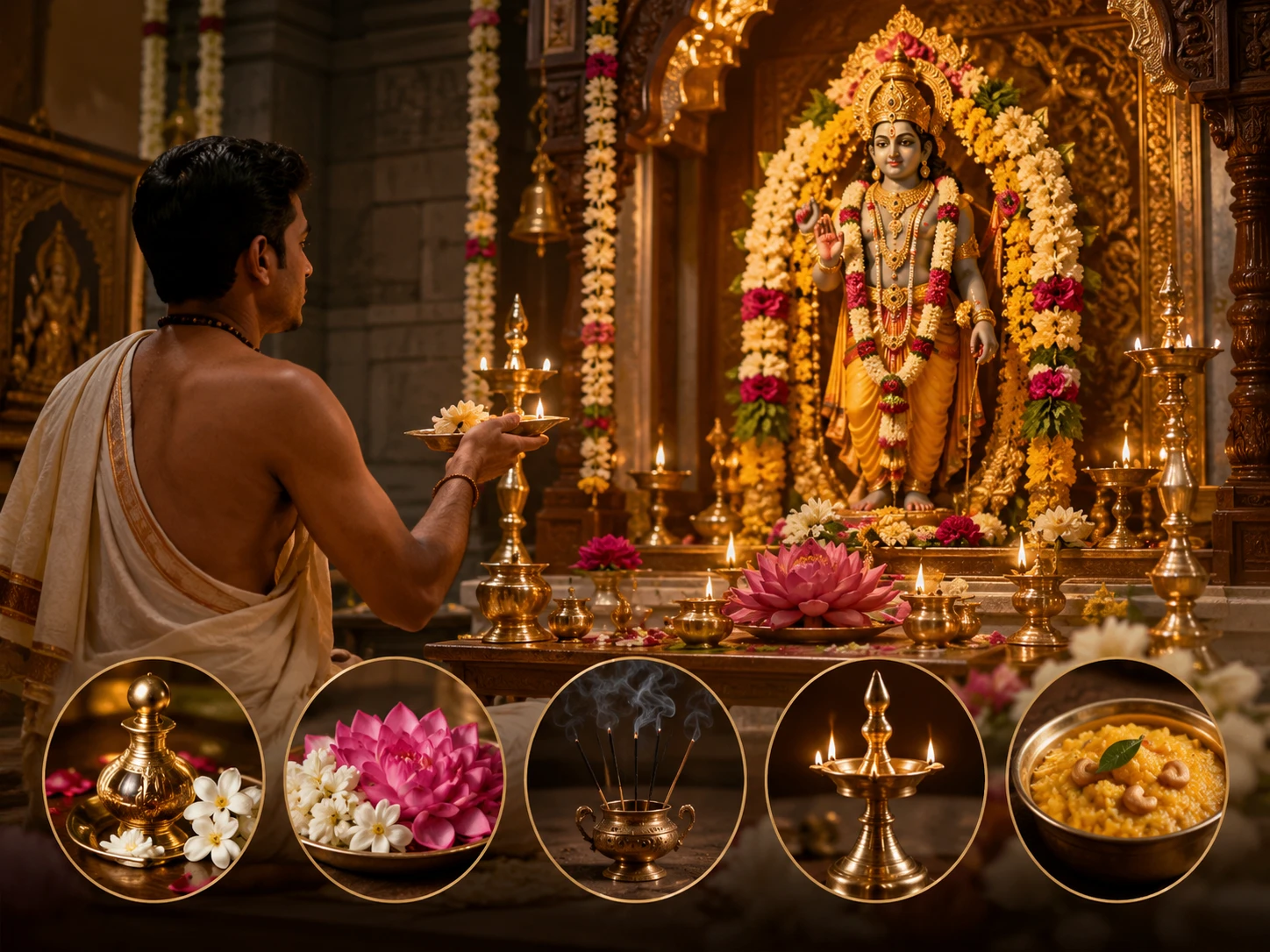
Panchopachara Puja -- The 5 Offerings That Engage All Five Senses
पंचोपचार पूजा -- पाँच इन्द्रियों को जोड़ने वाले पाँच उपचार
The most common excuse for not doing daily puja is: 'I don't know the full procedure.' And it is a valid concern. The Shodashopachara Puja -- the sixteen-step grand worship -- involves Avahana, Asana, Padya, Arghya, Achamaniya, Snana, Vastra, Yajnopavita, Gandha, Pushpa, Dhupa, Dipa, Naivedya, Tambula, Namaskara, and Pradakshina. For someone who grew up watching their grandmother do it effortlessly, the sequence can feel intimidating. For someone who grew up in a home where puja was not practised, it can feel alien.
The tradition anticipated this problem and designed a solution: the Panchopachara Puja. Five offerings. Five elements. Five senses. One complete act of worship that any person -- regardless of training, time, or resources -- can perform in under five minutes.
This is not a diluted puja. It is a concentrated one. The Shodashopachara adds hospitality layers (welcoming the deity, offering a seat, bathing, dressing). The Panchopachara strips those away and focuses on the five sensory channels through which a human being can connect with the divine. It is the kernel, the seed, the irreducible core. Everything else is beautiful elaboration, but this is the minimum complete circuit.
The five offerings are: Gandha (fragrance -- sandalwood paste or kumkum), Pushpa (flowers), Dhupa (incense), Dipa (lamp -- oil or ghee), and Naivedya (food offering -- fruit, sweet, or cooked food). Each corresponds to one of the Pancha Bhutas (five elements) and engages one of the five senses.
The Five Offerings -- Element, Sense, and Symbolism
| Offering | उपचार | Element (Bhuta) | Sense Engaged | Inner Symbolism |
|---|---|---|---|---|
| Gandha (Sandalwood / Kumkum) | गन्ध (चन्दन / कुमकुम) | Prithvi (Earth) | Smell (Ghrana) | Purification of intention -- fragrance even under pressure, like sandalwood ground on stone |
| Pushpa (Flowers) | पुष्प (फूल) | Akasha (Space / Ether) | Sight (Chakshu) | Offering one's virtues -- the flower blooms, gives beauty, and falls without complaint |
| Dhupa (Incense) | धूप (अगरबत्ती) | Vayu (Air) | Smell carried by air | Surrender of ego -- the incense stick consumes itself to spread fragrance |
| Dipa (Lamp) | दीप (दीपक) | Agni (Fire) | Sight (light perception) | Illumination of the soul -- dispelling inner darkness (avidya) |
| Naivedya (Food) | नैवेद्य (भोग) | Jala (Water) | Taste (Rasana) | Complete surrender -- offering the sustenance of life itself |
Some traditions substitute Akshata (unbroken rice) for Naivedya, making the five: Gandha, Pushpa, Dhupa, Dipa, Akshata. The Panchamahabhuta correspondence varies slightly across Shaiva and Vaishnava Agama texts.
1. Gandha -- The Earth Speaks Through Fragrance
The first offering is Gandha -- typically sandalwood paste (chandan), though kumkum, turmeric, or any natural fragrance serves the purpose. The mantra accompanying the offering is simply: 'Gandham samarpayami' -- I offer fragrance.
Sandalwood holds a unique position in Indian civilisation. It is cooling, it is calming, and it carries a philosophical metaphor that the tradition loves: the sandalwood tree gives fragrance even to the axe that cuts it. Offering chandan to the deity is a statement of aspiration -- I wish to be like this, to remain fragrant and generous even when life grinds me down.
The element correspondence is Prithvi (Earth), because fragrance is considered the tanmatra (subtle essence) of the earth element in Samkhya philosophy. When you apply chandan to the murti's forehead, you are engaging your sense of smell and simultaneously connecting the act to the solidity, patience, and nurturing quality of the earth.
For the young professional in a rented flat in Indiranagar, Bangalore, who does not have access to fresh chandan: a dab of kumkum works. A touch of natural attar works. Even a pinch of haldi from the kitchen shelf works. The tradition cares about the offering, not the price tag.
2. Pushpa -- Space Made Visible Through Beauty
The second offering is Pushpa -- flowers. The mantra: 'Pushpam samarpayami.' Flowers represent Akasha (space/ether) because they are the most ethereal, delicate, and short-lived of natural offerings. A flower blooms, gives beauty and fragrance freely, and falls without resistance. It is the perfect metaphor for a life well-lived.
Different deities have traditional flower preferences. Shiva loves Bilva leaves and Datura flowers. Vishnu accepts Tulsi as the supreme offering. Ganesha loves red flowers, especially Hibiscus (Jasvand). Devi receives red and yellow flowers. Krishna is associated with Parijat (night jasmine) from the famous incident where he brought the Parijat tree from Indra's garden for Satyabhama.
The tradition around flowers in puja is extraordinarily specific. The Padma Purana lists flowers that should not be offered -- wilted flowers, flowers that have fallen to the ground, flowers without fragrance, flowers touched by insects. The principle is freshness and intention. You offer the best, not the leftover.
In temples across India -- from the jasmine garlands of Madurai Meenakshi to the rose mountains at Tirupati to the marigold carpets at Varanasi's ghats -- flowers are the most visible and immediate expression of devotion. The Pushpa Abhisheka (flower shower) during festivals is one of the most visually stunning rituals in any religion on earth.
For the NRI family in Edison, New Jersey, who cannot find Tulsi or Bilva easily: any fresh flower offered with love is accepted. Krishna himself declares this in the Gita. The verse does not say 'offer Me a rare orchid.' It says 'pushpam' -- a flower. Any flower.
पत्रं पुष्पं फलं तोयं यो मे भक्त्या प्रयच्छति। तदहं भक्त्युपहृतमश्नामि प्रयतात्मनः॥
patraṁ puṣpaṁ phalaṁ toyaṁ yo me bhaktyā prayacchati tad ahaṁ bhakty-upahṛtam aśnāmi prayatātmanaḥ
Whoever offers Me with devotion a leaf, a flower, a fruit, or water -- I partake of that offering made with love by one whose heart is pure.
— Bhagavad Gita 9.26
3. Dhupa -- Air Carries the Devotee's Surrender
The third offering is Dhupa -- incense. The mantra: 'Dhupam samarpayami.' Incense corresponds to Vayu (Air) because its fragrance travels through the air to fill the space around the deity and the devotee. The incense stick embodies a powerful metaphor: it consumes itself entirely to create fragrance for others. This is the definition of selfless service.
The science behind dhupa is not merely symbolic. Agarbatti smoke has been shown to have mild antimicrobial properties, and the aromatic compounds in traditional dhupa ingredients -- guggul, loban, camphor, sandalwood powder -- affect the nervous system in ways that promote calm and focus. The ancient rishis may not have had gas chromatography, but they understood empirically that certain smells shift consciousness.
In Ayurveda, dhupa is used therapeutically. Dhoopana (fumigation) with specific herbs is prescribed for purifying a room after illness, for calming a restless mind, and for creating an atmosphere conducive to meditation. The puja dhupa is a daily micro-dose of this therapeutic tradition.
For the pragmatist who finds incense smoke irritating or triggering for respiratory issues: a natural camphor tablet (kapur) dissolved in warm water, or a few drops of essential oil on a cotton ball near the deity, serves the Vayu-element purpose without the smoke. The tradition is intelligent enough to accommodate the body's limitations.
4. Dipa -- Fire Reveals What Darkness Hides
The fourth offering is Dipa -- the lamp. 'Deepam darshayami' -- I show the light. Note the verb: darshayami, not samarpayami. You do not 'offer' light; you 'show' it. The light reveals the deity's form to the devotee, and symbolically, it reveals the truth that was always present but hidden in darkness.
The element correspondence is Agni (Fire). The lamp -- whether a traditional brass diya with ghee, a cotton wick in sesame oil, or even a simple candle -- represents the transformative power of fire. Fire converts matter into energy. Ignorance (avidya) is the matter; knowledge (vidya) is the energy. The dipa is a daily reminder that the function of spiritual practice is transformation, not accumulation.
The tradition prescribes ghee lamps as the highest form, sesame oil lamps as excellent, and other oils as acceptable. Ghee produces a sattvic flame -- bright, steady, and clean. This is why aarti lamps in temples predominantly use ghee. The steady flame also serves as a drishti (focal point) for dhyana -- the flicker of the lamp becomes the first meditation object for beginners.
Every Indian knows the experience of walking into a dark temple sanctum and seeing a single diya illuminating the deity's face. That moment -- when the eyes adjust and the murti emerges from shadow -- is a condensed experience of spiritual awakening. The Dipa offering recreates this experience daily, in miniature, in your own home.
The Karthigai Deepam festival in Tamil Nadu, where thousands of oil lamps are lit on a single night, and the Deva Deepavali in Varanasi, where the entire Ganga ghat glows with diyas, are community-scale expressions of this same offering. What you do alone in your living room with one small diya, the civilisation does collectively with millions.
5. Naivedya -- Water Sustains, Food Surrenders
The fifth and final offering is Naivedya -- food. 'Naivedyam nivedayami' -- I present the offering. Naivedya corresponds to Jala (Water) because water is the element of taste, and food is experienced primarily through taste. More importantly, water and food together represent the sustenance of life. Offering Naivedya is the most radical of the five offerings: you are giving the deity the very thing your body needs to survive, before you consume it yourself.
The rules of Naivedya are precise: the food must be freshly prepared, not previously tasted, not touched by anyone before offering, and ideally sattvic (no onion, garlic, or meat). The food is placed before the deity, a prayer is offered, and a few moments of silence allow the offering to be 'accepted.' After acceptance, the food becomes Prasada -- sanctified food, imbued with divine grace.
This transformation -- from Naivedya to Prasada -- is one of the most profound concepts in Hindu theology and deserves its own article. But within the Panchopachara context, the key insight is this: the fifth offering completes the sensory circuit. You have engaged smell (Gandha), sight (Pushpa and Dipa), and the air-borne dimension of smell (Dhupa). Now you engage taste. All five senses have participated. The entire sensory apparatus of the human being has been conscripted into the act of worship.
For the busy couple who do not cook in the morning: a piece of fruit, a few almonds, a glass of milk, or even a glass of clean water serves as Naivedya. Krishna's own verse is the authority here -- patram, pushpam, phalam, toyam. A fruit. Water. That is enough.
The Samkhya Science Behind It -- Pancha Tanmatra
The five-fold structure of Panchopachara is not arbitrary or aesthetic. It rests on a precise philosophical foundation from the Samkhya system of Indian philosophy -- one of the six classical darshanas and arguably the oldest systematic metaphysics in the world.
Samkhya identifies five Tanmatras -- subtle essences that are the building blocks of sensory experience. These are: Shabda (sound), Sparsha (touch), Rupa (form/sight), Rasa (taste), and Gandha (smell). Each Tanmatra corresponds to one of the five gross elements (Pancha Mahabhutas): Akasha (space) carries Shabda. Vayu (air) carries Sparsha. Agni (fire) carries Rupa. Jala (water) carries Rasa. Prithvi (earth) carries Gandha.
The Panchopachara offerings map directly onto this architecture. Pushpa occupies space and is perceived through form (Akasha-Rupa). Dhupa's fragrance travels through air (Vayu-Gandha carried by Vayu). Dipa manifests fire and is perceived through sight (Agni-Rupa). Naivedya engages taste through water-element correspondence (Jala-Rasa). Gandha engages the earth element through smell (Prithvi-Gandha).
What this means practically is that Panchopachara is not five random nice things to give God. It is a systematically designed sensory circuit that engages the entire perceptual apparatus of the human being. When all five senses are simultaneously directed toward the divine, the mind has no spare bandwidth for distraction. This is the puja equivalent of what modern neuroscience calls 'flow state' -- total absorption in a single activity through multi-sensory engagement.
The IIT Madras cognitive science department has published research on how multi-sensory religious rituals affect neural synchronisation and subjective well-being. While the research does not validate metaphysical claims, it does confirm that rituals engaging multiple senses simultaneously produce measurably different brain states than single-sense activities. The Rishis did not have fMRI machines, but their design of the Panchopachara system suggests they understood experientially what the machines are now confirming: engage all five channels, and the mind becomes still.
This is why the tradition insists on physical offerings rather than purely mental worship for most practitioners. The Manasika Puja (purely mental worship) is considered the highest form, but it is prescribed only for advanced sadhakas whose concentration can sustain the entire five-sensory experience internally, without external props. For the rest of us, the physical offerings are training wheels -- and very effective ones.
The Hierarchy of Puja -- From Three to Sixty-Four
The Hindu worship system is designed as a scalable architecture. At its simplest, you have Triopachara -- three offerings (typically Gandha, Pushpa, and Naivedya or Dipa). At the next level, Panchopachara adds Dhupa and Dipa to complete the five-element circuit. Shodashopachara expands to sixteen steps, treating the deity as a royal guest who is invited, seated, bathed, clothed, adorned, fed, and bid farewell. Some traditions enumerate thirty-two upacharas. The most elaborate temple rituals recognise sixty-four upacharas (Chatusshashti Upachara), covering every conceivable act of hospitality.
The key insight is that these are not different pujas. They are the same puja at different resolutions. A five-megapixel image and a hundred-megapixel image show the same scene -- one just has more detail. Panchopachara is the five-megapixel version: everything essential is present, and the image is complete. Shodashopachara is the higher resolution version for those with the time, training, and inclination to add sixteen layers of devotional detail.
This scalability is the genius of the system. It means a JEE aspirant in a Kota hostel room with a small deity photo on the study desk can perform a valid, complete puja in three minutes with whatever is available. It also means the Rajarajeshwara Temple in Thanjavur can spend three hours on a single Maha Puja with sixty-four elaborate steps. Both are valid. Both are complete at their own resolution. Neither judges the other.
The Agama texts -- the liturgical manuals that govern temple worship across South India -- explicitly state that Panchopachara is sufficient for daily worship and that the deity is fully pleased with these five offerings when performed with devotion. The elaboration is for the devotee's benefit, not the deity's need. God does not need your sandalwood paste. Your mind needs the discipline of offering it.
The five-sense engagement principle of Panchopachara Puja has a striking parallel in modern UX design. The best digital experiences engage multiple senses: visual design (Pushpa/Dipa), sound/haptic feedback (Dhupa as carried vibration), tactile interaction (Gandha as touch), and reward/satisfaction (Naivedya as gratification). Apple's product design philosophy -- which prioritises sensory coherence across sight, touch, and sound -- unknowingly follows the Panchopachara principle: complete engagement requires addressing every sensory channel. The ancient puja designers were, in effect, the world's first UX architects.
A Practical Five-Minute Morning Puja
Here is a practical Panchopachara sequence that any reader can begin tomorrow morning:
1. Stand or sit before your home deity or a framed image. Take three deep breaths. 2. Apply a small dot of kumkum or chandan to the deity's forehead (or the image frame). Say 'Gandham samarpayami.' -- 30 seconds. 3. Place a flower or a few petals before the deity. Say 'Pushpam samarpayami.' -- 30 seconds. 4. Light an incense stick and wave it gently. Say 'Dhupam samarpayami.' -- 30 seconds. 5. Light a diya (ghee or oil) and show it to the deity in a circular motion. Say 'Deepam darshayami.' -- 30 seconds. 6. Place a fruit, a sweet, or a glass of water before the deity. Say 'Naivedyam nivedayami.' Close your eyes for a moment. -- 30 seconds. 7. Join your palms and bow. Silently thank the divine for the day ahead.
Total time: under five minutes. No Sanskrit expertise required. No priest required. No special training. Just five acts of conscious offering that connect your body, your senses, and your intention to the divine before the day's chaos begins.
If you do this every single day for thirty days, something will shift. The tradition guarantees it. And the tradition has been running this experiment for over three thousand years.
Complete Your Panchopachara with Japa
After your five offerings, add 108 repetitions of your chosen mantra on a mala. The five sensory offerings prepare the ground; the mantra sows the seed. Together they make a complete ten-minute morning sadhana. The mantra meditation library on Eternal Raga has mantras to choose from.
Eternal Raga · शाश्वत राग
Institutional voice — scholarly articles on Sanatan Dharma
Deepen Your Understanding
अपनी समझ और गहरी करें
rituals traditions
Shodashopachara Puja -- The Sixteen-Step Protocol of Hindu Worship
When a Hindu temple priest performs puja, he is not improvising. He is executing a precise sixteen-step protocol called Shodashopachara -- literally 'sixteen offerings' -- that treats God as a royal guest arriving at your home. From invitation to farewell, each step has a specific action, material, mantra, and philosophical meaning. This is the complete user manual.
rituals traditions
Puja at Home -- The Complete Beginner's Guide
You have a small mandir shelf in your apartment. A brass diya your mother gave you. A photo of a deity you feel drawn to. And absolutely no idea what to do next. This guide is for you -- the 22-year-old in Pune who just moved out, the NRI in New Jersey setting up a puja corner for the first time, the curious soul who wants to start but does not know where.
rituals traditions
Naivedya and Prasada -- Why Hindus Feed God Before They Eat
You cook food. You place it before the deity. You wait. The food has not physically changed -- same molecules, same temperature, same taste. And yet the tradition insists that something fundamental has transformed. What went in as Naivedya (offering) comes out as Prasada (grace). This transformation is not chemistry. It is theology -- and it may be the most quietly radical idea in all of Hindu practice.
rituals traditions
Aarti -- Why Hindus Circle Light Before God
Every evening, millions of flames are circled before millions of deities across India. The aarti is the single most recognisable act of Hindu worship -- yet most people performing it cannot explain why the light moves clockwise, why camphor is preferred, or why the flame is touched to the eyes afterward. The answer is older than temples, deeper than devotion, and more scientific than you would expect.
rituals traditions
Why Bells, Lamps, and Flowers -- The Sensory Engineering Behind Hindu Worship
Hindu worship is not random. Every bell, every lamp, every flower, every stick of incense, every drop of water addresses a specific sense, invokes a specific element, and produces a specific psychological effect. The puja is a sensory design system -- a five-element, five-sense immersive experience engineered three thousand years before UX designers existed. Here is the complete map.
rituals traditions
Sandhyavandana -- The Daily Vedic Practice That Even Rama and Krishna Never Skipped
Three times a day, at the junction of night and day, morning and afternoon, afternoon and night, the twice-born Hindu is commanded to stop everything and perform Sandhyavandana. It combines pranayama, the Gayatri Mantra, water offerings, and meditation into a single twenty-minute ritual. The Ramayana shows Rama doing it in the forest. The Mahabharata shows Krishna doing it before battle. And somewhere in India right now, an IIT student is doing it in his hostel room.
rituals traditions
Nitya, Naimittika, and Kamya Karma -- The Three Categories of Duty
Hinduism does not say 'do good things.' It says 'know which kind of action you are performing and why.' The three-fold classification of Karma into Nitya (daily non-negotiable), Naimittika (occasion-triggered), and Kamya (desire-driven) is the most practical decision-making framework the tradition offers -- and it works as well in a Bangalore startup as it did in a Vedic gurukul.
The five-sense engagement principle of Panchopachara Puja has a striking parallel in modern UX design. The best digital experiences engage multiple senses: visual design (Pushpa/Dipa), sound/haptic feedback (Dhupa as car…
More in Rituals & Traditions
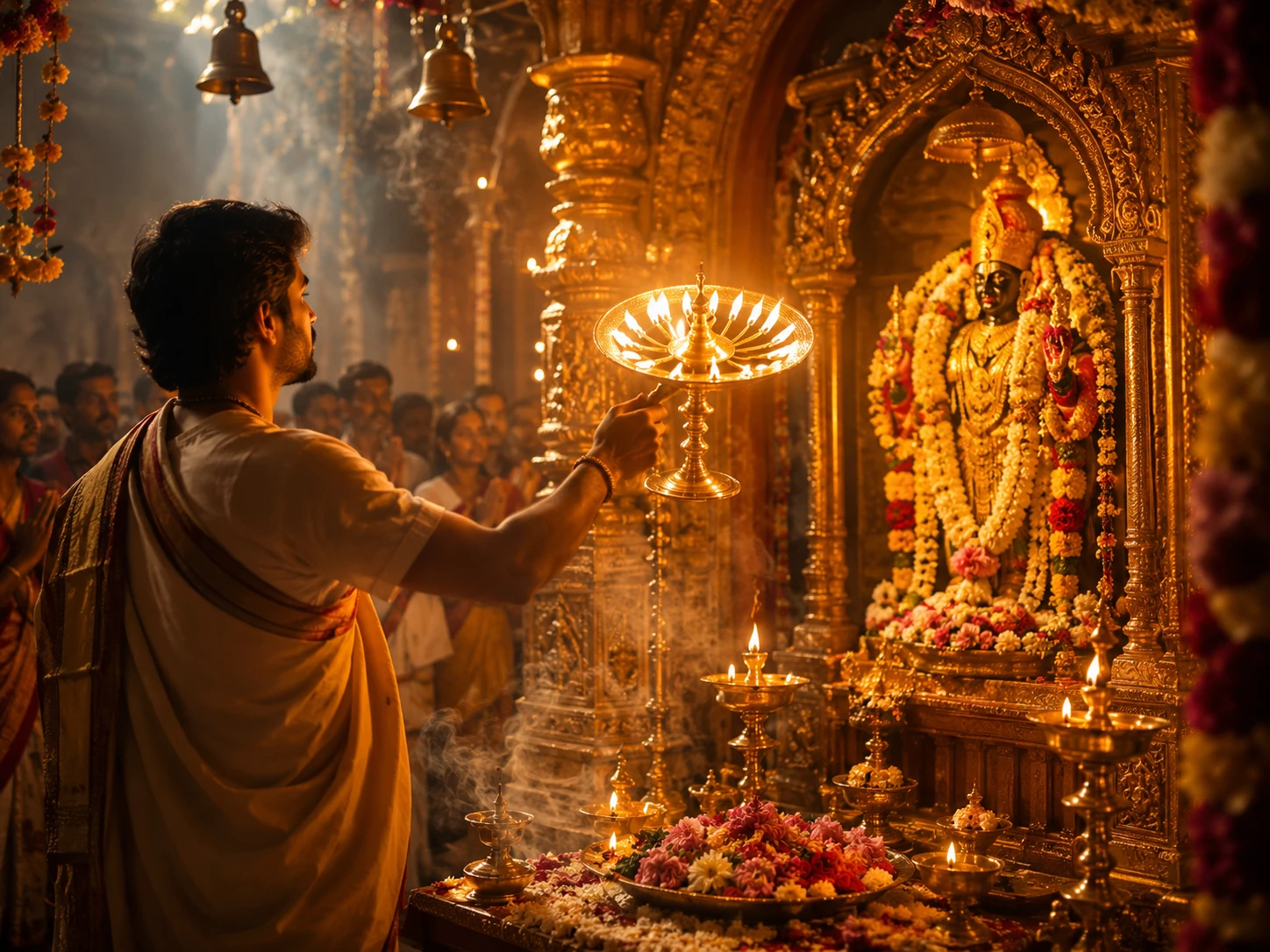
Aarti -- Why Hindus Circle Light Before God
13 min read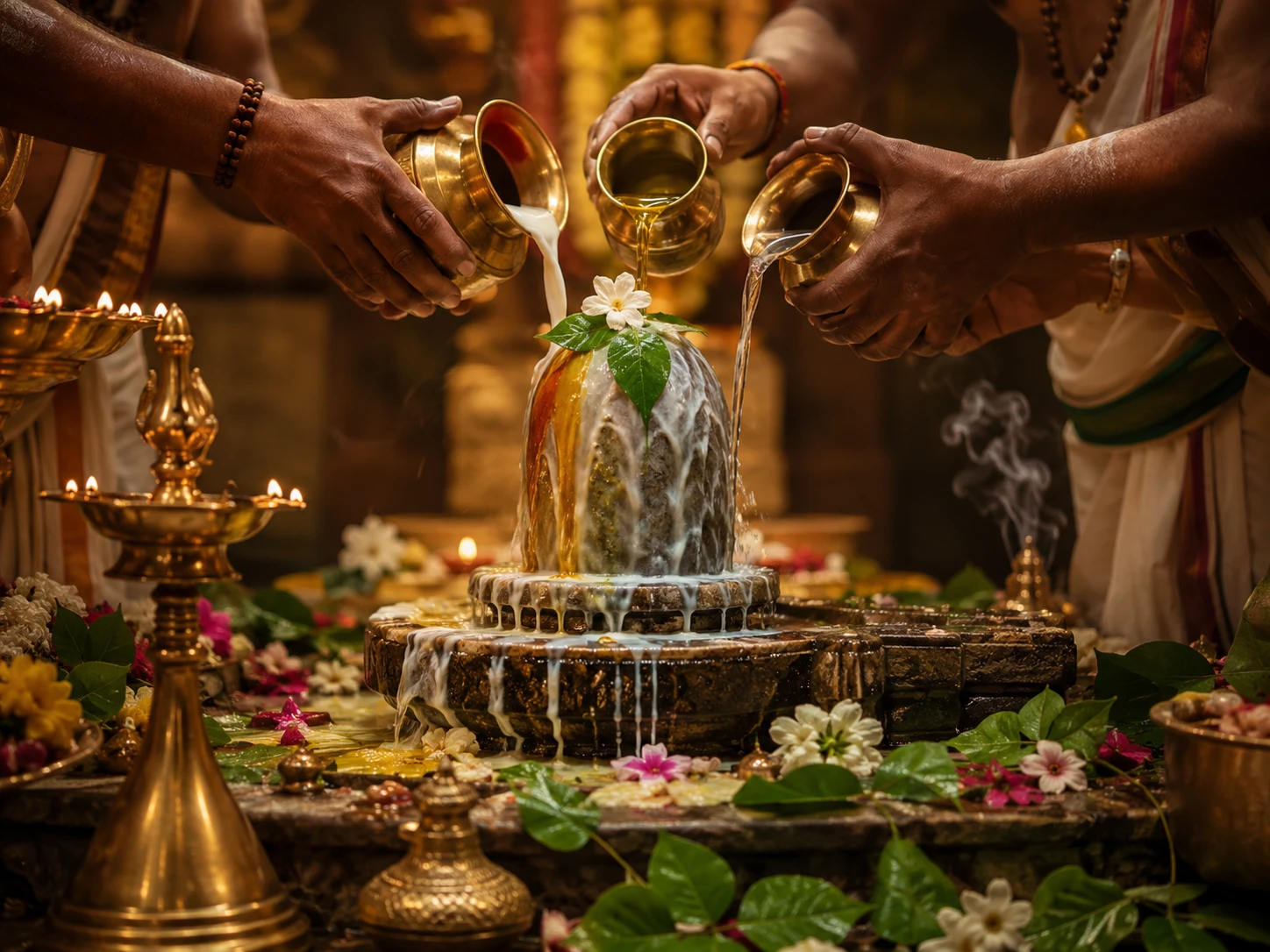
Abhisheka -- Why Hindus Bathe Their Gods
10 min read
Akshaya Tritiya -- The Day Nothing Given Away Runs Out
12 min readThe same translation error that turned '33 Koti' into '33 crore' in Hinduism also happened in Buddhism. The Chinese translation of Buddhist texts rendered 'Sapta Koti Buddha' (7 Supreme Buddhas) as '7 Crore Buddhas.' The…
Deities AvatarsCommunity Reflections
🕉️
Be the first to share your reflection.