
Nitya, Naimittika, and Kamya Karma -- The Three Categories of Duty
नित्य, नैमित्तिक और काम्य कर्म -- कर्तव्य की तीन श्रेणियाँ
Every morning, millions of Indians face the same invisible question: what should I do today?
The UPSC aspirant in Old Rajinder Nagar knows she must revise her notes daily -- that is non-negotiable. When her friend's father passes away, she takes a break to attend the funeral rites -- that is triggered by a specific event. And when she decides to attempt an optional mock test because she wants to crack the top 50 -- that is driven by personal ambition.
Without knowing it, she has just enacted the three-fold classification of Karma that the Dharmashastra tradition codified thousands of years ago: Nitya (the daily non-negotiable), Naimittika (the occasion-triggered duty), and Kamya (the desire-driven action).
This is not abstract philosophy. It is the most practical framework for understanding why you do what you do -- and whether you should keep doing it.
Nitya Karma -- The Daily Non-Negotiable
Nitya Karma is action that must be performed every day, regardless of mood, desire, or circumstance. The word 'nitya' means eternal, constant, daily. These are duties whose non-performance incurs sin (pratyavaya dosha) -- not because some angry god is keeping score, but because neglecting the foundation of life causes structural decay.
The traditional list includes Sandhyavandana (twilight prayer), Agnihotra (fire offering), Brahma Yajna (scriptural study), and basic bodily maintenance. But the principle behind Nitya Karma is far larger than any specific ritual. It is the recognition that certain actions are load-bearing walls in the architecture of a good life. Remove them and the entire structure weakens.
Consider the modern equivalents. A software developer at an IT company in Hyderabad who skips code review for a week does not face immediate punishment. But the codebase degrades. Bugs accumulate. Technical debt compounds. The daily code review is Nitya Karma -- not glamorous, not rewarding in the moment, but structurally essential.
A mother in Pune who reads to her child every night before bed is performing Nitya Karma. A diabetic patient in Chennai who takes medication at the same time daily is performing Nitya Karma. A cricketer at the National Cricket Academy in Bangalore who does fielding drills every morning, even when he would rather bat, is performing Nitya Karma.
The Gita makes the case with characteristic directness: perform your prescribed duties, because action is superior to inaction. Even the maintenance of your body would not be possible without action. Krishna does not say 'do what feels meaningful.' He says 'do what is prescribed' -- because meaning is a byproduct of sustained discipline, not a prerequisite for it.
The Mimamsa school of philosophy treats Nitya Karma with the seriousness of natural law. Kumarila Bhatta argued that Nitya Karma does not produce positive merit (punya) -- it merely prevents the accumulation of negative merit (papa). This is a crucial distinction. Brushing your teeth does not make you a hero. But not brushing them will definitely make you sick. Nitya Karma is the spiritual equivalent of dental hygiene.
नियतं कुरु कर्म त्वं कर्म ज्यायो ह्यकर्मणः। शरीरयात्रापि च ते न प्रसिद्ध्येदकर्मणः॥
niyataṁ kuru karma tvaṁ karma jyāyo hyakarmaṇaḥ śarīra-yātrāpi ca te na prasiddhyed akarmaṇaḥ
Perform your prescribed duties, for action is superior to inaction. Even the maintenance of your body would not be possible through inaction.
— Bhagavad Gita 3.8
Naimittika Karma -- The Occasion-Triggered Duty
Naimittika Karma comes from 'nimitta' -- a cause, an occasion, a trigger. These are duties that arise in response to specific life events. They are not daily, but when the occasion arrives, they become as binding as Nitya Karma.
The classical examples are funeral rites (Antyeshti Kriya), solar and lunar eclipses (when specific snana and dana are prescribed), birth ceremonies (Jatakarma), and seasonal observances like Shraddha during Pitru Paksha.
The logic is elegant: life does not unfold in a uniform rhythm. Some duties cannot be anticipated and cannot be scheduled. A death in the family triggers thirteen days of specific rituals. A solar eclipse triggers charitable giving and ritual bathing. The birth of a child triggers Jatakarma. These are not arbitrary -- they are the tradition's way of ensuring that the extraordinary moments of life receive extraordinary attention.
In modern terms, think of it this way. You run a startup in Koramangala, Bangalore. Your daily stand-up meetings and sprint reviews are Nitya Karma. But when a co-founder decides to leave, the exit negotiation, the team communication, the legal restructuring -- those are Naimittika Karma. You did not plan for them. You cannot ignore them. And there is a right way to do them that the 'tradition' of startup culture has evolved over time (clean cap tables, transparent messaging, proper vesting schedules).
When your grandmother passes away and you fly home to Varanasi for the last rites, you are performing Naimittika Karma in the most literal sense. The Garuda Purana prescribes a detailed sequence of rituals for the thirteen days following death -- not because ancient people were obsessed with ritual, but because grief needs structure, and the bereaved family needs a framework that tells them exactly what to do when they are least capable of deciding for themselves.
NRI families understand this viscerally. Living in New Jersey or Dubai, disconnected from the automatic ritual infrastructure of India, they feel the absence of Naimittika structure most acutely. When should the havan happen? Who performs the pind daan when there is no pandit nearby? These are not trivial questions -- they are the architecture of emotional processing.
Kamya Karma -- The Desire-Driven Action
Kamya Karma is the action you choose to perform because you want something specific. The word 'kamya' comes from 'kama' -- desire. These are not obligatory. No sin accrues from not performing them. But they promise a specific reward if you do.
The Vedic examples include the Ashvamedha Yajna (for imperial sovereignty), Putrakameshti (for obtaining a son), and Jyotishtoma (for attaining Svarga). In each case, the performer has a clear goal, and the ritual is the means to achieve it.
Kamya Karma is the most controversial category in the Gita's scheme. Krishna acknowledges that learned people define sannyasa (renunciation) as the giving up of Kamya Karma specifically. Not all action -- just desire-driven action. This is a surgical instruction, not a blanket prohibition. The tradition does not say desire is evil. It says desire-driven action, when it becomes the dominant mode of living, traps the performer in an endless cycle of wanting, achieving, wanting more.
Modern equivalents are everywhere. A JEE aspirant in Kota who studies for twelve hours a day to crack IIT Bombay is performing Kamya Karma. A salesperson in Mumbai who exceeds quarterly targets to earn a bonus is performing Kamya Karma. A devotee who performs Satyanarayan Puja specifically to get a promotion is performing Kamya Karma.
None of these are wrong. The tradition does not condemn Kamya Karma. It ranks it. It says: Nitya Karma is foundational and non-negotiable. Naimittika Karma is structurally necessary when triggered. Kamya Karma is optional, desire-dependent, and -- this is the key insight -- should ideally be performed with detachment from its results (nishkama bhava). The moment you can perform desire-driven action without being consumed by the desire itself, you have begun the journey from Karma to Karma Yoga.
This is the real genius of the system. It does not deny human ambition. It channels it. It says: go ahead, perform the Ashvamedha, crack the IIT entrance, build the business empire. But do not let the result own you. Act with full intensity and zero attachment. That is the highest alchemy -- turning Kamya Karma into Nishkama Karma.
काम्यानां कर्मणां न्यासं संन्यासं कवयो विदुः। सर्वकर्मफलत्यागं प्राहुस्त्यागं विचक्षणाः॥
kāmyānāṁ karmaṇāṁ nyāsaṁ saṁnyāsaṁ kavayo viduḥ sarva-karma-phala-tyāgaṁ prāhus tyāgaṁ vicakṣaṇāḥ
The learned understand sannyasa to be the giving up of desire-motivated actions. The wise declare tyaga to be the abandonment of the fruits of all actions.
— Bhagavad Gita 18.2
The Three Categories of Karma -- At a Glance
| Aspect | Nitya (नित्य) | Naimittika (नैमित्तिक) | Kamya (काम्य) |
|---|---|---|---|
| Meaning | Daily, constant, obligatory | Occasion-triggered, event-based | Desire-driven, reward-seeking |
| Frequency | Every day without exception | When specific event occurs | When the performer desires a result |
| Non-performance consequence | Pratyavaya dosha (sin of omission) | Sin accrues if occasion arises and duty ignored | No sin -- it is optional |
| Classical examples | Sandhyavandana, Agnihotra, Brahma Yajna | Shraddha, Eclipse rituals, Jatakarma | Ashvamedha, Putrakameshti, Jyotishtoma |
| Modern parallel | Daily exercise, medication, code review, parenting routine | Funeral attendance, emergency response, festival observance | IIT prep, startup funding, promotion-targeted puja |
| Gita's recommendation | Never abandon (BG 18.5-6) | Never abandon when occasion arises | Perform without attachment to fruit (BG 2.47) |
The Mimamsa school adds two more categories: Prayaschitta (expiatory actions to atone for past wrongs) and Nishiddha (prohibited actions that must never be performed). Together, the five-fold classification covers the entire spectrum of human action.
Why the Classification Matters -- Beyond Ritual
The three-fold classification is not merely a catalogue of rituals. It is a diagnostic tool for self-examination.
When you feel burnt out, the framework asks: are you neglecting your Nitya Karma (the daily disciplines that keep you grounded) while overloading on Kamya Karma (the achievement-chasing that drains you)? When you feel aimless, it asks: have you abandoned all Kamya Karma in the name of spirituality, leaving yourself without direction?
The balance between the three is individual and dynamic. A twenty-two-year-old preparing for placements at an engineering college in Pune will have heavy Kamya Karma -- that is age-appropriate. A sixty-year-old retired schoolteacher in Nashik should have shifted the centre of gravity toward Nitya Karma -- daily prayer, scriptural study, physical maintenance -- with Kamya Karma playing a diminishing role.
The Ashrama system (Brahmacharya, Grihastha, Vanaprastha, Sannyasa) is, in fact, a life-stage rebalancing of these three categories. The student phase emphasises learning (Nitya). The householder phase adds desire-driven achievement (Kamya) and event-based social duties (Naimittika). The retirement phase gradually strips away Kamya and intensifies Nitya. And the renunciate phase aims to transcend the classification altogether -- performing all action as offering, without the performer-action-result triad binding consciousness.
This is not about becoming less ambitious with age. It is about becoming more precise about why you act. The tradition does not celebrate passivity. It celebrates conscious action -- action performed with full awareness of which category it belongs to and what it demands of the performer.
Mimamsa vs Vedanta -- Two Views of the Same Framework
The three-fold classification is accepted across Hindu philosophical schools, but the schools disagree -- sometimes sharply -- on what it means and how far it applies.
The Purva Mimamsa school, founded by Jaimini, treats Karma as the central mechanism of the universe. For the Mimamsaka, Nitya Karma is not a stepping stone to something higher -- it IS the highest path. The Vedic injunction to perform Sandhyavandana daily is as absolute and self-sufficient as the law of gravity. You do not ask 'why does gravity work?' You simply acknowledge that it does. Similarly, you do not ask 'why should I perform Sandhyavandana?' The Vedic command (vidhi) is its own justification. Kumarila Bhatta and Prabhakara, the two great sub-schools of Mimamsa, debated whether Nitya Karma produces positive merit or merely prevents sin, but both agreed on its non-negotiable status.
The Vedanta school, particularly Advaita Vedanta as articulated by Adi Shankaracharya, takes a different view. For the Advaitin, all Karma -- including Nitya -- is ultimately a tool for chitta shuddhi (purification of the mind). The goal is not the Karma itself but the Jnana (knowledge of Brahman) that becomes accessible once the mind is purified through disciplined action. In this framework, Nitya Karma is like the scaffolding used to build a temple. Essential during construction, but eventually removed when the structure is complete. The Jnani (one established in knowledge) transcends the Karma framework altogether.
Shankara's position created a philosophical earthquake. If Nitya Karma is ultimately transcended, why perform it at all? His answer: because you are not yet a Jnani. Until you have genuinely realised Brahman, the Karma framework is not optional -- it is the ladder you are climbing. Throwing away the ladder before you have reached the roof is not transcendence. It is delusion.
Ramanuja's Vishishtadvaita offers a middle path. Nitya Karma is not merely preparatory scaffolding -- it is an eternal expression of the Jiva's loving service to Bhagavan. Even in Moksha, the liberated soul continues to serve the divine. The classification of Karma thus never becomes obsolete; it transforms. Nitya Karma in the material world becomes nitya seva in the spiritual world.
For the average person navigating daily life in Indore or Guwahati or Thiruvananthapuram, these philosophical distinctions may seem academic. But they have a practical consequence: they tell you how seriously to take your daily routine. If you follow Mimamsa, your morning Sandhyavandana is as non-negotiable as breathing. If you follow Vedanta, it is non-negotiable for now, but you should understand that you are performing it to purify the mind, not to earn cosmic brownie points. If you follow Ramanuja, it is an act of devotion that you will continue doing forever, in this world and the next, because it is the nature of the soul to serve.
The Fourth Category Nobody Talks About -- Nishiddha Karma
The Dharmashastra tradition actually recognises a fourth (and sometimes fifth) category that completes the picture: Nishiddha Karma -- prohibited actions that must never be performed under any circumstance.
Nishiddha Karma is not simply 'sin' in the Abrahamic sense. It is action whose performance is structurally destructive -- like removing a keystone from an arch. The tradition lists specific prohibitions (violence against the innocent, theft, betrayal of trust, consuming prohibited substances), but the underlying principle is broader: any action that degrades the performer's capacity for dharma is Nishiddha.
The fifth category, Prayaschitta Karma, is corrective action -- the rituals and disciplines prescribed to atone for past violations. If Nishiddha is the disease, Prayaschitta is the medicine.
Together, the five categories form a complete action-diagnostic system: what you must do daily (Nitya), what you must do when triggered (Naimittika), what you may choose to do for a goal (Kamya), what you must never do (Nishiddha), and what you must do to repair damage already done (Prayaschitta). Name a single human action that does not fall into one of these five buckets.
The Indian corporate compliance framework unknowingly mirrors this ancient classification. Statutory audits and tax filings are Nitya Karma (daily/periodic non-negotiables). Event-triggered disclosures (mergers, board changes) are Naimittika. Strategic acquisitions driven by growth ambition are Kamya. Insider trading is Nishiddha. And the penalties and settlements paid for past violations? That is Prayaschitta Karma -- corporate atonement, complete with fines and remedial action plans.
Karma Classification in Daily Life -- A Self-Audit Framework
Here is a practical exercise that any reader can perform tonight. Take a blank page. Draw three columns: Nitya, Naimittika, Kamya. Now list everything you did today and place each action in the appropriate column.
The morning alarm, brushing teeth, getting dressed -- these are so basic they feel beneath categorisation, but they are Nitya Karma. Your employer's mandatory daily check-in call -- Nitya. The gym session you skipped because you did not feel like it -- that was Nitya Karma you defaulted on. The birthday party of a colleague's child that you attended out of social obligation -- Naimittika. The LinkedIn post you crafted carefully to attract recruiter attention -- Kamya.
Most people will discover that their day is dominated by Kamya Karma -- actions driven by personal ambition, career advancement, financial goals, social status. Their Nitya Karma is thin (perhaps reduced to basic hygiene and contractual work obligations) and their Naimittika Karma is reactive and resentful ('I had to go to the funeral -- it ruined my weekend plans').
The framework does not judge this discovery. It illuminates it. And illumination is the first step to rebalancing. If your Nitya column is sparse, it means your foundations are weak. No matter how much Kamya Karma you pile on top -- promotions, IPOs, Instagram followers -- the structure will eventually crack because the load-bearing walls are missing.
A chartered accountant in Nagpur shared an analogy that perfectly captures this: 'Nitya Karma is like filing your GST returns every month. Nobody celebrates you for doing it. But miss three months in a row and your entire business is in jeopardy. Kamya Karma is like chasing that one big deal. Exciting, but if you forget the GST filings while chasing the deal, SEBI will come knocking before the deal closes.'
The three-fold classification also helps resolve a common dilemma faced by young professionals: should I follow my passion or do my duty? The framework says this is a false binary. Your Nitya Karma (daily discipline, health maintenance, relationship upkeep) is non-negotiable regardless of your career path. Your Kamya Karma (passion projects, ambitious goals) is welcome but must be built on top of Nitya, not instead of it. The IAS aspirant who neglects sleep and nutrition to study twenty hours a day has abandoned Nitya Karma for Kamya Karma -- and the body will eventually present the bill.
Similarly, the startup founder in HSR Layout who has not called her parents in three weeks because she is 'too busy building' has defaulted on Naimittika Karma (family obligation is triggered by the ongoing event of having living parents). The business may succeed, but the human being running it is accruing structural debt that no Series A funding can repay.
The Gita's Final Word -- Do Not Abandon Duty
Chapter 18 of the Bhagavad Gita devotes its opening verses to resolving the confusion between sannyasa and tyaga -- renunciation of action versus renunciation of the fruits of action. Krishna's verdict is unambiguous: Nitya and Naimittika Karma must never be abandoned. Yajna, Dana, and Tapa (sacrifice, charity, and austerity) are purifiers and should be performed even by those seeking liberation -- but without attachment and without expectation of reward.
The brilliance of this teaching is that it does not require you to exit life to achieve spiritual progress. You do not need to leave your job in Gurgaon, your family in Lucknow, or your coaching centre in Kota. You need to understand what category of action you are performing at any given moment and adjust your inner posture accordingly.
Performing Nitya Karma with love transforms routine into sadhana. Performing Naimittika Karma with presence transforms obligation into grace. Performing Kamya Karma with detachment transforms ambition into offering. And avoiding Nishiddha Karma with awareness transforms restraint into strength.
The three-fold classification is not a cage. It is a compass. And in a world that offers infinite choices but zero clarity about which ones matter, that compass is more valuable than ever.
Begin Your Nitya Karma -- Daily Japa
The simplest nitya karma you can adopt today is a daily japa practice. Set a fixed time, choose a mantra, and commit to 108 repetitions on a mala every single day -- no exceptions. A tick on a paper calendar each day is enough to keep you honest. The mantra meditation library on Eternal Raga has mantras to choose from.
Eternal Raga · शाश्वत राग
Institutional voice — scholarly articles on Sanatan Dharma
Deepen Your Understanding
अपनी समझ और गहरी करें
rituals traditions
Panchamaha Yajnas -- The 5 Daily Duties Every Householder Owes
You owe five debts the moment you wake up: to knowledge, to the divine, to your ancestors, to all living beings, and to fellow humans. The Panchamaha Yajnas are not grand fire rituals -- they are five daily micro-acts that the tradition considers the minimum operating system of a responsible life. Skip them and you are, according to Manu, living as a thief.
rituals traditions
Sandhyavandana -- The Daily Vedic Practice That Even Rama and Krishna Never Skipped
Three times a day, at the junction of night and day, morning and afternoon, afternoon and night, the twice-born Hindu is commanded to stop everything and perform Sandhyavandana. It combines pranayama, the Gayatri Mantra, water offerings, and meditation into a single twenty-minute ritual. The Ramayana shows Rama doing it in the forest. The Mahabharata shows Krishna doing it before battle. And somewhere in India right now, an IIT student is doing it in his hostel room.
rituals traditions
The 16 Samskaras -- Rites of Passage from Womb to Pyre
Hinduism does not leave life to chance. From the moment a couple decides to conceive to the moment the body returns to the five elements, there are sixteen rituals -- samskaras -- designed to refine the human being at every critical transition. Think of them as firmware updates for the soul, installed at precisely the right moments.
rituals traditions
Vrata -- What a Hindu Vow Really Means (It Is Not Just Fasting)
Your mother kept Karva Chauth without water for sixteen hours. Your grandmother observed Ekadashi every fortnight without fail. Your colleague skips lunch on Tuesdays 'for Hanuman.' The world sees Hindu fasting as dietary restriction. The tradition sees it as something far more radical: Vrata is a voluntary, time-bound act of self-imposed discipline that rewires the relationship between desire and willpower. Fasting is the most visible expression. But the real Vrata happens inside.
rituals traditions
Sankalpa -- The Ritual GPS That Locates You in the Cosmos Before Every Puja
Before any Hindu ritual begins, there is a quiet declaration that most people rush through without understanding. It names the current cosmic age, the ruling Manu, the Yuga, the year, the season, the month, the fortnight, the day, the star, the continent, the country, the river, your name, your lineage, and your exact intention. This declaration -- Sankalpa -- is the most sophisticated geo-temporal tagging system in any religious tradition. It tells the universe: I am here, I am this person, and I intend to do this specific act.
rituals traditions
Shraddha and Pitru Paksha -- Why Hindus Feed the Dead
For sixteen days every September, millions of Hindus stop celebrating, avoid new ventures, and turn their attention to the dead. Pitru Paksha is not morbid -- it is the tradition's most concentrated expression of a radical idea: you owe your existence to people who are no longer alive, and the debt does not expire with their death. Shraddha (faith-offerings), Tarpana (water libations), and Pinda Daan (rice-ball offerings) are the currency of this trans-generational debt system. The story that inaugurated it? Karna -- the greatest giver in the Mahabharata -- who discovered that even infinite gold is worthless if you never fed your ancestors.
rituals traditions
Havan Vidhi -- The Vedic Fire Ritual That Purifies Air, Mind, and Karma
Every major Hindu milestone -- birth, thread ceremony, wedding, housewarming, death -- involves fire. The havan is the oldest continuous ritual technology in Hinduism, dating to the Rig Veda. You pour ghee, herbs, and grains into a consecrated fire while chanting 'Svaha,' and Agni carries your offering to the gods. Modern science confirms: the smoke actually does purify the air. Here is the complete procedure.
The Indian corporate compliance framework unknowingly mirrors this ancient classification. Statutory audits and tax filings are Nitya Karma (daily/periodic non-negotiables). Event-triggered disclosures (mergers, board ch…
More in Rituals & Traditions
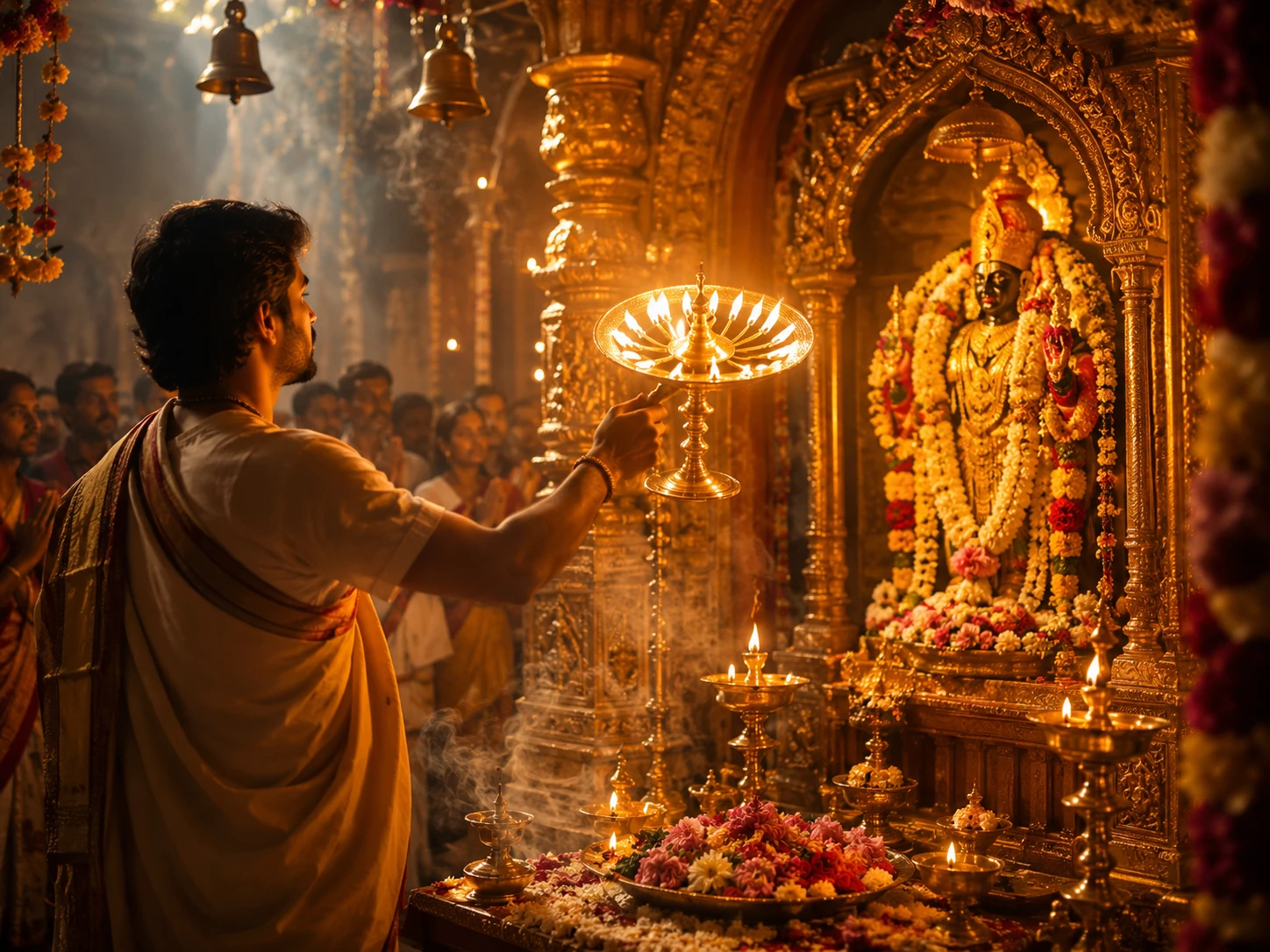
Aarti -- Why Hindus Circle Light Before God
13 min read
Abhisheka -- Why Hindus Bathe Their Gods
10 min read
Akshaya Tritiya -- The Day Nothing Given Away Runs Out
12 min readThe same translation error that turned '33 Koti' into '33 crore' in Hinduism also happened in Buddhism. The Chinese translation of Buddhist texts rendered 'Sapta Koti Buddha' (7 Supreme Buddhas) as '7 Crore Buddhas.' The…
Deities AvatarsCommunity Reflections
🕉️
Be the first to share your reflection.