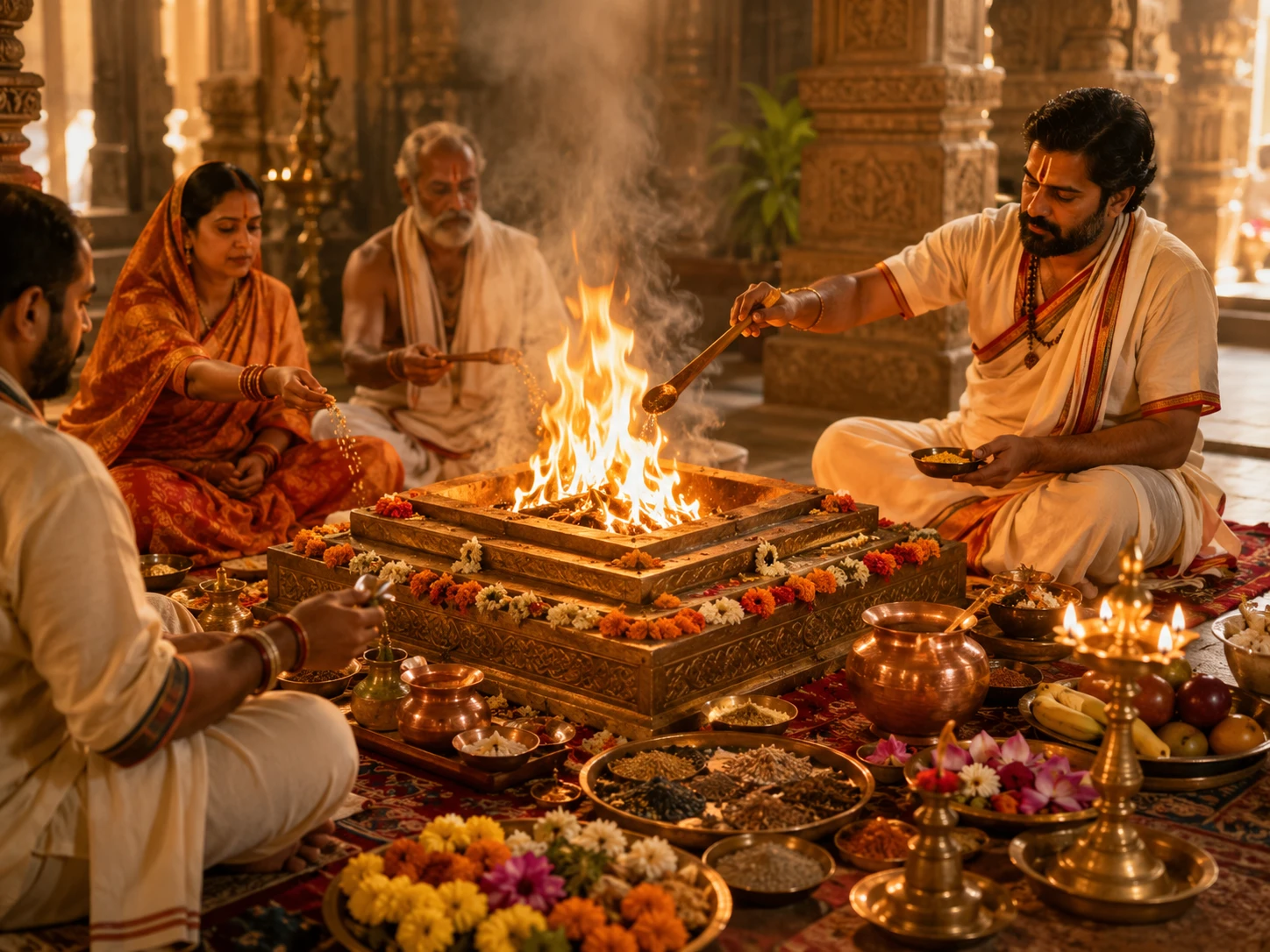
Havan Vidhi -- The Vedic Fire Ritual That Purifies Air, Mind, and Karma
हवन विधि -- वह वैदिक अग्नि अनुष्ठान जो वायु, मन और कर्म शुद्ध करता है
Before there were temples, there was fire. Before there were murtis, there was fire. Before there were elaborate puja thalis with kumkum and camphor and flowers, there was a pit in the ground, a pile of dried wood, a ladle of ghee, and fire. The havan -- also called homa or yajna depending on scale and tradition -- is the original Hindu ritual. Everything else in Hindu worship descended from it.
The Rig Veda, the oldest text in Hinduism, is essentially a havan manual. Hymn after hymn is addressed to Agni -- the fire deity who is simultaneously the ritual fire, the cosmic fire, and the digestive fire within every living being. Agni is invoked in the very first verse of the very first mandala of the Rig Veda: 'Agnim ile purohitam yajnasya devam ritvijam' -- I praise Agni, the household priest, the divine minister of the yajna. Fire is not one element among many in Vedic worship. Fire is the foundation.
The word 'havan' comes from the Sanskrit root 'hu,' meaning to offer into fire. 'Homa' comes from the same root. 'Yajna' comes from 'yaj,' meaning to worship or to sacrifice. In contemporary usage, 'havan' typically refers to a domestic fire ritual performed in a havan kund (fire pit), 'homa' is used in South Indian and temple contexts, and 'yajna' refers to larger-scale Vedic fire ceremonies. But all three describe the same fundamental act: pouring offerings into a consecrated fire while reciting mantras, with the understanding that Agni transforms the physical offering into a subtle form that reaches the divine realm.
The havan is performed at virtually every Hindu lifecycle event. Birth (Jatakarma includes a fire offering), thread ceremony (Upanayana revolves around the sacred fire), wedding (the saptapadi happens around the havan kund), housewarming (Griha Pravesh Havan), and even death (the cremation pyre is the final havan). Additionally, havans are performed for specific purposes: Navagraha Havan for planetary pacification, Ganapati Homa for obstacle removal, Maha Mrityunjaya Havan for health, Sudarshana Homa for protection, and Ayushya Homa for longevity.
In modern India, the havan survives across all strata. The Arya Samaj performs weekly Sunday havans in every chapter across India and the diaspora. Corporate offices in Gurugram and BKC Mumbai perform havans before moving into new premises. Bollywood production houses do muhurat havans before the first shot. ISRO performed a puja with havan elements before the Chandrayaan-3 launch. The Indian Army performs havans before major operations. The fire ritual is not an anachronism -- it is the most actively practised Vedic technology in contemporary India.
अग्निमीळे पुरोहितं यज्ञस्य देवमृत्विजम्। होतारं रत्नधातमम्॥
agnimīḷe purohitaṃ yajñasya devamṛtvijam | hotāraṃ ratnadhātamam ||
I praise Agni, the household priest, the divine minister of the yajna, the invoker, the best bestower of treasures.
— Rig Veda, Mandala 1, Sukta 1, Mantra 1 (the very first verse of the Rig Veda)
The complete havan procedure has a clear structure: preparation, fire establishment, offerings, and conclusion. Here is the step-by-step guide for a standard domestic havan.
Preparation (Havan Kund and Materials). The havan kund is traditionally a copper, brick, or clay fire pit with a specific geometric shape -- the inverted pyramid (vedi) is the classic Vedic form. For home use, small copper havan kunds are widely available (Rs 200-2,000 depending on size). The kund is placed on a clean surface, ideally on the ground or on a metal stand. The performer sits facing east (or north), with the kund between themselves and the direction of the sun.
Materials needed: dried mango wood (aam ki lakdi) or palash wood for fuel; havan samagri (a mixture of herbs, dried fruits, aromatic seeds, and resins -- typically including guggul, loban, jau/barley, til/sesame, chandan/sandalwood powder, kapoor/camphor, and various dried herbs); pure cow ghee; a wooden ladle (sruk or sruva); a small water pot (kalash) with mango leaves; camphor for ignition; akshat, flowers, and coconut for purnahuti.
Step 1: Achamana and Sankalpa. The performer sips water three times (Om Keshavaya Svaha, Om Narayanaya Svaha, Om Madhavaya Svaha) for purification. Then the sankalpa is taken -- a formal declaration in Sanskrit stating the date, location, gotra, deity, and purpose of the havan.
Step 2: Kalash Shuddhi (Water Purification). The water in the kalash is purified by invoking the seven sacred rivers: 'Gange cha Yamune chaiva Godavari Saraswati, Narmade Sindhu Kaveri jalesmin sannidhim kuru.' This water is sprinkled on the kund, materials, and the performer.
Step 3: Agni Sthapana (Establishing Fire). Dried wood is arranged in the kund. Camphor is placed at the centre and ignited while chanting 'Om Bhurbhuvah Svah.' The fire is fanned to grow while reciting agni-prajna mantras. Three pieces of ghee-dipped wood (samidha) are offered with specific mantras -- symbolising the offering of thoughts, words, and deeds to Agni.
Step 4: Pradhana Ahuti (Main Offerings). This is the core of the havan. The performer takes a pinch of havan samagri mixed with ghee in the right hand (or on the wooden ladle), recites a mantra, and at the word 'Svaha,' pours the offering into the fire. 'Svaha' is not merely an exclamation -- she is the wife of Agni, and without uttering her name, no offering is considered complete. Each ahuti follows the pattern: 'Om [deity name] Svaha' followed by 'Idam [deity name], idam na mama' -- 'This is for [deity], not for me.'
The 'idam na mama' declaration is philosophically crucial. It is the explicit renunciation of ownership over the offering and its fruits. You are not bargaining with God. You are giving without expectation. This single phrase -- 'not mine' -- is the havan's deepest teaching.
The number of ahutis depends on the type and purpose of havan. For daily Agnihotra (the simplest daily fire offering), the Vedas prescribe just two ahutis -- one at sunrise and one at sunset. For a standard domestic havan, 108 ahutis with the Gayatri Mantra are traditional. For specific deity havans, 108 repetitions of the deity's mool mantra are used: 'Om Gam Ganapataye Namah Svaha' for Ganesha, 'Om Namah Shivaya Svaha' for Shiva, 'Om Namo Bhagavate Vasudevaya Svaha' for Vishnu. For elaborate rituals, the count can go to 1,008 or even 10,008.
The Sarva-Devata (all-deity) sequence of 108 ahutis begins with Ganesha (obstacle removal), proceeds through the Navagrahas (planetary deities), the Trimurthi (Brahma, Vishnu, Shiva), the Dikpalas (directional guardians), and individual deities, and concludes with universal peace mantras. Each mantra follows the 'Om [name] Svaha / Idam [name], idam na mama' structure.
Step 5: Purnahuti (The Final Offering). The purnahuti is the climactic moment. It means 'complete offering' -- purna (full) + ahuti (oblation). The remaining ghee, samagri, dry fruits, flowers, and sometimes a whole coconut wrapped in red cloth are offered into the fire in one grand gesture. The mantra includes the famous Purnamadah verse from the Isha Upanishad: 'Om purnamadah purnamidam purnat purnamudachyate / Purnasya purnamadaya purnamevavashishyate' -- That is complete, this is complete. From the complete, the complete arises. Taking the complete from the complete, the complete alone remains.
This verse, recited at the moment of total offering, encapsulates the havan's metaphysics: nothing is truly lost in the offering because the universe is already complete. What you give returns to completeness. What remains is also complete.
Step 6: Shanti Patha and Conclusion. The havan concludes with the Shanti Patha -- the universal peace chant: 'Om Dyauh Shantir Antariksha Shantih, Prithvi Shantih, Apah Shantih, Oshadhayah Shantih...' invoking peace in heaven, space, earth, water, plants, trees, all deities, Brahman, and everything that exists. The triple 'Om Shantih Shantih Shantih' addresses the three sources of suffering: adhyatmika (from within), adhibhautika (from other beings), and adhidaivika (from cosmic forces).
The sacred ash (vibhuti) is collected from the kund after it cools. This ash is applied as a tilak on foreheads, mixed with water and sprinkled around the house, or added to garden soil as natural fertiliser rich in potassium and calcium. The havan ash is not waste -- it is prasad from Agni himself.
Types of Fire Rituals -- From Daily Agnihotra to Grand Yajna
| Type | Scale | Duration | Ahuti Count | When Performed |
|---|---|---|---|---|
| Agnihotra | Minimal (two-person) | 15-20 minutes | 2 (sunrise + sunset) | Daily -- simplest Vedic fire offering |
| Griha Havan | Domestic (family) | 45-90 minutes | 108 (Gayatri or deity) | Weekly, monthly, or on occasions |
| Navagraha Homa | Medium (with pandit) | 1.5-2 hours | 108 per graha (972 total) | Planetary pacification, before weddings |
| Ganapati Homa | Medium | 1-1.5 hours | 108 or 1008 | New ventures, obstacle removal |
| Maha Mrityunjaya Havan | Medium-Large | 2-3 hours | 1008 or more | Health crises, longevity prayers |
| Ati Rudra Maha Yajna | Grand (temple-scale) | 11 days | 14,641 repetitions of Rudram | Rare -- performed for national welfare |
| Ashwamedha Yajna | Imperial (historical) | Over 1 year | Thousands -- with horse sacrifice | Ancient -- last performed in 18th century |
The Arya Samaj popularised the simplified weekly havan format accessible to all Hindus regardless of caste. The Gayatri Parivar (founded by Pandit Shriram Sharma Acharya) promotes daily Agnihotra as a household practice.
In 2007, the CSIR-National Botanical Research Institute in Lucknow published a landmark study in the Journal of Ethnopharmacology showing that havan smoke (from a traditional samagri mixture) reduced airborne bacteria by up to 94 percent in a closed room within one hour, and the purifying effect lasted up to 24 hours. The study identified that the combustion of specific herbs like guggul, neem, and mango wood released formaldehyde and other volatile compounds with demonstrable antimicrobial properties. Meanwhile, the word 'Svaha' -- uttered at every single ahuti in every havan across India -- is the name of Agni's wife, Svaha Devi. According to the Shiva Purana, she fell in love with Agni and took the form of six of the seven Krittikas (Pleiades stars) to be with him, which is why the Kartikeya birth story involves both Agni and the Krittikas. Every time a priest says 'Svaha,' he is invoking a love story older than recorded history.
Start Your Agnihotra Practice
Begin with the simplest form -- daily Agnihotra with two ahutis at sunrise and sunset. The Gayatri mantra, often chanted alongside a home havan, has its own page on Eternal Raga with its meaning and how to chant it.
Tags
Eternal Raga · शाश्वत राग
Institutional voice — scholarly articles on Sanatan Dharma
Deepen Your Understanding
अपनी समझ और गहरी करें
rituals traditions
Sandhyavandana -- The Daily Vedic Practice That Even Rama and Krishna Never Skipped
Three times a day, at the junction of night and day, morning and afternoon, afternoon and night, the twice-born Hindu is commanded to stop everything and perform Sandhyavandana. It combines pranayama, the Gayatri Mantra, water offerings, and meditation into a single twenty-minute ritual. The Ramayana shows Rama doing it in the forest. The Mahabharata shows Krishna doing it before battle. And somewhere in India right now, an IIT student is doing it in his hostel room.
rituals traditions
Puja at Home -- The Complete Beginner's Guide
You have a small mandir shelf in your apartment. A brass diya your mother gave you. A photo of a deity you feel drawn to. And absolutely no idea what to do next. This guide is for you -- the 22-year-old in Pune who just moved out, the NRI in New Jersey setting up a puja corner for the first time, the curious soul who wants to start but does not know where.
rituals traditions
Shodashopachara Puja -- The Sixteen-Step Protocol of Hindu Worship
When a Hindu temple priest performs puja, he is not improvising. He is executing a precise sixteen-step protocol called Shodashopachara -- literally 'sixteen offerings' -- that treats God as a royal guest arriving at your home. From invitation to farewell, each step has a specific action, material, mantra, and philosophical meaning. This is the complete user manual.
rituals traditions
Aarti -- Why Hindus Circle Light Before God
Every evening, millions of flames are circled before millions of deities across India. The aarti is the single most recognisable act of Hindu worship -- yet most people performing it cannot explain why the light moves clockwise, why camphor is preferred, or why the flame is touched to the eyes afterward. The answer is older than temples, deeper than devotion, and more scientific than you would expect.
rituals traditions
Hindu Wedding Rituals -- Seven Steps Around Fire That Bind Two Lives Forever
A Hindu wedding is not a contract signed on paper. It is a Vedic yajna performed around fire, witnessed by Agni, sealed by seven vows taken step by step, and marked by sindoor and mangalsutra. By Indian law, the marriage is not legally valid until the Saptapadi is complete. Here is every ritual, from the baraat arriving at the gate to the bride crossing the threshold of her new home.
rituals traditions
The 16 Samskaras -- Rites of Passage from Womb to Pyre
Hinduism does not leave life to chance. From the moment a couple decides to conceive to the moment the body returns to the five elements, there are sixteen rituals -- samskaras -- designed to refine the human being at every critical transition. Think of them as firmware updates for the soul, installed at precisely the right moments.
In 2007, the CSIR-National Botanical Research Institute in Lucknow published a landmark study in the Journal of Ethnopharmacology showing that havan smoke (from a traditional samagri mixture) reduced airborne bacteria by…
More in Rituals & Traditions
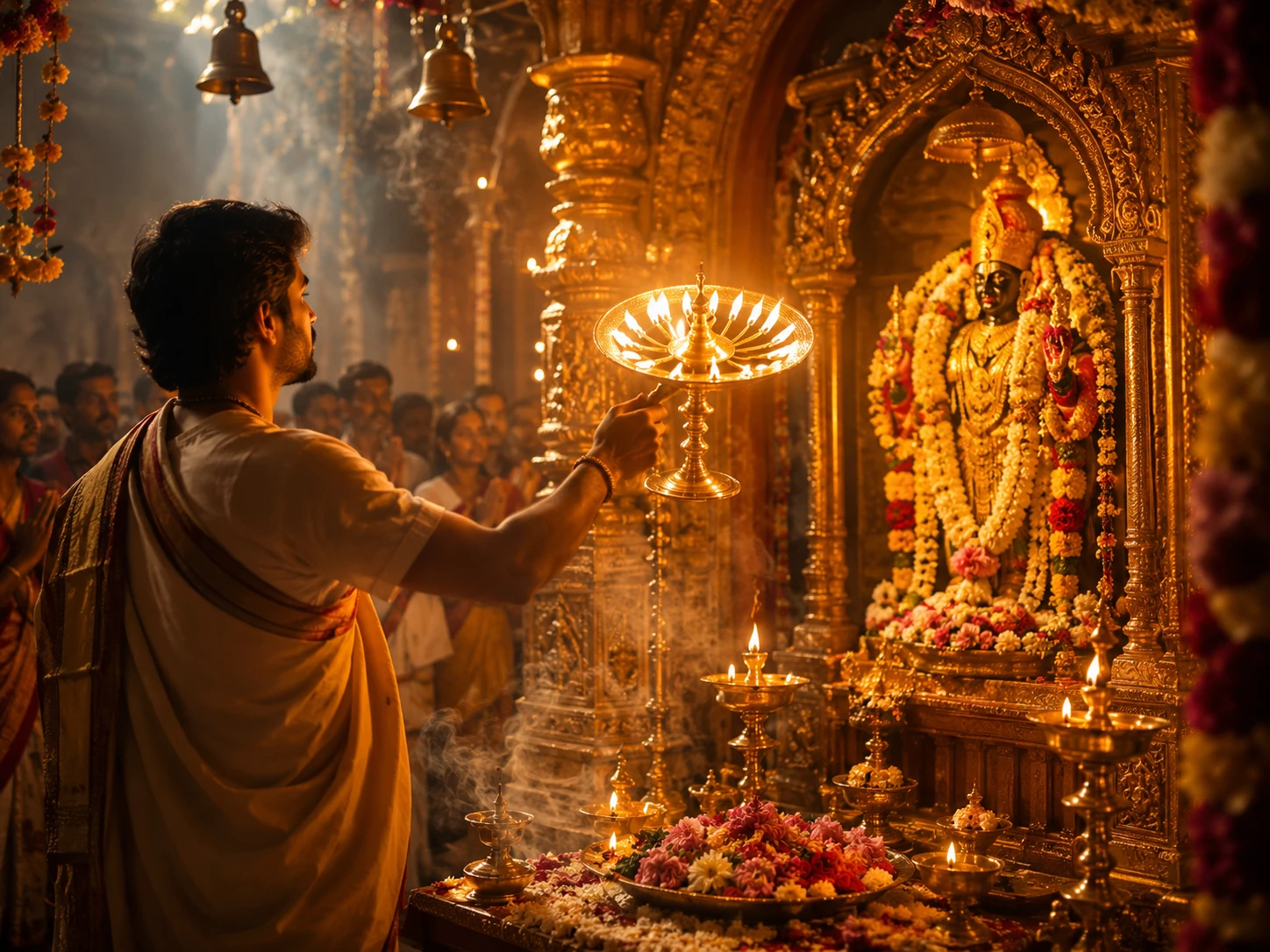
Aarti -- Why Hindus Circle Light Before God
13 min read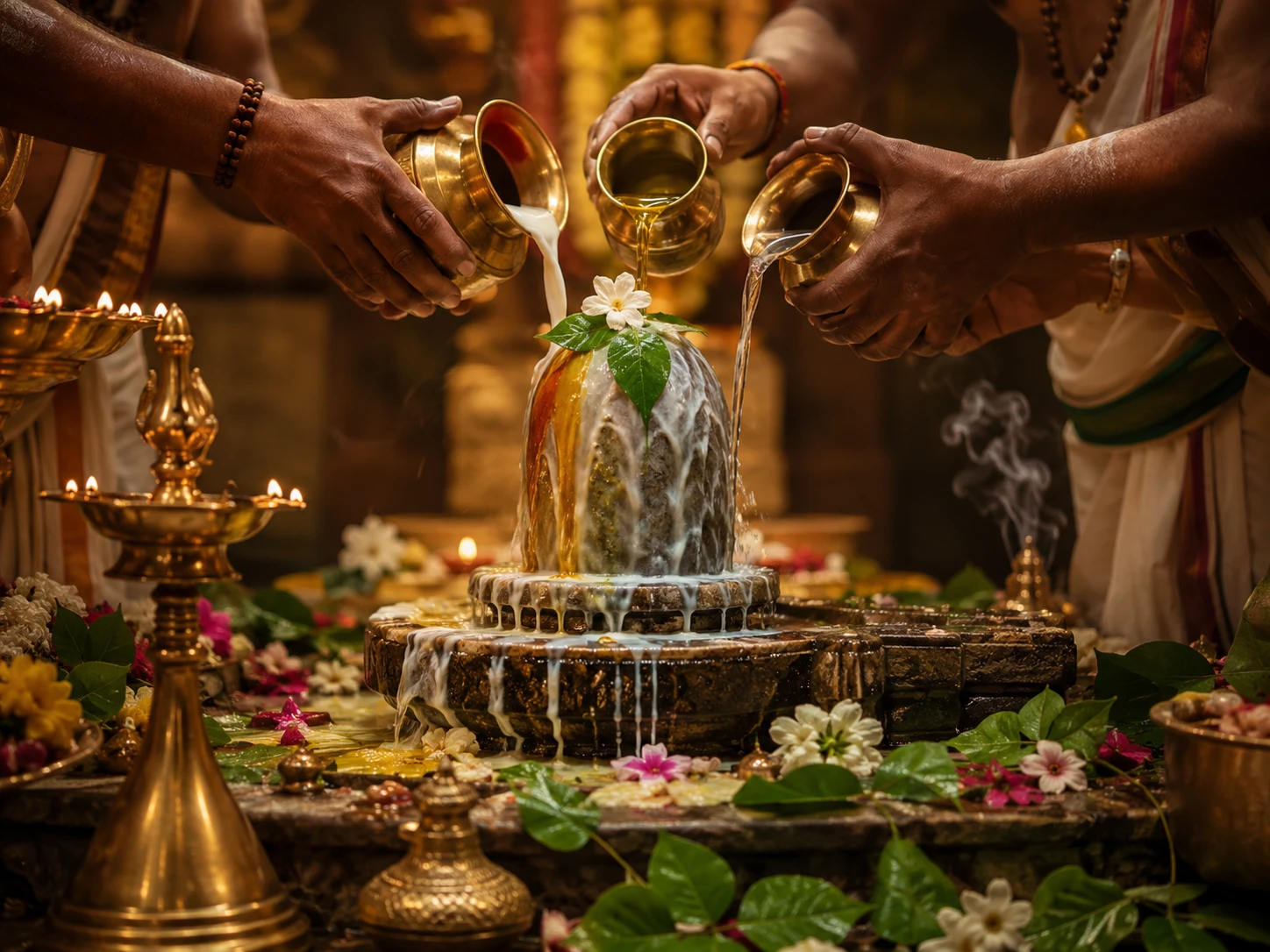
Abhisheka -- Why Hindus Bathe Their Gods
10 min read
Akshaya Tritiya -- The Day Nothing Given Away Runs Out
12 min readThe same translation error that turned '33 Koti' into '33 crore' in Hinduism also happened in Buddhism. The Chinese translation of Buddhist texts rendered 'Sapta Koti Buddha' (7 Supreme Buddhas) as '7 Crore Buddhas.' The…
Deities AvatarsCommunity Reflections
🕉️
Be the first to share your reflection.