Hindu Wedding Rituals -- Seven Steps Around Fire That Bind Two Lives Forever
हिन्दू विवाह संस्कार -- अग्नि की सात परिक्रमाएँ जो दो जीवन सदा के लिए बाँधती हैं
The Hindu wedding is not merely one of the sixteen Samskaras. The Smritis call it the most important of all sixteen. It is the foundational ritual of the Grihastha Ashrama -- the householder's life -- which the Dharma Shastras consider the central pillar supporting all other ashramas: the student, the retired, and the renunciate all depend on the householder for sustenance. Without Vivaha, the entire four-ashrama system collapses.
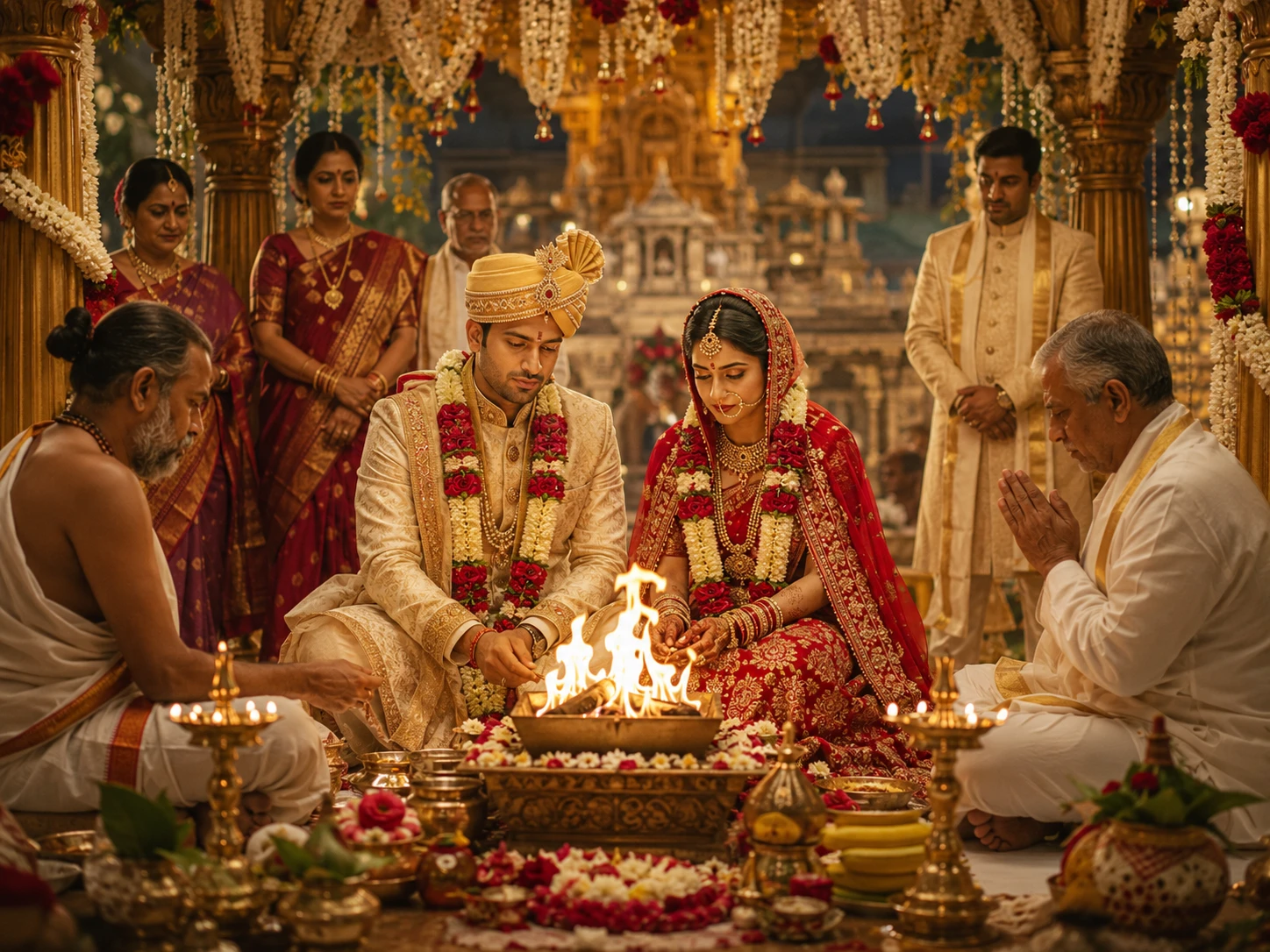
At its core, a Hindu wedding is a Vedic yajna -- a fire ritual. The couple sits around the havan kund, makes offerings to Agni, and takes vows in the presence of fire. Agni is not merely decorative ambiance. He is the divine witness. Under Section 7 of the Hindu Marriage Act, 1955, a Hindu marriage is legally complete only when the Saptapadi (seven steps around the fire) has been performed. No saptapadi, no marriage -- by both religious and civil law.
No two Hindu weddings are identical. Regional variation is enormous: a Tamil Iyengar wedding differs dramatically from a Punjabi Arya Samaj wedding, which differs from a Bengali ceremony, which differs from a Marwari celebration. North Indian weddings feature the baraat procession, joota chupai (shoe-stealing), and elaborate sangeet nights. South Indian weddings emphasise the Muhurtham timing, thali tying, and Nadaswaram music. Maharashtrian weddings include the antarpat ceremony. Bengali weddings have the Shubho Drishti eye-contact ritual. But beneath all regional variation, three Vedic rituals remain constant: Kanyadaan, Panigrahana, and Saptapadi.
The Indian wedding industry is estimated at Rs 10 lakh crore (approximately USD 130 billion) annually, making it one of the largest event economies in the world. From a five-day destination wedding at a Udaipur palace to a simple two-hour ceremony at an Arya Samaj hall, from a Marriott ballroom in New Jersey to a pandal in a Kolkata lane, the Hindu wedding is simultaneously the most ancient and the most economically significant ritual in Indian civilisation.
मांगल्यं तन्तुनानेन मम जीवनहेतुना। कण्ठे बध्नामि सुभगे सञ्जीव शरदः शतम्॥
māṅgalyaṃ tantunānena mama jīvanahetunā | kaṇṭhe badhnāmi subhage sañjīva śaradaḥ śatam ||
This is a sacred thread essential for my long life. I tie this around your neck, O maiden of many auspicious attributes. May you live happily for a hundred years with me.
— Mangalsutra Bandhana Mantra (recited during the tying of the Mangalsutra in Hindu weddings across traditions)
The pre-wedding rituals set the stage. The Sagai (engagement) formalises the families' agreement. In many communities, the pandit matches the couple's horoscopes (Kundli Milan, scoring 36 gunas) to determine compatibility -- a practice that drives an entire sub-industry of astrologers, apps, and matrimonial site algorithms. The Haldi ceremony involves turmeric paste applied to the bride and groom for complexion and purification. The Mehndi ceremony adorns the bride's hands with intricate henna designs -- the groom's name is often hidden in the patterns, and he must find it on the wedding night. The Sangeet is the music and dance celebration, originally women-only but now a co-ed extravaganza that has become the most Instagram-documented part of Indian weddings.
On the wedding day, the Baraat arrives. The groom's procession -- complete with a decorated horse or car, a brass band or DJ, dancing relatives, and fireworks -- arrives at the bride's venue. The Dwar Puja follows: the bride's mother welcomes the groom at the threshold with an aarti, tilak, and garland. This ritual acknowledges the groom as a representative of Vishnu arriving to claim Lakshmi.
The Jai Mala (Varmala) is the mutual exchange of garlands. Both bride and groom place flower garlands around each other's necks, signifying mutual acceptance. This is one of the few moments in traditional Hindu weddings where the bride has explicit agency -- she chooses to garland the groom, not merely receive him.
Kanyadaan -- the giving of the daughter -- is emotionally the most intense ritual. The bride's father places her hand in the groom's hand while the priest chants the Kama Sukta (hymn of love). The father formally entrusts his daughter, asking the groom to uphold Dharma, Artha, and Kama in their life together. The groom promises three times. Kanyadaan is considered one of the highest acts of charity (Maha Daan) in Hindu tradition -- the gift of a daughter, given without expectation of return. Modern feminist scholarship critiques this ritual as treating the woman as property to be 'given.' Many contemporary Hindu weddings have reframed it as 'Kanya Samarpan' (offering the daughter's hand) or involve both parents of both families, acknowledging the evolved social context while preserving the ritual structure.
Panigrahana follows Kanyadaan. 'Pani' means hand; 'grahana' means holding. The groom takes the bride's right hand in his right hand, symbolising their lifelong partnership. The groom acknowledges responsibility to four deities: Bhaga (wealth), Aryama (heavens), Savita (new beginning), and Purandhi (wisdom). This is the hand-holding that precedes the fire.
The Vivaha Homa (Wedding Fire) is then lit. This is the same sacred fire that has been central to Hindu worship since the Rig Veda. The couple makes offerings to Agni together, seeking blessings for their married life. From this point, every remaining ritual happens in the presence of, and witnessed by, this fire.
The Mangalsutra Bandhana is the groom tying the sacred necklace around the bride's neck. The mangalsutra has two strands (representing husband and wife), black beads (for protection from evil eye), and gold pendants (representing Shiva-Shakti). In Sanskrit, mangalsutra is also called 'mangalyatantu' -- the thread of auspiciousness. The four beads represent the four Purusharthas: Dharma, Artha, Kama, and Moksha. This is the Hindu equivalent of the wedding ring, though it carries far more complex symbolism.
And then the Saptapadi. The seven steps. The seven vows. The ritual that makes everything before it a preamble and everything after it a consequence. The couple walks seven steps around the sacred fire -- each step accompanied by a specific vow they make to each other. In North Indian tradition, the bride leads in the first six rounds and the groom leads the seventh. In South Indian tradition, the groom leads the bride by her finger around the fire. Seven mounds of rice are placed at equal distances, and the couple touches each mound as they step.
The seven vows, in their long Vedic form, cover the complete architecture of married life: Step 1 -- nourishment and food. Step 2 -- strength, energy, and vitality. Step 3 -- prosperity and spiritual growth. Step 4 -- happiness, harmony, and family. Step 5 -- progeny and the welfare of children. Step 6 -- health, seasons, and longevity. Step 7 -- friendship, loyalty, and companionship through all of life's challenges. With the seventh step, the marriage is complete. Legally, religiously, and socially -- the couple is now husband and wife.
Saubhagya Chinha follows: the groom applies sindoor (vermillion) in the parting of the bride's hair and gives her the mangalsutra. The Dhruva Darshan asks the couple to look at the Pole Star (Dhruva Tara) -- fixed, unmoving, constant -- as a model for their relationship. They also look at the Arundhati star (the companion star of Vashishtha in the Saptarishi constellation), invoking the legendary devotion of sage Vashishtha's wife.
The Vidaai (farewell) is the bride leaving her parents' home. The Griha Pravesh is her entry into the groom's home, where she kicks over a pot of rice with her right foot -- symbolising abundance flowing into the household. The threshold crossing is marked with kumkum footprints leading inward.
The Seven Saptapadi Vows -- What Each Step Promises
| Step | Theme | Groom's Vow (Summary) | Bride's Vow (Summary) |
|---|---|---|---|
| 1st | Nourishment (Anna) | I will provide food and sustenance | I will prepare and safeguard our nourishment |
| 2nd | Strength (Bala) | I will protect with strength and courage | I will stand beside you with energy and resolve |
| 3rd | Prosperity (Dhana) | I will earn and manage wealth righteously | I will maintain our home with purity and thought |
| 4th | Happiness (Sukha) | I will bring joy and harmony to our family | I will bring love and contentment to our life |
| 5th | Progeny (Praja) | I will care for our children and elders | I will nurture our children with wisdom and love |
| 6th | Health (Ritu) | I will remain faithful through all seasons | I will share in your joys and sorrows alike |
| 7th | Friendship (Sakhya) | You are my eternal companion and friend | I walk with you as friend and partner forever |
The vows vary by tradition and region. The long Vedic form includes detailed reciprocal commitments. The short form used in many North Indian weddings compresses each into a single line. Both are valid.
The Manusmriti lists eight types of Hindu marriage, ranging from the ideal Brahma Vivaha (arranged by families with full consent) to the abducted Rakshasa Vivaha and the secret Gandharva Vivaha (love marriage without family consent -- essentially the ancient equivalent of eloping). The tradition of the groom's shoes being stolen by the bride's sisters (Joota Chupai) has no Vedic basis whatsoever -- it is a purely folk tradition, probably North Indian in origin, that became pan-Indian through Bollywood films. Meanwhile, the Dhruva Darshan ritual at the end of the wedding -- looking at the Pole Star together -- is both astronomical and philosophical: the couple is told to look at the one star in the sky that never moves, as a model for the constancy of their relationship. Astronomers will note that Polaris is only approximately fixed -- it wobbles slightly. Perhaps even the stars understand that perfect constancy requires constant adjustment.
Prepare for Your Vivaha with Sacred Mantras
The mantras of the Hindu wedding, including the seven steps of the saptapadi, come from the Grihya Sutras. Read the vivaha section of the Ashvalayana Grihya Sutra with your partner before the ceremony; it is on Eternal Raga with Sanskrit and translation. Your officiating priest can tell you which tradition's sequence they will follow.
Tags
Eternal Raga · शाश्वत राग
Institutional voice — scholarly articles on Sanatan Dharma
Deepen Your Understanding
अपनी समझ और गहरी करें
rituals traditions
The 16 Samskaras -- Rites of Passage from Womb to Pyre
Hinduism does not leave life to chance. From the moment a couple decides to conceive to the moment the body returns to the five elements, there are sixteen rituals -- samskaras -- designed to refine the human being at every critical transition. Think of them as firmware updates for the soul, installed at precisely the right moments.
rituals traditions
Havan Vidhi -- The Vedic Fire Ritual That Purifies Air, Mind, and Karma
Every major Hindu milestone -- birth, thread ceremony, wedding, housewarming, death -- involves fire. The havan is the oldest continuous ritual technology in Hinduism, dating to the Rig Veda. You pour ghee, herbs, and grains into a consecrated fire while chanting 'Svaha,' and Agni carries your offering to the gods. Modern science confirms: the smoke actually does purify the air. Here is the complete procedure.
rituals traditions
Shodashopachara Puja -- The Sixteen-Step Protocol of Hindu Worship
When a Hindu temple priest performs puja, he is not improvising. He is executing a precise sixteen-step protocol called Shodashopachara -- literally 'sixteen offerings' -- that treats God as a royal guest arriving at your home. From invitation to farewell, each step has a specific action, material, mantra, and philosophical meaning. This is the complete user manual.
rituals traditions
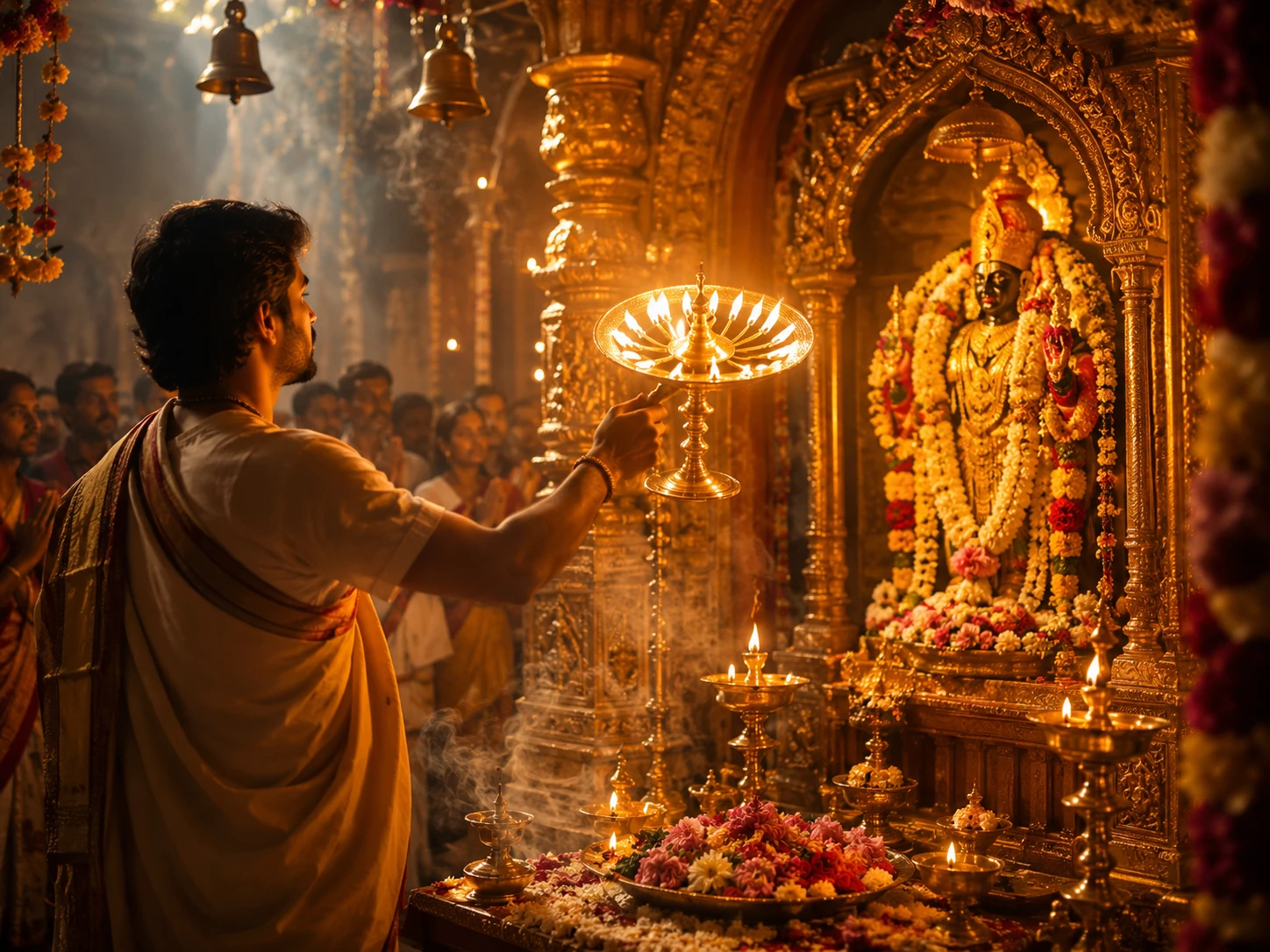
Aarti -- Why Hindus Circle Light Before God
Every evening, millions of flames are circled before millions of deities across India. The aarti is the single most recognisable act of Hindu worship -- yet most people performing it cannot explain why the light moves clockwise, why camphor is preferred, or why the flame is touched to the eyes afterward. The answer is older than temples, deeper than devotion, and more scientific than you would expect.
rituals traditions
Puja at Home -- The Complete Beginner's Guide
You have a small mandir shelf in your apartment. A brass diya your mother gave you. A photo of a deity you feel drawn to. And absolutely no idea what to do next. This guide is for you -- the 22-year-old in Pune who just moved out, the NRI in New Jersey setting up a puja corner for the first time, the curious soul who wants to start but does not know where.
rituals traditions
Why Bells, Lamps, and Flowers -- The Sensory Engineering Behind Hindu Worship
Hindu worship is not random. Every bell, every lamp, every flower, every stick of incense, every drop of water addresses a specific sense, invokes a specific element, and produces a specific psychological effect. The puja is a sensory design system -- a five-element, five-sense immersive experience engineered three thousand years before UX designers existed. Here is the complete map.
The Manusmriti lists eight types of Hindu marriage, ranging from the ideal Brahma Vivaha (arranged by families with full consent) to the abducted Rakshasa Vivaha and the secret Gandharva Vivaha (love marriage without fam…
More in Rituals & Traditions
Aarti -- Why Hindus Circle Light Before God
13 min read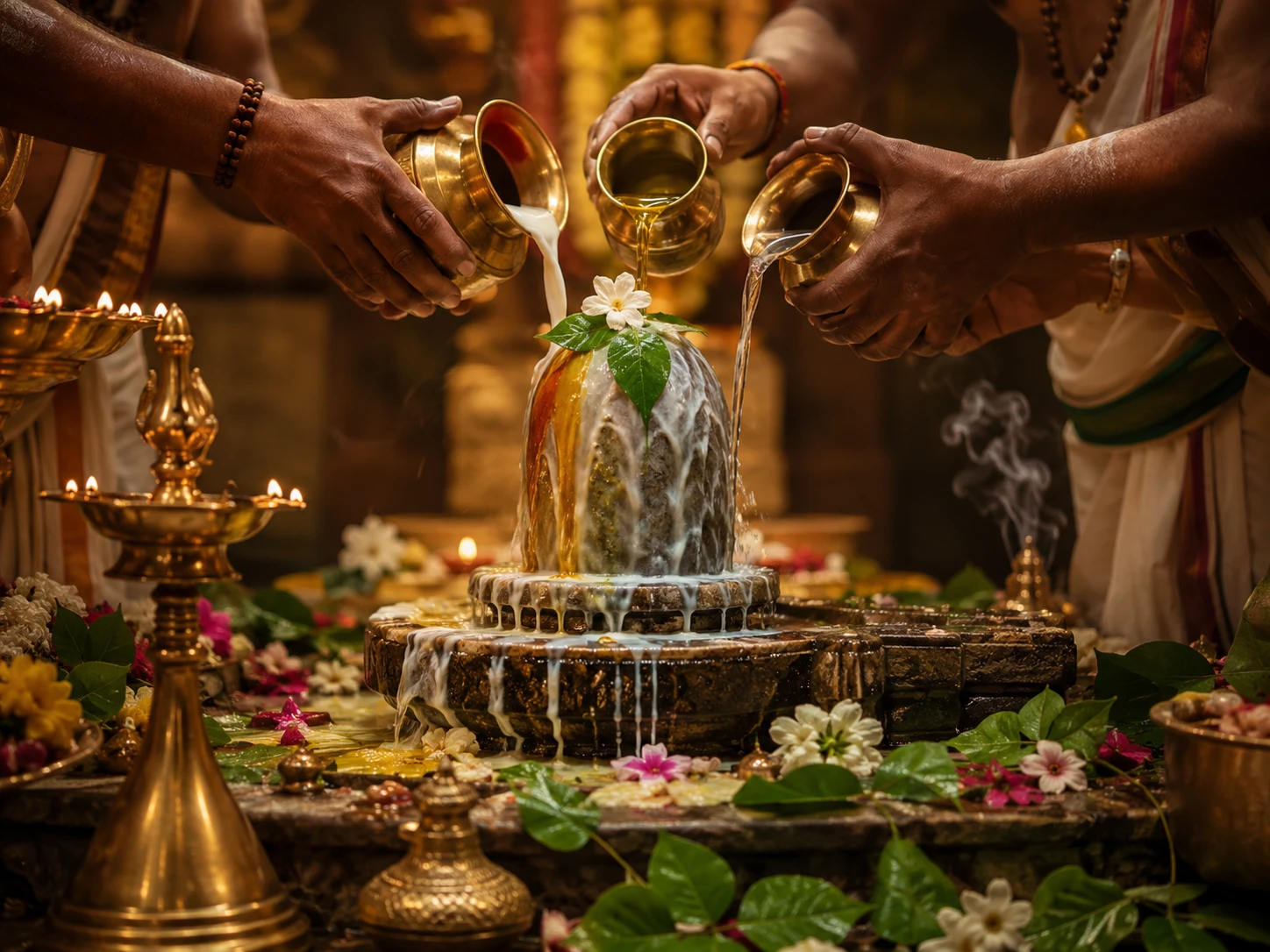
Abhisheka -- Why Hindus Bathe Their Gods
10 min read
Akshaya Tritiya -- The Day Nothing Given Away Runs Out
12 min readThe same translation error that turned '33 Koti' into '33 crore' in Hinduism also happened in Buddhism. The Chinese translation of Buddhist texts rendered 'Sapta Koti Buddha' (7 Supreme Buddhas) as '7 Crore Buddhas.' The…
Deities AvatarsCommunity Reflections
🕉️
Be the first to share your reflection.