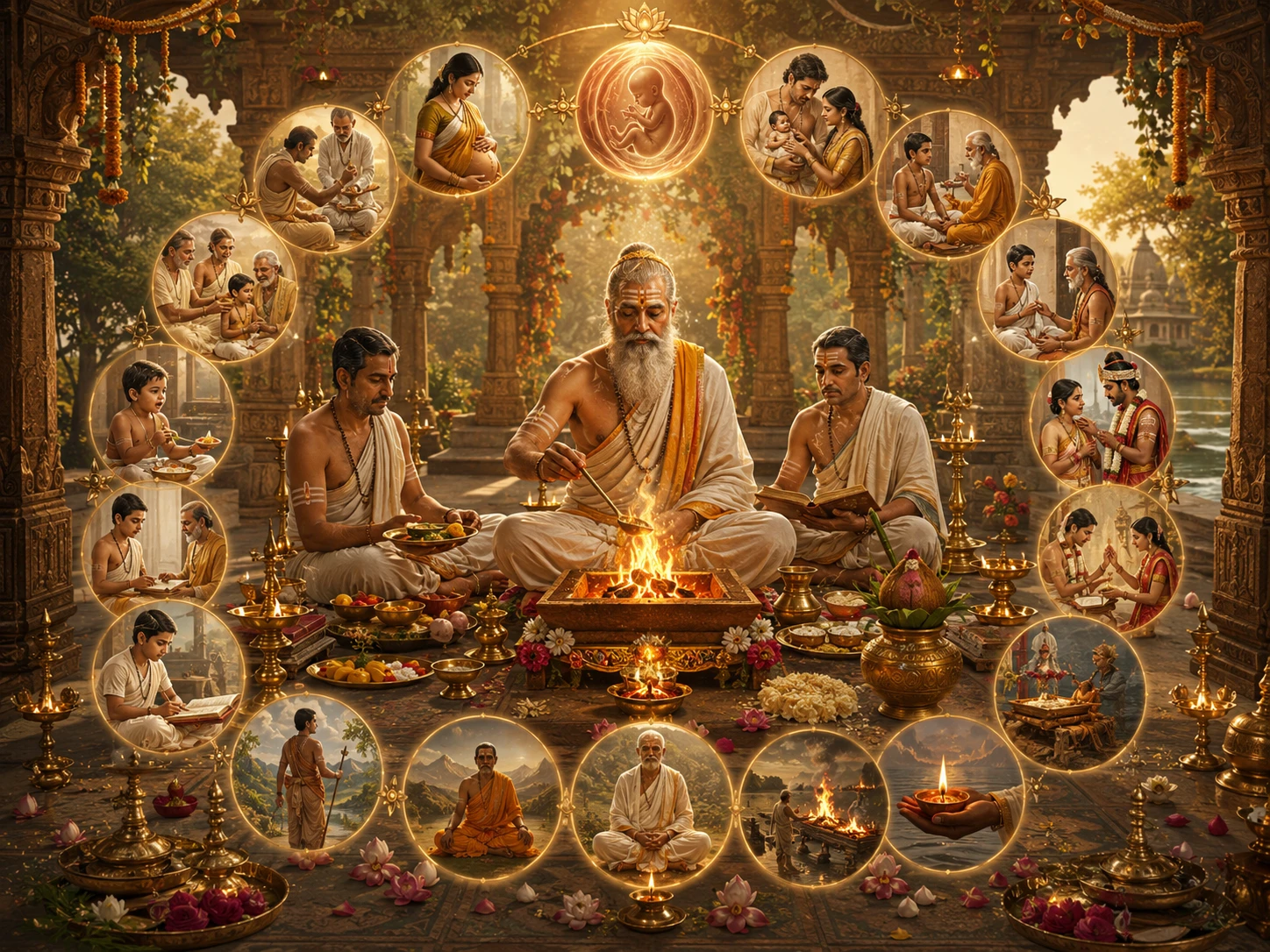
The 16 Samskaras -- Rites of Passage from Womb to Pyre
षोडश संस्कार -- गर्भ से चिता तक जीवन के सोलह पड़ाव
There is a word in Sanskrit that has no exact English equivalent: samskara. It is sometimes translated as 'sacrament', sometimes as 'rite of passage', sometimes as 'purificatory ritual'. None of these captures its full weight. The root 'sam-kr' means to refine, to perfect, to make complete. A samskara is an act that transforms raw human experience into something polished, intentional, and spiritually charged.
Hindu tradition prescribes sixteen such samskaras -- the Shodasha Samskaras -- that span the entire arc of a human life. They begin before birth, with the intention of conception. They end after death, with the cremation fire. In between, they mark naming, first food, first haircut, the start of education, the investiture of the sacred thread, marriage, and the transitions of aging. Each one is anchored in Vedic mantras, performed around a sacred fire, and designed to address a specific psychological, social, or spiritual need at that particular stage of life.
The primary textual sources are the Grihya Sutras -- domestic ritual manuals attached to different Vedic schools. Ashvalayana, Paraskara, Gobhila, and Apastamba each have their own Grihya Sutra with slightly different sequences and procedures. The Dharma Sutras and later Dharmashastras (especially Manusmriti, chapters 2-5) codify the samskaras further. The number sixteen became standard through works like the Vira Mitrodaya of Mitramishra (17th century), though some texts list as few as twelve and as many as forty.
What makes the samskara system remarkable is its comprehensiveness. No other ancient civilisation designed a ritual architecture that covers the complete human lifecycle with this level of granularity. The closest parallels -- Christian sacraments (seven), Jewish life-cycle rituals, Confucian li -- are either fewer in number or less systematically linked to developmental stages. The Hindu samskara system is, in effect, an ancient human development framework -- a protocol for raising a human being from biological organism to conscious, dharmic individual.
प्रजां च धत्तं द्रविणं च धत्तम्
prajāṃ ca dhattaṃ draviṇaṃ ca dhattam
Bestow upon us progeny and affluence.
— Rig Veda 8.35.10-12 (invoked during Garbhadhana Samskara)
The 16 Samskaras -- Complete Map
| # | Samskara | Sanskrit | Life Stage | Purpose | Still Practised? |
|---|---|---|---|---|---|
| 1 | Garbhadhana | गर्भाधान | Pre-conception | Sanctifies the intention to conceive; invokes divine blessing for a healthy child | Rarely as formal ritual; intention-setting persists culturally |
| 2 | Pumsavana | पुंसवन | 2nd-3rd month of pregnancy | Prayers for healthy development of the fetus; historically for a male child | Declining; replaced by baby showers in urban India |
| 3 | Simantonnayana | सीमन्तोन्नयन | 7th-8th month of pregnancy | Hair-parting ceremony for the mother; ensures safe delivery; emotional support | Common in South India as Seemantham/Valaikappu |
| 4 | Jatakarma | जातकर्म | Immediately after birth | Father welcomes newborn; touches lips with honey and ghee; first breath ritual | Simplified but widely practised across communities |
| 5 | Namakarana | नामकरण | 11th-12th day after birth | Formal naming ceremony; name based on nakshatra, family tradition, or deity | Very widely practised; often combined with cradle ceremony |
| 6 | Nishkramana | निष्क्रमण | 4th month | Child's first outing; first sight of sun and moon | Informal but common; temple visit as first outing |
| 7 | Annaprashana | अन्नप्राशन | 6th-7th month | Baby's first solid food; usually rice with ghee or payasam | Widely celebrated; major family event across India |
| 8 | Chudakarana | चूडाकरण | 1st or 3rd year | First tonsure (mundan); shaving of head except shikha tuft | Very common; performed at temples like Tirupati, Varanasi |
| 9 | Karnavedha | कर्णवेध | 3rd-5th year | Ear-piercing ceremony; Sushruta cites health benefits | Widely practised; often combined with Chudakarana |
| 10 | Vidyarambha | विद्यारम्भ | 5th year | Beginning of alphabet learning; child writes first letters in rice | Very common in South India (Aksharabhyasa on Vijayadashami) |
| 11 | Upanayana | उपनयन | 7th-12th year | Sacred thread ceremony; initiation into Vedic study; Gayatri Mantra given | Practised in Brahmin, Kshatriya, Vaishya families; declining in urban settings |
| 12 | Vedarambha | वेदारम्भ | After Upanayana | Formal commencement of Vedic study with the guru | Merged with Upanayana in most modern practice |
| 13 | Keshanta / Godana | केशान्त / गोदान | 16th year | First shaving of facial hair; marks approach of adulthood | Rare as formal samskara; culturally absorbed into puberty |
| 14 | Samavartana | समावर्तन | End of studentship | Convocation; ritual bath; student returns home from gurukula | Replaced by university convocations; spiritual meaning lost |
| 15 | Vivaha | विवाह | Adult | Marriage; Saptapadi (seven steps); most elaborate samskara | Universally practised; the most visible samskara in modern India |
| 16 | Antyeshti | अन्त्येष्टि | After death | Cremation; returning body to five elements; releasing the soul | Universally practised; electric cremation now common in cities |
Of the 16, only 4-5 are commonly practised today in most families: Jatakarma, Namakarana, Annaprashana, Vivaha, and Antyeshti. The Arya Samaj movement (19th century) attempted to revive all sixteen.
The Architecture Behind the Sequence
The sixteen samskaras are not randomly ordered. They follow a developmental logic that mirrors what modern developmental psychology recognises as critical periods -- windows of time when specific interventions have maximum impact.
The first three samskaras (Garbhadhana, Pumsavana, Simantonnayana) are prenatal. They focus on the parents, not the child. The couple's intention is sanctified. The mother's wellbeing is prioritised. The community rallies around the expectant family. In modern terms, these are prenatal care rituals with a spiritual wrapper.
Samskaras 4 through 10 cover infancy and early childhood. Each one marks a developmental milestone: birth (Jatakarma), identity (Namakarana), exposure to the outside world (Nishkramana), nutrition transition (Annaprashana), hygiene and health (Chudakarana, Karnavedha), and cognitive readiness (Vidyarambha). A paediatrician would recognise every one of these as a genuine developmental checkpoint.
Samskaras 11 through 14 govern education and adolescence. Upanayana -- the sacred thread ceremony -- is the most significant. It marks the child's 'second birth' (dvija) into the world of knowledge. The guru whispers the Gayatri Mantra into the child's ear for the first time. The child receives the yajnopavita (sacred thread) and is charged with three debts: to the Rishis (for knowledge), to the ancestors (for lineage), and to the Devas (for sustenance). For centuries, this was the Indian equivalent of university matriculation -- except it happened at age seven or eight, and the curriculum was the Vedas.
Samskara 15 -- Vivaha -- is the pivot point. Marriage is the only samskara that the Grihya Sutras describe as applicable to both men and women. The Saptapadi (seven steps around the fire) is the legally and spiritually binding act. Each step carries a vow: nourishment, strength, prosperity, happiness, progeny, longevity, and eternal friendship. The Grihya Sutras record the formula: 'One step for strength, two steps for vitality, three steps for prosperity, four steps for happiness, five steps for cattle, six steps for seasons, seven steps for friendship. To me be devoted.'
Samskara 16 -- Antyeshti -- closes the loop. The body, made of five elements (pancha-bhuta: earth, water, fire, air, space), is returned to those elements through cremation. The eldest son or closest male relative lights the pyre. The skull is cracked to release the prana. The ashes are immersed in a sacred river. The family observes a mourning period (typically 13 days), after which a purification ceremony and feast mark the transition from grief to resumption of life.
Samskaras in Modern India -- What Survived and What Did Not
Of the sixteen samskaras, most urban Indian families today practise only four or five with any formality: Namakarana (naming), Annaprashana (first food), Vivaha (marriage), and Antyeshti (funeral). Upanayana survives strongly among Brahmin and some Kshatriya families, particularly in South India, Maharashtra, and Karnataka. Chudakarana (mundan) remains popular across caste lines, with Tirupati, Varanasi, and local temples hosting thousands of tonsure ceremonies annually.
The prenatal samskaras have largely disappeared as formal Vedic rituals but have been replaced by cultural equivalents. The baby shower (godh bharai in Hindi, seemantham in Tamil, valaikappu in Telugu) is a direct descendant of Simantonnayana -- the form has changed, but the function (celebrating and protecting the expectant mother) is identical.
Vidyarambha -- the start of learning -- survives most vibrantly in Kerala, where Aksharabhyasa on Vijayadashami is a massive annual event. Children are seated on their parent's lap, and a guru or elder writes the first letter of the alphabet (usually Om or a deity's name) on the child's tongue with a gold ring, or on a plate of rice. In Kochi and Thrissur, the queues outside temples on Vijayadashami morning stretch for kilometres.
The most dramatic disappearance is Samavartana -- the convocation from the gurukula. Since the gurukula system itself collapsed under colonial education, the ritual lost its institutional anchor. Modern university convocations inherit the form (robes, procession, certificate) but not the spiritual content (ritual bath, formal permission from the guru to re-enter worldly life).
For NRI families in London, Toronto, or Silicon Valley, samskaras have become identity anchors. A Namakarana ceremony in a Bay Area living room, conducted over Zoom with a pandit in Varanasi, is now a common occurrence. The form adapts; the intention persists. The samskara system's deepest teaching is that life without intentional ritual becomes accidental -- and accidental lives lack the structural support to navigate suffering, transition, and growth.
The Grihya Sutras understood what modern psychologists are only now formalising: that human beings need ritualised transitions to process change. Without them, we carry unfinished psychological business from one life stage to the next. The samskaras are not superstition. They are spiritual infrastructure.
The Upanayana samskara (sacred thread ceremony) is the origin of the term 'Dvija' (twice-born) in Hindu society. The first birth is biological; the second is intellectual and spiritual -- the moment the Gayatri Mantra enters the child's consciousness. The three strands of the yajnopavita (sacred thread) represent three debts (rinas): Deva Rina (debt to the gods), Rishi Rina (debt to the teachers), and Pitru Rina (debt to the ancestors). A Brahmin traditionally wears the thread from Upanayana onward for life, and it is only replaced at specific junctures -- including after touching a funeral pyre (Antyeshti), completing it as a full circle back to Samskara 16.
Chant the Gayatri -- The Mantra of Upanayana
The Gayatri mantra is the heart of the Upanayana samskara. Chant it 108 times on a mala and reconnect with the tradition of the twice-born. The Gayatri mantra's page on Eternal Raga gives its meaning.
Tags
Eternal Raga · शाश्वत राग
Institutional voice — scholarly articles on Sanatan Dharma
Deepen Your Understanding
अपनी समझ और गहरी करें
rituals traditions
Puja at Home -- The Complete Beginner's Guide
You have a small mandir shelf in your apartment. A brass diya your mother gave you. A photo of a deity you feel drawn to. And absolutely no idea what to do next. This guide is for you -- the 22-year-old in Pune who just moved out, the NRI in New Jersey setting up a puja corner for the first time, the curious soul who wants to start but does not know where.
rituals traditions
Shodashopachara Puja -- The Sixteen-Step Protocol of Hindu Worship
When a Hindu temple priest performs puja, he is not improvising. He is executing a precise sixteen-step protocol called Shodashopachara -- literally 'sixteen offerings' -- that treats God as a royal guest arriving at your home. From invitation to farewell, each step has a specific action, material, mantra, and philosophical meaning. This is the complete user manual.
rituals traditions
Hindu Wedding Rituals -- Seven Steps Around Fire That Bind Two Lives Forever
A Hindu wedding is not a contract signed on paper. It is a Vedic yajna performed around fire, witnessed by Agni, sealed by seven vows taken step by step, and marked by sindoor and mangalsutra. By Indian law, the marriage is not legally valid until the Saptapadi is complete. Here is every ritual, from the baraat arriving at the gate to the bride crossing the threshold of her new home.
rituals traditions
Havan Vidhi -- The Vedic Fire Ritual That Purifies Air, Mind, and Karma
Every major Hindu milestone -- birth, thread ceremony, wedding, housewarming, death -- involves fire. The havan is the oldest continuous ritual technology in Hinduism, dating to the Rig Veda. You pour ghee, herbs, and grains into a consecrated fire while chanting 'Svaha,' and Agni carries your offering to the gods. Modern science confirms: the smoke actually does purify the air. Here is the complete procedure.
tantra mantra yantra
The Gayatri Mantra -- 24 Syllables That Illuminate the Mind
The most chanted verse in human history is not a prayer for wealth, power, or protection. It is a prayer for light -- for the divine radiance to illuminate the intellect. 24 syllables from Rig Veda 3.62.10, attributed to Rishi Vishwamitra, have shaped Indian civilisation for over three thousand years.
rituals traditions
Sandhyavandana -- The Daily Vedic Practice That Even Rama and Krishna Never Skipped
Three times a day, at the junction of night and day, morning and afternoon, afternoon and night, the twice-born Hindu is commanded to stop everything and perform Sandhyavandana. It combines pranayama, the Gayatri Mantra, water offerings, and meditation into a single twenty-minute ritual. The Ramayana shows Rama doing it in the forest. The Mahabharata shows Krishna doing it before battle. And somewhere in India right now, an IIT student is doing it in his hostel room.
The Upanayana samskara (sacred thread ceremony) is the origin of the term 'Dvija' (twice-born) in Hindu society. The first birth is biological; the second is intellectual and spiritual -- the moment the Gayatri Mantra en…
More in Rituals & Traditions
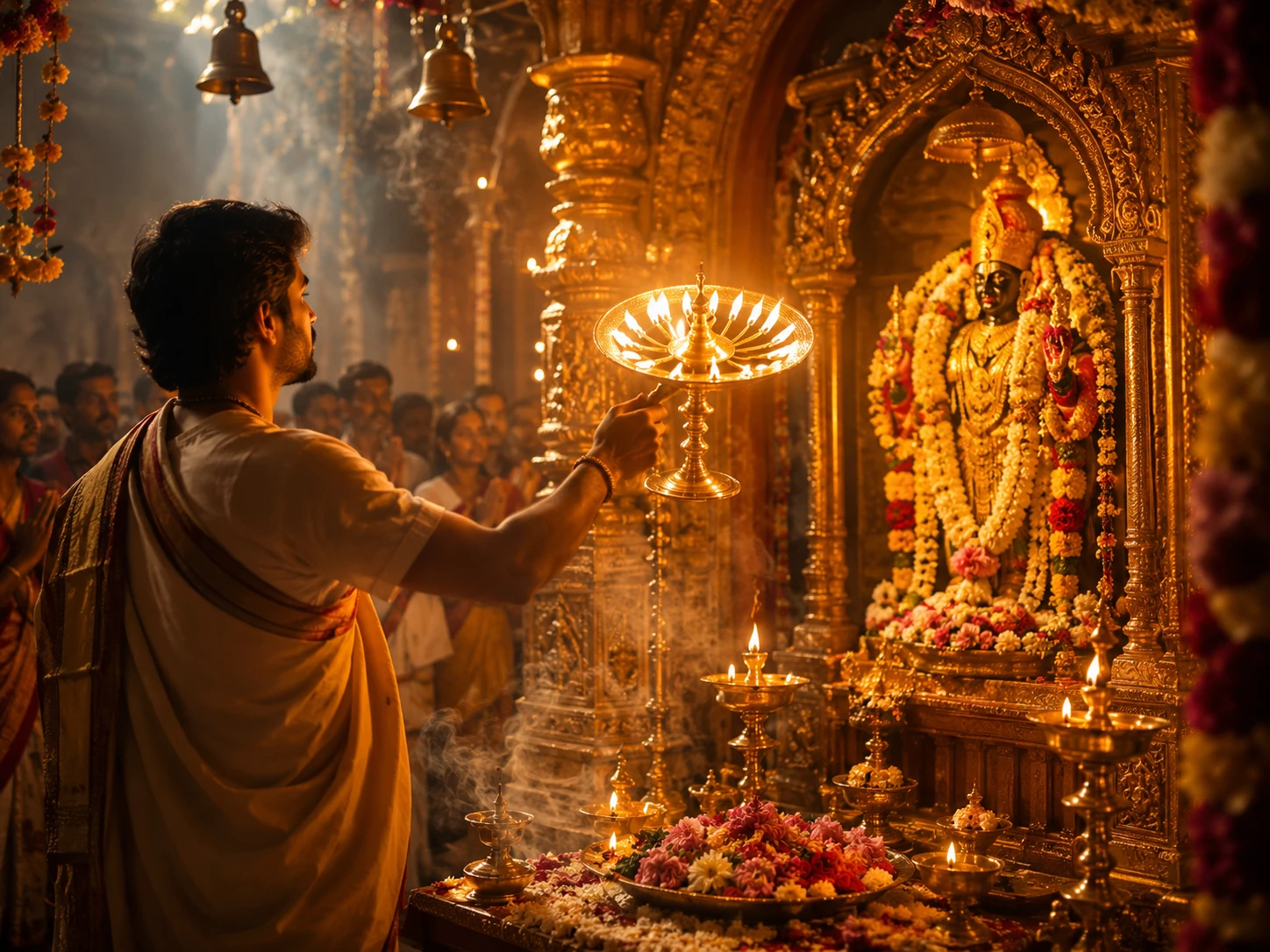
Aarti -- Why Hindus Circle Light Before God
13 min read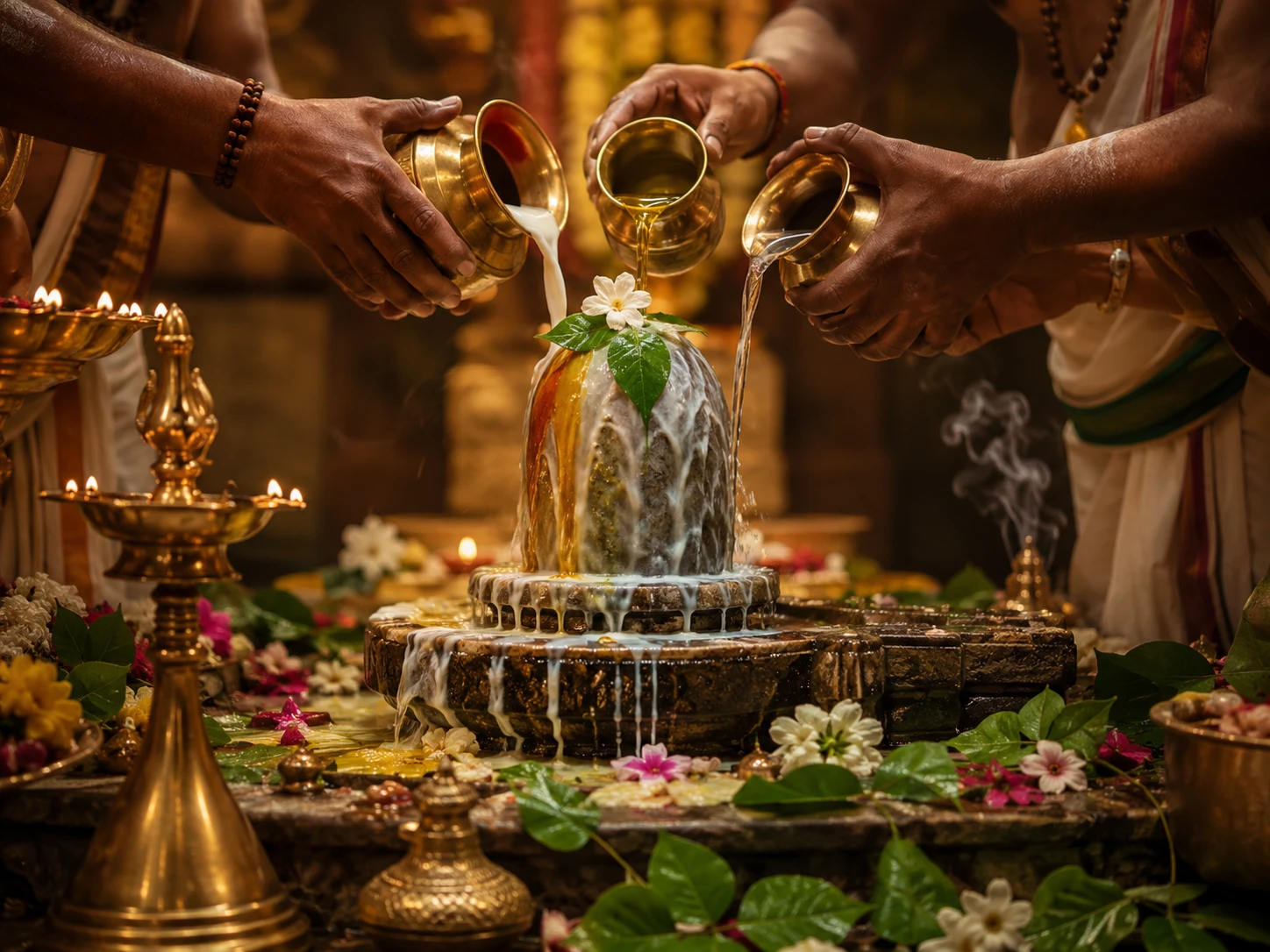
Abhisheka -- Why Hindus Bathe Their Gods
10 min read
Akshaya Tritiya -- The Day Nothing Given Away Runs Out
12 min readThe same translation error that turned '33 Koti' into '33 crore' in Hinduism also happened in Buddhism. The Chinese translation of Buddhist texts rendered 'Sapta Koti Buddha' (7 Supreme Buddhas) as '7 Crore Buddhas.' The…
Deities AvatarsCommunity Reflections
🕉️
Be the first to share your reflection.