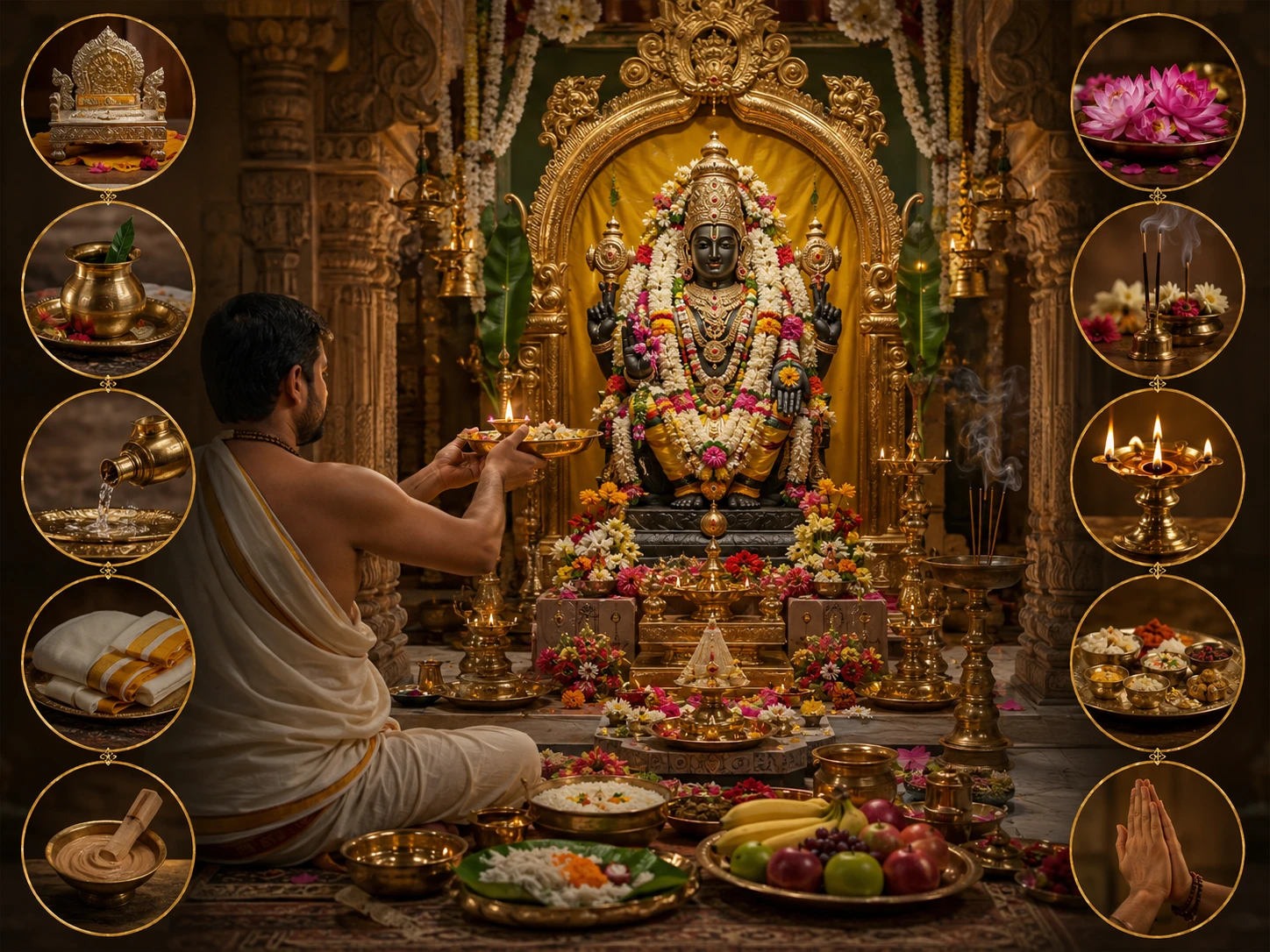
Shodashopachara Puja -- The Sixteen-Step Protocol of Hindu Worship
षोडशोपचार पूजा -- हिन्दू उपासना का सोलह-चरणीय प्रोटोकॉल
In Indian culture, the highest expression of respect is hospitality. When an important guest visits your home, you welcome them at the door, offer them a seat, bring water for their feet and hands, serve them food, present gifts, and bid them farewell with blessings. This is not merely social etiquette -- it is an ancient civilisational code. The Taittiriya Upanishad declares: 'Atithi Devo Bhava' -- let the guest be as God.
Shodashopachara Puja inverts this. If a guest should be treated as God, then God should be treated as the most honoured guest. The entire sixteen-step sequence is structured as a hospitality protocol -- the deity is invited into the puja space, offered a seat, given water for bathing, dressed, adorned, fed, entertained with light and fragrance, and finally sent off with reverence. Every step maps exactly to how a king or revered elder would be received in a traditional Indian household.
The word itself breaks down cleanly: 'Shodasha' means sixteen (shasht + dasha, 6 + 10). 'Upachara' means service, offering, or attendance given with devotion. So Shodashopachara is literally 'sixteen services.' This is the standard form of full-fledged puja used in temples across India -- from the Padmanabhaswamy Temple in Thiruvananthapuram to the Kashi Vishwanath in Varanasi, from the Meenakshi Temple in Madurai to the Siddhivinayak in Mumbai. If a puja is described as 'complete' or 'vidhivat' (according to proper procedure), it almost always means the sixteen upacharas have been performed.
The system is documented across multiple texts -- the Grihya Sutras, the Agamas (particularly the Pancharatra and Shaiva Agamas), and various Puranas including the Agni Purana and the Skanda Purana. The specific mantras differ by deity and tradition -- a Ganapati Shodashopachara Puja uses different shlokas than a Shiva or Vishnu version -- but the sixteen-step structure remains constant. It is one of Hinduism's most standardised ritual architectures.
Within the sixteen, five steps are considered the absolute core -- the Pancha Upachara. These are: Gandham (sandalwood paste, activating touch), Pushpam (flowers, activating sound through name-chanting), Dhoopam (incense, activating smell), Deepam (lamp, activating sight), and Naivedyam (food offering, activating taste). If you cannot perform all sixteen, the Pancha Upachara covers the five senses and is accepted as a valid shortcut in most traditions. The average home puja in India, when it includes incense, flowers, a diya, a tilak, and prasad, is actually performing the Pancha Upachara -- a compressed version of the full protocol.
मन्त्रहीनं क्रियाहीनं भक्तिहीनं महेश्वर। यत्पूजितं मया देव परिपूर्णं तदस्तु ते॥
mantrahīnaṃ kriyāhīnaṃ bhaktihīnaṃ maheśvara | yatpūjitaṃ mayā deva paripūrṇaṃ tadastu te ||
O Lord Maheshvara, may the puja done by me, even though devoid of proper mantras, wanting in the steps, and lacking in devotion, be received by you as complete.
— Puja Samarpana Mantra (recited at conclusion of Shodashopachara Puja across Shaiva and Smarta traditions)
The sixteen steps, in their standard sequence, unfold as a complete hospitality arc. Here is each upachara, what it involves, and what it means.
1. Dhyanam / Avahana (Meditation and Invocation). The puja begins in the mind. The devotee meditates on the form of the Ishta Deva -- visualising the deity's attributes, weapons, ornaments, and expression. Then the deity is formally invited into the murti or image with specific mantras. This is the equivalent of sending an invitation and then opening the front door. In the Ganesha tradition, the avahana mantra often begins with 'Agaccha brahmanam natha' -- Come, O Lord of Brahman. The priest sprinkles akshat and flowers towards the murti while chanting, symbolising the deity's descent from the divine realm into the physical form. Without avahana, the murti is simply stone or metal. With avahana, it becomes a vessel for divine presence.
2. Asanam (Offering a Seat). Every Indian home offers the best seat to the most honoured guest. In puja, the deity is offered an asana -- usually a decorated wooden platform (chauki), a lotus-shaped base, or a silken cloth. The mantra typically describes the seat in cosmic terms: it is not merely a chair but a jewelled throne adorned with divine attributes. When the pandit at Kashi Vishwanath places the Shivalinga on its decorated base, he is performing asanam. When your grandmother places a clean red cloth under the Ganesh murti during Chaturthi, she is performing asanam.
3. Padyam (Water for Feet). The guest's feet are washed upon arrival -- a practice that survives in rural India to this day. In puja, water (often Ganga Jal) is offered at the deity's feet with specific mantras. This acknowledges the deity's journey from the celestial realm and purifies the connection between divine and human worlds.
4. Arghyam (Water for Hands). After the feet, the hands are washed. Arghya water is typically mixed with sandalwood, flowers, and akshat. In many South Indian temples, arghyam is a distinct ritual action with its own mudra (hand gesture) and mantra.
5. Achamanam (Water for Sipping). The guest is offered water to drink -- or more precisely, to sip for purification. Three sips of water are offered, each accompanied by a name of Vishnu in Vaishnava traditions or a name of Shiva in Shaiva ones. This step also purifies the devotee performing the puja.
6. Snanam (Bathing the Deity). The deity is given a ritual bath -- abhishekam. In Shiva worship, this is the Rudrabhishekam, performed with milk, curd, honey, ghee, sugar water, and Ganga Jal (the Panchamrit), often accompanied by the chanting of Purusha Suktam or Sri Suktam. In Vaishnava temples, Vishnu or Krishna murtis are bathed with similar substances. The Mahakal Temple in Ujjain performs the Bhasma Aarti at 4 AM, where Shiva is bathed with sacred ash -- a unique variant. Abhishekam is one of the most dramatic and sensory-rich moments in Hindu worship. The sounds of Vedic chanting, the sight of liquids cascading over the deity, the fragrance of camphor and sandalwood -- all converge at this step.
7. Vastram (Clothing the Deity). After bathing, the deity is offered fresh clothes. In practice, this often means draping a new cloth (vastra) around the murti. At Tirupati Balaji, the daily vastra-alankaram of Lord Venkateswara involves specific garments, each associated with a day of the week. In home pujas, a fresh piece of cloth -- even a new handkerchief -- serves the purpose. The symbolic point is dignity: you would not let an honoured guest sit undressed.
8. Yajnopavitam (Sacred Thread). The deity is offered a sacred thread. This step is performed primarily for male deities in the Brahmanical tradition. It signifies the deity's status as the ultimate Dvija -- the twice-born principle itself.
9. Gandham (Sandalwood Paste). Sandalwood paste or kumkum is applied to the deity. This is the first of the Pancha Upachara -- the five essential offerings. Gandham addresses the sense of touch. Sandalwood is sattvic, cooling, and fragrant. In Ayurveda, it calms pitta dosha. Applying chandan to a deity is simultaneously worship, aromatherapy, and a demonstration of the devotee's willingness to offer the costliest substance available -- historically, Mysore sandalwood was among the most expensive natural materials in the Indian subcontinent.
10. Pushpam (Flowers). Flowers are offered while chanting the deity's names or the Ashtottara Shatanamavali (108 names). Each flower placement is accompanied by a name. This is the second Pancha Upachara, activating the sense of sound through nama-japa. Specific deities require specific flowers: bilva for Shiva, tulasi for Vishnu, red hibiscus for Devi, durva grass for Ganesha. Offering a prohibited flower is considered a ritual error -- you would not serve a vegetarian guest meat.
11. Dhoopam (Incense). Incense or dhoop is waved before the deity. This is the third Pancha Upachara, activating smell. The fragrant smoke rising upward is a metaphor for the devotee's aspirations reaching the divine. In major temples, the dhoop used is not the commercial agarbatti but a specific blend of guggul, camphor, sandalwood powder, and other natural resins. The CSIR-National Botanical Research Institute's research on havan smoke's antimicrobial properties gives scientific backing to what temple architects have practised for centuries -- the fumigation of enclosed sacred spaces with specific aromatic compounds.
12. Deepam (Lamp). A ghee or oil lamp is lit and shown to the deity -- head to foot. This is the fourth Pancha Upachara, activating sight. The Agni Purana specifically recommends ghee for the deepam in puja. The deepam illuminates the deity's form, allowing devotees a clear darshan. In ancient temples without electricity, this was the only way to see the murti in the dark inner sanctum. The practice of waving light before the deity evolved into the aarti -- which itself became one of Hinduism's most recognisable ritual forms.
13. Naivedyam (Food Offering). The deity is offered specially prepared food. This is the fifth and final Pancha Upachara, activating taste. The food must be prepared in separate, clean utensils, never tasted beforehand. Common naivedya items include modak for Ganesha, butter and mishri for Krishna, fruit and coconut for most deities. The food is offered with a specific mantra, a tulsi leaf is placed on top, and water is sprinkled around the plate in a ritual gesture of dedication. After the deity has symbolically 'partaken,' the food becomes prasad -- divine leftovers infused with blessing. The prasad distribution system in Hindu temples -- from Tirupati's laddoo to Puri's mahaprasad to Shirdi's udi -- is one of the world's largest sacred food networks.
14. Tamboolam (Betel Leaf Offering). Paan, supari, and sometimes camphor are offered. This represents the post-meal digestive offering -- the paan that every Indian household traditionally offers after a feast. It is the gesture of gracious completion.
15. Neerajanam (Aarti). The camphor or ghee-wick aarti is performed, waving the flame clockwise before the deity. This is the climactic moment of the puja -- the congregational singing, the bells, the conch, the visible flame illuminating the deity's face. The aarti is both the fifteenth upachara and, in popular practice, the single most recognisable act of Hindu worship. When the Ganga Aarti happens at Dashashwamedh Ghat in Varanasi every evening, when the Mangal Aarti begins at 4 AM at Mahakal Ujjain, when your mother waves a small camphor flame before the home mandir -- they are all performing Neerajanam.
16. Pranamam and Pradakshina (Prostration and Circumambulation). The devotee bows before the deity and performs pradakshina -- walking clockwise around the sanctum or the puja space. The mantra recited often includes: 'Yani kani cha papani janmantarakritani cha / Tani tani vinashyanti pradakshina pade pade' -- May the sins of this life and previous births be destroyed with every step of the circumambulation. This is the farewell -- the devotee has hosted God, served God with sixteen services, and now seeks blessings before the divine guest departs.
The Sixteen Upacharas -- Sequence, Sense, and Hospitality Mapping
| # | Upachara | उपचार | Hospitality Equivalent | Sense / Element |
|---|---|---|---|---|
| 1 | Dhyanam / Avahana | ध्यानम् / आवाहन | Sending invitation, opening door | Mind (Manas) |
| 2 | Asanam | आसनम् | Offering the best seat | Touch (Prithvi) |
| 3 | Padyam | पाद्यम् | Washing the guest's feet | Touch (Jal) |
| 4 | Arghyam | अर्घ्यम् | Water for washing hands | Touch (Jal) |
| 5 | Achamanam | आचमनम् | Offering water to drink | Taste (Jal) |
| 6 | Snanam | स्नानम् | Drawing bath for the guest | Touch (Jal) |
| 7 | Vastram | वस्त्रम् | Offering fresh clothes | Touch (Prithvi) |
| 8 | Yajnopavitam | यज्ञोपवीतम् | Honouring status and dignity | Touch |
| 9 | Gandham* | गन्धम्* | Applying perfume / sandalwood | Touch (Pancha Upachara 1) |
| 10 | Pushpam* | पुष्पम्* | Garland of welcome | Sound (Pancha Upachara 2) |
| 11 | Dhoopam* | धूपम्* | Fragrant atmosphere | Smell (Pancha Upachara 3) |
| 12 | Deepam* | दीपम्* | Lighting the room for the guest | Sight (Pancha Upachara 4) |
| 13 | Naivedyam* | नैवेद्यम्* | Serving the finest meal | Taste (Pancha Upachara 5) |
| 14 | Tamboolam | ताम्बूलम् | Post-meal paan offering | Taste |
| 15 | Neerajanam | नीराजनम् | Grand salute with light (Aarti) | Sight (Agni) |
| 16 | Pranamam / Pradakshina | प्रणाम / प्रदक्षिणा | Farewell with respect | All senses |
* Marks the five Pancha Upacharas -- the irreducible core of Hindu worship. Sequence may vary slightly in Pancharatra, Shaiva Agama, and Smarta traditions.
The Shodashopachara Puja structure is so deeply embedded in Indian culture that it shows up in secular hospitality too. Traditional Indian wedding reception lines follow the exact sixteen-step logic: guest is invited (avahana), offered a seat (asana), given a drink (arghya/achamana), fed (naivedya), given gifts (tamboolam), and bid farewell (pradakshina as they leave). Meanwhile, the Jagannath Temple in Puri performs a version with 'Rajopachara' -- royal services that include fanning the deity, offering an umbrella, showing a mirror, providing elephant and horse rides, and singing and dancing for entertainment. The deity is treated not merely as a guest but as a reigning monarch holding court.
Learn the Pancha Upachara at Home
Start with the five essential steps -- gandham, pushpam, dhoopam, deepam, naivedyam -- before attempting all sixteen. Eternal Raga's article on panchopachara puja goes through each of the five in turn.
Tags
Eternal Raga · शाश्वत राग
Institutional voice — scholarly articles on Sanatan Dharma
Deepen Your Understanding
अपनी समझ और गहरी करें
rituals traditions
Puja at Home -- The Complete Beginner's Guide
You have a small mandir shelf in your apartment. A brass diya your mother gave you. A photo of a deity you feel drawn to. And absolutely no idea what to do next. This guide is for you -- the 22-year-old in Pune who just moved out, the NRI in New Jersey setting up a puja corner for the first time, the curious soul who wants to start but does not know where.
rituals traditions
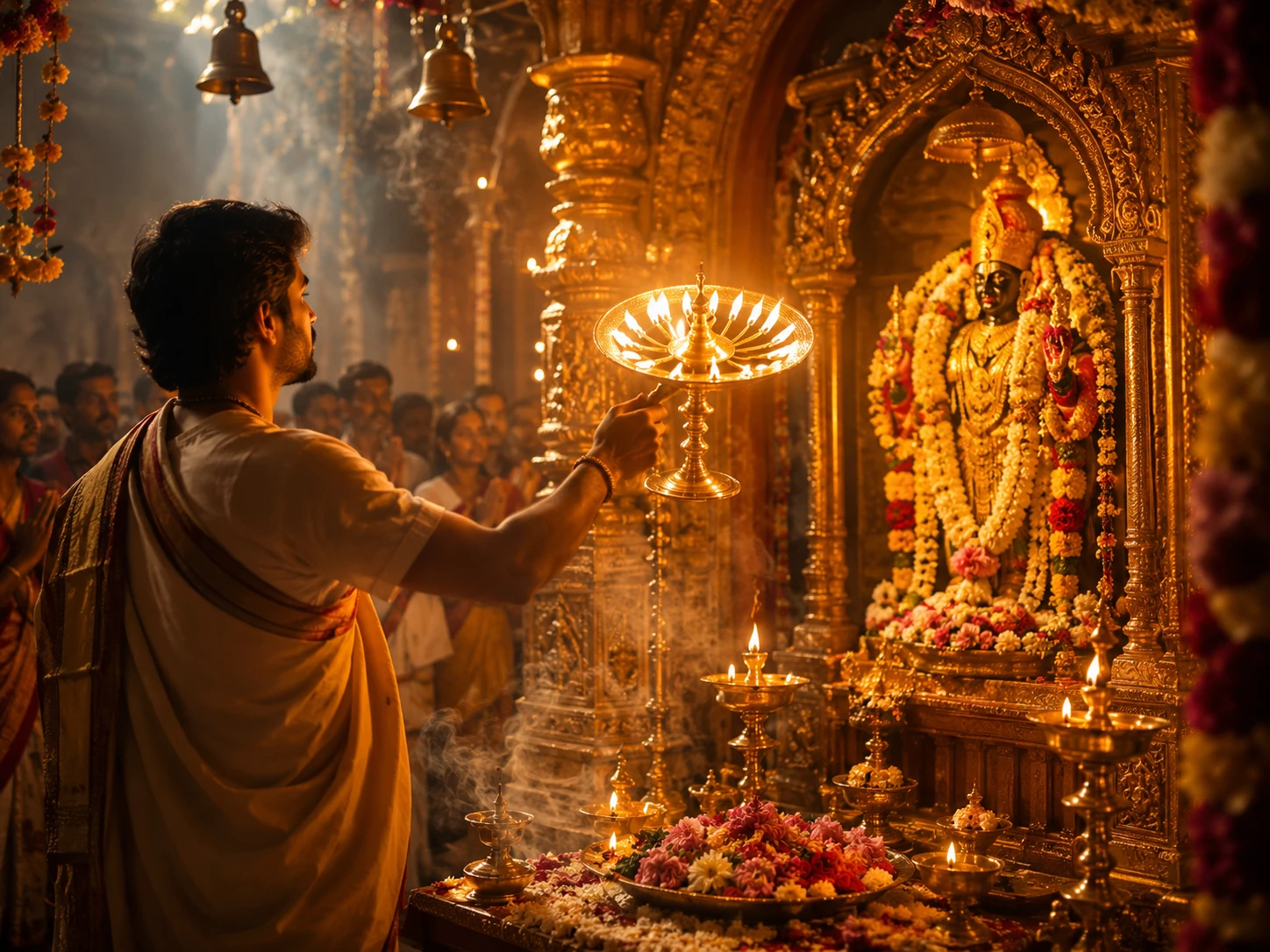
Aarti -- Why Hindus Circle Light Before God
Every evening, millions of flames are circled before millions of deities across India. The aarti is the single most recognisable act of Hindu worship -- yet most people performing it cannot explain why the light moves clockwise, why camphor is preferred, or why the flame is touched to the eyes afterward. The answer is older than temples, deeper than devotion, and more scientific than you would expect.
rituals traditions
Why Bells, Lamps, and Flowers -- The Sensory Engineering Behind Hindu Worship
Hindu worship is not random. Every bell, every lamp, every flower, every stick of incense, every drop of water addresses a specific sense, invokes a specific element, and produces a specific psychological effect. The puja is a sensory design system -- a five-element, five-sense immersive experience engineered three thousand years before UX designers existed. Here is the complete map.
rituals traditions
Temple Darshan Etiquette -- The Complete Protocol for Visiting a Hindu Temple
Most Hindus visit temples. Few know the correct sequence. There is a reason you remove shoes before entering, ring the bell at the threshold, worship Ganesha first, walk clockwise around the sanctum, accept prasad in the right hand, and never point your feet at the deity. Every rule has a Vedic, architectural, or psychological rationale. This is the complete user guide to Hindu temple darshan.
rituals traditions
The 16 Samskaras -- Rites of Passage from Womb to Pyre
Hinduism does not leave life to chance. From the moment a couple decides to conceive to the moment the body returns to the five elements, there are sixteen rituals -- samskaras -- designed to refine the human being at every critical transition. Think of them as firmware updates for the soul, installed at precisely the right moments.
rituals traditions
Havan Vidhi -- The Vedic Fire Ritual That Purifies Air, Mind, and Karma
Every major Hindu milestone -- birth, thread ceremony, wedding, housewarming, death -- involves fire. The havan is the oldest continuous ritual technology in Hinduism, dating to the Rig Veda. You pour ghee, herbs, and grains into a consecrated fire while chanting 'Svaha,' and Agni carries your offering to the gods. Modern science confirms: the smoke actually does purify the air. Here is the complete procedure.
The Shodashopachara Puja structure is so deeply embedded in Indian culture that it shows up in secular hospitality too. Traditional Indian wedding reception lines follow the exact sixteen-step logic: guest is invited (av…
More in Rituals & Traditions
Aarti -- Why Hindus Circle Light Before God
13 min read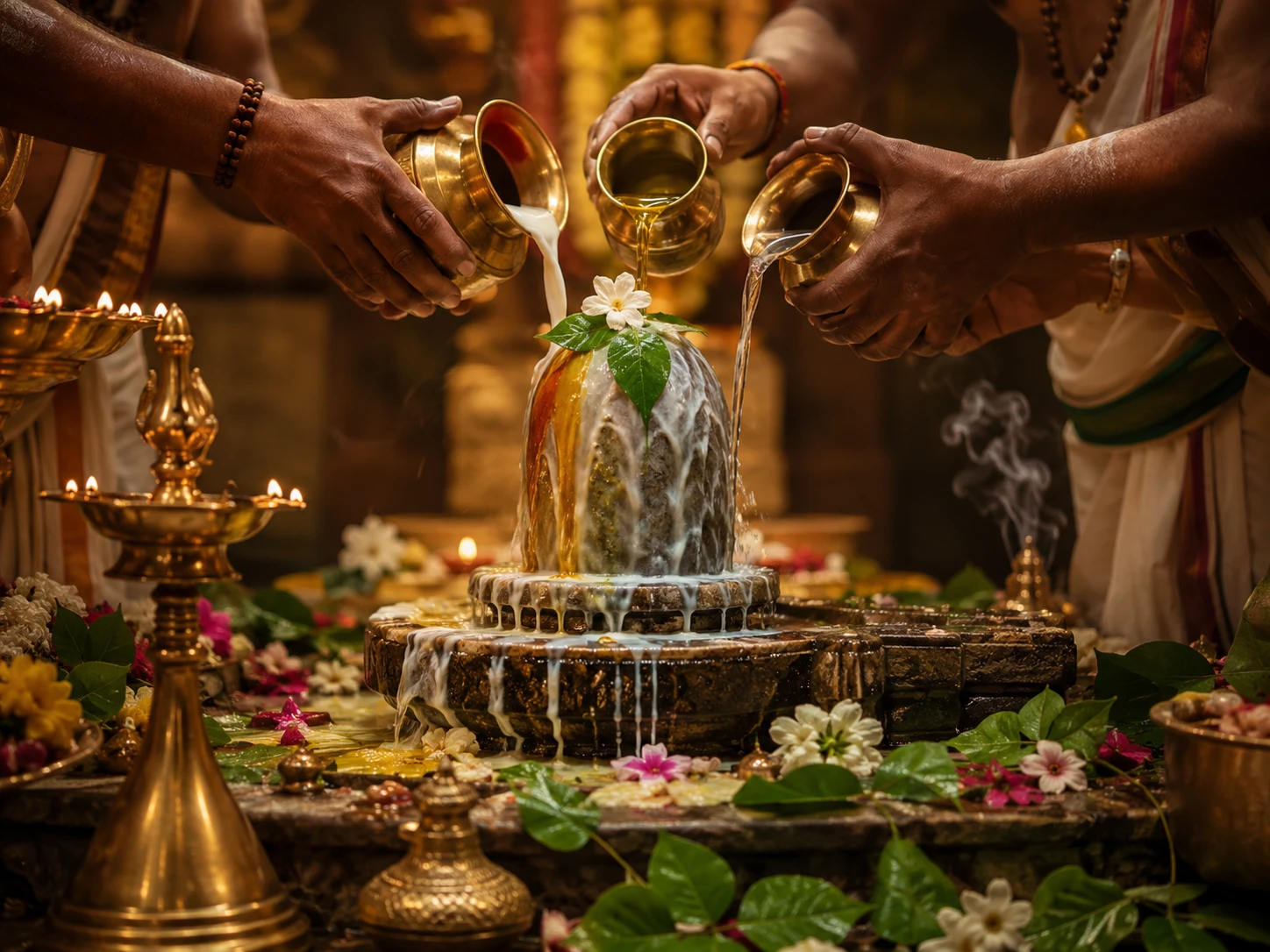
Abhisheka -- Why Hindus Bathe Their Gods
10 min read
Akshaya Tritiya -- The Day Nothing Given Away Runs Out
12 min readThe same translation error that turned '33 Koti' into '33 crore' in Hinduism also happened in Buddhism. The Chinese translation of Buddhist texts rendered 'Sapta Koti Buddha' (7 Supreme Buddhas) as '7 Crore Buddhas.' The…
Deities AvatarsCommunity Reflections
🕉️
Be the first to share your reflection.