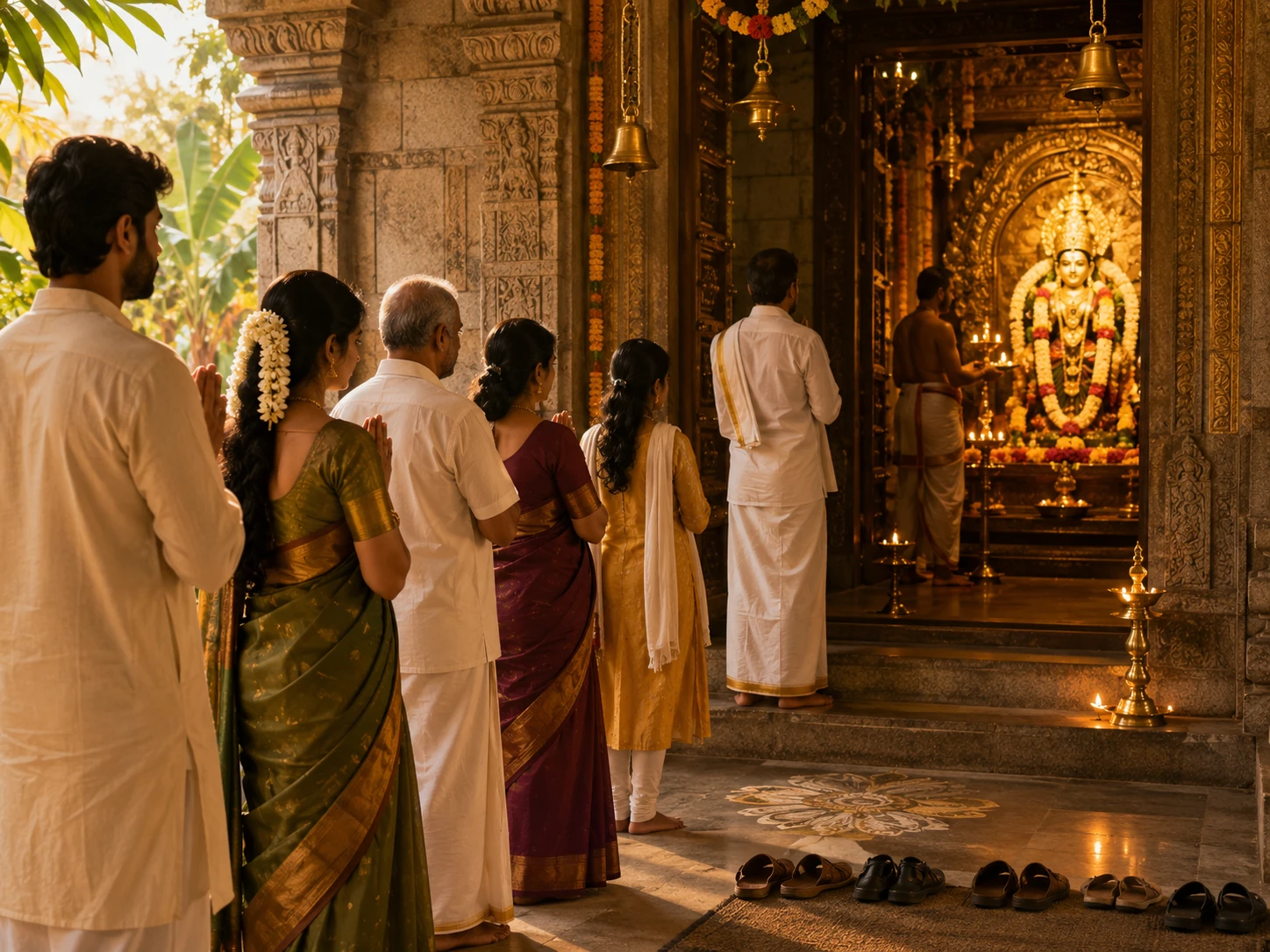
Temple Darshan Etiquette -- The Complete Protocol for Visiting a Hindu Temple
मन्दिर दर्शन शिष्टाचार -- हिन्दू मन्दिर जाने का सम्पूर्ण प्रोटोकॉल
A Hindu temple is not a community hall with idols. It is a consecrated energy field. The temple architecture -- from the towering gopuram at the entrance to the dark garbhagriha at the centre -- is designed as a map of the human body and consciousness. The outer courtyard represents the gross physical world. The successive prakaras (concentric enclosures) represent progressively subtle layers of reality. The garbhagriha -- literally 'womb-house' -- represents the deepest core of the self where the divine resides. The journey from entrance to sanctum is the journey from surface awareness to the centre of being.
The deity inside is not a statue. After Prana Pratishtha -- the ritual of life-installation -- the murti is understood to house divine presence. The rituals of daily worship (waking, bathing, feeding, adorning, and putting the deity to sleep) treat the murti as a living being. When you enter a temple for darshan, you are not visiting an exhibit. You are entering the presence of the divine, and the etiquette reflects that understanding.
The word 'darshan' itself is critical. It means 'seeing' -- but in the Hindu context, it is reciprocal. You see the deity, and the deity sees you. Darshan is not passive observation. It is a two-way exchange of spiritual energy. The large, open eyes on Hindu murtis are not an aesthetic choice -- they are designed to 'see' the devotee. This is why the most important moment in a temple visit is not when you deposit money in the hundi, but when your eyes meet the deity's eyes.
The protocol that follows is synthesised from the Agama texts (Pancharatra and Shaiva Agamas), temple traditions across India, and the guidance of Hinduism Today's 'Dancing with Siva' -- one of the most authoritative modern references on Hindu practice. Regional variations exist, but the core sequence is remarkably consistent from Madurai to Manhattan.
यानि कानि च पापानि जन्मान्तरकृतानि च। तानि तानि विनश्यन्ति प्रदक्षिणपदे पदे॥
yāni kāni ca pāpāni janmāntarakṛtāni ca | tāni tāni vinaśyanti pradakṣiṇapade pade ||
Whatever sins have been committed in this life and in previous births, they are all destroyed with every step of the pradakshina.
— Pradakshina Mantra (recited during circumambulation in Hindu temples across all traditions)
Step 1: Arrival and Intention. Stand at the temple entrance. Before crossing the threshold, pause. Raise your hands above your head in anjali mudra (prayer gesture) three, five, or seven times. This is not ritualistic flourish -- it is a psychological reset. You are consciously transitioning from the outside world to the sacred space. Set an intention for your visit: peace, clarity, gratitude, a specific prayer. The temple visit begins before you enter.
Step 2: Remove Shoes. Footwear is removed before entering the temple premises. The practical reason is hygiene -- shoes carry dirt from the streets. The symbolic reason is deeper: shoes represent worldly attachments, and removing them is an act of surrender, leaving the material world at the threshold. Socks are generally acceptable, especially in cold climates or hot stone floors. In mega-temples like Tirupati, organised shoe-deposit counters handle tens of thousands of pairs daily.
Step 3: Purification. If the temple has a water facility, rinse your hands, feet, and mouth. This external cleansing signals internal readiness. Many temples have a pushkarini (temple tank) or a tap near the entrance. This step maps directly to the Marjana (sprinkling) and Achamana (sipping) of Sandhyavandana -- the temple visit compresses the same purification logic.
Step 4: Ring the Bell. Most temples have a bell (ghanta) at the entrance or near the inner sanctum. Ring it as you enter. The bell serves multiple functions: it announces your arrival to the deity (and the devas in the inner worlds, according to tradition), it clears the mental chatter through a sharp sensory interruption, and the specific resonance frequency of a well-crafted temple bell has been shown (IIT Madras studies) to promote alertness and calm simultaneously. The bell is the temple's doorbell -- and your alarm clock out of distraction.
Step 5: Worship Ganesha First. In almost every Hindu temple, regardless of the main deity, there is a Ganesha shrine near the entrance. Worship Ganesha before proceeding to the main sanctum. Ganesha is Vighnaharta -- the remover of obstacles. By honouring him first, you request that your worship proceed without impediment. This is not merely tradition but ritual architecture: Ganesha clears the path.
Step 6: Prostrate at the Dhvajastambha (Flagpole). Many temples have a flagpole and a balipitha (offering stone) in the courtyard. The devotee may prostrate here -- ashtanga pranama (eight-point prostration) for men, panchanga pranama (five-point) for women. At the balipitha, you symbolically deposit your worldly thoughts and concerns before proceeding inward.
Step 7: Worship the Vahana (Mount). Before reaching the main deity, you encounter the vahana -- the divine mount. For Shiva temples, this is Nandi the bull. For Vishnu temples, Garuda the eagle. For Ganesha temples, Mushika the mouse. Worship the vahana with folded hands. The vahana is the deity's companion and gatekeeper -- paying respects to the mount is like greeting the host's closest associate before meeting the host.
Step 8: Pradakshina (Circumambulation). Walk clockwise around the garbhagriha -- typically three times, though the count varies. For male deities, even numbers (2, 4, 6) are preferred in some traditions. For female deities, odd numbers (1, 3, 5). For Shiva, some traditions prescribe a crescent-shaped pradakshina that does not cross behind the abhisheka drainage channel (somasutra). Walk at a medium pace with hands in Namaskar mudra, chanting the deity's name. Do not touch the outer wall of the garbhagriha. Pause at the rear of the deity to pay special obeisance.
Pradakshina is not a casual stroll. It is a meditative act. As you walk, you are symbolically placing the divine at the centre of your existence and revolving around it. The clockwise direction aligns with cosmic movement (savya). Each circuit sheds accumulated negativity. The Pradakshina Mantra states explicitly: sins of this life and previous births are destroyed with each step.
Step 9: Darshan. Arrive at the entrance of the garbhagriha. Stand with folded hands or in anjali mudra. Look into the deity's eyes. This is the moment of darshan -- the reciprocal seeing. Close your eyes briefly and feel the presence inwardly. This is not sightseeing. It is soul-seeing. Do not rush. Do not push. Wait your turn with patience. The queue at Tirupati or Vaishno Devi tests this principle on an industrial scale, but the teaching is the same: the divine is worth waiting for.
Do not enter the garbhagriha unless specifically permitted. In most South Indian temples, only the priest enters. In some North Indian temples, devotees may enter the inner sanctum. Follow the specific temple's practice. Do not touch the deity unless instructed.
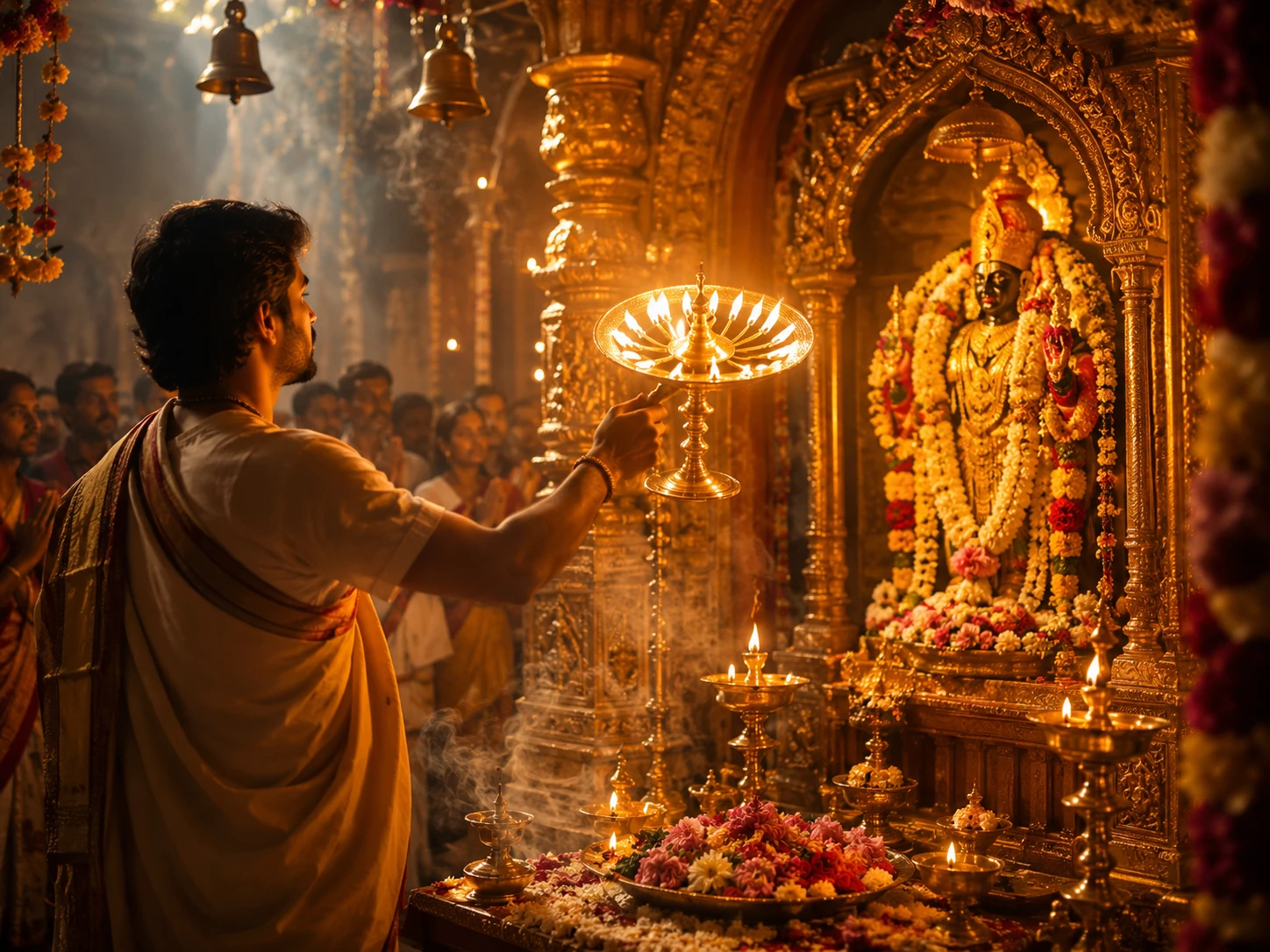
Step 10: Receive Aarti, Tirtha, and Prasad. After the priest performs aarti, cup your hands over the flame and touch your eyes and forehead. Accept tirtha (sacred water) in the right palm -- sip it, then touch the remainder to your head. This tirtha has been used for the deity's abhishekam and is charged with mantra-recitation. Accept prasad (blessed food) with the right hand or both hands together -- never the left hand alone. The prasad could be anything: the iconic Tirupati laddoo, the Puri Jagannath Mahaprasad, a banana and sugar at a local temple, or sacred ash (vibhuti) at a Shiva temple.
Step 11: Final Pradakshina and Departure. Walk around the garbhagriha one final time. Bow at the exit. As you leave the temple, walk out without turning your back to the deity -- side-step or walk backward for the first few steps. The departure is as important as the arrival. The temple experience does not end at the threshold -- it is meant to accompany you into the world.
Temple Darshan Sequence -- The Complete Walkthrough
| Step | Action | Location | Why It Matters |
|---|---|---|---|
| 1 | Pause and set intention | Temple entrance (gopuram) | Psychological transition from worldly to sacred |
| 2 | Remove shoes | Before temple boundary | Surrender worldly attachments; hygiene |
| 3 | Wash hands, feet, mouth | Water facility / pushkarini | External purification signals internal readiness |
| 4 | Ring the bell | Entrance or inner doorway | Announce arrival; clear mental chatter |
| 5 | Worship Ganesha | Ganesha shrine near entrance | Remove obstacles before main worship |
| 6 | Prostrate at dhvajastambha | Courtyard flagpole / balipitha | Deposit worldly concerns; full surrender |
| 7 | Honour the vahana | Before main sanctum (Nandi/Garuda) | Respect the deity's companion-gatekeeper |
| 8 | Pradakshina (3 rounds) | Around the garbhagriha | Place divine at centre; shed negativity |
| 9 | Darshan -- eye contact with deity | Garbhagriha entrance | The core act -- reciprocal seeing |
| 10 | Receive aarti, tirtha, prasad | From priest at sanctum | Accept divine blessings into body |
| 11 | Final pradakshina and exit | Around sanctum; then temple exit | Carry the experience into the world |
This sequence applies to most South and North Indian temples. Jain, Buddhist, and Sikh gurudwara protocols differ significantly. Always observe the specific temple's posted guidelines.
The Tirupati Balaji Temple (Tirumala) processes approximately 60,000-100,000 devotees daily, making it the most visited religious site on Earth by daily footfall. The temple's prasad kitchen produces over 100,000 laddoos per day using 10,000 kilograms of ingredients. The hundi (donation box) receives Rs 3-5 crore daily. The entire operation -- queue management, darshan scheduling, prasad production, accommodation -- is run by the Tirumala Tirupati Devasthanams (TTD) board with the operational sophistication of a Fortune 500 company. Meanwhile, the oldest continuously functioning temple in India is debated -- contenders include the Mundeshwari Temple in Bihar (dated to the 1st century CE), the Sanchi Temples in Madhya Pradesh, and the Lad Khan Temple in Aihole, Karnataka. The tradition of temple worship in India is at least 2,000 years old and shows no sign of slowing.
Plan Your Temple Visit with Eternal Raga
Eternal Raga's temple guides cover each temple's history, presiding deity and traditions. Read the guide for the temple you plan to visit before you go, so you arrive knowing whom you are meeting.
Tags
Eternal Raga · शाश्वत राग
Institutional voice — scholarly articles on Sanatan Dharma
Deepen Your Understanding
अपनी समझ और गहरी करें
rituals traditions
Shodashopachara Puja -- The Sixteen-Step Protocol of Hindu Worship
When a Hindu temple priest performs puja, he is not improvising. He is executing a precise sixteen-step protocol called Shodashopachara -- literally 'sixteen offerings' -- that treats God as a royal guest arriving at your home. From invitation to farewell, each step has a specific action, material, mantra, and philosophical meaning. This is the complete user manual.
rituals traditions
Aarti -- Why Hindus Circle Light Before God
Every evening, millions of flames are circled before millions of deities across India. The aarti is the single most recognisable act of Hindu worship -- yet most people performing it cannot explain why the light moves clockwise, why camphor is preferred, or why the flame is touched to the eyes afterward. The answer is older than temples, deeper than devotion, and more scientific than you would expect.
rituals traditions
Why Bells, Lamps, and Flowers -- The Sensory Engineering Behind Hindu Worship
Hindu worship is not random. Every bell, every lamp, every flower, every stick of incense, every drop of water addresses a specific sense, invokes a specific element, and produces a specific psychological effect. The puja is a sensory design system -- a five-element, five-sense immersive experience engineered three thousand years before UX designers existed. Here is the complete map.
rituals traditions
Puja at Home -- The Complete Beginner's Guide
You have a small mandir shelf in your apartment. A brass diya your mother gave you. A photo of a deity you feel drawn to. And absolutely no idea what to do next. This guide is for you -- the 22-year-old in Pune who just moved out, the NRI in New Jersey setting up a puja corner for the first time, the curious soul who wants to start but does not know where.
rituals traditions
The 16 Samskaras -- Rites of Passage from Womb to Pyre
Hinduism does not leave life to chance. From the moment a couple decides to conceive to the moment the body returns to the five elements, there are sixteen rituals -- samskaras -- designed to refine the human being at every critical transition. Think of them as firmware updates for the soul, installed at precisely the right moments.
rituals traditions
Havan Vidhi -- The Vedic Fire Ritual That Purifies Air, Mind, and Karma
Every major Hindu milestone -- birth, thread ceremony, wedding, housewarming, death -- involves fire. The havan is the oldest continuous ritual technology in Hinduism, dating to the Rig Veda. You pour ghee, herbs, and grains into a consecrated fire while chanting 'Svaha,' and Agni carries your offering to the gods. Modern science confirms: the smoke actually does purify the air. Here is the complete procedure.
The Tirupati Balaji Temple (Tirumala) processes approximately 60,000-100,000 devotees daily, making it the most visited religious site on Earth by daily footfall. The temple's prasad kitchen produces over 100,000 laddoos…
More in Rituals & Traditions
Aarti -- Why Hindus Circle Light Before God
13 min read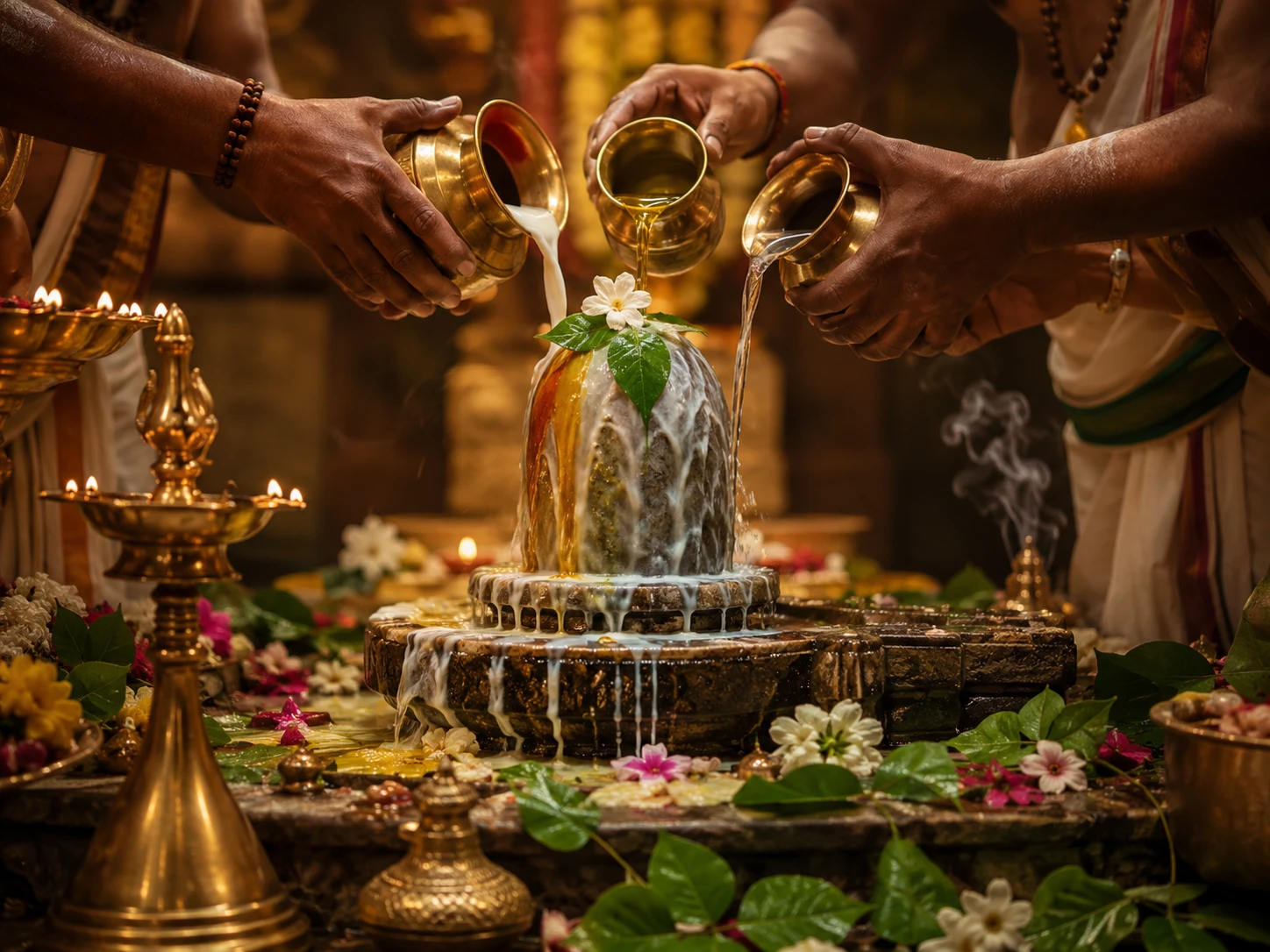
Abhisheka -- Why Hindus Bathe Their Gods
10 min read
Akshaya Tritiya -- The Day Nothing Given Away Runs Out
12 min readThe same translation error that turned '33 Koti' into '33 crore' in Hinduism also happened in Buddhism. The Chinese translation of Buddhist texts rendered 'Sapta Koti Buddha' (7 Supreme Buddhas) as '7 Crore Buddhas.' The…
Deities AvatarsCommunity Reflections
🕉️
Be the first to share your reflection.