Puja at Home -- The Complete Beginner's Guide
घर पर पूजा -- सम्पूर्ण शुरुआती गाइड
Let us get something out of the way first: there is no wrong way to start. If you lit a diya and said a quiet 'thank you' to the universe this morning, you did puja. If you placed a flower before a photo of your grandmother and sat in silence for two minutes, you did puja. The elaborate sixteen-step Shodashopachara Puja with Sanskrit mantras and panchamrit abhishekam is beautiful and powerful -- but it is not a prerequisite for connecting with the divine. It is a destination. This article is the road.
Puja (from the Sanskrit root 'puj', meaning to honour, to worship) is the central act of personal devotion in Hinduism. Unlike the Vedic yajna (fire sacrifice), which requires a trained priest, specific altar geometry, and public participation, puja can be performed by anyone, anywhere, with whatever is available. It is democratic, intimate, and endlessly adaptable. A billionaire's puja room in a South Mumbai penthouse and a migrant worker's single incense stick before a torn calendar print of Hanuman serve the same function: creating a moment of conscious connection between the finite self and the infinite.
The roots of puja are debated among scholars. The Vedic literature emphasises yajna over idol worship. Puja as we know it -- with murtis, flowers, lamps, and food offerings -- likely developed during the Agamic and Puranic periods (roughly 5th century CE onward), absorbing elements from Dravidian, tribal, and Bhakti traditions. The Pancharatra Agamas and Shaiva Agamas codified temple puja into elaborate systems. But home puja has always been simpler, more personal, and more flexible.
This guide covers four things: what you need, where to set up, the basic steps, and how to build a sustainable daily practice. No prior knowledge required. No judgement if you have never done this before. Ganesha removes obstacles, including the obstacle of not knowing where to start.
पत्रं पुष्पं फलं तोयं यो मे भक्त्या प्रयच्छति। तदहं भक्त्युपहृतमश्नामि प्रयतात्मनः॥
patraṃ puṣpaṃ phalaṃ toyaṃ yo me bhaktyā prayacchati | tadahaṃ bhaktyupahṛtam aśnāmi prayatātmanaḥ ||
Whoever offers Me a leaf, a flower, a fruit, or water with devotion -- I accept that offering of love from the pure-hearted.
— Bhagavad Gita, Chapter 9, Verse 26
What You Need -- The Puja Essentials Kit
Here is the minimum viable puja setup. You can start with just the first five items and add the rest over time.
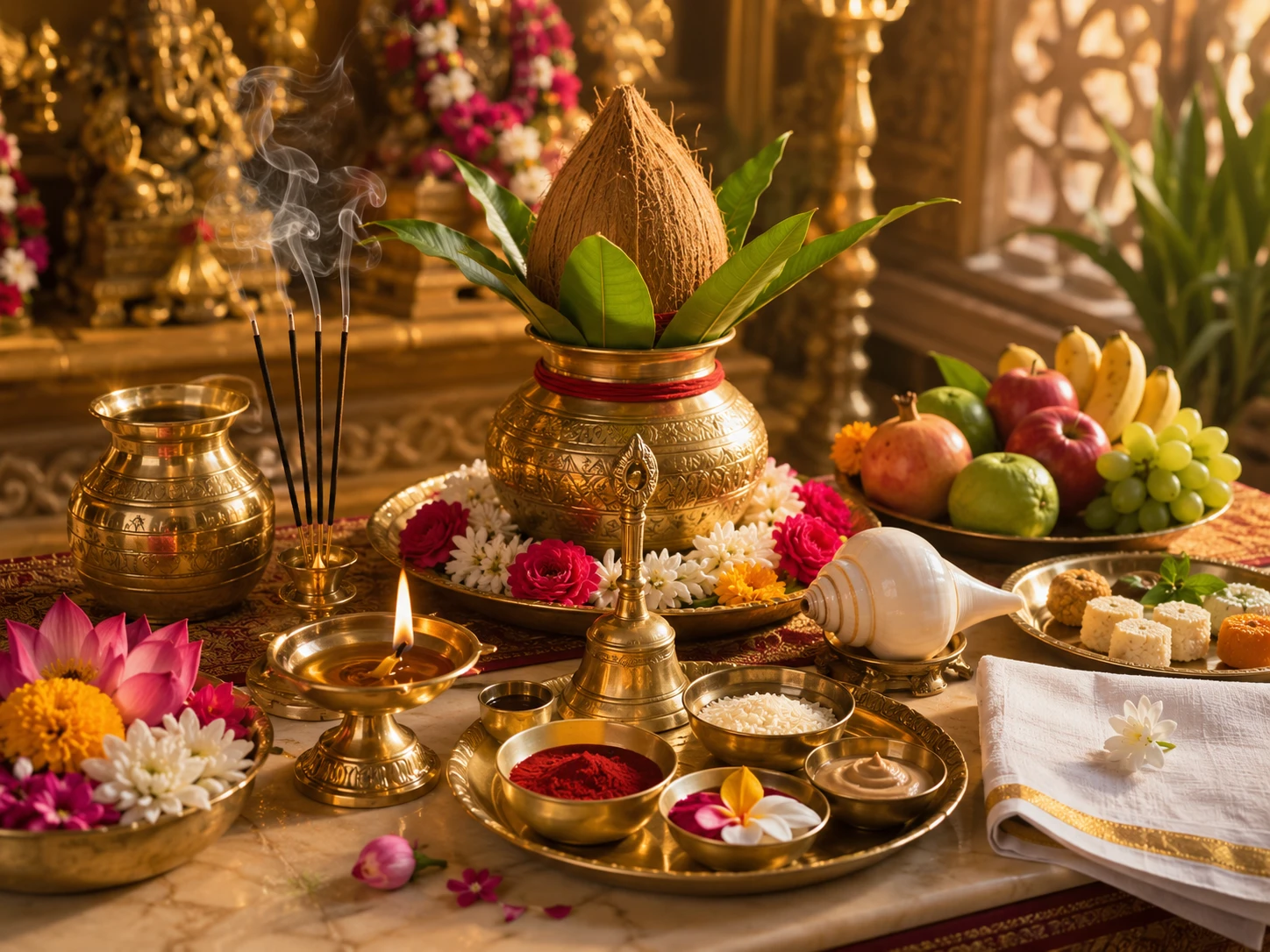
1. A clean, dedicated space. This can be a shelf, a small table, a wall-mounted mandir, or even a windowsill. The key is that it is only for puja -- not shared with keys, wallets, or laptop chargers. In Indian tradition, the northeast corner (Ishanya) of the home is considered ideal, but any clean, quiet spot works.
2. A deity image or murti. This can be a brass or stone murti, a framed photo, or even a printout. Choose a deity you feel naturally drawn to -- Krishna, Shiva, Durga, Ganesha, Hanuman, Lakshmi, Saraswati. There is no wrong choice. If you are unsure, start with Ganesha -- he is traditionally invoked before all beginnings.
3. A diya (oil lamp) or candle. The lit flame represents consciousness, knowledge, and the dispelling of ignorance. Traditionally, a brass or clay diya with sesame oil or ghee is used. A candle works too.
4. Incense (agarbatti) or dhoop. The fragrance purifies the space and signals to your mind that puja time has begun. Sandalwood, jasmine, and rose are traditional choices.
5. Fresh flowers or leaves. Even a single marigold, tulsi leaf, or rose petal is sufficient. The Bhagavad Gita (9.26) explicitly says: a leaf, a flower, a fruit, or water offered with devotion is enough.
Additional items as you grow: kumkum (vermilion), haldi (turmeric), akshat (unbroken rice), a small bell (ghanti), a copper or brass lota (water vessel), a plate for offerings (naivedya), and a conch shell (shankh) for blowing before or after puja.
For NRI families in the US, UK, or Middle East: Indian grocery stores (Patel Brothers, Swagat, Lulu) stock puja kits. Amazon and Etsy have curated puja starter sets. If nothing is available, remember the Gita verse: a leaf and water offered with love is accepted by the divine.
Puja Complexity Levels -- Start Where You Are
| Level | Name | Time | Items Needed | Steps | Best For |
|---|---|---|---|---|---|
| 1 | Diya + Silence | 2-3 min | Diya or candle, match | Light diya, sit in silence, express gratitude mentally | Absolute beginners; anyone short on time; daily minimum |
| 2 | Panchopachara (5-step) | 5-7 min | Diya, incense, flower, water, naivedya (fruit/sweet) | Light diya, offer incense, flower, water, food; close with namaskara | Regular daily practice; working professionals |
| 3 | Dasopachara (10-step) | 10-15 min | Above + bell, kumkum, haldi, akshat, dhoop | Adds aavahana (invocation), asana, arghya, snana, vastra | Weekend practice; festival days |
| 4 | Shodashopachara (16-step) | 20-45 min | Full puja thali + panchamrit, abhishekam items | Complete 16-step worship with mantras, abhishekam, aarti, pushpanjali | Festivals; special occasions; advanced devotees |
| 5 | Elaborate Festival Puja | 1-3 hours | Full setup + havan kund, specific samagri | Includes Sankalpa, Kalash Sthapana, Havan, Purnahuti | Navratri, Ganesh Chaturthi, Griha Pravesh |
Level 1 done daily with sincerity is more powerful than Level 5 done once with distraction. Consistency trumps complexity.
The Basic Five-Step Puja (Panchopachara) -- Your Daily Practice
This is the puja format most Indian households actually use daily. It takes five to seven minutes and requires only five offerings. Each step has a Sanskrit name and a symbolic meaning.
Step 1: Gandha (Fragrance). Light incense or dhoop. Wave it gently before the deity. The fragrance purifies the air and your mind. Symbolically, you are offering the element of Earth (prithvi tattva) in its most refined form.
Step 2: Pushpa (Flower). Place a fresh flower or leaf at the feet of the deity. This represents the element of Space (akasha tattva) -- the openness of your heart. If no fresh flower is available, a tulsi leaf or even a mentally offered flower (manasa pushpa) is accepted.
Step 3: Dipa (Light). Light the diya. The flame represents the element of Fire (agni tattva) and symbolises knowledge, consciousness, and the dispelling of inner darkness. Circle the flame clockwise before the deity.
Step 4: Naivedya (Food offering). Place a small portion of fruit, mithai, or cooked food before the deity. This represents the element of Water (jala tattva) -- sustenance, nurture. The food becomes prasad after it is offered and is then consumed by the family.
Step 5: Dhupa (or Namaskara to close). Offer a final namaskara (bow with folded hands). Some traditions replace this with a second dhoop offering. The namaskara represents the element of Air (vayu tattva) -- the breath of surrender.
That is it. Five steps, five elements, five minutes. You have just performed a puja that is structurally identical to what a priest does in a temple -- the difference is only in scale, not in spiritual validity.
Building a Daily Habit
The single biggest barrier to daily puja is not lack of knowledge or items. It is the belief that puja must be done 'properly' or not at all. This perfectionism trap kills more spiritual practices than laziness ever could.
Start with Level 1 (diya + silence) for the first week. Do it at the same time every day -- ideally morning, but evening works too. After a week, add incense. After two weeks, add a flower. By the end of the month, you will be doing a natural Panchopachara without having to think about it.
The best time for puja is the Brahma Muhurta (approximately 4:00 to 5:30 AM) or at sunrise. But if you are a software engineer who gets home from Koramangala at 10 PM, doing a two-minute diya-and-silence puja at 10:15 PM is infinitely better than skipping because you missed the 'ideal' time. The divine does not check timestamps.
The bell (ghanti) rung during puja is not decorative. Its sound frequency (typically between 3,000 and 8,000 Hz) is designed to clear the space of ambient noise and centre the worshipper's attention. Studies at IIT Madras and IIT Bombay have measured the acoustic properties of traditional temple bells and found that the sustained resonance activates both hemispheres of the brain, producing a brief state of heightened alertness followed by calm. The ancient Agama texts prescribe specific alloys (pancha-loha, a five-metal blend of copper, zinc, tin, iron, and gold or silver) for bell-making -- the metallurgy is as intentional as the ritual.
Start Your Daily Puja with Eternal Raga
Light your diya and sing a morning aarti -- the words and meaning of many aartis are in the Eternal Raga mantra library. Follow it with five minutes of japa on a mala. Make it a habit before your first chai.
Tags
Eternal Raga · शाश्वत राग
Institutional voice — scholarly articles on Sanatan Dharma
Deepen Your Understanding
अपनी समझ और गहरी करें
rituals traditions
The 16 Samskaras -- Rites of Passage from Womb to Pyre
Hinduism does not leave life to chance. From the moment a couple decides to conceive to the moment the body returns to the five elements, there are sixteen rituals -- samskaras -- designed to refine the human being at every critical transition. Think of them as firmware updates for the soul, installed at precisely the right moments.
rituals traditions
Shodashopachara Puja -- The Sixteen-Step Protocol of Hindu Worship
When a Hindu temple priest performs puja, he is not improvising. He is executing a precise sixteen-step protocol called Shodashopachara -- literally 'sixteen offerings' -- that treats God as a royal guest arriving at your home. From invitation to farewell, each step has a specific action, material, mantra, and philosophical meaning. This is the complete user manual.
rituals traditions
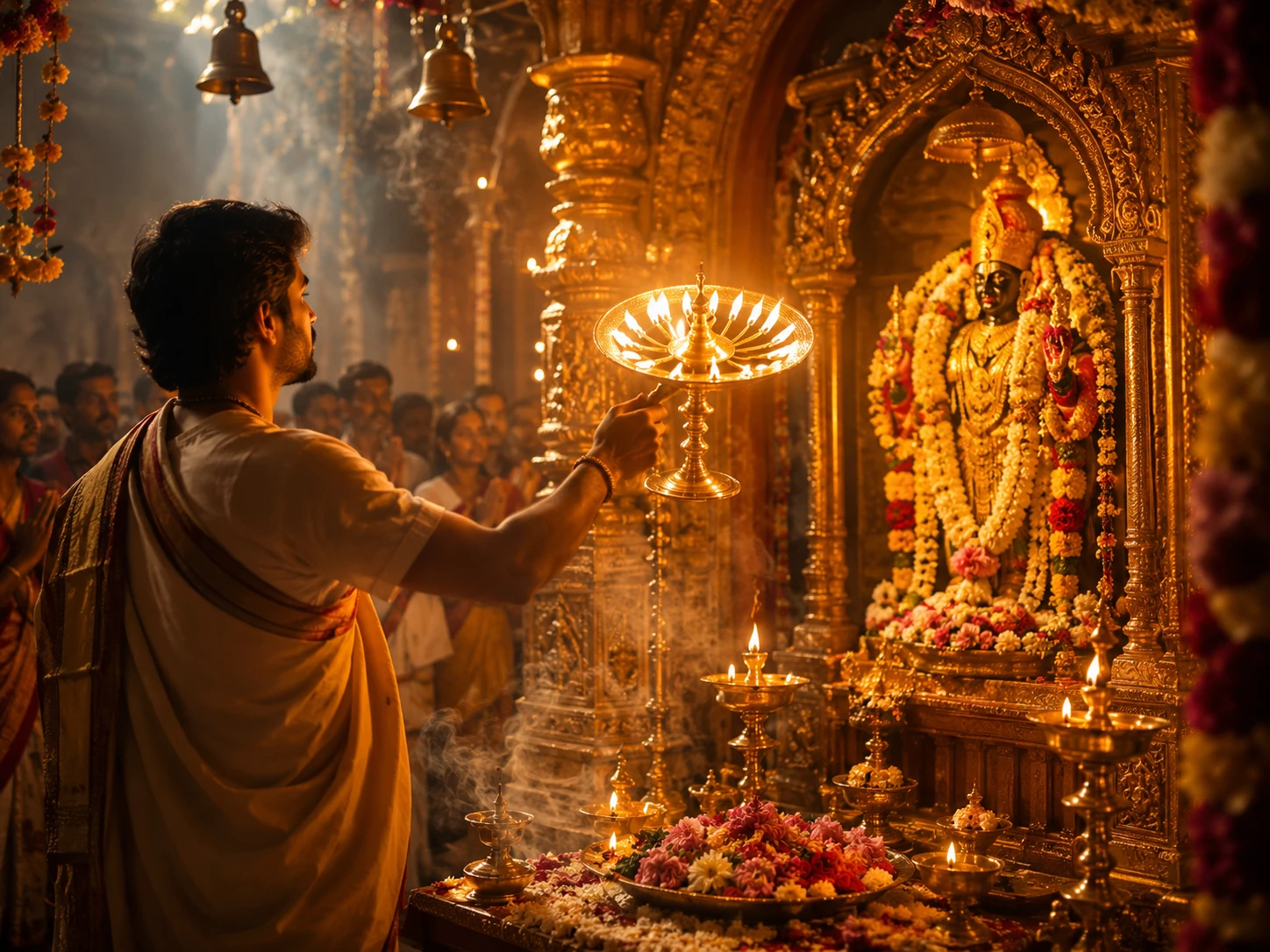
Aarti -- Why Hindus Circle Light Before God
Every evening, millions of flames are circled before millions of deities across India. The aarti is the single most recognisable act of Hindu worship -- yet most people performing it cannot explain why the light moves clockwise, why camphor is preferred, or why the flame is touched to the eyes afterward. The answer is older than temples, deeper than devotion, and more scientific than you would expect.
rituals traditions
Havan Vidhi -- The Vedic Fire Ritual That Purifies Air, Mind, and Karma
Every major Hindu milestone -- birth, thread ceremony, wedding, housewarming, death -- involves fire. The havan is the oldest continuous ritual technology in Hinduism, dating to the Rig Veda. You pour ghee, herbs, and grains into a consecrated fire while chanting 'Svaha,' and Agni carries your offering to the gods. Modern science confirms: the smoke actually does purify the air. Here is the complete procedure.
rituals traditions
Sandhyavandana -- The Daily Vedic Practice That Even Rama and Krishna Never Skipped
Three times a day, at the junction of night and day, morning and afternoon, afternoon and night, the twice-born Hindu is commanded to stop everything and perform Sandhyavandana. It combines pranayama, the Gayatri Mantra, water offerings, and meditation into a single twenty-minute ritual. The Ramayana shows Rama doing it in the forest. The Mahabharata shows Krishna doing it before battle. And somewhere in India right now, an IIT student is doing it in his hostel room.
rituals traditions
Why Bells, Lamps, and Flowers -- The Sensory Engineering Behind Hindu Worship
Hindu worship is not random. Every bell, every lamp, every flower, every stick of incense, every drop of water addresses a specific sense, invokes a specific element, and produces a specific psychological effect. The puja is a sensory design system -- a five-element, five-sense immersive experience engineered three thousand years before UX designers existed. Here is the complete map.
The bell (ghanti) rung during puja is not decorative. Its sound frequency (typically between 3,000 and 8,000 Hz) is designed to clear the space of ambient noise and centre the worshipper's attention. Studies at IIT Madra…
More in Rituals & Traditions
Aarti -- Why Hindus Circle Light Before God
13 min read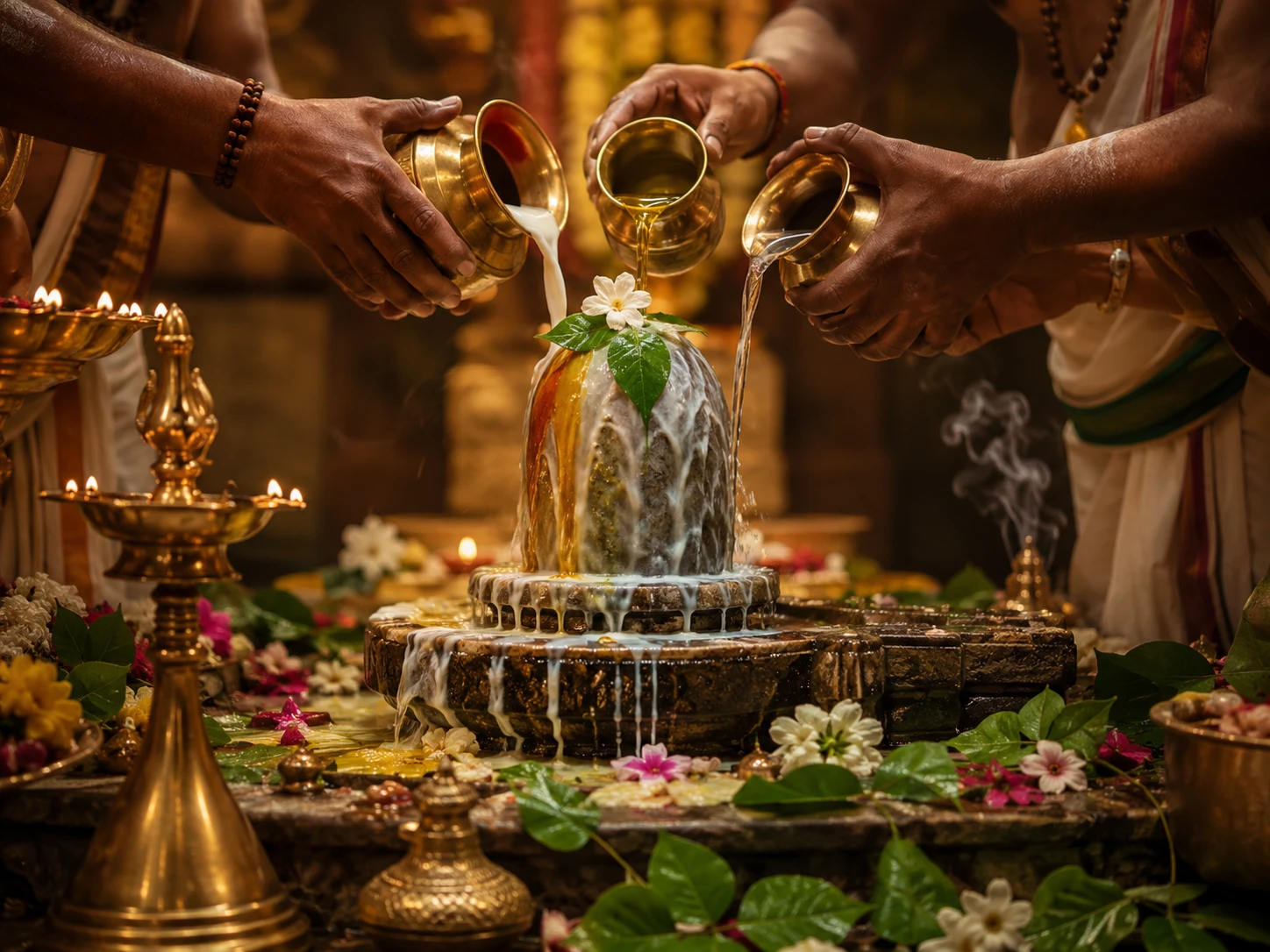
Abhisheka -- Why Hindus Bathe Their Gods
10 min read
Akshaya Tritiya -- The Day Nothing Given Away Runs Out
12 min readThe same translation error that turned '33 Koti' into '33 crore' in Hinduism also happened in Buddhism. The Chinese translation of Buddhist texts rendered 'Sapta Koti Buddha' (7 Supreme Buddhas) as '7 Crore Buddhas.' The…
Deities AvatarsCommunity Reflections
🕉️
Be the first to share your reflection.