Why Bells, Lamps, and Flowers -- The Sensory Engineering Behind Hindu Worship
घण्टी, दीप, और फूल क्यों -- हिन्दू पूजा के पीछे संवेदी इंजीनियरिंग
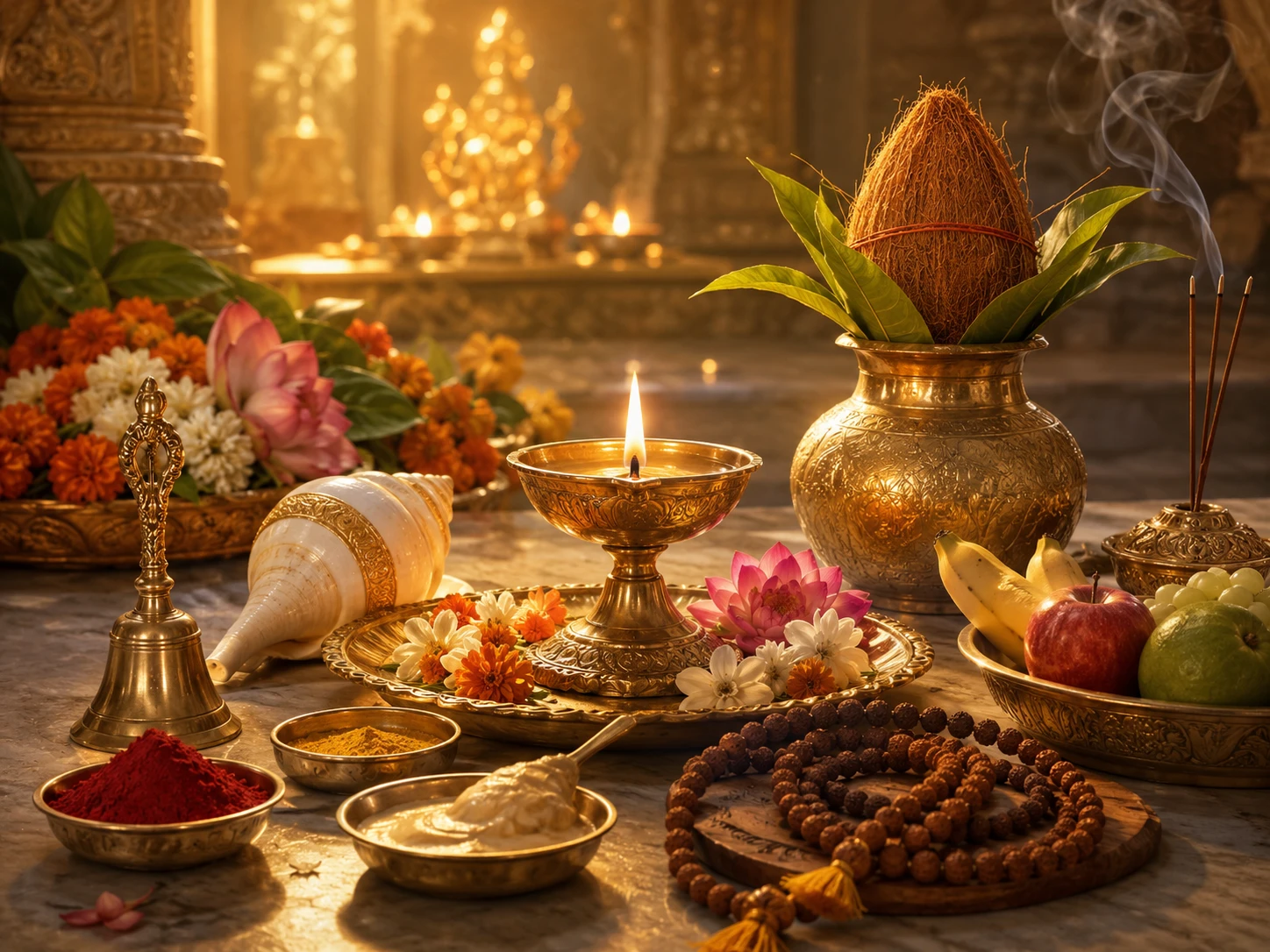
Walk into a Hindu temple or a well-maintained home mandir during puja and count what your senses encounter. Your ears hear the bell and the conch and the chanting. Your eyes see the flame of the diya and the colours of flowers and the form of the deity. Your nose catches the incense and the camphor and the sandalwood. Your tongue receives prasad. Your skin feels the warmth of the flame during aarti and the coolness of tirtha water on your forehead. In under five minutes, every single sensory channel in the human nervous system has been activated.
This is not accidental. Hindu worship is a deliberately engineered sensory immersion system. The Agama Shastras -- the temple worship manuals that govern ritual procedure across South and North Indian traditions -- specify not just which items to use but in what sequence, at what distance, with what mantras, and for what duration. The combination of bell (sound), lamp (sight), incense (smell), prasad (taste), and tilak/water (touch) is not a folk tradition that evolved randomly. It is a designed protocol that maps precisely onto the Pancha Bhuta (five elements) and the Pancha Indriya (five senses).
Modern sensory science calls this 'multisensory integration' -- the principle that engaging multiple senses simultaneously produces deeper cognitive processing, stronger memory formation, and more profound emotional response than engaging any single sense alone. Hindu worship discovered this principle empirically, encoded it in the Agamas, and has been deploying it at scale across tens of thousands of temples and hundreds of millions of homes for millennia.
The Shilpa Shastras specify that a temple bell should be made from Panchadhatu -- five metals representing the five elements: copper (Venus/Shukra), silver (Moon/Chandra), gold (Sun/Surya), zinc (Jupiter/Guru), and iron (Saturn/Shani). These are not arbitrary choices. The specific alloy determines the bell's resonance profile -- its frequency, duration, and overtone structure. A well-crafted temple bell produces a sustained tone lasting seven seconds or more, generating frequencies that IIT Madras acoustic studies have confirmed activate both alertness (beta waves) and calm (alpha waves) in the brain simultaneously. The Agama Shastra prescribes ringing the bell with the mantra: 'Aagamaartham tu devaanaam, gamanaartham tu rakshasaam, kurve ghantaaravam tatra, devataahvaana lanchanam' -- I ring this bell to invoke the arrival of the divine and the departure of the demonic.
आगमार्थं तु देवानां गमनार्थं तु रक्षसाम्। कुर्वे घण्टारवं तत्र देवताह्वानलाञ्छनम्॥
āgamārthaṃ tu devānāṃ gamanārthaṃ tu rakṣasām | kurve ghaṇṭāravaṃ tatra devatāhvānalāñchanam ||
I ring this bell indicating the invocation of divinity, so that virtuous and noble forces enter, and the demonic and evil forces from within and without depart.
— Agama Shastra (recited while ringing the bell before puja across Hindu traditions)
The Bell (Ghanta) addresses sound -- Akash tattva (ether/space element). In Sanskrit, the bell is called Ghanta, and the sound it produces is called Ghanta Naad. The Skanda Purana states that ringing a temple bell absolves sins committed over a hundred births. Symbolically, the bell's body represents Ananta (infinity/time), its tongue represents Saraswati (knowledge), and its handle represents Prana Shakti (life force), linked to Hanuman, Garuda, or Nandi depending on the deity tradition. The bell is classified in Sanskrit literature into types: Kansyaghanta, Tala, Ghatika, Jayaghantika, Kshudraghanta, and Krama. Each type serves a different ritual function. The bell is not optional decoration -- it is the first act of worship, the instrument that opens the channel between human and divine.
The Conch (Shankha) is the bell's cosmic counterpart. Its deep, resonant blast represents the primordial sound Om -- Nada Brahma, the vibration from which the universe emerged. The conch is blown during aarti, abhishekam, and at the commencement of major rituals. Its sound is said to purify the atmosphere within a specific radius. The Panchjanya shankha of Vishnu and the conch sounds in the opening chapter of the Bhagavad Gita (Arjuna's Devadatta, Bhima's Paundra, Yudhishthira's Anantavijaya) establish the shankha as both a ritual instrument and a cosmic weapon.
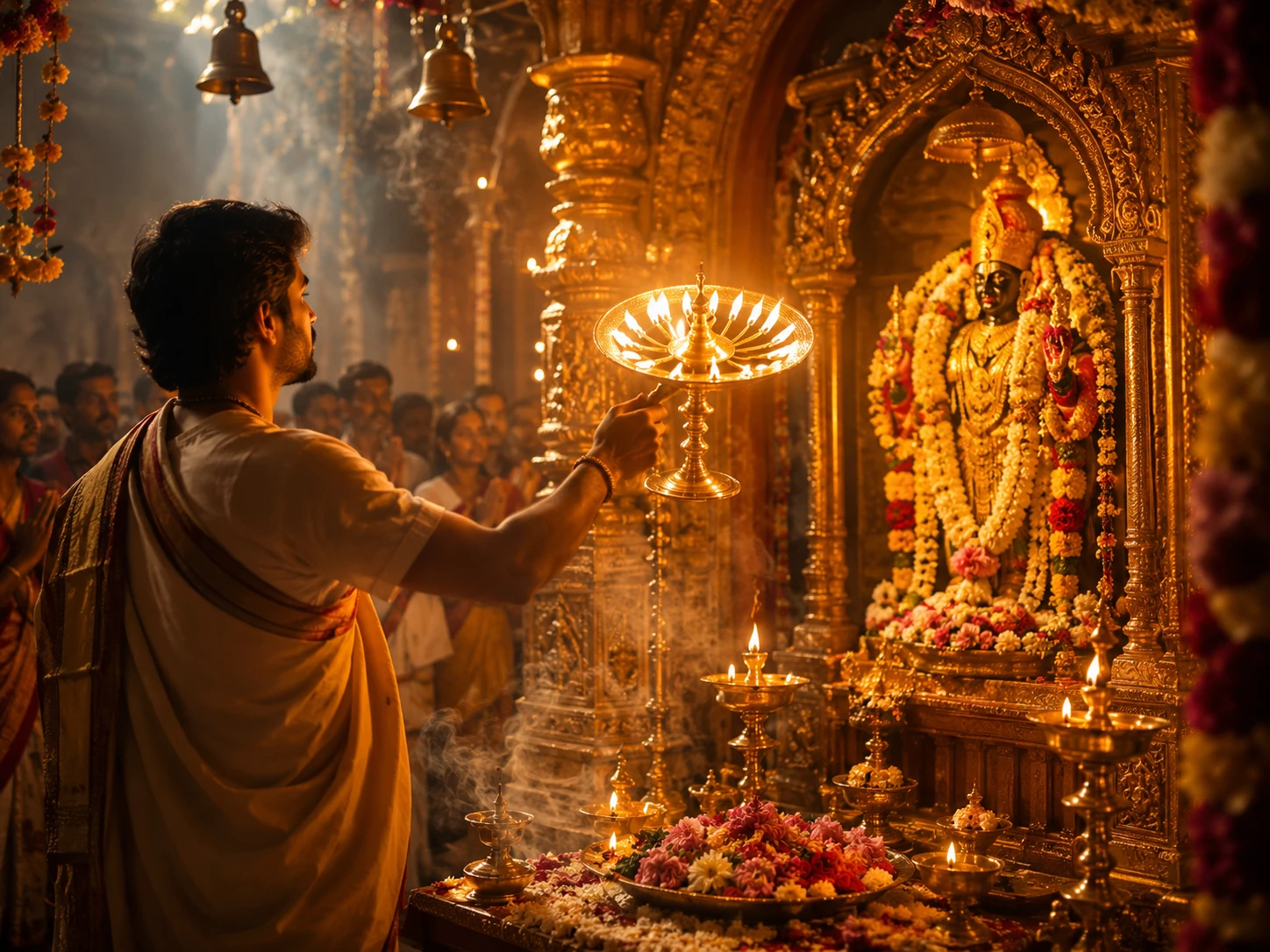
The Lamp (Deepa/Diya) addresses sight -- Agni tattva (fire element). The lamp is the non-negotiable centrepiece of Hindu worship. The Mundaka Upanishad describes Brahman as 'jyotisham jyotih' -- the light of lights. The diya is its physical echo. Ghee lamps are preferred in most North Indian traditions for their sattvic quality; sesame oil lamps are standard in South Indian temples. The five-wick lamp (pancha pradeep) used during elaborate aartis represents the five elements offered to the divine. The lamp serves a practical function too -- in ancient dark garbhagrihas, the deepam was the only way devotees could see the deity's face. The entire practice of aarti evolved from this practical necessity of illumination.
Flowers (Pushpa) address sight and smell -- Prithvi and Akash tattva. Flowers are perhaps the oldest worship offering in human history. The etymological theory that 'puja' itself derives from the Dravidian 'pu' (flower) + 'cey' (to do) suggests that flowers preceded fire as the primary worship medium. Specific flowers carry specific meanings: lotus (padma) for Lakshmi and Saraswati, bilva leaves for Shiva, tulasi for Vishnu, red hibiscus (jaba) for Devi and Kali, white flowers for funeral rites, marigold (genda) for general auspiciousness. Offering a prohibited flower to a deity is a ritual error -- hibiscus for Vishnu or tulasi for Shiva are avoided in most traditions.
The flower economy of Hindu worship is massive. India produces over 2.3 million tonnes of flowers annually, with a significant proportion consumed by temples and domestic worship. The jasmine farms of Tamil Nadu, the marigold fields of Karnataka, the tuberose cultivation in West Bengal, and the rose gardens of Pushkar are all direct economic derivatives of puja demand.
Incense (Dhoop/Agarbatti) addresses smell -- Vayu tattva (air element). Fragrant smoke rising upward is the universal metaphor for human aspiration reaching the divine. The specific ingredients matter: guggul (bdellium resin), loban (frankincense), sandalwood, camphor, and various dried herbs are the traditional components. The CSIR-National Botanical Research Institute's study on havan smoke demonstrated measurable antimicrobial effects -- a 94 percent reduction in airborne bacteria within one hour. Commercial agarbatti has evolved significantly from its traditional origins, with Mysuru (Mysore) remaining India's incense manufacturing capital. The bambooless dhoop (masala-style incense without a bamboo core) is gaining popularity as a cleaner-burning alternative.
Water (Jal) addresses touch and taste -- Jal tattva. Water appears in nearly every step of Hindu worship: Achamana (ritual sipping), Marjana (sprinkling), Arghya (offering to the sun), Abhishekam (bathing the deity), and Tirtha (sacred water distributed to devotees). Ganga Jal is the premium standard. The Panchamrit abhishekam uses five liquids: milk, curd, honey, sugar, and ghee -- each with specific Ayurvedic properties. The water that has been used for the deity's abhishekam becomes tirtha -- charged with mantra-vibration and divine contact -- and is distributed to devotees who sip it and touch it to their foreheads.
Prasad addresses taste -- Prithvi tattva. The offering of food (naivedya) to the deity and its subsequent distribution as prasad (blessed food) is one of the most sophisticated social distribution systems ever devised. Major temples operate industrial-scale kitchens: Tirupati produces over 100,000 laddoos daily, Puri's Jagannath Mahaprasad feeds thousands, Shirdi distributes udi (sacred ash) to millions annually. Prasad is not merely symbolic -- it is a functional food distribution network that, for millennia, ensured that anyone visiting a temple received at least one meal, regardless of caste, class, or ability to pay.
Tilak (forehead mark) addresses touch -- Prithvi tattva at the Ajna Chakra. Kumkum, chandan, vibhuti, or gopichandan applied to the forehead marks the third-eye point and activates it through gentle pressure and the properties of the applied substance. Each sect has its mark: the U-shaped Urdhvapundra for Vaishnavas, the three horizontal lines (Tripundra) for Shaivas, the red kumkum dot for Devi worship, and vibhuti (sacred ash) for general Shaiva-Smarta traditions.
Together, these elements form a closed sensory loop. No sense is unaddressed. No element is unrepresented. The bell triggers auditory processing. The lamp and flowers trigger visual processing. The incense triggers olfactory processing. The prasad triggers gustatory processing. The water and tilak trigger tactile processing. And the mantras chanted throughout -- the Sanskrit verses that accompany every action -- trigger linguistic and semantic processing. The result is a total-brain activation event that modern neuroscience would recognise as a state of heightened consciousness. The rishis who designed this system did not have fMRI machines. They had something arguably more powerful: three thousand years of iterative empirical refinement.
The Five-Sense Worship Map -- Element, Sense, Item, and Function
| Element | Sense | Worship Item | Primary Function | Scientific/Practical Note |
|---|---|---|---|---|
| Akash (Ether) | Sound | Bell (Ghanta) + Conch (Shankha) | Invoke divine; dispel negativity; focus mind | Panchadhatu alloy resonance; 7-second sustained tone; alpha-beta wave activation |
| Agni (Fire) | Sight | Lamp (Diya) + Camphor (Kapur) | Illuminate deity; ego-dissolution (camphor) | Ghee = sattvic smoke; camphor = zero residue sublimation |
| Vayu (Air) | Smell | Incense (Agarbatti/Dhoop) | Purify atmosphere; create meditation ambiance | CSIR study: 94% airborne bacteria reduction in 1 hour |
| Jal (Water) | Touch/Taste | Water (Ganga Jal) + Panchamrit | Purification; abhishekam; tirtha distribution | Ganges bacteriophages studied; Namami Gange Rs 20K Cr mission |
| Prithvi (Earth) | Taste/Touch | Prasad + Flowers + Tilak (Kumkum) | Nourishment; beauty offering; Ajna Chakra activation | Turmeric-based kumkum; temple prasad = food distribution network |
The mapping is systematic but not rigid -- many items activate multiple senses simultaneously (e.g., camphor activates both sight and smell, flowers activate both sight and smell).
The symbolic anatomy of a Hindu temple bell is remarkably detailed: the curved body represents Ananta (infinity), the tongue/clapper represents Saraswati (goddess of knowledge), and the handle represents Prana Shakti (life force). Bells for Shiva worship have Nandi on the handle; bells for Vishnu worship have Garuda or Sudarshana Chakra. The Sanskrit literature classifies bells into six types: Kansyaghanta, Tala, Ghatika, Jayaghantika, Kshudraghanta, and Krama -- each serving a distinct ritual purpose. Meanwhile, India's flower industry for worship alone is estimated at over Rs 15,000 crore annually. The Dadar Phool Galli in Mumbai operates from 4 AM daily, supplying marigold, jasmine, rose, and lotus to temples and households across the city. During Ganesh Chaturthi, Mumbai's flower consumption spikes by an estimated 300 percent in a single week.
Offer a Full Five-Sense Puja
Engage all five senses: ring the bell (sound), light the lamp (sight), offer incense (smell), lay flowers at the deity's feet (touch), and receive prasad (taste). Sing an aarti as you wave the lamp; the words and meaning of many aartis are in Eternal Raga's mantra library.
Tags
Eternal Raga · शाश्वत राग
Institutional voice — scholarly articles on Sanatan Dharma
Deepen Your Understanding
अपनी समझ और गहरी करें
rituals traditions
Puja at Home -- The Complete Beginner's Guide
You have a small mandir shelf in your apartment. A brass diya your mother gave you. A photo of a deity you feel drawn to. And absolutely no idea what to do next. This guide is for you -- the 22-year-old in Pune who just moved out, the NRI in New Jersey setting up a puja corner for the first time, the curious soul who wants to start but does not know where.
rituals traditions
Shodashopachara Puja -- The Sixteen-Step Protocol of Hindu Worship
When a Hindu temple priest performs puja, he is not improvising. He is executing a precise sixteen-step protocol called Shodashopachara -- literally 'sixteen offerings' -- that treats God as a royal guest arriving at your home. From invitation to farewell, each step has a specific action, material, mantra, and philosophical meaning. This is the complete user manual.
rituals traditions
Aarti -- Why Hindus Circle Light Before God
Every evening, millions of flames are circled before millions of deities across India. The aarti is the single most recognisable act of Hindu worship -- yet most people performing it cannot explain why the light moves clockwise, why camphor is preferred, or why the flame is touched to the eyes afterward. The answer is older than temples, deeper than devotion, and more scientific than you would expect.
rituals traditions
Temple Darshan Etiquette -- The Complete Protocol for Visiting a Hindu Temple
Most Hindus visit temples. Few know the correct sequence. There is a reason you remove shoes before entering, ring the bell at the threshold, worship Ganesha first, walk clockwise around the sanctum, accept prasad in the right hand, and never point your feet at the deity. Every rule has a Vedic, architectural, or psychological rationale. This is the complete user guide to Hindu temple darshan.
rituals traditions
Havan Vidhi -- The Vedic Fire Ritual That Purifies Air, Mind, and Karma
Every major Hindu milestone -- birth, thread ceremony, wedding, housewarming, death -- involves fire. The havan is the oldest continuous ritual technology in Hinduism, dating to the Rig Veda. You pour ghee, herbs, and grains into a consecrated fire while chanting 'Svaha,' and Agni carries your offering to the gods. Modern science confirms: the smoke actually does purify the air. Here is the complete procedure.
rituals traditions
Sandhyavandana -- The Daily Vedic Practice That Even Rama and Krishna Never Skipped
Three times a day, at the junction of night and day, morning and afternoon, afternoon and night, the twice-born Hindu is commanded to stop everything and perform Sandhyavandana. It combines pranayama, the Gayatri Mantra, water offerings, and meditation into a single twenty-minute ritual. The Ramayana shows Rama doing it in the forest. The Mahabharata shows Krishna doing it before battle. And somewhere in India right now, an IIT student is doing it in his hostel room.
The symbolic anatomy of a Hindu temple bell is remarkably detailed: the curved body represents Ananta (infinity), the tongue/clapper represents Saraswati (goddess of knowledge), and the handle represents Prana Shakti (li…
More in Rituals & Traditions
Aarti -- Why Hindus Circle Light Before God
13 min read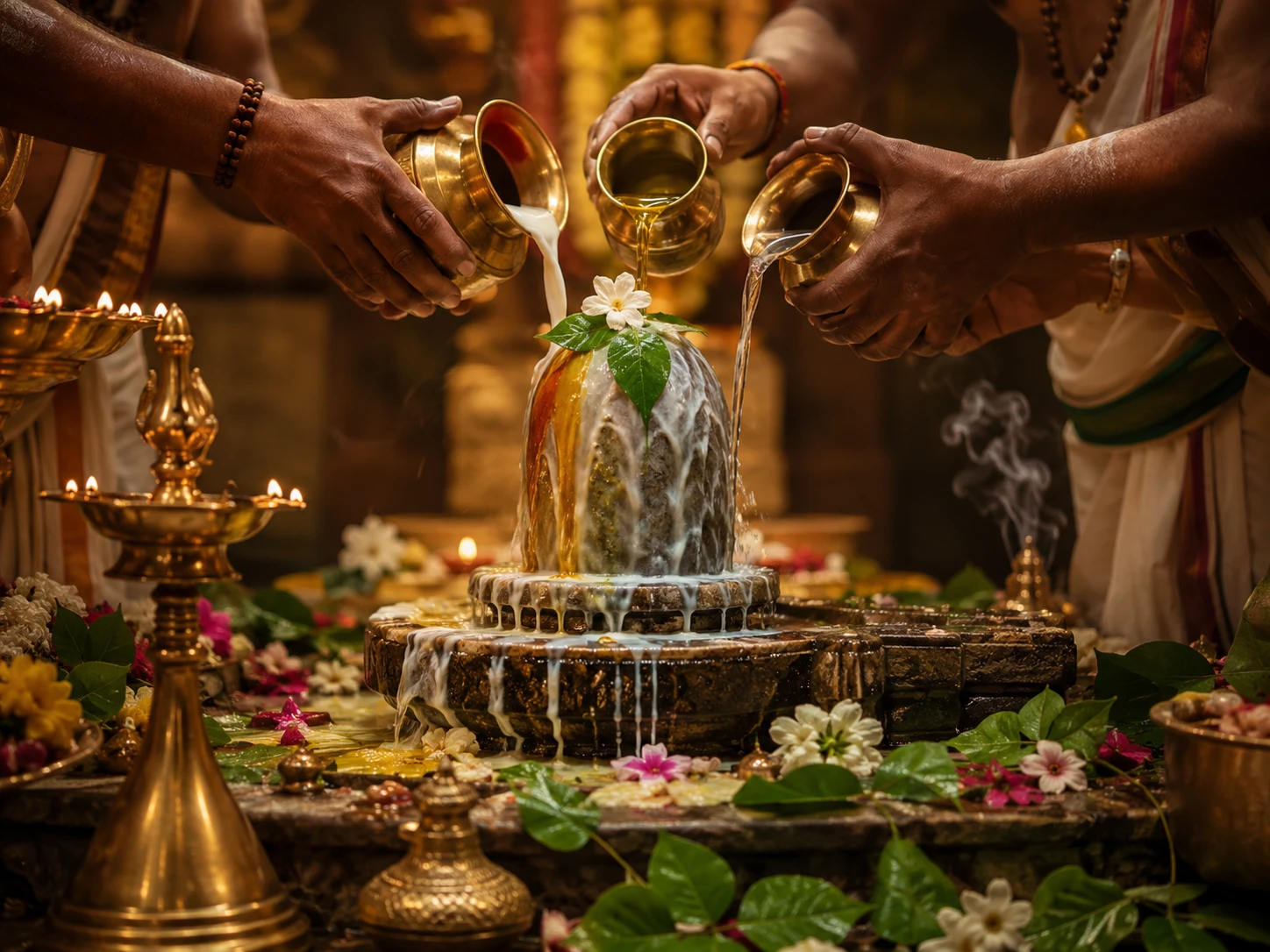
Abhisheka -- Why Hindus Bathe Their Gods
10 min read
Akshaya Tritiya -- The Day Nothing Given Away Runs Out
12 min readThe same translation error that turned '33 Koti' into '33 crore' in Hinduism also happened in Buddhism. The Chinese translation of Buddhist texts rendered 'Sapta Koti Buddha' (7 Supreme Buddhas) as '7 Crore Buddhas.' The…
Deities AvatarsCommunity Reflections
🕉️
Be the first to share your reflection.