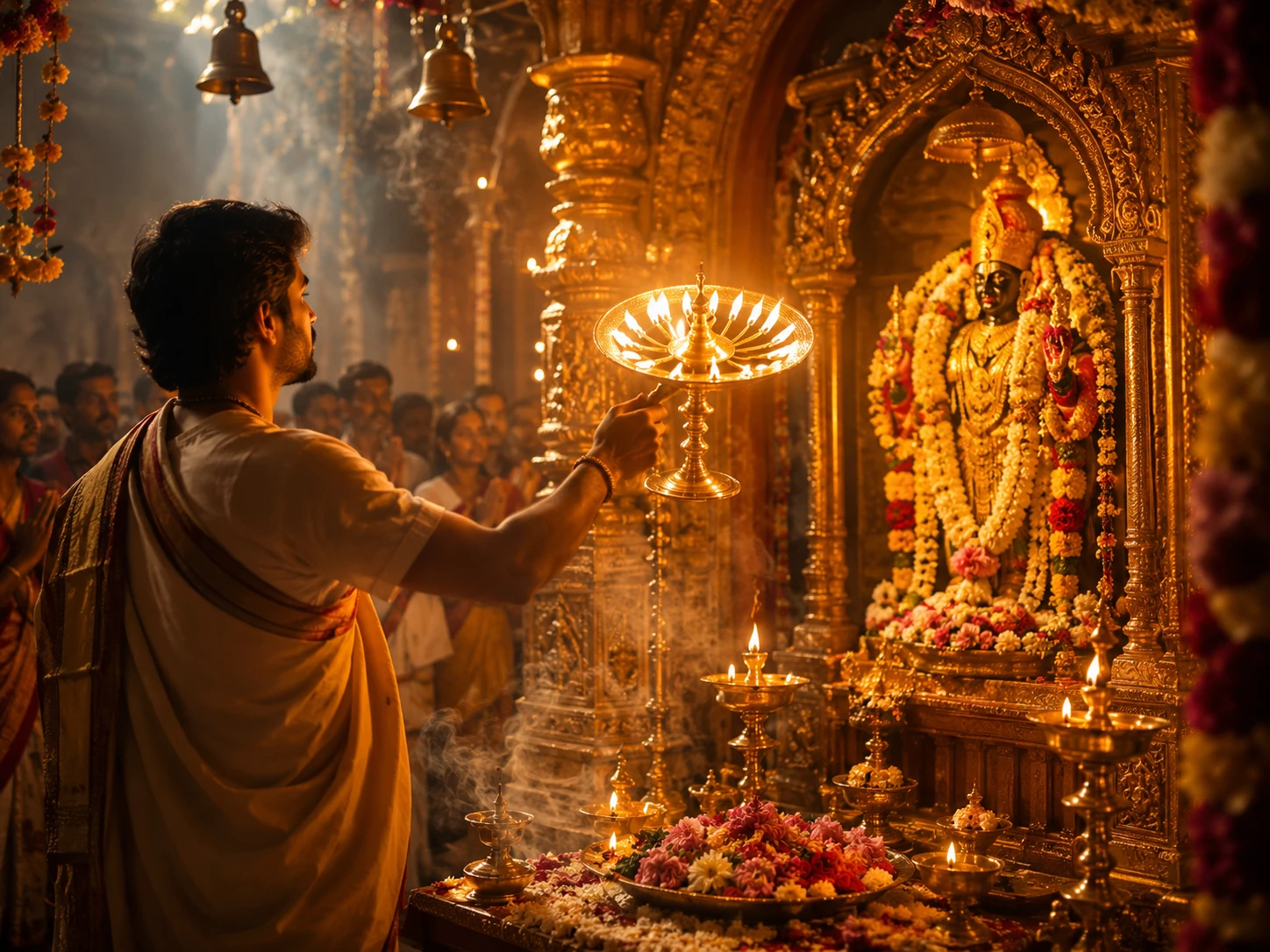
Aarti -- Why Hindus Circle Light Before God
आरती -- हिन्दू भगवान के सामने दीप क्यों घुमाते हैं
If you have ever been to Varanasi at dusk, you have seen it. If you have stood at the banks of the Ganges in Haridwar during evening prayer, you have felt it. If you have watched your mother, grandmother, or great-grandmother wave a small flame before the home mandir while singing 'Om Jai Jagdish Hare,' you know what aarti is even if you cannot define it.
Aarti is the ritual of waving light before a deity. That is the one-sentence definition. But contained within that sentence is one of Hinduism's deepest philosophical demonstrations, a sensory design masterpiece, a Vedic fire ritual compressed into a portable domestic format, and -- according to recent scientific research -- a measurable air-purification event.
The word 'aarti' comes from the Sanskrit 'Aarartika,' which means 'that which removes darkness (ratri).' Some scholars decompose it differently: 'Aa' (complete) + 'Rati' (love, devotion), making aarti 'the expression of complete love.' Both etymologies are accepted in different traditions. A third derivation connects it to 'Aart-Nivaran' -- the removal of sorrow. All three meanings converge on the same core idea: aarti is the deliberate act of bringing light into darkness, knowledge into ignorance, love into the space between human and divine.
The aarti likely descends from Vedic fire rituals -- the homa and yajna. In the Vedic period, fire was the primary medium of worship: Agni carried offerings from the human realm to the divine. As temple architecture evolved and worship shifted from open-air fire altars to enclosed sanctums, the massive Vedic fire shrank to a portable lamp. The priest who once tended a sacrificial fire now waved a camphor flame before a murti. The form changed; the function did not.
There is also a practical origin story. Ancient temple garbhagrihas (inner sanctums) were deliberately designed as dark, cave-like enclosures. The deity was invisible without light. The priest would light an oil lamp and wave it slowly from the deity's head to feet, allowing assembled devotees to see -- to have darshan of -- the divine form. Over centuries, this utilitarian act of illumination was ritualised into the structured, musical, congregational ceremony that hundreds of millions of Hindus perform daily.
न तत्र सूर्यो भाति न चन्द्रतारकं नेमा विद्युतो भान्ति कुतोऽयमग्निः। तमेव भान्तमनुभाति सर्वं तस्य भासा सर्वमिदं विभाति॥
na tatra sūryo bhāti na candratārakaṃ nemā vidyuto bhānti kuto'yamagniḥ | tameva bhāntamanubhāti sarvaṃ tasya bhāsā sarvamidaṃ vibhāti ||
There the sun does not shine, nor the moon, nor the stars. These lightnings do not shine there -- how then this fire? When He shines, everything shines after Him; by His light, all this is illuminated.
— Mundaka Upanishad, 2.2.10 (also Kathopanishad 2.2.15, Shvetashvatara Upanishad 6.14)
Why clockwise? This is the question every curious child asks and most parents cannot answer beyond 'it is tradition.' But there is a reason.
Clockwise movement in Hindu ritual is called Pradakshina -- 'going to the right.' The right side is considered auspicious in Vedic tradition. When you do pradakshina of a temple, you keep the deity to your right. When you circumambulate the sacred fire during a wedding, you move clockwise. The aarti flame follows the same principle: the light traces a clockwise arc around the deity, mirroring the cosmic movement of celestial bodies (from the Indian subcontinent's perspective, the sun appears to move from east to south to west -- a clockwise arc across the southern sky).
The clockwise motion also aligns with the concept of 'savya' -- the auspicious direction in Sanskrit geometry and ritual. Anti-clockwise movement (apasavya or prasavya) is reserved for specific rituals related to ancestors (pitru karma) and death rites. The aarti's clockwise direction is a deliberate choice signifying life, growth, creation, and positive energy flow.
Why camphor? Among all possible fuels for the aarti flame, camphor holds a unique philosophical position. When camphor burns, it leaves absolutely no residue -- no ash, no soot, no trace. It transforms entirely into flame, light, fragrance, and then nothingness. This is the metaphor for the ideal devotee: the ego burns completely in the fire of knowledge, leaving nothing behind. Ghee and oil leave residue. Camphor does not. That is why camphor aarti is considered the highest form.
Camphor is also a natural sublimate -- it transitions directly from solid to gas without passing through a liquid state. In chemistry, this is sublimation. In Hindu philosophy, this maps to the concept of direct liberation (sadyo-mukti) -- the soul transcending the material world without passing through intermediate states. The Agni Purana specifically recommends ghee for daily deepam but acknowledges camphor as the premium substance for the concluding nirajanam.
Why is the flame touched to the eyes? After the aarti, devotees cup their hands over the flame and then touch their eyes and forehead. This gesture has multiple layers. At the devotional level, the flame has been in the presence of the deity, absorbing divine radiance -- touching it to your eyes means receiving that radiance into yourself. At the Ayurvedic level, the warmth from camphor-infused air stimulates the tear glands and the skin around the eyes. At the yogic level, touching the forehead activates the Ajna Chakra -- the third eye. It is simultaneously worship, wellness, and meditation practice, compressed into a two-second gesture.
The aarti is also a Pancha Bhuta (five-element) ritual. The traditional full aarti uses materials representing all five elements of Hindu cosmology. The flower represents Prithvi (Earth). The water sprinkled during aarti represents Jal (Water). The ghee or camphor flame represents Agni (Fire). The peacock-feather fan (chamara) or the yak-tail fan waved during temple aartis represents Vayu (Air). The cloth or sound of the bell represents Akash (Ether/Space). Together, the aarti returns the entire material creation -- in its five elemental forms -- back to the Creator. It is a miniature act of cosmic dissolution performed on a brass plate.
This five-element mapping is what makes the aarti philosophically distinct from a simple candle-lighting. It is not merely illumination. It is the symbolic offering of the entire universe -- earth, water, fire, air, and space -- to the divine. The devotee is saying, through physical action rather than verbal prayer: 'Everything that exists, exists because of You. I return it all to You.'
The congregational dimension of aarti is equally important. Unlike most steps of the Shodashopachara Puja, which are performed by the priest alone, the aarti is participatory. Everyone present sings, claps, rings bells, and watches the flame. This makes aarti the most democratic act in Hindu worship -- no Sanskrit knowledge required, no priestly intermediary needed, no caste restriction. A child can perform aarti. An illiterate grandmother can perform aarti. The JEE aspirant in a Kota hostel who lights a small camphor piece in his room before exam day is performing aarti. The Bollywood actress who does aarti at Siddhivinayak before a film release is performing aarti. The fisherman on the banks of the Ganges in Varanasi performing the Ganga Aarti at sunset is performing the same fundamental act as the priest inside the Meenakshi Temple in Madurai.
The four standard timings for aarti in temple traditions are: Prabhat Aarti (dawn, welcoming the deity from sleep), Madhyahna Aarti (midday), Sandhya Aarti (evening, the most popular), and Shayan Aarti (night, before the deity 'retires'). The Ganga Aarti at Dashashwamedh Ghat in Varanasi, performed every evening without fail for centuries, has become one of India's most iconic visual symbols -- attracting thousands of tourists and devotees nightly. Similar grand aartis are performed at Har Ki Pauri in Haridwar, at the Triveni Sangam in Prayagraj, and at the Mahodadhi Aarti on the shores of the Bay of Bengal at Puri.
The most universally known aarti hymn is 'Om Jai Jagdish Hare,' composed by Pandit Shardha Ram Phillauri in 1870. It is deity-agnostic -- addressed to the supreme Lord rather than any specific form -- which is why it transcends sectarian boundaries and is sung in virtually every Hindu household across India and the diaspora. If there is one song that unites Hindu India across region, caste, language, and generation, it is this aarti.
Types of Aarti -- Forms, Fuels, and Traditions
| Type | Fuel / Medium | Characteristic | Where Practised | Philosophical Note |
|---|---|---|---|---|
| Kapur Aarti | Camphor (solid) | Burns without residue | Pan-India (home and temple) | Ego dissolution -- complete sublimation |
| Panch-Pradeep | Five ghee wicks | Five flames for Pancha Bhuta | South Indian temples, Bengali puja | Each wick = one element offered to divine |
| Eka-Deep | Single ghee wick | Simplest form -- one flame | Daily home puja across India | Singular focus -- one soul, one God |
| Mahanirajanam | Multi-tiered brass lamp | Grand multi-flame display | Major temple festivals | Cosmic scale -- universe offered to deity |
| Ganga Aarti | Multiple large lamps | Congregational riverside ceremony | Varanasi, Haridwar, Prayagraj, Rishikesh | River as deity -- aarti to sacred water |
| Bhasma Aarti | Sacred ash + camphor | Deity bathed in ash before flame | Mahakal Temple, Ujjain (4 AM daily) | Shiva as Lord of cremation ground |
Regional variants include the Sandhya Aarti in Jagannath Puri, the Mangal Aarti in Vrindavan temples, and the unique Tiruppavai tradition in Tamil Vaishnavism.
The Ganga Aarti at Dashashwamedh Ghat in Varanasi is performed every single evening without exception -- it has not been cancelled for weather, riots, elections, or even pandemics (during COVID-19 lockdowns, a skeleton crew of priests continued performing it without an audience). The ceremony uses brass lamps weighing approximately 10-15 kilograms each, with seven priests performing simultaneously. 'Om Jai Jagdish Hare,' the most popular aarti hymn in Hinduism, was composed by Pandit Shardha Ram Phillauri in Lahore in 1870 -- making it younger than many famous Bollywood songs. Before its composition, there was no single universally accepted pan-Hindu aarti. Phillauri's genius was writing a hymn that addressed no specific deity, making it usable across all traditions -- the first truly 'open-source' aarti.
Perform Aarti with Eternal Raga
Eternal Raga's mantra library has the words and meaning of aartis for all the major deities -- Ganesha, Shiva, Vishnu, Devi, and the universal Om Jai Jagdish Hare. Start your evening aarti practice today.
Tags
Eternal Raga · शाश्वत राग
Institutional voice — scholarly articles on Sanatan Dharma
Deepen Your Understanding
अपनी समझ और गहरी करें
rituals traditions
Shodashopachara Puja -- The Sixteen-Step Protocol of Hindu Worship
When a Hindu temple priest performs puja, he is not improvising. He is executing a precise sixteen-step protocol called Shodashopachara -- literally 'sixteen offerings' -- that treats God as a royal guest arriving at your home. From invitation to farewell, each step has a specific action, material, mantra, and philosophical meaning. This is the complete user manual.
rituals traditions
Puja at Home -- The Complete Beginner's Guide
You have a small mandir shelf in your apartment. A brass diya your mother gave you. A photo of a deity you feel drawn to. And absolutely no idea what to do next. This guide is for you -- the 22-year-old in Pune who just moved out, the NRI in New Jersey setting up a puja corner for the first time, the curious soul who wants to start but does not know where.
rituals traditions
Why Bells, Lamps, and Flowers -- The Sensory Engineering Behind Hindu Worship
Hindu worship is not random. Every bell, every lamp, every flower, every stick of incense, every drop of water addresses a specific sense, invokes a specific element, and produces a specific psychological effect. The puja is a sensory design system -- a five-element, five-sense immersive experience engineered three thousand years before UX designers existed. Here is the complete map.
rituals traditions
Temple Darshan Etiquette -- The Complete Protocol for Visiting a Hindu Temple
Most Hindus visit temples. Few know the correct sequence. There is a reason you remove shoes before entering, ring the bell at the threshold, worship Ganesha first, walk clockwise around the sanctum, accept prasad in the right hand, and never point your feet at the deity. Every rule has a Vedic, architectural, or psychological rationale. This is the complete user guide to Hindu temple darshan.
rituals traditions
Havan Vidhi -- The Vedic Fire Ritual That Purifies Air, Mind, and Karma
Every major Hindu milestone -- birth, thread ceremony, wedding, housewarming, death -- involves fire. The havan is the oldest continuous ritual technology in Hinduism, dating to the Rig Veda. You pour ghee, herbs, and grains into a consecrated fire while chanting 'Svaha,' and Agni carries your offering to the gods. Modern science confirms: the smoke actually does purify the air. Here is the complete procedure.
rituals traditions
Sandhyavandana -- The Daily Vedic Practice That Even Rama and Krishna Never Skipped
Three times a day, at the junction of night and day, morning and afternoon, afternoon and night, the twice-born Hindu is commanded to stop everything and perform Sandhyavandana. It combines pranayama, the Gayatri Mantra, water offerings, and meditation into a single twenty-minute ritual. The Ramayana shows Rama doing it in the forest. The Mahabharata shows Krishna doing it before battle. And somewhere in India right now, an IIT student is doing it in his hostel room.
The Ganga Aarti at Dashashwamedh Ghat in Varanasi is performed every single evening without exception -- it has not been cancelled for weather, riots, elections, or even pandemics (during COVID-19 lockdowns, a skeleton c…
More in Rituals & Traditions
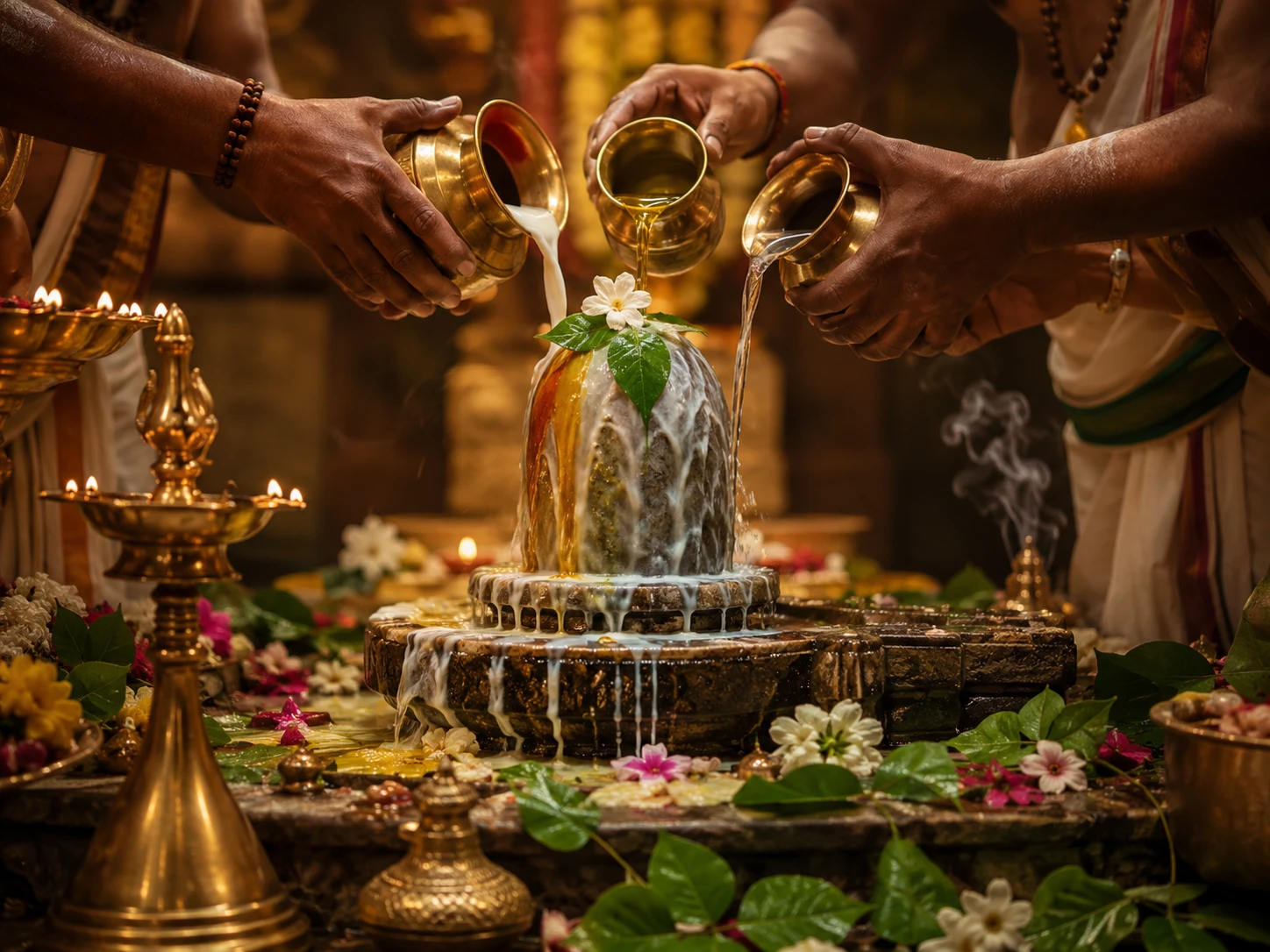
Abhisheka -- Why Hindus Bathe Their Gods
10 min read
Akshaya Tritiya -- The Day Nothing Given Away Runs Out
12 min read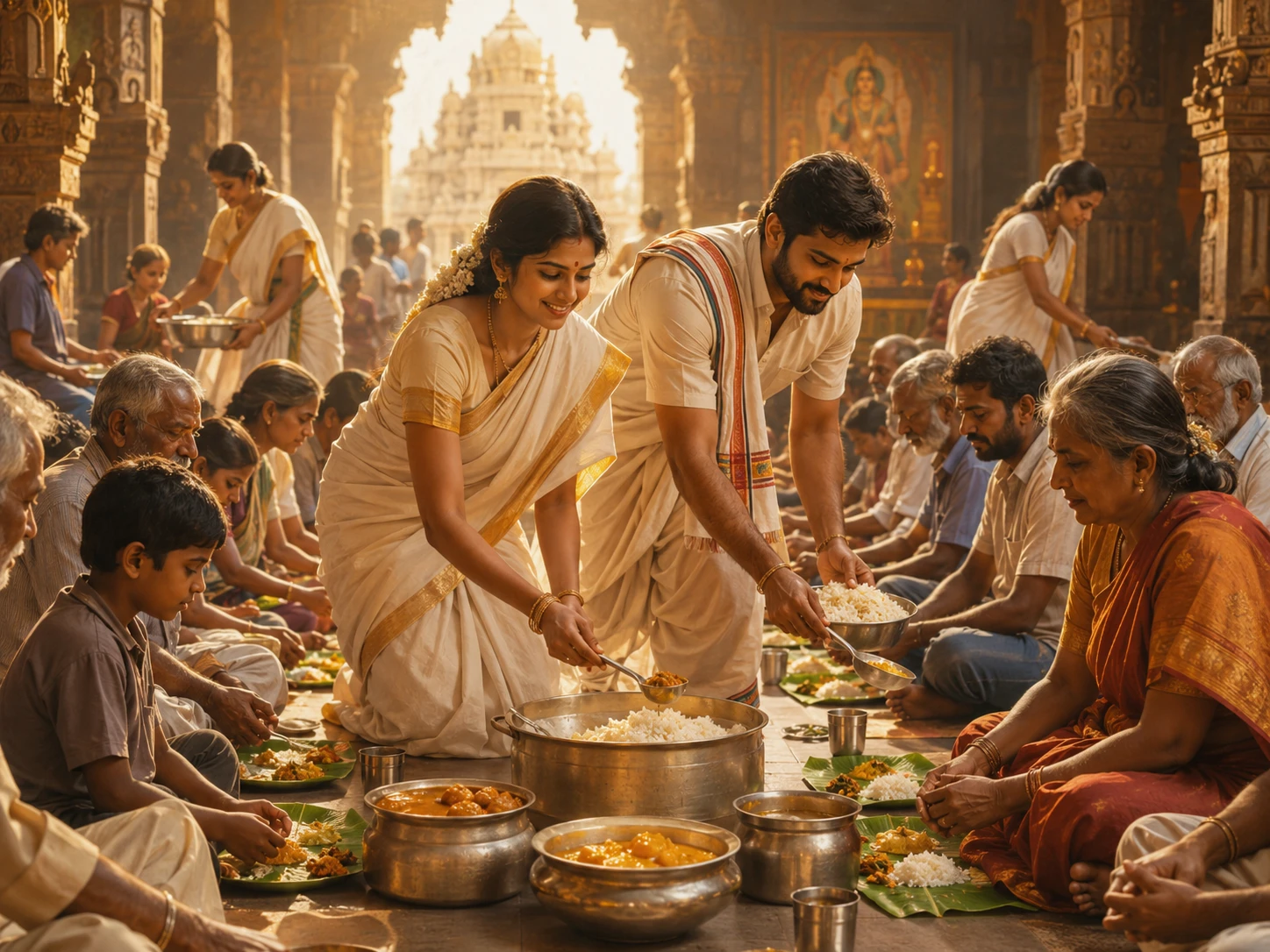
Annadana -- Why Feeding Is the Highest Form of Charity in Hindu Tradition
12 min readThe same translation error that turned '33 Koti' into '33 crore' in Hinduism also happened in Buddhism. The Chinese translation of Buddhist texts rendered 'Sapta Koti Buddha' (7 Supreme Buddhas) as '7 Crore Buddhas.' The…
Deities AvatarsCommunity Reflections
🕉️
Be the first to share your reflection.