Archana -- Why Chanting the Deity's Names Is the Simplest and Most Powerful Form of Worship
अर्चना -- देवता के नाम का जप सबसे सरल और सबसे शक्तिशाली पूजा क्यों है
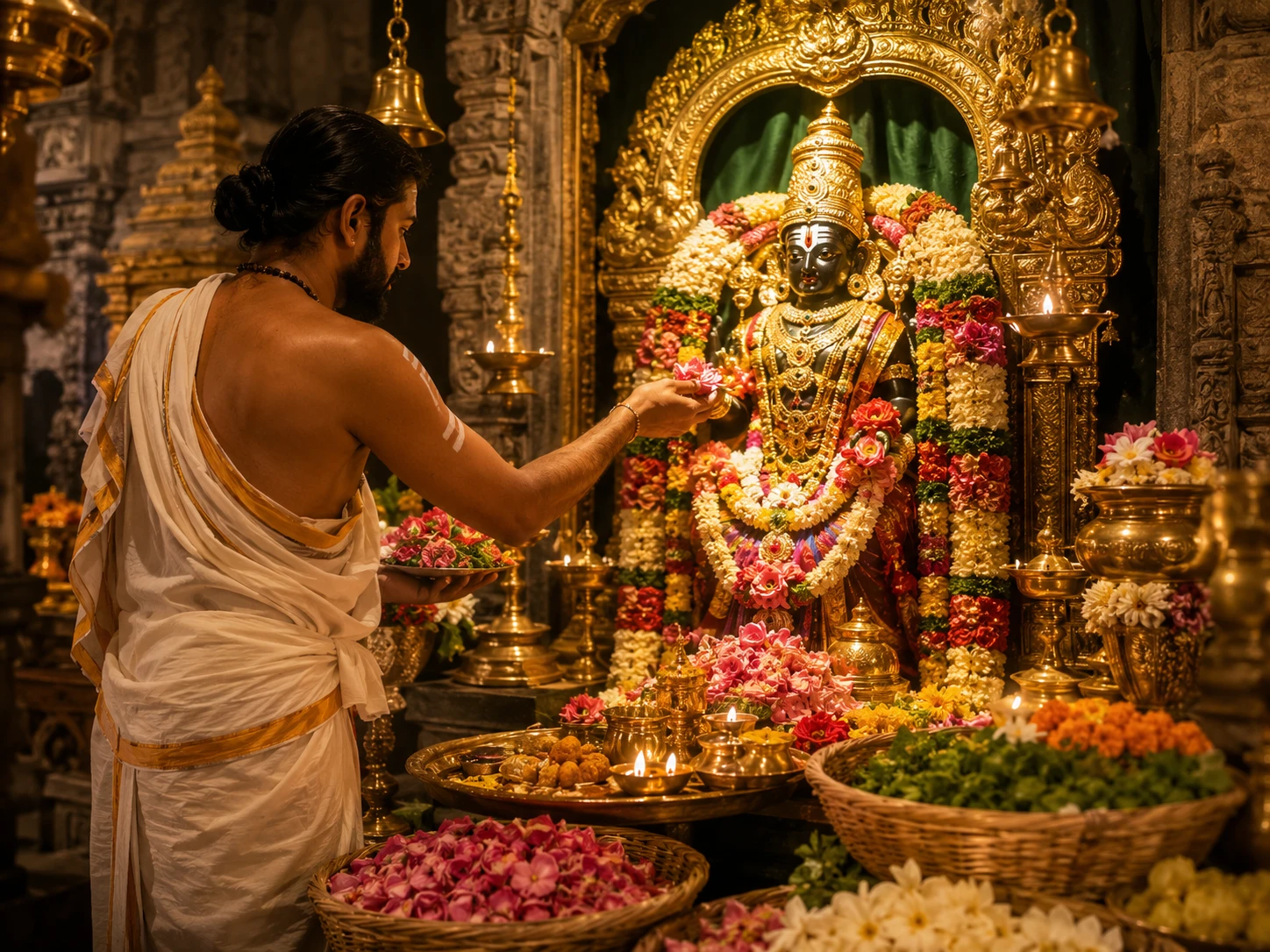
In the Meenakshi Amman Temple in Madurai, a devotee pays Rs 20 for an Archana ticket. She writes her name, her husband's name, her Nakshatra, and her Gotra on a slip. The priest accepts the slip, stands before the towering Meenakshi deity, and begins to chant: 'Om Shri Meenakshyai Namah, Om Shri Sundara Vallabhayai Namah, Om Shri Maha Devyai Namah...' With each name, he places a flower at the deity's feet. One hundred and eight names later (the Ashtottara Shatanamavali -- 108 names), the Archana is complete. The priest returns a pinch of kumkum and a flower to the devotee as Prasada.
This transaction -- slip, chant, flower, Prasada -- happens millions of times every day across India's temples. It is the most common form of personal worship offered in a temple setting. It requires no special knowledge from the devotee, no fasting, no elaborate preparation. You walk in, pay a modest fee, hand over your slip, and the priest performs the Archana on your behalf. In under ten minutes, every one of the deity's 108 names has been chanted with your name and intention attached.
But beneath this apparent simplicity lies a profound theology of the Name (Nama) that the Bhakti tradition considers one of the most powerful spiritual technologies available to any human being.
The tradition holds that the Name of God is not merely a label -- a human convention for referring to the divine. The Name IS the divine. In the Padma Purana's famous declaration: 'There is no difference between the Name and the Named.' When you say 'Rama,' Rama is present -- not symbolically, not metaphorically, but actually. The sonic vibration of the divine Name carries the full potency of the deity it names. This is why Archana -- the systematic chanting of the deity's many Names -- is considered direct communion with the divine, not merely talking about the divine.
The 108 names (Ashtottara Shatanamavali) used in standard Archana are not random epithets. Each name describes a specific attribute, deed, or quality of the deity. 'Meenakshi' means 'fish-eyed one' (eyes shaped like a fish, symbolising grace and beauty). 'Sundara Vallabha' means 'beloved of the beautiful one (Shiva).' 'Maha Devi' means 'the Great Goddess.' By chanting all 108, the devotee (or the priest on the devotee's behalf) has traversed the complete landscape of the deity's identity -- every aspect acknowledged, every dimension honoured.
नामोच्चारणमात्रेण पापसंहारकारणम्।
nāmoccāraṇamātreṇa pāpa-saṁhāra-kāraṇam
By the mere utterance of the divine Name, the destruction of sin is accomplished.
— Padma Purana (traditional attribution)
Types of Archana -- From 108 to 1,000 Names
| Type | प्रकार | Names Chanted | Duration | Common Deities | Typical Temple Fee |
|---|---|---|---|---|---|
| Ashtottara Archana | अष्टोत्तर अर्चना | 108 names | 5-10 min | All deities | Rs 20-100 |
| Sahasranama Archana | सहस्रनाम अर्चना | 1,000 names | 30-45 min | Vishnu, Lalita, Shiva | Rs 100-500 |
| Trisati Archana | त्रिशती अर्चना | 300 names | 15-20 min | Lalita (Devi) | Rs 50-200 |
| Nama Japa | नाम जप | Single name repeated 108+ times | Varies | Any deity | Usually self-performed |
| Koti Archana | कोटि अर्चना | 10 million name repetitions (collective) | Days-weeks | Major temples, special events | Varies (community effort) |
The Vishnu Sahasranama (1,000 names of Vishnu) from the Mahabharata's Anushasana Parva is the most widely chanted Sahasranama in India. The Lalita Sahasranama from the Brahmanda Purana is pre-eminent in Shakta tradition. Shiva Sahasranama appears in the Linga Purana.
The Science of Sound -- Why Names Work
The Bhakti tradition's claim that the Name carries the deity's full potency may sound mystical, but there is a psycho-acoustic dimension worth examining.
Every Sanskrit divine Name is constructed from specific seed syllables (Bija Aksharas) that, according to Mantra Shastra, activate specific energy centres in the body. The name 'Narayana' contains the syllables Na-Ra-Ya-Na -- each associated with specific Chakra resonances. 'Shiva' contains the Sha and Va sounds that the tradition associates with stillness and flow respectively. The 108 names of any deity are, in this framework, a systematic acoustic journey through 108 frequency patterns that together constitute the complete 'sound body' of the deity.
Neuroscience research on repetitive chanting (published in the International Journal of Yoga and the Journal of Cognitive Enhancement) shows that repetitive vocalization of specific syllable patterns produces measurable changes in brain wave frequencies, heart rate variability, and cortisol levels. The changes are pattern-specific -- different sounds produce different neurological signatures. This does not prove that chanting 'Vishnu' makes Vishnu appear, but it does establish that the acoustic properties of Sanskrit names are not arbitrary -- they produce real, measurable effects on the chanter's physiology.
The great Bhakti saints understood this experientially. Tyagaraja's kritis (compositions) in Carnatic music are essentially Archana set to melody -- each kriti explores a Name or attribute of Rama through music. Mirabai's bhajans are Nama Archana through devotional song. Tulsidas's Ramcharitmanas is a 12,800-verse Archana of Rama through epic poetry. The entire Bhakti movement can be understood as the democratisation of Archana -- taking the Name out of the temple and into the street, the kitchen, the field, the heart.
For the music lover who listens to Carnatic or Hindustani devotional music: you are receiving Archana through your ears. Every time MS Subbulakshmi's recording of Vishnu Sahasranama plays in your home, a thousand Names of Vishnu are sounding through your space. The tradition would say: that is not merely 'nice music.' That is the deity, in sonic form, visiting your living room.
MS Subbulakshmi's recording of Vishnu Sahasranama, released in the 1970s, is estimated to have sold over 10 million copies -- making it one of the bestselling devotional recordings in history. The recording is played daily in millions of Indian homes and temples. If each playback constitutes one complete Archana of Vishnu's 1,000 names, then MS Subbulakshmi has performed more Archanas than any temple priest in history -- through the medium of recorded sound. In the streaming era, her Sahasranama recording accumulates millions of plays annually on Spotify, YouTube, and JioSaavn, creating a continuous, global, 24-hour Archana of Vishnu powered by the internet.
Perform Your Own Archana -- Chant 108 Names
You do not need a temple or a priest. Choose the 108 names of your ishta-devata -- Vishnu, Shiva, Devi or Ganesha -- and recite all of them, offering a flower or tulsi leaf with each name. Eternal Raga's 108 Names collections give the names with their meanings. One archana, 108 flowers, 108 names: a complete worship in fifteen minutes.
Eternal Raga · शाश्वत राग
Institutional voice — scholarly articles on Sanatan Dharma
Deepen Your Understanding
अपनी समझ और गहरी करें
rituals traditions
Puja at Home -- The Complete Beginner's Guide
You have a small mandir shelf in your apartment. A brass diya your mother gave you. A photo of a deity you feel drawn to. And absolutely no idea what to do next. This guide is for you -- the 22-year-old in Pune who just moved out, the NRI in New Jersey setting up a puja corner for the first time, the curious soul who wants to start but does not know where.
rituals traditions
Panchopachara Puja -- The 5 Offerings That Engage All Five Senses
You do not need a pandit, a pavilion, or a two-hour ritual to worship. The Panchopachara Puja -- five offerings representing the five elements and engaging the five senses -- is the tradition's elegant minimum viable puja. Sandalwood for earth, flowers for space, incense for air, lamp for fire, food for water. Five items. Five minutes. A complete act of devotion.
rituals traditions
Shodashopachara Puja -- The Sixteen-Step Protocol of Hindu Worship
When a Hindu temple priest performs puja, he is not improvising. He is executing a precise sixteen-step protocol called Shodashopachara -- literally 'sixteen offerings' -- that treats God as a royal guest arriving at your home. From invitation to farewell, each step has a specific action, material, mantra, and philosophical meaning. This is the complete user manual.
rituals traditions
Why Bells, Lamps, and Flowers -- The Sensory Engineering Behind Hindu Worship
Hindu worship is not random. Every bell, every lamp, every flower, every stick of incense, every drop of water addresses a specific sense, invokes a specific element, and produces a specific psychological effect. The puja is a sensory design system -- a five-element, five-sense immersive experience engineered three thousand years before UX designers existed. Here is the complete map.
rituals traditions
Temple Darshan Etiquette -- The Complete Protocol for Visiting a Hindu Temple
Most Hindus visit temples. Few know the correct sequence. There is a reason you remove shoes before entering, ring the bell at the threshold, worship Ganesha first, walk clockwise around the sanctum, accept prasad in the right hand, and never point your feet at the deity. Every rule has a Vedic, architectural, or psychological rationale. This is the complete user guide to Hindu temple darshan.
sacred symbols
108 -- The Sacred Number That Links Your Mala to the Solar System
Why does a japa mala have exactly 108 beads? Why do temples list 108 names for every deity? The answer involves astronomy, anatomy, music, and mathematics -- and a coincidence so precise it still stuns astrophysicists: the distance from Earth to the Sun is approximately 108 times the Sun's diameter.
sacred symbols
Om -- The Primordial Sound That Contains the Universe
Every temple bell, every mantra, every meditation session begins and ends with Om. But what exactly IS Om? The Mandukya Upanishad claims this single syllable contains all of reality -- past, present, future, and whatever lies beyond time itself. Twelve verses. One sound. The entire map of consciousness.
MS Subbulakshmi's recording of Vishnu Sahasranama, released in the 1970s, is estimated to have sold over 10 million copies -- making it one of the bestselling devotional recordings in history. The recording is played dai…
More in Rituals & Traditions
Aarti -- Why Hindus Circle Light Before God
13 min read
Abhisheka -- Why Hindus Bathe Their Gods
10 min read
Akshaya Tritiya -- The Day Nothing Given Away Runs Out
12 min readThe same translation error that turned '33 Koti' into '33 crore' in Hinduism also happened in Buddhism. The Chinese translation of Buddhist texts rendered 'Sapta Koti Buddha' (7 Supreme Buddhas) as '7 Crore Buddhas.' The…
Deities AvatarsCommunity Reflections
🕉️
Be the first to share your reflection.