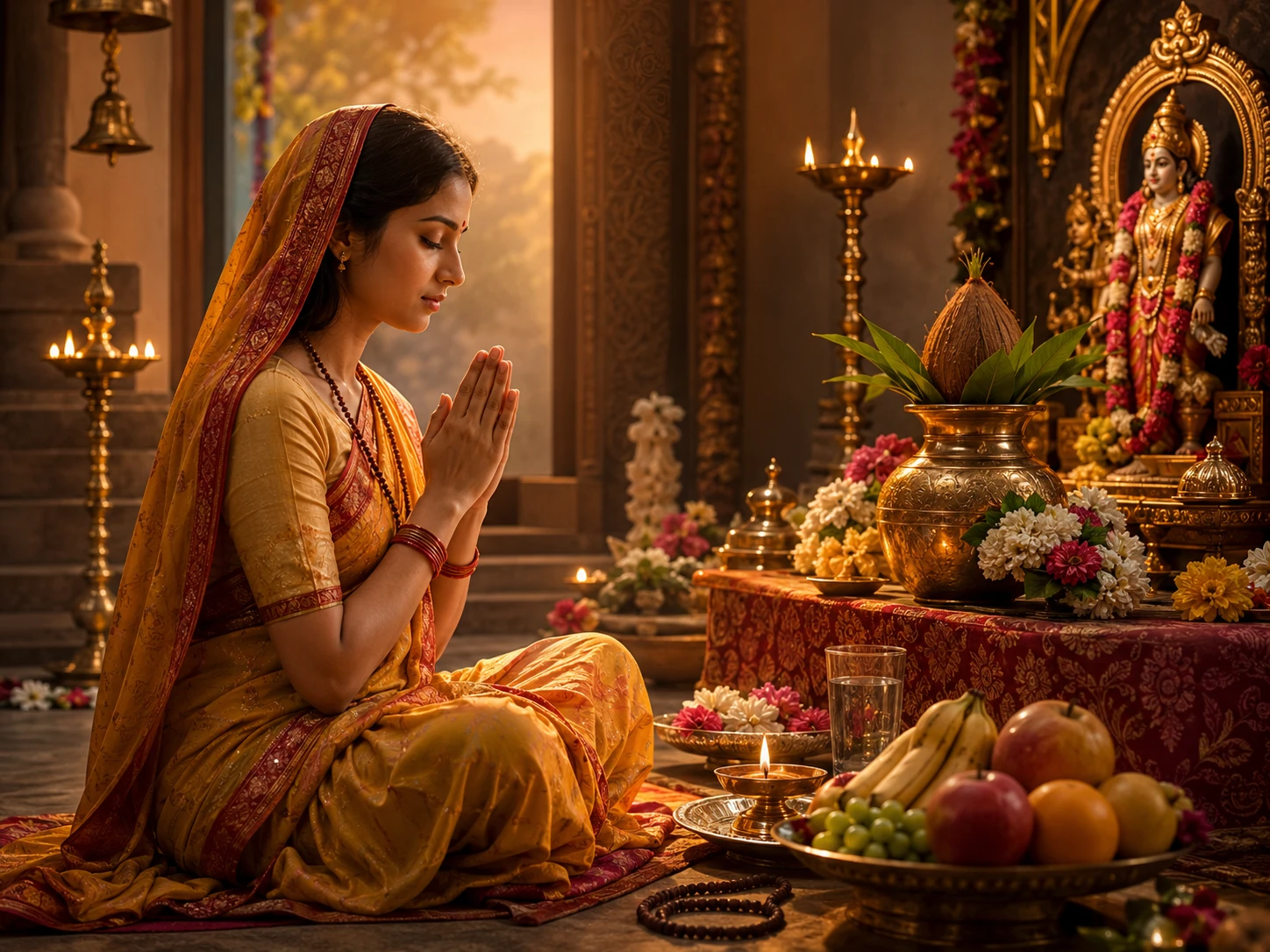
Vrata -- What a Hindu Vow Really Means (It Is Not Just Fasting)
व्रत -- हिन्दू प्रतिज्ञा का वास्तविक अर्थ (ये केवल उपवास नहीं)
The English word 'fasting' does not capture what Vrata means. Fasting is the absence of food. Vrata is the presence of resolve.
The word comes from the Sanskrit root 'vri' -- to choose, to will, to resolve. A Vrata is a conscious, voluntary, time-bound act of self-discipline undertaken with a specific spiritual intention. Fasting (Upavasa -- literally 'sitting near' the divine) is the most common expression of Vrata, but it is not the only one. A Vrata can involve silence (Mauna Vrata), celibacy (Brahmacharya Vrata), truthfulness (Satya Vrata), or any other self-imposed restriction that sharpens the will and redirects energy from consumption to contemplation.
The Bhagavad Gita addresses Vrata within its framework of the three Gunas. Sattvic Vrata is performed with faith, without expectation of reward, following proper guidelines. Rajasic Vrata is performed for show, to gain prestige or social approval -- the Instagram-documented Karva Chauth with designer thali and professional photography. Tamasic Vrata involves self-torture, harming the body, or forcing others to observe against their will. Krishna's classification is typically surgical: the act itself is not the issue. The motivation behind it determines its quality.
For the twenty-five-year-old data analyst in Gurgaon who has never observed a Vrata and finds the concept alien: consider that every New Year's resolution, every Dry January, every digital detox, every 'no sugar for thirty days' challenge is a secular Vrata. The structure is identical: a voluntary, time-bound restriction on a habitual behaviour, undertaken with the intention of self-improvement. The Hindu Vrata system simply adds a dimension that the secular version lacks: the restriction is offered to the divine, transforming self-discipline into devotion and willpower into worship.
अभयं सत्त्वसंशुद्धिर्ज्ञानयोगव्यवस्थितिः। दानं दमश्च यज्ञश्च स्वाध्यायस्तप आर्जवम्॥
abhayaṁ sattva-saṁśuddhir jñāna-yoga-vyavasthitiḥ dānaṁ damaś ca yajñaś ca svādhyāyas tapa ārjavam
Fearlessness, purity of heart, steadfastness in the yoga of knowledge, charity, self-control, sacrifice, study of scriptures, austerity (tapas), and uprightness...
— Bhagavad Gita 16.1 (Daivi Sampat -- Divine Qualities)
The Types of Vrata -- A Complete Taxonomy
The Dharmashastra tradition classifies Vratas along several axes.
By duration: Nityaa Vratas are observed daily (like the twice-daily Sandhyavandana). Naimittika Vratas are triggered by specific occasions (like Shraddha during Pitru Paksha). Kamya Vratas are undertaken voluntarily for a specific desire (like Santoshi Mata Vrata for family harmony).
By intensity: Nirjala (without water -- the most severe, like Nirjala Ekadashi), Nirahara (without food but water permitted), Phalahari (fruit-only diet), Eka-Bhukta (one meal a day), and Nakta (eating only after sunset).
By deity: Ekadashi Vrata (Vishnu), Pradosha Vrata (Shiva), Mangala Gauri Vrata (Parvati), Satyanarayan Vrata (Vishnu as Narayana), Hanuman Vrata (Tuesday or Saturday fasting), Santoshi Mata Vrata (Friday fasting).
By purpose: Prayaschitta Vratas are undertaken as atonement for specific transgressions. Kaamya Vratas seek specific boons. Nishkama Vratas are performed without desire for reward -- the highest form, where the discipline itself is the offering.
The most universally observed Vrata in India is the Ekadashi fast -- observed on the 11th day (Tithi) of both the Shukla and Krishna Paksha, which means it occurs twice every lunar month. The Bhagavata Purana and Padma Purana elaborate extensively on the spiritual merit of Ekadashi fasting. In Vaishnava traditions, Ekadashi is non-negotiable -- even more important than major festivals. The ISKCON movement has made Ekadashi observance global, with devotees in Moscow, New York, and Sao Paulo fasting on the same Tithi.
Major Vratas Across India
| Vrata | व्रत | Deity | Frequency | Who Observes | Key Practice |
|---|---|---|---|---|---|
| Ekadashi | एकादशी | Vishnu | Twice monthly | All Vaishnavas, widely observed | Full fast or grain-free diet |
| Pradosha | प्रदोष | Shiva | Twice monthly (13th Tithi) | Shaivites | Evening puja during twilight |
| Karva Chauth | करवा चौथ | Moon/Husband's well-being | Annual (Kartik K4) | Married women (North India) | Nirjala fast until moonrise |
| Mangala Gauri | मंगला गौरी | Parvati | Every Tuesday in Shravan | Married women (Maharashtra) | Puja with 16 Shringara items |
| Satyanarayan | सत्यनारायण | Vishnu | Monthly (Purnima) or as needed | Any family | Katha + Puja + Prasada distribution |
| Chhath | छठ | Surya | Annual (Kartik S6) | Bihar, Jharkhand, UP | Standing in water at sunrise/sunset |
| Navratri | नवरात्रि | Devi (9 forms) | Twice yearly | Pan-India | 9 days fast, Devi puja, Garba |
This is a representative sample. India has hundreds of regional Vratas -- from Kerala's Thiruvathira to Bengal's Jamai Shashthi to Tamil Nadu's Aadi Perukku. Each regional Vrata reflects local deity traditions, agricultural cycles, and community identity.
The Psychology of Vrata -- Why Voluntary Restriction Works
Modern psychology has a name for what the Vrata system does: ego depletion reversal through deliberate practice.
Roy Baumeister's research on willpower (published in the Journal of Personality and Social Psychology) showed that self-control is like a muscle -- it strengthens with use and weakens with neglect. Every time you exercise voluntary restraint -- choosing not to eat when hungry, choosing not to speak when provoked, choosing not to indulge when tempted -- you strengthen the neural circuitry of self-regulation.
The Vrata system is a structured programme for building this muscle. By fasting on specific days (Ekadashi, Tuesday, Saturday), the practitioner creates regular, predictable challenges for the self-control system. Over time, the capacity to resist impulse grows. And this capacity transfers -- the person who can resist hunger on Ekadashi finds it easier to resist anger at work, resist procrastination on a deadline, resist the impulse to check the phone during meditation.
The time-bound nature of Vratas is psychologically brilliant. A permanent restriction ('I will never eat sweets again') triggers resistance and often fails. A time-bound restriction ('I will not eat grains today, from sunrise to the next sunrise') is manageable, achievable, and creates a sense of accomplishment upon completion. This is the same principle behind intermittent fasting programmes, sprint-based productivity systems, and the Pomodoro Technique -- structured intervals of discipline followed by release.
The devotional framing adds another layer. When the restriction is offered to a deity -- 'I fast today for Vishnu,' 'I observe silence today for Shiva' -- the willpower challenge is transformed from self-denial into self-offering. The psychological experience shifts from deprivation to devotion. This is why traditional Vrata observers often report feeling energised and joyful during the fast, not depleted. The dedication to something larger than the self provides the motivational fuel that pure self-discipline often lacks.
For the fitness enthusiast in Mumbai who already practices intermittent fasting: adding a devotional Sankalpa to your fasting day transforms a health practice into a Vrata. The physiological effects are identical. The psychological and spiritual effects are amplified. You are no longer fasting for a six-pack. You are fasting as an offering. The body does not know the difference. The mind does.
Intermittent fasting -- currently one of the most researched dietary interventions in modern medicine -- follows a pattern structurally identical to the Hindu Ekadashi Vrata observed for thousands of years. The 16:8 fasting protocol (16 hours fasting, 8 hours eating) maps almost exactly onto a traditional Ekadashi fast (sunrise to next-day sunrise, with one light meal in between). Research published in the New England Journal of Medicine (2019) confirmed that intermittent fasting improves insulin sensitivity, reduces inflammation, enhances autophagy (cellular self-cleaning), and extends lifespan in animal models. The Rishis prescribed this twice a month -- 24 times a year -- millennia before Mark Mattson published his landmark paper.
The Vrata Calendar -- How India Fasts Year-Round
If you mapped every Vrata observed by at least one major Hindu community onto a calendar, there would not be a single week without a fast day. Mondays belong to Shiva. Tuesdays to Hanuman. Wednesdays to Vithal (in Maharashtra) or Budh (Mercury). Thursdays to Brihaspati (Jupiter) or Sai Baba. Fridays to Santoshi Mata or Lakshmi. Saturdays to Shani or Hanuman. And Sundays to Surya.
Layer on top of this the fortnightly Ekadashis, the monthly Pradosha (13th Tithi for Shiva), the monthly Chaturthi (4th Tithi for Ganesha), the monthly Purnima and Amavasya observances, the seasonal Navaratris (Chaitra and Sharad), the annual mega-festivals (Mahashivaratri, Janmashtami, Karva Chauth, Chhath), and the regional specialities (Thiruvathira in Kerala, Varalakshmi Vratam in Karnataka, Hartalika Teej in North India) -- and India emerges as a civilisation that has structured its calendar around periodic voluntary deprivation to a degree unmatched anywhere in the world.
This is not ascetic masochism. It is a distributed willpower training system. By ensuring that every week contains at least one day of restraint (for whichever deity or tradition you follow), the Hindu calendar prevents the atrophy of self-discipline. You never go more than a few days without exercising the muscle of voluntary restraint. Compare this to secular culture, where the only structured 'fast' most people observe is the annual New Year's resolution -- which research shows has a failure rate above 80% by February.
The tradition's approach is the opposite of the all-or-nothing resolution. It says: fast a little, frequently. Tuesday every week. Ekadashi every fortnight. Navaratri every six months. The frequency builds the habit. The habit builds the capacity. The capacity transforms the character. This is progressive overload applied to the will, using the same principle that strength training applies to the body.
For the fitness-minded reader who already understands periodisation in training (base phase, build phase, peak phase, recovery): the Hindu Vrata calendar IS a periodised programme for the will. Weekly day-fasts are the base volume. Fortnightly Ekadashis are the intensity sessions. Navaratri is the peak week. And the feasting days (Diwali, Holi, festival celebrations) are the recovery phases. The ancients designed a year-round spiritual training programme that any modern performance coach would recognise as structurally sound.
Women and Vrata -- The Gendered Landscape of Hindu Fasting
Any honest examination of the Vrata tradition must address its gendered dimension. In practice, women observe significantly more Vratas than men. Karva Chauth (wife fasting for husband's longevity), Vat Savitri (wife fasting for husband's life), Hartalika Teej (unmarried girls fasting for a good husband), Mangala Gauri (newly married women fasting on Tuesdays in Shravan) -- these are all women-specific Vratas with no male equivalent.
The feminist critique is valid and important: why should a woman fast for her husband's life when no corresponding Vrata requires the husband to fast for hers? The tradition's defenders point to the Savitri narrative (where Savitri's Vrata literally conquered Yama and retrieved her husband from death) as empowering -- the woman's spiritual power, not the man's physical strength, is the force that defeats death. Critics respond that framing female spiritual power as existing primarily in service to the husband's welfare is itself a patriarchal construction.
Both sides have a point. The tradition must be held accountable for its gender asymmetries while also being credited for the genuine spiritual agency it grants to women through Vrata. A woman observing Karva Chauth is not a passive victim. She is performing an act of concentrated will, physical endurance, and spiritual focus that most men in her family cannot match. The Vrata gives her a structured space for devotional expression that is entirely hers -- her Sankalpa, her discipline, her offering.
Reform-minded families across India are increasingly adapting the tradition. Some couples now observe Karva Chauth mutually -- both fasting for each other. Some families have created new Vratas that are gender-neutral. Progressive teachers within the tradition emphasise that the Vrata principle (voluntary discipline offered to the divine) has no inherent gender restriction -- only specific cultural Vratas do.
For the young woman in Delhi who finds Karva Chauth problematic but wants to maintain a Vrata practice: Ekadashi is entirely gender-neutral. Navaratri fasting is open to all. Pradosha is observed by both men and women. The tradition offers dozens of gender-inclusive Vratas alongside the gendered ones. Choose the practice that aligns with your values. The divine does not check your gender before accepting your offering.
For the young man who has never fasted because 'Vrata is for women': try one Ekadashi. The 36-hour grain-fast will teach you more about your own willpower than any gym session. The tradition has been shortchanging men by allowing them to outsource spiritual discipline to their mothers and wives. That outsourcing ends when you take your first Sankalpa and skip your first meal.
Vrata and the Modern Wellness Industry -- Ancient Discipline Repackaged
The global wellness industry -- valued at over $5.6 trillion according to the Global Wellness Institute -- has rediscovered virtually every component of the Vrata system, stripped it of its devotional framework, and repackaged it under secular branding.
Intermittent fasting (Ekadashi without Vishnu). Digital detox (Mauna Vrata without Shiva). Dry January (Nirjala without the Tithi). Cold water immersion (Snana Vrata without the river). Gratitude journaling (Sankalpa without the Sanskrit). Mindful eating (Naivedya without the deity). Each of these billion-dollar wellness trends is a fragment of the integrated Vrata system, divorced from its spiritual context and sold as an innovation.
This is not a complaint -- it is an observation. The secular wellness industry has validated the physiological and psychological mechanisms that the Vrata tradition has been running for millennia. The science works whether or not you frame it as devotion. But the tradition offers something the wellness industry cannot: a reason to sustain the practice beyond personal benefit.
The dropout rate for wellness challenges is notoriously high. Dry January participants resume drinking in February. Intermittent fasting adherents quit after the initial weight loss plateaus. Digital detox lasts until the next notification. The reason is structural: self-improvement for the sake of self-improvement has a motivation ceiling. At some point, the self gets bored of improving itself.
The Vrata system solves this problem by redirecting the practice outward -- toward the divine, toward the ancestors, toward the community. You fast not because your Instagram aesthetic demands a flat stomach, but because Vishnu asked you to. You maintain silence not because a meditation app told you to, but because Shiva is listening. The devotional frame provides motivational fuel that outlasts personal ambition. This is why an 80-year-old grandmother in Madurai has observed every Ekadashi for sixty years without a single wellness coach -- while a 30-year-old in Gurgaon cannot sustain a 30-day juice cleanse.
For the wellness enthusiast who has tried every trend and burned out: the Vrata system is waiting. It contains everything the wellness industry sells -- fasting, discipline, mindfulness, community, periodic challenge -- plus the one ingredient the industry cannot manufacture: devotion. And devotion is the only renewable fuel source for lifelong practice.
Observe Your First Ekadashi
The next Ekadashi is your chance to experience a vrata first-hand. Skip grains for the day and eat only fruit, milk and nuts. Chant 'Om Namo Narayanaya' 108 times on a mala during the day. Notice how fasting and devotion together create a distinctly different quality of awareness. The mantra's page on Eternal Raga gives its meaning and how to chant it.
Eternal Raga · शाश्वत राग
Institutional voice — scholarly articles on Sanatan Dharma
Deepen Your Understanding
अपनी समझ और गहरी करें
rituals traditions
Ekadashi -- Why Hindus Fast on the 11th Day (And What the '11' Actually Means)
Twice every lunar month, millions of Hindus stop eating grains. Not as a diet. Not for health. Because the Padma Purana says that on the 11th day of the lunar fortnight, all sin takes refuge in grain -- and the person who abstains from grain on that day is freed from sin and drawn closer to Vishnu. The number 11 is not accidental: it represents the 10 senses plus the mind, and Ekadashi is the day you master all eleven. This is the most widely observed Vrata in the Hindu world -- and it maps almost perfectly onto modern intermittent fasting science.
rituals traditions
Nitya, Naimittika, and Kamya Karma -- The Three Categories of Duty
Hinduism does not say 'do good things.' It says 'know which kind of action you are performing and why.' The three-fold classification of Karma into Nitya (daily non-negotiable), Naimittika (occasion-triggered), and Kamya (desire-driven) is the most practical decision-making framework the tradition offers -- and it works as well in a Bangalore startup as it did in a Vedic gurukul.
rituals traditions
Navratri -- Nine Nights That Transform India
For nine nights, India becomes a different country. In Gujarat, millions dance garba till dawn. In Bengal, the streets turn into open-air art galleries. In Varanasi, nine temples light up in sequence. In Mysore, the palace blazes with 100,000 bulbs. Navratri is not a single festival -- it is nine nights of goddess worship that unite India's most diverse traditions into one cosmic celebration.
rituals traditions
Mahashivaratri -- The Great Night of Shiva
One night a year, the cosmos tilts toward Shiva. Temples stay open past midnight. Millions fast, chant, and keep vigil through the darkest night of the lunar month. The Shiva Purana says this is the night Shiva performed the Ananda Tandava -- the cosmic dance -- for the first time. It is also the night Shiva drank the Halahala poison to save creation. And the night Shiva married Parvati. Three origin stories. One night. The only Hindu festival that asks you to stay awake through the darkness rather than celebrate the light.
rituals traditions
Karva Chauth -- India's Most Debated Fast (And Why It Endures)
On the fourth day after the full moon in Kartik, millions of married Hindu women across North India fast without food or water from sunrise to moonrise -- a Nirjala fast of 14-16 hours -- for the long life and well-being of their husbands. They dress in their finest, apply mehndi, wear all sixteen Shringara items, and break the fast only after sighting the moon through a sieve and then looking at their husband's face. It is simultaneously Hinduism's most romantic, most feminist-debated, and most Bollywood-celebrated ritual.
rituals traditions
Panchamaha Yajnas -- The 5 Daily Duties Every Householder Owes
You owe five debts the moment you wake up: to knowledge, to the divine, to your ancestors, to all living beings, and to fellow humans. The Panchamaha Yajnas are not grand fire rituals -- they are five daily micro-acts that the tradition considers the minimum operating system of a responsible life. Skip them and you are, according to Manu, living as a thief.
rituals traditions
Sankalpa -- The Ritual GPS That Locates You in the Cosmos Before Every Puja
Before any Hindu ritual begins, there is a quiet declaration that most people rush through without understanding. It names the current cosmic age, the ruling Manu, the Yuga, the year, the season, the month, the fortnight, the day, the star, the continent, the country, the river, your name, your lineage, and your exact intention. This declaration -- Sankalpa -- is the most sophisticated geo-temporal tagging system in any religious tradition. It tells the universe: I am here, I am this person, and I intend to do this specific act.
Intermittent fasting -- currently one of the most researched dietary interventions in modern medicine -- follows a pattern structurally identical to the Hindu Ekadashi Vrata observed for thousands of years. The 16:8 fast…
More in Rituals & Traditions
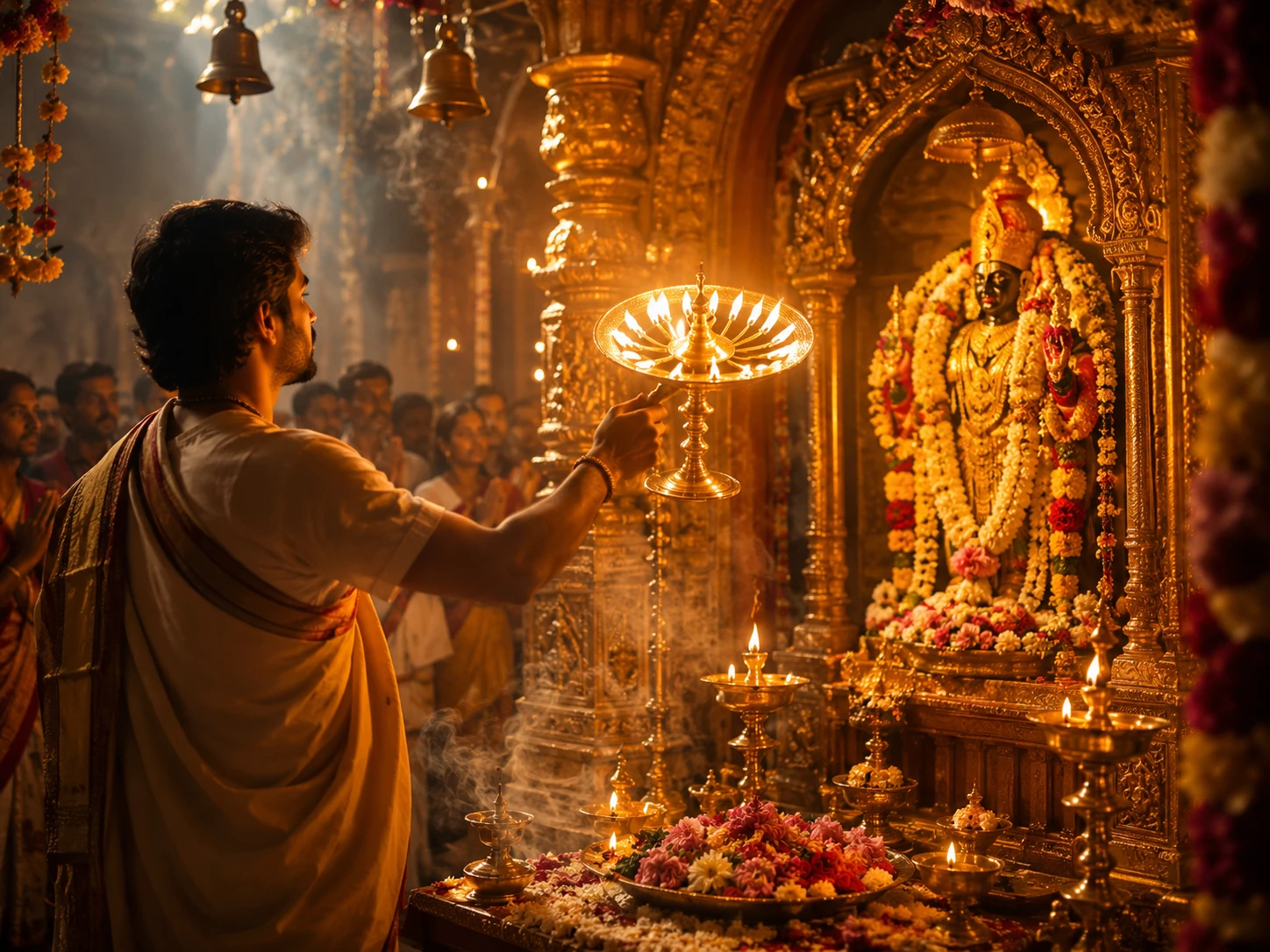
Aarti -- Why Hindus Circle Light Before God
13 min read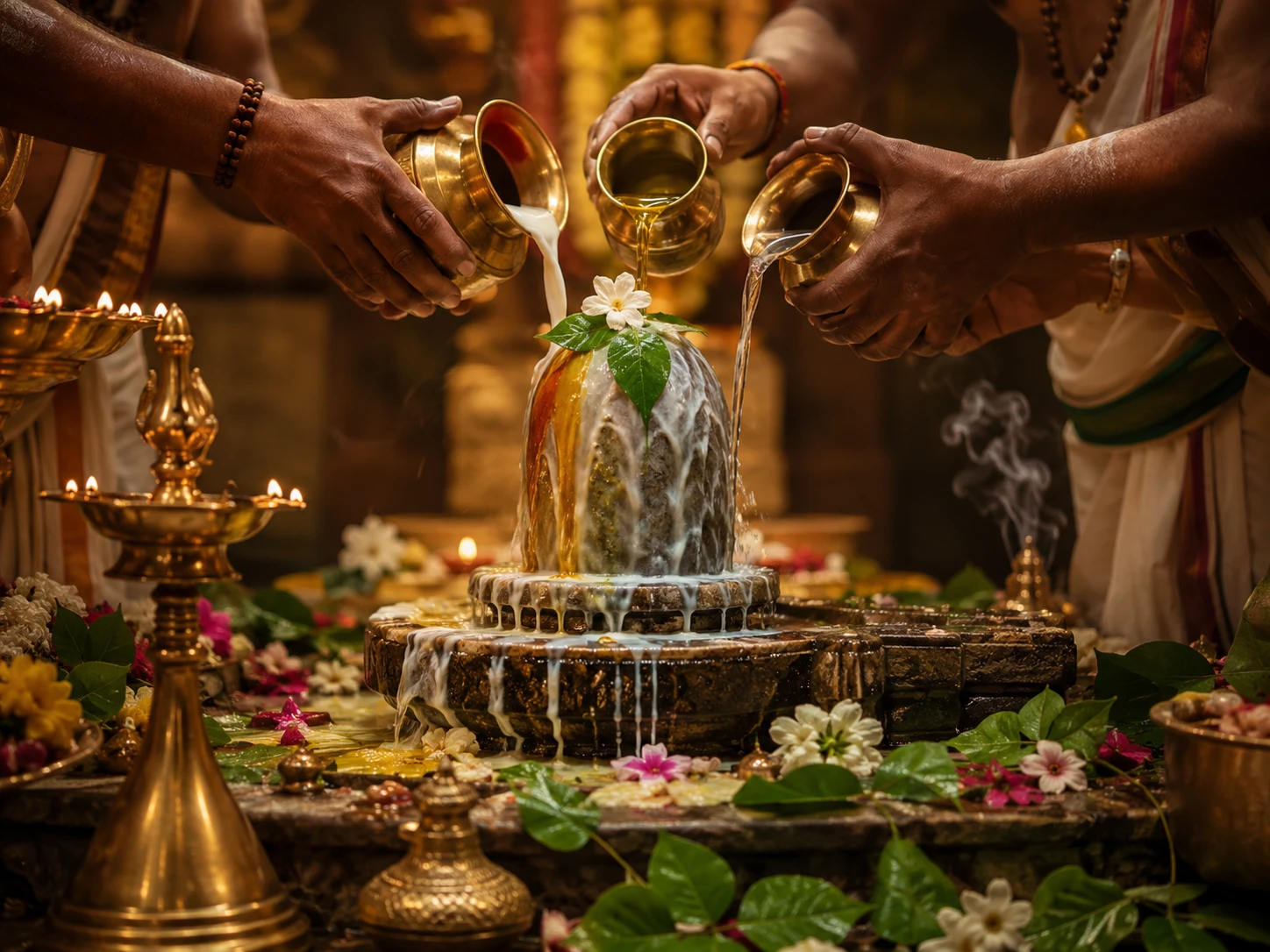
Abhisheka -- Why Hindus Bathe Their Gods
10 min read
Akshaya Tritiya -- The Day Nothing Given Away Runs Out
12 min readThe same translation error that turned '33 Koti' into '33 crore' in Hinduism also happened in Buddhism. The Chinese translation of Buddhist texts rendered 'Sapta Koti Buddha' (7 Supreme Buddhas) as '7 Crore Buddhas.' The…
Deities AvatarsCommunity Reflections
🕉️
Be the first to share your reflection.