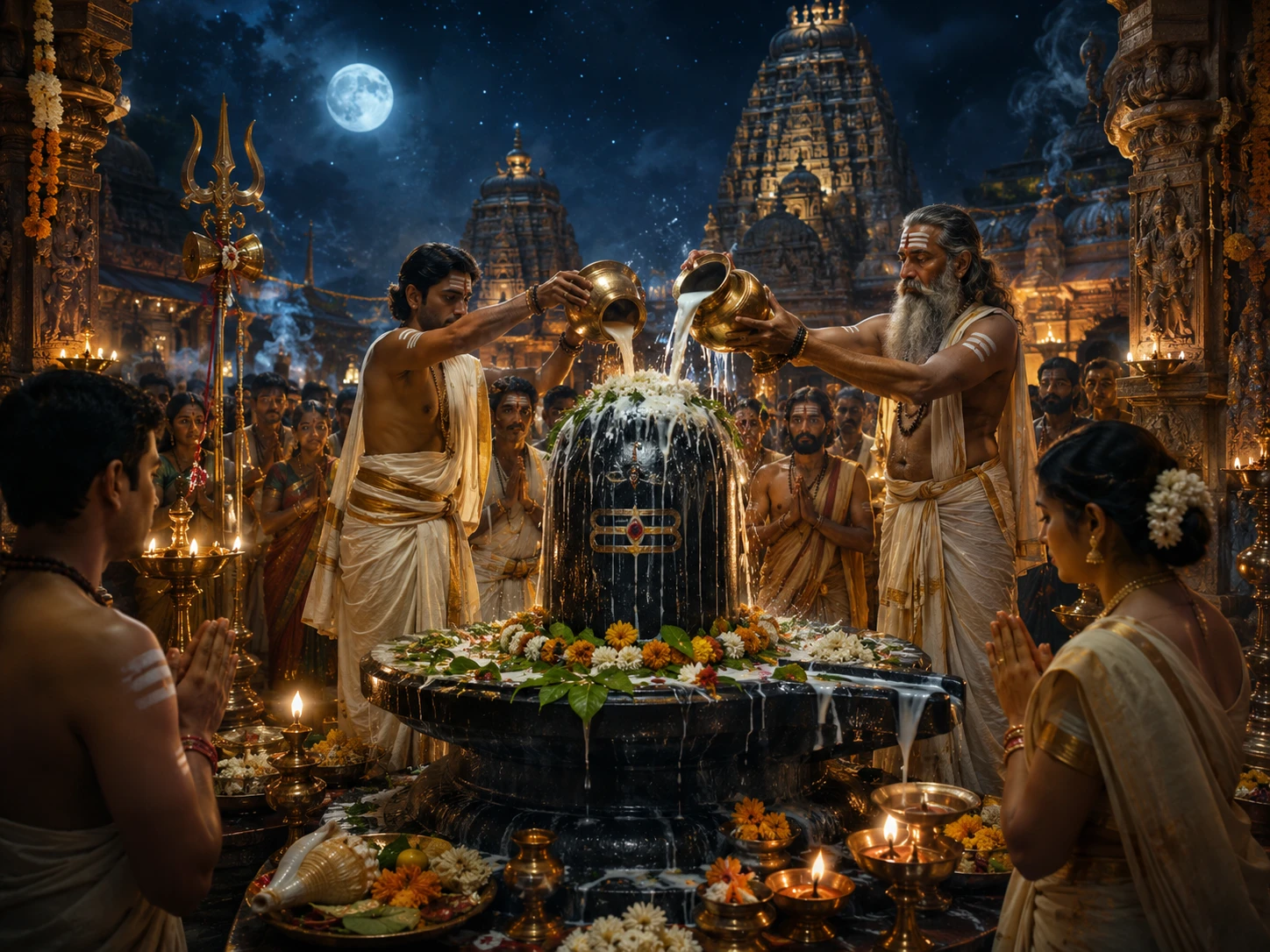
Mahashivaratri -- The Great Night of Shiva
महाशिवरात्रि -- शिव की महारात्रि
Every major Hindu festival celebrates light. Diwali lights lamps. Holi lights bonfires. Makar Sankranti celebrates the sun's northward journey. Navratri culminates in the triumph of the Goddess over darkness. Mahashivaratri is the exception. It celebrates the darkest night -- Phalguna Krishna Chaturdashi, the 14th night of the waning moon in the month of Phalguna (February-March), when the moon is a barely visible sliver. There is almost no moonlight. The night is as dark as it gets.
And the instruction is: stay awake through it.
This is not accidental theology. The Shiva Purana, Linga Purana, and Skanda Purana each provide different origin stories for Mahashivaratri, but they converge on one principle: Shiva is not found by escaping darkness. He is found IN the darkness. The festival does not ask you to light the night away. It asks you to sit in the dark, fully conscious, and discover what is already luminous within.
For a UPSC aspirant pulling an all-nighter in Old Rajinder Nagar, for a software engineer in Whitefield working a graveyard shift, for a mother nursing a newborn at 3 AM, for a medical intern on a 36-hour call -- Mahashivaratri is the festival that says: the vigil you are already keeping has spiritual value. Wakefulness in darkness is not punishment. It is practice.
शिवरात्रिव्रतं नाम सर्वपापप्रणाशनम्। आचण्डालमनुष्याणां भुक्तिमुक्तिप्रदायकम्॥
shivaraatrivratam naama sarvapaapapraNaashanam | aachaNDaala manuShyaaNaaM bhuktimukti pradaayakam ||
The vow of Shivaratri destroys all transgressions. It grants worldly fulfilment and liberation to all human beings -- from the highest to the most marginalised.
— Shiva Purana, Vidyeshvara Samhita -- establishing the universal accessibility of the Shivaratri vow regardless of caste or social position
Three Origin Stories -- One Night
The tradition preserves at least three distinct Puranic narratives for why Mahashivaratri is sacred. Each reveals a different dimension of Shiva.
The Cosmic Dance: The Shiva Purana states that on this night, Shiva performed the Ananda Tandava for the first time -- the cosmic dance of creation, preservation, and dissolution. The Nataraja danced the universe into existence on the darkest night. The implication: creation does not emerge from light. It emerges from the dark void, set in motion by rhythm. Physicists would recognise this -- the Big Bang was not a flash of light. It was a singularity in darkness that exploded into spacetime.
The Marriage of Shiva and Parvati: Other texts, including sections of the Shiva Purana and folk traditions across North India, hold that Mahashivaratri is the night Shiva married Parvati -- the cosmic union of Purusha and Prakriti, consciousness and energy. The Baraat (wedding procession) of Shiva is famously described as terrifying: ghosts, goblins, Aghoris, snakes, ash-smeared attendants. Parvati's family is horrified. But Parvati sees only her Lord. This is the teaching: love sees through appearance. The marriage of Shiva and Parvati is the prototype for every Hindu wedding -- which is why Shivaratri is considered an auspicious night for Shiva-Parvati puja by married couples.
The Halahala Night: The Samudra Manthan narrative (Bhagavata Purana, Vishnu Purana) recounts that when the Halahala poison emerged from the churning ocean and threatened to destroy all creation, Shiva drank it. Parvati held his throat to prevent the poison from descending, turning it blue. Some traditions hold that this event occurred on the Chaturdashi night of Phalguna. On this reading, Mahashivaratri is a night of gratitude -- the night the universe was saved by one being's willingness to absorb the world's poison into his own body.
All three stories share a structural pattern: something emerges from darkness (dance, union, poison), Shiva engages with it directly (dances, marries, drinks), and the cosmos is transformed. Mahashivaratri is the annual re-enactment of this pattern. You enter the darkness. You stay conscious. You emerge changed.
The Four Praharas -- How the Night is Structured
| Prahara (Watch) | Approximate Time | Abhisheka Offering | Mantra Focus | Inner Significance |
|---|---|---|---|---|
| First Prahara | 6 PM - 9 PM | Milk (Dugdha) | Om Namah Shivaya | Purification of the physical body (Annamaya Kosha). Milk is the first nourishment. You begin by cleansing the most gross layer. |
| Second Prahara | 9 PM - 12 AM | Curd/Yoghurt (Dadhi) | Om Namah Shivaya | Purification of the vital/pranic body (Pranamaya Kosha). Curd is milk transformed. The practice deepens. |
| Third Prahara | 12 AM - 3 AM | Ghee (Ghrita) | Mahamrityunjaya Mantra | Purification of the mental body (Manomaya Kosha). Ghee is the essence of milk. The mind becomes still in the deepest darkness. |
| Fourth Prahara | 3 AM - 6 AM (Brahma Muhurta) | Honey (Madhu) | Rudra Gayatri or Om Namah Shivaya | Purification of the intellectual/bliss body (Vijnanamaya/Anandamaya Kosha). Honey is the rarest offering. Dawn approaches. The vigil is complete. |
The four Praharas map onto the Pancha Kosha (five sheaths) model of Vedantic psychology. Each successive Prahara goes deeper -- from the gross body to the vital body to the mind to the intellect/bliss. The night vigil is not random sleeplessness. It is a structured inward journey through the layers of self, using progressively refined offerings and deepening mantra practice. By 3 AM, if the practice is sincere, the mind is in a state that yogic texts call 'Pratyahara' -- withdrawal of the senses, the doorstep of meditation.
The Fasting and Its Logic
Mahashivaratri is observed with a full-day fast (Upavasa). Strict observers take no food and only water. Moderate observers eat fruits and milk once during the day before the night vigil. The fast is broken the next morning after the final Prahara puja.
The Ayurvedic logic of the fast aligns with the yogic purpose. An empty stomach reduces Tamas (heaviness, dullness) and enhances the body's capacity to remain alert through the night. The digestive fire (Jatharagni) is redirected from processing food to supporting internal awareness. This is the same principle behind Ekadashi fasting and the Buddhist Uposatha: when the body stops digesting, the mind starts perceiving.
Bilva (Bael) leaves are the signature offering of Shivaratri. The trifoliate leaf (three leaflets on one stalk) represents the three eyes of Shiva, the three Gunas (Sattva, Rajas, Tamas), and the three functions (creation, preservation, dissolution). Offering Bilva to the Shiva Linga during Abhisheka is considered the single most meritorious act of Shivaratri worship. In rural India, Bilva trees near Shiva temples are considered sacred and never cut.
The night vigil (Jagaran) is the heart of the practice. Staying awake is not passive. The four Praharas structure the night into a progressive deepening: each three-hour block has its own Abhisheka substance, its own mantra, and its own kosha (sheath) being addressed. By the fourth Prahara (3-6 AM), the practitioner has been awake for over 12 hours without food, chanting continuously, in the darkest and coldest part of the night. This is the moment of maximum vulnerability and maximum receptivity. The tradition says Shiva is most accessible at this hour.
Temples across India run Mahashivaratri as a marathon event: continuous Abhisheka of the Linga, Rudra Parayana (complete recitation of the Sri Rudram), Maha Mrityunjaya Homa, kirtan, and discourse through the night. Kashi Vishwanath (Varanasi), Mahakaleshwar (Ujjain), and Somnath (Gujarat) each draw lakhs of devotees. The atmosphere at 2 AM in the Kashi Vishwanath temple corridor -- thousands of voices chanting Om Namah Shivaya in unison, the Ganga steps away, the Linga continuously bathed in milk and Gangajal -- is one of the most concentrated spiritual experiences available anywhere in the world.
There is a Shivaratri every month -- on the Chaturdashi (14th day) of every Krishna Paksha (waning moon). These monthly Shivaratris are called Masik Shivaratri and are observed by devout Shaiva practitioners with fasting and night puja. Mahashivaratri -- the 'great' Shivaratri -- is specifically the one that falls in Phalguna (February-March) and is the most significant. Some traditions, particularly in South India, also observe Maha Pradosha on Trayodashi (13th day) as a preparatory vigil for Shivaratri. The Shivaratri in the month of Shravana (July-August) is also widely observed in North India and is associated with the Kanwar Yatra -- the annual pilgrimage where millions of Shiva devotees carry Ganga water from Haridwar to their local Shiva temples, walking hundreds of kilometres on foot.
The Shiva Purana tells the story of a hunter named Gurudruha who unknowingly observed Shivaratri. Lost in the forest, he climbed a Bilva tree to escape wild animals and stayed awake all night in fear. Through the night, dew-covered Bilva leaves fell from the tree onto a Shiva Linga below that the hunter had not noticed. By morning, the hunter -- who had been awake all night (Jagaran), had not eaten (Upavasa), and had inadvertently offered Bilva leaves to a Linga (Archana) -- had fulfilled the essential Shivaratri vow without knowing it. At the moment of his death, Shiva's attendants came to escort him to Kailasa. The story's teaching: Shiva's grace does not require knowledge, intention, or even belief. The ritual has power even when performed unknowingly. This is the most radically accessible soteriology in Hindu tradition -- salvation available to a man who did not even know he was worshipping.
Keep the Shivaratri Night Vigil
Four praharas, four abhishekas. Keep the vigil at home or at a temple: chant Om Namah Shivaya and the Mahamrityunjaya through the night, a round of japa in each prahara. The darkness is easier when shared, so keep it with family or friends. Both mantras have their own pages on Eternal Raga.
Tags
Eternal Raga · शाश्वत राग
Institutional voice — scholarly articles on Sanatan Dharma
Deepen Your Understanding
अपनी समझ और गहरी करें
deities avatars
Who is Shiva?
He is the ash-smeared ascetic who is also the ideal husband. The destroyer of the universe who is called 'The Auspicious One.' The god of death who drank poison to save all life. He sits in meditation on a Himalayan peak, and simultaneously dances the cosmos into existence and annihilation. No deity in Hinduism contains more contradictions -- and no deity resolves them more completely. This is not a mythology explainer. This is an attempt to stand at the foot of the mountain and look up.
tantra mantra yantra
Om Namah Shivaya -- The Panchakshari Mantra
Five syllables. Three thousand years of continuous chanting. The most spoken mantra in Shaivism, extracted from the heart of the Vedas -- the eighth Anuvaka of the Sri Rudram in the Krishna Yajurveda. Na is earth. Ma is water. Shi is fire. Va is air. Ya is space. When you chant Om Namah Shivaya, you are not simply praying to a deity. You are vibrating the five elements that constitute your body, the universe, and the consciousness that witnesses both. This is how a mantra becomes a technology.
tantra mantra yantra
Mahamrityunjaya Mantra -- Conquering Death
A 16-year-old boy clings to a Shiva Linga as the god of death throws a noose around his neck. Shiva emerges from the Linga, kicks Yama in the chest, and declares the boy immortal. That boy is Markandeya. That mantra is the Mahamrityunjaya. It appears in the Rig Veda, the Yajur Veda, and the Atharva Veda -- the only healing mantra attested in three of the four Vedas. It is chanted in ICU corridors, before surgeries, at bedsides, and in cremation grounds. This is not a mantra about avoiding death. It is a mantra about not being afraid of it.
deities avatars
Nataraja -- The Cosmic Dancer
One foot crushes a dwarf. The other is raised in liberation. A ring of fire frames the dance. A drum beats creation into existence. An open palm says 'do not fear.' This is Nataraja -- Shiva as the Lord of Dance -- and it is the single most replicated Indian bronze in the history of art. The physicists at CERN chose it to stand outside the world's largest particle accelerator. The Chola bronzesmiths of Tamil Nadu perfected it a thousand years ago. And every time a subatomic particle appears and disappears, the cosmic dance continues.
sacred symbols
Shiva Linga -- Symbol, Form, and Misunderstanding
The most searched, most misunderstood, and most deliberately distorted symbol in Hinduism. The word 'Linga' means 'sign' or 'mark' in Sanskrit -- the same word Panini uses in grammar for 'gender marker' and the Nyaya school uses for 'evidence in logical inference.' The Shvetashvatara Upanishad says Shiva has no linga -- meaning He is beyond all characteristics, including gender. The Linga Purana says the Linga is the formless Brahman made graspable. Colonial-era mistranslation turned this into something else entirely. Here is what the texts actually say.
scriptural exegesis
Samudra Manthan -- When Gods and Demons Ran a Joint Venture and the Universe Almost Died
A cosmic ocean. A mountain for a churning rod. A serpent king for a rope. Gods on one end, demons on the other. And out came 14 treasures -- including wealth, beauty, medicine, immortality, and one poison so lethal it could end creation itself. The Samudra Manthan is not mythology. It is the original playbook for collaboration, crisis management, and how to handle it when your joint venture partner tries to cheat you.
deities avatars
Nine Forms of Shiva -- The Many Faces of Mahadeva
He is the silent teacher under a banyan tree and the screaming destroyer on a battlefield. He is half-woman and half-man. He drank the poison that would have ended the universe and his throat turned blue. Nine scripturally-attested forms of Shiva -- from Nataraja to Rudra -- and why each one exists.
There is a Shivaratri every month -- on the Chaturdashi (14th day) of every Krishna Paksha (waning moon). These monthly Shivaratris are called Masik Shivaratri and are observed by devout Shaiva practitioners with fasting…
More in Rituals & Traditions
Aarti -- Why Hindus Circle Light Before God
13 min read
Abhisheka -- Why Hindus Bathe Their Gods
10 min read
Akshaya Tritiya -- The Day Nothing Given Away Runs Out
12 min readThe same translation error that turned '33 Koti' into '33 crore' in Hinduism also happened in Buddhism. The Chinese translation of Buddhist texts rendered 'Sapta Koti Buddha' (7 Supreme Buddhas) as '7 Crore Buddhas.' The…
Deities AvatarsCommunity Reflections
🕉️
Be the first to share your reflection.