Ekadashi -- Why Hindus Fast on the 11th Day (And What the '11' Actually Means)
एकादशी -- हिन्दू ग्यारहवें दिन उपवास क्यों रखते हैं (और '11' का वास्तविक अर्थ क्या है)
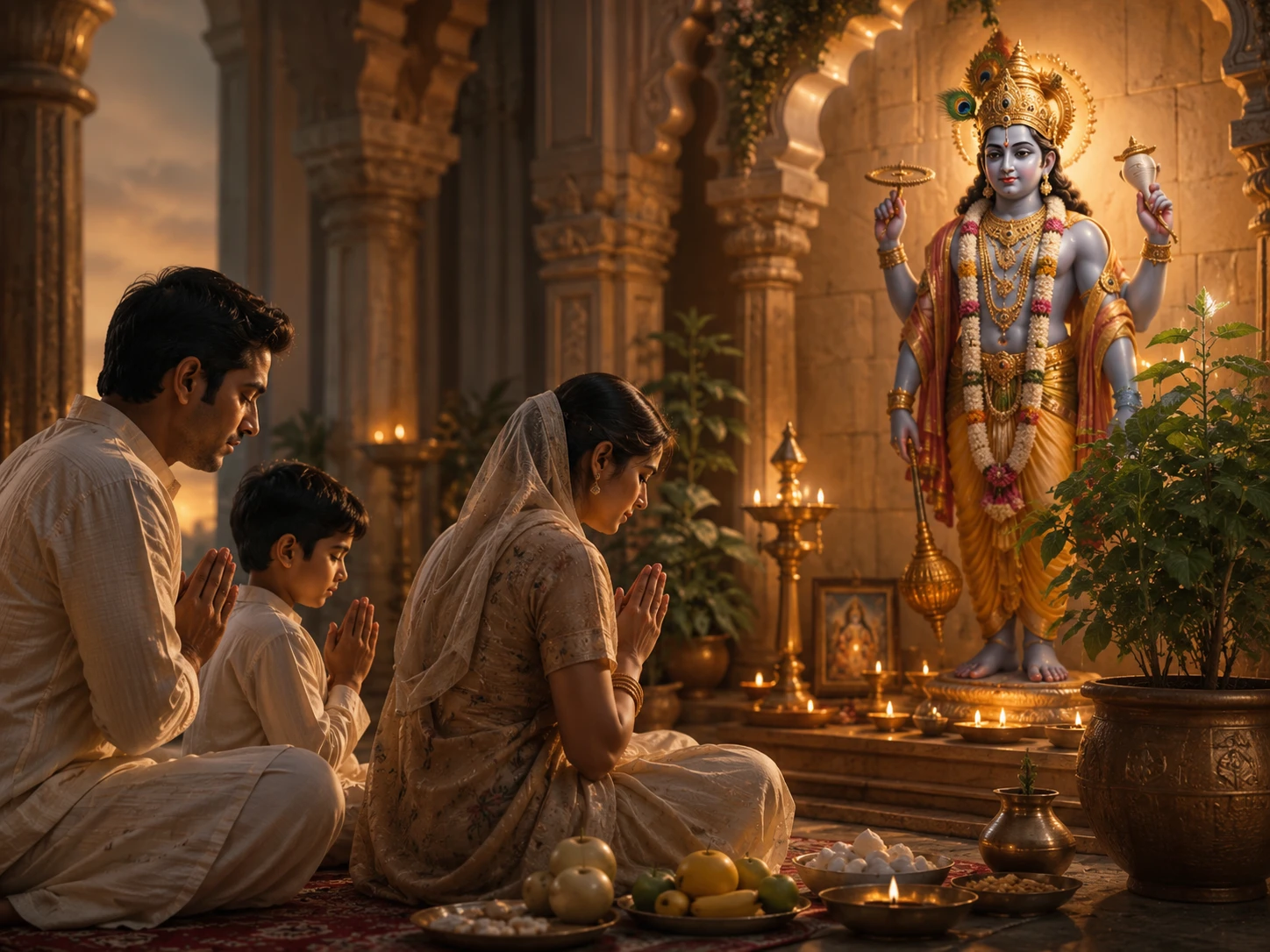
In an ISKCON temple in Vrindavan, Moscow, or Nairobi, the routine shifts every eleven days. The kitchen stops cooking rice and dal. Devotees prepare only fruit, milk, nuts, and specific root vegetables. The chanting intensifies. The atmosphere changes. This is Ekadashi -- the eleventh lunar day -- and for Vaishnavas worldwide, it is the most important regular observance in the calendar, more fundamental than any festival.
The word Ekadashi means simply 'the eleventh.' It falls on the 11th Tithi (lunar day) of both the Shukla Paksha (waxing moon) and Krishna Paksha (waning moon), which means it occurs twice every lunar month -- 24 times in a normal year, 26 in a year with an Adhika (leap) month.
But the number 11 carries a deeper significance than its calendrical position. According to the Padma Purana, when Lord Vishnu defeated the demon Mura, a radiant feminine energy manifested from His body on the 11th lunar day. Vishnu named her Ekadashi and declared that anyone who fasted on her day, controlling all 11 senses (5 Jnana Indriyas or knowledge senses, 5 Karma Indriyas or action senses, and 1 Manas or mind), would be freed from sin and drawn toward His abode.
The 11 senses are the key. Ekadashi is not merely about not eating. It is about withdrawing every sensory channel from worldly indulgence and redirecting it toward the divine. The fast from food is the most visible and measurable expression of this withdrawal, but the complete Ekadashi observance includes restraint of speech, restraint of sight (avoiding trivial entertainment), restraint of hearing (avoiding gossip), and restraint of mind (avoiding agitation). The grain-fast is the entry point; the sense-mastery is the destination.
The Padma Purana goes further with an extraordinary theological detail: on Ekadashi, all sin (Papapurusha) takes refuge in grain. This is why grains -- rice, wheat, barley, dal, beans -- are specifically prohibited. Not because grain is inherently impure, but because on this specific Tithi, the cosmic arrangement places the residue of adharma in grain. Eating grain on Ekadashi is, in this framework, like knowingly ingesting a contaminant. The prohibition is protective, not punitive.
एकादश्यां तु यो भक्त्या विष्णोरर्चनतत्परः। सर्वपापविनिर्मुक्तः परं याति सनातनम्॥
ekādaśyāṁ tu yo bhaktyā viṣṇor arcana-tatparaḥ sarva-pāpa-vinirmuktaḥ paraṁ yāti sanātanam
The devotee who worships Lord Vishnu with devotion on Ekadashi becomes free from all sins and attains the eternal supreme abode.
— Skanda Purana, Vaishnava Khanda
The 24 Ekadashis -- Each With Its Own Story and Power
Each of the 24 (or 26) annual Ekadashis has a unique name, a specific Katha (story narrated by Krishna to Yudhishthira in the Padma Purana), a presiding form of Vishnu, and a particular blessing. The most significant include:
Nirjala Ekadashi (Jyeshtha Shukla): the most severe -- a complete fast without even water, observed in the peak heat of summer. Bhima, who could not observe regular Ekadashis due to his enormous appetite, was granted permission to observe just this one with full Nirjala austerity, gaining the merit of all 24 Ekadashis combined. This is the most physically demanding Vrata in the Hindu calendar.
Devshayani Ekadashi (Ashadha Shukla): the day Vishnu goes to sleep (Yoga Nidra) on Shesha Naga for four months. The Chaturmas period begins -- no weddings, no new ventures, no celebrations until Prabodhini Ekadashi.
Prabodhini / Dev Uthani Ekadashi (Kartik Shukla): Vishnu awakens. The wedding season opens. Tulsi Vivah is performed. One of the most joyous Ekadashis.
Vaikunta Ekadashi (Margashirsha Shukla): considered the most sacred in South India. Ranganathaswamy Temple in Srirangam opens the Vaikunta Dwara (Gate of Heaven) only on this day. Millions queue for darshan through this gate, believing that passing through it leads to Vaikunta.
Mokshada Ekadashi (same day as Vaikunta, different regional names): the day Krishna spoke the Bhagavad Gita to Arjuna on the battlefield of Kurukshetra. Gita Jayanti is celebrated.
The Padma Purana dedicates an entire section (Uttara Khanda) to narrating the Katha of each Ekadashi, with Krishna explaining to Yudhishthira which Ekadashi falls when, which form of Vishnu presides, and what specific merit accrues.
Notable Ekadashis -- A Quick Reference
| Ekadashi | एकादशी | Month | Significance | Fasting Level |
|---|---|---|---|---|
| Nirjala | निर्जला | Jyeshtha Shukla | Most severe; Bhima's Ekadashi; merit of all 24 | No food, no water |
| Devshayani | देवशयनी | Ashadha Shukla | Vishnu sleeps; Chaturmas begins | Grain-free |
| Prabodhini | प्रबोधिनी | Kartik Shukla | Vishnu awakens; Tulsi Vivah | Grain-free |
| Vaikunta / Mokshada | वैकुण्ठ / मोक्षदा | Margashirsha Shukla | Vaikunta Gate opens; Gita Jayanti | Grain-free |
| Putrada | पुत्रदा | Shravan Shukla | Boon of progeny | Grain-free |
| Papamochani | पापमोचनी | Chaitra Krishna | Destroys all accumulated sin | Grain-free |
| Kamada | कामदा | Chaitra Shukla | Fulfils desires; story of Lalit-Lalita | Grain-free |
There are 24 named Ekadashis in a standard lunar year. In an Adhika (leap) month, two additional Ekadashis appear. ISKCON and Gaudiya Vaishnava traditions maintain the strictest observance, prohibiting all grains and beans.
The Science -- Ekadashi and Intermittent Fasting
The convergence between traditional Ekadashi observance and modern intermittent fasting research is striking.
A standard Ekadashi fast begins the evening before (Dashami) with a light sattvic meal before sunset, continues through the entire Ekadashi day with no grain consumption (fruit, milk, and nuts permitted), and concludes the morning after (Dvadashi) when the fast is broken. The total fasting window from grain is approximately 36-48 hours, depending on the strictness of observance.
This maps closely onto the 36-hour and 48-hour fasting protocols studied in clinical research. A landmark 2019 review in the New England Journal of Medicine by Mark Mattson confirmed that periodic fasting of this duration triggers autophagy (cellular self-cleaning), improves insulin sensitivity, reduces systemic inflammation, enhances neuroplasticity, and may extend lifespan.
The twice-monthly frequency is also significant. Research on periodic fasting (as opposed to daily intermittent fasting) suggests that fasting once or twice per month at the 36-48 hour level provides many of the same benefits as daily restriction, without the adherence challenges. The Ekadashi system prescribes exactly this: two 36-48 hour fasts per month, 24 per year.
The prohibition specifically on grain (rather than all food) also has an Ayurvedic rationale. Grains are heavy to digest (guru, or 'heavy' in Ayurvedic classification) and increase Kapha dosha. On the 11th Tithi, the moon's gravitational influence on body fluids is at a specific phase where digestive capacity (Agni) is believed to be weaker. Avoiding heavy food on this day gives the digestive system a rest -- a principle that modern gastroenterology would endorse as periodical gut rest.
For the biohacker in Indiranagar who tracks macros and does 16:8 intermittent fasting: try a full Ekadashi fast. The protocol is more demanding than 16:8 but less extreme than a 72-hour water fast. And unlike secular fasting, the Ekadashi framework provides a community (millions fasting on the same day), a narrative (the Katha), a practice (chanting and puja during the fast), and a purpose (devotion to Vishnu). These psychological scaffolds make the fast easier to sustain and more meaningful to complete.
The ISKCON movement has made Ekadashi the most globally observed Hindu Vrata. With temples in over 100 countries, ISKCON devotees in Moscow, Nairobi, Sao Paulo, Sydney, and New York all fast on the same Tithi, creating a planetary network of simultaneous fasting. ISKCON's official Vaishnava Calendar app provides Ekadashi dates adjusted for every timezone, including the precise Parana (fast-breaking) window. The movement's founder, Srila Prabhupada, called Ekadashi 'the day of Lord Hari' and insisted that even new devotees observe it from their first month -- making it the entry-level practice that has introduced millions worldwide to Hindu spiritual discipline.
The Ambarisha Story -- When Even Durvasa Bowed to Ekadashi
The most dramatic narrative about Ekadashi's power comes from the Bhagavata Purana (Skandha 9, Chapter 4-5) -- the story of King Ambarisha and the sage Durvasa.
Ambarisha was a king who observed Ekadashi with absolute devotion. He fasted, chanted Vishnu's names, performed puja through the night, and prepared to break his fast (Parana) on Dvadashi at the prescribed time. Just as the Parana window was about to close, the temperamental sage Durvasa arrived as a guest. Protocol demanded that Ambarisha feed the sage before eating. But Durvasa went to bathe in the Yamuna and delayed his return. The Parana window was closing. If Ambarisha ate without feeding the guest, he violated Atithi Dharma. If he waited for Durvasa and missed the window, he violated Ekadashi Vrata Dharma.
Ambarisha resolved the dilemma with a stroke of genius: he sipped a few drops of water (technically breaking the fast, since water is considered neither food nor non-food in this context) and waited for Durvasa. When Durvasa returned and learned that Ambarisha had broken his fast without feeding him first, he was furious. He created a demonic fire (Kritya) to destroy Ambarisha. But Vishnu's Sudarshana Chakra intervened, destroying the Kritya and pursuing Durvasa across the three worlds. Terrified, Durvasa appealed to Brahma, then Shiva, then Vishnu himself -- all of whom said they could not recall the Chakra; only Ambarisha could, because it was the devotee's merit that had activated the divine protection.
Durvasa had to return and beg Ambarisha's forgiveness. Ambarisha, true to his nature, forgave immediately and prayed for Durvasa's welfare. The Chakra withdrew.
This story teaches three principles: first, that the Ekadashi Vrata creates a protective shield (Vishnu's Chakra) around the devoted observer. Second, that even the most powerful sages cannot override the merit of sincere devotion. Third, that the resolution of dharmic conflicts requires creativity, humility, and grace -- not rigidity.
For the UPSC aspirant studying ethics: the Ambarisha-Durvasa dilemma is a perfect case study in competing dharmic obligations. It belongs in the ethics paper alongside the Trolley Problem and the Prisoner's Dilemma -- as a specifically Indian framework for thinking about moral conflict where every option involves sacrifice.
Ekadashi for Beginners -- Your First Fast
If you have never observed Ekadashi, here is a beginner-friendly protocol that the tradition fully supports:
Dashami (day before): Eat a simple sattvic dinner before sunset. Avoid heavy, rajasic, or tamasic food. Set your intention (Sankalpa) for the next day's fast.
Ekadashi day: Wake during Brahma Muhurta if possible. Bathe and wear clean clothes. Perform a simple puja to Vishnu or Krishna -- even lighting a diya and offering Tulsi with 'Om Namo Bhagavate Vasudevaya' is sufficient. Throughout the day, avoid all grains (rice, wheat, dal, beans, oats). You may eat fruits, nuts, milk, yogurt, potatoes, sweet potatoes, and sabudana (tapioca). If this is your first Ekadashi, do not attempt Nirjala (waterless) fasting -- that is an advanced practice.
During the day, chant Vishnu Sahasranama or the Maha Mantra (Hare Krishna Hare Krishna Krishna Krishna Hare Hare, Hare Rama Hare Rama Rama Rama Hare Hare). Read a chapter of the Bhagavad Gita or the Bhagavata Purana. Avoid gossip, anger, and unnecessary screen time. The fast is not just dietary -- it extends to the senses.
Dvadashi (next morning): Break the fast during the Parana window (check Drik Panchang for your city's exact timing -- typically within a few hours after sunrise). Break with a simple grain-based meal -- khichdi is traditional. Offer the food to Vishnu before eating (Naivedya). Share the Prasada with family.
That is it. One Ekadashi. If you feel the difference -- the lightness, the clarity, the sense of accomplishment -- you will understand why millions observe it twice a month without being told to. The tradition does not need to convince you. The experience does.
The Lunar Connection -- Why the 11th Day Specifically
The choice of the 11th lunar day is not arbitrary. Ayurvedic and Jyotisha traditions hold that the moon exerts a measurable influence on bodily fluids -- just as it governs ocean tides. On the 11th day of the lunar cycle (both waxing and waning), the moon's gravitational pull on the earth's water reaches a specific phase that, according to the tradition, affects the digestive fire (Jatharagni) and the movement of fluids in the body.
Modern research on lunar cycles and human physiology is inconclusive but suggestive. A 2013 study published in Current Biology found that human sleep patterns shifted measurably with lunar phases -- subjects slept 20 minutes less and took 5 minutes longer to fall asleep around the full moon, even in controlled laboratory conditions with no moonlight exposure. A 2021 study in Science Advances confirmed that human sleep-wake cycles synchronise with lunar periodicity. While these studies do not directly validate the Ekadashi mechanism, they establish that lunar influence on human biology is not purely mythological.
The Ayurvedic perspective is more specific. On the Ekadashi Tithi, the body's water content is believed to be in a transitional state -- the Kapha dosha is elevated, digestive capacity is reduced, and the accumulation of Ama (metabolic waste) increases. Fasting on this specific day allows the body to process accumulated Ama without adding new digestive burden. This is why Ayurvedic physicians in Kerala and Karnataka traditionally recommended Ekadashi fasting as a health practice long before it became associated primarily with Vaishnava devotion.
The grain-specific prohibition also has a lunar rationale. Grains are Kapha-increasing foods -- heavy, moisture-retaining, and slow to digest. On a day when Kapha is already elevated due to lunar influence, adding grain creates a surplus that the body struggles to process. Fruits, nuts, and milk are comparatively lighter and do not aggravate the Kapha imbalance. The dietary restriction is thus not arbitrary religious prohibition but targeted nutritional advice calibrated to a specific day's physiological conditions.
For the Ayurveda student at Jamnagar or Coimbatore: Ekadashi fasting is clinical nutrition aligned with the lunar biorhythm. For the biohacker: it is a twice-monthly metabolic reset timed to a gravitational cycle. For the devotee: it is a day with Lord Hari. All three are true simultaneously.
Observe Your Next Ekadashi
Check a panchang for the next Ekadashi in your city. Skip grains for the day and eat only fruit, milk and nuts. Chant Om Namo Bhagavate Vasudevaya 108 times on a mala, and break the fast the next morning in the parana window. One Ekadashi will show you why millions keep it twice a month. The mantra's page on Eternal Raga gives its meaning and how to chant it.
Eternal Raga · शाश्वत राग
Institutional voice — scholarly articles on Sanatan Dharma
Deepen Your Understanding
अपनी समझ और गहरी करें
rituals traditions
Vrata -- What a Hindu Vow Really Means (It Is Not Just Fasting)
Your mother kept Karva Chauth without water for sixteen hours. Your grandmother observed Ekadashi every fortnight without fail. Your colleague skips lunch on Tuesdays 'for Hanuman.' The world sees Hindu fasting as dietary restriction. The tradition sees it as something far more radical: Vrata is a voluntary, time-bound act of self-imposed discipline that rewires the relationship between desire and willpower. Fasting is the most visible expression. But the real Vrata happens inside.
rituals traditions
Nitya, Naimittika, and Kamya Karma -- The Three Categories of Duty
Hinduism does not say 'do good things.' It says 'know which kind of action you are performing and why.' The three-fold classification of Karma into Nitya (daily non-negotiable), Naimittika (occasion-triggered), and Kamya (desire-driven) is the most practical decision-making framework the tradition offers -- and it works as well in a Bangalore startup as it did in a Vedic gurukul.
deities avatars
Dashavatara -- Why Vishnu Comes Back Ten Times
Fish, tortoise, boar, half-lion, dwarf, axe-warrior, prince, cowherd, enlightened teacher, future horseman. The ten avatars of Vishnu are not random folklore. Read them in sequence and you get something startling -- a narrative that mirrors evolutionary biology, tracks the rise and fall of political systems, and argues that God does not sit above history but enters it, gets dirty, and does the work. The Dashavatara is Hinduism's answer to the question every civilisation asks: why does the world keep breaking, and who fixes it?
rituals traditions
Naivedya and Prasada -- Why Hindus Feed God Before They Eat
You cook food. You place it before the deity. You wait. The food has not physically changed -- same molecules, same temperature, same taste. And yet the tradition insists that something fundamental has transformed. What went in as Naivedya (offering) comes out as Prasada (grace). This transformation is not chemistry. It is theology -- and it may be the most quietly radical idea in all of Hindu practice.
rituals traditions
Sankalpa -- The Ritual GPS That Locates You in the Cosmos Before Every Puja
Before any Hindu ritual begins, there is a quiet declaration that most people rush through without understanding. It names the current cosmic age, the ruling Manu, the Yuga, the year, the season, the month, the fortnight, the day, the star, the continent, the country, the river, your name, your lineage, and your exact intention. This declaration -- Sankalpa -- is the most sophisticated geo-temporal tagging system in any religious tradition. It tells the universe: I am here, I am this person, and I intend to do this specific act.
rituals traditions
Navratri -- Nine Nights That Transform India
For nine nights, India becomes a different country. In Gujarat, millions dance garba till dawn. In Bengal, the streets turn into open-air art galleries. In Varanasi, nine temples light up in sequence. In Mysore, the palace blazes with 100,000 bulbs. Navratri is not a single festival -- it is nine nights of goddess worship that unite India's most diverse traditions into one cosmic celebration.
rituals traditions
Puja at Home -- The Complete Beginner's Guide
You have a small mandir shelf in your apartment. A brass diya your mother gave you. A photo of a deity you feel drawn to. And absolutely no idea what to do next. This guide is for you -- the 22-year-old in Pune who just moved out, the NRI in New Jersey setting up a puja corner for the first time, the curious soul who wants to start but does not know where.
The ISKCON movement has made Ekadashi the most globally observed Hindu Vrata. With temples in over 100 countries, ISKCON devotees in Moscow, Nairobi, Sao Paulo, Sydney, and New York all fast on the same Tithi, creating a…
More in Rituals & Traditions
Aarti -- Why Hindus Circle Light Before God
13 min read
Abhisheka -- Why Hindus Bathe Their Gods
10 min read
Akshaya Tritiya -- The Day Nothing Given Away Runs Out
12 min readThe same translation error that turned '33 Koti' into '33 crore' in Hinduism also happened in Buddhism. The Chinese translation of Buddhist texts rendered 'Sapta Koti Buddha' (7 Supreme Buddhas) as '7 Crore Buddhas.' The…
Deities AvatarsCommunity Reflections
🕉️
Be the first to share your reflection.