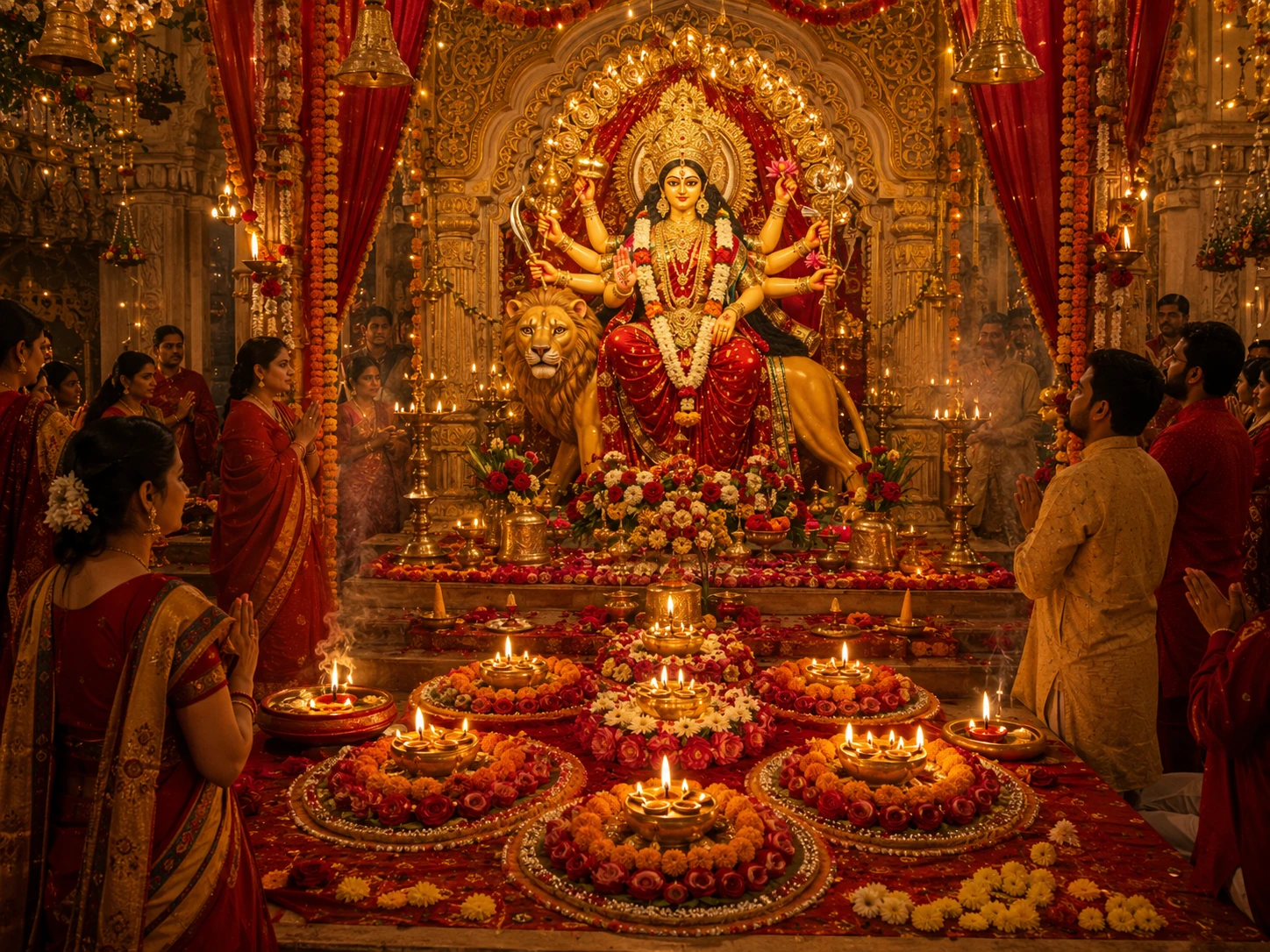
Navratri -- Nine Nights That Transform India
नवरात्रि -- नौ रातें जो भारत को बदल देती हैं
Every October, something extraordinary happens across India. A country that cannot agree on language, politics, cuisine, or cricket strategy finds itself united by the same nine nights. The UPSC aspirant in Old Rajinder Nagar takes a break from polity notes to visit the neighbourhood pandal. The investment banker in Nariman Point ducks out of a late meeting because garba starts at nine. The NRI in New Jersey sets up a makeshift Kalash in her apartment and video-calls her mother in Indore for Ghatasthapana instructions. The farmer in Madhya Pradesh begins nine days of fasting that will end with the same Vijayadashami on which the urban India celebrates Dussehra.
Navratri -- literally 'nine nights' -- is Hinduism's most geographically diverse and emotionally intense festival. It occurs four times a year (Sharad, Chaitra, Magha, Ashadha), but the Sharad Navratri in September-October is the great one, the one that transforms the country. Unlike Diwali (which is essentially one night of intensity) or Holi (one day of colour), Navratri sustains its energy across nine consecutive nights, building like a raga from the quiet alap of Ghatasthapana to the thundering climax of Vijayadashami.
The festival is simultaneously a theological journey (worshipping nine forms of the Goddess), a seasonal transition (marking the shift from monsoon to autumn), a martial celebration (Rama's victory over Ravana, which is why Vijayadashami is also Dussehra), a social event (India's largest annual dance festival in Gujarat alone draws over 10 million participants), and an economic engine (Navratri spending in India is estimated at over 30,000 crore rupees annually, rivalling Diwali in some states).
But at its core, Navratri is about the Goddess. Everything else -- the commerce, the dance, the social bonding, the food -- exists because nine nights were set aside to honour the feminine divine. To understand Navratri is to understand how India worships: not in silence and solitude, but in movement, colour, sound, and community.
सर्वमंगलमांगल्ये शिवे सर्वार्थसाधिके। शरण्ये त्र्यम्बके गौरि नारायणि नमोऽस्तुते॥
sarvamaṅgalamāṅgalye śive sarvārthasādhike | śaraṇye tryambake gauri nārāyaṇi namo'stute ||
O auspicious of all that is auspicious, O consort of Shiva, O accomplisher of all objectives, O refuge, O three-eyed Gauri, O Narayani, salutations to you.
— Devi Mahatmya, Chapter 11, Verse 10 (Narayani Stuti)
Ghatasthapana -- The Cosmic Seed Is Planted
Navratri begins with Ghatasthapana -- the installation of the sacred pot. A clay or copper pot (Kalash) is filled with water, covered with mango leaves and a coconut, placed on a bed of soil in which barley seeds have been sown. This is done during a specific muhurta on Pratipada (the first day), usually in the morning.
The symbolism is layered. The pot is the cosmic womb (Brahmanda). The water is the primordial ocean. The mango leaves represent life force. The coconut is the Goddess's face -- three marks for three eyes. And the barley seeds, which will sprout over the nine days, represent the creative power of Shakti: what is planted in devotion grows in the darkness of faith.
By the ninth night, if the seeds have sprouted strong green shoots, it is considered an auspicious sign for the household. In many families, the height and health of these sprouts determine the family's confidence about the coming year -- a living, botanical oracle that connects agriculture, religion, and domestic hope.
In Rajasthan and parts of Gujarat, the Ghatasthapana also involves the Akhand Jyoti -- a continuously burning lamp that must not extinguish for nine days. Keeping this lamp alive becomes a family project, with members taking shifts to ensure the flame survives. For a generation raised on Instagram stories with 24-hour expiry, there is something profound about committing to a flame that must burn unbroken for 216 hours.
Regional Navratris -- One Festival, Many Indias
Navratri's genius is that it is simultaneously universal (same nine nights, same Goddess) and radically local (every region celebrates it differently). This section maps the major regional traditions.
Gujarat: The heartland of Navratri as dance. The garba -- a circular dance around a central lamp representing the Goddess's womb (garbha deep) -- is the world's largest participatory dance tradition. In Ahmedabad, Vadodara, Rajkot, and Surat, grounds are set up that hold 10,000 to 50,000 dancers. Live orchestras play folk songs that transition into Bollywood remixes. The nine nights build in tempo: the first three nights are relatively restrained, the middle three accelerate, and the last three are ecstatic marathons where dancers collapse with exhaustion at 4 AM. Dandiya Raas -- the stick dance -- adds a martial dimension, its clashing sticks originally representing the clash of swords in the Goddess's battle.
Bengal: Navratri is Durga Puja, and Durga Puja is not a festival but a civilisational event. For five days (Shashthi to Dashami), Kolkata becomes the world's largest outdoor art installation. Over 30,000 pandals transform every neighbourhood into a themed universe -- from replicas of Roman temples to installations made entirely from recycled electronic waste. The artistic ambition is staggering. In 2019, UNESCO inscribed Durga Puja as an Intangible Cultural Heritage of Humanity. The emotional peak is Sindoor Khela on Dashami, when married women smear vermillion on each other and on Ma Durga's image before the idol is immersed in the Hooghly. Hardened Bengali intellectuals who dismiss religion all year weep openly during visarjan.
Mysore: Dasara (the local spelling of Dussehra) transforms Mysore into a royal spectacle. The Mysore Palace is illuminated with nearly 100,000 light bulbs. A grand procession features a golden howdah atop an elephant carrying the idol of Chamundeshwari -- the palace goddess and the city's tutelary deity. The tradition dates to the Vijayanagara Empire (15th century) and was revived by the Wodeyar dynasty. It remains one of the few living royal celebrations in democratic India.
North India (Hindi Belt): The emphasis shifts to Ram Lila -- dramatic re-enactments of the Ramayana performed across nine nights, culminating in the burning of Ravana's effigy on Vijayadashami. In Delhi, the Ram Lila at Red Fort grounds has been performed for over 200 years. In Varanasi, the Ramnagar Ram Lila is performed across a 4-square-kilometre area using multiple stages, making it one of the world's largest theatrical productions. The audience walks from stage to stage following the story -- making the viewer a pilgrim.
Navratri Across India -- Regional Expressions
| Region | Primary Expression | Key Ritual | Duration Focus | Cultural Highlight |
|---|---|---|---|---|
| Gujarat | Garba and Dandiya Raas | Garbha Deep (womb lamp) | All 9 nights equally | World's largest participatory dance tradition |
| Bengal | Durga Puja | Prana Pratishtha (idol consecration) | Shashthi to Dashami (5 days) | UNESCO Intangible Cultural Heritage (2021) |
| Mysore / Karnataka | Dasara procession | Chamundeshwari puja at palace | Vijayadashami climax | Royal elephant procession with golden howdah |
| North India (Hindi Belt) | Ram Lila | Ravana effigy burning | Builds to Dussehra | Ramnagar Ram Lila across 4 sq km |
| Himachal Pradesh | Kullu Dussehra | Raghunath deity procession | Starts on Vijayadashami (7 days) | 200+ village deities gather in Kullu Valley |
| Tamil Nadu | Golu / Kolu | Bommai Golu (doll display) | All 9 nights | Terraced doll displays depicting mythology and modern life |
| Maharashtra | Ghatasthapana + Garba | Akhand Jyoti lamp | All 9 nights | Blend of Gujarati garba and local Marathi traditions |
Kullu Dussehra is unique in that it begins on Vijayadashami when most of India's Navratri ends, and continues for seven more days. Over 200 village deities from across the Kullu Valley are carried to the town in palanquins for a grand gathering -- making it the world's largest assembly of local deities.
The Spiritual Architecture -- Nine Nights, Nine Transformations
Navratri is not nine repetitions of the same worship. It is a structured spiritual journey in which each night carries a distinct energy, a distinct form of the Goddess, and a distinct internal transformation for the devotee.
Nights 1-3 are dedicated to Kali / Durga energy (Tamas dissolution). The devotee confronts inertia, lethargy, and fear. Fasting begins. The body protests. The mind resists discipline. This is the phase of purification -- the breaking down of old patterns. Shailaputri (potential), Brahmacharini (discipline), and Chandraghanta (courage) guide the devotee through this threshold.
Nights 4-6 are dedicated to Lakshmi energy (Rajas activation). The devotee moves from dissolution to construction. Energy surges. Fasting becomes easier as the body adapts. Creativity flows. This is the phase of empowerment. Kushmanda (cosmic creation), Skandamata (nurturing power), and Katyayani (fierce focus) guide this middle passage.
Nights 7-9 are dedicated to Saraswati energy (Sattva illumination). The devotee experiences clarity, insight, and expanded awareness. Kalaratri (destruction of ignorance) strips away the last veils. Mahagauri (radiant purity) reveals what was always there beneath the layers. Siddhidatri (completeness) bestows the integration of all nine energies into one unified awareness.
Vijayadashami (the tenth day) is not another night of worship. It is the victory that follows the nine-night transformation -- the moment the devotee carries the Goddess's energy back into the world. This is why Dussehra is the traditional day to begin new ventures, buy new vehicles, start new courses. The nine nights were preparation. The tenth day is launch.
This structure maps remarkably well onto modern psychological models of transformation: the hero's journey (threshold-initiation-return), the stages of grief (denial-bargaining-acceptance), and the process of any serious personal change (resistance-action-integration). The Rishis who designed Navratri understood something that modern self-help gurus are still rediscovering: transformation is not an event. It is a nine-night process.
Gujarat's garba nights have become one of India's largest economic micro-ecosystems. The nine-night festival generates an estimated 25,000+ crore rupees in Gujarat alone, spanning live event infrastructure, ethnic wear retail (chaniya choli sales spike 400% in September), food stalls, dandiya stick manufacturing, sound and lighting rental, parking management, and increasingly, corporate sponsorship deals. Major tech companies now sponsor garba grounds the way they sponsor IPL teams. Ahmedabad's GMDC Ground garba event sells passes ranging from 500 to 25,000 rupees per night. For many small businesses -- from costume jewellery vendors to coconut water sellers -- these nine nights generate more revenue than the rest of the year combined.
Keep the Nine Nights with Durga
Honour one form of the goddess each night, from Shailaputri on the first to Siddhidatri on the ninth, and chant the Navarna mantra 108 times on a mala. Check a panchang for the Ghatasthapana muhurta in your city. Durga's hymns and aartis are gathered on Eternal Raga for each night's worship.
Tags
Eternal Raga · शाश्वत राग
Institutional voice — scholarly articles on Sanatan Dharma
Deepen Your Understanding
अपनी समझ और गहरी करें
deities avatars
Devi Swaroopa -- Forms of the Goddess
She is Durga on the battlefield and Annapurna in the kitchen. She is Kali at the cremation ground and Lakshmi in the boardroom. She is Saraswati at the university and Parvati in the family. The Hindu Goddess is not one deity with accessories -- she is the entire spectrum of feminine power, from terrifying to tender, from cosmic to domestic. Understanding her forms is understanding the universe itself.
scriptural exegesis
Devi Mahatmya -- The Three Charitas That Changed How India Worships the Feminine
700 verses. 13 chapters. Three battles. One thesis: when every god in the universe has failed, a woman finishes the job. The Devi Mahatmya from the Markandeya Purana is not just a scripture -- it is the founding document of Shakta theology and the reason 300 million people celebrate Navaratri.
rituals traditions
Durga Puja -- The Ritual System Behind the World's Largest Art Festival
Behind the spectacular pandals and the Instagram-worthy lighting lies a ritual system of extraordinary precision. From the moment the sculptor draws the first line on Mahalaya to the heartbreaking immersion on Dashami, every step of Durga Puja follows a choreography that is part Vedic ritual, part Tantric sadhana, and part Bengali genius. UNESCO recognised it in 2021. Here is what they recognised.
deities avatars
Kali -- The Fierce Mother Who Devours Time Itself
Black-skinned, wild-haired, wearing a garland of fifty severed heads and a skirt of severed arms, standing on Shiva's chest with her tongue extended in shock -- Kali is the most misunderstood deity in Hinduism and the most theologically radical. She is not a demon. She is not 'dark energy.' She is Time in feminine form, the cosmic mother who destroys everything so that everything can be reborn. Ramakrishna called her 'Ma.' Millions still do.
tantra mantra yantra
Dasha Mahavidya -- Ten Wisdom Goddesses Who Map the Entire Universe
One holds her own severed head. Another is an ugly old widow. A third paralyses enemies by seizing their tongues. The Dasha Mahavidya are not comfortable goddesses. They are the ten dimensions of reality that most religions are too afraid to acknowledge -- from transcendent beauty to terrifying destruction, from cosmic abundance to abject poverty. Together, they form the most complete map of feminine divinity ever conceived.
philosophy darshana
Shakta Philosophy -- Devi as Ultimate Reality
What if God is not He but She? Not an abstract principle but a living, breathing, dancing power? Shakta philosophy does not merely add a feminine dimension to Hindu theology. It inverts the entire structure: Shakti is the primary reality, and consciousness without her is inert. Shiva without Shakti is shava -- a corpse. This is not metaphor. This is metaphysics.
deities avatars
Durga -- The Warrior Goddess Who Cannot Be Defeated
When every male god in the Hindu pantheon failed to defeat the buffalo demon Mahishasura, they pooled their tejas -- their divine radiance and rage -- into a single being. What emerged was not another god. It was a goddess. And she succeeded where they could not. That is the origin story of Durga, and it rewrites every assumption about power.
Gujarat's garba nights have become one of India's largest economic micro-ecosystems. The nine-night festival generates an estimated 25,000+ crore rupees in Gujarat alone, spanning live event infrastructure, ethnic wear r…
More in Rituals & Traditions
Aarti -- Why Hindus Circle Light Before God
13 min read
Abhisheka -- Why Hindus Bathe Their Gods
10 min read
Akshaya Tritiya -- The Day Nothing Given Away Runs Out
12 min readThe same translation error that turned '33 Koti' into '33 crore' in Hinduism also happened in Buddhism. The Chinese translation of Buddhist texts rendered 'Sapta Koti Buddha' (7 Supreme Buddhas) as '7 Crore Buddhas.' The…
Deities AvatarsCommunity Reflections
🕉️
Be the first to share your reflection.