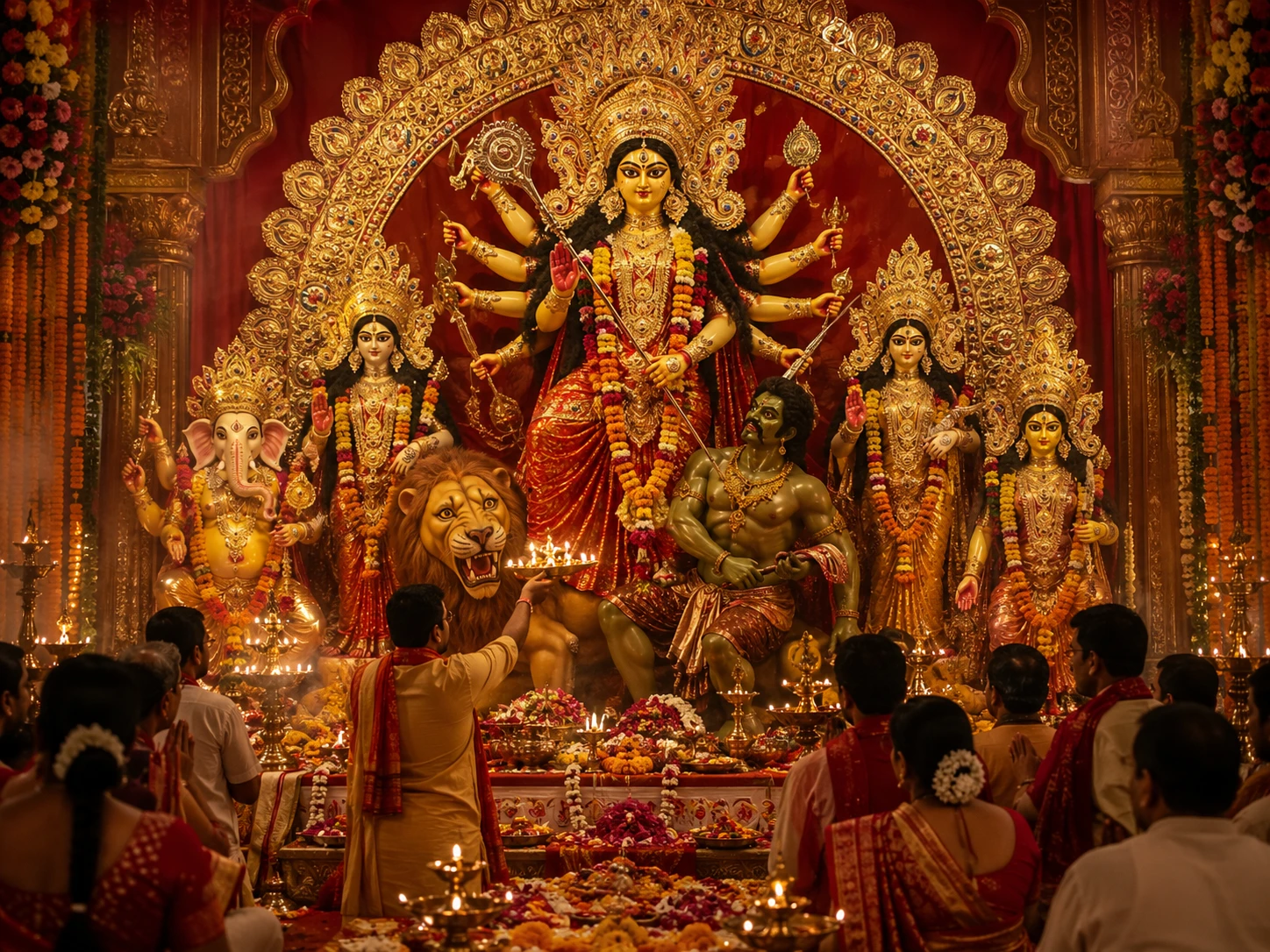
Durga Puja -- The Ritual System Behind the World's Largest Art Festival
दुर्गा पूजा -- विश्व के सबसे बड़े कला उत्सव की अनुष्ठान प्रणाली
At 4 AM on Mahalaya morning, Bengal wakes up. Not to an alarm, but to the voice of Birendra Krishna Bhadra. Since 1931, All India Radio has broadcast his recitation of the Chandipath -- the Devi Mahatmya set to dramatic narration with orchestral accompaniment. Bengalis set their radios (now phones) to tune in. Children are woken by grandmothers. Fathers make tea. The entire household listens in the pre-dawn darkness as Bhadra's deep voice narrates the Goddess's descent to earth. Mahalaya marks the beginning of Devi Paksha -- the fortnight of the Goddess -- and the unofficial start of Durga Puja.
For the next sixteen days, Kolkata becomes a city possessed. Over 30,000 pandals rise from every neighbourhood, each competing to be more spectacular, more conceptual, more emotionally resonant than the last. The city's annual GDP temporarily spikes. Schools close. Offices empty. The streets fill with the specific Bengali combination of intellectual critique, aesthetic appreciation, and unabashed devotion that makes Durga Puja unlike any other religious festival on earth.
But beneath the spectacle runs a ritual system of immense precision. The UNESCO recognition in 2021 was not just for the art or the social bonding -- it was for the living intangible heritage of a ritual sequence that has been performed, refined, and transmitted for centuries. Every step, from the sculptor's first cut to the final immersion, carries theological meaning.
या देवी सर्वभूतेषु चेतनेत्यभिधीयते। नमस्तस्यै नमस्तस्यै नमस्तस्यै नमो नमः॥
yā devī sarvabhūteṣu cetanetyabhidhīyate | namastasyai namastasyai namastasyai namo namaḥ ||
To the Devi who abides in all beings and is spoken of as Consciousness -- salutation to her, salutation to her, salutation to her, again and again.
— Devi Mahatmya, Chapter 5, Verses 17-19 (Aparajita Stuti)
The Idol -- From Ganga Clay to Living Goddess
The Durga idol is not manufactured. It is born. The process begins months before Puja in Kumartuli -- the potter's quarter of North Kolkata, a labyrinth of narrow lanes where families have been sculpting Durga idols for over 300 years.
The clay must come from the banks of the Ganga (or Hooghly). But tradition requires one additional ingredient: mitti from the doorstep of a sex worker's house. This startling requirement is not accidental. The Tantric theology underlying Durga Puja insists that the divine is present everywhere -- including in the most socially marginalised spaces. The sex worker's mitti sanctifies the idol precisely because it comes from a place that 'respectable' society rejects. The Goddess, by definition, encompasses all of reality.
The sculptor (Sutradhar) begins with a bamboo frame, adds straw, then layers of clay. The face is always the last element to be sculpted -- and the eyes are the last to be painted. This is because the eyes are where the Goddess 'enters' the idol during Prana Pratishtha (the life-installation ceremony). Until the eyes are painted, it is clay. After the eyes, it is the Goddess.
The Chakshu Daan (eye-giving) ceremony happens on Mahalaya morning. Across Kumartuli, sculptors paint the final strokes on thousands of Durga eyes simultaneously. It is one of the most photographed moments in Indian art -- and one of the most theologically precise. The sculptor is not decorating a statue. He is opening a portal.
The Five Days -- Shashthi to Dashami
Shashthi (Day 6 of Navratri): The Goddess arrives. Bodhon -- the 'awakening' ceremony -- formally invites the Goddess from her cosmic sleep. The face of the idol is unveiled. A mirror is held before her so she can 'see' herself for the first time. A Bel (wood apple) tree is ritually consecrated because it is believed to be where the Goddess first rested upon arriving on earth. The mood is anticipation -- like the arrival of a beloved daughter who has been away all year. Because that is precisely who Durga is in Bengali theology: a married daughter returning to her parental home.
Saptami (Day 7): The full puja begins. Navapatrika -- nine plants wrapped in a white sari and bathed in the Ganga -- represents the Goddess's botanical presence (she is present not just in sculpted clay but in living vegetation). The elaborate homa (fire ceremony) begins. Priests chant the Devi Mahatmya's 700 verses. The community gathers for anjali -- the offering of flowers with cupped hands while chanting mantras. Office-going Bengalis take half-days to attend Saptami anjali.
Ashtami (Day 8): The most ritually intense day. Sandhi Puja -- the 'junction worship' performed during the exact 48-minute window when Ashtami transitions to Navami -- is the climactic moment. In the Devi Mahatmya, this is the moment Chamunda killed Chanda and Munda. 108 lotuses and 108 earthen lamps are offered. Dhunuchi Naach -- the incense dance performed with smoking coconut-shell pots -- fills the pandal with intoxicating fragrance and wild, devotional energy. Kumari Puja takes place: a pre-pubescent girl (usually between 5-12 years old) is worshipped as the living Goddess, adorned with the Goddess's ornaments and seated on the Goddess's throne.
Navami (Day 9): The great feast day. Navami bhog -- the elaborate vegetarian meal cooked on Navami -- is distributed to all visitors. The Maha-arati at night is the largest and most attended ritual, with thousands pressing into pandals. The mood shifts: tomorrow the Goddess leaves. An undercurrent of sorrow begins.
Dashami (Day 10): The departure. The morning begins with Sindoor Khela -- married women smear vermillion on each other and on the Goddess's feet, a ritual that has become one of the most iconic visual moments in Indian festival culture. Then comes the goodbye: women place sweets in the Goddess's hands, whisper prayers into her ears, and weep. The idol is carried in a procession to the river. Visarjan -- the immersion -- is performed with the cry 'Asche Bochor Abar Hobe' ('It will happen again next year'). The Goddess returns to the water from which her clay came. The cycle is complete.
Five Days of Durga Puja -- Ritual Map
| Day | दिन | Key Ritual | Theological Meaning | Emotional Register |
|---|---|---|---|---|
| Shashthi | षष्ठी | Bodhon (Awakening), Bel tree puja | The Goddess descends from Kailash | Joy and anticipation -- daughter returns home |
| Saptami | सप्तमी | Navapatrika bath, Anjali, Homa begins | Goddess manifests in nine botanical forms | Devotion deepens -- formal worship begins |
| Ashtami | अष्टमी | Sandhi Puja, Dhunuchi Naach, Kumari Puja | Chamunda kills Chanda-Munda (peak battle) | Ecstasy and intensity -- ritual climax |
| Navami | नवमी | Maha-arati, Navami Bhog | Final battle victory | Fullness mixed with approaching sorrow |
| Dashami | दशमी | Sindoor Khela, Darpan Darshan, Visarjan | Goddess returns to Kailash | Grief, gratitude, and the promise of return |
The Sandhi Puja on Ashtami evening is timed to the exact astronomical transition from Ashtami to Navami tithi. Pandals that miss this 48-minute window consider the entire Puja ritually incomplete. In traditional households, the family purohit monitors the panchang by the minute.
Kolkata's Durga Puja generates an estimated 50,000 crore rupees in economic activity annually, making it larger than the GDP of several small nations. The festival employs over 300,000 artisans, decorators, electricians, and support staff. Kumartuli alone produces approximately 10,000 Durga idols each year. The pandal-hopping tradition -- where families spend entire nights walking from pandal to pandal, evaluating art installations and eating street food -- has spawned its own micro-economy of transportation, food stalls, and mobile charging stations. In 2019, UNESCO inscribed Durga Puja in Kolkata on the Representative List of the Intangible Cultural Heritage of Humanity, recognising it as a living tradition that transcends religion and becomes an inclusive cultural event.
The Theology of Homecoming
What makes Durga Puja emotionally unique -- and different from Navratri in other parts of India -- is the Bengali framing of the Goddess not as a cosmic warrior but as a daughter coming home.
In Bengali tradition, Durga is Uma -- Parvati as a married woman who lives in Kailash with her husband Shiva. Once a year, she comes home to her parents' house (her maika) with her children: Ganesha, Kartikeya, Lakshmi, and Saraswati. The five days of Puja are the five days of her visit. And Dashami is the day she must return to her husband's home.
This is why Bengali women weep during visarjan. They are not mourning a goddess. They are mourning a daughter's departure. Every mother who has sent a married daughter back to her in-laws' home after a festival visit understands the Dashami grief in her bones. The ritual touches the specific, gendered wound of Indian family life: the daughter who belongs to two homes and is always leaving one of them.
The idol's immersion in water completes the metaphor. The Goddess returns to the formless -- just as a daughter, once she crosses the threshold, becomes part of another family's world. The clay dissolves. The Ganga flows on. And the family waits for next year.
This is why Durga Puja cannot be replicated by technology, tourism, or cultural export. Its emotional core is not the spectacle. It is the goodbye. And the goodbye only works if you understand what it means for a daughter to leave home.
Begin the Chandipath on Mahalaya
Begin your Durga Puja preparation as millions of Bengalis have since the Mahalaya radio broadcast first went on air in 1931: with the Devi Mahatmya on Mahalaya morning. Read its first chapter that day and continue through the Puja. The full Devi Mahatmya is on Eternal Raga as chapters 81 to 93 of the Markandeya Purana, with Sanskrit and translation.
Tags
Eternal Raga · शाश्वत राग
Institutional voice — scholarly articles on Sanatan Dharma
Deepen Your Understanding
अपनी समझ और गहरी करें
scriptural exegesis
Devi Mahatmya -- The Three Charitas That Changed How India Worships the Feminine
700 verses. 13 chapters. Three battles. One thesis: when every god in the universe has failed, a woman finishes the job. The Devi Mahatmya from the Markandeya Purana is not just a scripture -- it is the founding document of Shakta theology and the reason 300 million people celebrate Navaratri.
deities avatars
Devi Swaroopa -- Forms of the Goddess
She is Durga on the battlefield and Annapurna in the kitchen. She is Kali at the cremation ground and Lakshmi in the boardroom. She is Saraswati at the university and Parvati in the family. The Hindu Goddess is not one deity with accessories -- she is the entire spectrum of feminine power, from terrifying to tender, from cosmic to domestic. Understanding her forms is understanding the universe itself.
rituals traditions
Navratri -- Nine Nights That Transform India
For nine nights, India becomes a different country. In Gujarat, millions dance garba till dawn. In Bengal, the streets turn into open-air art galleries. In Varanasi, nine temples light up in sequence. In Mysore, the palace blazes with 100,000 bulbs. Navratri is not a single festival -- it is nine nights of goddess worship that unite India's most diverse traditions into one cosmic celebration.
deities avatars
Kali -- The Fierce Mother Who Devours Time Itself
Black-skinned, wild-haired, wearing a garland of fifty severed heads and a skirt of severed arms, standing on Shiva's chest with her tongue extended in shock -- Kali is the most misunderstood deity in Hinduism and the most theologically radical. She is not a demon. She is not 'dark energy.' She is Time in feminine form, the cosmic mother who destroys everything so that everything can be reborn. Ramakrishna called her 'Ma.' Millions still do.
deities avatars
Mahishasuramardini -- The Slayer of the Buffalo Demon and India's Most Iconic Image of Power
No single image has been reproduced more in Indian art than a goddess standing on a buffalo, trident in hand. From Gupta-era gold coins to Kolkata's 40,000 Durga Puja pandals, Mahishasuramardini -- the Slayer of the Buffalo Demon -- is the defining visual of Hindu civilisation's most radical claim: that the ultimate power in the universe is feminine.
philosophy darshana
Shakta Philosophy -- Devi as Ultimate Reality
What if God is not He but She? Not an abstract principle but a living, breathing, dancing power? Shakta philosophy does not merely add a feminine dimension to Hindu theology. It inverts the entire structure: Shakti is the primary reality, and consciousness without her is inert. Shiva without Shakti is shava -- a corpse. This is not metaphor. This is metaphysics.
tantra mantra yantra
Dasha Mahavidya -- Ten Wisdom Goddesses Who Map the Entire Universe
One holds her own severed head. Another is an ugly old widow. A third paralyses enemies by seizing their tongues. The Dasha Mahavidya are not comfortable goddesses. They are the ten dimensions of reality that most religions are too afraid to acknowledge -- from transcendent beauty to terrifying destruction, from cosmic abundance to abject poverty. Together, they form the most complete map of feminine divinity ever conceived.
Kolkata's Durga Puja generates an estimated 50,000 crore rupees in economic activity annually, making it larger than the GDP of several small nations. The festival employs over 300,000 artisans, decorators, electricians,…
More in Rituals & Traditions
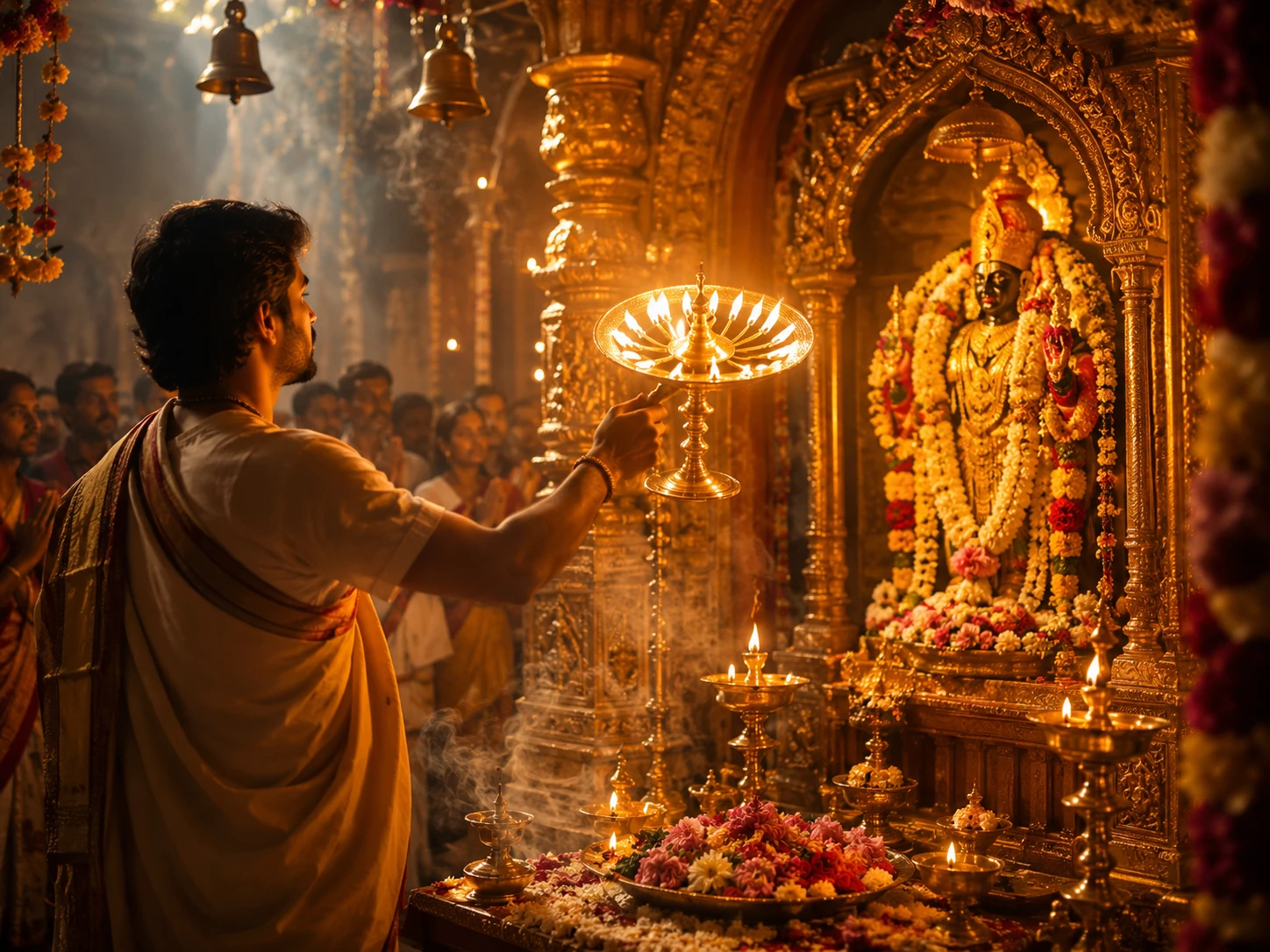
Aarti -- Why Hindus Circle Light Before God
13 min read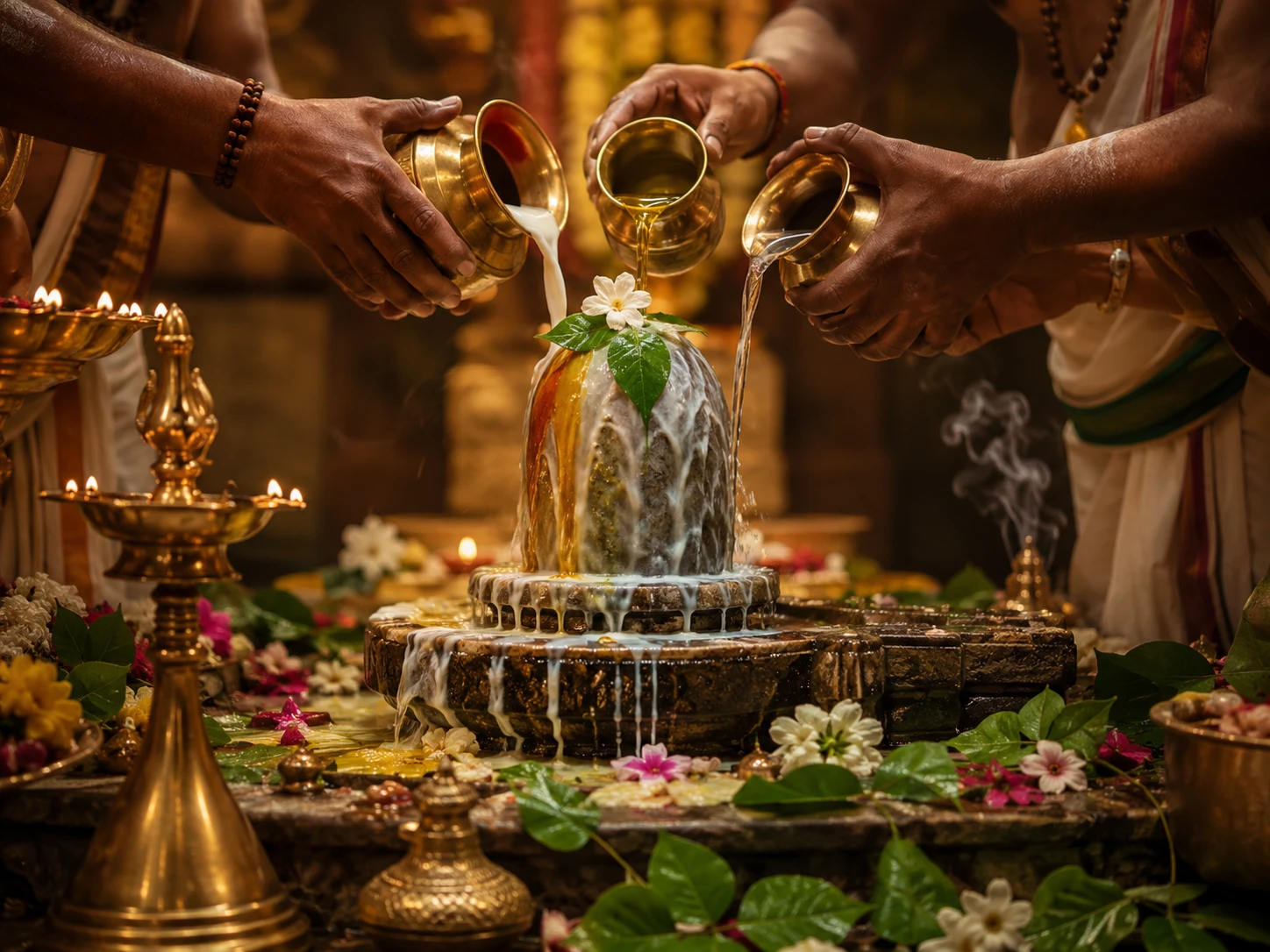
Abhisheka -- Why Hindus Bathe Their Gods
10 min read
Akshaya Tritiya -- The Day Nothing Given Away Runs Out
12 min readThe same translation error that turned '33 Koti' into '33 crore' in Hinduism also happened in Buddhism. The Chinese translation of Buddhist texts rendered 'Sapta Koti Buddha' (7 Supreme Buddhas) as '7 Crore Buddhas.' The…
Deities AvatarsCommunity Reflections
🕉️
Be the first to share your reflection.