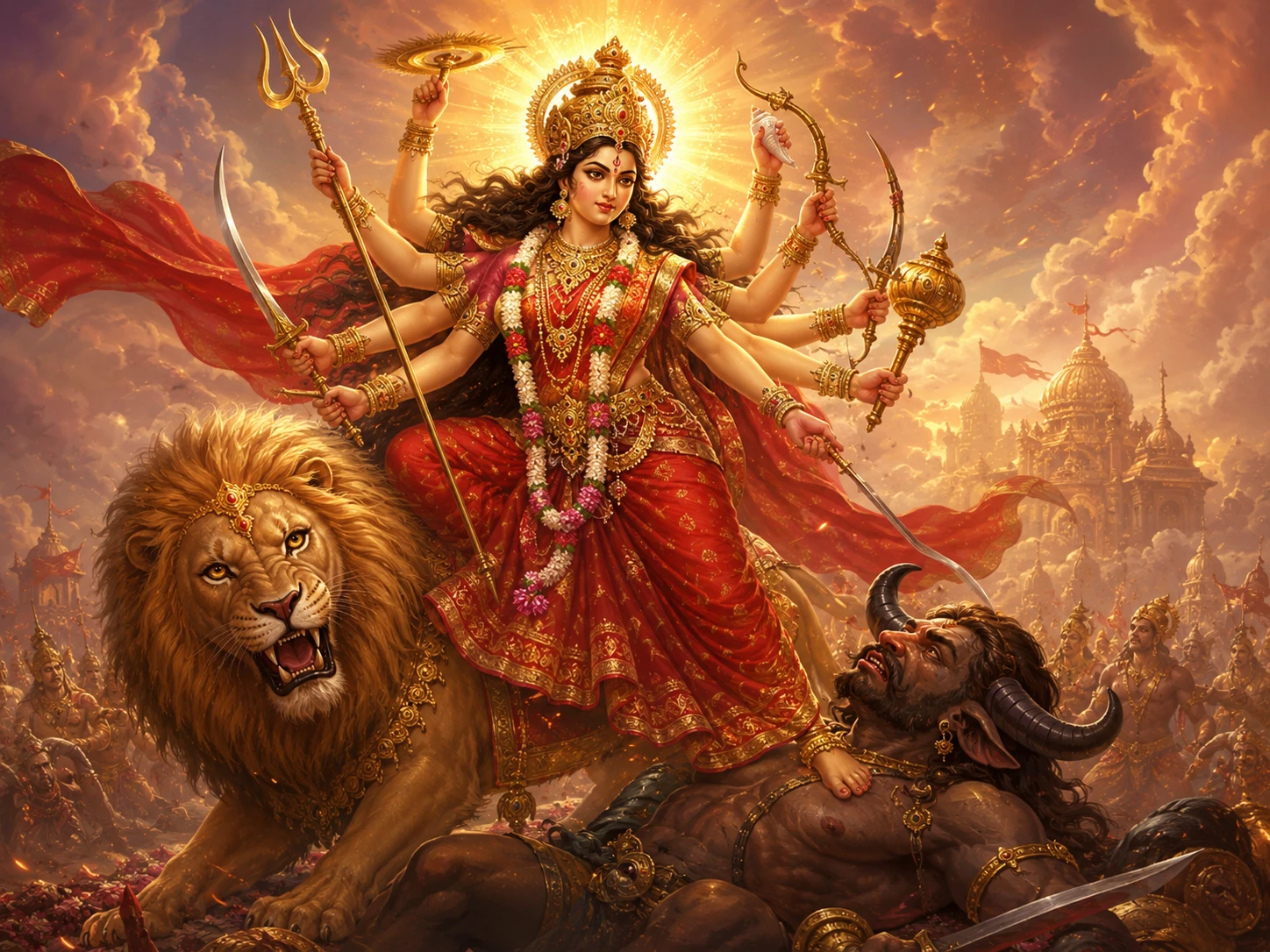
Mahishasuramardini -- The Slayer of the Buffalo Demon and India's Most Iconic Image of Power
महिषासुरमर्दिनी -- महिष दानव की संहारक और भारत की शक्ति की सबसे प्रतिष्ठित छवि
If Hindu civilisation had a single signature image -- the way Christianity has the crucifix or Buddhism has the seated meditating Buddha -- it would be the Mahishasuramardini. A goddess, radiant and composed, standing on a lion, driving her trident through a buffalo-headed demon who writhes beneath her. This image has been carved, cast, painted, sculpted, and printed more times than any other in Indian visual culture, across two millennia, three subcontinents, and a hundred dynastic styles.
You have seen it even if you do not know the name. It is the centrepiece of every Durga Puja pandal in Kolkata. It is carved into the cave walls at Mahabalipuram, dating to the 7th century Pallava dynasty. It appears on gold coins of the Gupta Empire (4th-6th century CE), the dynasty that is considered India's classical golden age. It adorns the gopurams of Tamil Nadu, the temple walls of Odisha, the bronze sculptures of the Chola dynasty, the miniature paintings of Rajasthan, and the digital art of Instagram illustrators in 2026. It is the image on the cover of the Devi Mahatmya, sold in every religious bookshop from Varanasi to Southall.
The Mahishasuramardini is not merely popular. It is structurally central to Hinduism. It is the visual expression of the Devi Mahatmya's core theological argument: that the combined power of every male god was insufficient to defeat evil, and that power, when reconstituted as feminine Shakti, succeeded. Every reproduction of this image -- whether in a Rs 50 calendar print or a Rs 5 crore bronze installation -- makes the same argument. The ultimate warrior is a woman.
For the corporate woman who walks into a board meeting where she is the only woman present. For the female constable who patrols a UP highway at midnight. For the girl in Class 10 who is told that science is not for her. The Mahishasuramardini, hanging on the wall of almost every Hindu home in some form, has been making the same argument for two thousand years: feminine power is not an exception. It is the rule.
अयि गिरिनन्दिनि नन्दितमेदिनि विश्वविनोदिनि नन्दिनुते गिरिवरविन्ध्यशिरोऽधिनिवासिनि विष्णुविलासिनि जिष्णुनुते। भगवति हे शितिकण्ठकुटुम्बिनि भूरिकुटुम्बिनि भूरिकृते जय जय हे महिषासुरमर्दिनि रम्यकपर्दिनि शैलसुते॥
ayi girinandini nanditamedini viśvavinodini nandinute girivaravindhyaśiro'dhinivāsini viṣṇuvilāsini jiṣṇunute | bhagavati he śitikaṇṭhakuṭumbini bhūrikuṭumbini bhūrikṛte jaya jaya he mahiṣāsuramardini ramyakapardini śailasute ||
O Daughter of the Mountain, who makes the earth joyful, who delights the universe, praised by Nandi; who dwells on the peak of the great Vindhya mountain, who brings joy to Vishnu, praised by the victorious Indra; O Bhagavati, O wife of the blue-throated Shiva, O you of vast families and vast deeds -- victory, victory to you, O Slayer of the Buffalo Demon, O beautiful-braided one, O Daughter of the Mountain!
— Mahishasuramardini Stotram (Aigiri Nandini), Verse 1 -- attributed to Adi Shankaracharya / Ramakrishna Kavi
The Aigiri Nandini stotram has had a remarkable second life in the digital age. YouTube videos of the chant regularly accumulate tens of millions of views. The version by Rajalakshmee Sanjay crossed 100 million views, making it one of the most-watched Sanskrit devotional compositions online. Electronic music producers have remixed it. Flash mobs have performed it in public spaces. TikTok and Instagram reels featuring the stotram -- set to images of powerful women, female athletes, scientists, and activists -- have created a new visual vocabulary around the Mahishasuramardini that the original composers could never have imagined.
This is not cultural dilution. It is cultural evolution. The stotram was composed to be performed -- loudly, publicly, with drums and vigour. That it is now performed on digital platforms, shared across continents in milliseconds, and used as the soundtrack to feminist protest videos would, one imagines, delight the goddess who delights the universe (viśvavinodini). The medium changes; the message remains: there is a power that cannot be defeated. It is feminine. It has beautiful braided hair. And it stands on a lion.
The theological significance of the Mahishasuramardini extends beyond narrative into Hindu philosophical anthropology. The Devi Mahatmya does not merely tell a battle story; it makes a structural claim about the relationship between good and evil. Evil in the Hindu framework is not a permanent cosmic principle (as in Zoroastrian dualism or Manichaean theology). It is a periodic disturbance that arises, is defeated, and will arise again. The Goddess does not eliminate evil permanently -- she restores balance. The cycle continues. This is why Navaratri happens every year: the battle is annual because evil is perennial. The victory is real but temporary. The implication for personal life is both humbling and empowering: you will never permanently defeat your inner Mahishasura -- your ego, your laziness, your shapeshifting excuses. But you can defeat it today. And tomorrow, when it rises again, you can defeat it again. The trident is always in your hand.
The battle between Durga and Mahishasura, as described in the Devi Mahatmya (Chapters 5-8 of the text, also called Durga Saptashati or Chandi Path), is one of the longest, most detailed, and most cinematically narrated combat sequences in all of ancient literature.
Mahishasura is not a simple villain. He is a shapeshifter -- a demon who can assume any form at will. His boon from Brahma specified that no god or man could kill him. He did not think to exclude women from the list, because in his worldview, feminine power was not a category that could threaten him. This is not merely a plot device; it is a commentary on the nature of patriarchal arrogance. The blind spot in Mahishasura's boon IS the blind spot in every power structure that excludes women from consideration.
The battle unfolds across multiple chapters and involves armies of millions. Durga's lion tears through Mahishasura's elephant cavalry. Her weapons destroy his generals -- Chikshura, Chamara, Udagra, Mahahanu, Asiloma, Baskala -- each named, each described in combat, each dispatched. When Mahishasura himself enters the fray, the text describes his shapeshifting in extraordinary detail: he becomes a buffalo and charges, throwing mountains with his horns and churning the ocean with his hooves. When Durga's noose catches him, he becomes a lion. When she attacks the lion, he becomes a man with a sword. When she strikes the man, he becomes an elephant, seizing her lion with his trunk. When she cuts the trunk, he returns to his buffalo form.
The killing blow is precise and theologically loaded. As Mahishasura transitions between his buffalo form and his human form -- in the liminal space between shapes, in the moment of vulnerability between identities -- Durga places her foot on his neck, pins him, and drives her trident through his chest. The demon's own head emerges from the severed neck of the buffalo, and Durga's sword completes the decapitation.
The symbolism operates on multiple levels. The buffalo represents brute force, stubbornness, and tamas (inertia). The shapeshifting represents the way evil adapts -- it never presents the same face twice, it changes its form to suit the moment. Durga's ability to defeat each form is not about superior weaponry; it is about superior consciousness. She sees through each disguise because she operates at a level of awareness where form is irrelevant -- only essence matters.
For anyone who has faced a problem that kept changing shape -- an opponent who argued one thing on Monday and another on Tuesday, a disease that responded to one treatment and then mutated, a bureaucratic system that redirected you from office to office -- Mahishasura is not a metaphor. He is a clinical description.
The art history of the Mahishasuramardini image is a two-thousand-year journey through every major Indian dynasty, medium, and aesthetic tradition.
The earliest known representations date to the Kushana period (1st-3rd century CE), found in Mathura -- simple relief panels showing a goddess attacking a buffalo. By the Gupta period (4th-6th century CE), the image has matured into its classical form: Durga standing, multi-armed, her trident piercing the buffalo, often with a small human figure (Mahishasura in his anthropomorphic form) emerging from the buffalo's neck. Gupta-era gold coins minted by Chandragupta I and his successors feature the Mahishasuramardini on the reverse -- making it, quite literally, the official currency of India's greatest ancient empire.
The Mahabalipuram cave relief (7th century, Pallava dynasty, Tamil Nadu) is perhaps the most famous single sculpture of the theme. Carved into a monolithic granite cliff face, the panel shows Durga in dynamic combat, her body twisting with martial energy, the buffalo collapsing beneath her. This is not a static devotional image; it is action caught in stone. The Pallava sculptors achieved something that would not be seen again in European art until Bernini's Baroque sculptures a thousand years later -- the representation of violent movement frozen at its climactic moment.
The Chola bronzes (10th-12th century) represent the pinnacle of the Mahishasuramardini in metal. Cast using the lost-wax (cire perdue) technique, these bronzes depict Durga with eight or ten arms, each holding a different weapon, her face serene even as she destroys. The serenity is the point -- she is not angry. She is not struggling. She is performing her cosmic function with the calm of a surgeon. Several of these Chola bronzes are now in the collections of the Metropolitan Museum of Art (New York), the British Museum (London), and the National Museum (New Delhi).
In the miniature painting traditions of Rajasthan and the Pahari hills (17th-19th century), the Mahishasuramardini takes on softer, more lyrical qualities. The goddess is depicted with delicate features, elaborate jewellery, and vibrant colours -- red, gold, saffron -- against backgrounds of stylised clouds and forests. But even in these intimate, almost romantic paintings, the trident is always there, and the buffalo is always dying.
In contemporary India, the image has exploded into every medium. Durga Puja pandal art in Kolkata features the Mahishasuramardini in installations made of fiberglass, recycled electronics, bamboo, wire, and even sugar. Street art in Bengaluru and Mumbai features feminist reimaginations of the image. Graphic novels, Instagram illustrations, and AI-generated art all draw from the same visual vocabulary. The Mahishasuramardini is not a museum piece; it is a living image, reinterpreted by each generation.
The image has also crossed India's borders. The Prambanan temple complex in Java (9th century, built during the Mataram Kingdom) contains a stunning Mahishasuramardini relief in the Durga temple. The Angkor Wat complex in Cambodia (12th century) features the Samudra Manthan and related goddess imagery. In Bali, the Mahishasuramardini is part of the living Hindu artistic tradition. The global spread of the image traces the historical reach of Indian cultural influence across Southeast Asia -- a reach that was carried not by armies but by traders, monks, and artists.
Mahishasuramardini Across Indian Dynasties -- 2,000 Years of One Image
| Dynasty / Period | Century | Medium | Notable Example | Style Characteristics |
|---|---|---|---|---|
| Kushana | 1st-3rd CE | Stone relief | Mathura Museum panels | Simple, frontal, buffalo prominent, goddess with 2-4 arms |
| Gupta | 4th-6th CE | Gold coins, stone | Chandragupta I gold dinars | Classical proportions, refined detail, 4-8 arms, serene face |
| Pallava | 7th CE | Rock-cut cave relief | Mahabalipuram Mahishasuramardini Cave | Dynamic movement, martial energy, monolithic granite, masterpiece |
| Chalukya | 6th-8th CE | Temple sculpture | Aihole Durga Temple | Architectural integration, multiple narrative panels |
| Chola | 10th-12th CE | Bronze (lost-wax) | Government Museum Chennai, Met Museum NY | Supreme bronze-casting, 8-10 arms, serene amid violence |
| Hoysala | 12th-13th CE | Soapstone | Belur Chennakeshava Temple | Intricate jewellery, ornate detail, rotational compositions |
| Vijayanagara | 14th-16th CE | Granite, bronze | Hampi temple panels | Monumental scale, narrative friezes, courtly refinement |
| Pahari / Rajasthani | 17th-19th CE | Miniature painting | Various museum collections | Vivid colour, lyrical beauty, intimate scale, forest settings |
| Colonial Bengal | 19th-20th CE | Clay (kumartuli) | Kolkata Durga Puja pandals | Dramatic poses, painted clay, annually created and dissolved |
| Contemporary | 21st CE | All media | Pandal installations, digital art, graphic novels | Experimental, feminist, global, AI-influenced, multi-material |
The Mahishasuramardini is arguably the single longest continuously produced art motif in human civilisation -- a two-thousand-year unbroken chain of artistic creation around a single theological image.
The Mahishasuramardini Stotram -- popularly known as Aigiri Nandini -- is the soundtrack to this image, and it deserves a place alongside the greatest devotional poetry in any language.
The stotram is a 21-verse composition in a thundering, rhythmic metre that mimics the cadence of battle drums. Each verse ends with the refrain: 'Jaya jaya he Mahishasuramardini, ramyakapardini, shailasute' -- 'Victory, victory to the Slayer of the Buffalo Demon, the beautiful-braided one, the Daughter of the Mountain.' The repetition is not decorative; it is structural. Each verse describes a different battle scene, a different divine attribute, a different defeated demon, and each returns to the same roaring conclusion: victory.
The authorship is debated. It is widely attributed to Adi Shankaracharya, though some scholars credit Ramakrishna Kavi. The composition is part of the Bhagavati Padya Pushpanjali Stotra, a larger text of which the 21 Mahishasuramardini verses form the core. Regardless of authorship, the stotram has become one of the most frequently performed devotional compositions in India.
In Kolkata during Durga Puja, the stotram is broadcast from loudspeakers across the city on Mahalaya morning -- the day when the goddess is ritually invoked. The voice of Birendra Krishna Bhadra, who recorded the iconic Mahalaya programme 'Mahishasura Mardini' for All India Radio in 1966, is as inseparable from Bengali identity as Rabindrasangeet. When that recording plays at 4 AM on Mahalaya, an entire city wakes up. The stotram is not background music; it is an alarm clock for an entire civilisation.
In the Carnatic music tradition, the stotram has been set to multiple ragas and performed by artists from M.S. Subbulakshmi to contemporary performers. In the Hindustani tradition, Durga-themed compositions are part of the Navaratri concert cycle. The crossover into Bollywood and pop culture is extensive -- the stotram has been featured in films, remixed by electronic artists, and adapted into Instagram reels that accumulate millions of views.
The Aigiri Nandini's power lies in its rhythm. The metre is relentless -- it does not pause, it does not soften, it does not equivocate. It charges forward like Durga's lion, and the refrain hits like her trident. Try reading the first verse aloud at speed and you will feel it: this is not prayer. This is a war cry. And it has been sung for a thousand years by people who needed to remember that there is a force in the universe that evil cannot defeat.
The Mahishasuramardini cave relief at Mahabalipuram was one of the monuments that UNESCO designated as a World Heritage Site in 1984 -- meaning the image of a goddess slaying a buffalo demon is, officially, a protected treasure of all humanity. The Gupta gold coins featuring the Mahishasuramardini are among the most valuable numismatic items in Indian history, with individual specimens fetching over $100,000 at international auctions. In Indonesia, the 14th-century Javanese text Kakawin Bhomantaka contains a detailed retelling of the Mahishasura myth adapted to Javanese literary conventions -- proving that the story was a pan-Asian export, not a narrowly Indian one. And in 2023, a team of IIT Madras researchers used the Mahabalipuram relief as a case study in their computational analysis of dynamic poses in ancient Indian sculpture, using 3D scanning and biomechanical modelling to prove that the Pallava sculptors had achieved anatomically correct representations of combat movement -- 1,300 years before motion capture technology.
The Kumartuli artisan tradition of Kolkata -- the neighbourhood that produces the clay murtis for Durga Puja -- is one of the most remarkable living craft traditions in the world, and the Mahishasuramardini is its centrepiece.
Kumartuli (literally 'the potters' quarter') is a narrow, labyrinthine neighbourhood in North Kolkata where approximately 500 families have been creating clay murtis for generations. The process begins months before Durga Puja. Bamboo frames are constructed for the skeleton. Straw is bound to create the body shape. River clay from the Hooghly (mixed with cow dung and jute fibre) is layered on. The face is sculpted last -- the eyes painted on during a ceremony called chakshu-daan (the 'gift of eyes'), which is the moment the murti is considered to come alive.
The Mahishasuramardini murti follows a specific iconographic template: Durga stands at the centre, ten-armed, trident in hand, piercing Mahishasura. Flanking her are four figures: Ganesha and Kartikeya (her sons), and Lakshmi and Saraswati (who in Bengali tradition are considered her daughters). The lion is at her feet, mauling the buffalo demon. This five-figure composition (pancha-devata) is unique to the Bengali Durga Puja tradition and is not found in other regional celebrations of Navaratri.
The artisans of Kumartuli have elevated what is technically a temporary art form into a high artistic practice. Each year, the murtis are created, worshipped for five days, and then immersed in the river. The art is designed to be destroyed. This annual cycle of creation and dissolution is itself a profound spiritual practice -- the artisan who spends three months sculpting a face knows that in five days, that face will dissolve in the Hooghly. The attachment to the created work must be released. This is karma yoga applied to art -- action without attachment to the fruit of action.
The economic scale of Kumartuli's output is significant. During the Durga Puja season, the neighbourhood produces an estimated 5,000-10,000 murtis for Kolkata alone, plus thousands more shipped to Bengali communities across India and the world -- London, New York, Singapore, Dubai. A single pandal's murti commission can range from Rs 50,000 for a simple traditional style to Rs 50 lakhs or more for an avant-garde artistic installation. The Kumartuli artisans, many of whom are Muslim (a fact that surprises many), have been producing Hindu religious art for centuries -- a quiet, working example of India's syncretic tradition that no political narrative can erase.
Beyond Kumartuli, the Mahishasuramardini has inspired contemporary Indian artists working across media. The image has been reimagined by M.F. Husain, by Anjolie Ela Menon, by contemporary graphic novelists and digital artists. Each reinterpretation brings something new: a feminist reading, a political commentary, an aesthetic experiment. But the core image persists: a woman, standing over a defeated evil, weapon in hand, face serene. Two thousand years of art, and the image has not lost a fraction of its power.
For anyone who has ever created something beautiful and then had to let it go -- a sandcastle at Juhu Beach, a rangoli that gets walked over, a presentation that impresses the client but is never revisited, a childhood home that gets sold -- the Kumartuli tradition and the Durga visarjan offer a theological framework for the most universal human experience: everything you make will eventually dissolve. The question is not whether it will last, but whether it was worth making. The Mahishasuramardini murtis, dissolved in the Hooghly every October, answer with a thunderous yes.
Chant the Aigiri Nandini (Mahishasuramardini Stotram)
Recite the 21 verses of the Mahishasuramardini Stotram, at once prayer, war cry and devotional anthem, and let their rhythm carry you. Its page on Eternal Raga gives the Sanskrit, transliteration and meaning.
Tags
Eternal Raga · शाश्वत राग
Institutional voice — scholarly articles on Sanatan Dharma
Deepen Your Understanding
अपनी समझ और गहरी करें
deities avatars
Durga -- The Warrior Goddess Who Cannot Be Defeated
When every male god in the Hindu pantheon failed to defeat the buffalo demon Mahishasura, they pooled their tejas -- their divine radiance and rage -- into a single being. What emerged was not another god. It was a goddess. And she succeeded where they could not. That is the origin story of Durga, and it rewrites every assumption about power.
deities avatars
Parvati -- Shakti, Wife, Mother, and the Woman Who Moved a Mountain God
She is the daughter of the Himalayas who performed tapas so intense that even Shiva -- the god who burned Kamadeva to ash for daring to disturb his meditation -- was compelled to open his eyes. Parvati is Hinduism's most complete feminine archetype: lover, mother, warrior, philosopher, and the literal other half of god.
deities avatars
Kali -- The Fierce Mother Who Devours Time Itself
Black-skinned, wild-haired, wearing a garland of fifty severed heads and a skirt of severed arms, standing on Shiva's chest with her tongue extended in shock -- Kali is the most misunderstood deity in Hinduism and the most theologically radical. She is not a demon. She is not 'dark energy.' She is Time in feminine form, the cosmic mother who destroys everything so that everything can be reborn. Ramakrishna called her 'Ma.' Millions still do.
deities avatars
Devi Swaroopa -- Forms of the Goddess
She is Durga on the battlefield and Annapurna in the kitchen. She is Kali at the cremation ground and Lakshmi in the boardroom. She is Saraswati at the university and Parvati in the family. The Hindu Goddess is not one deity with accessories -- she is the entire spectrum of feminine power, from terrifying to tender, from cosmic to domestic. Understanding her forms is understanding the universe itself.
scriptural exegesis
Devi Mahatmya -- The Three Charitas That Changed How India Worships the Feminine
700 verses. 13 chapters. Three battles. One thesis: when every god in the universe has failed, a woman finishes the job. The Devi Mahatmya from the Markandeya Purana is not just a scripture -- it is the founding document of Shakta theology and the reason 300 million people celebrate Navaratri.
deities avatars
Nataraja -- The Cosmic Dancer
One foot crushes a dwarf. The other is raised in liberation. A ring of fire frames the dance. A drum beats creation into existence. An open palm says 'do not fear.' This is Nataraja -- Shiva as the Lord of Dance -- and it is the single most replicated Indian bronze in the history of art. The physicists at CERN chose it to stand outside the world's largest particle accelerator. The Chola bronzesmiths of Tamil Nadu perfected it a thousand years ago. And every time a subatomic particle appears and disappears, the cosmic dance continues.
tantra mantra yantra
Dasha Mahavidya -- Ten Wisdom Goddesses Who Map the Entire Universe
One holds her own severed head. Another is an ugly old widow. A third paralyses enemies by seizing their tongues. The Dasha Mahavidya are not comfortable goddesses. They are the ten dimensions of reality that most religions are too afraid to acknowledge -- from transcendent beauty to terrifying destruction, from cosmic abundance to abject poverty. Together, they form the most complete map of feminine divinity ever conceived.
The Mahishasuramardini cave relief at Mahabalipuram was one of the monuments that UNESCO designated as a World Heritage Site in 1984 -- meaning the image of a goddess slaying a buffalo demon is, officially, a protected t…
More in Deities & Avatars
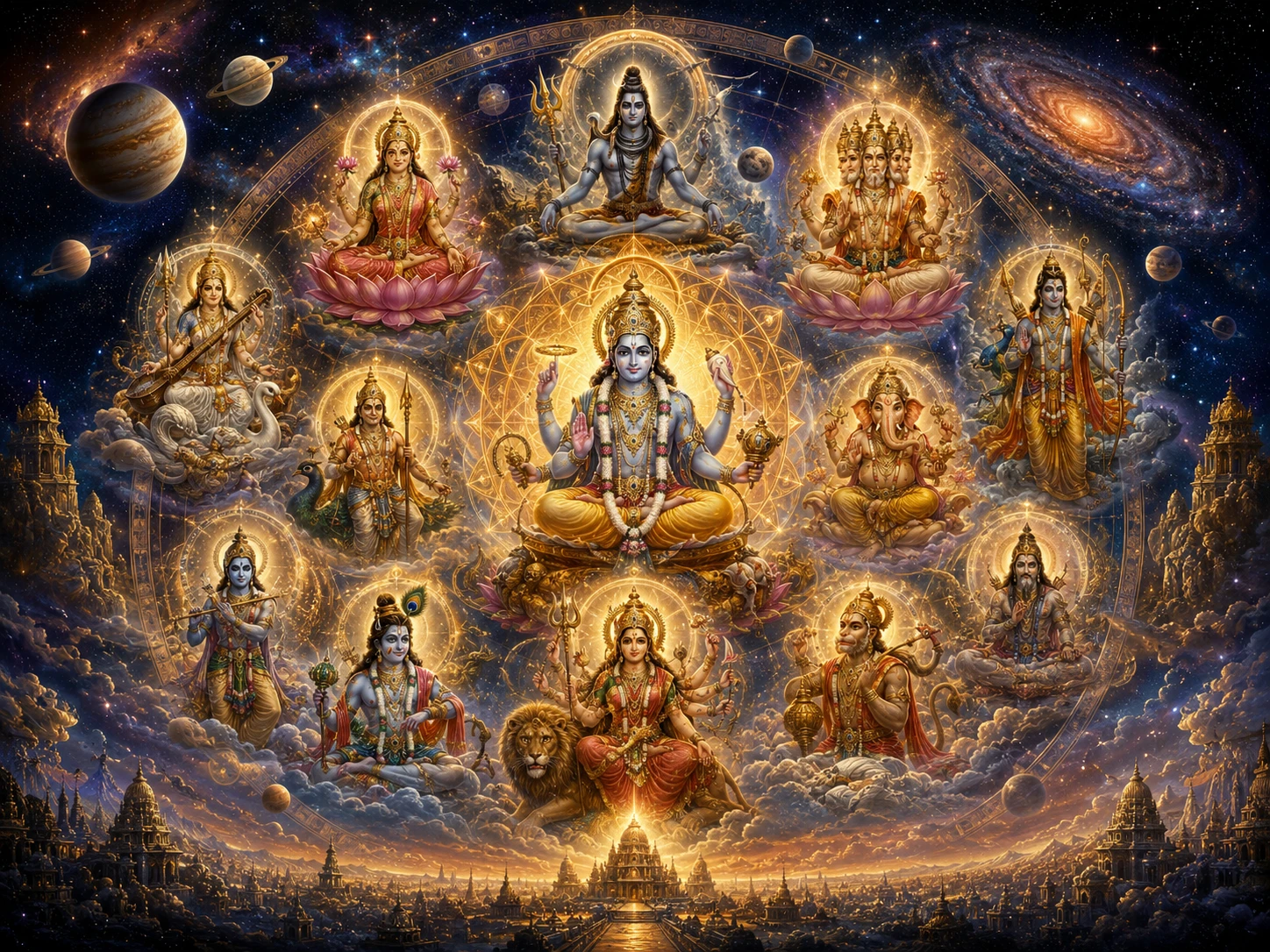
33 Koti Devata -- Why Hinduism Has 33 Types of Gods, Not 33 Crore
13 min read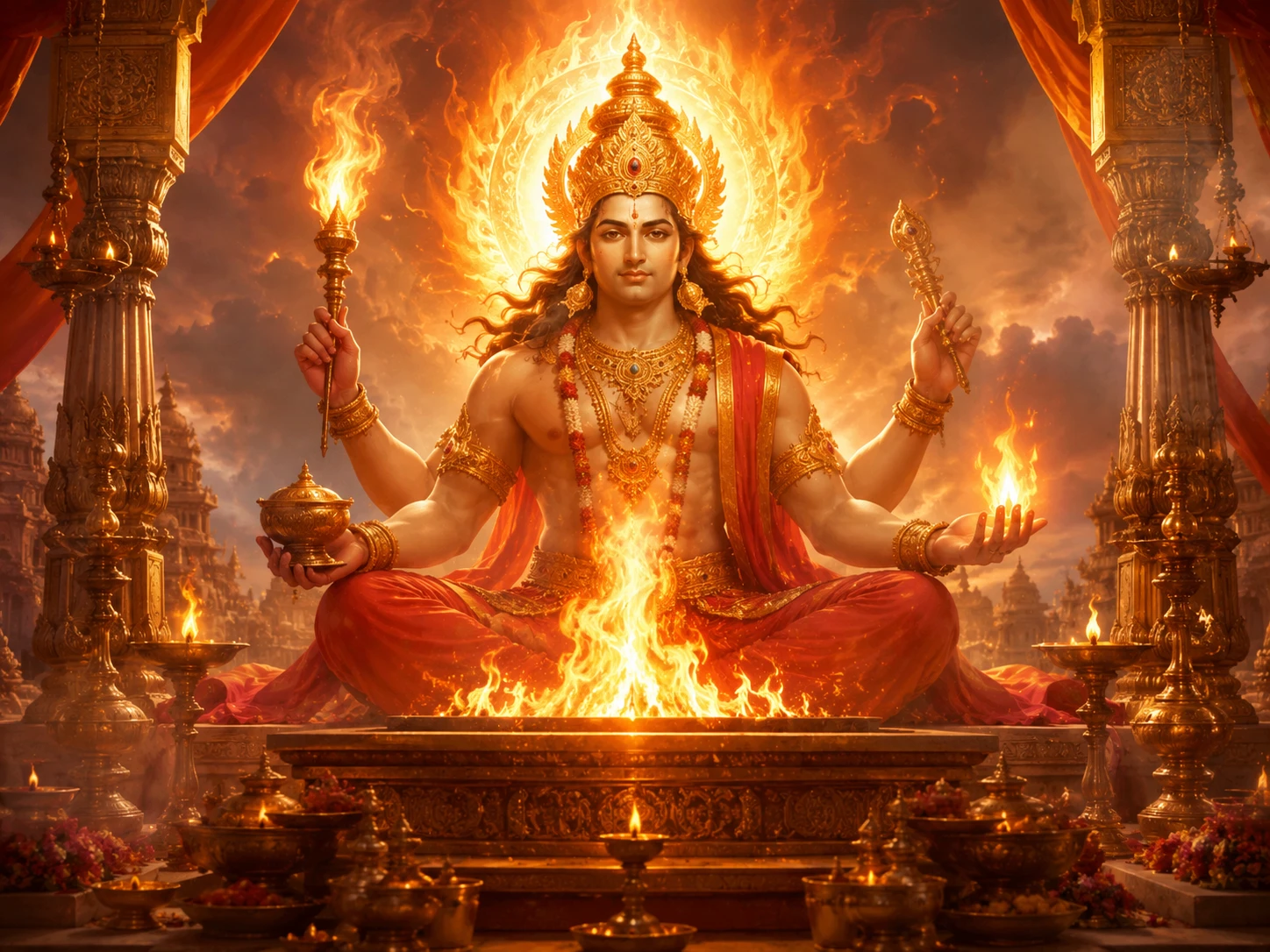
Agni -- The Fire God
19 min read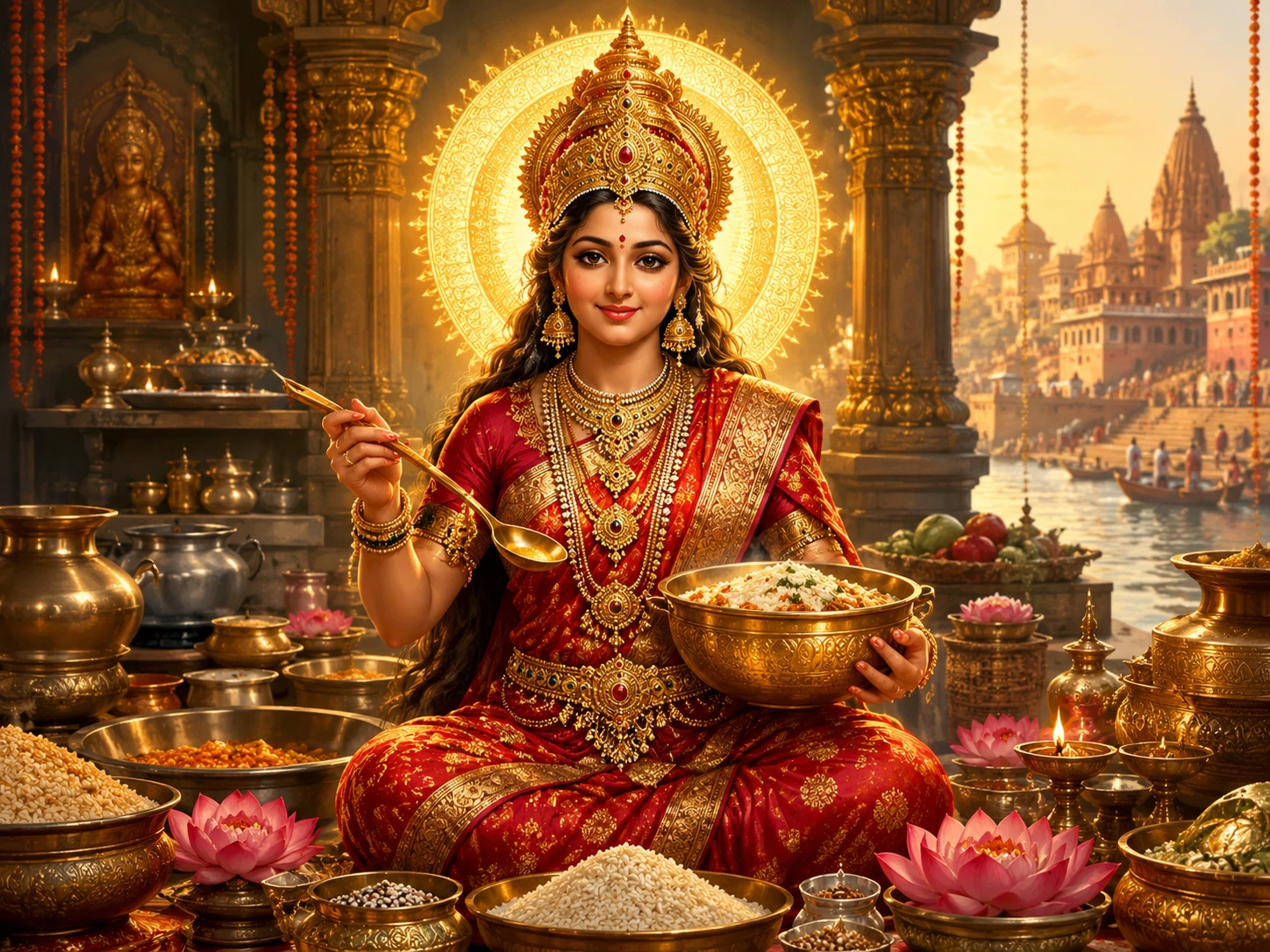
Annapurna -- Goddess of Food
19 min readThe same translation error that turned '33 Koti' into '33 crore' in Hinduism also happened in Buddhism. The Chinese translation of Buddhist texts rendered 'Sapta Koti Buddha' (7 Supreme Buddhas) as '7 Crore Buddhas.' The…
Deities AvatarsCommunity Reflections
🕉️
Be the first to share your reflection.