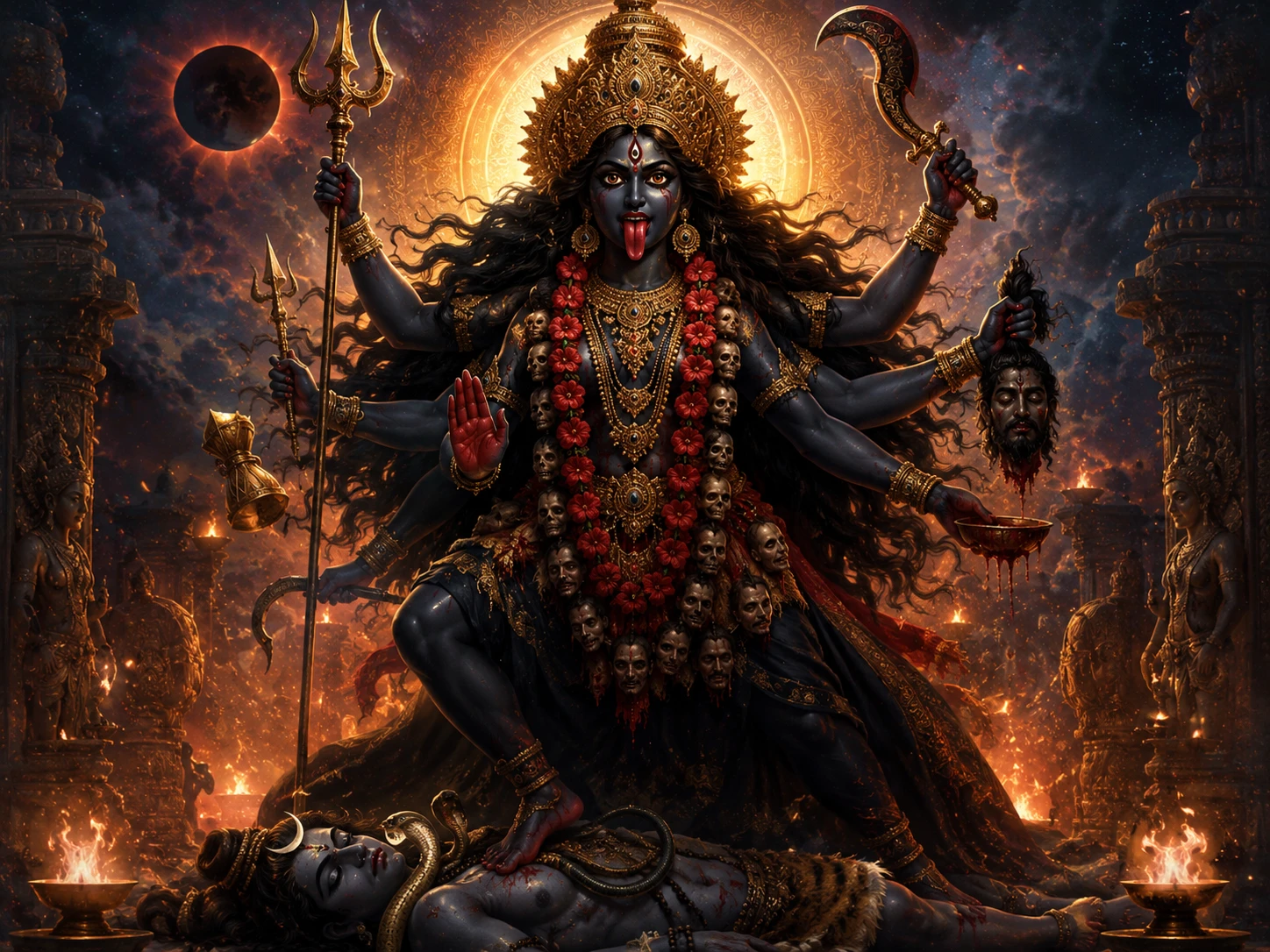
Kali -- The Fierce Mother Who Devours Time Itself
काली -- वो उग्र माता जो स्वयं काल को निगल लेती हैं
When a Western tourist walks into the Kalighat temple in South Kolkata for the first time and sees the image of Kali -- black-faced, tongue protruding, three eyes blazing, wearing a garland of skulls -- the reaction is almost always the same: shock. How can this be a goddess? How can people worship this? The image violates every expectation of what divinity should look like.
And that is precisely the point.
Kali exists to shatter expectations. She is the theological equivalent of a controlled demolition -- she destroys every comfortable, sanitised, 'nice' image of God so that the devotee can encounter reality as it actually is: raw, overwhelming, terrifying, and ultimately liberating.
Her name comes from 'Kala' -- the Sanskrit word for Time. Kali is feminine Time, the force that creates, sustains, and devours everything in existence. She is not the opposite of life. She IS life -- the whole of it, including the parts that polite religion prefers to ignore: decay, destruction, death, the dark night of the soul. To worship Kali is to look at the full truth of existence without flinching.
In the Devi Mahatmya (Markandeya Purana, 5th-6th century CE), Kali makes her dramatic first appearance emerging from the furrowed brow of the goddess Ambika during the battle against the demons Chanda and Munda. She is described as gaunt, dark-skinned, with sunken eyes, wearing a tiger skin and a garland of corpses, carrying a skull-topped staff. She slaughters Chanda and Munda with such ferocity that she earns the title Chamunda.
But her most famous act comes during the Raktabija episode. The demon Raktabija has a terrible boon: every drop of his blood that touches the ground generates a new full-sized clone of himself. The more the gods fight him, the more he multiplies. Kali solves this impossible problem by extending her tongue across the entire battlefield, drinking every drop of blood before it hits the ground. Only then can the other shaktis deliver the final blow.
This single image -- the extended tongue covering the battlefield -- contains Kali's entire theology. She consumes the consequences of violence itself. She prevents suffering from multiplying. She is the ultimate recycler: nothing is wasted, nothing escapes, everything returns to her.
करालवदनां घोरां मुक्तकेशीं चतुर्भुजाम्। कालिकां दक्षिणां दिव्यां मुण्डमालाविभूषिताम्॥
karālavadanāṁ ghorāṁ muktakeśīṁ caturbhujām | kālikāṁ dakṣiṇāṁ divyāṁ muṇḍamālā-vibhūṣitām ||
She whose face is terrible, who is fierce, whose hair flows freely, who has four arms -- the dark one, the auspicious (Dakshina), the divine, adorned with a garland of severed heads.
— Karpuradi Stotram, Verse 1 (Tantric hymn to Dakshina Kali)
Decoding the Iconography -- Every Symbol Means Something
Kali's iconography is not random horror. Every element is a precise philosophical statement:
Black skin: She is the colour of infinite space, of the void before creation, of the darkness from which all light emerges. Black is not absence of colour. It is the presence of everything -- all wavelengths absorbed, nothing reflected. Kali contains all of reality within herself.
Wild, unbound hair: Unlike 'civilised' goddesses whose hair is neatly tied, Kali's hair flows free. She is unbound by social convention, by patriarchal expectation, by any rule that limits divine power. Her hair represents prakriti (nature) in its untamed state.
Garland of 50 severed heads: The 50 heads represent the 50 letters of the Sanskrit alphabet (the same 50 mapped onto the chakra petals). Kali wears the entire language around her neck -- she is the mistress of all sound, all meaning, all knowledge. The heads also represent the 50 human tendencies (vrittis) that she has conquered.
Skirt of severed arms: Arms represent karma -- the actions performed in the world. Kali wears them because she has severed the karmic bonds of her devotees. She does not merely forgive karma. She cuts it off.
Four arms: The upper left hand holds a severed head (ego-death). The lower left holds a sword (the power of discrimination, viveka). The upper right hand is in abhaya mudra (gesture of fearlessness -- 'do not be afraid'). The lower right is in varada mudra (gesture of granting boons -- 'I give'). Left side destroys. Right side blesses. Both are her.
Extended tongue: The most debated element. The Bengali tradition says she extended her tongue in surprise and embarrassment after stepping on her husband Shiva. The Tantric tradition says the tongue represents rajas (active energy) emerging from tamas (inertia). Some scholars interpret it as the consuming principle -- the tongue that devours all existence.
Standing on Shiva: Shiva lies beneath her like a corpse because without Shakti (Kali), consciousness (Shiva) is inert. She does not dominate him through violence. She stands on him because he is her ground. She is the activity. He is the stillness. Without her, he is shava (corpse). With her, he is Shiva (the auspicious one).
Three eyes: Like Shiva, she sees past, present, and future simultaneously. She is trikala-darshini -- the seer of three times.
Ramakrishna and the Devotional Revolution
No figure has done more to transform Kali from a 'terrifying Tantric deity' into a 'universal divine mother' than Sri Ramakrishna Paramahamsa (1836-1886), the priest of the Dakshineswar Kali Temple near Kolkata.
Ramakrishna did not approach Kali as a philosopher or a Tantric adept. He approached her as a child approaches a mother -- with total, unreserved, sometimes desperate love. He would weep before her image, cry out 'Ma! Ma!' in anguish, roll on the ground in divine madness (unmada), lose consciousness in ecstatic trances (samadhi), and emerge speaking of the Goddess with such intimacy that listeners felt she was a living person who had just left the room.
His relationship with Kali scandalised the orthodox Brahmin establishment. He declared that the Goddess was as real as the person standing before him. He saw her in everything -- in the Ganga, in the food he ate, in the cat that wandered into the temple. He performed Tantric sadhana under the guidance of Bhairavi Brahmani, a female Tantric guru -- a choice that further outraged conventional sensibilities.
But Ramakrishna's greatest contribution was making Kali accessible to householders. Before him, Kali worship was primarily associated with Tantric practitioners, cremation-ground sadhus, and the Bengali warrior class. Ramakrishna democratised her. He insisted that the terrifying mother was also the tender mother, that the destroyer was also the protector, and that any devotee -- regardless of caste, education, or spiritual qualification -- could call her 'Ma' and receive her grace.
His disciple Swami Vivekananda carried this message to the world. The Ramakrishna Mission, now a global organisation, bears as its emblem the combined symbols of the four yogas arranged around a swan -- but its spiritual heart remains the relationship between a simple Bengali priest and the black-skinned goddess who consumed his entire being.
Today, Dakshineswar remains one of the most visited Kali temples in India. On any given evening, you can see software professionals from Salt Lake City (Kolkata), college students from Jadavpur University, elderly widows from the surrounding villages, and occasionally a bewildered foreign tourist -- all standing before the same image, all calling her 'Ma,' all finding in that terrifying face something that the rest of the world's religions have largely forgotten: that the divine is not always gentle, and that the fiercest love sometimes wears the fiercest face.
Forms of Kali -- The Many Faces of the Dark Mother
| Form | रूप | Iconography | Domain | Major Worship Centre |
|---|---|---|---|---|
| Dakshina Kali | दक्षिण काली | Right foot on Shiva, 4 arms, garland of heads | The 'auspicious' Kali -- the form most widely worshipped in Bengal | Dakshineswar, Kalighat (Kolkata) |
| Shamshan Kali | श्मशान काली | Seated in cremation ground, surrounded by jackals and corpses | The cremation ground form -- dissolution of all attachments | Tarapith (Birbhum), various cremation ghats |
| Bhadra Kali | भद्र काली | Gentle, auspicious, often shown as a protective mother | The 'gracious' Kali worshipped in South India | Bhadrakali temples across Kerala and Tamil Nadu |
| Mahakali | महाकाली | Ten arms, ten heads, cosmic form | The cosmic form who presides over the first charita of Devi Mahatmya | Pan-Hindu (Devi Mahatmya tradition) |
| Chamunda | चामुण्डा | Emaciated, riding a corpse, owl/jackal vahana | The slayer of Chanda-Munda, the most fierce battle form | Chamundeshwari Hill, Mysore |
| Tara | तारा | Blue-skinned, scissors, standing on Shiva | The compassionate saviour -- closely linked to Kali and Buddhist Tara | Tarapith, West Bengal |
The distinction between Kali's forms is regionally significant. Bengali Kali worship centres on Dakshina Kali. South Indian Bhadrakali is considerably gentler. The Tantric tradition distinguishes between Saumya (gentle) and Ugra (fierce) forms, but insists both are the same Goddess seen from different angles of devotion.
The city of Kolkata derives its name from Kali -- specifically from Kalighat (Kali's ghat/steps), one of the 51 Shakti Peethas where Sati's right toe is believed to have fallen. The British anglicised 'Kalikata' to 'Calcutta' in the colonial period, and the city was renamed 'Kolkata' in 2001 to reflect the Bengali pronunciation. But the Kali connection runs deeper than nomenclature. Kolkata's identity as India's intellectual and artistic capital, its tradition of fierce political resistance (from the Swadeshi movement to Naxalbari), its reputation for producing India's most passionate debates, and its culture of uncompromising creative expression -- all echo the energy of the deity who gave the city its name. Kolkata is, in a real sense, Kali's city.
Why Kali Matters Now
In an age of curated Instagram feeds, toxic positivity culture, and the relentless pressure to perform happiness -- Kali is the necessary antidote. She is the theological permission to stop pretending.
She says: destruction is real. Loss is real. The midnight terror when you cannot sleep and the future feels like a black wall -- that is real. And it is sacred. Not because suffering is good, but because reality is sacred in all its dimensions, including the ones that hurt.
For the cancer patient whose friends keep saying 'stay positive,' Kali says: you do not have to stay positive. You have to stay real. For the parent who has lost a child, Kali says: your grief is not a problem to be solved. It is a dimension of love. For the young professional who has been laid off and feels like a failure, Kali says: I am the one who took it away. And I am the one who will give you something new -- but only after you stop clinging to what was.
Kali's promise is not that she will make things better. Her promise is fiercer: she will make things real. And from the real -- from the stripped-down, demolished, ash-covered ground of absolute honesty -- something authentic can finally grow.
This is why Ramakrishna wept before her. Not because she was frightening. But because she was the most honest face of love he had ever seen.
Meet the Dark Mother -- Kali Meditation
The simplest Kali practice is also the most profound: sit in the dark, close your eyes, and chant Kreem, the Kali beej mantra, 108 times. Do not visualise anything nice. Let whatever arises -- fear, grief, anger, confusion -- arise without resistance. Kali's gift is not peace; it is truth. The Om Kali Ma japa page on Eternal Raga gives a gentler mantra and how to chant it.
Tags
Eternal Raga · शाश्वत राग
Institutional voice — scholarly articles on Sanatan Dharma
Deepen Your Understanding
अपनी समझ और गहरी करें
deities avatars
Devi Swaroopa -- Forms of the Goddess
She is Durga on the battlefield and Annapurna in the kitchen. She is Kali at the cremation ground and Lakshmi in the boardroom. She is Saraswati at the university and Parvati in the family. The Hindu Goddess is not one deity with accessories -- she is the entire spectrum of feminine power, from terrifying to tender, from cosmic to domestic. Understanding her forms is understanding the universe itself.
scriptural exegesis
Devi Mahatmya -- The Three Charitas That Changed How India Worships the Feminine
700 verses. 13 chapters. Three battles. One thesis: when every god in the universe has failed, a woman finishes the job. The Devi Mahatmya from the Markandeya Purana is not just a scripture -- it is the founding document of Shakta theology and the reason 300 million people celebrate Navaratri.
tantra mantra yantra
Dasha Mahavidya -- Ten Wisdom Goddesses Who Map the Entire Universe
One holds her own severed head. Another is an ugly old widow. A third paralyses enemies by seizing their tongues. The Dasha Mahavidya are not comfortable goddesses. They are the ten dimensions of reality that most religions are too afraid to acknowledge -- from transcendent beauty to terrifying destruction, from cosmic abundance to abject poverty. Together, they form the most complete map of feminine divinity ever conceived.
philosophy darshana
Shakta Philosophy -- Devi as Ultimate Reality
What if God is not He but She? Not an abstract principle but a living, breathing, dancing power? Shakta philosophy does not merely add a feminine dimension to Hindu theology. It inverts the entire structure: Shakti is the primary reality, and consciousness without her is inert. Shiva without Shakti is shava -- a corpse. This is not metaphor. This is metaphysics.
tantra mantra yantra
Tantra, Mantra and Yantra -- The Three Pillars of Spiritual Practice
Tantra is the loom, Mantra is the thread, Yantra is the pattern. Together they form the complete technology of spiritual transformation that India gifted to the world -- and they are far more profound than popular culture imagines.
rituals traditions
Navratri -- Nine Nights That Transform India
For nine nights, India becomes a different country. In Gujarat, millions dance garba till dawn. In Bengal, the streets turn into open-air art galleries. In Varanasi, nine temples light up in sequence. In Mysore, the palace blazes with 100,000 bulbs. Navratri is not a single festival -- it is nine nights of goddess worship that unite India's most diverse traditions into one cosmic celebration.
rituals traditions
Durga Puja -- The Ritual System Behind the World's Largest Art Festival
Behind the spectacular pandals and the Instagram-worthy lighting lies a ritual system of extraordinary precision. From the moment the sculptor draws the first line on Mahalaya to the heartbreaking immersion on Dashami, every step of Durga Puja follows a choreography that is part Vedic ritual, part Tantric sadhana, and part Bengali genius. UNESCO recognised it in 2021. Here is what they recognised.
The city of Kolkata derives its name from Kali -- specifically from Kalighat (Kali's ghat/steps), one of the 51 Shakti Peethas where Sati's right toe is believed to have fallen. The British anglicised 'Kalikata' to 'Calc…
More in Deities & Avatars
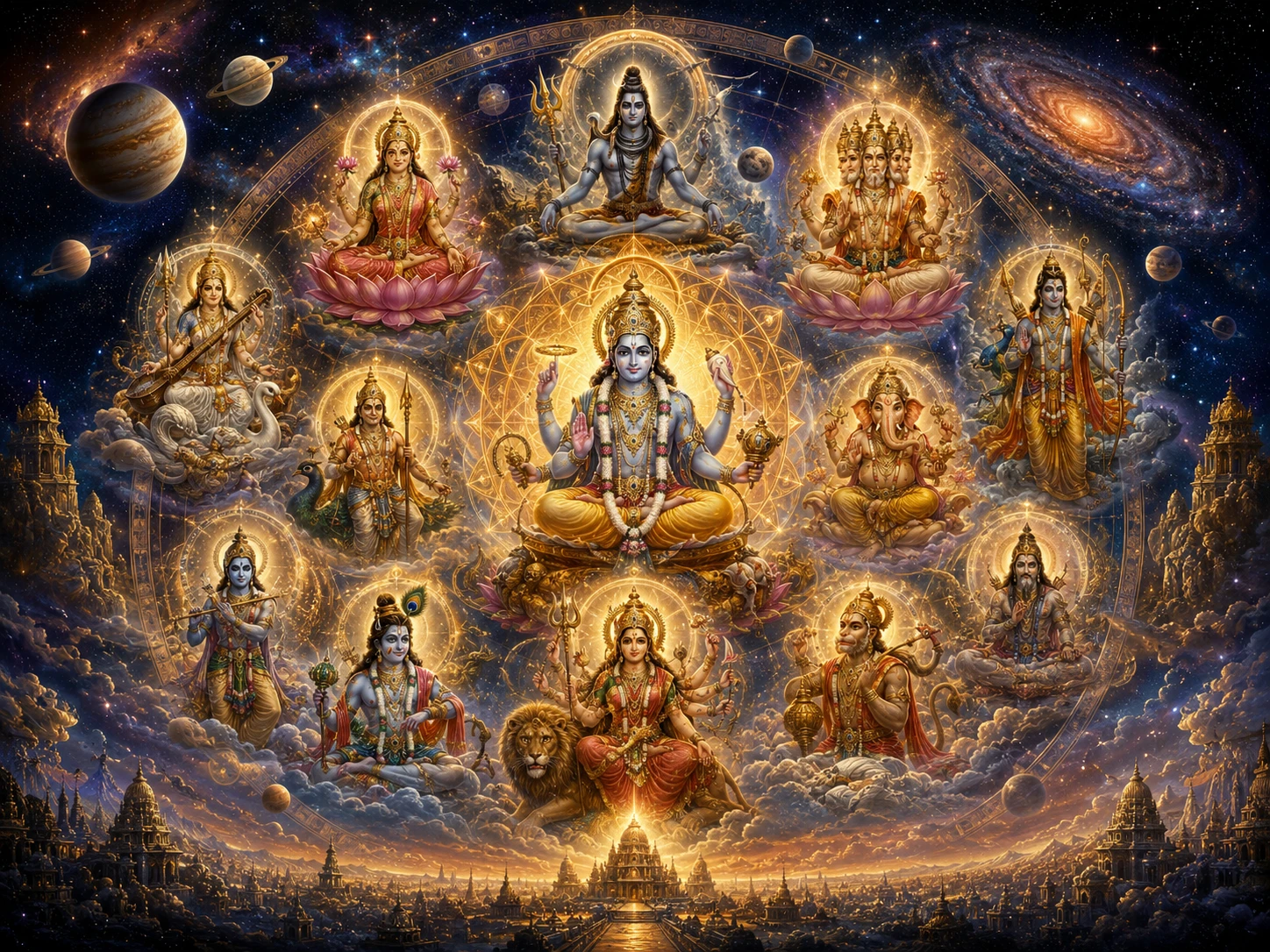
33 Koti Devata -- Why Hinduism Has 33 Types of Gods, Not 33 Crore
13 min read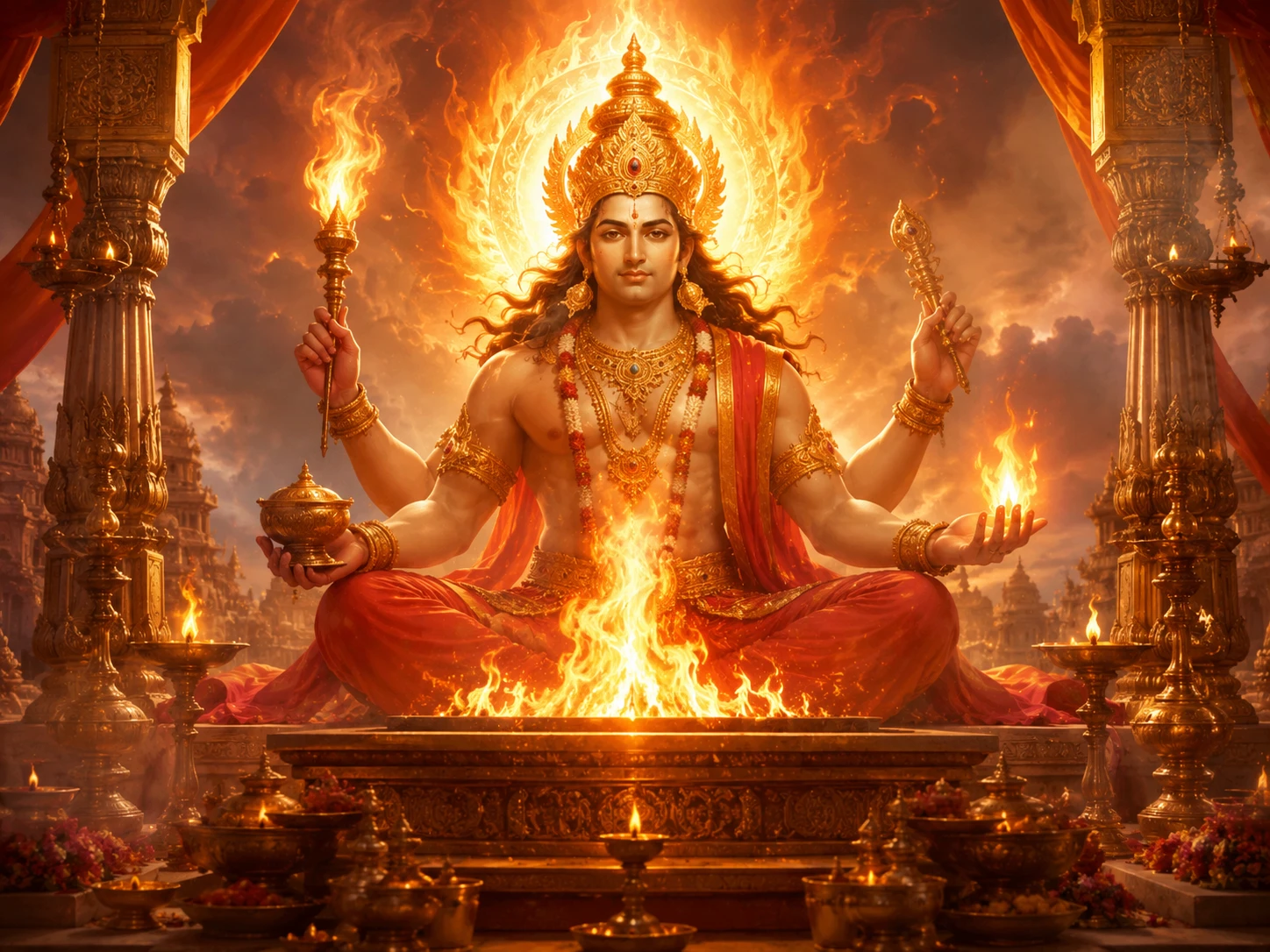
Agni -- The Fire God
19 min read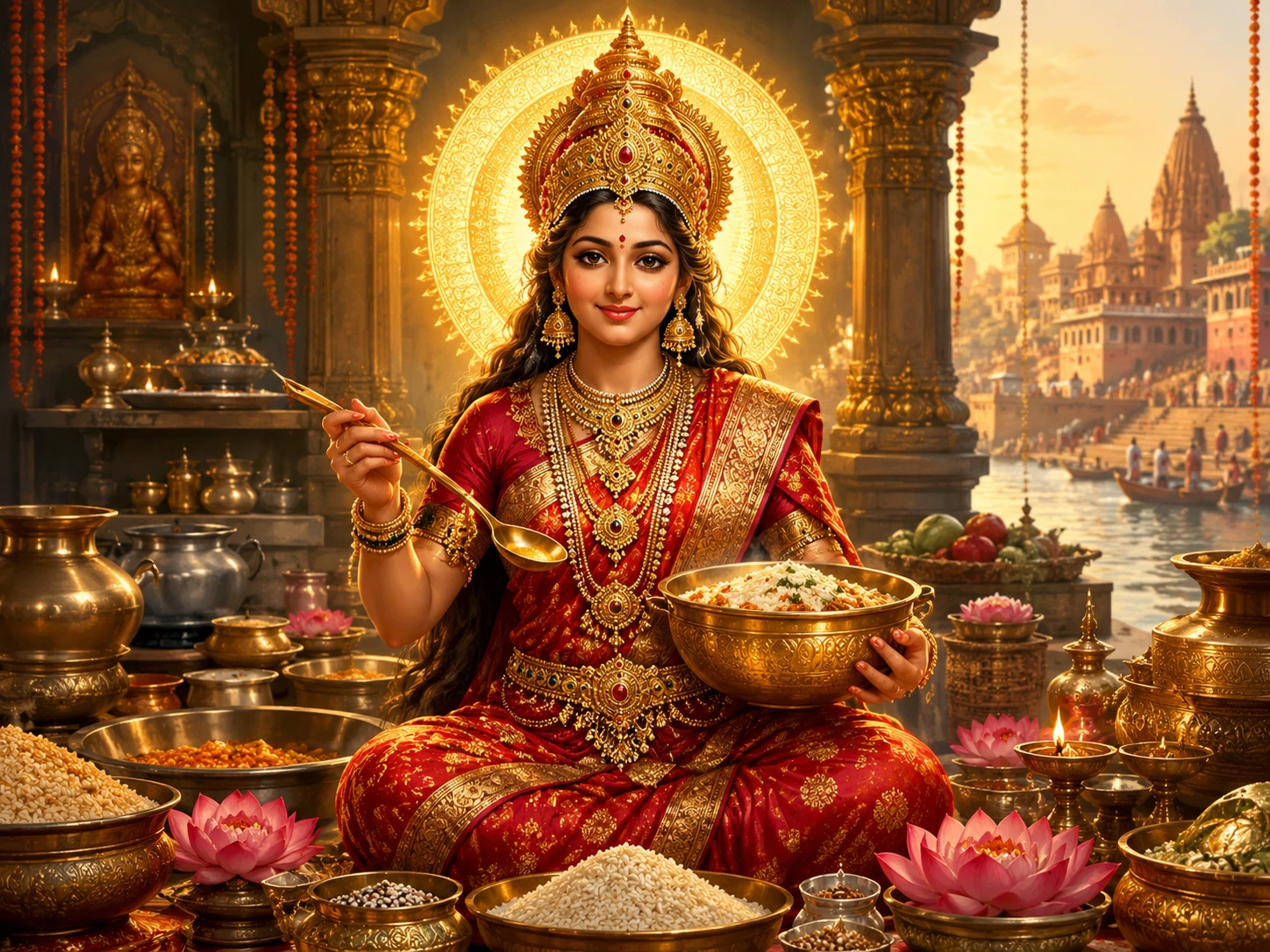
Annapurna -- Goddess of Food
19 min readThe same translation error that turned '33 Koti' into '33 crore' in Hinduism also happened in Buddhism. The Chinese translation of Buddhist texts rendered 'Sapta Koti Buddha' (7 Supreme Buddhas) as '7 Crore Buddhas.' The…
Deities AvatarsCommunity Reflections
🕉️
Be the first to share your reflection.