Naivedya and Prasada -- Why Hindus Feed God Before They Eat
नैवेद्य और प्रसाद -- हिन्दू भगवान को पहले क्यों खिलाते हैं
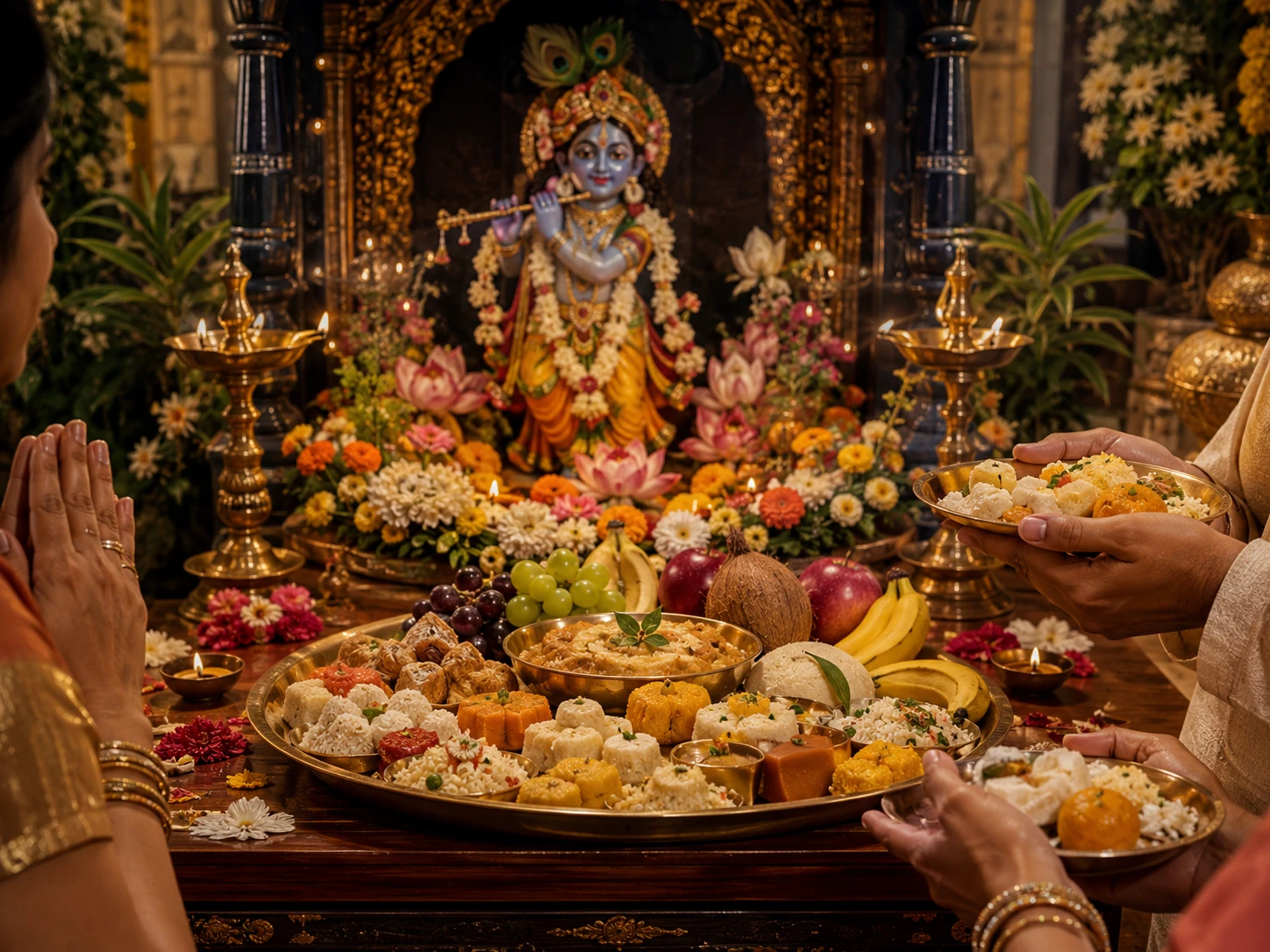
In almost every Hindu household across the planet -- from a flat in Borivali to a farmhouse in Iowa to a terrace apartment in Singapore -- there is a moment each day when food is placed before a deity before anyone eats. Sometimes it is elaborate: a full thali with rice, dal, sabzi, roti, sweet, and pickle arranged on a silver plate. Sometimes it is minimal: a spoonful of rice or a single banana placed on a small brass katori. Sometimes it is a glass of water set before a framed photograph.
This act -- Naivedya -- is so deeply embedded in Hindu daily life that most people perform it without thinking about what it actually means. It is one of those practices that exists in the background of Indian civilisation like gravity: always present, rarely questioned, and carrying far more philosophical weight than its simplicity suggests.
The word 'Naivedya' comes from 'nivedana' -- to inform, to present, to submit. It is the act of presenting food to the divine before consuming it yourself. The food that returns after this offering is called 'Prasada' -- literally, clarity, brightness, grace. The linguistic shift from Naivedya to Prasada encodes the theology: what you give as submission returns as grace.
This is not a transaction. The deity does not eat the food. The molecules have not changed. A laboratory analysis before and after would show identical composition. And yet every Hindu grandmother in the world will tell you, with absolute certainty, that Prasada tastes different from ordinary food. This is not superstition. It is the experiential trace of a theological transformation that the tradition considers real, even if it is not measurable by instruments.
पत्रं पुष्पं फलं तोयं यो मे भक्त्या प्रयच्छति। तदहं भक्त्युपहृतमश्नामि प्रयतात्मनः॥
patraṁ puṣpaṁ phalaṁ toyaṁ yo me bhaktyā prayacchati tad ahaṁ bhakty-upahṛtam aśnāmi prayatātmanaḥ
Whoever offers Me with devotion a leaf, a flower, a fruit, or water -- I partake of that offering made with love by one whose heart is pure.
— Bhagavad Gita 9.26
The Rules of Naivedya -- Precision in Love
The Dharmashastra and Agama traditions prescribe specific rules for Naivedya that reveal the seriousness with which the act is treated:
The food must be freshly prepared. Stale food, reheated food, or food that has been sitting for hours is not offered. This is not arbitrary -- it ensures that the offering represents your best effort, not your leftovers.
The food must not be tasted before offering. This is perhaps the most distinctive rule. In Indian households, the cook typically tastes food to check seasoning. For Naivedya, this is explicitly prohibited. The deity gets the first taste. This reversal of the normal cooking sequence -- where the cook is the first quality-checker -- is a daily exercise in letting go of control.
The food should ideally be sattvic. No meat, no onion, no garlic. Sattvic food is calming, nourishing, and promotes clarity. Rajasic food (spicy, stimulating) and tamasic food (stale, heavy, processed) are avoided because the offering is meant to create a channel of purity between the devotee and the divine.
The utensils should be dedicated. Many traditional households maintain separate cooking vessels and serving plates exclusively for Naivedya. This is not obsessive -- it is architectural. It creates a physical boundary between the sacred and the mundane, ensuring that the act of offering retains its distinctiveness even after thousands of repetitions.
A Tulsi leaf is placed on the Naivedya before offering, particularly in Vaishnava traditions. Tulsi is considered the embodiment of devotion itself, and her presence sanctifies the offering. Water is sprinkled around the plate three times (parisechanam) to create a symbolic boundary of purity.
After the food is placed before the deity, the devotee waits -- typically for a few minutes, sometimes accompanied by the chanting of a prayer or a few minutes of meditation. This waiting period is the liminal space in which Naivedya transforms into Prasada.
The Transformation -- How Naivedya Becomes Prasada
The philosophical heart of this practice lies in the transformation. Three schools of Hindu theology explain it differently, and the differences are instructive.
In Advaita Vedanta, the transformation is in the consciousness of the devotee, not in the food. By offering food before eating, you break the automatic association between hunger and consumption. You insert a pause -- a moment of awareness -- between desire and gratification. That pause is the entire spiritual practice. The food has not changed, but your relationship to it has. You are no longer an animal satisfying a biological urge. You are a conscious being who has chosen to filter the act of eating through devotion. Prasada is food eaten in awareness.
In Vishishtadvaita (Ramanuja's tradition), the transformation is real and theological. When food is offered to Bhagavan, His divine will (sankalpa) accepts it. The food receives the touch of divine grace (anugraha), and what returns is substantively different -- it carries the Lord's blessing as a real, though subtle, quality. Eating Prasada is therefore a sacrament, not merely a mindful meal. This is why in Sri Vaishnava temples, the Prasada (called Tirumaal Prasadam in Tirupati) is distributed with the reverence of a sacrament.
In Dvaita (Madhvacharya's tradition), the transformation is even more emphatic. Bhagavan is understood to actually consume the subtle essence (sukshma bhaga) of the food, and what remains for the devotee is the gross portion infused with divine residual energy. This is not metaphorical. The Madhva tradition takes Naivedya seriously enough to prescribe that the food must be offered only to Vishnu/Krishna and that the devotee must explicitly invite the Lord to eat.
All three schools agree on one point: eating without offering is spiritually degrading. The Gita verse 3.13 is explicit -- those who cook only for themselves eat sin. This is not a guilt-trip. It is a structural observation: if your relationship with food begins and ends with your own hunger, you have reduced one of life's most sacred acts to its most animal dimension.
Prasada in Practice -- From Home Kitchen to Jagannath's Kitchen
The Prasada tradition reaches its most spectacular expression at the Jagannath Temple in Puri, Odisha. The temple's Mahaprasad is cooked daily in the world's largest kitchen, using a system of seven earthen pots stacked one above the other over a wood fire. The food cooks from the top pot downward -- defying the normal expectation that the bottom pot should cook first. Devotees and priests regard this as divine engineering.
The Mahaprasad of Puri is unique in Indian temple tradition because it is considered so sacred that there are no caste restrictions on who can eat it. When you eat Jagannath's Prasad, social hierarchy dissolves. The Brahmin and the Dalit eat from the same vessel. This was radical when it was established centuries ago, and it remains radical today.
Tirupati's Laddu Prasadam is perhaps the most famous Prasada in the world. The Tirumala Tirupati Devasthanams (TTD) produces over 300,000 laddus daily, using a recipe that has remained essentially unchanged for centuries. The process is industrial in scale but devotional in intent -- every laddu is offered to Venkateswara before distribution. The economics of Tirupati's Prasada system is a case study in sacred supply chain management: ingredients sourced from dedicated farms, prepared in temperature-controlled kitchens, distributed through a logistics network that rivals any FMCG company.
In Shirdi, the Sai Baba Temple's Udi (sacred ash) is the primary Prasada -- a reminder that Prasada need not be food at all. In Vaishno Devi, it is dry fruits and sugar candy. In Siddhivinayak, Mumbai, it is the iconic modak. In Golden Temple, Amritsar, it is the karah prasad -- made from equal parts wheat flour, sugar, and ghee, served to every visitor without exception.
Each temple's Prasada carries the flavour of its deity, its region, and its community. But the underlying theology is identical: something was offered, something was accepted, and what returns carries grace.
Famous Temple Prasadas Across India
| Temple | मन्दिर | Location | Prasada | Unique Feature |
|---|---|---|---|---|
| Jagannath Temple | जगन्नाथ मन्दिर | Puri, Odisha | Mahaprasad (56 bhog items) | No caste restriction. World's largest temple kitchen. |
| Tirumala Venkateswara | तिरुमला वेंकटेश्वर | Tirupati, Andhra Pradesh | Laddu Prasadam | 300,000+ laddus daily. Centuries-old recipe. |
| Golden Temple | स्वर्ण मन्दिर | Amritsar, Punjab | Karah Prasad (and Langar) | Feeds 100,000+ daily. Open to all. |
| Siddhivinayak | सिद्धिविनायक | Mumbai, Maharashtra | Modak and Laddu | Ganesha's favourite sweet. |
| Sabarimala Ayyappa | शबरिमला अय्यप्पा | Kerala | Aravana Payasam | Jaggery-rice-ghee payasam. Made in massive urns. |
| Shirdi Sai Baba | शिर्डी साईं बाबा | Shirdi, Maharashtra | Udi (sacred ash) | Non-food prasada. Healing tradition. |
| Vaishno Devi | वैष्णो देवी | Katra, J&K | Dry fruits and Mishri | Mountain pilgrimage prasada, light to carry. |
Temple prasada traditions often reflect local agriculture and cuisine. Puri's rice-based Mahaprasad mirrors Odisha's rice culture. Tirupati's laddu uses regional jaggery. The prasada is both sacred and hyper-local.
The Psychology of Prasada -- Why It Actually Works
Set aside theology for a moment and consider the psychology of Naivedya-Prasada purely as a behavioural intervention.
The act of offering food before eating creates a mandatory pause between the stimulus (hunger) and the response (eating). This pause is precisely what cognitive behavioural therapy calls a 'stimulus-response gap' -- the space in which automatic behaviour can be interrupted and replaced with conscious choice. Every diet plan, every mindful eating programme, every portion-control strategy is trying to create this gap. The Hindu tradition built it into the daily architecture of eating three thousand years ago.
The act of preparation -- cooking with the intention of offering, selecting fresh ingredients, maintaining cleanliness, not tasting before offering -- creates what psychologists call 'ritual framing.' Research on ritual behaviour (published in journals like Psychological Science and the Journal of Experimental Psychology) shows that performing rituals before eating enhances the subjective experience of the food. People rate food as tastier, more satisfying, and more valuable when a ritual precedes consumption. Your grandmother was right: Prasada does taste different. Not because of divine intervention, but because ritual preparation primes the brain to receive the experience more fully.
The communal distribution of Prasada -- the practice of sharing sanctified food with family, neighbours, and visitors -- creates social bonding through shared sacred consumption. This is not unique to Hinduism; the Christian Eucharist, the Jewish Kiddush, and the Sikh Langar all use sacred food as social glue. But the Hindu Prasada system is distinctive in its daily frequency and its domestic location. It does not require you to go to a temple. It happens in your kitchen. Every meal can be a sacrament.
For the startup founder in HSR Layout eating Swiggy-delivered food alone in front of a laptop -- the Naivedya-Prasada practice offers a structural correction. Even if the food is ordered, even if it is not sattvic, the act of pausing to offer it before eating transforms the relationship between the eater and the eaten. It moves the meal from consumption to communion.
The Tirumala Tirupati Devasthanams (TTD) is one of the richest religious institutions in the world, and its Laddu Prasadam operation is a marvel of sacred logistics. The TTD obtained a Geographical Indication (GI) tag for its laddu in 2009 -- making Tirupati Laddu one of the few temple offerings in the world with intellectual property protection. The recipe uses specific varieties of Bengal gram dal, sugar, cardamom, cashew, and raisins, and the cooking process follows a precise sequence perfected over centuries. The TTD's annual laddu production exceeds 100 million pieces -- a scale that would make any FMCG company envious.
Naivedya and the Ethics of Eating -- Anna Brahman
The Naivedya-Prasada system is embedded in a larger Hindu philosophy of food that the Taittiriya Upanishad articulates with extraordinary force: 'Annam Brahma' -- food is Brahman. This is not a casual metaphor. The Upanishad devotes an entire section (Bhrigu Valli) to demonstrating that food is the foundation of existence, that all beings are born from food, live by food, and return to food at death.
In this framework, cooking is not a mundane chore. It is a sacred act of transformation -- converting raw ingredients (Prakriti) into nourishment (Prana). The cook is a kind of priest, and the kitchen is a kind of yajna-shala. This is why traditional Indian households maintained strict rules about kitchen purity: no shoes, no arguments, no entering while in a state of ritual impurity. The food absorbs the consciousness of the cook. Angry cooking produces angry food. Loving cooking produces loving food.
Modern food science has begun to document what the tradition always knew: the emotional state of the food preparer affects the physiological response of the eater. Studies on cortisol levels in breast milk have shown that a stressed mother produces milk with higher cortisol, which affects the infant's stress response. While the mechanism for cooked food is different, the principle -- that the maker's state transfers to the made -- is consistent with the tradition's insistence on sattvic cooking.
The Naivedya practice elevates this further. By offering food to the divine before consumption, the devotee is performing a double purification: first, by cooking with devotion (purifying the making), and second, by offering before eating (purifying the consuming). The food passes through two filters of consciousness before it enters the body. This is why the Vaishnavite tradition insists that a devotee should eat only Prasada -- only food that has been offered. It is not dietary restriction. It is epistemic hygiene.
For the college student eating in a hostel mess in VIT Vellore or NIT Trichy, the full Naivedya procedure may not be possible. But the minimum is always possible: a moment of silence before eating, a mental offering, a brief prayer. Even this micro-practice transforms the relationship with food from consumption to communion. And in a generation dealing with disordered eating, stress-eating, and emotional disconnection from food, this ancient practice offers something no diet app can: a daily moment of sacred awareness that you are eating not just to survive, but to sustain a life that is itself an offering.
Naivedya in the Modern Kitchen -- Practical Guidelines
For the reader who wants to begin a Naivedya practice but feels overwhelmed by the rules, here is a simplified starting point that the tradition fully supports:
If you cook at home: before serving anyone, take a small portion of freshly cooked food on a clean plate. Place a Tulsi leaf on it if available. Place the plate before your home deity. Fold your hands, close your eyes, and mentally offer the food with the thought 'Bhagavan, I offer this to You.' Wait for one to two minutes. Remove the plate. The food on that plate is now Prasada -- share it with your family, beginning with children and elders.
If you do not cook: a banana, an apple, a handful of almonds, or a glass of milk works perfectly. Place it before the deity, offer mentally, wait, and then consume it as Prasada.
If you are travelling: even a silent mental offering before eating in a restaurant or on a flight is a valid Naivedya. The tradition recognises that the offering is ultimately internal (manasika), not external. The physical food is the prop; the real offering is the devotee's intention.
The key principle is consistency. A daily banana offered with love over thirty years is infinitely more valuable than an elaborate feast offered once and forgotten. The practice trains the mind to remember, every single day, that you are not the ultimate consumer. Something larger than you has given you the capacity to eat. The least you can do is offer the first bite back.
Offer Your First Naivedya Today
Begin with the simplest naivedya: place a fruit or a glass of water before your deity, chant 'Om Namo Narayanaya' or a mantra of your ishta devata on a mala, and then receive the offering as prasada. One fruit, one mantra, one transformation. The mantra meditation library on Eternal Raga has mantras to choose from.
Eternal Raga · शाश्वत राग
Institutional voice — scholarly articles on Sanatan Dharma
Deepen Your Understanding
अपनी समझ और गहरी करें
rituals traditions
Panchopachara Puja -- The 5 Offerings That Engage All Five Senses
You do not need a pandit, a pavilion, or a two-hour ritual to worship. The Panchopachara Puja -- five offerings representing the five elements and engaging the five senses -- is the tradition's elegant minimum viable puja. Sandalwood for earth, flowers for space, incense for air, lamp for fire, food for water. Five items. Five minutes. A complete act of devotion.
rituals traditions
Shodashopachara Puja -- The Sixteen-Step Protocol of Hindu Worship
When a Hindu temple priest performs puja, he is not improvising. He is executing a precise sixteen-step protocol called Shodashopachara -- literally 'sixteen offerings' -- that treats God as a royal guest arriving at your home. From invitation to farewell, each step has a specific action, material, mantra, and philosophical meaning. This is the complete user manual.
rituals traditions
Puja at Home -- The Complete Beginner's Guide
You have a small mandir shelf in your apartment. A brass diya your mother gave you. A photo of a deity you feel drawn to. And absolutely no idea what to do next. This guide is for you -- the 22-year-old in Pune who just moved out, the NRI in New Jersey setting up a puja corner for the first time, the curious soul who wants to start but does not know where.
rituals traditions
Panchamaha Yajnas -- The 5 Daily Duties Every Householder Owes
You owe five debts the moment you wake up: to knowledge, to the divine, to your ancestors, to all living beings, and to fellow humans. The Panchamaha Yajnas are not grand fire rituals -- they are five daily micro-acts that the tradition considers the minimum operating system of a responsible life. Skip them and you are, according to Manu, living as a thief.
rituals traditions
Annadana -- Why Feeding Is the Highest Form of Charity in Hindu Tradition
The Taittiriya Upanishad declares: 'Do not turn away anyone who comes for food.' The Mahabharata ranks Annadana above all other forms of giving. The Sikh Langar feeds 100,000 people daily at the Golden Temple alone. The Akshaya Patra Foundation, inspired by ISKCON, serves mid-day meals to 2 million schoolchildren every day. In a civilisation that equates food with Brahman (Annam Brahma), feeding another person is not charity -- it is worship.
rituals traditions
Why Bells, Lamps, and Flowers -- The Sensory Engineering Behind Hindu Worship
Hindu worship is not random. Every bell, every lamp, every flower, every stick of incense, every drop of water addresses a specific sense, invokes a specific element, and produces a specific psychological effect. The puja is a sensory design system -- a five-element, five-sense immersive experience engineered three thousand years before UX designers existed. Here is the complete map.
rituals traditions
Nitya, Naimittika, and Kamya Karma -- The Three Categories of Duty
Hinduism does not say 'do good things.' It says 'know which kind of action you are performing and why.' The three-fold classification of Karma into Nitya (daily non-negotiable), Naimittika (occasion-triggered), and Kamya (desire-driven) is the most practical decision-making framework the tradition offers -- and it works as well in a Bangalore startup as it did in a Vedic gurukul.
The Tirumala Tirupati Devasthanams (TTD) is one of the richest religious institutions in the world, and its Laddu Prasadam operation is a marvel of sacred logistics. The TTD obtained a Geographical Indication (GI) tag fo…
More in Rituals & Traditions
Aarti -- Why Hindus Circle Light Before God
13 min read
Abhisheka -- Why Hindus Bathe Their Gods
10 min read
Akshaya Tritiya -- The Day Nothing Given Away Runs Out
12 min readThe same translation error that turned '33 Koti' into '33 crore' in Hinduism also happened in Buddhism. The Chinese translation of Buddhist texts rendered 'Sapta Koti Buddha' (7 Supreme Buddhas) as '7 Crore Buddhas.' The…
Deities AvatarsCommunity Reflections
🕉️
Be the first to share your reflection.