Sankalpa -- The Ritual GPS That Locates You in the Cosmos Before Every Puja
संकल्प -- हर पूजा से पहले ब्रह्माण्ड में तुम्हारा पता बताने वाला अनुष्ठान GPS
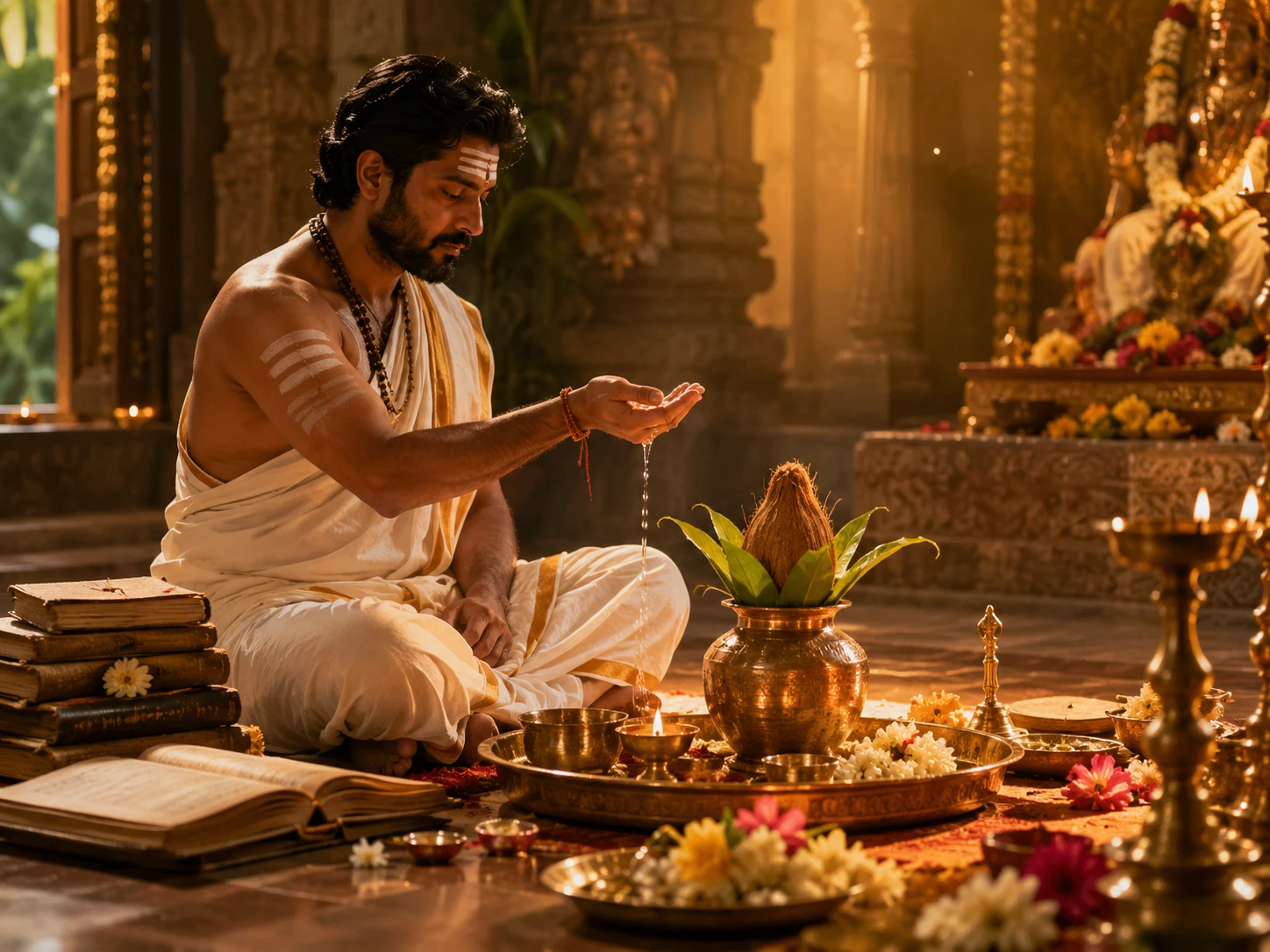
Every Hindu ritual -- from a two-minute morning prayer to a twelve-day Maha Yajna -- begins with the same quiet act. The performer sits in Padmasana, places the right palm over the left on the right knee, takes a small amount of water mixed with flowers and akshata (unbroken rice) in the right palm, and makes a declaration. This declaration is the Sankalpa.
If you have ever attended a puja, you have heard it. The pandit begins with 'Om Vishnuh Vishnuh Vishnuh' or 'Sri Govinda Govinda,' then launches into a rapid-fire Sanskrit cascade that sounds impressively complex and entirely incomprehensible to most listeners. You catch fragments -- Kaliyuge, Bharatavarshe, your father's name, something about a Samvatsara -- and then it is over, water is released, and the actual puja begins.
Most people treat Sankalpa as a formality. It is anything but. The Sankalpa is the most intellectually sophisticated opening statement in any religious tradition on earth. In under sixty seconds of Sanskrit, it accomplishes three extraordinary things:
First, it locates you in cosmic time -- not just today's date, but your position within Brahma's lifespan, the current Kalpa, the current Manvantara, the current Yuga, the current year (named in the sixty-year Samvatsara cycle), the current Ayana (solar half), the current Ritu (season), the current Masa (month), the current Paksha (fortnight), the current Tithi (lunar day), and the current Nakshatra (star).
Second, it locates you in space -- the Dvipa (continent), the Varsha (land), the Khanda (region), the river you are nearest to, and even the specific house or temple you are sitting in.
Third, it declares your identity (name, gotra/lineage) and your intention -- the specific ritual you are about to perform and the deity you are addressing.
In modern terms, the Sankalpa is a GPS coordinate plus a timestamp plus a user ID plus a declared intent. It is a ritual API call to the cosmos, with every parameter filled in.
मम उपात्त समस्त दुरितक्षयद्वारा श्री परमेश्वर प्रीत्यर्थम्...
mama upātta samasta duritakṣaya dvārā śrī parameśvara prītyartham...
For the removal of all sins accumulated by me, and for the pleasure of the Supreme Lord...
— Standard Sankalpa formula, derived from Dharmashastra tradition
The Structure of Sankalpa -- A Cosmic Address System
The Sankalpa mantra follows a precise structure that moves from the largest scale of time to the smallest, then from the largest scale of space to the smallest, and finally to the individual.
The cosmic time declaration begins: 'Adya Brahmane Dwiteeya Parardhe' -- in the second half of Brahma's lifespan. This immediately places the performer within a temporal framework of 155.52 trillion years. It continues: 'Shweta Varaha Kalpe' -- in the current Kalpa called Shweta Varaha (the day in which Vishnu incarnated as the White Boar). 'Vaivaswatha Manvantare' -- in the seventh Manvantara, ruled by the current Manu Vaivaswatha. 'Ashtavimshatitame Kaliyuge' -- in the twenty-eighth Kaliyuga. 'Prathama Pade' -- in the first quarter of this Kaliyuga.
The temporal drill-down continues through the sixty-year Samvatsara cycle (each year has a name -- Prabhava, Vibhava, Shukla, etc.), the Ayana (Uttarayana or Dakshinayana), the Ritu (Vasanta, Greeshma, Varsha, Sharad, Hemanta, or Shishira), the Masa (named month), the Paksha (Shukla or Krishna), the Tithi (first through fifteenth lunar day), the Vasara (day of the week, named after the Navagraha), and the Nakshatra (the star under which the moon resides that day).
The spatial declaration then begins: 'Jambudwipe' (the continent of Jambu -- the Indian subcontinent in classical geography). 'Bharatavarshe' (the land of Bharata). 'Bharatakhande' (the region of Bharata). Then the specific river: 'Godavari Dakshina Theere' (on the southern bank of the Godavari) or 'Ganga Uttara Theere' (on the northern bank of the Ganga). Then the specific location: 'Shobhana Gruhe' (in an auspicious house) or the temple name.
Finally, the personal declaration: the performer's name, their gotra (patrilineal Vedic lineage tracing back to a founding Rishi -- Kashyapa, Bharadvaja, Vishwamitra, etc.), and the explicit statement of intention: 'Sri [Deity Name] Pujam Karishye' -- I will now perform the worship of [Deity].
The effect of reciting all this is profound. In sixty seconds, the devotee has located themselves within the full scale of cosmic time (from Brahma's lifespan to this exact Nakshatra), the full scale of cosmic space (from the continent to this room), and the full chain of human identity (from the founding Rishi of their gotra to their own name). There is no more precise way to say 'I am here, now, and this is what I am about to do.'
Sankalpa Components -- From Cosmos to Self
| Layer | परत | Sanskrit Term | What It Declares | Modern Equivalent |
|---|---|---|---|---|
| Cosmic Era | ब्रह्माण्डीय युग | Parardha, Kalpa, Manvantara | Which half of Brahma's life, which day, which Manu | Geological era |
| Yuga | युग | Kaliyuge Prathama Pade | Which Yuga and which quarter | Historical epoch |
| Year | वर्ष | Samvatsare | Named year in 60-year cycle | Calendar year |
| Season | ऋतु | Uttarayana/Dakshinayana, Ritu | Solar half-year, season | Solstice, season |
| Month & Day | मास-तिथि | Masa, Paksha, Tithi, Vasara | Lunar month, fortnight, day, weekday | Date |
| Star | नक्षत्र | Nakshatra | Moon's position among 27 stars | Astrological transit |
| Continent | महाद्वीप | Jambudwipe | Which landmass | Continent |
| Country | देश | Bharatavarshe Bharatakhande | Which land and region | Country, state |
| River/City | नदी/नगर | Nadi Theere / Nagare | Nearest sacred river, specific location | GPS coordinates |
| Identity | पहचान | Nama, Gotra | Name and patrilineal Vedic lineage | User ID + ancestry |
| Intention | संकल्प | Pujam Karishye | The specific ritual to be performed | API call / task declaration |
The Sankalpa is effectively a multi-dimensional coordinate system: temporal (Brahma's age to this Nakshatra), spatial (continent to room), genealogical (founding Rishi to self), and intentional (the specific act). No other religious tradition packs this much contextual precision into a pre-ritual declaration.
Why Precision Matters -- The Theology Behind the GPS
Why does the tradition demand this level of detail? Why not simply say 'I am doing a puja' and begin?
The Dharmashastra offers three interconnected answers.
First, specificity prevents dilution. A vague intention produces vague results. By declaring exactly who you are, where you are, when you are, and what you intend to do, you concentrate the mind's energy into a single focused beam. This is the same principle behind the modern productivity technique of writing down specific goals: research consistently shows that specific written goals are achieved at significantly higher rates than vague mental aspirations. The Sankalpa is a goal statement -- spoken aloud, witnessed by the divine, and sealed with water released to the earth.
Second, cosmic context creates humility. When you begin a puja by declaring that you exist in the second Parardha of Brahma, in the seventh Manvantara, in the twenty-eighth Kaliyuga, you are reminding yourself how tiny you are within the fabric of time. And yet the tradition simultaneously insists that your specific act -- this puja, by this person, at this exact moment -- matters enough to declare before the cosmos. This is the paradox of Sankalpa: you are infinitesimally small AND cosmically significant. Both truths are spoken in the same breath.
Third, the water seals the intent. The act of releasing water (Jala Visarjana) at the conclusion of the Sankalpa is not decorative. In Vedic thought, water is the element of commitment. A promise made over water is binding. The water carries the Sankalpa from the devotee's hand to the earth, from the human realm to the cosmic, and the act is now registered.
For the UPSC aspirant who makes a Sankalpa before her daily Saraswati Puja in Old Rajinder Nagar: the specificity of the declaration -- naming the exact date, the exact exam she is preparing for, the exact blessing she seeks -- transforms a generic prayer into a precision instrument. For the NRI family performing Satyanarayan Puja in their apartment in Fremont, California, the Sankalpa adapts: instead of 'Bharatavarshe Bharatakhande,' they may declare 'Krauncha Dwipe' (the continent associated with the Americas in some traditional geographies) or simply 'America Khande.' The tradition stretches. The precision remains.
Sankalpa in Yoga and Modern Life -- The Internal Resolve
Beyond formal ritual, Sankalpa has found a powerful second life in the yoga tradition. In Yoga Nidra (yogic sleep meditation), the Sankalpa is a short, positive affirmation planted in the subconscious mind during the state between waking and sleeping. Swami Satyananda Saraswati of the Bihar School of Yoga popularised this practice, and it has since spread worldwide through yoga teacher training programmes.
In this yogic context, the Sankalpa is stripped of its cosmic-temporal architecture and reduced to its emotional core: a single sentence expressing the deepest resolve of the practitioner. 'I am at peace.' 'I am healing.' 'I live with courage.' The Yoga Nidra teacher instructs the student to repeat this Sankalpa three times at the beginning and three times at the end of the practice, when the mind is most receptive.
This secular adaptation retains the essence of the Vedic Sankalpa: the principle that a clearly stated intention, repeated with awareness, programs consciousness in the direction of its fulfilment. The corporate world has rediscovered this as 'intention setting' in mindfulness workshops. IIM Bangalore and IIM Ahmedabad include mindfulness modules in their MBA curricula that use Sankalpa-like techniques without the Sanskrit vocabulary.
The startup culture of Bangalore and Mumbai has its own version: the product vision statement, the OKR (Objectives and Key Results), the mission declaration on the office wall. These are secular Sankalpas -- declarations of intention meant to focus collective energy. The difference is that the Vedic Sankalpa places the individual within a cosmic framework, while the corporate version places the team within a market framework. But the psychological mechanism is identical: declare what you intend to do, and the mind organises itself to achieve it.
For the reader who does not perform formal puja: you can adopt a personal Sankalpa practice today. Each morning, before beginning work, sit quietly for thirty seconds. Mentally declare: today's date, your location, your name, and your primary intention for the day. 'It is April 9, 2026. I am in Nashik. My name is [Name]. Today I will complete [specific task] with full attention and without distraction.' This is a stripped-down Sankalpa. It works. Try it for seven days and notice the difference.
The Sankalpa declaration is one of the oldest surviving examples of what computer scientists would call 'metadata tagging.' By encoding the performer's temporal position (from Brahma's age to the current Nakshatra), spatial position (continent to room), identity (gotra to name), and intent (specific ritual), it creates a unique identifier for every single ritual performed anywhere in the Hindu world. No two Sankalpas are identical -- the Nakshatra changes every day, the Tithi changes, the performer changes. Each Sankalpa is a one-time, non-repeating cosmic transaction ID. The blockchain community talks about immutable, timestamped records. The Rishis had the concept thousands of years before Satoshi Nakamoto.
The NRI Sankalpa Problem -- Locating Yourself Outside Bharatavarsha
One of the most fascinating living debates in Hindu ritual practice is how to recite Sankalpa outside India. The traditional formula says 'Jambudwipe Bharatavarshe Bharatakhande' -- locating the performer on the Indian subcontinent. But what if you are in New Jersey? Or Dubai? Or Fiji?
Different communities have developed different solutions. Some South Indian communities in the US use 'Krauncha Dwipe' (the continent traditionally associated with the western hemisphere in Puranic geography) instead of 'Jambudwipe.' Others say 'America Khande' or 'Uttara America Deshe.' Some temples in the UK use 'Pushkara Dwipe.' The Tamil community in Malaysia and Singapore sometimes uses 'Shaka Dwipe.'
The river reference creates another challenge. 'Godavari Dakshina Theere' makes no sense in Houston. Some priests use the nearest major river -- 'Mississippi Nadi Theere' or 'Thames Nadi Theere' -- while purists argue that only sacred Indian rivers should be named. Others simply say 'Sapta Samudrantare' (between the seven oceans), which is geographically vague but cosmologically accurate.
This debate is not trivial. It reveals the Sankalpa's deepest principle: location matters. The tradition insists that your physical position in space is relevant to your spiritual act. You are not a disembodied consciousness performing an abstract ritual. You are a body, in a place, at a time, performing a specific act. The Sankalpa forces you to acknowledge all four dimensions of your embodied existence before you begin.
The Hindu American community's resolution of this problem -- adapting ancient geographic references to new continents while preserving the structural precision -- is one of the most creative acts of living tradition maintenance in the global diaspora. Every adapted Sankalpa is proof that the tradition is alive: not frozen in a museum but growing new roots in new soil.
For the NRI reader who has always felt uncomfortable during Sankalpa because they did not know what to say for their location: ask your local temple priest for the adapted version used in your city. If no standard exists, create one. The tradition permits and encourages it. The Sankalpa for New York might read: 'Krauncha Dwipe, Ramanaka Varshe, Uttara America Khande, Hudson Nadi Theere, [City] Nagare, Shobhana Gruhe.' Your grandmother in Thanjavur would recognise the structure instantly -- even if the river name sounds strange.
Sankalpa as Decision Architecture -- The Corporate Parallel
Strip the theology from Sankalpa and what remains is a remarkably effective decision-making protocol that modern organisations would benefit from adopting.
Consider what the Sankalpa demands before any action: context (where am I in time and space?), identity (who am I and what is my lineage/role?), and intent (what exactly am I about to do and for whom?). This three-part declaration prevents the two most common causes of failed projects: vague objectives and misaligned context.
In management consulting, the equivalent is the project charter -- a document that specifies the project's scope, stakeholders, timeline, and objectives before work begins. McKinsey's problem-solving framework requires a 'situation-complication-question' structure before analysis begins. Amazon's six-page memo culture demands that every initiative begins with a clear written narrative before any meeting or resource allocation.
The Sankalpa is the Vedic version of all these frameworks -- compressed into sixty seconds of spoken Sanskrit. It forces the performer to stop, specify, and commit before acting. In a world of impulsive decision-making (Slack messages sent without thinking, investments made on FOMO, relationships entered without clarity), the Sankalpa principle is a corrective: nothing begins without a declaration of context, identity, and intent.
The startup ecosystem in Bangalore would benefit enormously from a secular Sankalpa practice. Before every board meeting, every product launch, every hiring decision: who are we? Where are we? What exactly are we about to do, and for what purpose? Sixty seconds of forced clarity before the chaos begins. The Rishis were not just ritual designers. They were decision architects.
A product manager at Flipkart who writes a PRD (Product Requirements Document) before coding begins is performing a secular Sankalpa. A lawyer who drafts a case brief specifying jurisdiction, parties, and relief sought is performing a legal Sankalpa. A surgeon who performs a pre-operative checklist (WHO Surgical Safety Checklist) naming the patient, the procedure, and the site before cutting is performing a medical Sankalpa. The principle is universal. The Vedic tradition simply formalised it first -- and added the cosmic dimension that no corporate framework includes: you are not just a professional in an office. You are a being in a universe, at a specific coordinate of time and space, and your action ripples outward from that coordinate into the fabric of reality.
Set Your Daily Sankalpa Before Japa
Before your daily japa, take a moment of sankalpa. Mentally declare today's date, your location and your intention for this sitting. Then begin your 108 repetitions on a mala. The sankalpa focuses the mind; the japa deepens the focus. The mantra meditation library on Eternal Raga has mantras to choose from.
Eternal Raga · शाश्वत राग
Institutional voice — scholarly articles on Sanatan Dharma
Deepen Your Understanding
अपनी समझ और गहरी करें
rituals traditions
Puja at Home -- The Complete Beginner's Guide
You have a small mandir shelf in your apartment. A brass diya your mother gave you. A photo of a deity you feel drawn to. And absolutely no idea what to do next. This guide is for you -- the 22-year-old in Pune who just moved out, the NRI in New Jersey setting up a puja corner for the first time, the curious soul who wants to start but does not know where.
vedic sciences
Kaal Ganana -- The Hindu Measure of Time
From a single blink of the eye (Nimesha) to one Day of Brahma (4.32 billion years) -- explore the complete cosmic time hierarchy of Hindu cosmology, anchored in Vishnu Purana 1.3, with its remarkable parallels to modern science.
rituals traditions
Nitya, Naimittika, and Kamya Karma -- The Three Categories of Duty
Hinduism does not say 'do good things.' It says 'know which kind of action you are performing and why.' The three-fold classification of Karma into Nitya (daily non-negotiable), Naimittika (occasion-triggered), and Kamya (desire-driven) is the most practical decision-making framework the tradition offers -- and it works as well in a Bangalore startup as it did in a Vedic gurukul.
rituals traditions
Shodashopachara Puja -- The Sixteen-Step Protocol of Hindu Worship
When a Hindu temple priest performs puja, he is not improvising. He is executing a precise sixteen-step protocol called Shodashopachara -- literally 'sixteen offerings' -- that treats God as a royal guest arriving at your home. From invitation to farewell, each step has a specific action, material, mantra, and philosophical meaning. This is the complete user manual.
rituals traditions
Havan Vidhi -- The Vedic Fire Ritual That Purifies Air, Mind, and Karma
Every major Hindu milestone -- birth, thread ceremony, wedding, housewarming, death -- involves fire. The havan is the oldest continuous ritual technology in Hinduism, dating to the Rig Veda. You pour ghee, herbs, and grains into a consecrated fire while chanting 'Svaha,' and Agni carries your offering to the gods. Modern science confirms: the smoke actually does purify the air. Here is the complete procedure.
rituals traditions
Muhurta -- Why Hindus Obsess Over the Right Moment
Your grandmother checked the panchang before scheduling your mundan. Your parents consulted an astrologer before fixing your wedding date. Your colleague will not sign a business contract without checking the Choghadiya. The Hindu tradition divides every 24-hour day into 30 Muhurtas of 48 minutes each -- some auspicious, some neutral, some to be avoided -- and this time-quality framework has governed Indian life from Vedic fire rituals to modern real estate transactions.
rituals traditions
Sandhyavandana -- The Daily Vedic Practice That Even Rama and Krishna Never Skipped
Three times a day, at the junction of night and day, morning and afternoon, afternoon and night, the twice-born Hindu is commanded to stop everything and perform Sandhyavandana. It combines pranayama, the Gayatri Mantra, water offerings, and meditation into a single twenty-minute ritual. The Ramayana shows Rama doing it in the forest. The Mahabharata shows Krishna doing it before battle. And somewhere in India right now, an IIT student is doing it in his hostel room.
The Sankalpa declaration is one of the oldest surviving examples of what computer scientists would call 'metadata tagging.' By encoding the performer's temporal position (from Brahma's age to the current Nakshatra), spat…
More in Rituals & Traditions
Aarti -- Why Hindus Circle Light Before God
13 min read
Abhisheka -- Why Hindus Bathe Their Gods
10 min read
Akshaya Tritiya -- The Day Nothing Given Away Runs Out
12 min readThe same translation error that turned '33 Koti' into '33 crore' in Hinduism also happened in Buddhism. The Chinese translation of Buddhist texts rendered 'Sapta Koti Buddha' (7 Supreme Buddhas) as '7 Crore Buddhas.' The…
Deities AvatarsCommunity Reflections
🕉️
Be the first to share your reflection.