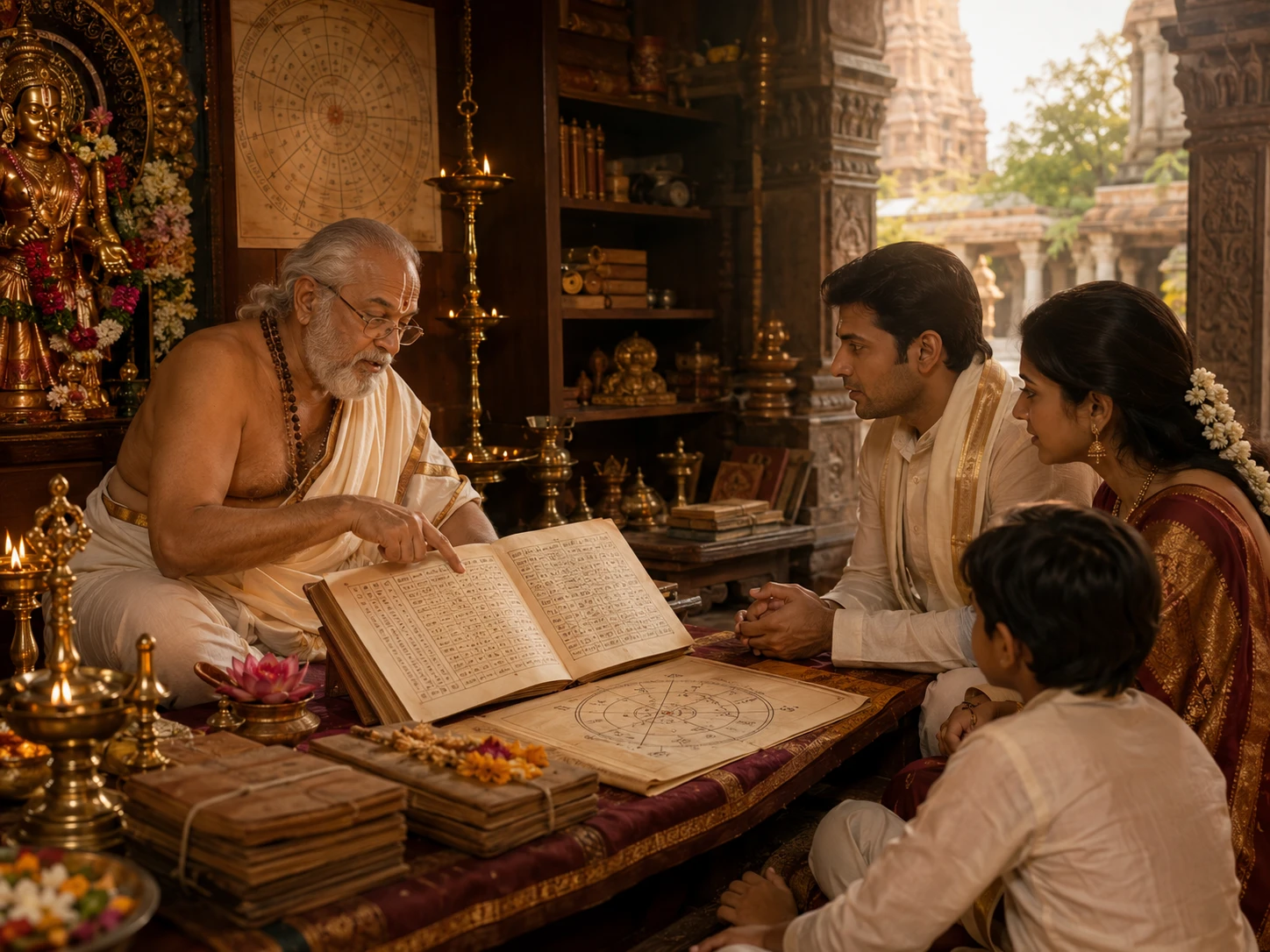
Muhurta -- Why Hindus Obsess Over the Right Moment
मुहूर्त -- हिन्दू सही क्षण को लेकर इतने सजग क्यों हैं
No Indian wedding invitation is printed without a Muhurta. No new business is inaugurated without checking the Choghadiya. No house is entered for the first time without a Griha Pravesh Muhurta. And every morning at 4:24 AM -- give or take, depending on sunrise -- millions of practitioners across India wake for Brahma Muhurta, the 48-minute window considered the most auspicious time in the entire day for meditation, prayer, and spiritual practice.
The word Muhurta comes from 'muhu' (moment, instant) and 'rta' (order, cosmic rhythm). A Muhurta is not merely a measurement of time -- it is a measurement of time's quality. The Hindu tradition holds that time is not uniform. Not all hours are created equal. Each 48-minute block of the day carries a specific energy signature, influenced by the ruling deity, the planetary alignment, and the cosmic rhythm of that particular period. Choosing the right Muhurta for an action is like choosing the right soil for a seed -- the seed is the same, but the conditions determine whether it thrives or withers.
This is not superstition. It is an empirical observation, refined over millennia, that the timing of an action affects its outcome. Modern chronobiology -- the science of biological rhythms -- confirms that human physiology, cognition, and emotional states fluctuate significantly across the 24-hour cycle. Cortisol peaks in the early morning. Melatonin surges at night. Cognitive performance varies by up to 20% depending on the time of day. The Muhurta system is the ancient Indian articulation of this same insight: time has texture, and aligning your actions with time's texture improves their results.
The Rigveda, Shatapatha Brahmana, and Taittiriya Brahmana all reference the Muhurta as a division of the day. The system was formalised in the Jyotisha Vedanga -- the astronomical appendix to the Vedas -- and further elaborated in texts like the Surya Siddhanta, Brihat Samhita by Varahamihira, and the Muhurta Chintamani. From these texts, a complete science of electional timing emerged -- one that remains in active daily use across India today.
ब्राह्मे मुहूर्ते बुध्येत धर्मार्थौ चानुचिन्तयेत्। कायक्लेशांश्च तन्मूलान् वेदतत्त्वार्थमेव च॥
brāhme muhūrte budhyeta dharmārthau cānucintayet kāya-kleśāṁś ca tan-mūlān veda-tattvārtham eva ca
One should wake during the Brahma Muhurta and contemplate upon dharma and artha (righteous conduct and material well-being), the afflictions of the body and their root causes, and the true meaning of the Vedas.
— Ashtanga Hridaya, Sutrasthana 2.1 (Vagbhata)
The 30 Muhurtas -- A Map of the Day's Energy
The Hindu day, measured from one sunrise to the next, is divided into 30 Muhurtas of approximately 48 minutes each. Fifteen Muhurtas span the daytime (sunrise to sunset) and fifteen span the night. Each Muhurta is named after a presiding deity or quality, and classified as auspicious (shubha), inauspicious (ashubha), or mixed.
The most important daytime Muhurtas include:
Brahma Muhurta (the 14th Muhurta of the night, approximately 1 hour 36 minutes before sunrise): universally considered the most sacred time of day. Vagbhata's Ashtanga Hridaya prescribes waking during this period for contemplation of dharma and self-study. The air is richest in oxygen and prana, the mind is naturally calm, and the noise pollution of modern life has not yet begun. IIT and AIIMS research on circadian rhythms has confirmed that cognitive clarity peaks during this pre-dawn window for early risers.
Abhijit Muhurta (the 8th Muhurta of the day, spanning local noon): ruled by Lord Vishnu, considered auspicious for beginning any major undertaking. The name Abhijit means 'victorious,' and this Muhurta is believed to overcome the doshas (flaws) of all other inauspicious factors in the horoscope. Rama is traditionally said to have been born during Abhijit Muhurta.
The inauspicious Muhurtas include Rahu Kala (a daily period ruled by Rahu, varying by day of the week), Yamaganda (ruled by Yama), and Gulika Kala. These are not times of disaster -- they are times when the cosmic energy is unfavourable for new beginnings. Existing work can continue, but new ventures should not be initiated.
The practical application is straightforward. Before scheduling a wedding, the pandit checks the Panchang for a Shubh Muhurta that avoids Rahu Kala, falls on a favourable Tithi and Nakshatra, and aligns with the couple's horoscopes. Before a Griha Pravesh, the same multi-factor analysis is performed. Before a business launch, the entrepreneur -- even in Bangalore's tech ecosystem -- often checks the Choghadiya (a simplified Muhurta system popular in Gujarat and Maharashtra) to ensure the first transaction happens at an auspicious moment.
Key Muhurtas of the Day
| Muhurta | मुहूर्त | Approximate Time | Quality | Best For |
|---|---|---|---|---|
| Brahma Muhurta | ब्रह्म मुहूर्त | ~4:24-5:12 AM (varies) | Most sacred | Meditation, Japa, Vedic study, yoga |
| Abhijit Muhurta | अभिजित मुहूर्त | ~11:36 AM-12:24 PM | Victorious | Beginning major ventures, signing contracts, travel |
| Rahu Kala | राहु काल | Varies by weekday | Inauspicious | Avoid new beginnings |
| Yamaganda | यमगण्ड | Varies by weekday | Inauspicious | Avoid new beginnings |
| Gulika Kala | गुलिक काल | Varies by weekday | Inauspicious | Avoid new beginnings |
| Godhuli Muhurta | गोधूलि मुहूर्त | ~Sunset (cow-dust time) | Auspicious | Weddings (especially in North India) |
| Nishita Muhurta | निशीथ मुहूर्त | ~Midnight | Sacred for Shiva | Mahashivaratri observance, special pujas |
Exact timings shift daily with sunrise/sunset. Brahma Muhurta is always the 14th Muhurta of the night (penultimate before sunrise). Abhijit Muhurta is always centred on local noon. Rahu Kala follows a fixed weekday rotation: Monday 7:30-9:00, Saturday 9:00-10:30, Friday 10:30-12:00, etc.
Brahma Muhurta -- The Golden Hour of Sadhana
Of all the Muhurtas, Brahma Muhurta holds the most exalted position. Beginning approximately 1 hour and 36 minutes before sunrise and lasting 48 minutes, it is the time when the Rishis performed their deepest meditation, when the Vedas were received, and when the boundary between the visible and invisible worlds is considered thinnest.
The Ayurvedic text Ashtanga Hridaya opens with the instruction to wake during Brahma Muhurta. The logic is both spiritual and physiological. At this hour, the body's cortisol levels begin to rise naturally (preparing the organism for wakefulness), melatonin is still partially present (maintaining a meditative, semi-dream state), and the atmosphere is saturated with prana (the air is cleanest, coolest, and richest in negative ions before dawn).
Every serious spiritual tradition in India -- from the Shaiva Nath Panth to the Vaishnava Gaudiya tradition to the Sikh Amrit Vela -- prescribes early morning practice. The IIT Kanpur and NIMHANS studies on meditation timing have shown that morning meditators report deeper and more sustained states of absorption compared to those who meditate at other times. The tradition's insistence on Brahma Muhurta is not arbitrary piety. It is performance optimisation for the spiritual athlete.
For the JEE aspirant in Kota who has heard that waking early improves results: the Muhurta system tells you when to wake and why. 4:24 AM is not a random number. It is calculated based on sunrise, and it places you in the window where cognitive clarity, emotional calm, and atmospheric purity converge. Many Kota coaching institutes have adopted 5 AM study sessions without realising they are implementing Brahma Muhurta.
For the startup founder in HSR Layout who meditates with Headspace: shifting the practice to Brahma Muhurta -- before the phone buzzes, before Slack notifications begin, before the mind enters reactive mode -- transforms the same ten-minute meditation from a stress-management tool into a genuine sadhana.
Modern India and Muhurta -- The Tension Between Tradition and Convenience
The Muhurta system faces a genuine tension in modern India. Wedding halls are booked months in advance with fixed time slots. Business meetings follow corporate calendars, not Panchang calendars. Property registrations happen during government office hours. The question arises: is the Muhurta system still relevant?
The tradition itself provides the answer through a hierarchy of principles. The Muhurta Chintamani states that if an ideal Muhurta is not available, the devotee should choose the best available time and compensate by intensifying the devotional component -- more mantras, more sincerity, more presence. The Muhurta is an optimiser, not a gatekeeper. A good deed done at a neutral Muhurta is infinitely better than no deed done at all.
Practically, this means: if you can choose the timing of your wedding, consult a Panchang and pick the best Muhurta. If your wedding hall is only available on a specific Saturday, perform additional Sankalpa and prayer to sanctify that specific time. If you are signing a business contract and the counterparty insists on 3 PM on Tuesday, check whether it falls in Rahu Kala -- if it does, chant a brief mantra internally before signing. The system is designed to be flexible, not rigid.
The smartphone has become the modern Panchang. Apps like Drik Panchang, Hindu Calendar, and Jyotish by Astrosage provide real-time Muhurta calculations for any location on earth -- including the Rahu Kala, Abhijit Muhurta, and Brahma Muhurta adjusted for local sunrise. An NRI in Toronto can check the exact Brahma Muhurta for their timezone as easily as checking the weather forecast. The ancient system has adapted seamlessly to digital infrastructure.
The deeper question is not whether Muhurta 'works' in some mystical sense. It is whether the practice of paying attention to time quality -- of treating time as a resource with varying properties rather than a uniform commodity -- improves the quality of your decisions. The answer, from both tradition and modern psychology, is yes. People who plan deliberately and time their actions consciously achieve better outcomes than those who act impulsively. The Muhurta system is, at minimum, a cultural technology for deliberate action. At maximum, it is a window into a cosmic rhythm that most of modern life has forgotten.
ISRO schedules its satellite launches after consulting the Panchang for auspicious Muhurtas -- a practice confirmed by former ISRO chairman G. Madhavan Nair. The Mangalyaan (Mars Orbiter Mission) launch on November 5, 2013, was timed to coincide with an astronomically and astrologically favourable window. While ISRO's primary timing criterion is orbital mechanics, the additional Muhurta consultation reflects how deeply the time-quality framework is embedded in Indian institutional culture -- even at the cutting edge of space science.
Abhijit Muhurta -- The Undefeatable Moment
If Brahma Muhurta is the golden hour for personal sadhana, Abhijit Muhurta is the golden hour for worldly action. Falling at local noon -- specifically, the 8th Muhurta of the daytime, spanning approximately 24 minutes before and after the exact midpoint between sunrise and sunset -- Abhijit is ruled by Lord Vishnu and is considered so powerful that it overrides most other inauspicious factors in the horoscope.
The name Abhijit means 'the victorious one.' It corresponds to the Abhijit Nakshatra (Vega, the brightest star in the Lyra constellation), which is not part of the standard 27-Nakshatra system but holds a special position in Muhurta calculations. Anything begun during Abhijit Muhurta is believed to succeed -- which is why traditionally, kings launched military campaigns, merchants opened new trade routes, and scholars began new texts during this window.
Rama is believed to have been born during Abhijit Muhurta -- which is why Rama Navami celebrations peak at noon, not at dawn or dusk. The midday timing of Rama's birth is not incidental; it encodes the message that Rama's arrival was destined to be 'victorious' from the first breath.
In modern India, the Abhijit Muhurta is widely used by businesses. Property registrations, company incorporations, and shop inaugurations are frequently timed to fall within this window. Real estate developers in Mumbai and Delhi routinely consult Panchang-savvy astrologers to schedule possession ceremonies during Abhijit Muhurta. The Bombay Stock Exchange's trading floor has, on multiple occasions, seen listings timed to coincide with this period -- though this is rarely acknowledged publicly.
For the entrepreneur who does not believe in astrology but wants every advantage: scheduling your most important meeting or launch for the noon window costs nothing and aligns with circadian research showing that alertness, confidence, and testosterone levels peak around midday. The tradition's recommendation and modern chronobiology converge on the same window. Whether you attribute it to Vishnu or to cortisol, noon is the warrior's hour.
Choghadiya -- The Gujarati Shortcut That Conquered Indian Business
While the 30-Muhurta system is the Vedic standard, the most practically used timing system in modern Indian business is the Choghadiya -- a simplified Muhurta framework that originated in Gujarat and has spread across Western and Central India, and into the diaspora.
Choghadiya divides the day and night into eight periods each (Cho = four, Ghadiya = periods of time). Each period is approximately 1.5 hours long (varying with sunrise and sunset). The eight types are classified by quality: Amrit (nectar -- best), Shubh (auspicious), Labh (gain), Char (neutral-moving), Kaal (time of death -- inauspicious), Rog (disease -- inauspicious), and Udveg (anxiety -- inauspicious).
The beauty of Choghadiya is its simplicity. You do not need to know your Nakshatra, your Lagna, or your detailed horoscope. You simply check the current Choghadiya period (available on every Panchang app and even Google search) and decide: is it Shubh, Labh, or Amrit? If yes, proceed. If it is Kaal, Rog, or Udveg? Wait.
The Gujarati and Marwari business communities have used Choghadiya for centuries with a discipline that borders on the obsessive. Diamond merchants in Surat will not close a deal during Kaal Choghadiya. Stock traders in Dalal Street check the Choghadiya before placing large orders. Gold shop owners in Zaveri Bazaar time their first sale of the day to an Amrit or Shubh Choghadiya. The practice is so embedded in Gujarat's commercial culture that asking 'Choghadiya shu chhe?' ('What is the current Choghadiya?') is as natural as asking the time.
The Jain community has been particularly rigorous in Choghadiya observance, linking it to their broader practice of time-awareness (Samayik). For Jains, awareness of time quality is not superstition but a form of mindfulness -- an extension of the principle that every moment has a character, and aligning your actions with the character of the moment is a spiritual discipline.
For the product manager in Pune who wants to time their app launch: Drik Panchang's Choghadiya feature tells you the exact Amrit and Shubh windows for your city. Launch during Amrit Choghadiya. The cost is zero. The psychological confidence boost is real. And if the tradition is right about time-quality, you have the cosmic wind at your back.
Wake for Brahma Muhurta -- Start with Japa
Set your alarm for Brahma Muhurta tomorrow: it begins about 96 minutes before sunrise, so check a panchang for your city's sunrise time. Chant 108 repetitions of your chosen mantra on a mala in this window. One week of Brahma Muhurta practice will change your whole relationship with the morning. The mantra meditation library on Eternal Raga has mantras to choose from.
Tags
Eternal Raga · शाश्वत राग
Institutional voice — scholarly articles on Sanatan Dharma
Deepen Your Understanding
अपनी समझ और गहरी करें
vedic sciences
Kaal Ganana -- The Hindu Measure of Time
From a single blink of the eye (Nimesha) to one Day of Brahma (4.32 billion years) -- explore the complete cosmic time hierarchy of Hindu cosmology, anchored in Vishnu Purana 1.3, with its remarkable parallels to modern science.
rituals traditions
Sankalpa -- The Ritual GPS That Locates You in the Cosmos Before Every Puja
Before any Hindu ritual begins, there is a quiet declaration that most people rush through without understanding. It names the current cosmic age, the ruling Manu, the Yuga, the year, the season, the month, the fortnight, the day, the star, the continent, the country, the river, your name, your lineage, and your exact intention. This declaration -- Sankalpa -- is the most sophisticated geo-temporal tagging system in any religious tradition. It tells the universe: I am here, I am this person, and I intend to do this specific act.
rituals traditions
Sandhyavandana -- The Daily Vedic Practice That Even Rama and Krishna Never Skipped
Three times a day, at the junction of night and day, morning and afternoon, afternoon and night, the twice-born Hindu is commanded to stop everything and perform Sandhyavandana. It combines pranayama, the Gayatri Mantra, water offerings, and meditation into a single twenty-minute ritual. The Ramayana shows Rama doing it in the forest. The Mahabharata shows Krishna doing it before battle. And somewhere in India right now, an IIT student is doing it in his hostel room.
rituals traditions
Puja at Home -- The Complete Beginner's Guide
You have a small mandir shelf in your apartment. A brass diya your mother gave you. A photo of a deity you feel drawn to. And absolutely no idea what to do next. This guide is for you -- the 22-year-old in Pune who just moved out, the NRI in New Jersey setting up a puja corner for the first time, the curious soul who wants to start but does not know where.
rituals traditions
Nitya, Naimittika, and Kamya Karma -- The Three Categories of Duty
Hinduism does not say 'do good things.' It says 'know which kind of action you are performing and why.' The three-fold classification of Karma into Nitya (daily non-negotiable), Naimittika (occasion-triggered), and Kamya (desire-driven) is the most practical decision-making framework the tradition offers -- and it works as well in a Bangalore startup as it did in a Vedic gurukul.
rituals traditions
Havan Vidhi -- The Vedic Fire Ritual That Purifies Air, Mind, and Karma
Every major Hindu milestone -- birth, thread ceremony, wedding, housewarming, death -- involves fire. The havan is the oldest continuous ritual technology in Hinduism, dating to the Rig Veda. You pour ghee, herbs, and grains into a consecrated fire while chanting 'Svaha,' and Agni carries your offering to the gods. Modern science confirms: the smoke actually does purify the air. Here is the complete procedure.
rituals traditions
Mahashivaratri -- The Great Night of Shiva
One night a year, the cosmos tilts toward Shiva. Temples stay open past midnight. Millions fast, chant, and keep vigil through the darkest night of the lunar month. The Shiva Purana says this is the night Shiva performed the Ananda Tandava -- the cosmic dance -- for the first time. It is also the night Shiva drank the Halahala poison to save creation. And the night Shiva married Parvati. Three origin stories. One night. The only Hindu festival that asks you to stay awake through the darkness rather than celebrate the light.
ISRO schedules its satellite launches after consulting the Panchang for auspicious Muhurtas -- a practice confirmed by former ISRO chairman G. Madhavan Nair. The Mangalyaan (Mars Orbiter Mission) launch on November 5, 20…
More in Rituals & Traditions
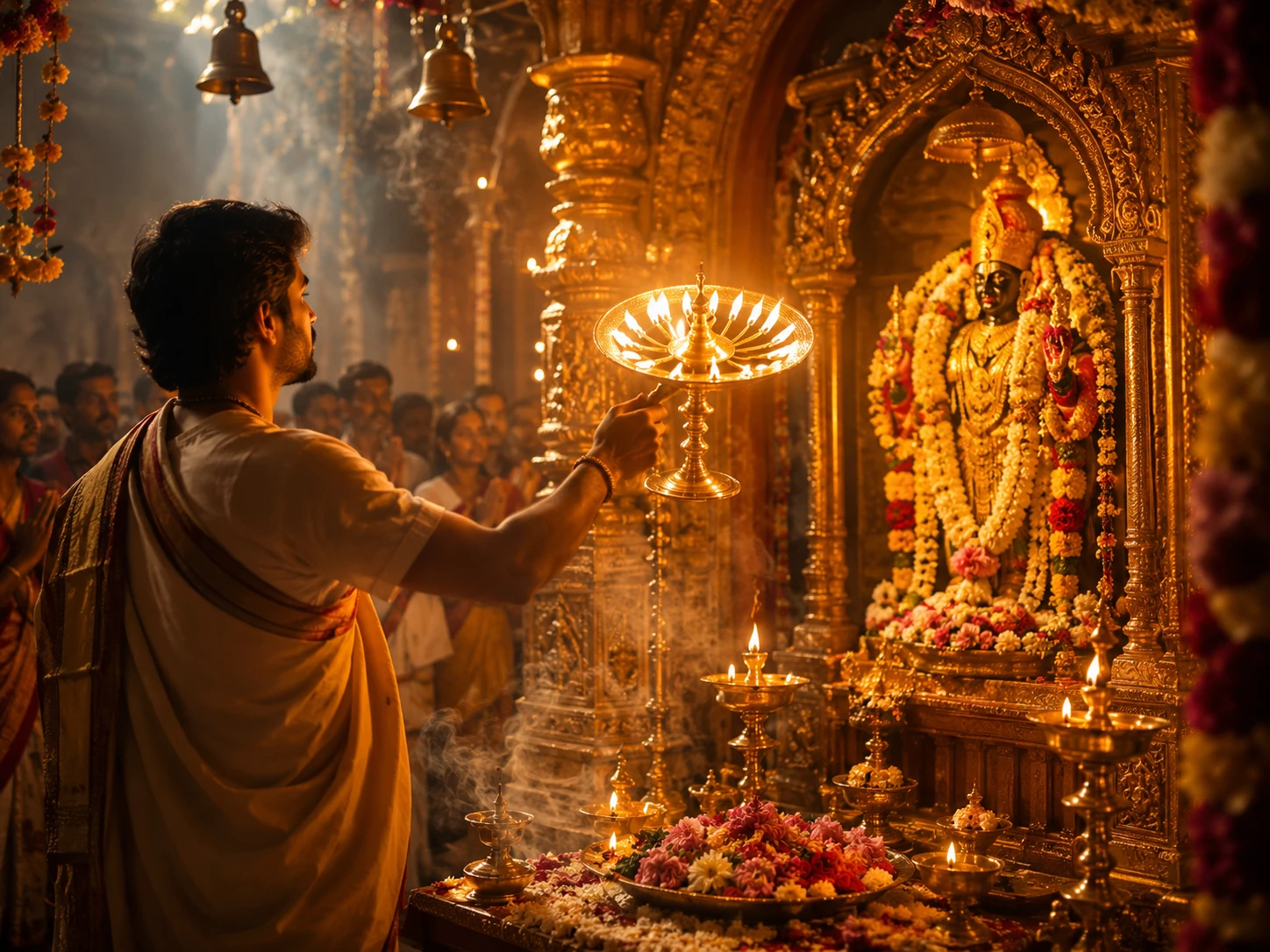
Aarti -- Why Hindus Circle Light Before God
13 min read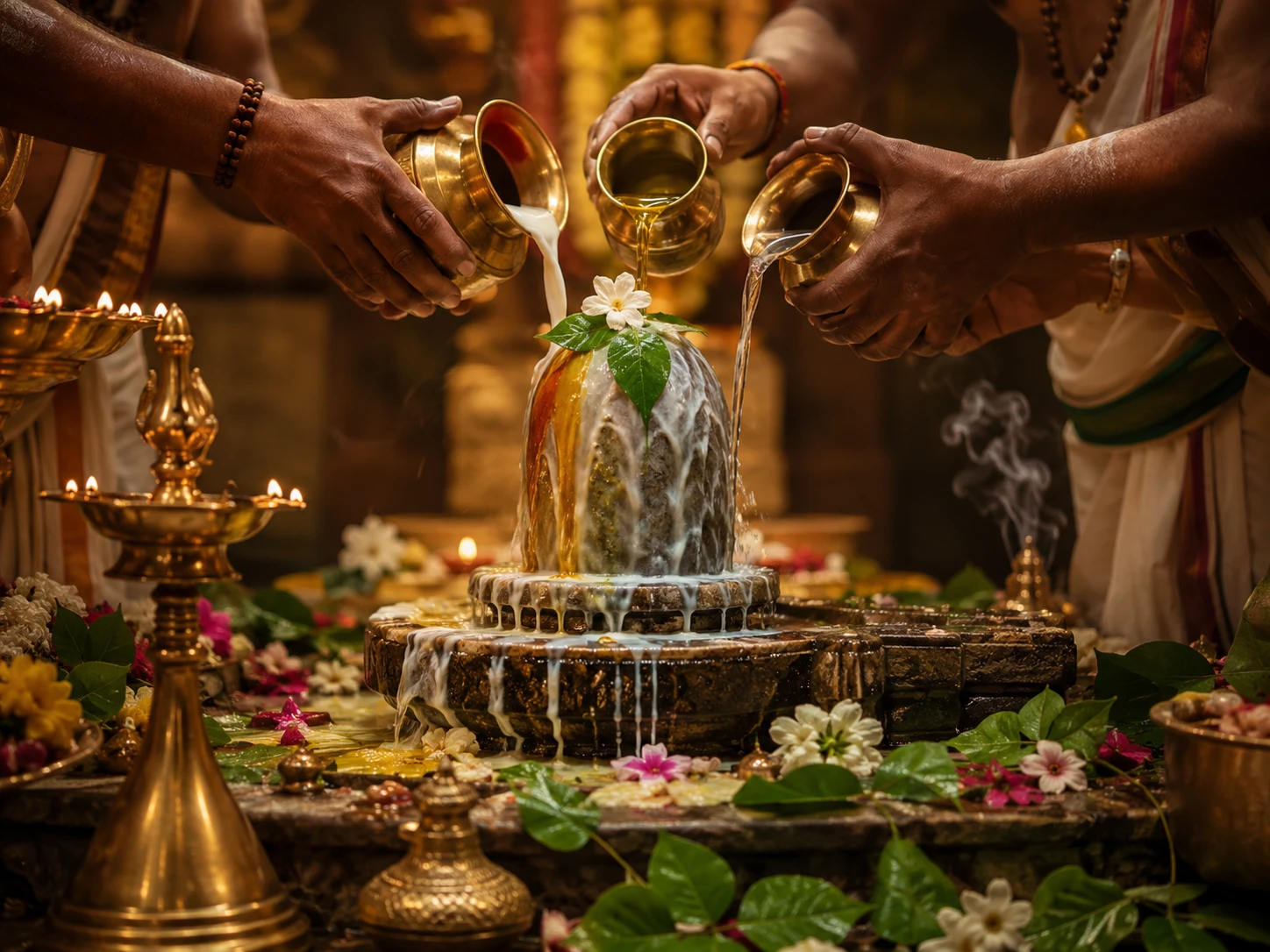
Abhisheka -- Why Hindus Bathe Their Gods
10 min read
Akshaya Tritiya -- The Day Nothing Given Away Runs Out
12 min readThe same translation error that turned '33 Koti' into '33 crore' in Hinduism also happened in Buddhism. The Chinese translation of Buddhist texts rendered 'Sapta Koti Buddha' (7 Supreme Buddhas) as '7 Crore Buddhas.' The…
Deities AvatarsCommunity Reflections
🕉️
Be the first to share your reflection.