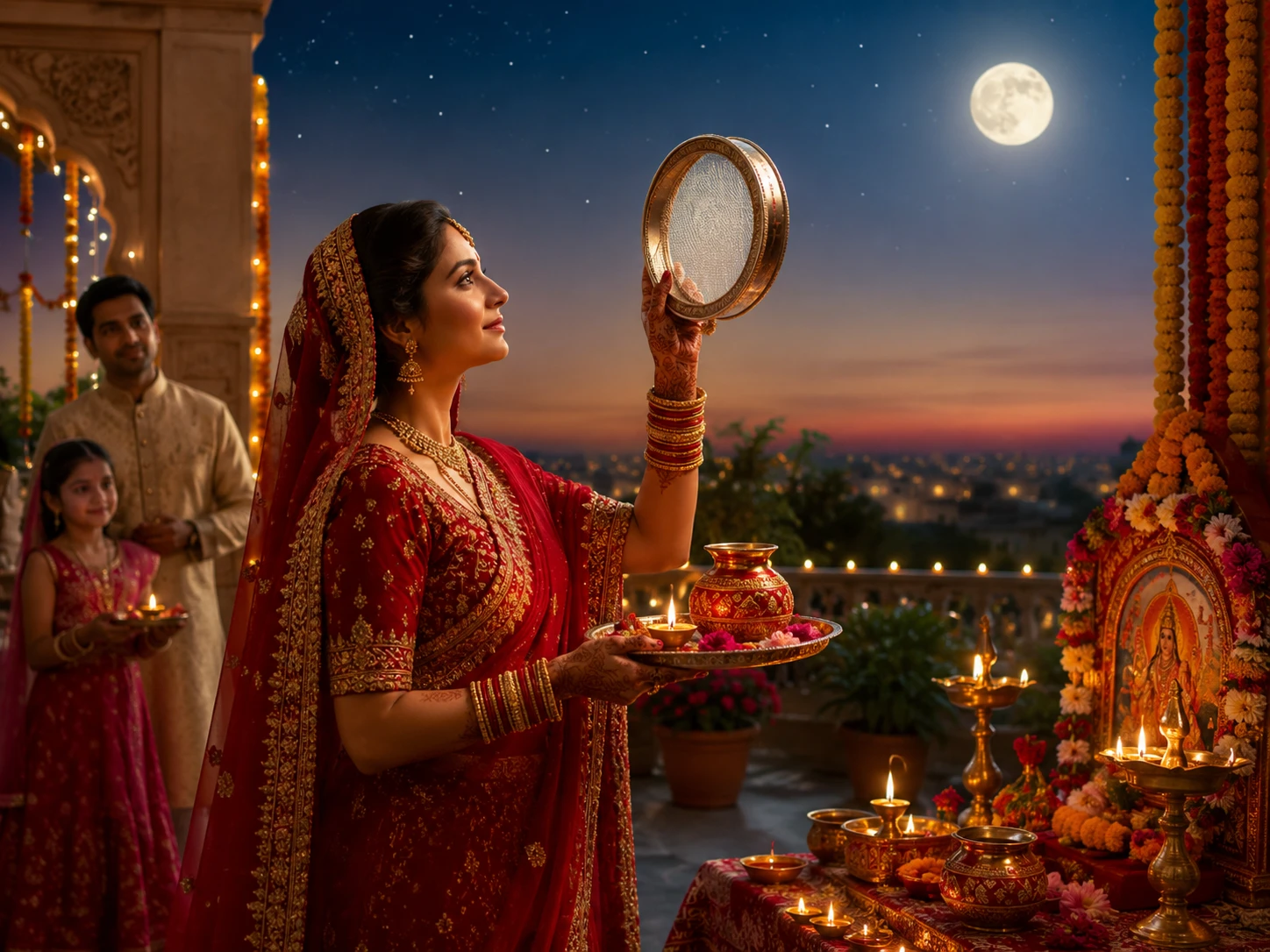
Karva Chauth -- India's Most Debated Fast (And Why It Endures)
करवा चौथ -- भारत का सबसे बहस-योग्य व्रत (और ये क्यों बना हुआ है)
Karva Chauth falls on the Chaturthi (4th day) of Krishna Paksha in the month of Kartik (October-November) -- four days after Sharad Purnima. It is observed primarily in North India (Punjab, Haryana, Rajasthan, UP, Delhi, Madhya Pradesh, Himachal Pradesh) and among North Indian communities in the diaspora. While not a pan-Indian festival (South and East India have their own equivalents like Vat Savitri and Thiruvathira), Karva Chauth has achieved national and global visibility primarily through Bollywood -- the iconic scenes in Dilwale Dulhania Le Jayenge, Kabhi Khushi Kabhie Gham, and Baghban have made the sieve-moon-husband sequence recognisable to Indians everywhere.
The word 'Karva' refers to an earthen pot with a spout, used to offer water and other items during the puja. 'Chauth' means fourth -- the fourth day of the lunar fortnight. The central Vrata involves a Nirjala fast (no food, no water) from Sargi (a pre-dawn meal eaten before sunrise, typically prepared by the mother-in-law) until the moon is sighted after sunset.
The origin story most commonly cited is that of Queen Veervati, narrated in the Karva Chauth Katha read during the evening puja. Veervati was a devoted wife who observed a strict Karva Chauth fast but, unable to bear the hunger, was tricked by her brothers into breaking the fast before moonrise. Immediately, her husband fell gravely ill. Through her devotion and the intervention of the goddess, she learned the truth, re-observed the fast with absolute discipline, and her husband was restored. The story reinforces the tradition's core claim: the wife's Vrata-shakti (power of her vow) directly protects her husband's life.
The evening ritual is highly specific and visually beautiful. Women dress in red or pink (the colours of Saubhagya, marital auspiciousness). They apply mehndi (henna) on their hands -- often days in advance. They wear the Solah Shringara (sixteen adornments): bindi, sindoor, kajal, nose ring, earrings, necklace, bangles, rings, mehendi, alta (red dye on feet), anklets, waist chain, armlets, hair ornament, perfume, and fine clothing. They gather in groups for the Karva Chauth Katha and puja, typically led by an elder woman. And when the moon rises, they sight it through a sieve (Chalni), then look at their husband's face through the same sieve, and then the husband offers the wife water and the first morsel of food -- breaking the fast.
The sieve symbolism is layered: seeing the moon through a filter represents seeing the divine through the mesh of worldly existence. Seeing the husband through the same filter equates the husband with the moon -- a luminous presence filtered through the fabric of daily life.
(No single canonical Sanskrit verse for Karva Chauth; the Katha is folk-Puranic tradition)
The Karva Chauth Katha, read during the evening puja, narrates the story of Queen Veervati whose devotion and strict fasting restored her husband's life. Unlike Ekadashi or Navaratri, Karva Chauth does not have a single Vedic or Puranic verse anchor -- its authority rests in the Stri-Dharma (women's dharmic) folk tradition of North India.
— Karva Chauth Katha (North Indian folk-Puranic tradition)
Karva Chauth vs Similar Women's Vratas Across India
| Vrata | व्रत | Region | When | For Whom | Key Ritual |
|---|---|---|---|---|---|
| Karva Chauth | करवा चौथ | North India | Kartik K4 | Husband's longevity | Nirjala fast, moon through sieve |
| Vat Savitri | वट सावित्री | Maharashtra, Gujarat, Bihar | Jyeshtha Amavasya | Husband's life | Fast, worship Banyan tree, tie thread |
| Hartalika Teej | हरतालिका तीज | North India, MP, Bihar | Bhadrapada S3 | Good husband / marital bliss | Nirjala fast, Shiva-Parvati puja |
| Thiruvathira | तिरुवातिरा | Kerala | Dhanu/Margashirsha | Husband's well-being | Dance, bath, special feast |
| Mangala Gauri | मंगला गौरी | Maharashtra, Karnataka | Tuesdays in Shravan | Marital happiness | 16 Shringara, Gauri puja |
| Chhath | छठ | Bihar, Jharkhand, UP | Kartik S6 | Family well-being | Standing in water, Surya worship |
Karva Chauth is the only major women's Vrata that has achieved pan-Indian and global recognition through Bollywood. The others remain strongly regional. The commercial ecosystem around Karva Chauth (mehndi artists, designer thalis, gift hampers, social media content) has made it a Rs 5,000+ crore annual market.
The Debate -- Patriarchy or Power?
Karva Chauth is Hinduism's most socially debated ritual. The feminist critique is direct: why should a woman torture herself with a waterless fast for her husband's benefit when no equivalent Vrata requires the husband to fast for the wife? Is this not a structural expression of patriarchy -- the woman's body subjected to suffering for the man's welfare?
The critique has merit and must be taken seriously. The historical context is clear: Karva Chauth emerged in a North Indian feudal society where women's social identity was entirely defined by marriage, where widowhood was a catastrophe, and where the husband's survival was quite literally the wife's survival. In that context, the Vrata was rational -- not romantic. It was existential insurance.
But the tradition's defenders offer a different reading. The Vrata is an expression of Stri-Shakti -- the specifically feminine spiritual power that the tradition considers equal to or greater than masculine tapas. The wife who fasts for her husband is not a victim. She is a warrior -- wielding the weapon of voluntary suffering to protect someone she loves. The Savitri narrative (where Savitri's Vrata defeated Yama himself) is invoked as precedent: a woman's Vrata-shakti is so powerful that even Death retreats before it.
Modern practice is evolving. In many urban families, husbands now fast alongside their wives -- not because tradition mandates it, but because love does. The mutual fast transforms Karva Chauth from a gendered obligation into a shared devotional practice. Some couples observe it as a day of mutual appreciation: fasting together, breaking the fast together, and using the day as an annual renewal of commitment.
Bollywood has paradoxically both reinforced and reformed the tradition. The DDLJ and K3G scenes cemented the romantic image (husband feeding wife at moonrise). But newer films and social media influencers have normalised the mutual fast, the husband's participation, and even the single woman's observance of Karva Chauth for her own spiritual discipline.
For the young woman navigating this: the tradition does not require you to observe Karva Chauth. It is not a Vedic mandate. It is a regional folk Vrata that millions find meaningful. If you choose to observe it, make it your own -- fast with intention, not obligation. If you choose not to, that is equally valid. And if you and your partner choose to fast together, you are creating a new tradition within the old one -- which is exactly how living traditions have always evolved.
The Karva Chauth market in India is estimated at over Rs 5,000 crore annually, making it one of the most commercially significant single-day festivals in the country. Mehndi artists in Delhi and Jaipur earn 30-40% of their annual income in the week before Karva Chauth. Designer Karva Chauth thali sets (with decorated sieve, diya, kumkum, and sweets) sell for Rs 500-5,000 on Amazon and Flipkart. Jewellers report 20-25% sales spikes. And Instagram posts tagged #KarvaChauth consistently trend at 10+ million views annually. A regional folk Vrata has become a full-fledged consumer economy -- the tradition's endurance powered as much by commerce as by devotion.
Strengthen Your Vrata with Japa
If you observe Karva Chauth (or any fasting vrata), use the fasting hours for sustained japa. Physical restraint (tapa) and mantra repetition (japa) strengthen each other. Chant 'Om Shivaya Namah' or 'Om Gauryai Namah' on a mala through the fast, building toward 1,008 repetitions. Turn the waiting into worship. The mantra meditation library on Eternal Raga has more mantras for japa.
Tags
Eternal Raga · शाश्वत राग
Institutional voice — scholarly articles on Sanatan Dharma
Deepen Your Understanding
अपनी समझ और गहरी करें
rituals traditions
Vrata -- What a Hindu Vow Really Means (It Is Not Just Fasting)
Your mother kept Karva Chauth without water for sixteen hours. Your grandmother observed Ekadashi every fortnight without fail. Your colleague skips lunch on Tuesdays 'for Hanuman.' The world sees Hindu fasting as dietary restriction. The tradition sees it as something far more radical: Vrata is a voluntary, time-bound act of self-imposed discipline that rewires the relationship between desire and willpower. Fasting is the most visible expression. But the real Vrata happens inside.
rituals traditions
Ekadashi -- Why Hindus Fast on the 11th Day (And What the '11' Actually Means)
Twice every lunar month, millions of Hindus stop eating grains. Not as a diet. Not for health. Because the Padma Purana says that on the 11th day of the lunar fortnight, all sin takes refuge in grain -- and the person who abstains from grain on that day is freed from sin and drawn closer to Vishnu. The number 11 is not accidental: it represents the 10 senses plus the mind, and Ekadashi is the day you master all eleven. This is the most widely observed Vrata in the Hindu world -- and it maps almost perfectly onto modern intermittent fasting science.
rituals traditions
Navratri -- Nine Nights That Transform India
For nine nights, India becomes a different country. In Gujarat, millions dance garba till dawn. In Bengal, the streets turn into open-air art galleries. In Varanasi, nine temples light up in sequence. In Mysore, the palace blazes with 100,000 bulbs. Navratri is not a single festival -- it is nine nights of goddess worship that unite India's most diverse traditions into one cosmic celebration.
rituals traditions
Shravan / Aadi -- The Holiest Month in the Hindu Calendar (And Why It Belongs to Shiva)
When the monsoon arrives and India turns green, the Hindu calendar enters its most intensely devotional month. In North India, it is Shravan (Sawan) -- Shiva's month, when every Monday sees millions fasting, every Shiva temple overflows, and the Kanwar Yatra sends 30 million pilgrims walking barefoot to collect Ganga water. In South India, it is Aadi -- Devi's month, when Amman temples blaze with special pujas and women perform Aadi Pooram and Aadi Perukku rituals. Same monsoon, different deities, identical intensity.
rituals traditions
Muhurta -- Why Hindus Obsess Over the Right Moment
Your grandmother checked the panchang before scheduling your mundan. Your parents consulted an astrologer before fixing your wedding date. Your colleague will not sign a business contract without checking the Choghadiya. The Hindu tradition divides every 24-hour day into 30 Muhurtas of 48 minutes each -- some auspicious, some neutral, some to be avoided -- and this time-quality framework has governed Indian life from Vedic fire rituals to modern real estate transactions.
rituals traditions
Sankalpa -- The Ritual GPS That Locates You in the Cosmos Before Every Puja
Before any Hindu ritual begins, there is a quiet declaration that most people rush through without understanding. It names the current cosmic age, the ruling Manu, the Yuga, the year, the season, the month, the fortnight, the day, the star, the continent, the country, the river, your name, your lineage, and your exact intention. This declaration -- Sankalpa -- is the most sophisticated geo-temporal tagging system in any religious tradition. It tells the universe: I am here, I am this person, and I intend to do this specific act.
The Karva Chauth market in India is estimated at over Rs 5,000 crore annually, making it one of the most commercially significant single-day festivals in the country. Mehndi artists in Delhi and Jaipur earn 30-40% of the…
More in Rituals & Traditions
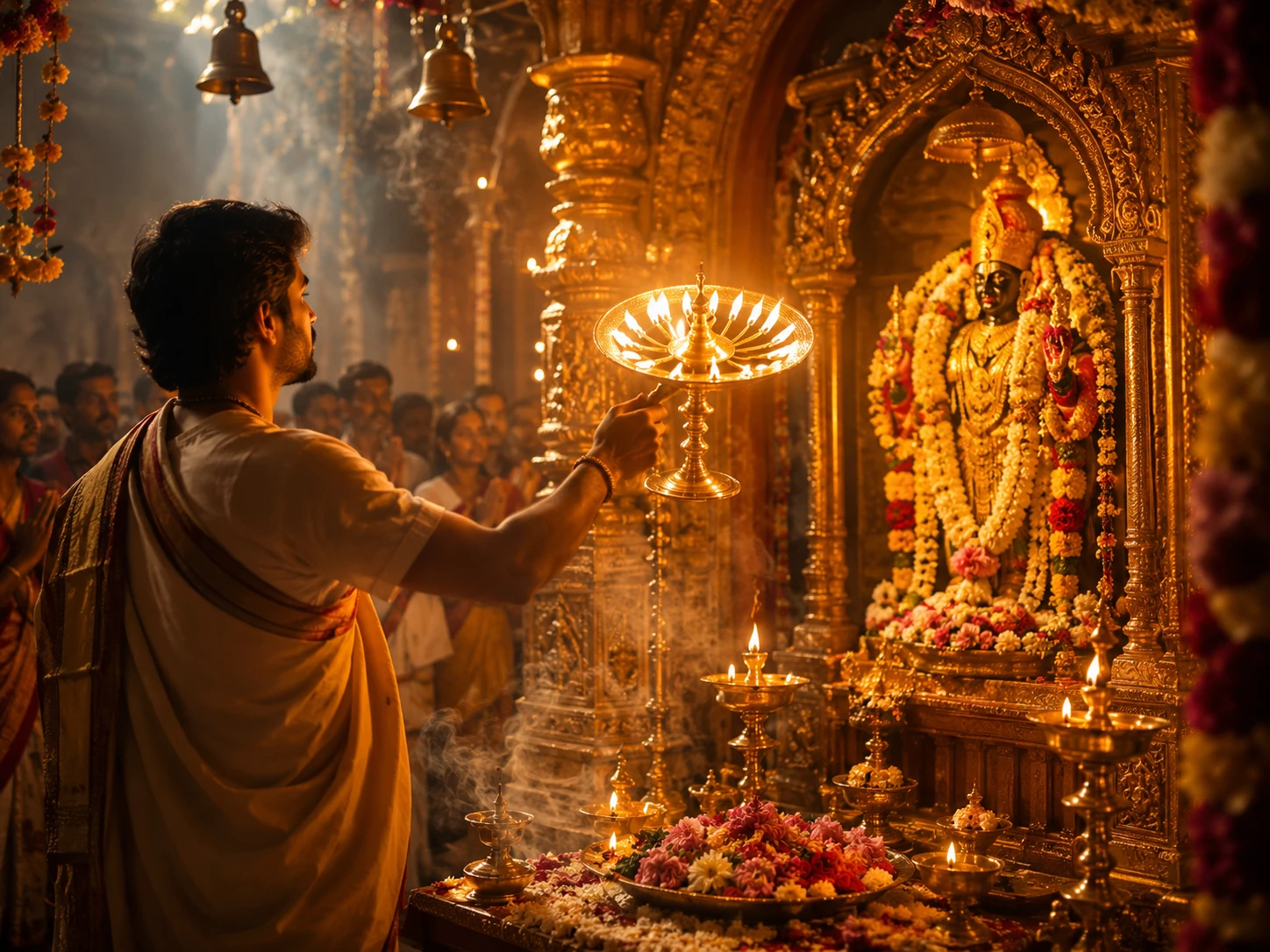
Aarti -- Why Hindus Circle Light Before God
13 min read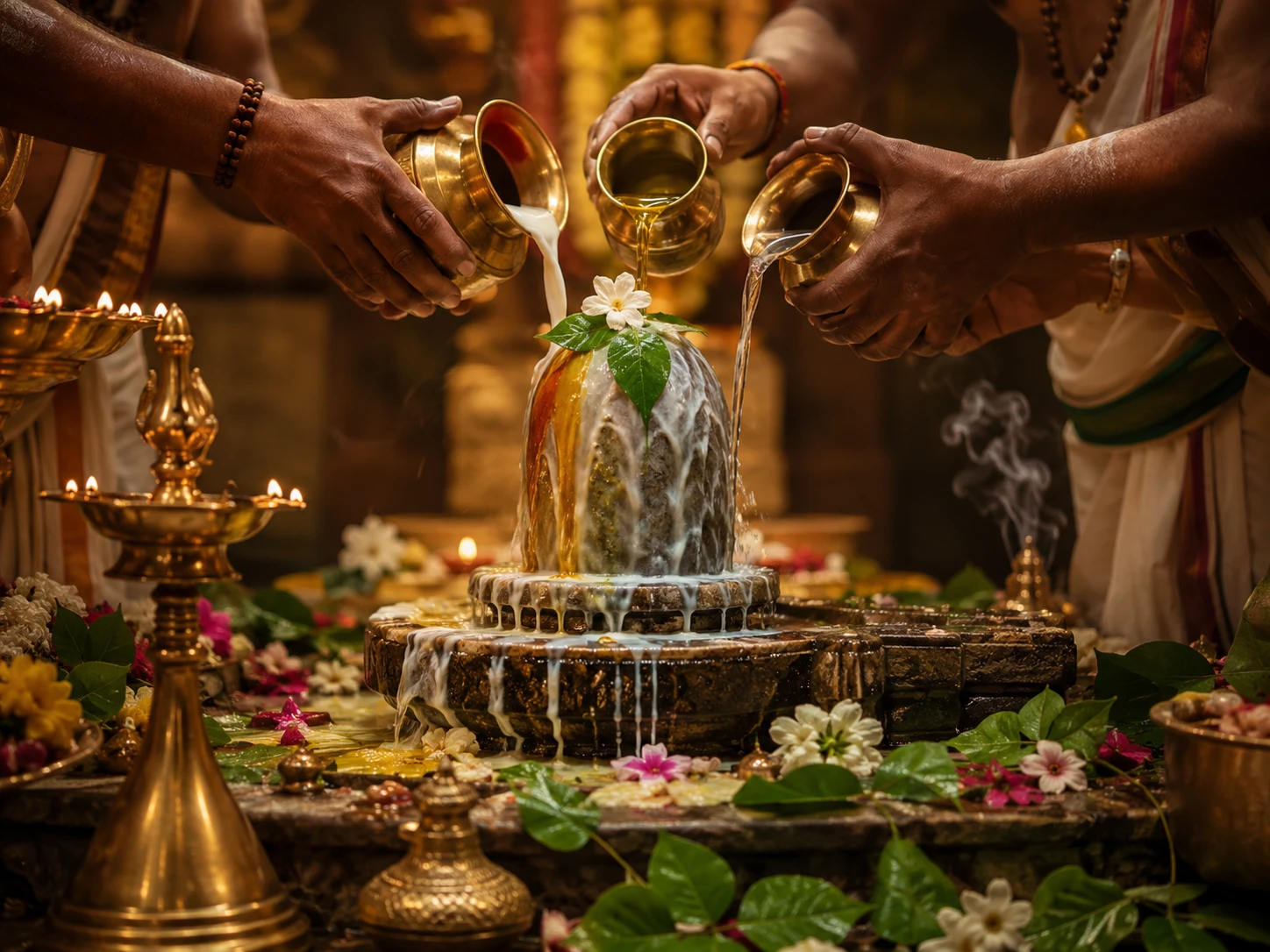
Abhisheka -- Why Hindus Bathe Their Gods
10 min read
Akshaya Tritiya -- The Day Nothing Given Away Runs Out
12 min readThe same translation error that turned '33 Koti' into '33 crore' in Hinduism also happened in Buddhism. The Chinese translation of Buddhist texts rendered 'Sapta Koti Buddha' (7 Supreme Buddhas) as '7 Crore Buddhas.' The…
Deities AvatarsCommunity Reflections
🕉️
Be the first to share your reflection.