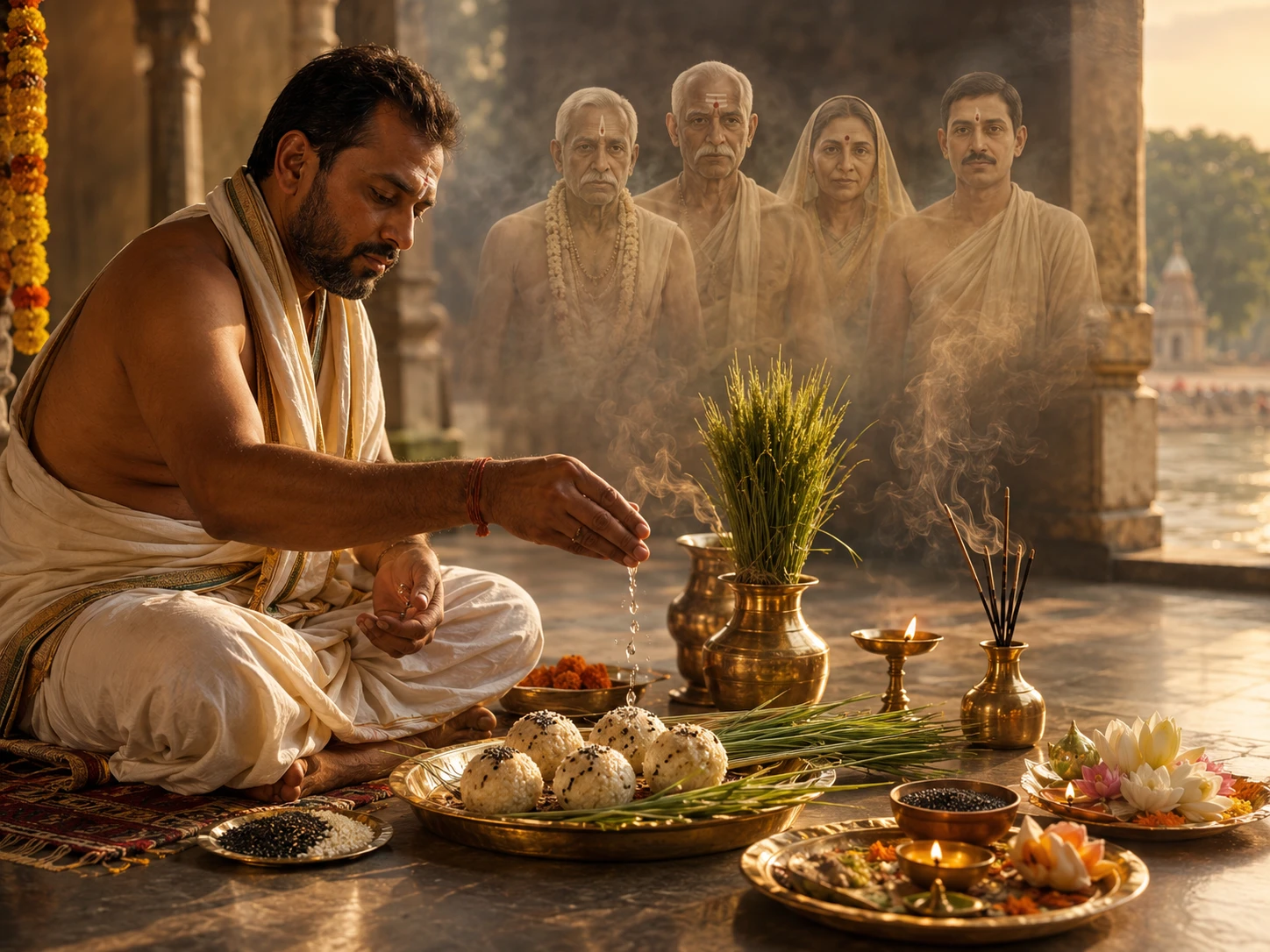
Shraddha and Pitru Paksha -- Why Hindus Feed the Dead
श्राद्ध और पितृ पक्ष -- हिन्दू मृतकों को क्यों खिलाते हैं
When Karna -- the most generous warrior in the Mahabharata -- died and ascended to the celestial realm, he found himself surrounded by gold and jewels but not a morsel of food. Everything he touched turned to gold. Desperate with hunger, he approached Indra (or Yama, depending on the version) and asked why. The answer was devastating: Karna had donated lavishly throughout his life -- gold, weapons, his own Kavach-Kundal -- but he had never offered food to his ancestors through Shraddha. His Pitris, stuck in a liminal realm, had cursed his afterlife sustenance to mirror his omission: gold everywhere, food nowhere.
Karna was granted sixteen days to return to earth and perform the ancestral rites he had neglected. During this period, he offered food, water, and Pinda to his forefathers, correcting the cosmic ledger. Those sixteen days became Pitru Paksha -- the annual fortnight when the boundary between the living and the ancestral realms thins, and descendants feed the dead.
This origin story is not about punishment. It is about completeness. Karna was the greatest giver the Mahabharata ever produced. And yet his giving was incomplete because it flowed in only one direction -- outward to the living. He forgot the vertical axis: the debt flowing backward through time to those who gave him life. Pitru Paksha exists to remind every Hindu, once a year, to attend to that vertical axis.
The word 'Shraddha' itself means faith, sincerity, devotion. It is not merely a ritual -- it is an act of faithful remembrance. The Manusmriti (Chapter 3, verses 122-286) provides the most comprehensive legal framework for Shraddha, detailing who must perform it, when, with what materials, and in what sequence. The Garuda Purana elaborates on the metaphysics -- what happens to the soul after death, how the offerings of the living affect the condition of the departed, and why neglecting Shraddha causes disturbance in the ancestral lineage.
न जायते म्रियते वा कदाचिन् नायं भूत्वा भविता वा न भूयः। अजो नित्यः शाश्वतोऽयं पुराणो न हन्यते हन्यमाने शरीरे॥
na jāyate mriyate vā kadācin nāyaṁ bhūtvā bhavitā vā na bhūyaḥ ajo nityaḥ śāśvato 'yaṁ purāṇo na hanyate hanyamāne śarīre
The soul is neither born, nor does it ever die; nor having once existed, does it ever cease to be. Unborn, eternal, ever-existing, and primeval -- it is not slain when the body is slain.
— Bhagavad Gita 2.20
The Three Pillars of Ancestor Rites -- Tarpana, Pinda Daan, Brahmana Bhojana
Shraddha ceremonies rest on three primary offerings, each addressing a different dimension of the ancestral relationship.
Tarpana (water libation) is the simplest and most fundamental. The performer faces south (the direction of Yama's realm), takes water mixed with black sesame seeds (til) and kusha grass in the right palm, and releases it while chanting the names and gotras of three generations of ancestors -- father, grandfather, great-grandfather on the paternal side, and the corresponding maternal ancestors. The water represents the flow of life and gratitude from the living to the departed. Sesame seeds are considered especially potent for pacifying restless ancestral spirits.
Pinda Daan (offering of rice balls) is the central ritual. Pindas are balls of cooked rice mixed with sesame seeds, barley flour, and ghee. Three pindas are offered -- one for each generation of ancestors. The pinda symbolically provides a 'body' for the ancestral soul to inhabit temporarily, enabling it to receive the offering. This is not a primitive belief -- it is a sophisticated theological mechanism for trans-dimensional communication.
Brahmana Bhojana (feeding of Brahmins) completes the triad. Learned Brahmins are invited, honoured, and fed a full meal. The tradition holds that the Brahmins serve as proxies for the ancestors -- the food consumed by the Brahmin reaches the ancestral realm through a mechanism of ritual transference. This is followed by Dakshina (monetary gift) to the priest and charitable donations to the poor.
The entire ceremony must be performed by the eldest son or a male descendant. On Sarvapitri Amavasya (the final day, when all ancestors are collectively honoured), daughters' sons can perform the rite for their maternal lineage if no male heir exists on the mother's side -- a flexibility the tradition explicitly provides.
Shraddha -- Types and Occasions
| Type | प्रकार | When Performed | Key Feature |
|---|---|---|---|
| Nitya Shraddha | नित्य श्राद्ध | Daily (as part of Panchamaha Yajna) | Simple water offering to ancestors |
| Tithi Shraddha | तिथि श्राद्ध | Death anniversary of specific ancestor | Full Pinda Daan, Brahmana Bhojana |
| Pitru Paksha Shraddha | पितृ पक्ष श्राद्ध | 16-day fortnight (Bhadrapada) | Collective annual rite for all ancestors |
| Sarvapitri Amavasya | सर्वपितृ अमावस्या | Last day of Pitru Paksha | For ALL ancestors, including unknown ones |
| Gaya Shraddha | गया श्राद्ध | Pilgrimage to Gaya, Bihar | Most potent location; believed to grant moksha |
| Ekodishta Shraddha | एकोद्दिष्ट श्राद्ध | First year after death | Specific to recently departed soul |
| Sapindikarana | सपिण्डीकरण | ~1 year after death | Merges departed soul with collective Pitri group |
Gaya on the Phalgu River is considered the most sacred location for Shraddha. The Vishnupad Temple in Gaya is dedicated to Vishnu as Pitru Devata (Lord of Ancestors). 5-7.5 lakh pilgrims visit Gaya during Pitru Paksha annually.
The Science of Grief -- Why Structure Helps the Bereaved
Modern grief psychology has confirmed what the Shraddha system always knew: grief needs structure. The thirteen-day mourning period following a death (Sutaka), followed by monthly rites (Masika), followed by the annual death anniversary (Tithi Shraddha), followed by the collective Pitru Paksha -- this is a graduated grief-processing system that provides the bereaved with specific actions to perform at specific intervals.
When someone you love dies, the mind enters a state of disorientation. Normal decision-making collapses. The Shraddha system steps in and says: on day one, do this. On day three, do this. On day thirteen, do this. At the end of the first year, do this. And every year after that, on this specific Tithi, do this. The bereaved person does not need to decide what to do. The system decides for them, and the physical actions -- cooking specific foods, inviting Brahmins, performing Tarpana, offering Pinda -- give the hands something to do while the heart is breaking.
Research on ritual and bereavement (published in the Journal of Experimental Psychology) shows that performing rituals after loss significantly reduces grief intensity, even when the person performing the ritual does not believe in its metaphysical efficacy. The act of doing something structured, something shared with community, something that connects the individual loss to a larger cultural framework -- this is therapeutic regardless of belief.
NRI families feel the absence of this structure most acutely. When a parent dies in India and the children are in the US, the disorientation is compounded by geographical and cultural disconnection. Many Hindu organisations in the diaspora -- from the Hindu Temple of Greater Chicago to the Shiva Vishnu Temple in Washington DC -- now offer structured Shraddha services specifically for NRI families, providing the ritual architecture that the geographical distance has disrupted.
For the young Indian who finds the Shraddha system 'superstitious' and wonders why they should offer rice balls to dead people: consider that the system is not asking you to believe in a literal mechanism of food reaching the dead. It is asking you to set aside time, once a year, to remember the people who made your existence possible. To cook for them. To speak their names aloud. To feel the weight of inheritance. That act of remembrance -- whether or not the Pinda reaches Pitriloka -- is profoundly healthy for the living.
Gaya in Bihar is India's largest Shraddha pilgrimage centre, attracting 5-7.5 lakh pilgrims during Pitru Paksha annually. The Vishnupad Temple -- built over a footprint believed to be Vishnu's -- is the epicentre. Bihar Tourism has invested in infrastructure specifically for Pitru Paksha, including temporary tent cities, sanitation facilities, and dedicated train services. The economic impact of Pitru Paksha on Gaya's economy rivals that of major festivals -- hotels, priests, flower vendors, and food stall operators depend on this sixteen-day season for a significant portion of annual revenue. Ancient grief ritual meets modern pilgrimage economics.
Pitru Paksha in Practice -- A 16-Day Guide
Pitru Paksha falls in the second half of the lunar month of Bhadrapada (typically September-October), beginning the day after Purnima and ending on Amavasya. Each of the 16 days corresponds to a specific Tithi, and ideally, the Shraddha for a particular ancestor is performed on the Tithi that matches their date of death. If you do not know the exact Tithi of death, the final day -- Sarvapitri Amavasya -- is designated for all ancestors collectively, making it the most important and most widely observed day of the fortnight.
The daily practice during Pitru Paksha includes: waking early, bathing, wearing clean clothes (preferably white or unbleached cotton), facing south for Tarpana (water-sesame offering), preparing Pinda (rice balls mixed with sesame, barley, and ghee), feeding crows (considered messengers of Yama or vehicles of ancestral spirits), feeding a cow and a dog, cooking a specific meal for Brahmana Bhojana, and making charitable donations.
The feeding of crows is one of the most distinctive visual markers of Pitru Paksha across India. On rooftops in Chennai, balconies in Kolkata, and courtyards in Varanasi, you will see families placing food on banana leaves or plates and waiting anxiously for a crow to arrive and eat. If the crow comes quickly, the ancestors are considered pleased. If it delays, additional prayers are offered. This practice connects the most urban Indian household to the natural world -- the crow becomes a sacred messenger, and the family's attention is directed, for at least sixteen days a year, toward the non-human creatures that share their space.
Gaya in Bihar is the most sacred destination for Pitru Paksha pilgrimage. The Vishnupad Temple on the banks of the Phalgu River is believed to be the location where Vishnu's footprint exists, and performing Pinda Daan here is considered to grant Moksha to the ancestors. Families travel from across India -- and increasingly from the global diaspora -- to perform Shraddha at Gaya. The city's economy revolves around this annual influx: priests (Gaya Pandas), guesthouse operators, flower sellers, and food vendors all depend on the sixteen-day season.
Other significant Shraddha locations include Prayagraj (at the Triveni Sangam), Haridwar (on the Ganga ghats), Varanasi (at Manikarnika and Harishchandra ghats), Nashik (on the Godavari at Ramkund), Gokarna (in Karnataka), and Siddhpur (in Gujarat, specifically for maternal ancestors).
For the family that cannot travel: Shraddha can be performed at home. The essential elements are the Sankalpa (declaring the intention), Tarpana (water offering with sesame seeds while chanting ancestor names), and Pinda Daan (offering rice balls). If a Brahmin cannot be invited, the food can be offered to a cow, a crow, or donated to the poor. The tradition explicitly states that sincerity of intent matters more than elaboration of procedure.
The Rna Traya Connection -- Why Ancestor Debt Is Non-Negotiable
Shraddha is the primary mechanism for repaying Pitri Rna -- the debt to ancestors -- which is one of the three fundamental debts (Rna Traya) that every Hindu is born with. The Taittiriya Samhita declares: 'A man is born with three debts -- to the Rishis, to the Devas, and to the Pitris.' This debt is not metaphorical. It is considered as real and as binding as a financial obligation.
Pitri Rna is repaid through three acts: producing offspring (continuing the lineage), performing Shraddha (nourishing the ancestors), and living a dharmic life (honouring the values the ancestors transmitted). A person who dies without performing any of these is considered to have defaulted on a cosmic loan -- and the consequences, according to the tradition, extend beyond their own life into the welfare of their descendants.
The Bhagavad Gita verse 1.42 -- often overlooked in philosophical discussions of the Gita because it comes from Arjuna's argument against fighting rather than from Krishna's instruction -- states that when family traditions (kula dharma) are destroyed, the ancestors fall from their exalted state because the offerings of Pinda and water cease. This verse is remarkable because it attributes real consequences in the ancestral realm to the actions (or inactions) of the living. It is not just that the living owe the dead. The dead depend on the living.
This mutual dependence -- the living nourishing the dead through Shraddha, the dead blessing the living through accumulated merit -- creates an intergenerational feedback loop that the tradition considers essential for social stability. When Shraddha is neglected, the loop breaks. The ancestors become restless (Preta). The descendants lose ancestral blessing. Discord, disease, and misfortune follow -- not as divine punishment but as the natural consequence of a broken connection.
For the rationalist who finds this framework superstitious: consider the secular version. When a family loses connection with its history -- when grandchildren do not know their grandparents' names, when ancestral stories are not told, when the sacrifices of previous generations are neither remembered nor honoured -- something genuinely degrades in the family's psychological fabric. Identity weakens. Rootlessness increases. The sense of belonging that comes from knowing where you come from erodes. Shraddha, at its most practical, is the tradition's antidote to this rootlessness. It says: once a year, at minimum, sit down, say your ancestors' names aloud, cook for them, and remember that you are not a self-generated individual but the latest node in a chain that stretches back to the beginning of time.
Remember Your Ancestors Today
You do not need to wait for Pitru Paksha. Light a diya and spend five minutes in quiet remembrance of your grandparents and great-grandparents. If you know their names, say them aloud. If you know a mantra, chant it. The simplest tarpana is a glass of water offered with love and the names of those who came before you. The mantra meditation library on Eternal Raga has mantras if you wish to chant.
Eternal Raga · शाश्वत राग
Institutional voice — scholarly articles on Sanatan Dharma
Deepen Your Understanding
अपनी समझ और गहरी करें
rituals traditions
Panchamaha Yajnas -- The 5 Daily Duties Every Householder Owes
You owe five debts the moment you wake up: to knowledge, to the divine, to your ancestors, to all living beings, and to fellow humans. The Panchamaha Yajnas are not grand fire rituals -- they are five daily micro-acts that the tradition considers the minimum operating system of a responsible life. Skip them and you are, according to Manu, living as a thief.
rituals traditions
The 16 Samskaras -- Rites of Passage from Womb to Pyre
Hinduism does not leave life to chance. From the moment a couple decides to conceive to the moment the body returns to the five elements, there are sixteen rituals -- samskaras -- designed to refine the human being at every critical transition. Think of them as firmware updates for the soul, installed at precisely the right moments.
rituals traditions
Nitya, Naimittika, and Kamya Karma -- The Three Categories of Duty
Hinduism does not say 'do good things.' It says 'know which kind of action you are performing and why.' The three-fold classification of Karma into Nitya (daily non-negotiable), Naimittika (occasion-triggered), and Kamya (desire-driven) is the most practical decision-making framework the tradition offers -- and it works as well in a Bangalore startup as it did in a Vedic gurukul.
vedic sciences
Kaal Ganana -- The Hindu Measure of Time
From a single blink of the eye (Nimesha) to one Day of Brahma (4.32 billion years) -- explore the complete cosmic time hierarchy of Hindu cosmology, anchored in Vishnu Purana 1.3, with its remarkable parallels to modern science.
rituals traditions
Havan Vidhi -- The Vedic Fire Ritual That Purifies Air, Mind, and Karma
Every major Hindu milestone -- birth, thread ceremony, wedding, housewarming, death -- involves fire. The havan is the oldest continuous ritual technology in Hinduism, dating to the Rig Veda. You pour ghee, herbs, and grains into a consecrated fire while chanting 'Svaha,' and Agni carries your offering to the gods. Modern science confirms: the smoke actually does purify the air. Here is the complete procedure.
rituals traditions
Sankalpa -- The Ritual GPS That Locates You in the Cosmos Before Every Puja
Before any Hindu ritual begins, there is a quiet declaration that most people rush through without understanding. It names the current cosmic age, the ruling Manu, the Yuga, the year, the season, the month, the fortnight, the day, the star, the continent, the country, the river, your name, your lineage, and your exact intention. This declaration -- Sankalpa -- is the most sophisticated geo-temporal tagging system in any religious tradition. It tells the universe: I am here, I am this person, and I intend to do this specific act.
divine arsenal
The Divine Shields and Armour -- Karna's Kavach-Kundal, Agastya's Gift, and the Spiritual Meaning of Protection
Karna was born wearing armour that made him invincible -- and gave it away to the one man who wanted him dead. Rama received divine armour from a sage moments before facing Ravana. In Hindu tradition, the greatest protection is not what you wear on your body but what you carry in your soul.
Gaya in Bihar is India's largest Shraddha pilgrimage centre, attracting 5-7.5 lakh pilgrims during Pitru Paksha annually. The Vishnupad Temple -- built over a footprint believed to be Vishnu's -- is the epicentre. Bihar …
More in Rituals & Traditions
Aarti -- Why Hindus Circle Light Before God
13 min read
Abhisheka -- Why Hindus Bathe Their Gods
10 min read
Akshaya Tritiya -- The Day Nothing Given Away Runs Out
12 min readThe same translation error that turned '33 Koti' into '33 crore' in Hinduism also happened in Buddhism. The Chinese translation of Buddhist texts rendered 'Sapta Koti Buddha' (7 Supreme Buddhas) as '7 Crore Buddhas.' The…
Deities AvatarsCommunity Reflections
🕉️
Be the first to share your reflection.