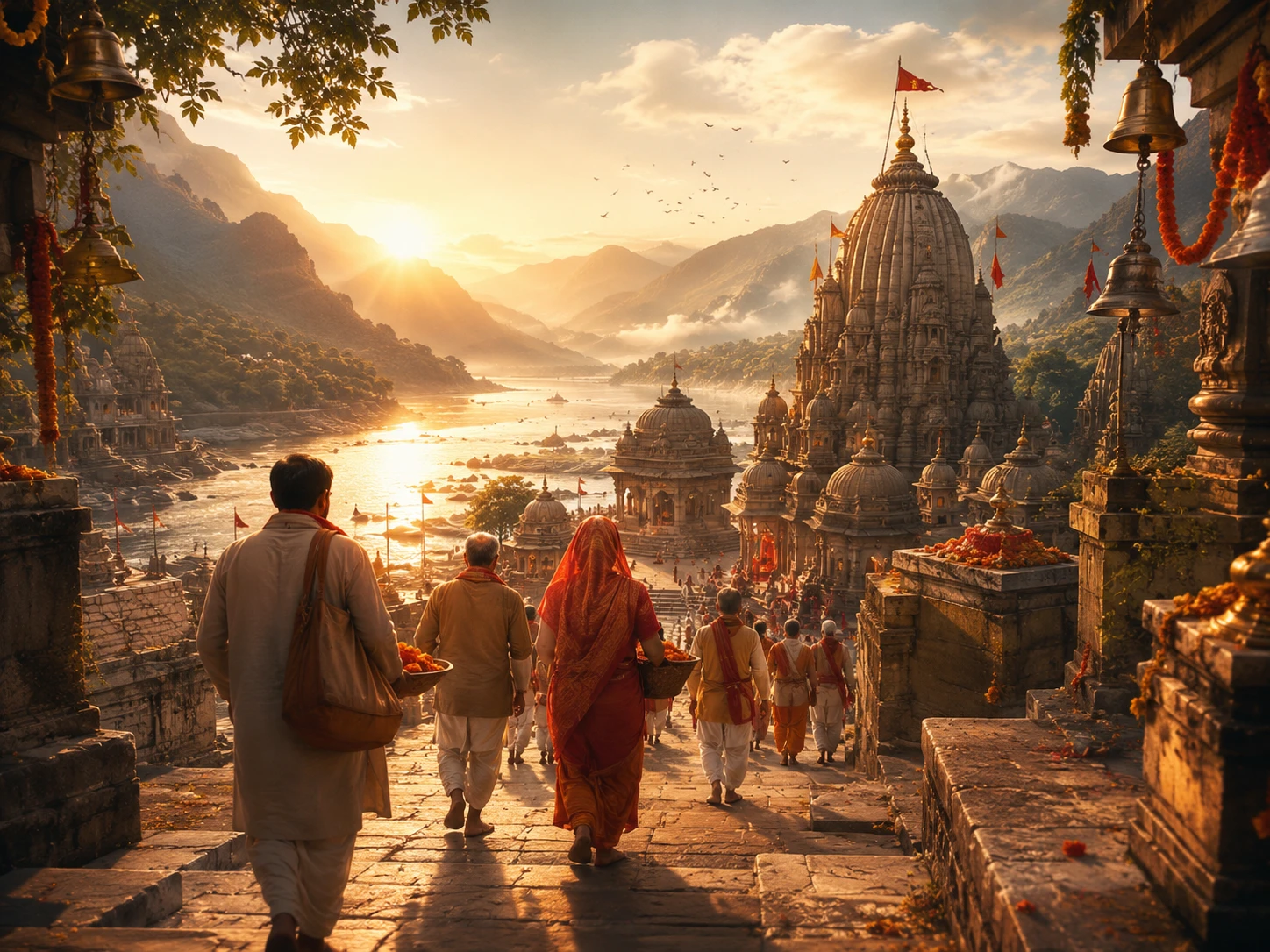
Tirtha Yatra -- Why Hindus Travel to Get Closer to God
तीर्थ यात्रा -- हिन्दू भगवान के निकट जाने के लिए यात्रा क्यों करते हैं
Every year, over 300 million Indians undertake some form of pilgrimage -- making Hindu Tirtha Yatra the largest mass movement of human beings for religious purposes on the planet. The 2019 Kumbh Mela at Prayagraj alone drew an estimated 240 million visitors over 49 days -- more than the combined populations of France, Germany, and the UK. The Char Dham Yatra to Badrinath, Kedarnath, Gangotri, and Yamunotri draws over 5 million pilgrims annually. Varanasi receives 6-8 million pilgrims per year. Tirupati sees 60,000-80,000 visitors daily.
These are not tourists. They are Tirtha Yatris -- people undertaking a journey with a specific spiritual purpose: to reach a Tirtha, to bathe in its waters, to perform its rituals, and to return transformed.
The word 'Tirtha' comes from the Sanskrit root 'tri' -- to cross. A Tirtha is a crossing point, a ford, a place where the river of Samsara (worldly existence) can be crossed to reach the shore of Moksha (liberation). In practical terms, Tirthas are locations where the accumulated spiritual energy of centuries of worship, the natural power of the landscape (rivers, mountains, forests), and the theological significance assigned by scripture converge to create a zone of heightened spiritual access.
The tradition identifies several categories of Tirtha. River Tirthas: the seven sacred rivers (Sapta Sindhu) -- Ganga, Yamuna, Godavari, Saraswati, Narmada, Sindhu, and Kaveri. Mountain Tirthas: Kailash, Arunachala, Govardhan, Vaishno Devi. Temple Tirthas: the Char Dham (Badrinath, Puri, Dwarka, Rameswaram), the 12 Jyotirlingas, the 51 Shakti Peethas, the 108 Divya Desams. Sangam Tirthas: confluences of rivers, especially Triveni Sangam at Prayagraj.
But the tradition also recognises an internal Tirtha. The Jabala Upanishad declares that the true Tirtha is not a geographical location but the inner state of detachment, knowledge, and surrender. The external pilgrimage is training wheels for the internal one -- you travel to Kashi to practice crossing, so that when the ultimate crossing (death) arrives, you are ready.
तीर्थमन्तर्गतं यस्य शमो दमस्तथा। क्षमा चैव दया सत्यं न तीर्थफलमश्नुते॥
tīrtham antargataṁ yasya śamo damas tathā kṣamā caiva dayā satyaṁ na tīrtha-phalam aśnute
One who has the Tirtha within -- calmness, self-control, forgiveness, compassion, and truth -- does not need to seek the fruit of external pilgrimage.
— Jabala Upanishad / Mahabharata tradition (attributed to Vidura)
Major Hindu Pilgrimage Circuits
| Circuit | परिक्रमा | Locations | Deity/Theme | Annual Pilgrims |
|---|---|---|---|---|
| Char Dham | चार धाम | Badrinath, Puri, Dwarka, Rameswaram | Vishnu (4 cardinal directions) | 10+ million (all four combined) |
| Chota Char Dham | छोटा चार धाम | Badrinath, Kedarnath, Gangotri, Yamunotri | Himalayan circuit | 5+ million |
| 12 Jyotirlingas | 12 ज्योतिर्लिंग | Somnath to Varanasi | Shiva (12 self-manifested Lingas) | Varies (50+ million total) |
| 51 Shakti Peethas | 51 शक्ति पीठ | Kamakhya to Hinglaj | Devi (body parts of Sati) | Varies |
| 108 Divya Desams | 108 दिव्य देसम | Tamil Nadu to Nepal | Vishnu (Alvars' sacred sites) | Millions (South Indian tradition) |
| Kumbh Mela | कुम्भ मेला | Prayagraj, Haridwar, Nashik, Ujjain | Cosmic nectar, all deities | 240 million (2019 Prayagraj) |
| Narmada Parikrama | नर्मदा परिक्रमा | Entire Narmada river (2,600 km) | Narmada as Shiva's daughter | Thousands (months-long walk) |
The 2019 Kumbh Mela at Prayagraj was the largest peaceful gathering of human beings in recorded history. Satellite imagery from NASA was used to estimate crowd density, and the Indian Railways operated 800+ special trains during the 49-day period.
Kashi -- The City That Never Lets You Die Unenlightened
Of all Tirthas, Kashi (Varanasi) holds the supreme position. The Kashi Khanda of the Skanda Purana declares that Kashi is not located on earth -- earth is located on Kashi. The city exists simultaneously in the physical and spiritual dimensions, and anyone who dies within its boundaries receives Taraka Mantra from Shiva himself at the moment of death -- the whispered liberation-mantra that guarantees Moksha.
This is why thousands of elderly Hindus choose to spend their final years in Varanasi. The Mukti Bhavans (liberation houses) of Kashi are hospices where the terminally ill come to die in the sacred city, attended by priests who chant Rama Nama around the clock. The practice is not morbid -- it is the ultimate expression of the pilgrimage principle: if the purpose of Tirtha Yatra is to reach a crossing point, then dying in Kashi is the final crossing, performed at the most powerful ford.
Mark Twain wrote: 'Varanasi is older than history, older than tradition, older even than legend, and looks twice as old as all of them put together.' The city's continuous habitation for over 3,000 years makes it one of the oldest living cities on earth. The Ganga ghats -- 87 of them stretching along 6.8 km of riverfront -- are the most concentrated sacred geography in Hinduism. Dashashwamedh Ghat's evening Ganga Aarti, performed every night without exception, draws thousands of spectators and has become one of India's most iconic spiritual experiences.
For the young professional who has never been to Varanasi: go. Not as a tourist who photographs ghats and leaves. Go as a Tirtha Yatri. Bathe in the Ganga at dawn. Sit on the ghats during the evening Aarti. Visit the Kashi Vishwanath Temple. Walk through the lanes so narrow that two people cannot pass side by side. Eat the kachori at Ram Bhandar. And understand, viscerally, why a civilisation chose this particular bend in a particular river as the place where heaven touches earth.
The 2019 Kumbh Mela at Prayagraj was visible from space. NASA satellite imagery captured the tent city that housed millions of pilgrims along the Sangam. The event generated an estimated Rs 1.2 lakh crore ($15 billion) economic impact for Uttar Pradesh. The UP government deployed 30,000+ police personnel, 122 CCTV cameras with AI-based crowd analytics, 40,000 LED lights, and 122,500 toilets. Google Maps provided a dedicated Kumbh Mela navigation layer. IRCTC ran 800+ special trains. The medical infrastructure included 100+ medical camps with 3,000+ beds. The Kumbh Mela is not just a pilgrimage -- it is the world's largest temporary city, rebuilt from scratch every 6 or 12 years, operating at a scale that would challenge any modern urban planner.
Begin Your Inner Tirtha Yatra
The Jabala Upanishad places the true tirtha within. Before your next pilgrimage, begin an inner one: a daily mantra japa on a mala that makes a portable tirtha of your own awareness. When you do reach Kashi or Rameswaram, the inner preparation will deepen the outer journey. The mantra meditation library on Eternal Raga has mantras to choose from.
Eternal Raga · शाश्वत राग
Institutional voice — scholarly articles on Sanatan Dharma
Deepen Your Understanding
अपनी समझ और गहरी करें
rituals traditions
Kumbh Mela -- The Largest Gathering on Earth and the Story of Immortal Nectar
Every 12 years at Prayagraj, every 12 years at Haridwar, every 12 years at Nashik, every 12 years at Ujjain -- the world's largest gathering of human beings assembles to bathe in sacred waters at the precise astronomical moment when Jupiter, Sun, and Moon align in configurations that mirror the moment when drops of immortal nectar fell from the sky during the Samudra Manthan. The 2019 Prayagraj Kumbh drew 240 million people. It was visible from space. And it has been happening, in some form, for over 2,000 years.
rituals traditions
Mahashivaratri -- The Great Night of Shiva
One night a year, the cosmos tilts toward Shiva. Temples stay open past midnight. Millions fast, chant, and keep vigil through the darkest night of the lunar month. The Shiva Purana says this is the night Shiva performed the Ananda Tandava -- the cosmic dance -- for the first time. It is also the night Shiva drank the Halahala poison to save creation. And the night Shiva married Parvati. Three origin stories. One night. The only Hindu festival that asks you to stay awake through the darkness rather than celebrate the light.
vedic sciences
Kaal Ganana -- The Hindu Measure of Time
From a single blink of the eye (Nimesha) to one Day of Brahma (4.32 billion years) -- explore the complete cosmic time hierarchy of Hindu cosmology, anchored in Vishnu Purana 1.3, with its remarkable parallels to modern science.
rituals traditions
Sankalpa -- The Ritual GPS That Locates You in the Cosmos Before Every Puja
Before any Hindu ritual begins, there is a quiet declaration that most people rush through without understanding. It names the current cosmic age, the ruling Manu, the Yuga, the year, the season, the month, the fortnight, the day, the star, the continent, the country, the river, your name, your lineage, and your exact intention. This declaration -- Sankalpa -- is the most sophisticated geo-temporal tagging system in any religious tradition. It tells the universe: I am here, I am this person, and I intend to do this specific act.
rituals traditions
Shraddha and Pitru Paksha -- Why Hindus Feed the Dead
For sixteen days every September, millions of Hindus stop celebrating, avoid new ventures, and turn their attention to the dead. Pitru Paksha is not morbid -- it is the tradition's most concentrated expression of a radical idea: you owe your existence to people who are no longer alive, and the debt does not expire with their death. Shraddha (faith-offerings), Tarpana (water libations), and Pinda Daan (rice-ball offerings) are the currency of this trans-generational debt system. The story that inaugurated it? Karna -- the greatest giver in the Mahabharata -- who discovered that even infinite gold is worthless if you never fed your ancestors.
rituals traditions
Abhisheka -- Why Hindus Bathe Their Gods
Every day in thousands of temples across India, deities made of stone, metal, and wood are bathed with milk, honey, curd, ghee, water, and a dozen other substances while Vedic hymns echo through the sanctum. Abhisheka is not symbolic cleansing -- the deity is not dirty. It is a technology of connection, where each liquid carries a specific energy, each mantra activates a specific dimension, and the devotee who watches or participates undergoes a transformation as real as the one happening to the murti.
rituals traditions
The 16 Samskaras -- Rites of Passage from Womb to Pyre
Hinduism does not leave life to chance. From the moment a couple decides to conceive to the moment the body returns to the five elements, there are sixteen rituals -- samskaras -- designed to refine the human being at every critical transition. Think of them as firmware updates for the soul, installed at precisely the right moments.
The 2019 Kumbh Mela at Prayagraj was visible from space. NASA satellite imagery captured the tent city that housed millions of pilgrims along the Sangam. The event generated an estimated Rs 1.2 lakh crore ($15 billion) e…
More in Rituals & Traditions
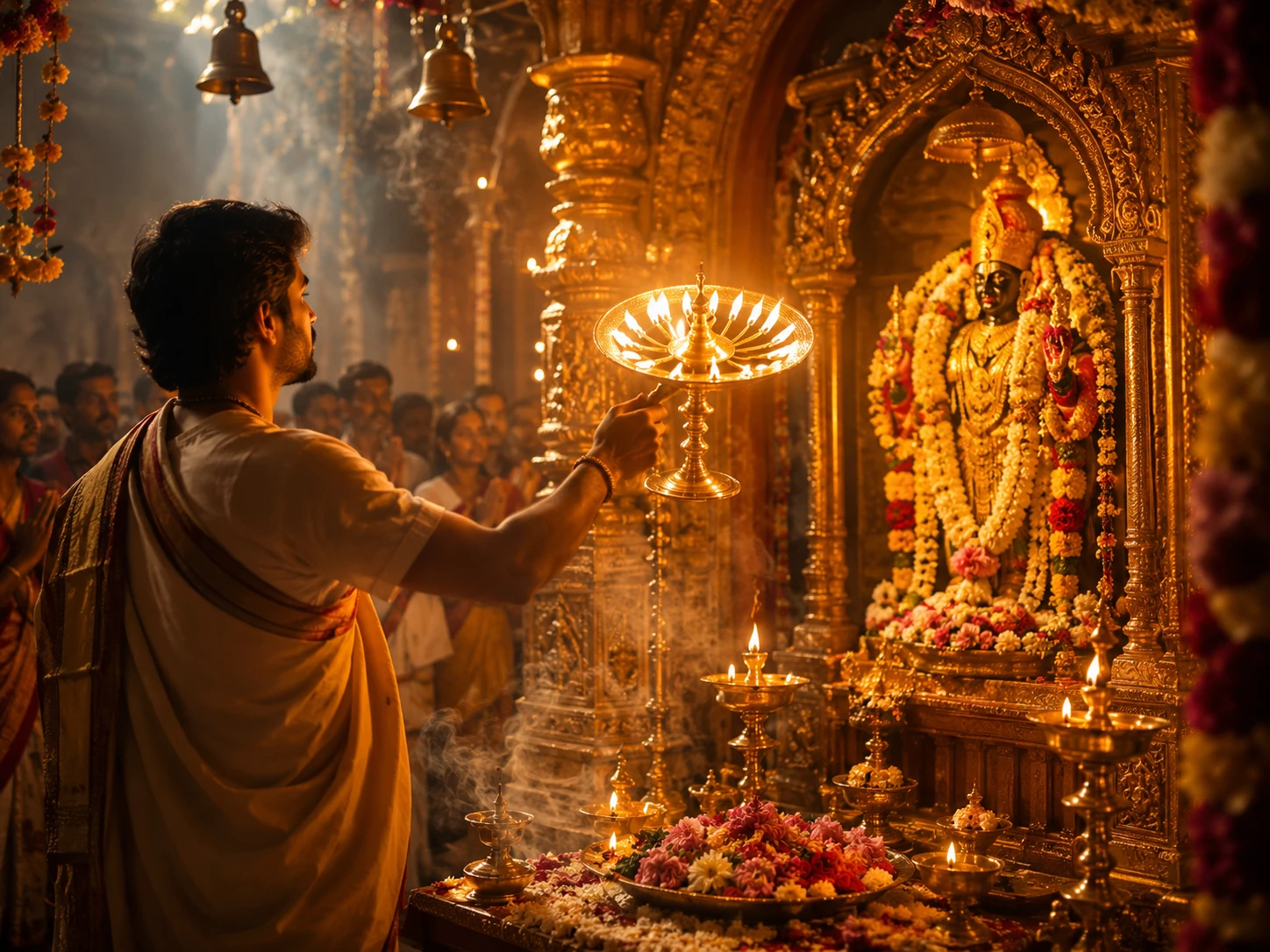
Aarti -- Why Hindus Circle Light Before God
13 min read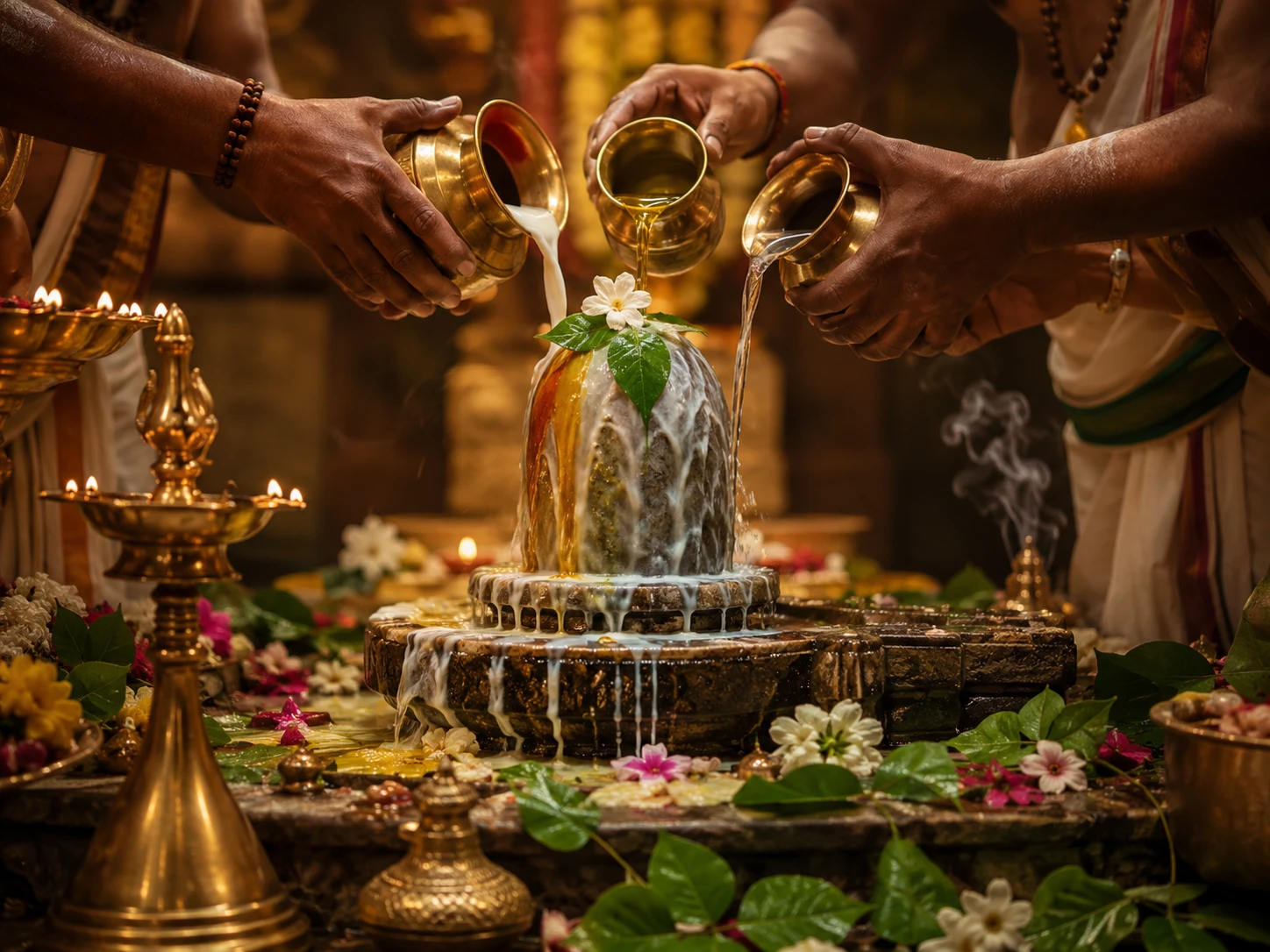
Abhisheka -- Why Hindus Bathe Their Gods
10 min read
Akshaya Tritiya -- The Day Nothing Given Away Runs Out
12 min readThe same translation error that turned '33 Koti' into '33 crore' in Hinduism also happened in Buddhism. The Chinese translation of Buddhist texts rendered 'Sapta Koti Buddha' (7 Supreme Buddhas) as '7 Crore Buddhas.' The…
Deities AvatarsCommunity Reflections
🕉️
Be the first to share your reflection.