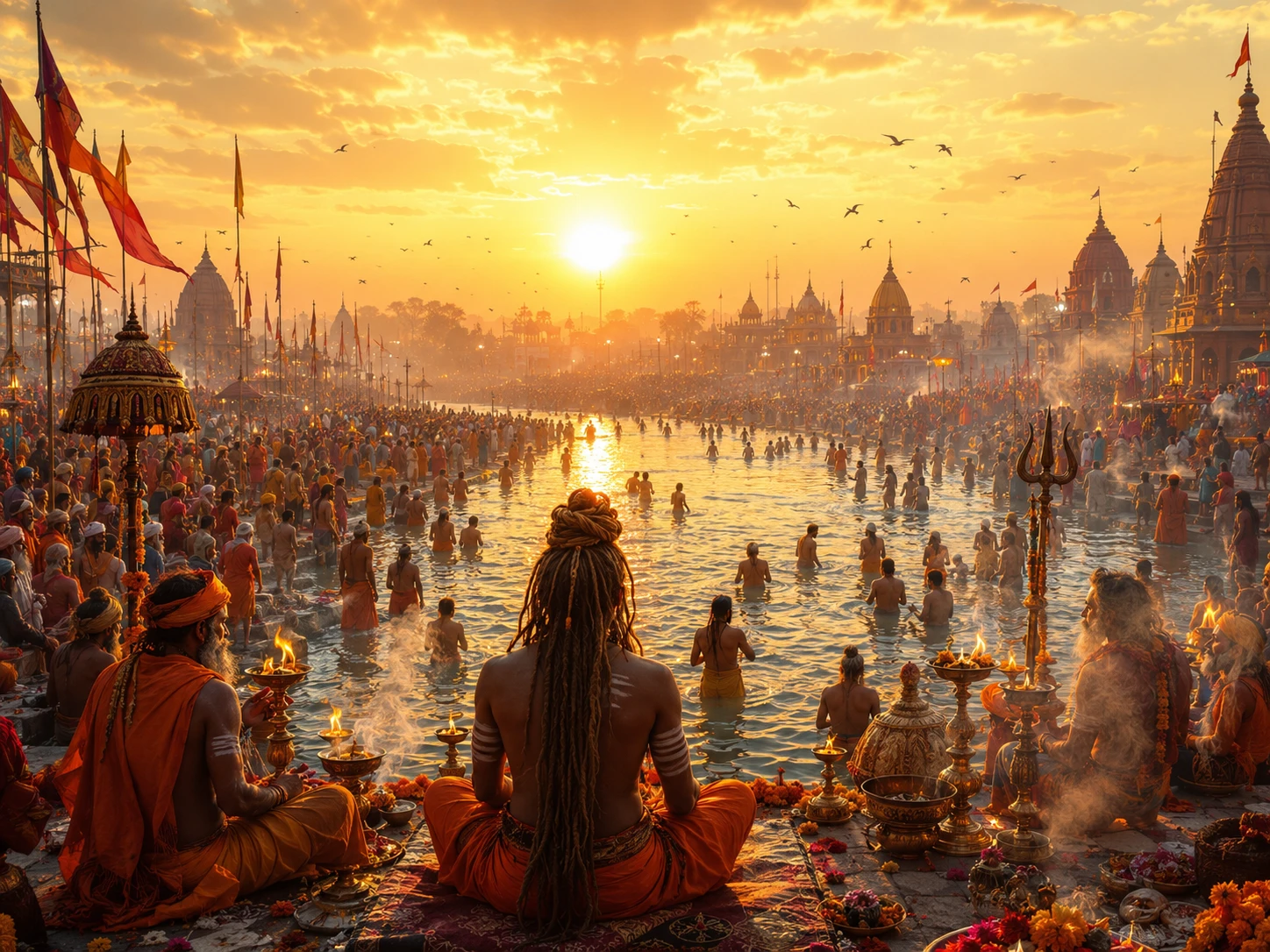
Kumbh Mela -- The Largest Gathering on Earth and the Story of Immortal Nectar
कुम्भ मेला -- पृथ्वी का सबसे बड़ा जमावड़ा और अमृत की कथा
The origin story of Kumbh Mela reaches back to one of Hinduism's most celebrated cosmic narratives: the Samudra Manthan (Churning of the Ocean of Milk). When the Devas and Asuras churned the cosmic ocean using Mount Mandara as the churning rod and Vasuki the serpent as the rope, fourteen treasures emerged -- including the Kumbh (pot) of Amrita (nectar of immortality).
As the Kumbh emerged, a fierce battle broke out between Devas and Asuras for possession of the nectar. During the struggle, Jayanta (son of Indra) fled with the pot, pursued by Asuras across the sky. The chase lasted twelve divine days (equivalent to twelve human years). During this flight, four drops of Amrita fell to earth at four locations: Prayagraj (at the confluence of Ganga, Yamuna, and the invisible Saraswati), Haridwar (where the Ganga enters the plains from the Himalayas), Nashik (on the banks of the Godavari), and Ujjain (on the banks of the Shipra). These four sites became the four Kumbh Mela locations.
The twelve-year cycle mirrors the time Jupiter (Brihaspati) takes to complete one orbit of the zodiac. The specific Kumbh at each location is determined by the position of Jupiter, Sun, and Moon in specific zodiacal signs. At Prayagraj: Jupiter in Taurus (Vrishabha) or Aquarius (Kumbha), Sun and Moon in Capricorn (Makara). At Haridwar: Jupiter in Aquarius, Sun in Aries (Mesha). At Nashik: Jupiter in Leo (Simha). At Ujjain: Jupiter in Leo, Sun in Aries.
The Ardh (half) Kumbh occurs every 6 years at Prayagraj and Haridwar. The Maha Kumbh -- the grand Kumbh -- occurs every 144 years (12 Kumbh cycles) at Prayagraj. The most recent Maha Kumbh was in 2013 (though some traditions place it in 2025). The next is anticipated in the mid-22nd century.
The centrepiece of Kumbh Mela is the Shahi Snan (Royal Bath) -- specific bathing dates determined by astrological alignments when the water at the Sangam is believed to transform into Amrita. On these dates, the Akharas (monastic orders) proceed in grand processions led by Naga Sadhus -- ash-smeared, dreadlocked, naked ascetics who represent the most extreme form of renunciation in Hinduism. The Naga Sadhus enter the water first, followed by the heads of Akharas, then the general public. The sight of hundreds of thousands bathing simultaneously at the Sangam is one of the most visually overwhelming spectacles in all of human civilisation.
त्रिषु लोकेषु विख्यातं तीर्थं त्रिपथगामिनि। प्रयागं परमं तीर्थं सर्वपापहरं शुभम्॥
triṣu lokeṣu vikhyātaṁ tīrthaṁ tripathagāmini prayāgaṁ paramaṁ tīrthaṁ sarva-pāpa-haraṁ śubham
Famous across the three worlds, at the confluence of three rivers -- Prayaga is the supreme Tirtha, auspicious and destroyer of all sins.
— Matsya Purana (Prayaga Mahatmya)
The Four Kumbh Mela Sites
| City | नगर | Sacred River | Jupiter Position | Last Kumbh | Key Feature |
|---|---|---|---|---|---|
| Prayagraj | प्रयागराज | Ganga-Yamuna-Saraswati Sangam | Taurus/Aquarius | 2019 (Ardh: 2025) | Triveni Sangam; largest of all Kumbhs |
| Haridwar | हरिद्वार | Ganga (enters plains) | Aquarius | 2021 | Har Ki Pauri ghat; Ganga emerges from Himalayas |
| Nashik-Trimbakeshwar | नासिक-त्र्यम्बकेश्वर | Godavari | Leo | 2015 | Jyotirlinga + river; South-Central India's Kumbh |
| Ujjain | उज्जैन | Shipra | Leo + Sun in Aries | 2016 | Mahakaleshwar Jyotirlinga; Simhastha Kumbh |
The 2019 Prayagraj Kumbh Mela drew an estimated 240 million visitors over 49 days -- more than the combined populations of France, Germany, and the UK. It generated Rs 1.2 lakh crore economic impact and was designated a UNESCO Intangible Cultural Heritage of Humanity in 2017.
The Infrastructure of Faith -- How Kumbh Mela Works
Kumbh Mela is not just a pilgrimage. It is the world's largest temporary city, assembled and disassembled every six or twelve years -- a feat of logistics that would challenge any modern urban planner.
The 2019 Prayagraj Kumbh covered 3,200 hectares of land along the Sangam. The temporary city included: 250+ km of roads built from scratch, 22 pontoon bridges across the Ganga and Yamuna, 122,500 toilets (the Indian government's largest single sanitation deployment), 40,000 LED streetlights, 500+ km of water pipeline, 300+ km of electric cable, 100+ medical camps with 3,000 beds, 30,000+ police and paramilitary personnel, 1,000+ CCTV cameras (many with AI-based crowd density analytics), and a dedicated 4G network to handle the communication load.
The Indian Railways operated 800+ special trains. IRCTC set up temporary booking counters. Google Maps provided a dedicated Kumbh navigation layer with real-time crowd updates. Drones monitored crowd flow. Satellite imagery from ISRO and NASA tracked the tent city's growth.
The Akhara camps -- semi-permanent settlements of monastic orders -- are the spiritual spine of the Mela. Thirteen recognized Akharas (seven Shaiva, three Vaishnava, three Udasin/Sikh) maintain large camps with their own temples, kitchens, and gathering spaces. The Akharas' Shahi Snan processions are coordinated by the Kumbh administration with military precision to prevent stampedes.
The economic impact rivals major international sporting events. Hotels in Prayagraj, Lucknow, and Varanasi are booked months in advance. Train tickets sell out weeks ahead. Local vendors -- chai wallahs, flower sellers, boat operators, tent makers, pujaris -- depend on Kumbh season for a disproportionate share of annual income. The Kumbh economy is estimated at Rs 1.2 lakh crore ($15 billion) -- roughly the GDP of a small country.
For the management student studying operations at IIM Ahmedabad: the Kumbh Mela is the most complex periodic operations challenge in the world. Building a city for 240 million visitors, operating it for 49 days, and dismantling it completely -- leaving the riverbank clean -- all within a fixed budget and timeline. No case study in any business school captures this scale. It should.
Kumbh Mela was inscribed on UNESCO's Representative List of the Intangible Cultural Heritage of Humanity in 2017. The UNESCO citation described it as 'the largest peaceful congregation of pilgrims on earth' and noted that 'the knowledge and skills related to the Mela are transmitted from one generation to the next through ancient texts, oral traditions, and institutional memory within the Akharas.' The inscription makes Kumbh Mela one of only a handful of living Hindu traditions recognized by UNESCO, alongside the Ramlila of Ramnagar and Vedic chanting.
Prepare for Your Kumbh Snan with Daily Japa
The tradition says the Kumbh snan bears most fruit when it is preceded by spiritual preparation. In the months before the next Kumbh, chant 'Om Namo Narayanaya' or 'Om Namah Shivaya' daily on a mala. When you finally enter the waters of the Sangam, you arrive already steadied by that practice. Both mantras are in the mantra meditation library on Eternal Raga.
Eternal Raga · शाश्वत राग
Institutional voice — scholarly articles on Sanatan Dharma
Deepen Your Understanding
अपनी समझ और गहरी करें
rituals traditions
Tirtha Yatra -- Why Hindus Travel to Get Closer to God
The word 'Tirtha' does not mean 'holy place.' It means 'crossing point' -- a ford where the river of worldly existence can be crossed to reach the far shore of liberation. Hindu pilgrimage is not tourism with a spiritual label. It is the deliberate journey to locations where the boundary between the material and the divine is believed to be thinnest -- where the crossing is easiest. From Kashi to Kailash, from Char Dham to Kumbh Mela, the tradition maps a sacred geography onto the physical landscape of the subcontinent, turning the act of travel itself into a spiritual practice.
scriptural exegesis
Samudra Manthan -- When Gods and Demons Ran a Joint Venture and the Universe Almost Died
A cosmic ocean. A mountain for a churning rod. A serpent king for a rope. Gods on one end, demons on the other. And out came 14 treasures -- including wealth, beauty, medicine, immortality, and one poison so lethal it could end creation itself. The Samudra Manthan is not mythology. It is the original playbook for collaboration, crisis management, and how to handle it when your joint venture partner tries to cheat you.
rituals traditions
Muhurta -- Why Hindus Obsess Over the Right Moment
Your grandmother checked the panchang before scheduling your mundan. Your parents consulted an astrologer before fixing your wedding date. Your colleague will not sign a business contract without checking the Choghadiya. The Hindu tradition divides every 24-hour day into 30 Muhurtas of 48 minutes each -- some auspicious, some neutral, some to be avoided -- and this time-quality framework has governed Indian life from Vedic fire rituals to modern real estate transactions.
vedic sciences
Kaal Ganana -- The Hindu Measure of Time
From a single blink of the eye (Nimesha) to one Day of Brahma (4.32 billion years) -- explore the complete cosmic time hierarchy of Hindu cosmology, anchored in Vishnu Purana 1.3, with its remarkable parallels to modern science.
rituals traditions
Sankalpa -- The Ritual GPS That Locates You in the Cosmos Before Every Puja
Before any Hindu ritual begins, there is a quiet declaration that most people rush through without understanding. It names the current cosmic age, the ruling Manu, the Yuga, the year, the season, the month, the fortnight, the day, the star, the continent, the country, the river, your name, your lineage, and your exact intention. This declaration -- Sankalpa -- is the most sophisticated geo-temporal tagging system in any religious tradition. It tells the universe: I am here, I am this person, and I intend to do this specific act.
rituals traditions
Abhisheka -- Why Hindus Bathe Their Gods
Every day in thousands of temples across India, deities made of stone, metal, and wood are bathed with milk, honey, curd, ghee, water, and a dozen other substances while Vedic hymns echo through the sanctum. Abhisheka is not symbolic cleansing -- the deity is not dirty. It is a technology of connection, where each liquid carries a specific energy, each mantra activates a specific dimension, and the devotee who watches or participates undergoes a transformation as real as the one happening to the murti.
rituals traditions
Makar Sankranti -- The Only Hindu Festival Tied to the Sun, Not the Moon
Almost every Hindu festival follows the lunar calendar. Makar Sankranti is the exception. It falls on a fixed solar date -- January 14 (or 15) -- when the sun crosses from Sagittarius (Dhanu) into Capricorn (Makara), marking the beginning of Uttarayana, the northern journey of the sun. This astronomical event triggers the most geographically diverse celebration in India: Pongal in Tamil Nadu, Lohri in Punjab, Bihu in Assam, Uttarayan in Gujarat, and Til-Gul in Maharashtra -- all on the same day, all celebrating the same sun, all in completely different ways.
Kumbh Mela was inscribed on UNESCO's Representative List of the Intangible Cultural Heritage of Humanity in 2017. The UNESCO citation described it as 'the largest peaceful congregation of pilgrims on earth' and noted tha…
More in Rituals & Traditions
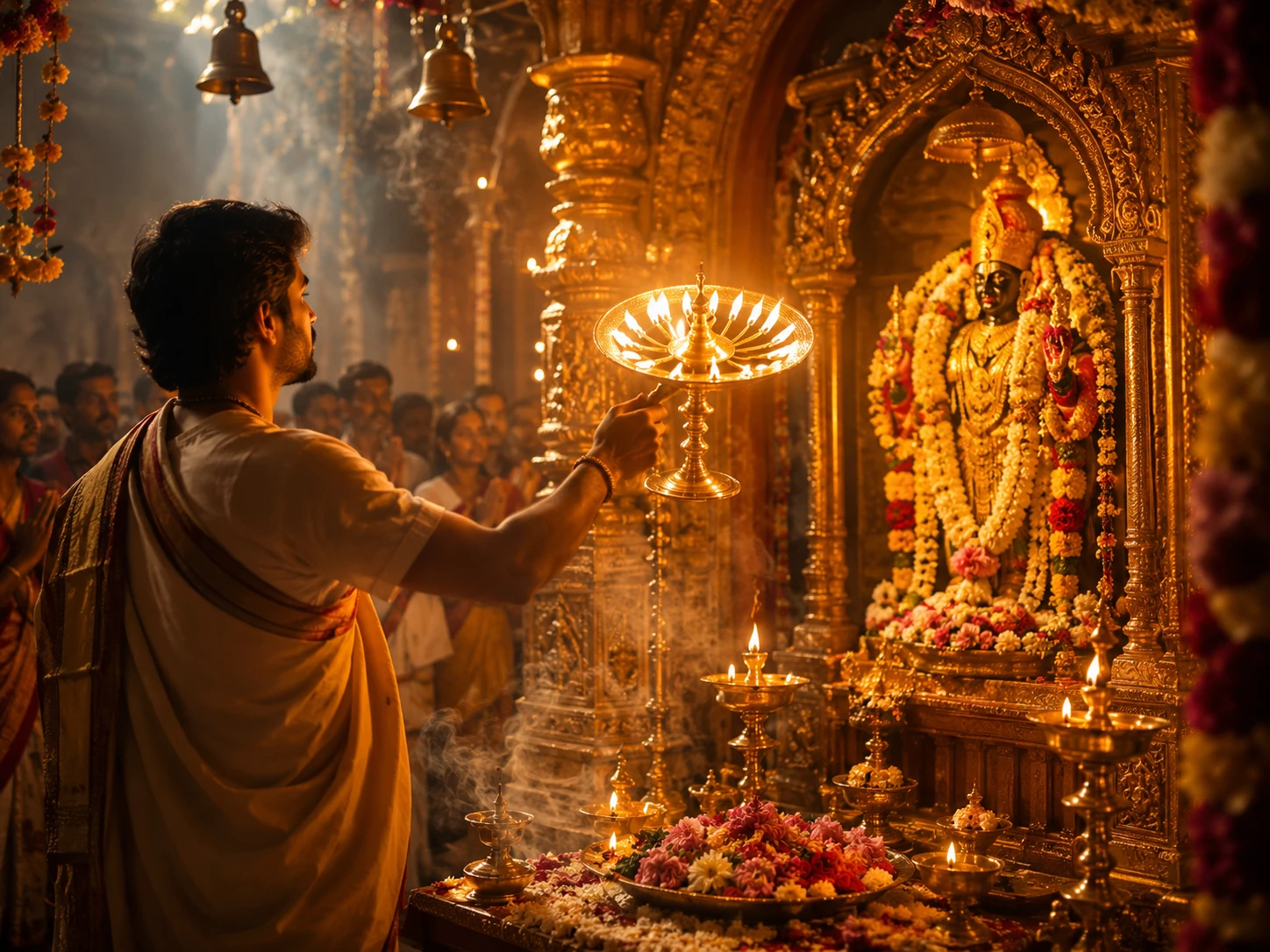
Aarti -- Why Hindus Circle Light Before God
13 min read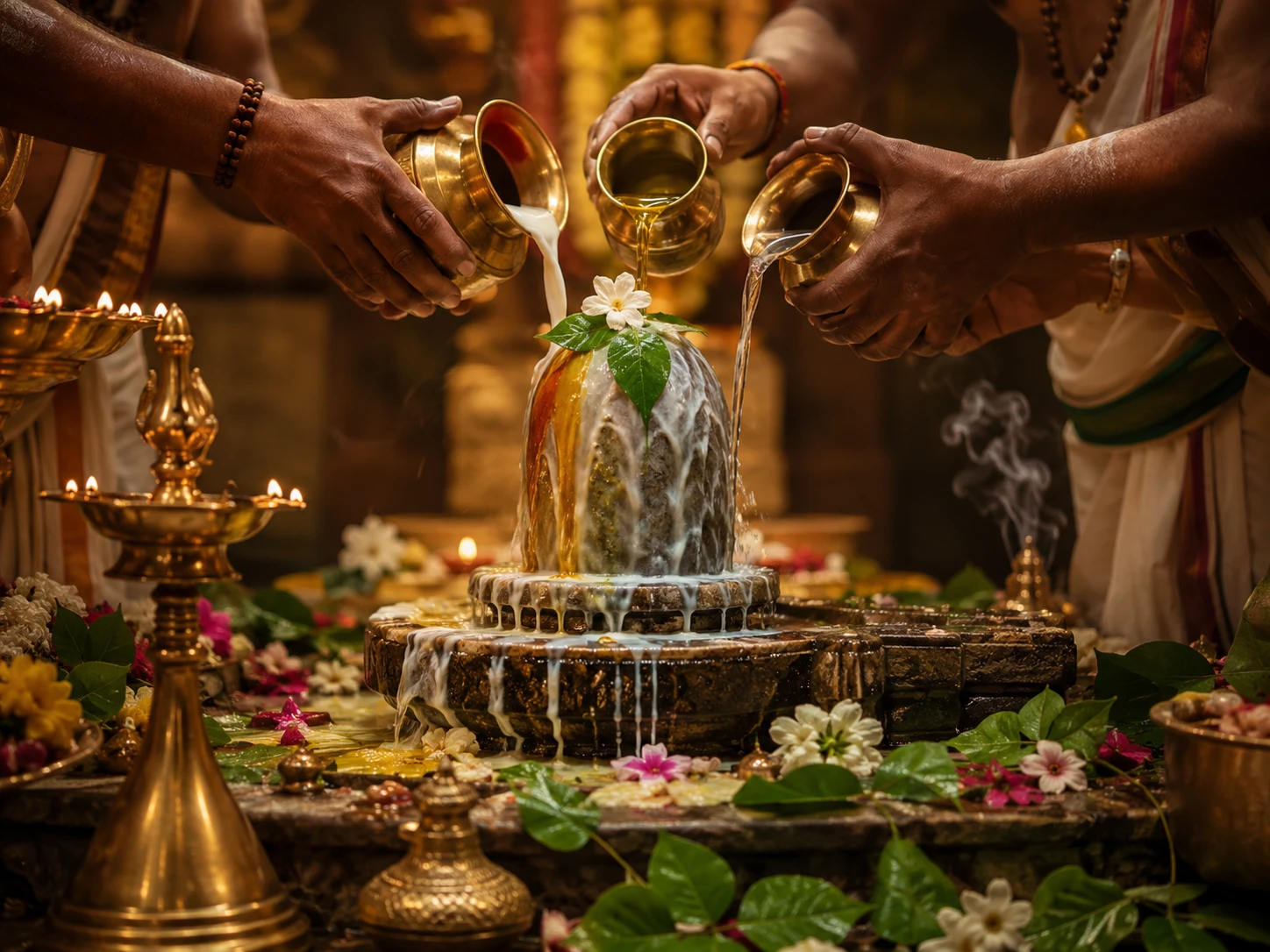
Abhisheka -- Why Hindus Bathe Their Gods
10 min read
Akshaya Tritiya -- The Day Nothing Given Away Runs Out
12 min readThe same translation error that turned '33 Koti' into '33 crore' in Hinduism also happened in Buddhism. The Chinese translation of Buddhist texts rendered 'Sapta Koti Buddha' (7 Supreme Buddhas) as '7 Crore Buddhas.' The…
Deities AvatarsCommunity Reflections
🕉️
Be the first to share your reflection.