Makar Sankranti -- The Only Hindu Festival Tied to the Sun, Not the Moon
मकर संक्रान्ति -- एकमात्र हिन्दू त्योहार जो सूर्य से जुड़ा है, चन्द्रमा से नहीं
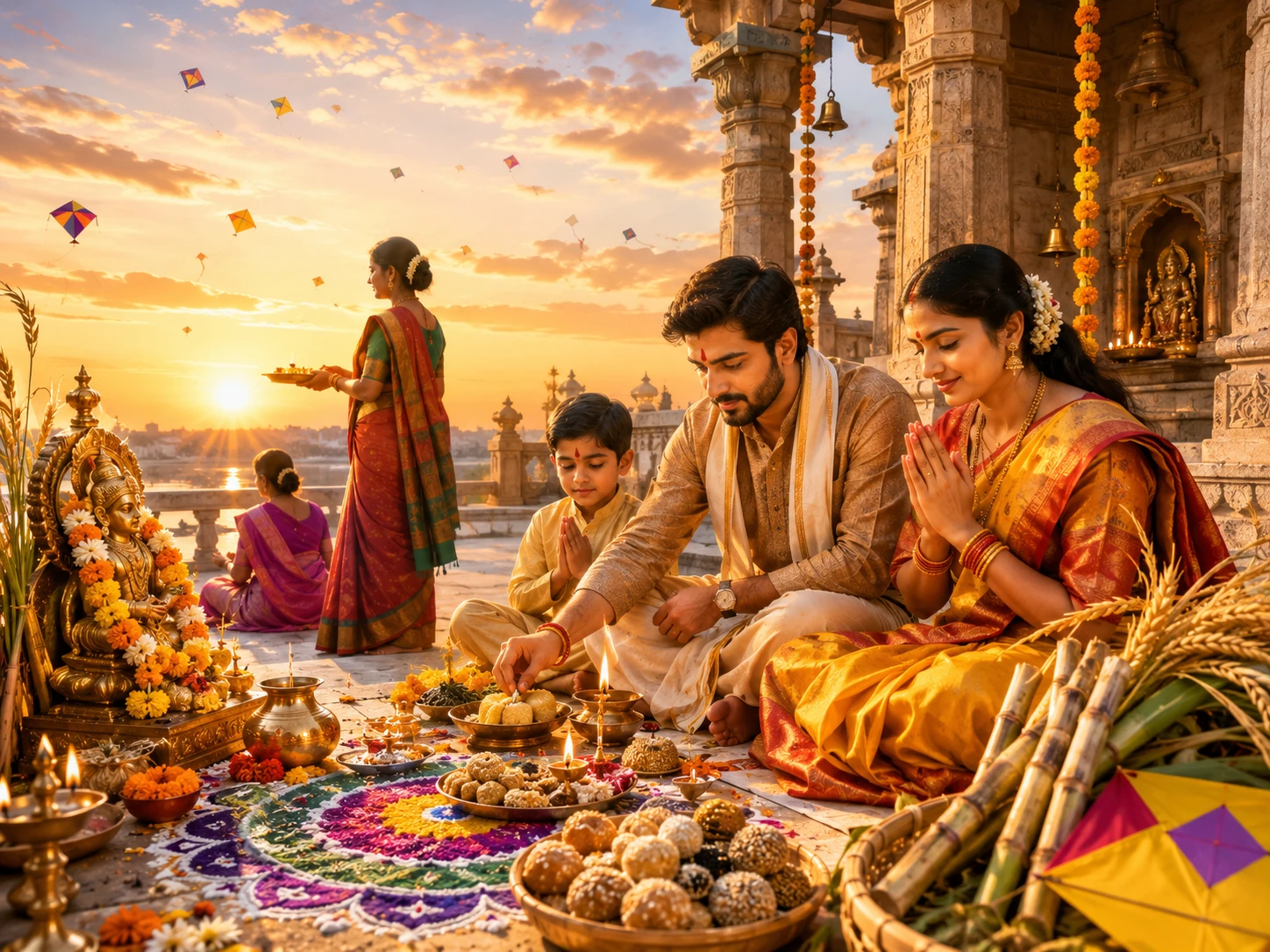
On the morning of January 14 (or 15, in some years due to astronomical calculation), a remarkable thing happens across India. In Ahmedabad, millions of kites fill the sky -- the city becomes a canvas of colour from rooftop to rooftop. In Chennai, newly harvested rice is boiled in milk in a clay pot on an open fire, and when it overflows, the family shouts 'Pongal-o-Pongal!' -- a jubilant announcement that the harvest is abundant. In Amritsar, bonfires are lit the previous evening for Lohri, and families gather around the fire to offer peanuts, popcorn, and rewri while singing folk songs. In Guwahati, Magh Bihu brings feasting, community bonfires (Meji), and traditional games. In Pune, women exchange Til-Gul (sesame-jaggery sweets) with the phrase 'Til-gul ghya, god god bola' -- take this sweet, and speak sweetly.
All of these are the same festival. All are triggered by the same astronomical event: the sun's transit from the zodiacal sign of Sagittarius (Dhanu Rashi) into Capricorn (Makara Rashi), which marks the beginning of Uttarayana -- the six-month period during which the sun appears to move northward in the sky.
This makes Makar Sankranti unique in the Hindu festival calendar. While Diwali, Holi, Navaratri, and virtually every other festival is calculated using the lunar Panchang (and therefore shifts by 10-12 days every year relative to the Gregorian calendar), Makar Sankranti is calculated using the solar calendar. It falls on nearly the same Gregorian date every year -- a fixed point in the solar cycle, as reliable as the solstice itself.
The word 'Sankranti' means transit or passage -- specifically, the sun's passage from one zodiacal sign to another. There are twelve Sankrantis in a year (one for each Rashi transit), but Makar Sankranti is the most significant because the Makara transit marks the turning point of the sun's annual journey. Before this date, the sun was in Dakshinayana (southern journey) -- days were short, nights were long, the cold was deepening. After this date, the sun begins its northward climb -- days lengthen, warmth returns, the earth wakes from winter. Uttarayana is literally the return of light.
उत्तरायणमाश्रित्य तं मासं यत्र यत्र सः। दक्षिणायनमाश्रित्य तं मासं यत्र यत्र सः॥
(Paraphrase from BG 8.24-25 concept)
Those who depart during Uttarayana, in the light, proceed toward the path of no return. Uttarayana is the period of light, ascent, and liberation in the Hindu cosmic framework.
— Concept from Bhagavad Gita 8.24 (Uttarayana as the path of light)
One Sun, Many Festivals -- Makar Sankranti Across India
| Region | क्षेत्र | Festival Name | Key Celebration | Signature Food |
|---|---|---|---|---|
| Gujarat | गुजरात | Uttarayan | Kite festival (International Kite Festival in Ahmedabad) | Undhiyu, Chikki |
| Tamil Nadu | तमिलनाडु | Pongal (4-day festival) | Boiling rice in milk, Kolam, cattle celebration (Jallikattu) | Pongal rice, Sakkarai Pongal |
| Punjab, Haryana | पंजाब, हरियाणा | Lohri (previous evening) | Bonfire, folk songs, Giddha dance | Rewri, Gajak, Peanuts |
| Maharashtra | महाराष्ट्र | Makar Sankranti | Til-Gul exchange, kite flying | Til-Gul laddoo, Puran Poli |
| Assam | असम | Magh Bihu | Community bonfire (Meji), feasting, traditional games | Pitha, Laru, Jolpan |
| Karnataka | कर्नाटक | Sankranti | Ellu-Bella exchange (sesame-sugar), cattle procession | Ellu-Bella, Huggi |
| UP, Bihar | UP, बिहार | Khichdi / Daan | Charity, river bathing, Khichdi feast | Khichdi, Til Laddoo |
Makar Sankranti is the only major Hindu festival celebrated on nearly the same Gregorian date every year (Jan 14-15), because it follows the solar rather than lunar calendar. The slight date variation occurs due to the precession of equinoxes -- the Makara transit shifts by approximately 1 day every 72 years.
The Astronomy Behind It -- Why Uttarayana Matters
Makar Sankranti marks the moment when the sun's apparent path crosses the celestial longitude of 270 degrees -- the boundary between Sagittarius and Capricorn in the sidereal zodiac. This is the astronomical event called the winter solstice transition in the Indian system (though the actual astronomical winter solstice in the tropical zodiac occurs around December 21-22; the difference is due to the precession of equinoxes, which causes the sidereal and tropical zodiacs to drift apart by about 1 degree every 72 years).
The Surya Siddhanta -- one of the most important astronomical texts of ancient India -- provides the mathematical basis for calculating Sankranti transitions. The text, attributed to the 4th-5th century CE but encoding observational data that may be much older, describes the sun's annual path with remarkable accuracy and provides the formulae that Indian astronomers used to predict Sankrantis for centuries.
Uttarayana is significant in Hindu cosmology for reasons that go far beyond festival timing. The Bhagavad Gita (Chapter 8, verses 23-26) describes two paths of departure from the body after death: the Shukla Gati (bright path, associated with Uttarayana, fire, light, daytime, and the waxing moon) and the Krishna Gati (dark path, associated with Dakshinayana, smoke, darkness, nighttime, and the waning moon). Those who depart during Uttarayana follow the path of no return -- the path to Brahman. Those who depart during Dakshinayana return to the cycle of rebirth.
This is why Bhishma Pitamah in the Mahabharata, lying on a bed of arrows after being mortally wounded by Arjuna, chose to wait until Uttarayana to leave his body. He possessed the boon of Iccha Mrityu (death at will) and used it to delay his death until the sun's northward transit began. His death on the day of Makar Sankranti (or shortly after) is commemorated as Bhishma Ekadashi or Bhishma Ashtami in some traditions.
For the ISRO scientist, the IIT physicist, or the curious schoolchild: Makar Sankranti is the one Hindu festival that can be verified with a telescope. Point it at the sun on January 14 and track its position against the background stars over the following weeks. You will see it climbing northward -- exactly as the Surya Siddhanta described over 1,500 years ago. The festival is not mythology. It is astronomy, celebrated with sesame sweets and kites.
The International Kite Festival held in Ahmedabad during Uttarayan is one of the largest kite festivals in the world, attracting participants from over 40 countries. The Gujarat government has promoted it as a global tourism event since 1989. An estimated 100+ million kites are sold in Gujarat alone during the Uttarayan season, supporting a kite-making industry that employs thousands of artisan families in Ahmedabad, Surat, and Rajkot. The festival has its own aerodynamics: experienced kite-fighters use manja (glass-coated string) to cut opponents' kite strings in competitive aerial battles. In recent years, synthetic manja has been banned due to environmental and safety concerns, and traditional cotton manja coated with rice paste is making a comeback -- an ancient material reclaiming its space from a modern substitute.
Til and Gul -- The Science Behind the Signature Foods
Every Makar Sankranti food tradition across India shares one common ingredient: sesame (Til). In Maharashtra, it is Til-Gul laddoo. In Karnataka, Ellu-Bella (sesame-sugar mix). In Gujarat, Til Chikki. In Bihar and UP, Til Laddoo and Til Ke Laddu. In Bengal, Til Pitha. The pan-Indian presence of sesame on this specific day is not coincidental -- it is Ayurvedic food engineering calibrated to the season.
Sesame seeds are one of the richest plant sources of calcium, iron, magnesium, and healthy fats. They are classified as Ushna Virya (heating potency) in Ayurveda, which means they generate internal warmth. January is the peak of winter across most of India. The body's caloric needs are highest. The digestive fire (Agni) is strongest (Ayurveda considers winter the season of maximum digestive capacity). Consuming sesame and jaggery -- both calorie-dense, warming, and rich in micronutrients -- on the coldest days of the year is nutritional common sense encoded as festival tradition.
Jaggery (Gul/Gur/Bellam) pairs with sesame for a reason beyond taste. Jaggery is a complex carbohydrate that provides sustained energy release (unlike refined sugar's spike-and-crash). It is rich in iron and functions as a blood purifier in Ayurvedic classification. Combined with sesame's fat and mineral profile, the Til-Gul combination creates a naturally balanced winter superfood.
The specific Makar Sankranti phrase in Maharashtra -- 'Til-gul ghya, god god bola' (accept this sesame-jaggery, and speak sweetly) -- adds a social-psychological dimension. The sweet is not just eaten; it is exchanged. And the exchange is accompanied by an instruction: speak sweetly. This transforms a nutritional practice into a social contract. By accepting the sweet and the instruction together, you are simultaneously nourishing your body and committing to harmonious communication. The food becomes a vehicle for social dharma.
In Tamil Nadu, the Pongal dish itself is an exercise in agricultural gratitude. Newly harvested rice is boiled in fresh milk with jaggery in a clay pot over a wood fire, allowed to overflow (symbolising abundance), and offered first to the Sun before the family eats. The four-day Pongal festival (Bhogi, Thai Pongal, Mattu Pongal, Kaanum Pongal) is the most elaborate harvest celebration in India -- and the only major Hindu festival that explicitly centres agriculture rather than mythology.
For the urban Indian who buys Til-Gul from a sweet shop and gives it to colleagues on January 14 without thinking about why: you are participating in a 3,000-year-old nutritional tradition designed by people who understood that the body's needs change with the sun's position, and that the best way to ensure a population eats right is to make the right food into a festival offering. You are not just exchanging sweets. You are exchanging health, wrapped in culture, delivered through celebration.
Bhishma's Choice -- Why Uttarayana Is the Time to Die Well
The most profound association of Makar Sankranti in Hindu tradition is not with kites or sesame but with death -- specifically, with the idea that Uttarayana is the most auspicious time to leave the body.
Bhishma Pitamah, the grand patriarch of the Kuru dynasty, was pierced by countless arrows on the tenth day of the Kurukshetra war. He fell from his chariot and lay on a bed of arrows -- suspended between life and death. He possessed Iccha Mrityu, the boon of choosing the moment of his own death. Despite the agony of his wounds, he chose to wait. For fifty-six days (some traditions say fifty-eight), he lay on his arrow-bed, conscious and teaching -- delivering the monumental discourses of the Shanti Parva and Anushasana Parva to Yudhishthira. And when Uttarayana arrived -- when the sun began its northward journey -- Bhishma finally released his life-breath.
This choice encodes a theological principle: the direction of the sun at the time of death influences the trajectory of the soul. Uttarayana represents the ascending, illuminated path (Deva Yana or Shukla Gati) that leads the soul toward liberation. Dakshinayana represents the descending path (Pitri Yana or Krishna Gati) that leads back to rebirth. Bhishma, who had lived his entire life in dharma (albeit with agonizing moral complexity), chose to die in the light.
This belief has practical consequences even today. In many traditional Hindu families, there is a quiet awareness of Uttarayana and Dakshinayana when a family elder is terminally ill. While modern medicine does not permit 'choosing' the moment of death in most cases, the family's prayers often include a wish that the departure happen during Uttarayana -- in the light half, during daytime, preferably in a sacred space.
For the hospice volunteer, the geriatric care professional, or the family member accompanying an elder through their final days: the Hindu tradition offers a framework for understanding death not as a random biological event but as a transition that can be influenced by timing, intention, and spiritual preparation. This framework does not replace medical care. It complements it -- adding a dimension of sacred meaning to the most difficult passage of human life.
Chant the Surya Mantra on Makar Sankranti
On Makar Sankranti, face the rising sun and chant 'Om Suryaya Namah' 108 times on a mala. The sun's northward journey begins -- align your own spiritual journey with it. Share til-gul or pongal with your neighbours as the Sun's prasada. For a longer hymn to Surya, the Aditya Hridayam is on Eternal Raga with its meaning.
Eternal Raga · शाश्वत राग
Institutional voice — scholarly articles on Sanatan Dharma
Deepen Your Understanding
अपनी समझ और गहरी करें
vedic sciences
Kaal Ganana -- The Hindu Measure of Time
From a single blink of the eye (Nimesha) to one Day of Brahma (4.32 billion years) -- explore the complete cosmic time hierarchy of Hindu cosmology, anchored in Vishnu Purana 1.3, with its remarkable parallels to modern science.
vedic sciences
Surya Siddhanta -- The Ancient Astronomy Text That Got the Year Right to 1.4 Seconds
Before Copernicus, before Galileo, before the telescope existed -- an Indian text calculated the tropical year as 365.2421756 days. The modern value is 365.2421904. The difference is 1.4 seconds per year. The Surya Siddhanta also described gravity, computed planetary diameters within 1% accuracy, and invented the sine function. It did all this in Sanskrit verse.
rituals traditions
Muhurta -- Why Hindus Obsess Over the Right Moment
Your grandmother checked the panchang before scheduling your mundan. Your parents consulted an astrologer before fixing your wedding date. Your colleague will not sign a business contract without checking the Choghadiya. The Hindu tradition divides every 24-hour day into 30 Muhurtas of 48 minutes each -- some auspicious, some neutral, some to be avoided -- and this time-quality framework has governed Indian life from Vedic fire rituals to modern real estate transactions.
rituals traditions
Pongal -- Tamil Nadu's Four-Day Harvest Festival That Worships the Sun, the Cow, and the Overflowing Pot
When the rice-milk pot overflows on Thai Pongal morning and the family shouts 'Pongal-o-Pongal!', Tamil Nadu is performing one of the oldest agricultural thanksgivings on earth. Four days of celebration -- Bhogi (discarding the old), Thai Pongal (thanking the Sun), Mattu Pongal (honouring cattle), and Kaanum Pongal (family outings) -- encode an entire civilisation's relationship with the land, the sun, and the animals that make agriculture possible. Pongal is not just a festival. It is Tamil Nadu's love letter to the harvest.
rituals traditions
Chhath Puja -- The Only Hindu Festival Where You Worship the Setting Sun
Most Hindu worship faces east -- toward the rising sun, toward beginnings. Chhath Puja faces west -- toward the setting sun, toward endings, toward the courage to honour what is departing. Standing waist-deep in a river or pond at sunset and again at sunrise, offering Arghya (water oblation) to Surya with bare hands while chanting Vedic hymns -- this is the most physically demanding, most ecologically pure, and most egalitarian festival in the Hindu calendar. No priest. No temple. No idol. Just you, the water, and the sun.
rituals traditions
Sandhyavandana -- The Daily Vedic Practice That Even Rama and Krishna Never Skipped
Three times a day, at the junction of night and day, morning and afternoon, afternoon and night, the twice-born Hindu is commanded to stop everything and perform Sandhyavandana. It combines pranayama, the Gayatri Mantra, water offerings, and meditation into a single twenty-minute ritual. The Ramayana shows Rama doing it in the forest. The Mahabharata shows Krishna doing it before battle. And somewhere in India right now, an IIT student is doing it in his hostel room.
rituals traditions
Diwali -- Five Days of Light
Diwali is not one night of firecrackers. It is a five-day arc from Dhanteras to Bhai Dooj, layering wealth, ancestors, Lakshmi, community, and sibling bonds into a single liturgical sequence. Its origins span Rama's return, Krishna's Narakasura victory, Jain Mahavira's nirvana, and Sikh Bandi Chhor Divas -- making it the most theologically layered festival in the Indian calendar.
The International Kite Festival held in Ahmedabad during Uttarayan is one of the largest kite festivals in the world, attracting participants from over 40 countries. The Gujarat government has promoted it as a global tou…
More in Rituals & Traditions
Aarti -- Why Hindus Circle Light Before God
13 min read
Abhisheka -- Why Hindus Bathe Their Gods
10 min read
Akshaya Tritiya -- The Day Nothing Given Away Runs Out
12 min readThe same translation error that turned '33 Koti' into '33 crore' in Hinduism also happened in Buddhism. The Chinese translation of Buddhist texts rendered 'Sapta Koti Buddha' (7 Supreme Buddhas) as '7 Crore Buddhas.' The…
Deities AvatarsCommunity Reflections
🕉️
Be the first to share your reflection.