Chhath Puja -- The Only Hindu Festival Where You Worship the Setting Sun
छठ पूजा -- एकमात्र हिन्दू त्योहार जहाँ डूबते सूर्य की पूजा
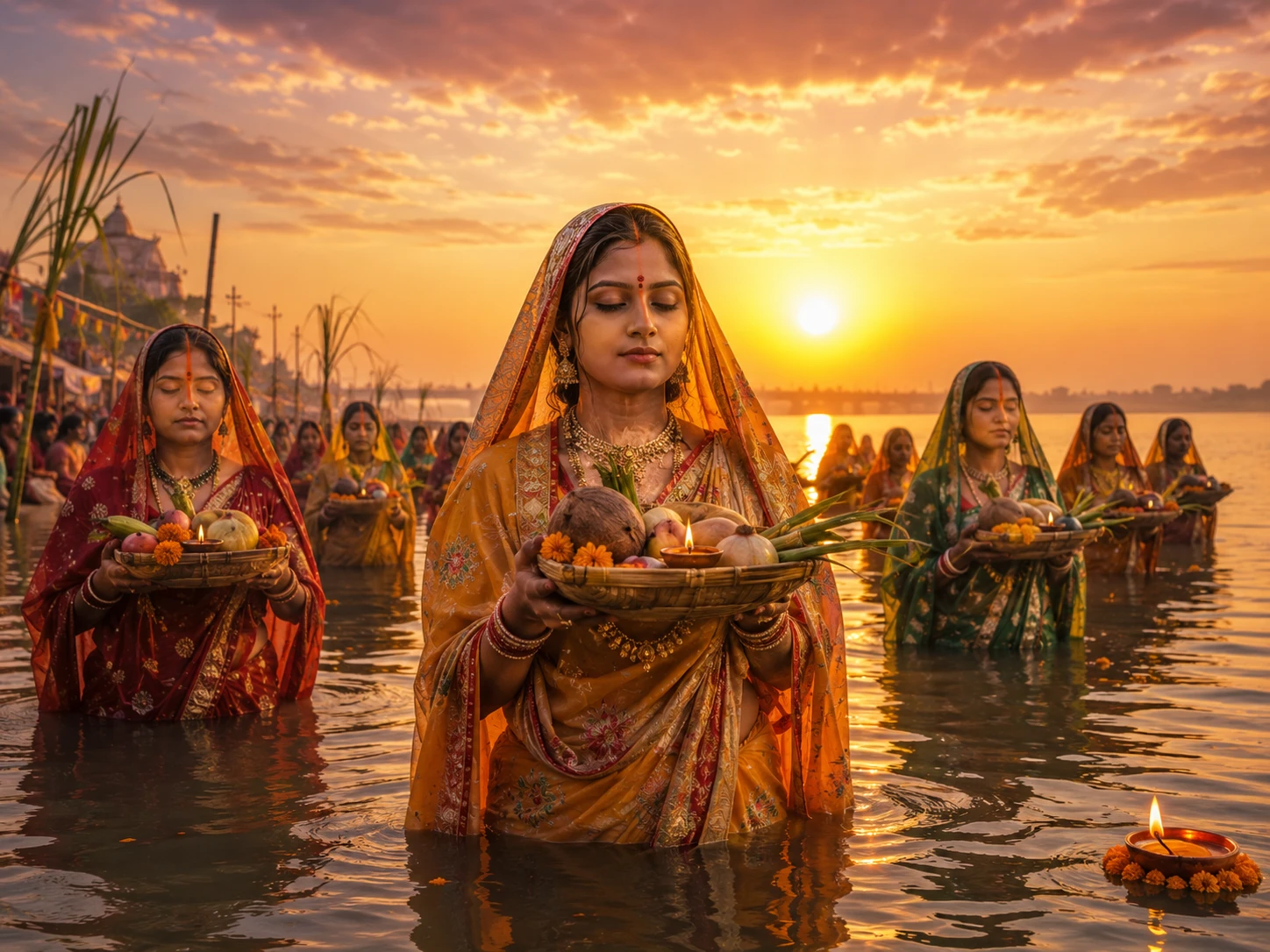
Chhath is unlike any other Hindu festival. It has no temple. No idol. No priest. No Brahminical mediation. The devotee -- typically a woman, though men also observe -- stands directly in water and offers Arghya directly to the sun. The transaction is between the worshipper and the cosmos, unmediated by institution or intermediary. This radical directness makes Chhath the most democratic and most ecologically conscious festival in the Hindu calendar.
The festival spans four days in Kartik (October-November), centred on the Shashthi (6th) Tithi -- hence 'Chhath' (sixth). The presiding deity is Chhathi Maiya, understood as the sister of Surya (the Sun God) or as a manifestation of Usha (the Dawn) and Pratyusha (the Dusk). The worship of the setting sun -- Sandhya Arghya on the evening of Day 3 -- is Chhath's most distinctive feature. While Hindu tradition overwhelmingly venerates the rising sun (Surya Namaskar, Gayatri at sunrise), Chhath uniquely honours the departing sun. The philosophical implication is profound: what is ending deserves as much reverence as what is beginning. Sunset is not defeat. It is the sun's promise to return.
The four-day sequence is rigorous:
Day 1 -- Nahay Khay: The Vratin (person observing the Vrata, typically the mother of the household) takes a ritual bath in a river, prepares a sattvic meal (lauki/kaddu ki sabzi with chana dal and rice cooked in a new earthen pot over a mango-wood fire), and eats once. From this point, the Vratin's discipline begins.
Day 2 -- Kharna (Lohanda): A full-day fast broken in the evening after sunset with kheer (rice pudding) and roti. The Kharna Prasada is distributed to neighbours and family. After eating, the Vratin begins a 36-hour Nirjala fast -- no food, no water -- that continues through Day 3 and into the morning of Day 4.
Day 3 -- Sandhya Arghya (Evening Offering): The family prepares elaborate Soop (bamboo winnowing baskets) filled with Thekua (a wheat-jaggery-ghee biscuit specific to Chhath), fruits (sugarcane, banana, coconut, seasonal fruits), and other offerings. At sunset, the Vratin enters a river, pond, or any clean water body, stands waist-deep facing west, and offers Arghya to the setting sun. The moment is electrifying -- thousands of Vratins standing in water simultaneously, the sky ablaze, folk songs filling the air.
Day 4 -- Usha Arghya (Dawn Offering): Before sunrise, the same ritual is repeated facing east -- the rising sun receives Arghya. The fast is broken after this morning offering. The Vratin is welcomed home with celebration.
The 36-hour Nirjala stretch across Days 2-4 makes Chhath one of the most physically demanding Vratas in Hinduism -- comparable to Nirjala Ekadashi but extended over a longer period and performed while standing in cold water.
उद्यन्नद्य मित्रमह आरोहन्नुत्तरां दिवम्। हृद्रोगं मम सूर्य हरिमाणं च नाशय॥
udyan adya mitramaha ārohan uttarāṁ divam hṛd-rogaṁ mama sūrya harimāṇaṁ ca nāśaya
O Sun, friend of all, as you rise today and ascend the highest sky, destroy the disease of my heart and the pallor of my body.
— Aditya Hridaya Stotra / Surya Upanishad tradition
Chhath Puja -- Four-Day Sequence
| Day | दिन | Name | Activity | Fasting Level |
|---|---|---|---|---|
| Day 1 | दिन 1 | Nahay Khay | River bath, single sattvic meal in new earthen pot | One meal |
| Day 2 | दिन 2 | Kharna / Lohanda | Full day fast, broken at evening with kheer-roti | Full day, broken evening |
| Day 3 | दिन 3 | Sandhya Arghya | 36-hr Nirjala begins; sunset Arghya in water | Nirjala (no food/water) |
| Day 4 | दिन 4 | Usha Arghya | Sunrise Arghya in water; fast broken; celebration | Nirjala broken at sunrise |
The 36-hour Nirjala stretch from Kharna evening to Usha Arghya morning is one of the most physically demanding fasts in any religious tradition. Vratins perform it while standing in cold October-November water, often in temperatures below 15 degrees Celsius in Bihar and Jharkhand.
Why Chhath Is Bihar's Soul -- Identity, Migration, and Cultural Pride
Chhath is to Bihar what Durga Puja is to Bengal -- not just a festival but a civilisational identity marker. For the millions of Biharis and Jharkhandis who have migrated to Delhi, Mumbai, Bangalore, and the Gulf countries for work, Chhath is the annual cultural anchor that reconnects them to their roots.
The festival's migration from Bihar to the rest of India is one of modern India's most remarkable cultural stories. In the 1990s, Chhath was virtually unknown outside Bihar, Jharkhand, and eastern UP. By the 2020s, it is celebrated on the banks of the Yamuna in Delhi (where the Delhi government builds temporary ghats), on Juhu Beach in Mumbai, on Hussain Sagar in Hyderabad, and in community gatherings in Singapore, Dubai, and the US. This spread was driven entirely by migration -- Bihari workers and professionals carried Chhath with them and refused to let it die in the diaspora.
The political dimension is significant. Chhath has become a symbol of Bihari cultural assertion. State governments invest heavily in Chhath infrastructure. Bihar's Chief Ministers -- regardless of party -- appear at Chhath ghats for photo opportunities. The festival's recognition as a national (not merely regional) celebration has been a source of immense pride for the Bihari community.
For the young Bihari professional in Bangalore who feels culturally invisible in a South Indian city: Chhath is your annual declaration of identity. Find your community. Go to the nearest water body. Stand in the water. Offer Arghya. Sing the folk songs. For those four days, you are not a migrant. You are a Vratin performing the most ancient and direct form of sun worship on the planet.
Chhath's ecological purity is remarkable. No idol to immerse. No chemical colours. No firecrackers. The offerings are entirely biodegradable -- fruits, thekua, sugarcane. The water body is cleaned before and after. Chhath is the Hindu festival that environmental activists should study and champion -- proof that profound devotion needs no environmental cost.
Chhath Puja is one of the few Hindu festivals with no Brahminical priesthood involved at any stage. The Vratin performs every ritual directly -- from cooking the offerings to standing in water to offering Arghya. This has made Chhath deeply egalitarian: all castes, all classes, all genders participate identically. The richest businesswoman in Patna and the poorest farmworker in Darbhanga perform the same Vrata, in the same water, wearing the same simple clothes. Chhath recognises no intermediary between the devotee and the sun. This radical directness has made it the most resistant of all Hindu festivals to commercialisation -- you cannot hire someone to do Chhath for you. Your body must be in the water. Your hands must offer the Arghya. Your voice must sing the songs.
Honour the Sun with Daily Surya Namaskar
Chhath's sun worship can extend into daily practice. Each morning, face the rising sun and chant 'Om Suryaya Namah' twelve times, once for each Aditya; if you practise yoga, add twelve rounds of Surya Namaskar. For a longer prayer, the Aditya Hridayam is on Eternal Raga with its meaning.
Eternal Raga · शाश्वत राग
Institutional voice — scholarly articles on Sanatan Dharma
Deepen Your Understanding
अपनी समझ और गहरी करें
rituals traditions
Makar Sankranti -- The Only Hindu Festival Tied to the Sun, Not the Moon
Almost every Hindu festival follows the lunar calendar. Makar Sankranti is the exception. It falls on a fixed solar date -- January 14 (or 15) -- when the sun crosses from Sagittarius (Dhanu) into Capricorn (Makara), marking the beginning of Uttarayana, the northern journey of the sun. This astronomical event triggers the most geographically diverse celebration in India: Pongal in Tamil Nadu, Lohri in Punjab, Bihu in Assam, Uttarayan in Gujarat, and Til-Gul in Maharashtra -- all on the same day, all celebrating the same sun, all in completely different ways.
rituals traditions
Vrata -- What a Hindu Vow Really Means (It Is Not Just Fasting)
Your mother kept Karva Chauth without water for sixteen hours. Your grandmother observed Ekadashi every fortnight without fail. Your colleague skips lunch on Tuesdays 'for Hanuman.' The world sees Hindu fasting as dietary restriction. The tradition sees it as something far more radical: Vrata is a voluntary, time-bound act of self-imposed discipline that rewires the relationship between desire and willpower. Fasting is the most visible expression. But the real Vrata happens inside.
deities avatars
Surya -- The Sun God Who Drives a Seven-Horse Chariot Across the Sky Every Day
He is the most visible god in Hinduism -- you can see him every morning. The Gayatri Mantra, the most sacred verse in the Vedas, is addressed to him. The Konark Sun Temple is shaped like his chariot. And every time you do Surya Namaskar in your yoga class, you are performing a 3,000-year-old sun worship ritual. Surya is the deity hiding in plain sight.
rituals traditions
Sandhyavandana -- The Daily Vedic Practice That Even Rama and Krishna Never Skipped
Three times a day, at the junction of night and day, morning and afternoon, afternoon and night, the twice-born Hindu is commanded to stop everything and perform Sandhyavandana. It combines pranayama, the Gayatri Mantra, water offerings, and meditation into a single twenty-minute ritual. The Ramayana shows Rama doing it in the forest. The Mahabharata shows Krishna doing it before battle. And somewhere in India right now, an IIT student is doing it in his hostel room.
rituals traditions
Tirtha Yatra -- Why Hindus Travel to Get Closer to God
The word 'Tirtha' does not mean 'holy place.' It means 'crossing point' -- a ford where the river of worldly existence can be crossed to reach the far shore of liberation. Hindu pilgrimage is not tourism with a spiritual label. It is the deliberate journey to locations where the boundary between the material and the divine is believed to be thinnest -- where the crossing is easiest. From Kashi to Kailash, from Char Dham to Kumbh Mela, the tradition maps a sacred geography onto the physical landscape of the subcontinent, turning the act of travel itself into a spiritual practice.
rituals traditions
Panchopachara Puja -- The 5 Offerings That Engage All Five Senses
You do not need a pandit, a pavilion, or a two-hour ritual to worship. The Panchopachara Puja -- five offerings representing the five elements and engaging the five senses -- is the tradition's elegant minimum viable puja. Sandalwood for earth, flowers for space, incense for air, lamp for fire, food for water. Five items. Five minutes. A complete act of devotion.
rituals traditions
Ekadashi -- Why Hindus Fast on the 11th Day (And What the '11' Actually Means)
Twice every lunar month, millions of Hindus stop eating grains. Not as a diet. Not for health. Because the Padma Purana says that on the 11th day of the lunar fortnight, all sin takes refuge in grain -- and the person who abstains from grain on that day is freed from sin and drawn closer to Vishnu. The number 11 is not accidental: it represents the 10 senses plus the mind, and Ekadashi is the day you master all eleven. This is the most widely observed Vrata in the Hindu world -- and it maps almost perfectly onto modern intermittent fasting science.
Chhath Puja is one of the few Hindu festivals with no Brahminical priesthood involved at any stage. The Vratin performs every ritual directly -- from cooking the offerings to standing in water to offering Arghya. This ha…
More in Rituals & Traditions
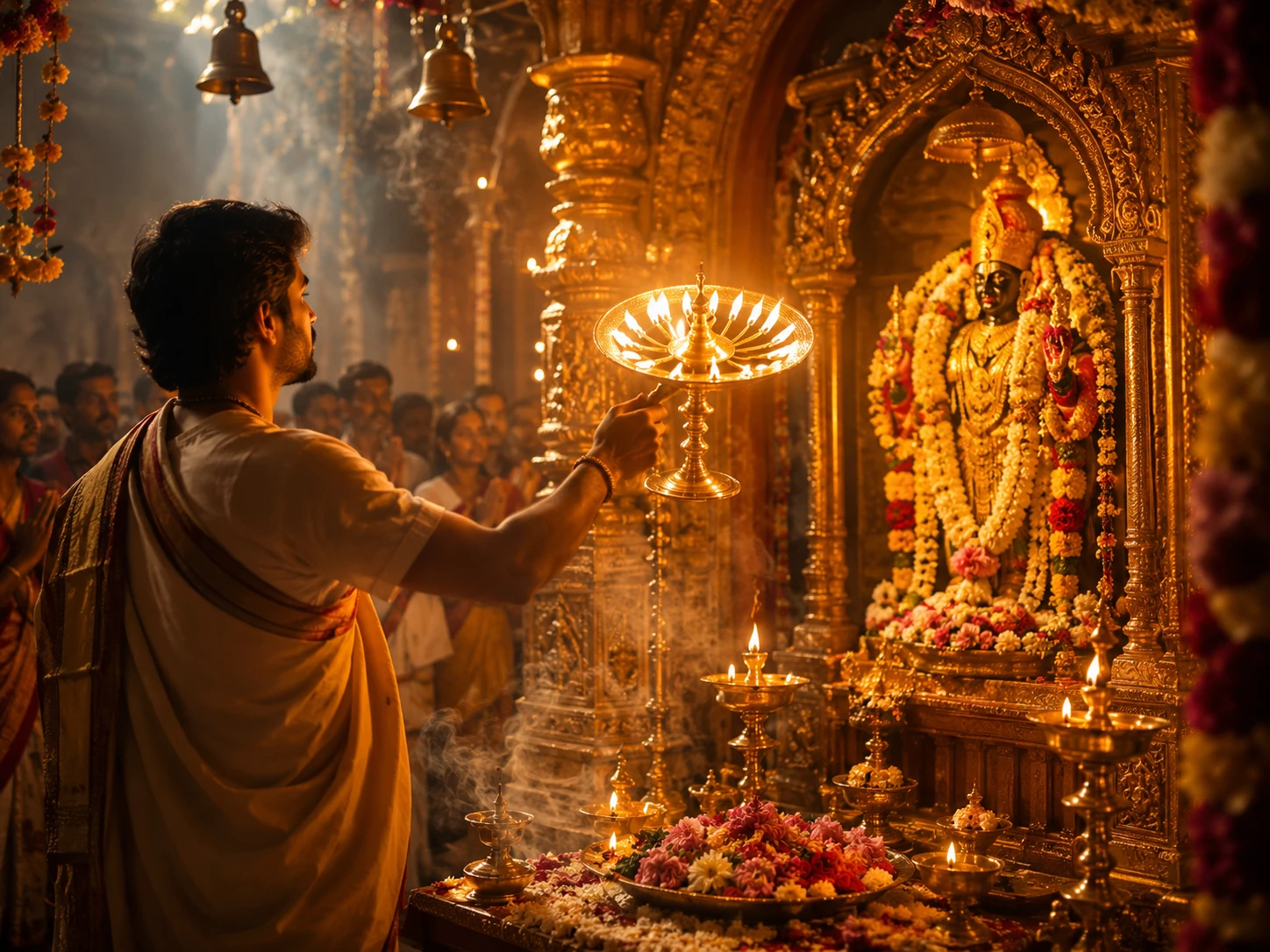
Aarti -- Why Hindus Circle Light Before God
13 min read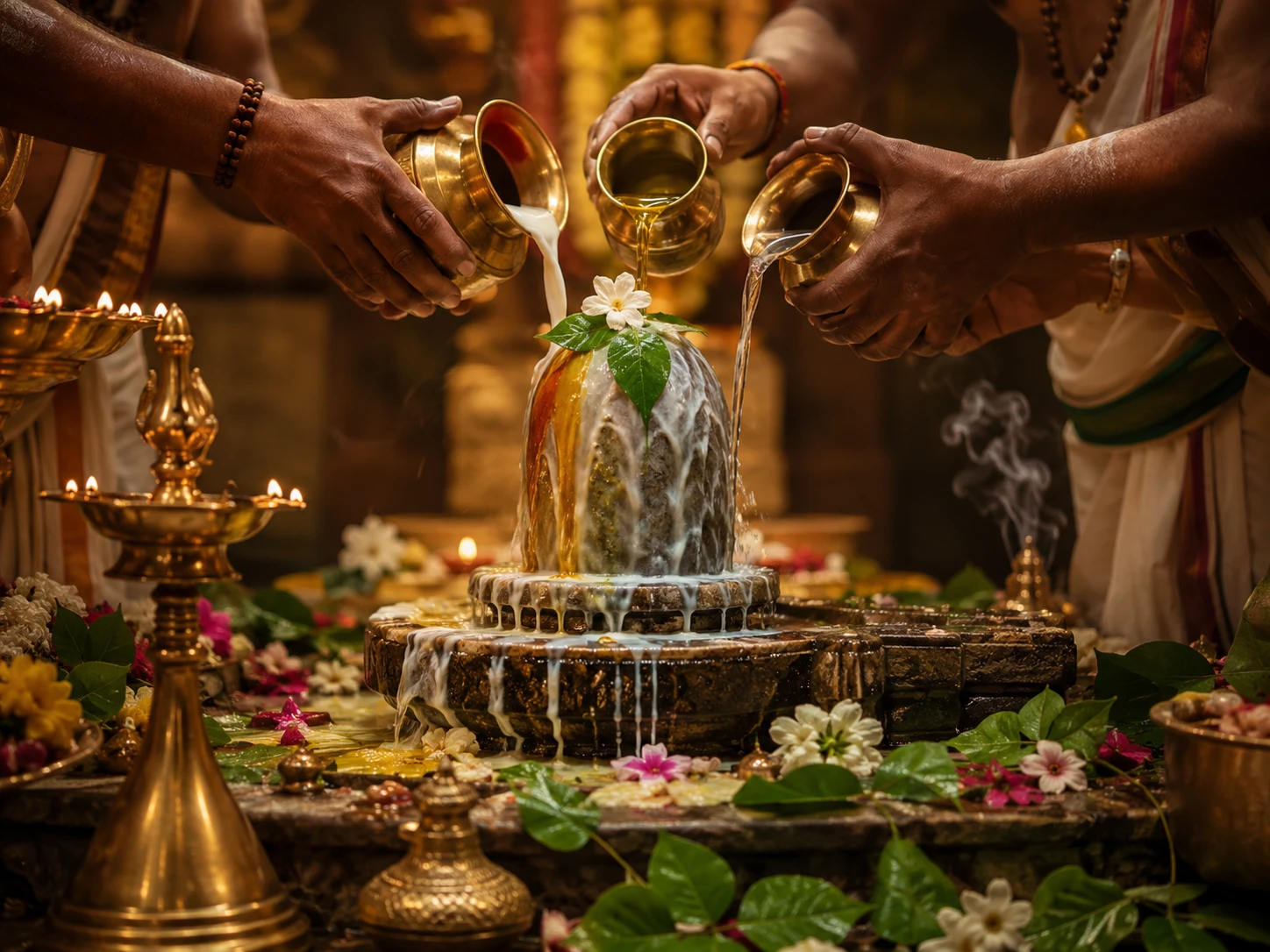
Abhisheka -- Why Hindus Bathe Their Gods
10 min read
Akshaya Tritiya -- The Day Nothing Given Away Runs Out
12 min readThe same translation error that turned '33 Koti' into '33 crore' in Hinduism also happened in Buddhism. The Chinese translation of Buddhist texts rendered 'Sapta Koti Buddha' (7 Supreme Buddhas) as '7 Crore Buddhas.' The…
Deities AvatarsCommunity Reflections
🕉️
Be the first to share your reflection.